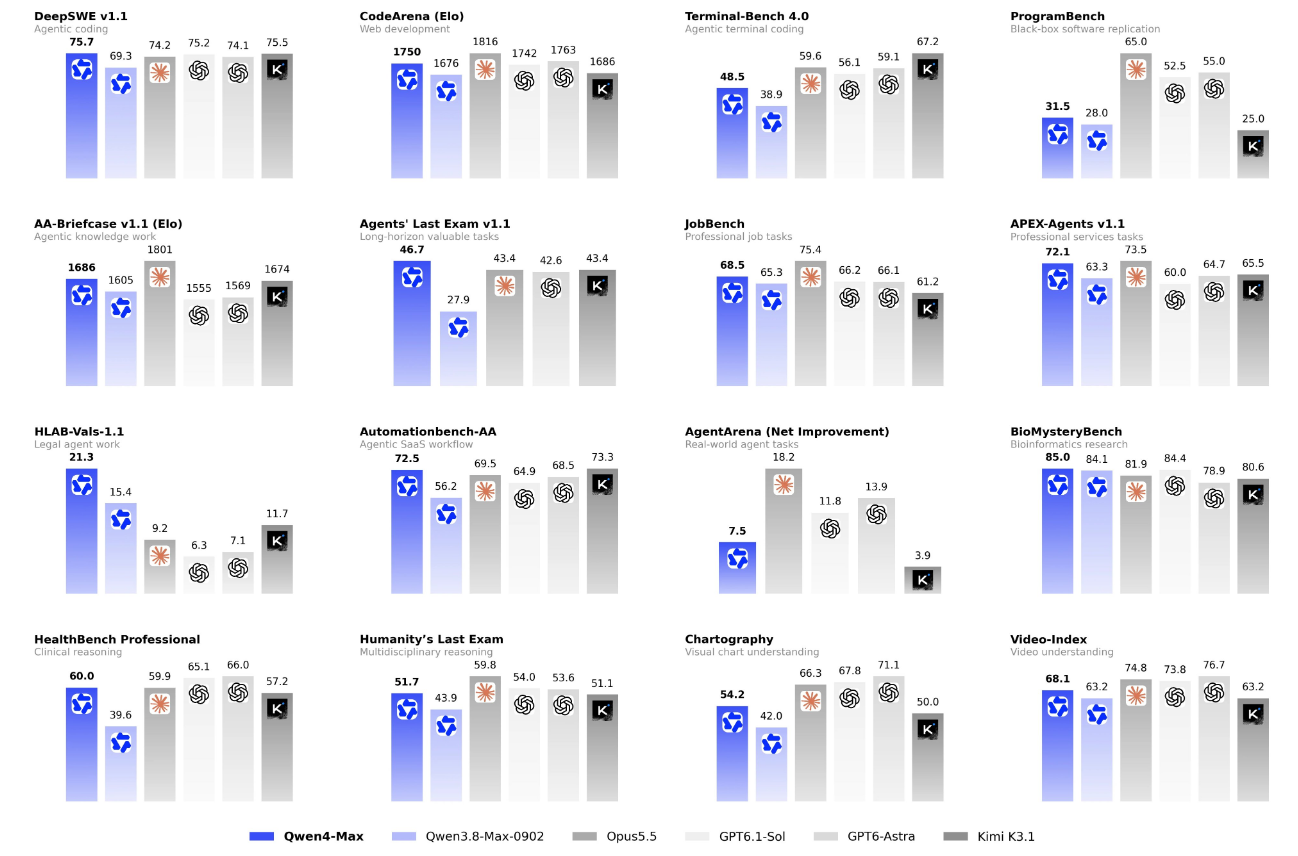
Qwen4-Max is live on Qwen Cloud. Alibaba describes it as a new mixture-of-experts architecture with native vision and a 1M-token context window, priced at $1.50 per million input tokens, $4.50 per million output tokens and $0.075 per million for implicit caching — all below Qwen3.8-Max, with implicit caching down 70%. The launch claims up to ~50% fewer tokens used and over 60% lower average cost per task in Alibaba’s internal evaluation, and lists real work across 3D modeling, game development, manufacturing, finance, law, healthcare and frontier science.
The API is live on Qwen Cloud, and the model is also reachable inside Qwen Studio, QwenWork and Qoder. But a launch claim is not a measurement, and a benchmark table is not a buying decision. We transcribed all sixteen scores from Alibaba’s table, who leads each test, and what each benchmark actually measures. Every number below is Alibaba’s published figure, checked against the launch table on 2026-11-16; nothing here is independently replicated yet.
Update, 2026-11-16: Qwen4-Max launched. The GA id is
qwen4-max, live on Qwen Cloud at $1.50 input, $4.50 output and $0.075 implicit caching per million, with a 1,000,000-token window and the sixteen-benchmark launch table published. Alibaba’s preview idqwen4-max-previewis retired. This post was written in preview week; the facts below are history. Start with the launch benchmarks, explained, then the full comparison cluster.
What Alibaba published
| Spec | Published value |
|---|---|
| Model id | qwen4-max (confirm the exact id in your Qwen Cloud console) |
| Architecture | Mixture-of-experts |
| Context window | 1,000,000 tokens |
| Input modalities | Text and image (native vision) |
| Open weights | No |
| API access | Live on Qwen Cloud, pay-as-you-go |
| Input price | $1.50 per million tokens |
| Output price | $4.50 per million tokens |
| Implicit caching | $0.075 per million tokens |
| Also available | Qwen Studio, QwenWork, Qoder |
The pricing is the cleanest part of the announcement. Against Alibaba’s own pay-as-you-go rates for Qwen3.8 Max — $2.00 input, $6.00 output, $0.25 cached input — Qwen4-Max undercuts its predecessor on every line: 25% off input, 25% off output, and caching down from $0.25 to $0.075, exactly the 70% the launch claims.
| Route | Input $/M | Output $/M | Cached input $/M |
|---|---|---|---|
| qwen3.8-max, Alibaba pay-as-you-go | $2.00 | $6.00 | $0.25 |
| qwen4-max, Alibaba pay-as-you-go | $1.50 | $4.50 | $0.075 |
| qwen3.8-max, One AI API Key | $0.577 | $1.73 | $0.25 |
| qwen4-max, One AI API Key | Not live here yet |
Two honest notes. First, the ~50% fewer tokens and 60% lower cost-per-task figures come from Alibaba’s internal evaluation, and the workload behind them is not published, so treat them as direction, not a bill. Second, our pattern is to sell below list: Qwen3.8 Max runs $0.577 / $1.73 here against Alibaba’s $2 / $6. When Qwen4-Max lands on the gateway it gets the same treatment, with a published rate and per-key limits like every other listing.
The full benchmark table
Sixteen benchmarks, six models, transcribed from the launch table. Bold marks the best score in each row.
| Benchmark | What it measures | Qwen4-Max | Qwen3.8-Max-0902 | Opus 5.5 | GPT-6.1 Sol | GPT-6 Astra | Kimi K3.1 |
|---|---|---|---|---|---|---|---|
| DeepSWE v1.1 | Agentic coding | 75.7 | 69.3 | 74.2 | 75.2 | 74.1 | 75.5 |
| CodeArena (Elo) | Web development | 1750 | 1676 | 1816 | 1742 | 1763 | 1686 |
| Terminal-Bench 4.0 | Agentic terminal coding | 48.5 | 38.9 | 59.6 | 56.1 | 59.1 | 67.2 |
| ProgramBench | Black-box software replication | 31.5 | 28.0 | 65.0 | 52.5 | 55.0 | 25.0 |
| AA-Briefcase v1.1 (Elo) | Agentic knowledge work | 1686 | 1605 | 1801 | 1555 | 1569 | 1674 |
| Agents’ Last Exam v1.1 | Long-horizon valuable tasks | 46.7 | 27.9 | 43.4 | 42.6 | 42.6 | 43.4 |
| JobBench | Professional job tasks | 68.5 | 65.3 | 75.4 | 66.2 | 66.1 | 61.2 |
| APEX-Agents v1.1 | Professional services tasks | 72.1 | 63.3 | 73.5 | 60.0 | 64.7 | 65.5 |
| HLAf-Vals-1.1 | Legal agentic work | 21.3 | 15.4 | 9.2 | 6.3 | 7.1 | 11.7 |
| Automationbench-AA | Agentic SaaS workflow | 72.5 | 56.2 | 69.5 | 64.9 | 68.5 | 73.3 |
| AgentArena (Net Improvement) | Real-world agent tasks | 18.2 | 7.5 | 11.8 | 13.9 | — | 3.9 |
| BioMysteryBench | Bioinformatics research | 85.0 | 84.1 | 81.9 | 84.4 | 78.9 | 80.6 |
| HealthBench Professional | Clinical reasoning | 60.0 | 39.6 | 59.9 | 65.1 | 66.0 | 57.2 |
| Humanity’s Last Exam | Multidisciplinary reasoning | 51.7 | 43.9 | 59.8 | 54.0 | 53.6 | 51.1 |
| Chartography | Visual chart understanding | 54.2 | 42.0 | 66.3 | 67.8 | 71.1 | 50.0 |
| Video-Index | Video understanding | 68.1 | 63.2 | 74.8 | 73.8 | 76.7 | 63.2 |
Qwen4-Max leads five of the sixteen rows outright, is within 1.4 points of the leader on APEX-Agents and 0.8 on Automationbench-AA, and trails badly on Terminal-Bench 4.0, ProgramBench, HealthBench Professional, Humanity’s Last Exam, Chartography and Video-Index. It beats Qwen3.8-Max-0902 on all sixteen, which is the cleanest signal in the table.
What each benchmark tests, and what the score says
Coding and software work. DeepSWE v1.1 scores agentic coding — fixing real issues inside a repository. Qwen4-Max’s 75.7 leads a tight pack: Kimi K3.1 at 75.5, GPT-6.1 Sol at 75.2, Opus 5.5 at 74.2. Qwen3.8-Max-0902 trails at 69.3. CodeArena is an Elo rating for web development, where Opus 5.5’s 1816 still tops the board; Qwen4-Max sits third at 1750, 74 Elo above its predecessor. Terminal-Bench 4.0 measures agentic coding inside a real terminal, and here Qwen4-Max’s 48.5 is mid-pack behind Kimi K3.1’s 67.2 and Opus 5.5’s 59.6 — the biggest single gap against the leaders. ProgramBench scores black-box software replication, rebuilding a working system from its behaviour alone; Opus 5.5’s 65.0 is double Qwen4-Max’s 31.5, the widest gap in the whole table.
Agentic and professional work. AA-Briefcase v1.1 rates agentic knowledge work on Elo: Opus 5.5 leads at 1801, Qwen4-Max second at 1686, 81 points above Qwen3.8-Max-0902. Agents’ Last Exam v1.1 is the long-horizon test — valuable tasks that take many steps — and it is Qwen4-Max’s best win: 46.7 against 43.4 for Opus 5.5 and Kimi K3.1, and an 18.8-point jump over the 0902 snapshot’s 27.9. JobBench covers professional job tasks, where Opus 5.5’s 75.4 leads and Qwen4-Max’s 68.5 is second. APEX-Agents v1.1 measures professional services tasks; Qwen4-Max’s 72.1 sits 1.4 behind Opus 5.5’s 73.5, effectively a tie. AgentArena reports net improvement on real-world agent tasks, and Qwen4-Max’s 18.2 leads GPT-6.1 Sol’s 13.9 and Opus 5.5’s 11.8 — GPT-6 Astra is not listed in this row. Automationbench-AA is an agentic SaaS workflow, where Kimi K3.1 edges the board at 73.3 against Qwen4-Max’s 72.5.
Professional domains. HLAf-Vals-1.1 is legal agentic work, and every score is low — this is a hard test, not a ceiling. Qwen4-Max’s 21.3 leads by 5.9 points over Qwen3.8-Max-0902 and doubles Opus 5.5’s 9.2. BioMysteryBench covers bioinformatics research, a tight cluster from 85.0 down to 78.9 with Qwen4-Max first and GPT-6 Astra last. HealthBench Professional is clinical reasoning, and it goes the other way: GPT-6 Astra leads at 66.0, GPT-6.1 Sol at 65.1, while Qwen4-Max’s 60.0 sits mid-pack — though still 20.4 points above the 0902 snapshot.
Reasoning and multimodal. Humanity’s Last Exam is multidisciplinary reasoning at the hardest end of the pool; Opus 5.5 leads at 59.8, Qwen4-Max is 51.7. Chartography tests visual chart understanding, where GPT-6 Astra’s 71.1 leads and Qwen4-Max’s 54.2 trails by 16.9. Video-Index measures video understanding; GPT-6 Astra leads at 76.7, Qwen4-Max is 68.1. The multimodal rows are the honest limit on “native vision”: the model sees, but the top visual scores belong to GPT-6 Astra and Opus 5.5, not Qwen.
How to read a vendor table
Three cautions before you quote any number. The table is Alibaba’s own launch material: no methodology card, no error bars, no prompt details, and no date or version stamp for the benchmark suites. Elo ratings and percentage scores share the same columns, so a 74-Elo gap and a 74-point gap are not the same thing. And “net improvement” rows like AgentArena measure change, not absolute quality, so 18.2 there is not comparable to 18.2 anywhere else.
The fair read: Qwen4-Max is a real generational step over Qwen3.8-Max-0902 on every published row, genuinely leading on agentic coding, long-horizon tasks, legal work and bioinformatics, and genuinely behind on terminal coding, black-box replication, clinical reasoning and the visual benchmarks. What it is not, on this evidence, is the best model at everything.
How to call qwen4-max
The API is live on Qwen Cloud. Get a key there, then call it with any OpenAI-compatible client:
curl https://ap-southeast-1.maas.qwencloudapi.com/compatible-mode/v1/chat/completions \
  -H "Authorization: Bearer $QWEN_API_KEY" \
  -H "Content-Type: application/json" \
  -d '{
    "model": "qwen4-max",
    "messages": [{"role": "user", "content": "Refactor this function for readability."}]
  }'
Python, same pattern:
import os
from openai import OpenAI

client = OpenAI(
    api_key=os.environ["QWEN_API_KEY"],
    base_url="https://ap-southeast-1.maas.qwencloudapi.com/compatible-mode/v1",
)
resp = client.chat.completions.create(
    model="qwen4-max",
    messages=[{"role": "user", "content": "Explain this stack trace."}],
)
print(resp.choices[0].message.content)
The base URL above is the one the Qwen Cloud docs sample; copy the exact host from your own console, because Qwen has shipped different regional hosts before. A 401 means the key is wrong or the account is not entitled to the model; a 404 on the model usually means a misspelled id — confirm qwen4-max against the live model list rather than trusting any blog, including this one. Enable streaming so long reasoning arrives token by token, and remember a reasoning model can spend its output budget thinking before it answers, so set max_tokens deliberately on output-heavy jobs.
Qwen4-Max on One AI API Key
Same playbook as every Alibaba flagship: the day the API is open to resellers, Qwen4-Max goes into the model catalog with a published rate below list, per-key limits and usage metering. No subscription required. Until then, Qwen3.8 Max is live here at $0.577 / $1.73 per million tokens against Alibaba’s $2 / $6, with the same 1M window, and qwen3.8-max:free runs on the free lane inside the 100-requests-a-day allowance.
Qwen4-Max is live upstream. We meter everything we sell.
When Qwen4-Max lands on One AI API Key it ships with a published per-token rate, per-key limits and real throughput on the rankings page. Start on the free lane now and the upgrade is one model-id change.
Mistakes to avoid
- Treating the launch table as independent evidence. It is vendor-published, with no methodology card, error bars or version stamps. Re-run your own workload before migrating.
- Comparing Elo to percentage scores. CodeArena and AA-Briefcase are Elo ratings; the rest are points. A 74-Elo gap and a 74-point gap are different things.
- Assuming native vision means best-in-class vision. Qwen4-Max trails GPT-6 Astra and Opus 5.5 on Chartography and Video-Index. Test your visual tasks specifically.
- Ignoring Terminal-Bench and ProgramBench. The model leads five rows and trails badly on two coding rows. If your workload is terminal automation or replication, benchmark it yourself first.
- Budgeting from the 60% cost claim. That figure is from an internal evaluation with an unpublished workload. The published rates are real; your burn is not.
- Pinning a moving id. The 3.8 generation shipped
qwen3.8-maxand a datedqwen3.8-max-0902that behave differently. Pin the exact id and re-run evals after any announcement.
FAQ
Is Qwen4-Max free?
No. It is pay-as-you-go on Qwen Cloud at $1.50 / $4.50 / $0.075 per million tokens for input, output and implicit caching. There is no announced free tier. On One AI API Key the free lane currently runs Qwen3.8 ids, including qwen3.8-max:free.
What is the API model id and base URL?
qwen4-max on Qwen Cloud’s OpenAI-compatible endpoint. Confirm the exact id and host in your own console; Qwen has used regional hosts before, and a 404 on the model usually means a misspelled id or an account that is not entitled to it.
Does Qwen4-Max beat Opus 5.5?
On Alibaba’s table it leads five of sixteen benchmarks, ties within 1.4 points on APEX-Agents, and trails on CodeArena, Terminal-Bench 4.0, ProgramBench, AA-Briefcase, JobBench, HealthBench Professional, Humanity’s Last Exam, Chartography and Video-Index. No independent replication exists yet.
How big is the jump over Qwen3.8-Max-0902?
It wins all sixteen rows. The largest gaps are HealthBench Professional +20.4, Agents’ Last Exam +18.8, Automationbench-AA +16.3, Chartography +12.2 and AgentArena +10.7. On the two Elo boards the jump is +74 (CodeArena) and +81 (AA-Briefcase).
What about the 50% fewer tokens and 60% lower cost claims?
Both come from Alibaba’s internal evaluation, and the workload behind them is unpublished. Directionally plausible given the price cut, but not a bill. Measure your own prompt and completion counts before you budget.
Is Qwen4-Max on One AI API Key yet?
Not yet. It is queued the moment upstream API access opens, at a published rate below list, the same as every other model. Until then Qwen3.8 Max is live at $0.577 / $1.73 per million tokens with a 1M context window, and the rankings page shows its real gateway throughput.
The bottom line
Qwen4-Max’s launch table is the strongest argument for the model: a clean generational sweep over Qwen3.8-Max-0902 on all sixteen benchmarks, real leads on agentic coding, long-horizon tasks, legal and bioinformatics work, and pricing 25% below its own predecessor with caching down 70%. The same table is the honest limit: Opus 5.5 still leads the Elo boards, GPT-6 Astra leads the visual and clinical rows, and Kimi K3.1 owns terminal coding. Read it as a vendor’s best case, test your own workload, and when Qwen4-Max lands on One AI API Key it arrives with a metered rate you can measure against the claim. Until then Qwen3.8 Max is live, cheap and on the free lane — create a key and measure it yourself.
More Qwen4-Max coverage
The Fable comparison, added 2026-11-16:
The rest of the cluster, plus the pages every comparison links back to:
- Qwen4-Max 1M context guide: what a million tokens holds, and the chunking that keeps it honest
- Qwen4-Max API pricing: every rate, the $43 Token Plan Pro and what a call actually costs
- Qwen4-Max API quickstart: the id, the base URL, streaming, max_tokens and the $43 plan
- The cheapest way to run Qwen4-Max: free routes checked, and the $3 plan that beats them all
- Run Qwen4-Max in your coding agent: base URL, model id, concurrency tiers and budget guards
- Qwen4-Max prompt caching: the $0.075 implicit cache, break-even math and cache-break probes
- Qwen4-Max vision and video benchmarks: what native vision actually scores against GPT-6 Astra and Opus 5.5
- Qwen4-Max vs every flagship launched this quarter: the full scoreboard, price per million and who serves what
- Qwen4-Max vs Gemini 4 Argon: multimodal routes, 1M context and what each actually costs
- Qwen4-Max vs GPT-6.1 Sol and GPT-6 Astra: benchmarks, pricing and the split
- Qwen4-Max vs GPT-6 Astra: sixteen benchmarks, the price gap and where each model wins
- Qwen4-Max vs Grok 4.7: flat flagship prices against the 2x long-context surcharge
- Qwen4-Max vs Kimi K3: sixteen benchmarks, terminal coding and the price per million tokens
- Qwen4-Max vs Claude Opus 5.5: sixteen benchmarks, token prices and the honest split
- Qwen4-Max vs Qwen3.8-Max-0902: the 16-benchmark sweep, the price cut and a migration checklist
- The model catalogue
- The model comparison tool
- API pricing and plans
- The cost calculator
- Prompt caching docs