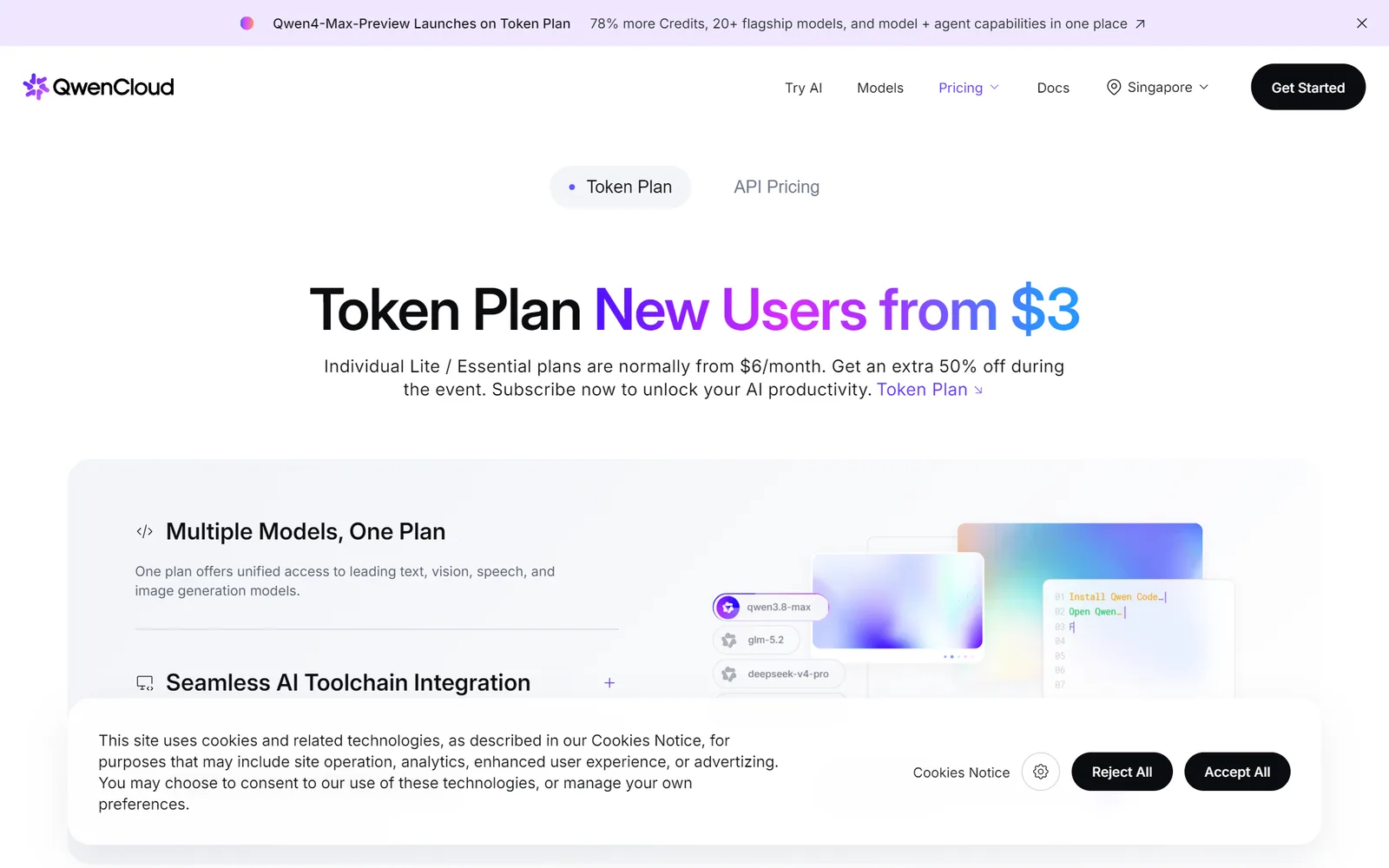
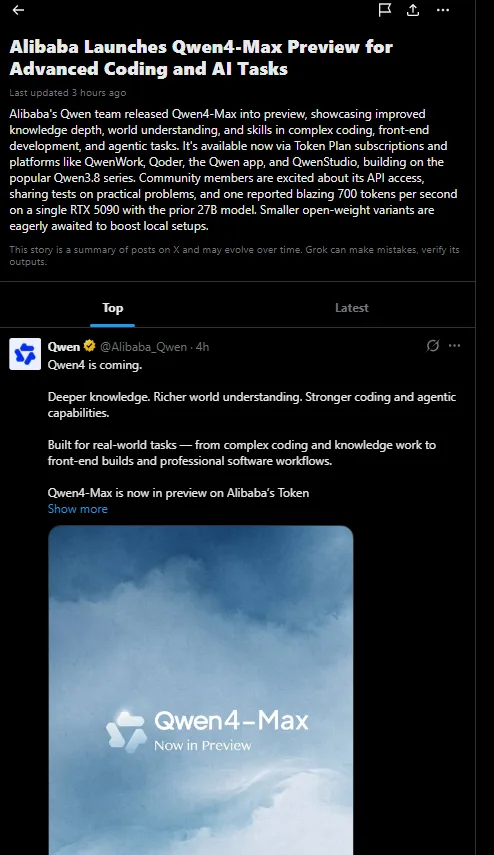
There is one number in the Qwen4-Max launch that matters more than any benchmark score if you run agents: $0.075 per million tokens for implicit caching. Alibaba cut cached input 70% below Qwen3.8-Max’s $0.25, and the launch blog pairs it with a claim of up to ~50% fewer tokens used per task. The claim is Alibaba’s internal evaluation with an unpublished workload, so do not budget on it. But the price is real, it is published, and this post turns it into math you can check: what implicit caching is, exactly when it pays, where it breaks, and the four numbers you must log from day one so a launch-day price surprise never reaches your bill.
What implicit caching means here
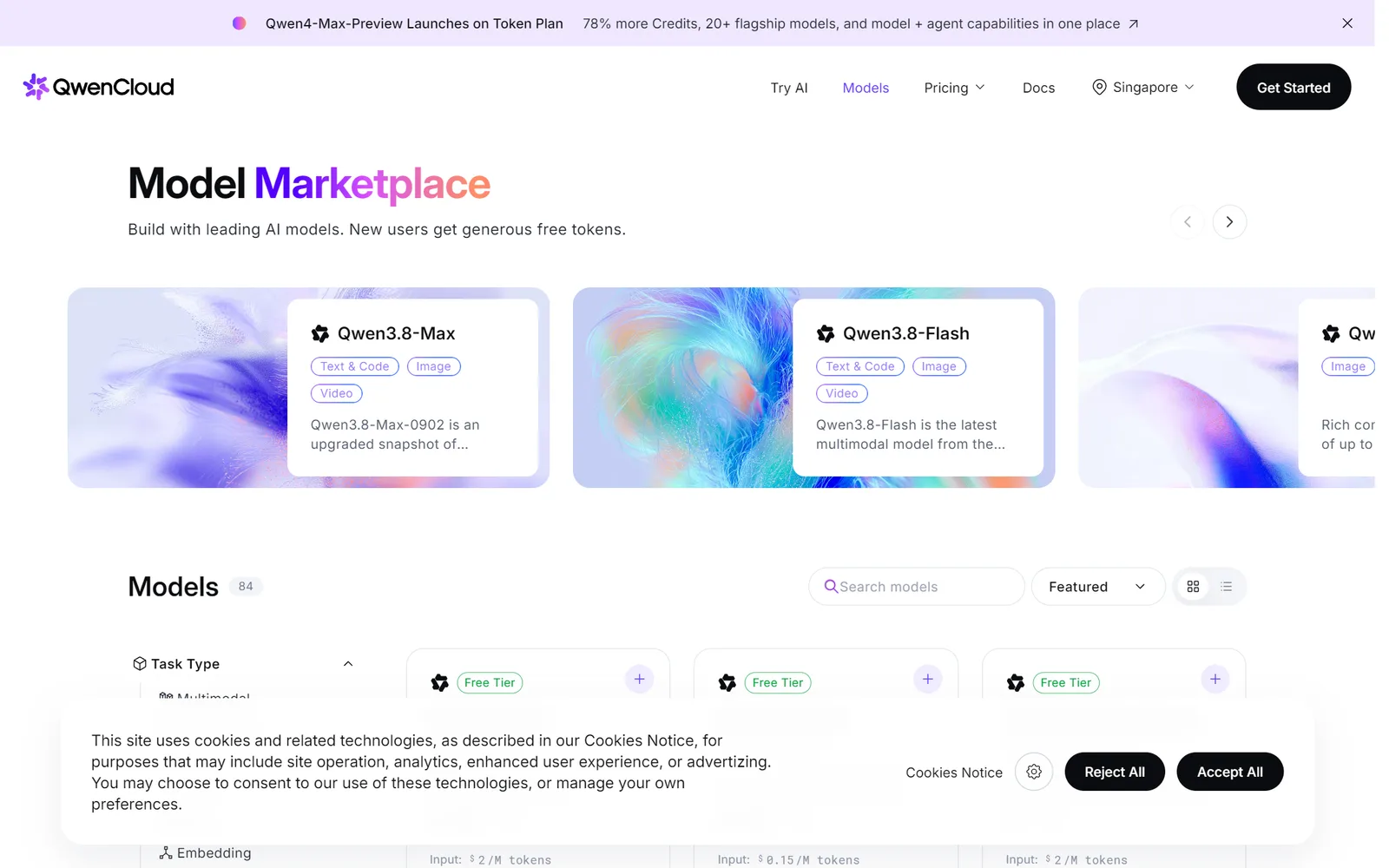
Explicit caching, the pattern most gateways sell, asks you to create a cache, store a prefix, and reference it by id. Implicit caching needs none of that: the vendor’s backend notices that your request repeats a prefix your recent requests already used, and bills the repeated tokens at the cached rate. You get the discount by doing your normal work. Alibaba’s launch material calls the row “implicit caching” at $0.075 per million tokens; the Qwen Cloud Token Plan page lists it under the Pro tier that costs $43 a month.
What is not published is the mechanics. No TTL, no minimum prefix length, no hit-rate guarantee, no cache-write line. BenchLM’s Qwen4-Max spec sheet documents exactly that gap. And kingy.ai’s head-to-head against GPT-6.1 Sol recorded the behaviour from the outside: across their five-task run, Qwen4-Max billed 296,704 cache-read tokens and zero cache-write tokens, while Sol billed 165,151 cache reads and 42,343 cache writes at $2.50 per million. Two data points, not a spec, but they tell you the direction: on Qwen Cloud’s OpenAI-compatible endpoint, cache activity shows up in usage with no write step you trigger.
The cached-rate board, model by model
Every rate below is per million tokens. Gateway rates are what we charge today; list rates are the vendor’s published ones.
| Model | Input $/M | Cached input $/M | Cache costs |
|---|---|---|---|
| Qwen4-Max, Qwen Cloud list | $1.50 | $0.075 | 5% of input |
| Qwen3.8 Max, One AI API Key | $0.577 | $0.25 | 43% of input |
| GPT-6.1 Sol, One AI API Key | $0.70 | $0.10 | 14% of input |
| GPT-6 Astra, One AI API Key | $3.50 | $1.00 | 29% of input |
| Gemini 4 Argon, One AI API Key | $0.525 | $0.10 | 19% of input |
| Claude Opus 5.5, One AI API Key | $2.80 | $0.20 | 7% of input |
| Claude Fable 5.1, One AI API Key | $7.00 | $0.25 | 4% of input |
| Kimi K3, One AI API Key | $0.353 | $0.30 | 85% of input |
| Grok 4.7, One AI API Key | $1.40 | $0.50 | 36% of input |
| DeepSeek V4 Flash, One AI API Key | $0.0392 | $0.003 | 8% of input |
Two things jump out. First, Qwen4-Max’s cached rate is the lowest flagship cache price on this board at a vendor-published rate, period. DeepSeek V4 Flash is cheaper at $0.003, but that is a different class of model. Second, the relative discount is what agents feel: on Qwen4-Max a cache hit costs 5% of the full input rate, against 29% on Astra, 36% on Grok 4.7 and 85% on Kimi K3. The models where caching is a rounding error are the cheap ones; the models where caching is a budget line are the expensive ones.
A gateway rule matters here: on our board, a model without a published cached rate bills cached tokens at the full input price, so an unpublished cache is not a discount, it is a flag. When Qwen4-Max joins the catalog, its row will carry the cached rate like every other listing, and the console cache page will show the split.
The break-even math, on your own workload
Take the agent workload we use across this cluster: fifty runs a day, 8,000 input and 2,000 output tokens each, so about 12.4M input and 3.1M output tokens a month. Now assume 80% of the input is a repeated prefix, your system prompt plus repo context, which is the realistic shape for a coding agent that re-reads the same instructions all day.
| Route | All input at full rate | Same workload at 80% cache hit |
|---|---|---|
| Qwen4-Max, Qwen Cloud list | $18.60 | $0.74 cached, $3.72 on the rest, $18.41 total with output |
| GPT-6 Astra, One AI API Key | $43.40 | $9.92 cached, $72.85 total with output |
| GPT-6.1 Sol, One AI API Key | $8.68 | $0.99 cached, $13.58 total with output |
| Gemini 4 Argon, One AI API Key | $6.51 | $0.99 cached, $10.43 total with output |
The Qwen4-Max column is the launch story: the implicit cache takes a $32.55 monthly bill at list down to about $18.41, a 43% cut, without you writing a single cache-management call. Astra’s cache saves more dollars, $24.80 on this workload, because its input rate is higher, and Sol through us stays the cheapest absolute route at about $20, which is why our cheapest-way post keeps saying the gateway rate beats the vendor list.
The break-even rule of thumb: caching pays the moment your repeated prefix is bigger than the noise, and it pays most on expensive input. At 20% cache hit, Qwen4-Max saves about $3.53 a month on this workload; at 80%, about $14.10. Below 10% hit rate, the complexity of even thinking about caching costs more than the discount. Measure your hit rate first; the next section is how.
Two probes that take ten minutes
Probe one, the cache-hit check. Send the same system prompt twice, then read the usage block. If the second response reports cached tokens, implicit caching engaged; if not, your prefix is not repeating the way you think.
# run twice: the second call should bill the repeated prefix at cache prices
curl https://ap-southeast-1.maas.qwencloudapi.com/compatible-mode/v1/chat/completions \
  -H "Authorization: Bearer $QWEN_API_KEY" \
  -H "Content-Type: application/json" \
  -d '{
    "model": "qwen4-max",
    "messages": [
      {"role": "system", "content": "You are a code reviewer. Repo context: 80k tokens here."},
      {"role": "user", "content": "Review this diff for correctness."}
    ]
  }' | python -c "import json,sys; print(json.load(sys.stdin)['usage'])"
Probe two, the cache-break check. Change one character in the system prompt, resend, and watch the cached count collapse to zero. Agents break their own caches this way in production: a timestamp in the instructions, a rotating nonce, a tool schema that reorders keys, a model id that differs per request. The 3.8 generation taught us this the hard way: pin your ids, log your usage, re-run your evals.
Our prompt caching docs cover the general mechanics on the gateway, and the token glossary defines cached input, cache write and context window in one page. The cost-control guide shows the budget side, and the monthly cost estimator gives the spreadsheet shape before you commit to a route.
What to log from day one
Four fields, no more, on every request: model id, input tokens, cached tokens, cost. Nothing else is negotiable, because those four catch the three ways a caching story goes wrong:
- Cached stays zero. Your prefix is not stable, or the vendor’s implicit cache is not engaging on your traffic shape. Probe one tells you which.
- Cached spikes, cost unchanged. You are on a gateway route that bills cached tokens at full input price because the model row has no cached rate. That is the rule above, and it is why the usage log is how you catch a launch-day price surprise before the bill does.
- Cost drops, quality drops too. A cheaper route that truncates context or downgrades effort is not a saving. The reasoning docs cover effort settings, and the rankings page tracks real throughput so you can see the speed side of the trade.
The Token Plan adds a second axis the launch blog does not price out: eesel.ai’s preview review records credits burning at 20% of the standard rate during preview, 8% between 22:00 and 08:00 Beijing time, with the preview id retired after 2026-11-25 in the UTC+8 window. Subscription credits and per-token list prices are different budgets with different breakage rules, and Alibaba has not published the credit burn rate for the GA id. Treat any Token Plan total that is not built from the per-token table as an estimate, including ours.
What Artificial Analysis, LMArena and the community are saying
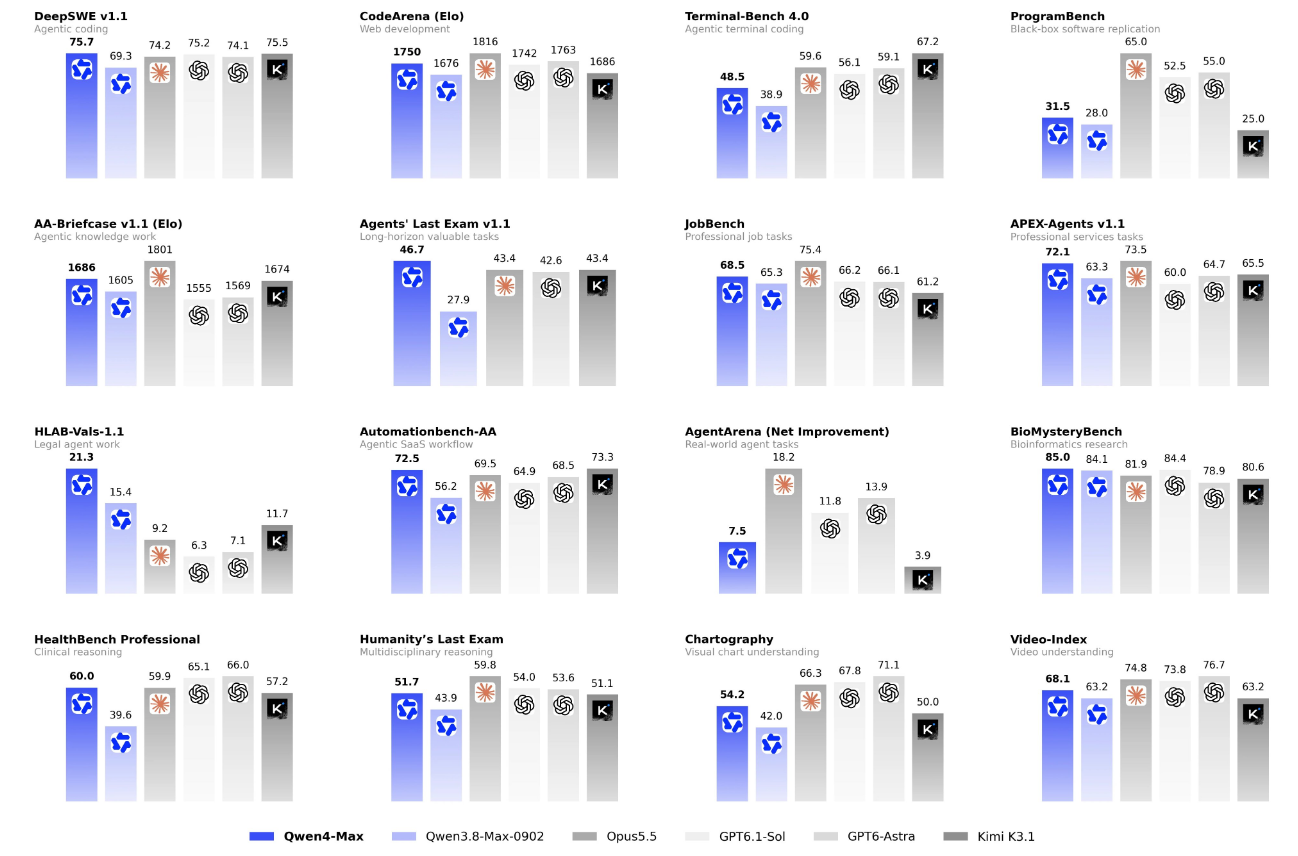
The honest state of play: Artificial Analysis publishes cache-price columns for many models, but it has no Qwen4-Max row as of 2026-11-16, and neither does LMArena, so there is no independent quality-per-cached-dollar figure to quote. BenchLM lists the caching price cut as a spec with the evidence gap flagged. MindStudio’s hands-on does not test cache behaviour; it covers animation generation, 82-language naming, satellite image reasoning and visual safety judgment. The Pandaily X thread leads with the 46.7 Agents’ Last Exam score and the caching price cut, which matches Alibaba’s table. kingy.ai’s run is the closest thing to a measurement: 296,704 cache reads, zero writes, on Qwen4-Max against Sol’s 165,151 reads and 42,343 writes, one synthetic repetition, unblinded AI grading, no settled invoice. Direction, not verdict.
Mistakes to avoid
- Budgeting on the 60% cost claim. It is from an internal evaluation with an unpublished workload. The $0.075 rate is real; your burn is not.
- Assuming implicit means automatic hit. Implicit means you do not manage it, not that you always hit it. Probe first.
- Mixing cache read and cache write prices. Sol writes at $2.50 per million via OpenRouter per kingy.ai; Qwen4-Max billed no writes in that run. Different mechanics, different math.
- Comparing cache to list across vendors. A 5%-of-input cache on a $1.50 list is not the same saving as 29% on a $3.50 gateway rate. Compute dollars, not percentages.
- Forgetting the free lanes bill differently.
qwen3.8-max-0902-uncensored:freeruns at $0 on the free lane with a daily allowance that resets at 00:00 UTC, so cache math there is about caps, not prices. - Pinning a moving id.
qwen4-maxis notqwen4-max-preview; the preview id was retired. Pin, log, re-run evals, as our API security guide argues for keys too.
FAQ
How much does Qwen4-Max caching cost?
$0.075 per million tokens for implicit cache reads, per Alibaba’s launch pricing, which is 70% below Qwen3.8-Max’s $0.25 cached rate and 5% of Qwen4-Max’s own $1.50 input rate.
Is the cache explicit or implicit?
Implicit, on the published evidence: no cache id, no write step, no published TTL. kingy.ai’s run observed cache reads billed with zero cache writes, consistent with a backend-managed prefix cache.
What is the cheapest cached route on your gateway today?
DeepSeek V4 Flash at $0.003 per million cached tokens, but among flagships the cheapest cached input is GPT-6.1 Sol and Gemini 4 Argon at $0.10. Qwen4-Max’s $0.075 is a vendor list rate, not yet a gateway rate; it is queued for the catalog like every Alibaba flagship.
Does caching change the context window?
No. The window is 1,000,000 tokens for Qwen4-Max. Caching changes what the repeated prefix costs, not how much fits. Our 1M context guide tests recall across the window, and our streaming guide covers how cached long contexts deliver their first token.
Where do I see cached tokens on my bill?
The usage log shows per-request metering, and the cache page shows the cached split once a model row carries a cached rate. If cached reads are zero across many identical-prefix requests, that is a probe-one moment, not a billing error.
Do Token Plan credits change the cache math?
They change the currency, not the rate. Credits burn at a rate Alibaba has not published for the GA id, so the per-token table remains the only budget you can verify. The $25 unlimited plan covers every listed model at no per-token cost, which is the one budget where caching does not matter.
The bottom line
Qwen4-Max’s implicit cache at $0.075 per million is the strongest published caching price on a flagship today, 95% below its own input rate, and it needs no cache-management code. It does not make the model free, it does not guarantee a hit, and it is a vendor list rate until our gateway publishes its own. Log four fields, run the two probes, compute your dollars, and let the cost calculator settle the rest. The benchmark explainer tells you what the model scores; this post tells you what it costs. Both are needed, and neither substitutes for your own metered run.
Keep reading: the sixteen-benchmark explainer, Qwen4-Max vs Gemini 4 Argon, the multimodal fork, Qwen4-Max vs Grok 4.7, token for token, Qwen4-Max API quickstart, Qwen4-Max vs every flagship, the routing matrix, the $43 Token Plan analysis, the 1M context guide, and the cheapest way to run Qwen4-Max.
What the cache price does not cover
The $0.075 figure is Qwen Cloud’s implicit cache read rate for Qwen4-Max, published with the GA launch. It is not a gateway promise: each model in our catalogue carries its own cached column, and a model without one bills cached tokens at the full input price, which is the default nobody reads until the bill arrives.
The split between ordinary input, cache writes and cache reads is visible per request in the usage log and per key in the cache console. Trust those numbers over any table in this post, including ours. And the Token Plan credit burn rate is still unpublished, so convert credits to dollars from your own metering, never from the plan page.
Do the arithmetic on your own volume before you believe any headline number. Ten million cache-read tokens in a month costs $0.75 at the $0.075 rate, and the same ten million at the ordinary $1.50 input rate costs $15.00. Fifty million costs $3.75 against $75.00. The discount stays the same, but the dollars decide whether the route is worth the engineering. Then run the same mix through the comparison tool, because a workload that misses the cache every time gets the ordinary rate, and no table in this post changes that. The usage log splits cached reads from ordinary input per request, so the two numbers are never a guess.
More Qwen4-Max coverage
The Fable comparison, added 2026-11-16:
-
Qwen4-Max vs Claude Fable 5.1: the real price gap, output ceilings and when Fable earns its rate
-
Qwen4-Max benchmarks explained: 16 tests against Opus 5.5, GPT-6.1 Sol, GPT-6 Astra and Kimi K3.1
-
Qwen4-Max vs GPT-6 Astra: sixteen benchmarks and the price gap
-
Qwen4-Max vs Claude Opus 5.5: sixteen benchmarks and the honest split
-
Qwen4-Max vs Qwen3.8-Max-0902: the generational jump, row by row
-
Qwen4-Max vs Kimi K3: harness differences and the honest numbers
-
Qwen4-Max vs Gemini 4 Argon: multimodal routes, 1M context and costs
-
Qwen4-Max API pricing: list rates, the $43 Token Plan and the cost math
-
Qwen4-Max 1M context guide: recall probes and the full-window bill
-
Qwen4-Max coding agents setup: Claude Code, Cursor, Codex and Qoder
-
Qwen4-Max vision and video benchmarks: what native vision actually wins
-
Qwen4-Max API quickstart: ids, base URLs, streaming and max_tokens
-
Qwen4-Max preview speed test: what we measured before launch