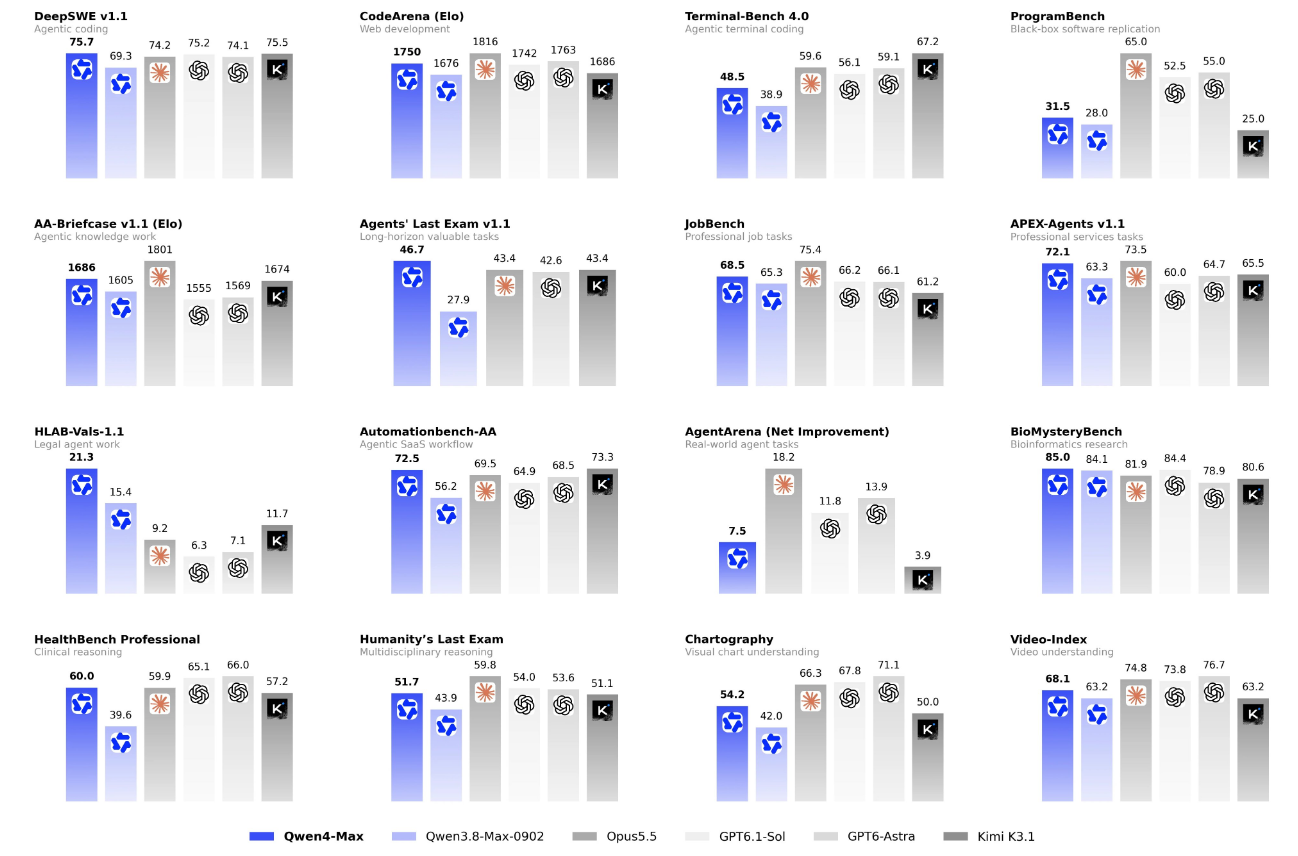
Two flagships shipped this quarter that agent builders actually compare. Qwen4-Max went live on Qwen Cloud on November 16, 2026, and Moonshot’s Kimi K3 has been on our gateway at One AI API Key since the summer. The question we get asked is simple: which one runs my agent? The honest answer needs three things: the sixteen benchmark rows Alibaba published, the harness caveat most comparisons skip, and a cost model that treats credits and tokens as different units. This post gives you all three.
Short version: on Alibaba’s own table, Qwen4-Max leads Kimi K3.1 on fourteen of sixteen rows. Kimi K3.1 owns the two rows that matter most for pure terminal automation: Terminal-Bench 4.0 by 18.7 points and Automationbench-AA by 0.8. Then the caveat: Kimi’s own model card publishes different numbers on different harnesses, so the table is Alibaba’s framing, not a neutral referee. And then the price twist: Kimi K3 through our gateway costs $0.353 per million input tokens against Qwen4-Max’s $1.50 list, so on input-heavy workloads the cheaper model is live today and the hyped one is not.
What each model is
Qwen4-Max is Alibaba’s flagship tier of the Qwen4 generation: a mixture-of-experts architecture with native vision, a 1,000,000-token context window, and pay-as-you-go API rates of $1.50 input, $4.50 output and $0.075 cached input per million tokens. It is also inside the Qwen Cloud Token Plan, the subscription that grants credits across 20+ models, and inside Qwen Studio, QwenWork and Qoder. Alibaba claims roughly 50% fewer tokens used and over 60% lower average cost per task versus its predecessor, from an internal evaluation whose workload is not published.
Kimi K3 is Moonshot AI’s flagship on our board. Our catalog lists it as a text-and-image model with a 1,048,576-token context at $0.353 input and $5.67 output per million tokens, priced below the lowest public rate we track, which is how every paid listing here works. It is a featured model on the catalog and it is live today, which is not a sentence you can write about Qwen4-Max on our gateway yet.
| Spec | Kimi K3 (One AI API Key) | Qwen4-Max (Qwen Cloud) |
|---|---|---|
| Vendor | Moonshot AI | Alibaba, Qwen team |
| Model id | kimi-k3 |
qwen4-max |
| Input modalities | Text, image | Text, image (native vision) |
| Context window | 1,048,576 | 1,000,000 |
| Open weights | Not listed in our catalog | No |
| API route | Our gateway, OpenAI-compatible | QwenCloud compatible-mode, or Token Plan credits |
| Input price | $0.353 / M | $1.50 / M list |
| Output price | $5.67 / M | $4.50 / M list |
One naming trap before the numbers. Alibaba’s table column says Kimi K3.1. Our board serves Kimi K3. We do not know from published sources that those are the same build, and we will not pretend otherwise. Every Kimi number in the launch table below is therefore labeled as Alibaba’s column, not as a measurement of our listing. Separately, Kimi’s own model card publishes its own rows on its own harnesses, which do not match Alibaba’s versions. Both facts matter, and we come back to them.
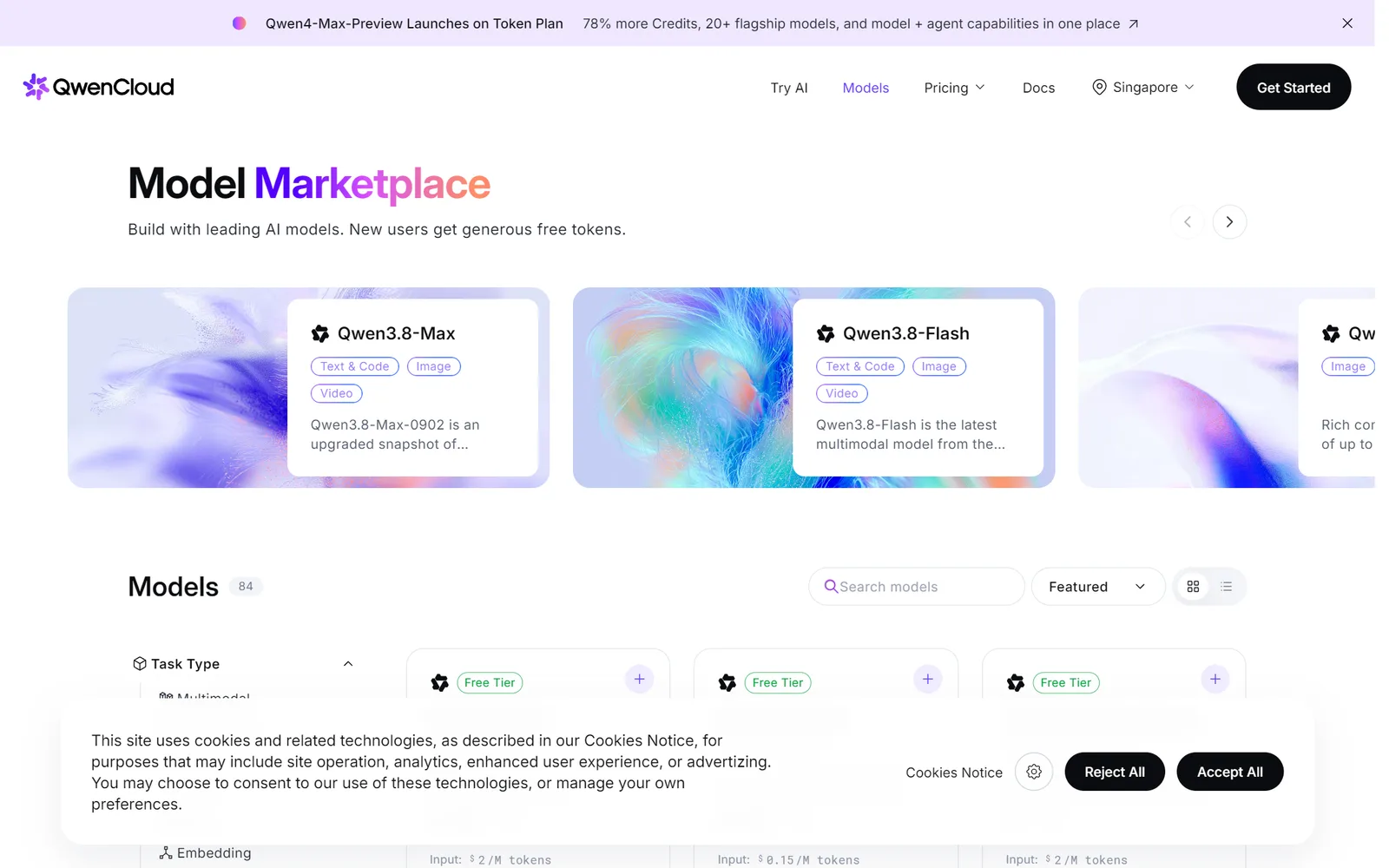
The banner above is the Model Marketplace capture from launch day. Note what it says and what it does not: it announces the launch and the Token Plan, and it shows no benchmark numbers at all. The scores live in Alibaba’s launch blog, which is the table we transcribed in Qwen4-Max benchmarks, explained.
The two-model table, with the gap
All sixteen rows from Alibaba’s launch table, with the pair isolated and the gap computed. Elo rows and percentage rows share a table in the source; a 64-Elo gap and a 64-point gap are not the same thing, so read the units in the first column.
| Benchmark | What it measures | Qwen4-Max | Kimi K3.1 | Gap | Leads |
|---|---|---|---|---|---|
| DeepSWE v1.1 | Agentic coding | 75.7 | 75.5 | +0.2 | Qwen4-Max |
| CodeArena (Elo) | Web development | 1750 | 1686 | +64 | Qwen4-Max |
| Terminal-Bench 4.0 | Agentic terminal coding | 48.5 | 67.2 | -18.7 | Kimi K3.1 |
| ProgramBench | Black-box software replication | 31.5 | 25.0 | +6.5 | Qwen4-Max |
| AA-Briefcase v1.1 (Elo) | Agentic knowledge work | 1686 | 1674 | +12 | Qwen4-Max |
| Agents’ Last Exam v1.1 | Long-horizon valuable tasks | 46.7 | 43.4 | +3.3 | Qwen4-Max |
| JobBench | Professional job tasks | 68.5 | 61.2 | +7.3 | Qwen4-Max |
| APEX-Agents v1.1 | Professional services tasks | 72.1 | 65.5 | +6.6 | Qwen4-Max |
| HLAf-Vals-1.1 | Legal agentic work | 21.3 | 11.7 | +9.6 | Qwen4-Max |
| Automationbench-AA | Agentic SaaS workflow | 72.5 | 73.3 | -0.8 | Kimi K3.1 |
| AgentArena (Net Improvement) | Real-world agent tasks | 18.2 | 3.9 | +14.3 | Qwen4-Max |
| BioMysteryBench | Bioinformatics research | 85.0 | 80.6 | +4.4 | Qwen4-Max |
| HealthBench Professional | Clinical reasoning | 60.0 | 57.2 | +2.8 | Qwen4-Max |
| Humanity’s Last Exam | Multidisciplinary reasoning | 51.7 | 51.1 | +0.6 | Qwen4-Max |
| Chartography | Visual chart understanding | 54.2 | 50.0 | +4.2 | Qwen4-Max |
| Video-Index | Video understanding | 68.1 | 63.2 | +4.9 | Qwen4-Max |
Read it as a map, not a verdict. Qwen4-Max’s wins are broad but mostly narrow: 0.2 on DeepSWE is a photo finish, 0.6 on Humanity’s Last Exam is noise, and the Elo rows are ratings, not percentages. Kimi’s wins are deep: 18.7 points on Terminal-Bench 4.0 is the largest single gap between these two anywhere in the table, and terminal coding is exactly the workload people buy these models for. The Automationbench-AA gap of 0.8 goes the other way but is small enough that we would not call it a real lead.
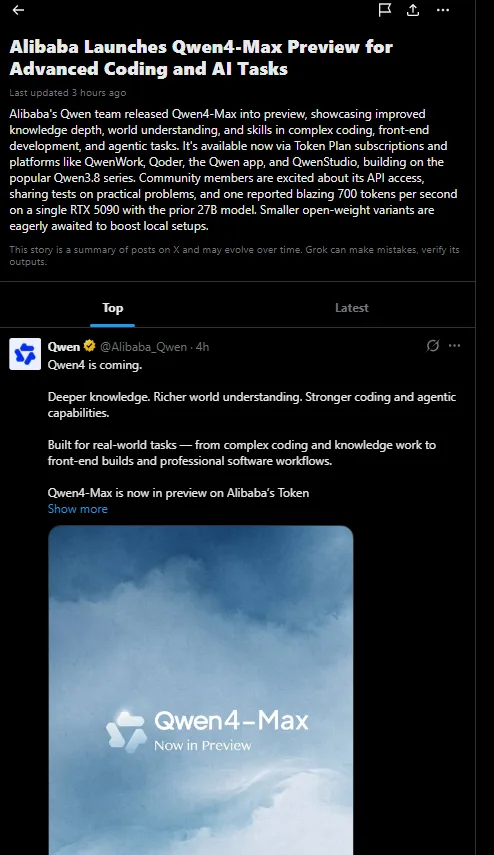
The launch post itself, captured from the verified Alibaba Qwen account. The wording is capability direction: deeper knowledge, richer world understanding, stronger coding and agentic capabilities. No scores in the post, no methodology attached to them either.
The harness caveat that breaks most comparisons
Kimi’s own model card, dated July 16, 2026, publishes a different set of rows: GPQA Diamond 93.5 at max effort, Humanity’s Last Exam without tools 43.5 at max effort, Terminal-Bench 2.1 at 88.3 on the Kimi Code harness at max effort, and DeepSWE v1.1 at 67.5, also on the Kimi Code harness at max effort.
None of those rows can be subtracted from Alibaba’s table. The versions differ: Terminal-Bench 2.1 versus Terminal-Bench 4.0. The harnesses differ: Kimi Code with max effort versus whatever Alibaba ran. The effort settings differ. A model can look like a terminal-coding god on one harness and a mid-pack model on another, and both numbers can be honest. The only defensible cross-model read of the two sources is directional: terminal and agentic coding is where Kimi’s published strength concentrates, and Alibaba’s table agrees, since it is the one row where Kimi K3.1 leads by a double-digit margin.
The same caution applies inside Alibaba’s table. No methodology card, no error bars, no prompt details, no suite versions for some rows, and Elo mixed with percentages in the same columns. Our benchmark explainer post walks every row of the full six-model table, and our no-benchmarks-yet post traces which viral numbers were vendor material and which were guesses.
Pricing: credits, tokens and the real monthly bill
Qwen4-Max has two price surfaces. Pay-as-you-go on Qwen Cloud is $1.50 input, $4.50 output, $0.075 cached input per million tokens. The Token Plan is a monthly subscription granting credits usable across 20+ models, and during the launch event new users get Lite at $3 a month. The launch banner says regular entry starts at $6 while the monthly Lite card lists $8, so $3 is the deepest discount on the page.
| Token Plan tier (individual, monthly) | Launch price | Regular price | Credits / month | Concurrent agents |
|---|---|---|---|---|
| Lite | $3 | $8 | 20,000 | 1-2 |
| Essential | $5 | $16 | 45,000 | 2-3 |
| Standard | $18 | $25 | 80,000 | 3-4 |
| Pro | $43 | $51 | 200,000 | 6-8 |
Kimi K3 has one price surface: tokens, through our gateway, at $0.353 in and $5.67 out per million. No subscription, no credits, no conversion mystery.
A concrete workload: a coding agent sending 8,000 input tokens and receiving 2,000 output, fifty times a day, for thirty days. That is 12 million input and 3 million output tokens a month.
| Route | Input cost | Output cost | Monthly total |
|---|---|---|---|
| Qwen4-Max, Qwen Cloud list | $18.00 | $13.50 | $31.50 |
| Qwen4-Max, list, half input cached | $9.45 | $13.50 | $22.95 |
| Kimi K3, One AI API Key | $4.24 | $17.01 | $21.25 |
| Qwen4-Max, Token Plan Pro | 200,000 credits | burn rate unpublished | cannot compute |
Three honest notes on that table. First, Qwen4-Max’s cached line assumes half your input repeats, which is true for agent loops with a stable system prompt and false for one-shot work; prompt caching is the mechanic, and Alibaba calls its version implicit caching. Second, the ~50% fewer tokens claim, if true, shrinks the Qwen4-Max column further, but it is an internal evaluation with no published workload, so we do not put it in the math. Third, the Pro row is not a number because Alibaba does not publish how many credits a call burns. Twenty thousand credits on Lite versus 200,000 on Pro means nothing per call until that burn rate exists. Run your own workload for a week before choosing a tier; our cost calculator shows the token math.
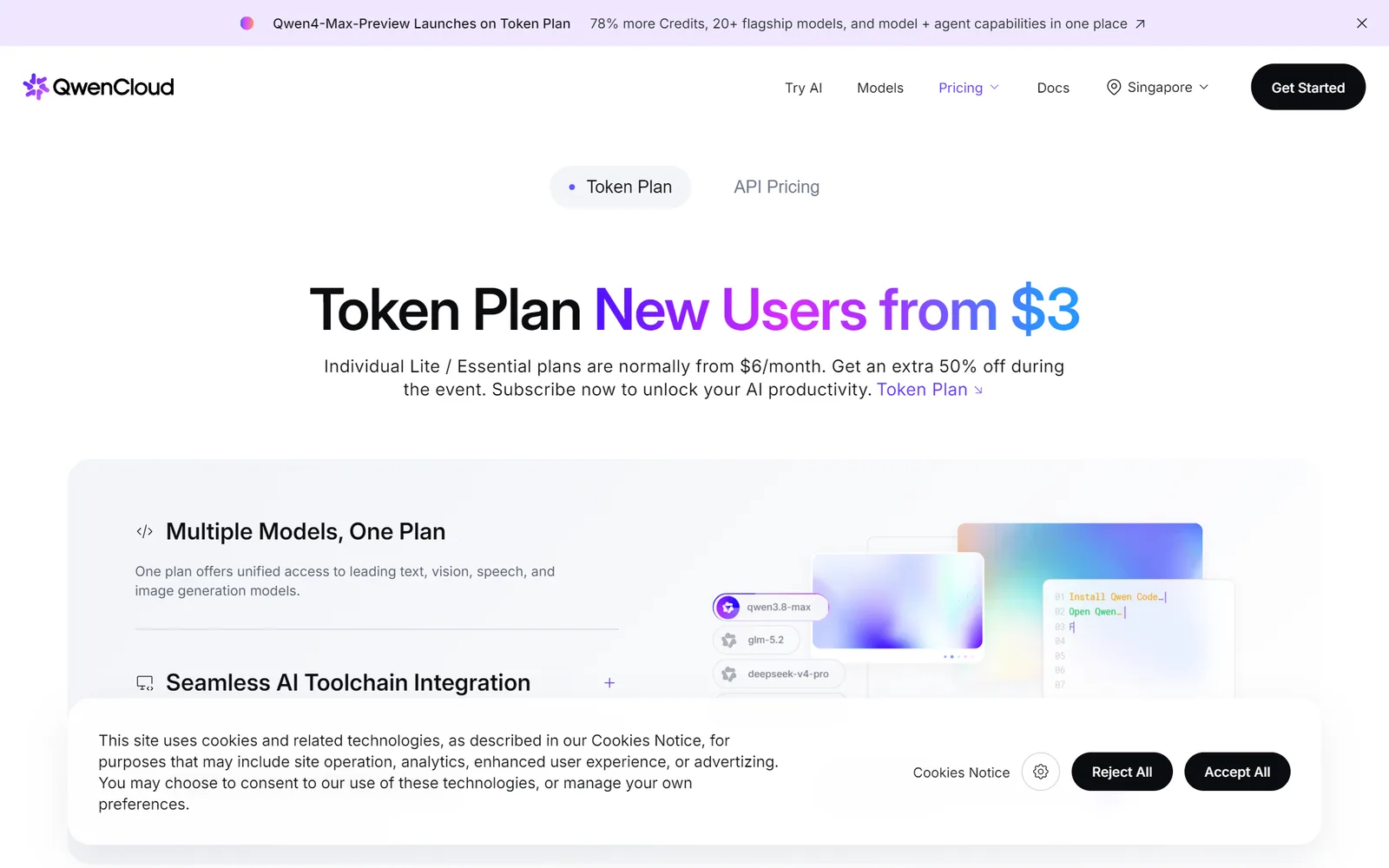
The Token Plan page as captured. The tier table above was transcribed from this page, including the launch-versus-regular split and the concurrent-agent column. The page also carries Individual and Team tabs and Monthly, Quarterly and Yearly toggles; the table here is Individual monthly launch prices, and Alibaba notes the checkout price after login is the one that counts.
What Artificial Analysis, LMArena and the community are saying
As of 2026-11-16, neither Artificial Analysis nor LMArena shows a Qwen4-Max row. There is no independent quality score, no arena Elo, no third-party speed chart for this model anywhere we could find. The same is true of a Kimi K3.1 column on those boards: the K3.1 label exists in Alibaba’s launch table, and the K3 rows in public benchmark databases come from Moonshot’s own model card, not from a neutral harness.
What exists instead:
- benchlm.ai documents the gap directly: no source-displayable benchmark rows yet for Qwen4-Max, with the evidence gaps listed rather than papered over.
- The launch thread on X from the verified Alibaba Qwen account, captured above, is where the ~50% fewer tokens and 60% lower cost-per-task claims live, labeled as internal evaluation.
- Third-party walkthroughs fill the space with defaults, not measurements: apidog’s guide shows a client configured with a 32,768 max_tokens default and a 983,616-token context, which is one integrator’s config, not a vendor limit.
- The Qoduck mystery from launch week, a free stealth model in Qoder that people guessed was Qwen4, is still unconfirmed and should stay out of any comparison.
The pattern is familiar from the 3.8 generation: eesel made the same point about vendor-only numbers then, and it applies again now. A launch table from the vendor is evidence of what the vendor measured. It is not evidence of what an independent harness would measure, and it is not evidence of what your workload will do.
When to pick which
Pick Kimi K3 if your workload is terminal-heavy automation, you need a metered per-token bill today, or your input volume dwarfs your output volume: at $0.353 per million input tokens through our gateway, it is the cheaper pipe by a wide margin on the input side, and its published terminal-coding strength is the strongest single signal in either catalog.
Pick Qwen4-Max if long-horizon valuable work is the point: Agents’ Last Exam 46.7 against 43.4, legal agentic work at 21.3 against 11.7, bioinformatics at 85.0, and a claim of roughly 50% fewer tokens per task that, if it holds outside Alibaba’s internal evaluation, changes the cost math entirely. It is also the pick if you want one subscription covering 20+ models inside Alibaba’s own apps, which is what the Token Plan actually sells.
Stay on neither if you need video input today. Our board lists Qwen3.8 Max with text, image and video input, and Alibaba has published text and image for Qwen4-Max. Video-in workflows should verify before migrating.
How to call both models today
Kimi K3 is live on our gateway, OpenAI-compatible at https://api.oneaiapikey.com/v1:
curl https://api.oneaiapikey.com/v1/chat/completions \
-H "Authorization: Bearer $ONEAI_API_KEY" \
-H "Content-Type: application/json" \
-d '{
  "model": "kimi-k3",
  "messages": [{"role": "user", "content": "Run this migration and report what broke."}]
}'
Qwen4-Max is live on Qwen Cloud’s compatible endpoint, not on our gateway yet. It is queued; when it lands here it gets the same below-list treatment as every other listing, with a published rate and per-key limits:
curl https://ap-southeast-1.maas.qwencloudapi.com/compatible-mode/v1/chat/completions \
  -H "Authorization: Bearer $QWEN_API_KEY" \
  -H "Content-Type: application/json" \
  -d '{
    "model": "qwen4-max",
    "messages": [{"role": "user", "content": "Refactor this function for readability."}]
}'import os
from openai import OpenAI
client = OpenAI(
api_key=os.environ["QWEN_API_KEY"],
base_url="https://ap-southeast-1.maas.qwencloudapi.com/compatible-mode/v1",
)
resp = client.chat.completions.create(
model="qwen4-max",
messages=[{"role": "user", "content": "Explain this stack trace."}],
)
print(resp.choices[0].message.content)The Qwen Cloud base URL is region-pinned; the example above uses ap-southeast-1. Confirm the exact model id in your Qwen Cloud console before you ship it in code: the preview generation used qwen4-max-preview, and ids in this family have dated siblings that behave differently.
Mistakes to avoid
- Subtracting across harnesses. Kimi’s 88.3 on Terminal-Bench 2.1 and Alibaba’s 67.2 on Terminal-Bench 4.0 are different tests. Do not build a migration on that arithmetic.
- Reading Elo rows as percentages. CodeArena and AA-Briefcase are ratings. A 64-Elo gap is not 64 percent of anything.
- Treating credits as tokens. The Token Plan’s 200,000 credits have no published burn rate. Nobody can tell you what Pro costs per call yet, including us.
- Ignoring the output column. Kimi K3 is $5.67 out against Qwen4-Max’s $4.50 list. Output-heavy agents flip the input-side price story.
- Assuming video parity. Qwen3.8 Max takes video input; Qwen4-Max is published as text and image. If your pipeline ships frames, test before you cut over.
- Quoting vendor rows as independent. Every score in the table above is Alibaba’s. The rankings page tracks what we actually serve, metered, and it says nothing about Qwen4-Max yet because we do not serve it yet.
FAQ
Is Qwen4-Max better than Kimi K3?
On Alibaba’s table, Qwen4-Max leads fourteen of sixteen rows against the Kimi K3.1 column. On Kimi’s own card, Kimi publishes 88.3 on Terminal-Bench 2.1 at max effort, a different harness and version. There is no independent head-to-head as of 2026-11-16, so the honest answer is: Alibaba says yes on most rows, and the one row that matters for terminal work goes to Kimi.
Which is cheaper?
Per token, Kimi K3 through our gateway: $0.353 in, $5.67 out. Qwen4-Max list on Qwen Cloud: $1.50 in, $4.50 out, $0.075 cached. Input-heavy work favors Kimi K3 today; output-heavy work favors Qwen4-Max’s list rate. The Token Plan changes the shape to a subscription, but without a published credit burn rate there is no per-call number to compare.
Is Kimi K3.1 the same as Kimi K3?
We do not know. Alibaba’s table says K3.1, our board serves Kimi K3, and no published source we found ties the two ids together. We do not claim they are the same build, and neither should you.
Does Qwen4-Max have a bigger context window?
No meaningful edge. Kimi K3 is listed at 1,048,576 tokens, Qwen4-Max at 1,000,000. Both are 1M-class windows, and both are vendor-published figures.
Where can I try Qwen4-Max for free?
The Try AI playground offers 1M free tokens after sign-in, but its anonymous picker covers older models and gates Qwen4-Max behind sign-in. The Token Plan’s Lite tier at $3 during the launch event is the cheapest confirmed route to the model itself.
Does One AI API Key serve Qwen4-Max?
Not yet. It is queued. Until it lands, the metered options on our board are Qwen3.8 Max at $0.577 / $1.73 per million and the free 0902 uncensored lane.
What is the single most important caveat?
That the whole sixteen-row table is one vendor’s launch material. It is a starting hypothesis, not a result. Re-run your own workload the week the model lands on your route, and pin the exact model id.
The bottom line
Qwen4-Max versus Kimi K3 is not a coronation, it is a trade. Qwen4-Max brings breadth: fourteen of sixteen rows on Alibaba’s table, the Agents’ Last Exam win, the legal and bioinformatics leads, native vision and a 1M window, at $1.50 / $4.50 list or inside a Token Plan that starts at $3 during launch. Kimi K3 brings depth and a bill: the biggest terminal-coding gap in the table, a 1,048,576 window, and a live per-token price through One AI API Key that undercuts Qwen4-Max’s input rate four to one. Buy the depth today if terminal work is your workload. Buy the breadth when it is metered here, and re-run your evals the day it lands.
Keep reading
-
Qwen4-Max benchmarks, explained: 16 tests against Opus 5.5, GPT-6.1 Sol, GPT-6 Astra and Kimi K3.1 — the full six-model table this post isolates two columns from
-
Qwen4-Max vs Claude Opus 5.5 — the Elo-board owner
-
Qwen4-Max vs GPT-6.1 Sol — the cheapest $2 / $10-list flagship
-
Qwen4 Max Preview: free, pricing, providers and specs — the launch-day master post
-
Use Qwen4 Max Preview in Claude Code, Cursor, Codex and Cline — wiring the model into your tools
-
Qwen4 Max Preview speed test — what early timing reports do and do not prove
-
Qwen4 Max Preview has no benchmarks yet — tracing the viral numbers to their sources
More Qwen4-Max coverage
The Fable comparison, added 2026-11-16:
The rest of the cluster, and the pages every comparison links back to:
- Qwen4-Max 1M context guide: what a million tokens holds, and the chunking that keeps it honest
- Qwen4-Max API pricing: every rate, the $43 Token Plan Pro and what a call actually costs
- Qwen4-Max API quickstart: the id, the base URL, streaming, max_tokens and the $43 plan
- The cheapest way to run Qwen4-Max: free routes checked, and the $3 plan that beats them all
- Run Qwen4-Max in your coding agent: base URL, model id, concurrency tiers and budget guards
- Qwen4-Max prompt caching: the $0.075 implicit cache, break-even math and cache-break probes
- Qwen4-Max vision and video benchmarks: what native vision actually scores against GPT-6 Astra and Opus 5.5
- Qwen4-Max vs every flagship launched this quarter: the full scoreboard, price per million and who serves what
- Qwen4-Max vs Gemini 4 Argon: multimodal routes, 1M context and what each actually costs
- Qwen4-Max vs GPT-6.1 Sol and GPT-6 Astra: benchmarks, pricing and the split
- Qwen4-Max vs GPT-6 Astra: sixteen benchmarks, the price gap and where each model wins
- Qwen4-Max vs Grok 4.7: flat flagship prices against the 2x long-context surcharge
- Qwen4-Max vs Claude Opus 5.5: sixteen benchmarks, token prices and the honest split
- Qwen4-Max vs Qwen3.8-Max-0902: the 16-benchmark sweep, the price cut and a migration checklist
- The model catalogue
- The model comparison tool
- API pricing and plans
- The cost calculator
- Live rankings and throughput
- The changelog