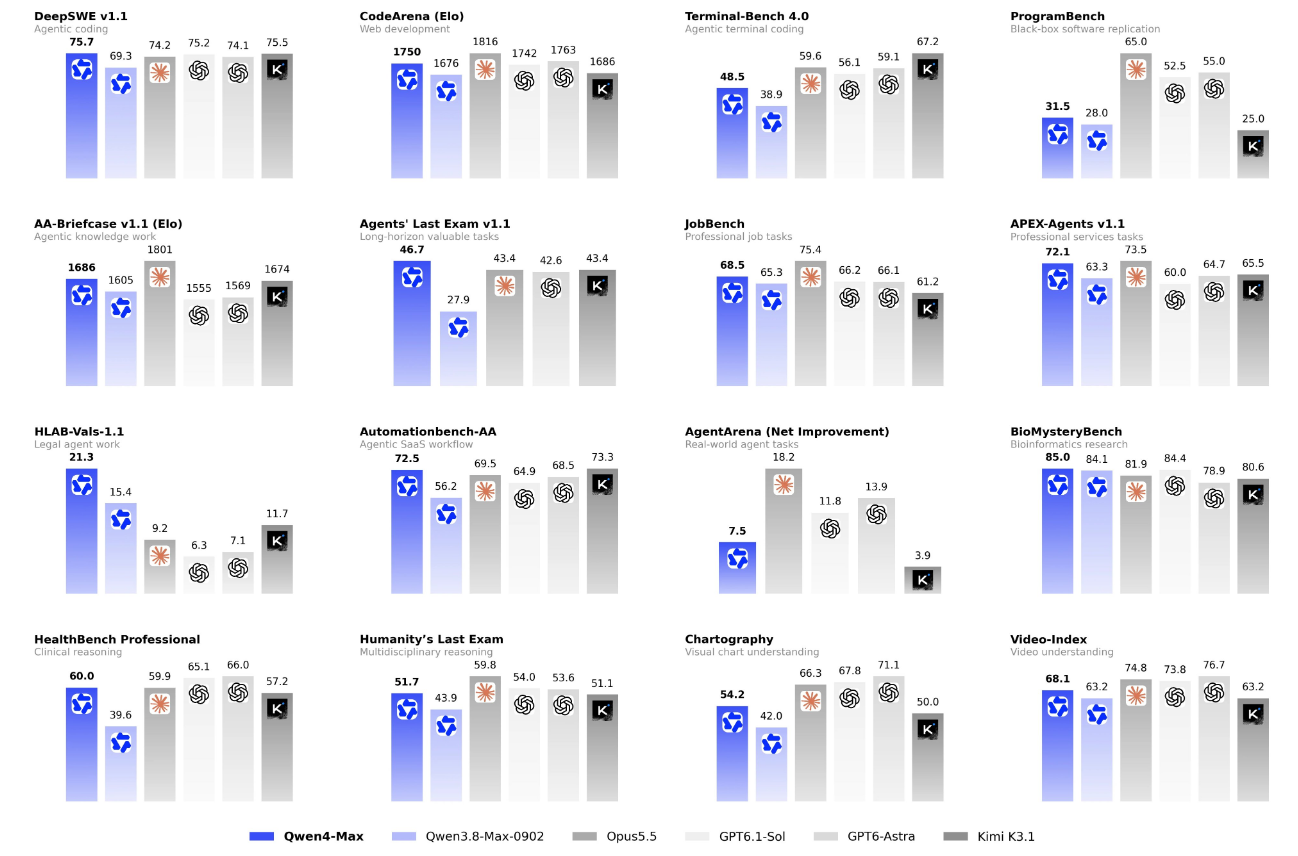
Start with the truth that shapes everything below: there is no shared benchmark table for Qwen4-Max and Grok 4.7. Alibaba’s launch table scores Qwen4-Max against Qwen3.8-Max-0902, Opus 5.5, GPT-6.1 Sol, GPT-6 Astra and Kimi K3.1. xAI publishes Grok 4.7’s own material. Nobody credible has put them in the same grid, and we are not going to pretend otherwise. What you can compare today is the part that decides most bills: price shape, context ceiling, modalities and availability. And on price shape, this is the most interesting fork in the whole Qwen4-Max cluster, because Grok 4.7 bills every token at 2x once your prompt passes 200,000 tokens, while Qwen4-Max charges one flat list rate at any length.
The verdict up front. Under 200,000-token prompts, Grok 4.7 through our gateway is the cheaper input token: $1.40 against Qwen4-Max’s $1.50 list, and $4.20 output against $4.50. Past 200,000 tokens, Grok doubles to an effective $2.80 / $8.40 and Qwen4-Max does not move. Qwen4-Max also doubles the context window, 1,000,000 against 500,000, and its preview-era max output of 393,216 tokens dwarfs Grok’s unpublished ceiling. Grok 4.7 is live and metered today; Qwen4-Max is live upstream on Qwen Cloud and queued on our gateway. Choose Grok for short-prompt work at today’s rates, and keep Qwen4-Max queued for the long-context agent bill.
What the two models are
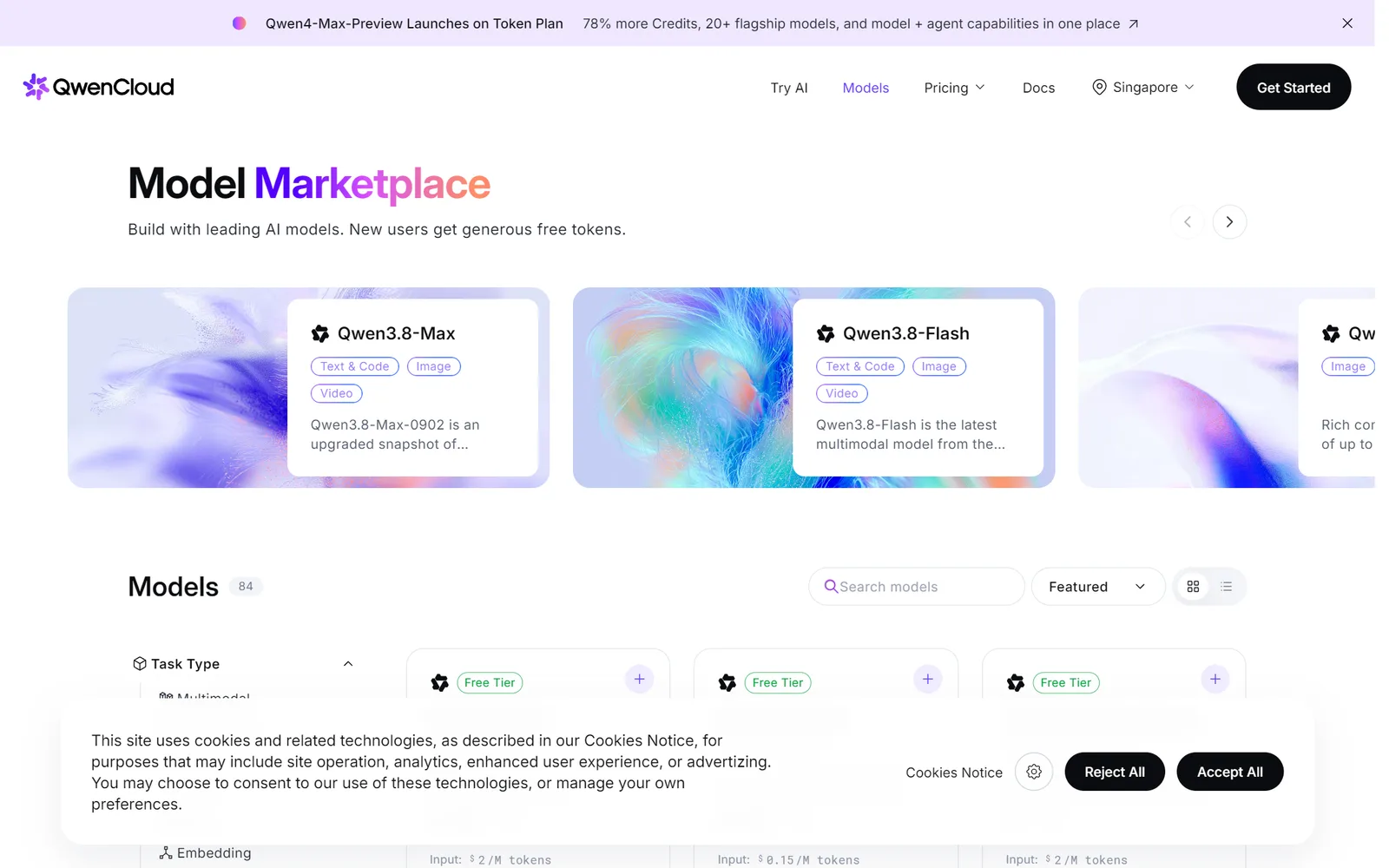
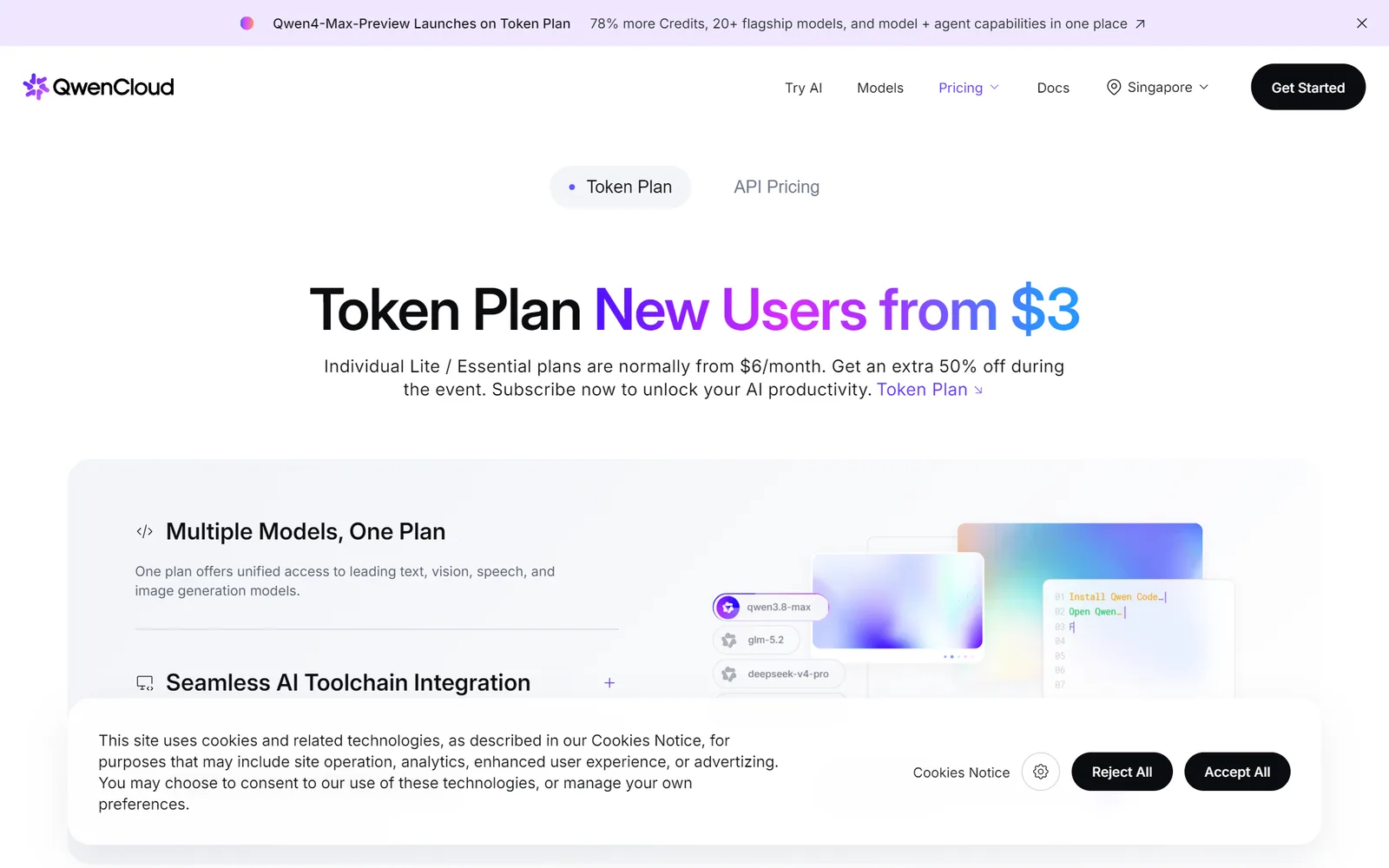
Qwen4-Max is Alibaba’s mixture-of-experts flagship, launched 2026-11-16 with native vision, a 1,000,000-token window, text and image input, and list pricing of $1.50 input, $4.50 output and $0.075 implicit caching per million tokens, live on Qwen Cloud with a Token Plan from $3 to $43 a month.
Grok 4.7 is xAI’s newest Grok, released 2026-09-21 per xAI’s own news page: a 500,000-token window, text and image input, tool calling, vision and reasoning, vendor list $2 input and $6 output per million, sold through our gateway at $1.40 / $4.20 with cached input at $0.50. Its own predecessor, Grok 4.6, sits on our board as listed but unavailable, so 4.7 is the only Grok route that answers today.
| Spec | Qwen4-Max | Grok 4.7 |
|---|---|---|
| Context window | 1,000,000 | 500,000 |
| Input modalities | Text, image (native vision) | Text, image |
| Max output | 393,216 on the preview, per eesel.ai’s review | Not published |
| List input $/M | $1.50 | $2.00 |
| List output $/M | $4.50 | $6.00 |
| Long-context rule | Flat at any length | 2x every token past 200K prompt |
| Cached input $/M | $0.075 implicit | $0.50 |
| On One AI API Key | Queued | Live $1.40 / $4.20 |
The long-context rule deserves its own line in every comparison you make, because it is the only pricing mechanic on this board that increases with use. xAI’s docs and our own Grok 4.7 release post both state it: once the prompt is above 200K tokens, every token, input and output, bills at twice the rate. The models catalog mirrors that tier exactly, so the rate you see in the console is the rate the upstream bills.

The price-shape math
Two workloads, both real agent shapes. First, the short-prompt workload: fifty runs a day at 8,000 input and 2,000 output tokens, about 12.4M input and 3.1M output a month, far below the 200K line.
| Route | Monthly cost, short-prompt workload |
|---|---|
| Qwen4-Max, Qwen Cloud list | $32.55 |
| Grok 4.7, One AI API Key | $30.38 |
| Grok 4.7, list | $43.40 |
| Qwen4-Max, One AI API Key | Queued, unknown |
Grok through us wins the short game by about $2 a month, roughly 7%, because our gateway sells both below list and Grok’s list is the lower list. Fine. Now the long-prompt workload: ten runs a day at 400,000 input and 2,000 output tokens, about 120M input and 0.6M output a month, a repo-wide agent with full context.
| Route | Monthly cost, 400K-token prompts |
|---|---|
| Qwen4-Max, Qwen Cloud list | $182.70 |
| Grok 4.7, One AI API Key | $341.04 |
| Grok 4.7, list | $487.20 |
Qwen4-Max list is 54% of Grok’s gateway rate at that prompt length, and 38% of its list, because Grok’s 2x surcharge applies to all 120M input tokens once the prompt crosses 200K, and to output as well. The crossover is not subtle: it is the 200,000-token line, and it is the only line in this comparison. Paste your own numbers into the cost calculator before you believe either column here, and read the rate-limits guide for the caps that sit on top of price.
Caching softens both. Grok’s cached input is $0.50 per million on our board, which is 36% of its input rate; Qwen4-Max’s implicit cache is $0.075, which is 5% of its input rate and the subject of our full Qwen4-Max prompt caching guide. At 80% cache hit on the same workload, Grok bills 9.92M cached tokens at $0.50 plus 2.48M at $1.40 plus output, about $21.45, against Qwen4-Max list at about $18.41. The cache is where Qwen4-Max’s flat price stops being the whole story, and where the prompt caching docs earn their keep.
Where each model is the honest pick
Short-prompt, high-volume work. Classification, chat, extraction, light agents under 200K tokens: Grok 4.7 through us is live, metered and the cheaper input token today. Qwen4-Max is not routable here yet, and its list rate would barely undercut it anyway.
Long-context agents. Repo-wide coding agents, whole-codebase review, book-length analysis, legal document sets: Qwen4-Max’s flat $1.50 at 1M context beats Grok’s doubled rate above 200K, and the window is twice as large. This is the workload where the queued listing matters most, and our 1M context guide shows the recall probes to run when it lands.
Vision input. Both take images. Qwen4-Max’s launch table scores Chartography at 54.2 and Video-Index at 68.1; Grok publishes vision capabilities but no head-to-head rows against Qwen, so the only honest move is your own probe: send the same five screenshots to both and grade the outputs yourself.
Long outputs. Qwen4-Max’s preview-era 393,216 max output, shared between thinking and answer per eesel.ai’s review, is the only published ceiling in this pair. Grok’s is not published, and we do not guess. If your job generates long artifacts, test it; the reasoning docs explain how thinking tokens eat output budget first.
Availability today. Grok 4.7 answers now. Qwen4-Max answers on Qwen Cloud now and is queued for our catalog, where every model gets a published rate, per-key limits and per-request metering, and the usage log shows exactly what you burned.
Routing this week? Grok 4.7 is live at $1.40 / $4.20, and Qwen4-Max switches on here with an id change, not a migration.
How to call each model today
Qwen4-Max is live on Qwen Cloud, OpenAI-compatible:
curl https://ap-southeast-1.maas.qwencloudapi.com/compatible-mode/v1/chat/completions \
  -H "Authorization: Bearer $QWEN_API_KEY" \
  -H "Content-Type: application/json" \
  -d '{
    "model": "qwen4-max",
    "messages": [{"role": "user", "content": "Summarise this 180k-token report."}]
  }'
Grok 4.7 is live on our gateway with your existing key:
curl https://api.oneaiapikey.com/v1/chat/completions \
  -H "Authorization: Bearer $ONEAI_API_KEY" \
  -H "Content-Type: application/json" \
  -d '{
    "model": "grok-4.7",
    "messages": [{"role": "user", "content": "Summarise this 180k-token report."}]
  }'
Enable streaming on both so long reasoning arrives token by token, set max_tokens deliberately on both because a reasoning model can spend its output budget thinking before it answers, and read errors before you retry, because a 429 on one gateway is not a 429 on the other. If you move an app between the two base URLs, our OpenAI SDK base-url switch guide is the ten-minute version, and the Anthropic-format guide covers Claude-shaped clients.
What Artificial Analysis, LMArena and the community are saying
The third-party picture is the same as the rest of the cluster: vendor material first, independent rows later. Artificial Analysis tracks Grok models and has no Qwen4-Max row as of 2026-11-16; LMArena is the same story, so there is no independent head-to-head to quote. BenchLM documents the Qwen4-Max evidence gap directly. The only independent measurement of Qwen4-Max in its first week is kingy.ai’s Sol run, which is not Grok but does show the shape of the model’s billing: 296,704 cache reads against zero writes, and durations of 15.67 minutes per first attempt against Sol’s 6.29. On Grok’s side, xAI’s own release notes and model docs are the primary sources, and our rankings page tracks real gateway throughput for every model we serve, which is the speed column no launch table gives you.
Mistakes to avoid
- Comparing flat rates without the surcharge line. Grok’s 2x past 200K changes the winner. Read the pricing shape, not the headline.
- Comparing list price to gateway price. Grok at $1.40 / $4.20 through us is below its $2 / $6 list; Qwen4-Max’s $1.50 / $4.50 is list. Compare the rate you actually pay.
- Reading the context window as recall. 1M against 500K is capacity, not quality. Run the recall probes in our 1M context guide.
- Assuming the cache price is the cache price. $0.075 implicit against $0.50 explicit-ish is different mechanics. Read the caching guide before you budget either.
- Pinning a moving id.
qwen4-maxis notqwen4-max-preview; the preview id was retired. Pin, log, re-run evals, as our one key per project guide argues. - Ignoring the free lanes while you wait.
qwen3.8-max-0902-uncensored:freeand the Groq 27B lane cost nothing while the queue clears.
FAQ
Is Qwen4-Max cheaper than Grok 4.7?
At list, Qwen4-Max: $1.50 / $4.50 against Grok’s $2 / $6. On our gateway, Grok 4.7 is live at $1.40 / $4.20 today, which beats Qwen4-Max’s list on both lines, until your prompt passes 200K tokens and Grok doubles. Then Qwen4-Max list is far cheaper.
Does Grok 4.7 really charge 2x past 200K?
Yes, every token, input and output, once the prompt is above 200,000 tokens. It is in xAI’s model docs and mirrored in our catalog pricing row.
Which has the bigger context window?
Qwen4-Max at 1,000,000 tokens against Grok 4.7’s 500,000. And Qwen4-Max’s cached rate is flat, so a 900K-token prompt costs the same per token as a 9K one.
Which should I use for coding agents today?
Grok 4.7 for short-prompt, high-volume work where it is live and metered. For repo-wide agents whose prompts cross 200K, the flat 1M-context Qwen4-Max rate wins the math, but it is queued here, so today that means Qwen Cloud directly or Qwen3.8 Max at $0.577 / $1.73 on our gateway.
Is Qwen4-Max on One AI API Key?
Not yet. It is queued for the catalog at a published rate below list, the same as every Alibaba flagship. Qwen3.8 Max is live today, and qwen3.8-max-0902-uncensored:free runs on the free lane.
Where is the honest scoreboard?
Nowhere yet. Neither Artificial Analysis nor LMArena has a Qwen4-Max row, no suite scores it against Grok, and we will not invent one. Run your own eval on the rows that decide your use case.
The bottom line
This is a price-shape comparison, not a quality one, because no shared scores exist. Grok 4.7 is live, cheap under 200K tokens, and doubles past them. Qwen4-Max is flat-priced, twice the window, published with a $0.075 implicit cache, and queued here. Match your prompt length to the mechanic, run your own probe on the task that decides your use case, and meter the result. Grok 4.7 is live and metered today; Qwen4-Max is live upstream and queued here, and your key will switch it on with an id change, not a migration.
Keep reading: all sixteen benchmarks explained, Qwen4-Max vs GPT-6 Astra, Qwen4-Max vs GPT-6.1 Sol, Qwen4-Max vs Claude Opus 5.5, Qwen4-Max vs Kimi K3, Qwen4-Max vs Gemini 4 Argon, the prompt caching guide, the API quickstart, and the cheapest way to run Qwen4-Max.
Reading the surcharge in a real bill
The 2x rule is simple to state and easy to misread, so here it is against real prompt sizes, input tokens only, at list price. Grok 4.7 lists $2.00 per million input and doubles every token in a request whose prompt passes 200K tokens. Qwen4-Max lists $1.50 flat.
| Prompt size | Grok 4.7 list, input only | Qwen4-Max list, input only |
|---|---|---|
| 100K tokens | $0.20 | $0.15 |
| 250K tokens | $0.50 (2x tier) | $0.375 |
| 400K tokens | $0.80 (2x tier) | $0.60 |
| 1M tokens | $2.00 (2x tier) | $1.50 |
Under 200K the two are nearly interchangeable on input cost, which is why the short-workload math in the opening section favoured neither. Past 200K the gap compounds: at 1M tokens in, Grok bills $2.00 where Qwen4-Max bills $1.50, before a single output token. Add output at list ($6.00 vs $4.50 per million) and the long-context agent workload widens further, because the multiplier sits on top of an already higher completion rate.
Two honest caveats. First, whether cache-read tokens inside a long prompt inherit the 2x tier is not documented anywhere we can verify; treat the first long bill as the measurement, not this table. Second, these are vendor list prices. Through the gateway, Grok 4.7 sells at $1.40 input and $4.20 output with cached reads at $0.50, while Qwen4-Max is queued and not yet metered here, so compare at the rate you actually pay, not the rate on this page. The comparison tool and the cost calculator both recompute the moment the Qwen4-Max row goes live, and the rankings page will show what the long-context tier does to real throughput once we meter it.
If you are on the fence today, the practical order is: short prompts, either model; long prompts, measure the tier on a week of real traffic before you sign a workload to it, because the 2x rule is the kind of detail that shows up in a bill, not in a spec sheet. Our pricing page and the model catalogue carry the rates we actually charge, and the changelog records every move.
One tactic the table does not show: shape the prompt before you shape the bill. A request at 190K tokens pays the flat rate; the same workload at 210K pays double on every input token. Trimming a system prompt, or moving repeated context into a cached prefix, can hold a workload under the tier, and the prompt caching guide covers how cache geometry changes the arithmetic on the Qwen side. Measure both shapes on a week of real traffic. The usage log will tell you which side of 200K you actually live on, and the first metered bill is the only table that counts.
More Qwen4-Max coverage
The Fable comparison, added 2026-11-16:
-
Qwen4-Max vs Claude Fable 5.1: the real price gap, output ceilings and when Fable earns its rate
-
Qwen4-Max benchmarks explained: 16 tests against Opus 5.5, GPT-6.1 Sol, GPT-6 Astra and Kimi K3.1
-
Qwen4-Max vs GPT-6 Astra: sixteen benchmarks and the price gap
-
Qwen4-Max vs Claude Opus 5.5: sixteen benchmarks and the honest split
-
Qwen4-Max vs Qwen3.8-Max-0902: the generational jump, row by row
-
Qwen4-Max vs Kimi K3: harness differences and the honest numbers
-
Qwen4-Max vs Gemini 4 Argon: multimodal routes, 1M context and costs
-
Qwen4-Max API pricing: list rates, the $43 Token Plan and the cost math
-
Qwen4-Max prompt caching guide: the $0.075 implicit cache math
-
Qwen4-Max 1M context guide: recall probes and the full-window bill
-
Qwen4-Max coding agents setup: Claude Code, Cursor, Codex and Qoder
-
Qwen4-Max vision and video benchmarks: what native vision actually wins
-
Qwen4-Max API quickstart: ids, base URLs, streaming and max_tokens
-
Qwen4-Max preview speed test: what we measured before launch