There is a version of this post that writes itself: paste two flagship names into a table, let the launch hype fill the cells, publish. We are not going to do that, because the honest answer is that no shared scoreboard exists for Qwen4-Max vs Claude Fable 5.1. Alibaba published sixteen launch benchmarks for Qwen4-Max and none of them carry a Fable column. Anthropic publishes Fable 5.1 specs and pricing, not a head-to-head. Artificial Analysis and LMArena have rows for neither pairing as of 2026-11-16.
So this post does the next best thing. It puts the two models side by side on what is actually published: rates, cache pricing, context, output ceilings, modalities, protocol support and availability on our gateway. Then it runs the arithmetic three ways so you can see where the money really goes, and it flags the one naming trap that will bite you in a support thread.
If you came here from a search result that promised “Qwen4-Max vs Fable 5.2 benchmarks”, stop here: Claude Fable 5.2 does not exist anywhere we can verify. Every Fable number in this post is 5.1.
What each vendor actually published
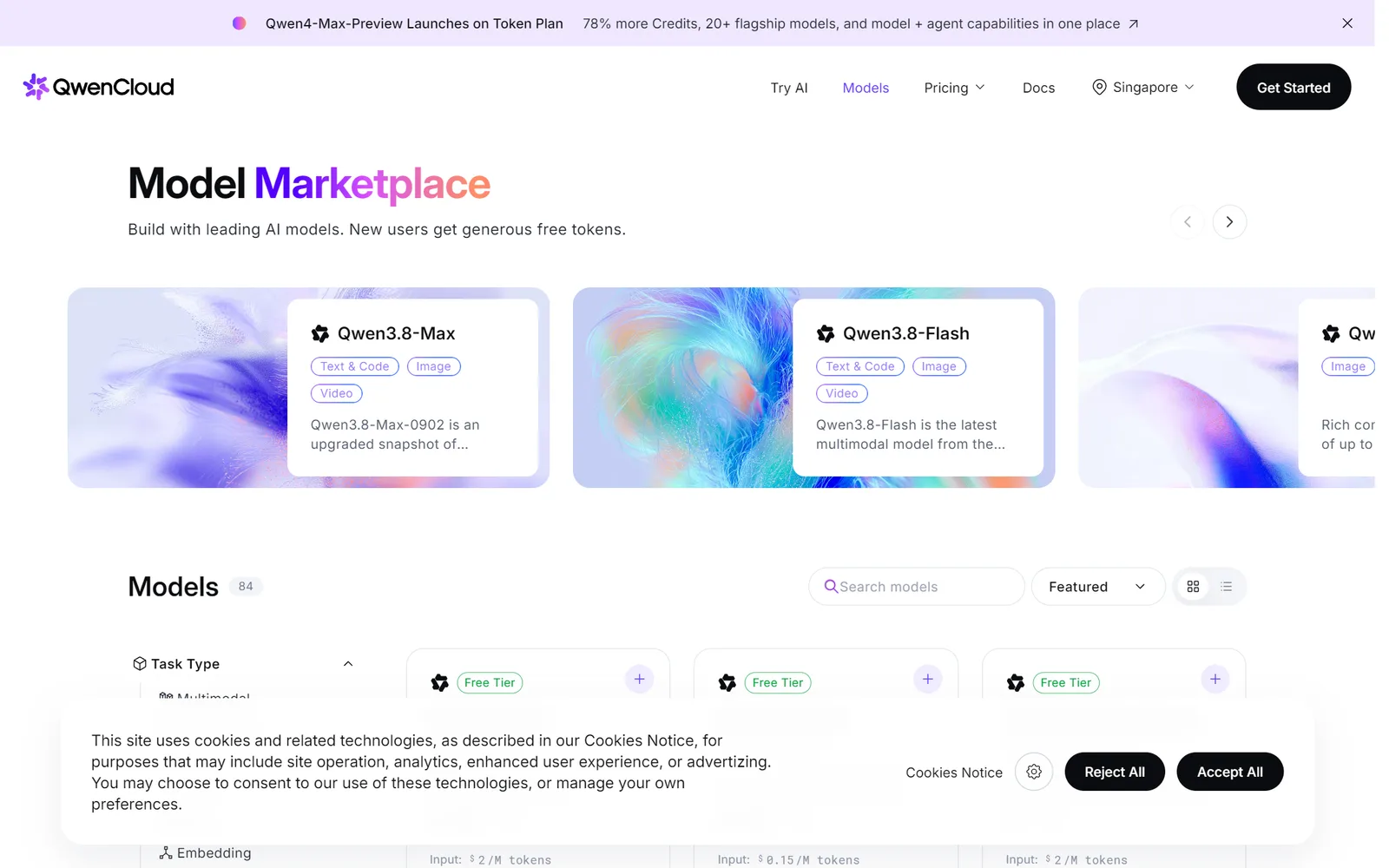
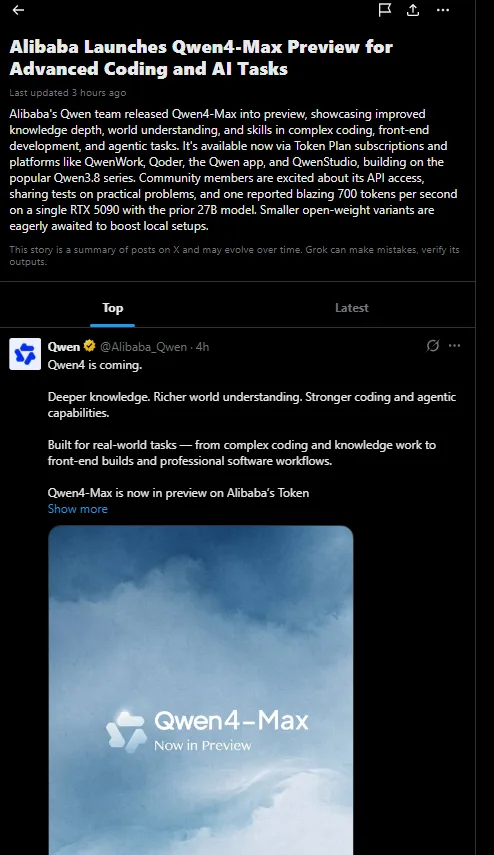
Qwen4-Max went GA on 2026-11-16 with the id qwen4-max (the preview id qwen4-max-preview is retired). Published facts: mixture-of-experts, native vision, text and image input at GA, a 1,000,000-token context window, $1.50 per million input, $4.50 per million output and $0.075 per million implicit cache reads, with a 393,216-token output ceiling shared between thinking and answer. The launch came with a sixteen-benchmark table we translated row by row. The Token Plan credit burn rate is still unpublished, which matters if you budget in credits rather than dollars; our pricing guide covers what is and is not known.
Claude Fable 5.1 is Anthropic’s long-agent model: 1,000,000-token context, 128,000-token max output, text and image input, tools, vision, reasoning, structured outputs, streaming and caching, on the OpenAI-compatible protocol here. Vendor list is $10 input and $50 output per million with cache reads at $0.25. Through us it sells at $7 input, $35 output, cache reads $0.25, and there is a free-lane twin that meters at the same $7 / $35 against your account credit, so “free” there means the lane, not a $0 bill.
| Spec | Qwen4-Max | Claude Fable 5.1 |
|---|---|---|
| Vendor list input / 1M | $1.50 | $10.00 |
| Vendor list output / 1M | $4.50 | $50.00 |
| Cached read / 1M | $0.075 (implicit) | $0.25 |
| Our gateway input / output | queued, not metered yet | $7.00 / $35.00 |
| Context | 1,000,000 | 1,000,000 |
| Max output | 393,216 shared thinking + answer | 128,000 |
| Input modalities | text, image | text, image |
| Protocols here | OpenAI (upstream), Anthropic later | OpenAI-compatible |
| Status | live on Qwen Cloud, queued on our gateway | live on our gateway + free lane |
One row deserves a second look. Qwen4-Max’s output ceiling is three times Fable’s, and it is shared between the thinking trace and the answer, which is the same design as the preview era’s 393,216 figure the eesel review flagged as unusual. If your agent writes 100K-token artefacts, that row decides the comparison before price enters the room. If your agent writes 8K-token answers, it is decorative.
The arithmetic, three ways
Rates are only meaningful against a workload. Take three: a chatty helper (2M input, 0.5M output a month, 80% cache hit), a codebase agent (20M input, 5M output, 80% hit) and the same chatty helper with caching ignored.
| Monthly workload | Qwen4-Max at list | Fable 5.1 at list | Fable 5.1 at our rate |
|---|---|---|---|
| 2M in / 0.5M out, 80% cached | $2.97 | $29.40 | $20.70 |
| 20M in / 5M out, 80% cached | $29.70 | $294.00 | $207.00 |
| 2M in / 0.5M out, no cache | $5.25 | $45.00 | $31.50 |
Read the columns, not the rows. Qwen4-Max is 4.7x cheaper on input and 7.8x cheaper on output at list-to-gateway rates, and the gap widens on output-heavy work because $35 vs $4.50 is where the multiplier lives. Fable’s cache read at $0.25 per million is 3.3x Qwen4-Max’s $0.075, so the models converge fastest exactly where you would hope they would not: on long, repetitive prompts that hit cache.
The no-cache row is the honest one for anyone who has never looked at their cache-hit rate. A 20% hit turns Qwen4-Max’s $5.25 into roughly $3.53 saved at the cached rate, which our prompt caching guide works through with the probe script; Fable saves $18 of $45 at the same hit rate. Both models reward caching. One of them rewards it in dollars you notice.
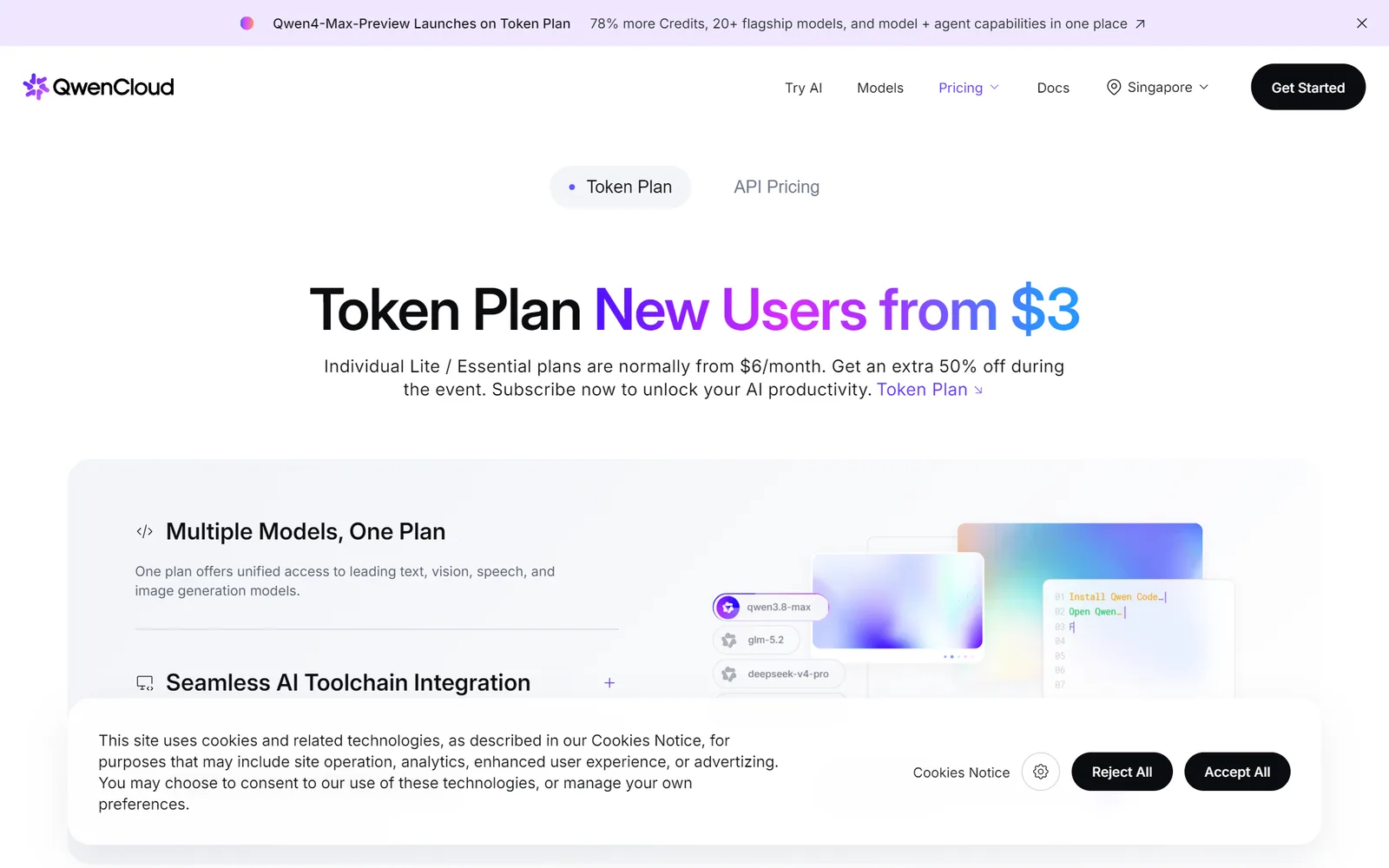
The credit wrinkle is real and it is the one number we cannot give you. Qwen4-Max runs on the Token Plan, where the eesel review measured credit burn at roughly 20% of the standard rate in their preview testing, 8% overnight Beijing time. That is a preview-era, single-tester figure and Alibaba has not published the burn schedule. Fable 5.1 through us is plain per-token metering with no conversion step. If your finance team bills in dollars, that difference is worth more than any benchmark row.
Where Fable 5.1 genuinely wins
Price is not the only column, and pretending otherwise is how bad routing tables get made.
The Claude ecosystem is the product. If your stack is already Anthropic-shaped, your tool schemas, your system prompts, your eval harness and your team’s intuition were all tuned on Claude models. Fable 5.1 drops into that with the Anthropic-compatible path our gateway speaks, and the switch cost is near zero. Qwen4-Max is OpenAI-compatible at Qwen Cloud; our gateway will serve it the same way, but your prompts were not written for it.
Structured output behaviour. Both list structured outputs; Fable 5.1 sits in a family whose JSON discipline is the reason teams pay Anthropic rates. We have no Qwen4-Max structured-output measurement to put against it, and we will not invent one.
A 128K output ceiling that is simple. No shared-thinking-budget accounting, no surprise where the trace ate half the window. For agents that produce one long document per call, 128K is a lot, and it is a fixed number you can plan around.
It is here, today, metered. Fable 5.1 answers on our gateway right now with per-request metering in the usage log. Qwen4-Max is queued; until the row goes live, every Qwen4-Max figure in this post is vendor list price, not your invoice.
Where Qwen4-Max genuinely wins
The rate card. At list, Qwen4-Max is $1.50 / $4.50 against Fable’s $10 / $50. There is no framing in which the flagship Qwen is the expensive call. Even against our discounted Fable rate, the output gap is 7.8x.
The output window. 393,216 tokens shared between thinking and answer versus 128,000. Long-horizon agents that draft, then draft again inside the same call, live in that difference.
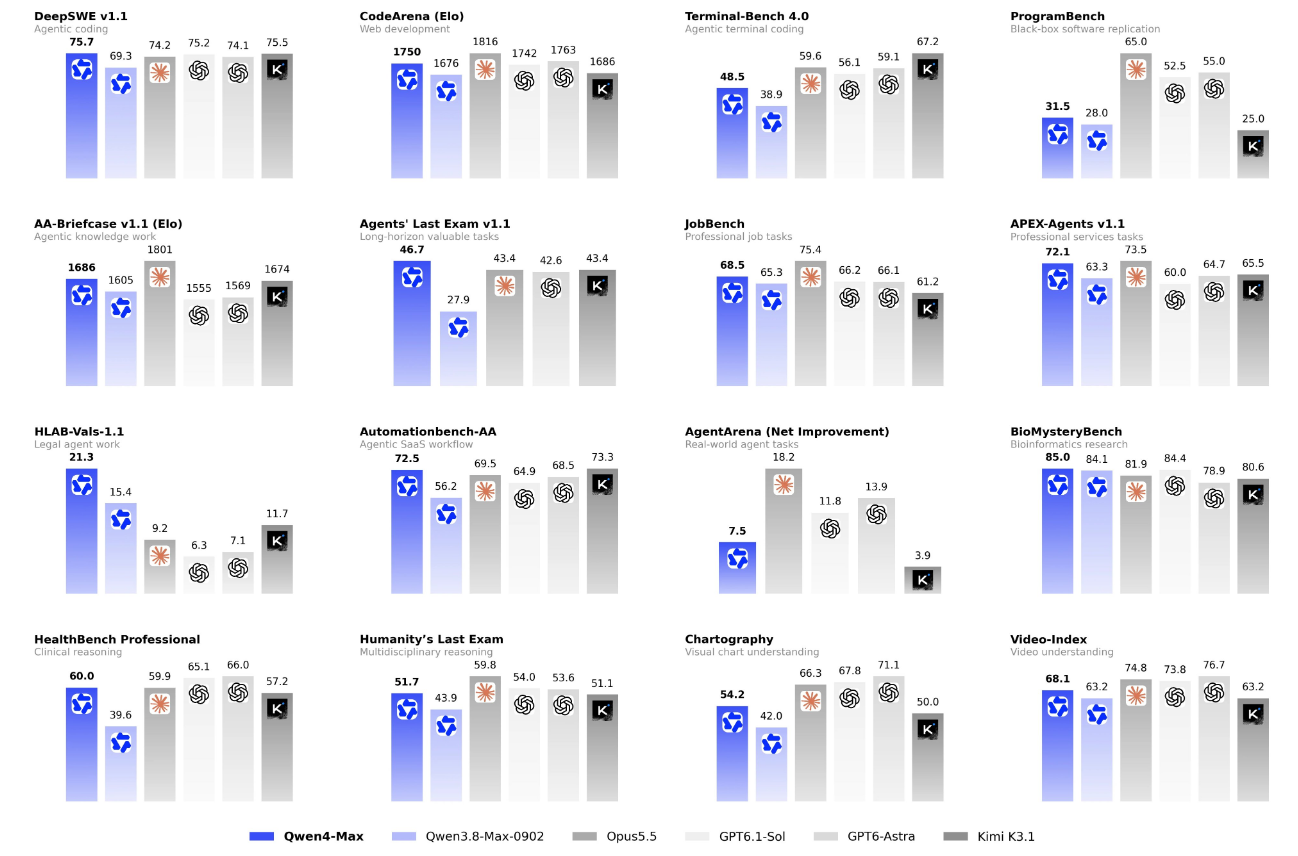
A fresh, published benchmark set. The sixteen-test launch table gives you something to run your own evals against, from DeepSWE to Agents’ Last Exam. Fable 5.1’s public picture is vendor copy plus whatever third-party trackers have posted; we found no head-to-head against Qwen4-Max to cite, which is itself the finding.
Native vision at GA with a cheaper input rate. Both take images; Qwen4-Max bills that input at a fifth of Fable’s cached rate before any discount.
What Artificial Analysis, LMArena and the community are saying
The honest section, because this is where comparison posts lie by omission.
Artificial Analysis has no Qwen4-Max row and no Qwen4-Max vs Fable 5.1 pairing as of 2026-11-16. LMArena likewise. BenchLM documents the gap directly: specifications and pricing, no source-displayable benchmark rows for the model. The kingy.ai piece that measured Qwen4-Max against GPT-6.1 Sol across five real tasks, including the two-stage self-review cost of $0.95 vs $0.66, is the closest thing to independent measurement published this week, and it does not include Fable. The Pandaily thread leads with the Agents’ Last Exam score of 46.7 and the caching price cut.
For Fable 5.1, Anthropic’s own positioning, long-running agent workflows and front-end code, is what you get; we found no independent head-to-head involving Qwen4-Max to quote, so we are not quoting one. What people are saying in the aggregate is consistent with every launch this quarter: vendor tables first, independent rows later. Watch our rankings for gateway-side throughput the moment Qwen4-Max is metered here, because that is a number nobody else will have.
Try both, properly
Fable 5.1 through the gateway, OpenAI-compatible:
curl https://api.oneaiapikey.com/v1/chat/completions \
  -H "Authorization: Bearer $ONEAI_API_KEY" \
  -H "Content-Type: application/json" \
  -d '{
    "model": "claude-fable-5-1",
    "messages": [{"role": "user", "content": "Refactor this function for readability."}]
  }'
Qwen4-Max at Qwen Cloud today, and the same call through us the day the row goes live:
curl https://ap-southeast-1.maas.qwencloudapi.com/compatible-mode/v1/chat/completions \
  -H "Authorization: Bearer $QWEN_API_KEY" \
  -H "Content-Type: application/json" \
  -d '{
    "model": "qwen4-max",
    "messages": [{"role": "user", "content": "Refactor this function for readability."}]
  }'
Copy the base URL from your own console, not from any blog. A 401 means the key or entitlement is wrong, a 404 on the model means the id, and qwen4-max is not qwen4-max-preview. On the Fable side, the free-lane id is claude-fable-5-1:free; it is listed at no rate but meters at the model’s usual rate against your account credit, so do not read “free lane” as “$0 bill”. Set max_tokens deliberately on both, because a reasoning model can spend the window thinking before it answers, and our reasoning docs explain the split.
The naming trap, in one paragraph
Search results and slide decks will call this model “Fable 5.2” for the same reason they called the Qwen preview “Qwen4-Max Preview”: version numbers drift upward in third-party copy. Our catalogue carries claude-fable-5-1 and claude-fable-5-1:free, and nothing with a 5.2 tag, verified against the vendor’s own listing on 2026-10-21 and again this week. If a tutorial, a Reddit thread or a competitor page quotes “Fable 5.2” numbers, you are reading about a model nobody can buy, and the rates they quote will not match your invoice. Pin the id, log it, re-run your eval when it changes. The 3.8 generation already proved that preview ids and GA ids bill differently.
The free lanes, side by side
Both vendors now have a zero-list-price story, and they are not the same animal, which is worth stating before you route anything by the word “free”.
Qwen3.8-Max 0902 Uncensored is a true $0 lane on our gateway: the upstream bills nothing per token, and it is the abliterated snapshot we announced on 2026-11-14. Fable 5.1’s :free twin is a lane, not a price: the gateway still meters it at $7.00 input and $35.00 output against your account credit, exactly as the free models page states. Neither is a budgeting shortcut, and both sit under the same usage ceilings as every other model here, so a runaway loop on a free lane still trips the daily caps and still shows up in the usage log.
The practical read: if “free” is the requirement, the Qwen lane is the free lane. If the requirement is “Fable-class reasoning on a project budget”, the paid Fable row at $7 / $35, the per-project spend limit and the low-balance alert are the honest toolkit.
Mistakes to avoid
- Inventing a winner table. There is no shared benchmark set. Any post that shows you sixteen rows for Fable vs Qwen4-Max is fabricating columns.
- Comparing list to gateway. Fable at $7 / $35 through us is not $10 / $50, and Qwen4-Max is not on our meter yet. Compare the rate you will actually pay.
- Forgetting the shared thinking budget. 393,216 tokens covers thinking plus answer. Plan
max_tokensaccordingly. - Reading “free lane” as free.
claude-fable-5-1:freebills $7 / $35 against your credit. The lane is free, the tokens are not. - Budgeting Qwen4-Max in credits without the burn rate. It is unpublished. Convert with your own usage log, never the plan page.
- Ignoring cache geometry. Fable cache reads at $0.25 are 3.3x Qwen4-Max’s $0.075. On long, sticky prompts that difference outruns the input rate.
- Pinning a moving id. Preview ids, GA ids and free-lane twins are three different billing objects. Log which one answered.
FAQ
Is Fable 5.2 coming? We cannot verify that, and we will not guess. What exists today is 5.1, priced and metered as above.
Which is cheaper for a coding agent? On published rates, Qwen4-Max by roughly 5-10x depending on cache hit. On ecosystem fit, Fable 5.1 if your stack is already Claude-shaped. Those are different questions.
Can I run Qwen4-Max on the gateway today? Not yet; it is queued. Fable 5.1 answers now, and its free-lane twin is on the free models page.
Does the gateway cache Fable prompts? Yes, at $0.25 per million read, and the cache console shows the split per request. A model without a cached field bills cache at full input price; Fable has one, so this is not that case.
What about Opus 5.5 instead? It sits between them at $2.80 / $14 through us with the Anthropic protocol native; the Opus comparison has the sixteen-benchmark detail.
Where do I see what I actually spent? The usage log per key, plus low-balance alerts before a runaway loop empties the account.
Bottom line
There is no head-to-head evidence, and the correct response to that is a routing decision, not a verdict. Route long-horizon, output-heavy, price-sensitive work to Qwen4-Max when the gateway row goes live, and re-run the same eval the week it lands. Route Claude-shaped stacks, structured-output-critical work and teams that bill Fable’s ecosystem in dollars to Fable 5.1 at $7 / $35 today. Use the comparison tool for the arithmetic on your real prompt mix, the cost calculator for the monthly number, and the catalogue for the rate you will actually be charged. When independent rows finally appear on Artificial Analysis or LMArena, this post gets the same update the rest of the cluster got: new facts, same honesty.
One worst-case check before you route. Filling the output ceiling once costs Fable 5.1 $4.48 at the gateway rate of $35 per million, because 128,000 tokens is $4.48. It costs Qwen4-Max $1.77 at list, because 393,216 tokens at $4.50 per million is $1.77. Nobody fills the ceiling on every call, but the bound is the honest way to compare agents that run long: when a task can eat a whole window, the ceiling price is the one that shows up in the bill. The comparison tool recomputes both sides the moment the Qwen4-Max row goes live.
More Qwen4-Max coverage
The rest of the cluster, and the pages every comparison links back to:
- Qwen4-Max 1M context guide: what a million tokens holds, and the chunking that keeps it honest
- Qwen4-Max API pricing: every rate, the $43 Token Plan Pro and what a call actually costs
- Qwen4-Max API quickstart: the id, the base URL, streaming, max_tokens and the $43 plan
- The cheapest way to run Qwen4-Max: free routes checked, and the $3 plan that beats them all
- Run Qwen4-Max in your coding agent: base URL, model id, concurrency tiers and budget guards
- Qwen4-Max prompt caching: the $0.075 implicit cache, break-even math and cache-break probes
- Qwen4-Max vision and video benchmarks: what native vision actually scores against GPT-6 Astra and Opus 5.5
- Qwen4-Max vs every flagship launched this quarter: the full scoreboard, price per million and who serves what
- Qwen4-Max vs Gemini 4 Argon: multimodal routes, 1M context and what each actually costs
- Qwen4-Max vs GPT-6.1 Sol and GPT-6 Astra: benchmarks, pricing and the split
- Qwen4-Max vs GPT-6 Astra: sixteen benchmarks, the price gap and where each model wins
- Qwen4-Max vs Grok 4.7: flat flagship prices against the 2x long-context surcharge
- Qwen4-Max vs Kimi K3: sixteen benchmarks, terminal coding and the price per million tokens
- Qwen4-Max vs Claude Opus 5.5: sixteen benchmarks, token prices and the honest split
- Qwen4-Max vs Qwen3.8-Max-0902: the 16-benchmark sweep, the price cut and a migration checklist
- The model catalogue
- The model comparison tool
- API pricing and plans
- The cost calculator
- Prompt caching docs