Claude Opus 5.5 is a credible choice for terminal-heavy coding agents and long-context work, but its benchmark story needs two labels. Anthropic officially reports 66.4% on Terminal-Bench 4.0 at xhigh effort, versus 55.8% for Fable 5.1. Artificial Analysis independently records 59 on Intelligence Index v5.0.1 at max effort, checked on 2026-11-24. Those are different evaluators at different effort settings. They are not one score.
The unfavorable evidence matters too. On Anthropic’s AutomationBench row, Opus 5.5 scored 40.0%, below GPT-6 Astra at 41.4%. OSWorld also has an unresolved metric conflict: the Opus launch page reports 81.8% partial success, while a separate Anthropic table reports 87.2%. Choose Opus 5.5 when your own task tests support the fit, not because a launch chart looks decisive.
This review is for developers, technical buyers and operators deciding where the model belongs in a production routing plan. It separates vendor claims from independent measurements, then connects the evidence to effort controls, cost, caching, refusals and deployment constraints.
The short answer
- What changed: Anthropic launched
claude-opus-5-5on 2026-09-22 with a 1,000,000-token context window, 128,000-token maximum output and five effort settings. - Who it is for: Teams running coding agents, repository analysis or document workflows that can be tested against real tasks.
- Main win: The official Terminal-Bench 4.0 result is 66.4% at
xhigh, ahead of the stated Fable 5.1 comparator at 55.8%. - Main loss: Opus 5.5 trails GPT-6 Astra on the official AutomationBench row, 40.0% versus 41.4%.
- Availability: The gateway catalogue lists
/models/claude-opus-5-5as of 2026-11-24. Check that page and the current model status before sending traffic. - What is missing: The accessed sources do not provide an independent reproduction of Anthropic’s Terminal-Bench, FrontierCode or GDPval claims, nor a reconciled OSWorld definition.
What the official model record establishes
The Anthropic models overview identifies claude-opus-5-5 as a text-and-image input model with text output. The context window is 1,000,000 tokens. Maximum output is 128,000 tokens. The knowledge cutoff is June 2026, and the stated end of life is no sooner than 2027-09-22.
Effort settings are low, medium, high, xhigh and max. The default is Medium. Adaptive thinking is always on, so operators cannot treat this as a non-reasoning mode with a larger budget attached. Effort changes how the model is asked to work; it does not turn a weak task definition into a reliable production contract.
These limits describe capacity, not usable quality. A 1,000,000-token window still has to hold the system prompt, tool definitions, retrieved material, conversation history and reserved output space. A team should measure its own effective context budget before moving a workflow there. The model documentation is the place to verify the integration details used by your client.
Explicit caching has a 512-token minimum per checkpoint and allows at most four checkpoints. The two retention options are five minutes and one hour. Those rules matter for long agent loops because a stable prefix can be reused, but a prefix that changes on every turn will not behave like a static document cache. The dedicated Opus 5.5 context and caching guide goes deeper on prefix design and replay behavior.
Read the benchmark evidence in two layers
The first layer is OFFICIAL. It contains results published by Anthropic. The second layer is INDEPENDENT. It contains Artificial Analysis measurements. A DERIVED figure is arithmetic from published inputs. None of these labels should be silently dropped when a score enters a slide, routing rule or procurement note.
The table below keeps the most decision-relevant rows separate. A percentage, an index score and an Elo rating are different units. They cannot be averaged into a universal quality number.
| Evidence row | Opus 5.5 result and unit | Comparator | Effort disclosed in the accessed evidence | Source and class |
|---|---|---|---|---|
| Terminal-Bench 4.0 | 66.4% | Fable 5.1: 55.8% | Opus 5.5: xhigh; comparator effort not stated |
Anthropic Opus 5.5 launch, OFFICIAL |
| FrontierCode v1.1 Main | 54.4% | GPT-6 Astra: 53.3% | Not stated for either model | Anthropic Opus 5.5 launch, OFFICIAL |
| GDPval-AA v2.1 | 1,846 Elo | No comparator score in the accessed claim | Not stated | Anthropic Opus 5.5 launch, OFFICIAL |
| AutomationBench, version not stated | 40.0% | GPT-6 Astra: 41.4% | Not stated | Anthropic Opus 5.5 launch, OFFICIAL |
| Intelligence Index v5.0.1 | 59 index points at max |
Fable 5.2: 65 index points at max |
Both models: max |
Artificial Analysis Opus 5.5 and Fable 5.2, INDEPENDENT snapshots checked 2026-11-24 |
The last row needs a reproduction caveat. Artificial Analysis’ Opus 5.5 page produced the 59 score with evaluator version v5.0.1 at Max effort on 2026-11-24. The Fable 5.2 score of 65 at Max came from an earlier direct fetch on the same date. A later Fable fetch reconfirmed default High, 1M context and pricing, but did not reproduce the score and evaluator version in extracted text. Keep the 65 as a date-stamped snapshot, not as a claim that every later page render reconfirmed it.
Terminal-Bench 4.0: the strongest official fit signal
For a team building an agent that works through a terminal, Terminal-Bench 4.0 is the most directly relevant official row in this record. Anthropic reports 66.4% for Opus 5.5 at xhigh, compared with 55.8% for Fable 5.1. The unit is task success percentage on that benchmark. The comparator’s effort is not stated in the published row, so this is not proof of a matched-effort victory.
The production implication is narrow but useful. Opus 5.5 deserves a place in a terminal-agent shortlist. It does not deserve automatic promotion based on the score alone. Your harness may expose different tools, use different timeouts or define completion differently. Run the same task set through both the official-style setup and your own setup before choosing a default.
This is also why the independent GPT-6 Astra review is useful context. Artificial Analysis’ September 2026 snapshot recorded a 53 Intelligence Index at Max effort for Astra, but that article did not state the evaluator version. That snapshot is not a clean version-matched comparison with Opus 5.5’s v5.0.1 score of 59.
FrontierCode and GDPval: useful claims with incomplete controls
Anthropic reports 54.4% for Opus 5.5 on FrontierCode v1.1 Main, versus 53.3% for GPT-6 Astra. The margin is small, and the accessed row does not state either model’s effort. Treat it as a vendor-published signal that the models are close on that harness, not as a durable ranking.
GDPval-AA v2.1 is reported as 1,846 Elo. Elo is a rating unit, not a percentage of tasks completed. The accessed claim does not supply a comparator score or effort setting. That limits its value for model selection. It may support a broader vendor narrative, but an operator still needs task-level evidence for the work being routed.
The distinction matters because FrontierCode and GDPval are not Terminal-Bench. A model can lead one harness and trail another. The honest reading is that Opus 5.5 has several favorable official rows, while the public record does not yet provide a shared independent harness that reproduces all of them.
AutomationBench: the loss to keep in the plan
Opus 5.5 loses the official AutomationBench row. Its 40.0% result trails GPT-6 Astra at 41.4%. The accessed evidence does not disclose the benchmark version or either model’s effort, so the loss cannot be explained away as a known setting mismatch. It also cannot be generalized into a claim that Astra is the better model for every automated workflow.
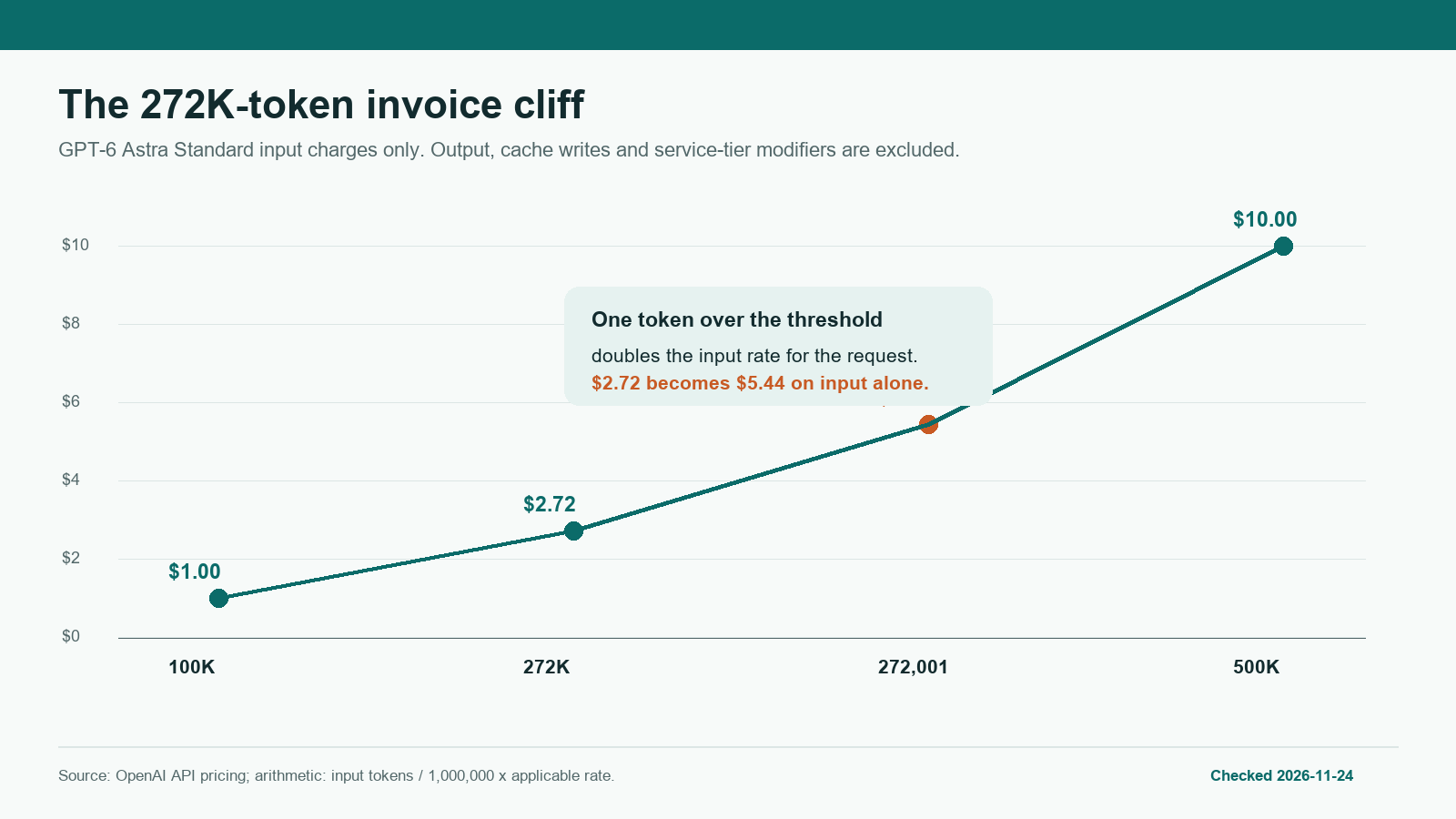
For automation-heavy teams, this row should change the evaluation order. Put Astra in the comparison set even if the rest of the buying discussion centers on Claude. If your tasks resemble the automation workload more than terminal coding, require Opus 5.5 to win in your own tests before it gets the default route. The GPT-6 Astra pricing analysis is relevant here because Astra also has a long-context pricing threshold that can change the economics of large requests.
The OSWorld conflict is not resolved
Anthropic’s Opus 5.5 launch page reports OSWorld 2.1 at 81.8% and labels it partial success. The same page gives Opus 5 a 74.0% comparator on that basis. A separate Fable 5.2 announcement table lists Opus 5.5 at 87.2%, alongside Fable 5.2 at 89.3%.
Those figures should not be placed in one column labeled “OSWorld score” without qualification. They come from different Anthropic pages and use different success definitions or table contexts. The accessed sources do not reconcile the metric, and they do not establish a clean matched comparison. Effort is not stated for these OSWorld rows. The 81.8% and 87.2% values therefore remain separate evidence, not a range and not an average.
For production planning, OSWorld is a reason to ask a vendor or evaluator for the exact success definition before using the number in a business case. It is not a reason to pick whichever figure is larger. A routing decision needs a pass condition that your application can observe, such as a completed transaction, a verified file change or a human-approved result.
Effort is part of the production configuration
Opus 5.5 exposes low, medium, high, xhigh and max. Medium is the official default. The Terminal-Bench result was measured at xhigh, while the Artificial Analysis Intelligence Index score was measured at max. Neither setting should be presented as the model’s single fixed capability.
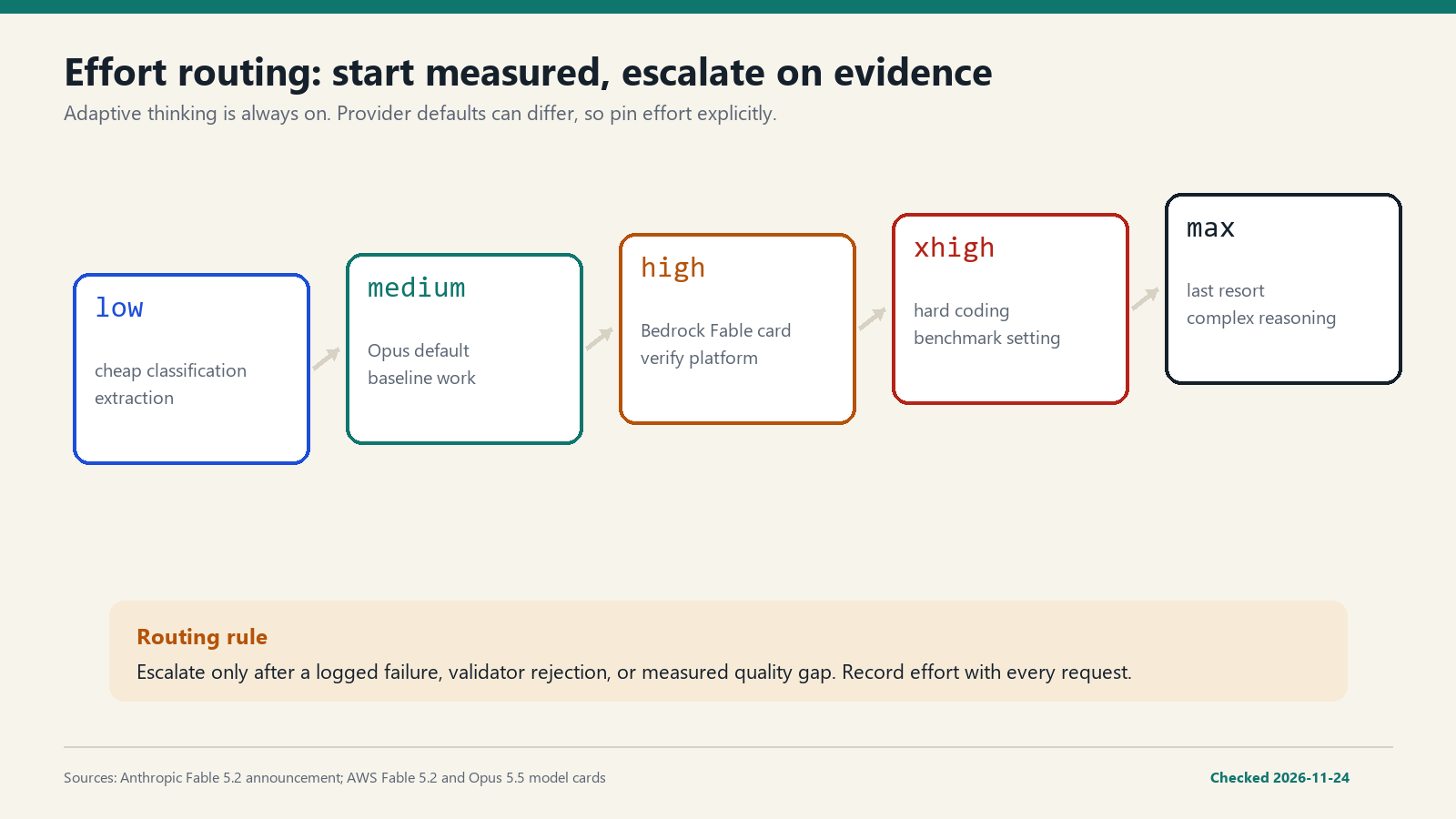
A practical routing policy starts with task difficulty, not with the highest available setting. Use a lower effort for bounded transformations and a higher effort for multi-step work where errors are expensive. Record the chosen setting with each request so quality, latency and cost can be compared later. The reasoning controls documentation explains the integration concepts behind that policy.
The public sources checked for this review do not quantify Opus 5.5 latency or output-token use at each effort level. Do not promise that max is a fixed multiplier over Medium. Instead, measure those values on your own workload. A/B testing should hold the prompt, tools, timeout and success criteria constant while changing only effort.
Also keep the Fable 5.2 default-effort conflict separate. Its launch article says Medium. Its models overview and AWS model card say High. That disagreement is documented in the Fable 5.2 launch breakdown. Opus 5.5’s default is Medium in the accessed official sources.
Where Opus 5.5 fits in production
The strongest production case is not “use Opus for everything.” It is “use Opus where long context and multi-step reasoning justify controlled testing.” Three workload patterns deserve attention.
Terminal and repository agents. The official Terminal-Bench 4.0 result supports evaluating Opus 5.5 for agents that inspect files, run commands and repair code. The fit depends on your tool permissions and stopping rules. A model that performs well in a benchmark harness can still fail when your sandbox blocks a needed command or when your success detector accepts a partial result.
Long-context analysis. The 1,000,000-token context window can reduce the need to truncate large inputs. It does not prove that the model will retrieve the right detail from every position. Build evaluation sets with relevant evidence near the beginning, middle and end of the input. Measure whether the answer cites the correct source and whether the system stays within its latency budget.
Document workflows with reusable prefixes. Stable instructions, schemas and reference material are candidates for explicit caching. Variable user data should sit after the stable prefix. This is an architectural recommendation, not a benchmark claim. Its value has to be confirmed through cache-hit rate and input-side cost in your logs.
For mixed workloads, keep the router simple. Start with a primary model, a narrow fallback policy and a task-specific challenger. Do not route on a composite index alone. The frontier model comparison can help organize candidates, while the November 2026 frontier model overview provides the broader release context. Treat the rankings page as a discovery aid, not an SLA.
Price the API you will actually call
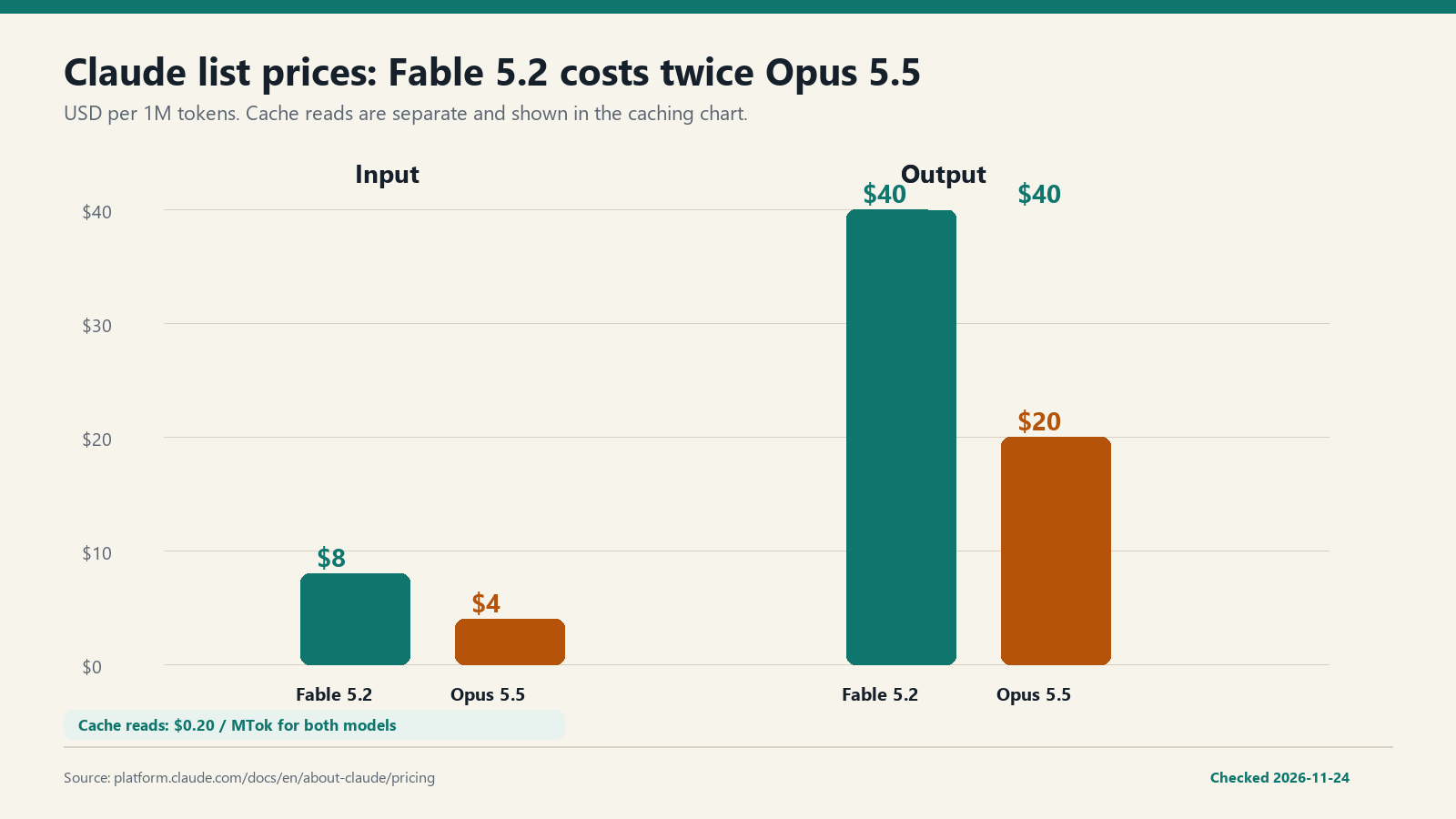
Anthropic’s official pricing page lists Opus 5.5 at $4 per 1,000,000 input tokens and $20 per 1,000,000 output tokens. Those are vendor API list rates. They are not a oneaiapikey.com gateway rate and they are not a conversion of a subscription allowance.
The same page lists a five-minute cache write at $5 per 1,000,000 tokens, a one-hour cache write at $8 and a cache read at $0.20. Batch input and output are $2 and $10. Fast mode is $8 and $40. Fast mode is unavailable with Batch, and fast-mode pricing applies across the full context window.
Applicable regional and multi-region endpoints carry a 10% premium over global endpoints. The scope matters. Do not turn that rule into a claim that every US customer or every Bedrock request pays the premium. The official record also says no separate above-200K surcharge is listed. That is safer than saying the bill can never change, because output, thinking, cache writes and endpoint choice still affect the final charge.
Cache economics are input-side arithmetic. A five-minute cache write costs 1.25 times one uncached input read. Two cache reads plus the write cost 2.5 uncached reads, so the write breaks even after approximately two reads. A one-hour write costs 2 times one uncached read. Three reads plus the write cost 3.6 uncached reads, so that write breaks even after approximately three reads.
Those break-even points assume the prefix is reused and stable. They exclude output cost. A cache that misses because the prefix changed can cost more than the simple model suggests. The Opus 5.5 pricing guide covers the billing rules in more detail. The cost calculator can test an uncached input-and-output scenario, but it does not model cache reads, cache writes or retries. Enter gateway rates separately when they are verified; do not substitute Anthropic list prices for an unknown gateway rate.
Refusals and fallback credits need explicit handling
A successful HTTP status is not enough to prove that a request produced usable output. The accessed routing evidence includes a refusal response that can return HTTP 200 with a body containing stop_reason: "refusal" and a restriction category. Billing depends on the refusal category and whether output started. Your client should inspect the response body and the stop reason before marking a task complete.
Opus 5.5 has a fallback-credit beta identified by the header fallback-credit-2026-07-01. Not every refusal carries a fallback token. The valid fallback models are Opus 5 and Opus 4.8. Opus 5.5 and Fable are not valid fallback models. A retry can bill the cached prefix at cache-read rather than cache-write rates.
This is not a promise of a free retry. Do not route a refused request to another Opus 5.5 ID or to Fable and label it an eligible fallback. The Fable 5.2 production routing guide explains the shared control pattern, including why body-level refusal checks belong in the application rather than only in an HTTP middleware dashboard.
Operationally, log the model, effort, stop reason, restriction category when present, token counts and whether a retry occurred. Keep fallback eligibility in configuration. A header should enable a documented behavior, not silently change the model behind a feature flag that nobody owns.
Bedrock changes the deployment contract
The AWS Bedrock Opus 5.5 model card lists anthropic.claude-opus-5-5, global.anthropic.claude-opus-5-5 and geo IDs for US, EU, AU and JP inference profiles. Bare-ID in-Region inference is available only in eu-west-2 London. Verify the exact profile and Region combination before designing a multi-region failover.
Bedrock supports Standard only for this model. Priority, Flex, Reserved and Batch are unsupported there. On bedrock-runtime, Messages, Converse and Invoke are supported. Responses and Chat Completions are unsupported. Those constraints can invalidate a gateway design that assumes every Anthropic feature exists on every hosting path.
Mantle is a separate path. bedrock-mantle supports Messages in us-east-1, ap-southeast-4 and us-gov-west-1. It lacks Guardrails, Knowledge Bases, Agents, Flows, Prompt Management, Application Inference Profiles and Invocation Logs. It supports Count tokens, while bedrock-runtime does not support Count tokens for this model. Mantle is billed through AWS Marketplace, and charges appear under the model provider rather than Amazon Bedrock in billing and Cost Explorer.
These are material differences, not footnotes. A team that needs Guardrails or Invocation Logs should not move to Mantle without redesigning its controls. A team that needs Batch should not assume the direct API’s Batch pricing carries into Bedrock. The Opus 5.5 Bedrock routing guide provides the profile-by-profile checklist.
When another model deserves the route
Opus 5.5 is not the automatic winner across the current frontier. The right comparator depends on the workload and the evidence boundary.
Fable 5.2 for a higher independent snapshot. Artificial Analysis recorded Fable 5.2 at 65 on Intelligence Index v5.0.1 at Max, versus Opus 5.5 at 59 on the same evaluator version and effort. Keep the Fable reproduction caveat attached. Anthropic also reports Fable ahead of Opus on FrontierCode 2.0, 49.1% versus 45.5%, with Fable at xhigh and Opus effort not fully disclosed. FrontierSWE v2 is another vendor row favoring Fable, 69.9% versus 62.3%, with effort not stated. The Fable 5.2 review explains those claims. Fable also has higher official list rates, $8 input and $40 output per 1,000,000 tokens, covered in the Fable pricing guide.
GPT-6 Astra for automation-led comparisons. Astra wins the official AutomationBench row in this record. Artificial Analysis’ September Astra snapshot is useful for task economics and failure patterns, but its Intelligence Index evaluator version is unstated. Use the GPT-6 Astra review for that dated context and the pricing analysis for the above-272K input tier. Do not blend the September snapshot with later launch commentary.
GPT-6 Sol for a different cost shape. Artificial Analysis lists GPT-6 Sol at 44 on the Intelligence Index at Max in the accessed snippet. The snippet does not state the evaluator version or a matched comparator score, so do not compare it directly with Opus 5.5’s v5.0.1 result. Official list pricing is $2 input and $10 output per 1,000,000 tokens at the standard tier for inputs up to 272K. Sol is not GPT-6.2 Sol, and the accessed sources contain no gateway page for GPT-6 Sol. The GPT-6 Sol versus Opus 5.5 comparison keeps the versions and access boundary separate.
Other frontier candidates for task-specific tests. The Qwen4 Max versus Opus 5.5 analysis and Gemini 4 Neon versus Opus 5.5 analysis cover alternative routing questions. Neither link is permission to declare a universal winner. Compare the same task set, success definition and cost inputs before assigning either model a production share.
The Opus 5.5 alternatives guide is the broader decision page. Its useful question is not which model has the largest headline number. It is which model produces the lowest cost per verified success on the workload you actually operate.
A production evaluation you can defend
Start with a frozen configuration. Record the exact model ID, effort, system prompt, tool schema, timeout, retry policy and evaluator version. If any of those change, label the run as a new experiment.
Next, build a task set from real work. Include routine cases, difficult multi-step cases, long-context cases and known failure cases. Define success before running the model. A response that looks plausible but does not complete the task is a failure, even if the HTTP request succeeded.
Run Opus 5.5 and the closest alternative through the same harness. Record completed tasks, rejected tasks, refusals, output tokens, input tokens, cache hits, wall-clock time and total cost. Inspect failures by category. A higher aggregate score can hide a severe weakness in one important task family.
Then test the controls that will exist in production. Verify tool permissions, output parsing, stop reasons, fallback eligibility and timeout behavior. Exercise a changed conversation prefix if your client replays prior turns. Use the tool calling documentation to align the harness with the integration path you plan to deploy.
Finally, set a routing gate. Opus 5.5 can be the default only for task classes where it meets the success threshold at an acceptable cost and latency. Keep the challenger route for the classes where it does not. Re-run the evaluation when the model snapshot, effort policy or prompt template changes.
This process will not reproduce every public benchmark. It will produce evidence that is more relevant to your service. That is the point.
What the public data does not show
The accessed evidence does not include an independent reproduction of Anthropic’s Terminal-Bench 4.0, FrontierCode v1.1 Main, GDPval-AA v2.1 or AutomationBench rows. It also does not provide Opus 5.5 task cost, output-token use, latency or sub-scores from Artificial Analysis. Those gaps prevent a complete cost-per-success comparison.
OSWorld remains unresolved because the 81.8% partial-success figure and the 87.2% table figure do not share a documented success definition in the accessed sources. The FrontierCode and GDPval claims lack stated effort or comparator detail in the sources checked for this review. Those are evidence gaps, not invitations to fill in likely values.
Gateway pricing is also absent. The verified access claim is that /models/claude-opus-5-5 exists and the model is listed as of 2026-11-24. No gateway rate was found in the accessed sources. This review should be updated when independent harness results, a reconciled OSWorld definition or a verified gateway rate becomes available.
How to use this without overbuying
For terminal-agent work, begin with Opus 5.5 at the effort level your evaluation supports. The official xhigh result is a reason to test it, not a reason to run every request at xhigh. For long-context work, measure retrieval quality and cache reuse before assuming the larger window saves money.
For automation-heavy work, keep GPT-6 Astra in the first comparison because it wins the official AutomationBench row. For teams prioritizing the independent composite snapshot, test Fable 5.2 alongside Opus 5.5 and preserve the Fable score’s reproduction caveat. For AWS deployments, choose the hosting path before promising features or prices.
You can inspect the Claude Opus 5.5 model page, confirm live availability, compare candidates with the side-by-side model comparison, and estimate an uncached input-and-output scenario with the cost calculator. Use verified gateway rates for gateway planning. Until your own tasks show a verified advantage, keep Opus 5.5 as a measured candidate rather than the default for every request.
More Opus 5.5 coverage
- Official rates, cache charges and endpoint rules
- Stable prefixes and cache break-even decisions
- Bedrock profiles, Mantle limits and API support
- Task-specific alternatives without a universal winner
- GPT-6 Sol versus Claude Opus 5.5
- GPT-6 Astra’s dated independent benchmark snapshot
- GPT-6 Astra’s long-context pricing threshold
- Fable 5.2 launch facts and access boundaries
- Fable 5.2 benchmark evidence and caveats
- Fable 5.2 list pricing and cache charges
- Refusal inspection and eligible fallback routing