Google launched Gemini 4 Neon on November 18, 2026, in Google’s launch post for Gemini 4 Neon, titled Introducing Gemini 4 Neon and written by Koray Kavukcuoglu. Claude Opus 5.5 has been Anthropic’s Opus tier on our gateway since September. This post is the head to head: Neon’s index lead against Opus 5.5’s cheaper Anthropic-flagship list price and our discounted rate, with the effort caveats named wherever they matter.
Every number below is sourced and date-stamped to the check on November 18 and 19, 2026. Scores come from the Artificial Analysis leaderboard and the Artificial Analysis page for Gemini 4 Neon. Launch detail and Google benchmark claims come from 9to5Google’s launch report, and the Opus benchmark rows come from Anthropic’s Fable 5.2 and Mythos 5.2 announcement. Google claims are cited as Google claims, Anthropic’s table as Anthropic’s table, and nothing here is our measurement.
Our Gemini 4 Neon launch explainer covers the picker changes, and our benchmark teardown explains each suite Neon shipped. This post adds the Opus 5.5 comparison.
The verdict up front
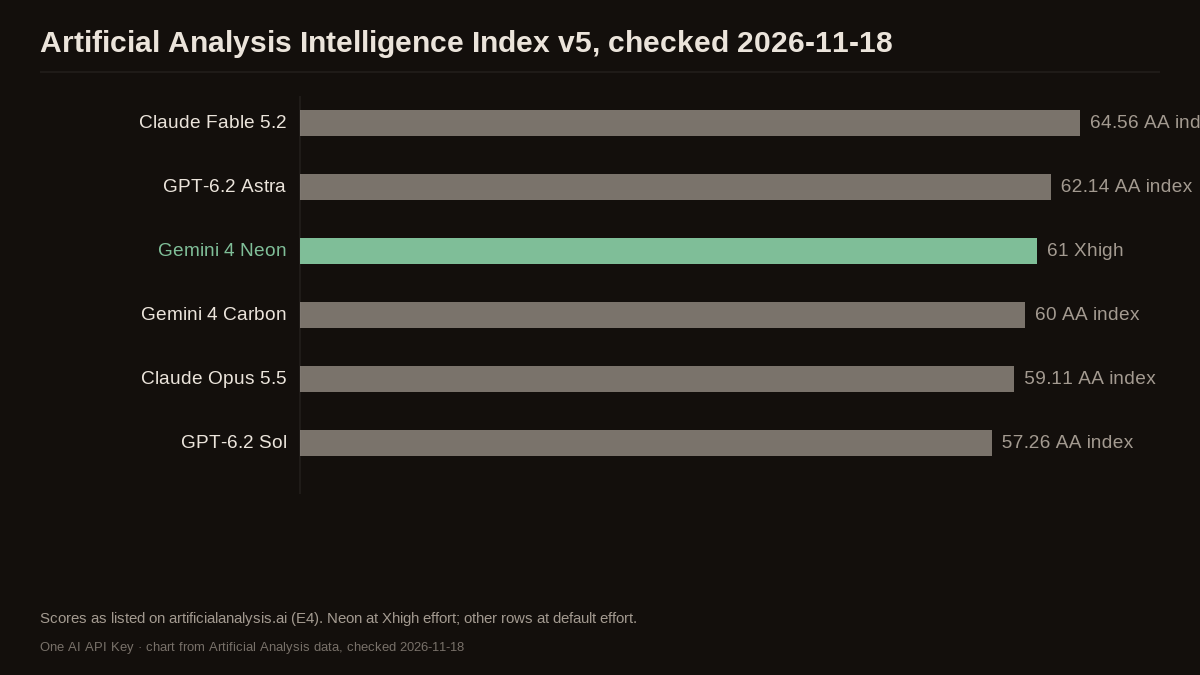
Neon leads the composite. Artificial Analysis lists Gemini 4 Neon at 61 on the Intelligence Index v5 at Xhigh effort, against Claude Opus 5.5 at 59.11. Neon sits at #6 of 96 models on that board. Google claims third overall, as reported by 9to5Google, and that is conflict C1 in our facts ledger: Artificial Analysis shows #6 of 96, Google says third, and we print both without adjusting either. The gap over Opus is 1.89 index points, about the size of one strong benchmark row, not a different class of model. The board grows between checks, so the caption’s 120-model list and the ledger’s 96 are the same board at different moments.
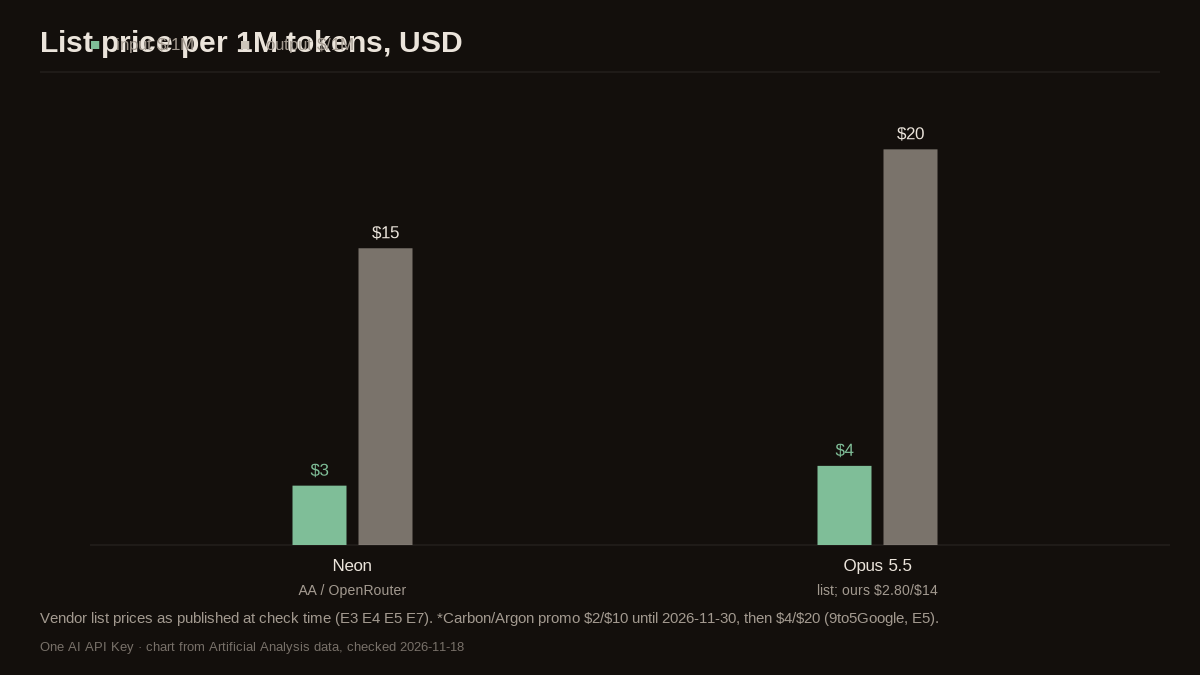
Opus 5.5 wins the bill if you buy it here. Anthropic lists it at $4 per million input and $20 per million output, with cached input at $0.20 per million. Our catalogue entry for Claude Opus 5.5 runs it at $2.80 in and $14.00 out with the same $0.20 cached rate, which is 30 percent below Anthropic list on both lines and below Neon’s $3/$15 list on both lines. Gemini 4 Neon is not listed on our gateway at check time. The Gemini model we serve is Gemini 4 Argon.
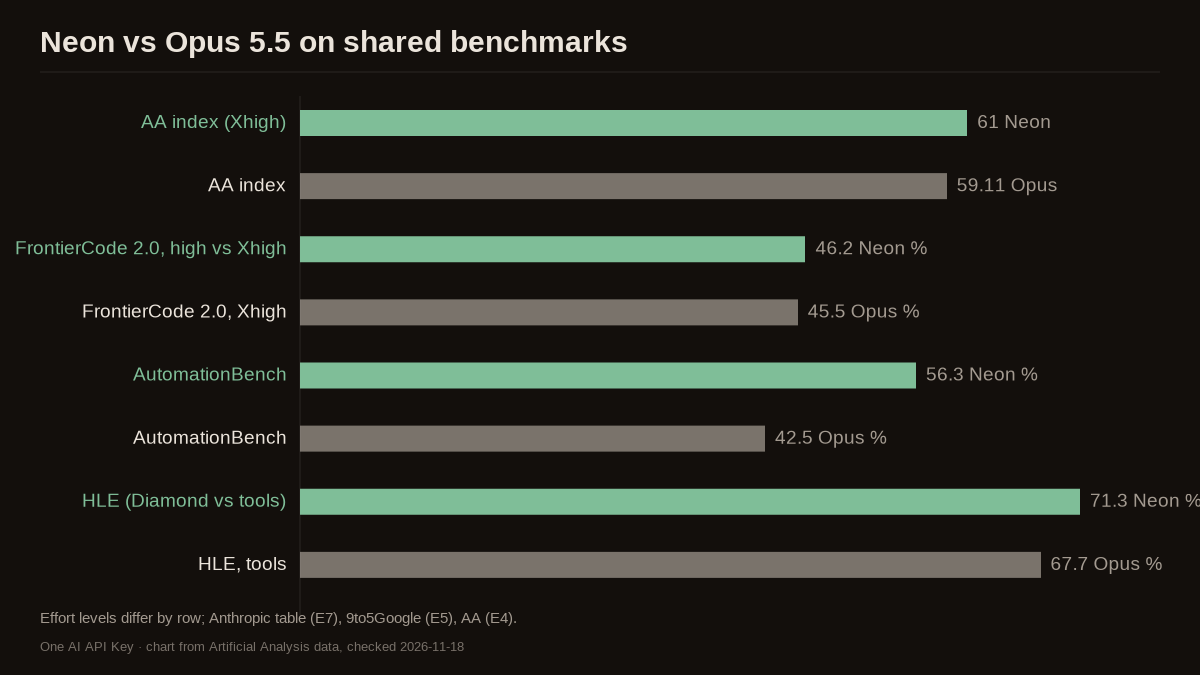
The coding rows are close and confounded. FrontierCode 2.0 has Neon at 46.2 percent at high effort against Opus 5.5 at 45.5 percent at Xhigh, and AutomationBench has Neon at 56.3 percent against Opus at 42.5 percent, both with effort levels that differ.
What the two models are
9to5Google reports that Google positions Neon for complex coding, analytical reasoning and production-grade enterprise workflows, replaces Argon in the picker, removes Gemini 3.1 Pro and renames Flash-Lite to Auto, leaving picker options Auto, Hydrogen, Neon and Carbon, with four thinking levels, on AI Pro and AI Ultra plans only.
The Opus rows come from Anthropic’s launch table, published with Fable 5.2 as the headline and Opus 5.5 as the reference. Fable 5.2 leads Opus on several rows: FrontierCode 2.0 49.1 at Xhigh against 45.5, AutomationBench 51.4 against 42.5, Terminal-Bench-Science 0.1 74.6 against 58.7, HLE with tools 74.2 against 67.7, and Chartography no-tools 73.4 against 64.4. This post stays on Neon against Opus.
Opus 5.5 from our catalogue takes text and image input, carries a 1 million token context window, and allows 128,000 output tokens, with tools, vision, reasoning, structured output, streaming and caching. The Claude 5.5 family guide covers how Opus, Sonnet and Haiku split the work, and our best frontier models for November 2026 puts both models on the same board.
One naming trap. neon.com documents a Neon AI Gateway serving Databricks-hosted gemini-4-argon at $4/$20 since October 2026, a different product from Google’s Gemini 4 Neon. This post is about the Google model. Conflict C6.
| Spec | Gemini 4 Neon | Claude Opus 5.5 |
|---|---|---|
| Vendor | Anthropic | |
| AA Intelligence Index v5 | 61 at Xhigh | 59.11 |
| Effort tiers | Xhigh, High, Medium, Low | Xhigh on the quoted rows; full list not in our ledger |
| List price in / out per 1M | $3 / $15 | $4 / $20 |
| Our gateway rate in / out per 1M | not listed here | $2.80 / $14.00 |
| Cached input per 1M | not published at check | $0.20 list and $0.20 here |
| Published speed | about 110 tokens/sec | not published at check |
| Context window | 1M tokens | 1M tokens |
| Max output | not in our ledger | 128,000 tokens |
| Input modalities | not in our ledger | text and image |
| On One AI API Key | no, see Argon | yes, plus the free-lane twin |
Benchmarks: the AA index, 61 against 59.11
Artificial Analysis lists Neon at 61 at Xhigh effort and Opus 5.5 at 59.11. Neon’s effort ladder is steep: 61 at Xhigh, 60 at High, 55 at Medium and 44 at Low. Low effort is not the same model, because 17 index points separate the top and bottom rungs. The Opus figure is a single AA composite, and AA did not publish an effort ladder for it in our ledger, so the 61 against 59.11 comparison is Xhigh against AA’s Opus row. Our rankings page tracks that board as it moves.
Pricing: Neon at $3/$15 against Opus list and our rate
Artificial Analysis lists Neon at $3 per million input tokens and $15 per million output. OpenRouter now lists four pricing rows for google/gemini-4-neon, including $3 in and $15 out, while 9to5Google reported at launch that Neon was not yet available on OpenRouter. That is conflict C2, a timing gap: we date-stamp both and treat the OpenRouter rows as current.
Anthropic lists Opus 5.5 at $4 in and $20 out, with cached input at $0.20 per million, and our catalogue carries the same cached rate at $2.80 in and $14 out. On list prices Neon is 25 percent below Opus on both lines. On our gateway Opus is 30 percent below Anthropic list, and it undercuts Neon’s list by $0.20 on input and $1.00 on output per million, about 7 percent on each line.
Token math you can check. At 100,000 input and 50,000 output tokens, Neon bills $0.30 plus $7.50, which is $7.80. The same mix on Opus list bills $0.40 plus $10.00, which is $10.40, and on our gateway $0.28 plus $7.00, which is $7.28. If every input token is a cache hit at $0.20 per million, Opus list bills $0.02 plus $10.00, which is $10.02, and our gateway bills $0.02 plus $7.00, which is $7.02. Every figure above is arithmetic on the published rates, not a vendor claim.
The cost calculator runs the same arithmetic on your own token counts, our Gemini 4 Neon pricing post covers Neon’s cache and promo context, and our monthly cost estimate guide applies the method to a full month. Our API pricing page explains gateway billing, and the free lane is where the arithmetic starts at zero.
Cost per coding task: what we can and cannot compute
The only published cost-per-coding-task number here is Neon’s $6.44 at Xhigh, from Artificial Analysis, with the 21.5 minute runtime, the 283 million output tokens, the 95 percent cache hit and the $2.21 blended rate attached. Opus 5.5 has no published cost-per-task figure in our verified ledger, and any vendor or blog quoting one today is extrapolating, so we print none.
What we can do is bound it with the same mix. An Opus 5.5 task shaped like AA’s Neon run, 100,000 input and 50,000 output tokens, bills $7.28 on our gateway and $10.40 at Anthropic list before cache effects. If 95,000 input tokens are cache hits at $0.20 per million, the cache rate AA measured on the Neon run, input bills $0.033 here and $0.039 at list, so the task totals about $7.03 here and $10.04 at list. That is our arithmetic on an AA-measured assumption, not an Anthropic number.
The honest read: Neon’s published $6.44 sits about 8 percent below our cached Opus estimate of $7.03 and about 12 percent below the uncached bound of $7.28. The runs differ in workload, effort tier and cache behaviour, so treat the gap as a reason to run your own eval, not a verdict.
Agentic coding rows: FrontierCode, AutomationBench, Chartography, HLE
FrontierCode 2.0 is the coding row that matters most, and it is not level. Google-published numbers reported by 9to5Google put Neon at 46.2 percent at high effort. Anthropic’s launch table puts Opus 5.5 at 45.5 percent at Xhigh. The efforts differ, high against Xhigh, so this is a near tie with a confound, not a Neon win, and we will not rank on it alone.
AutomationBench is the mirror image, and it carries conflict C5. Google-published numbers via 9to5Google give Neon 56.3 percent, and Anthropic’s table gives Opus 5.5 42.5 percent, with Fable 5.2 at 51.4, Fable 5.1 at 31.4, GPT-6 Astra at 41.4 and Gemini 4 Carbon at 53.9. The effort levels behind the two headline numbers differ, so the 13.8-point gap is direction, not verdict.
Chartography is the clean row. Neon scores 73.5 and Opus 5.5 scores 64.4 on the no-tools variant per the same sources, a 9.1-point gap on the same instrument and the widest clean margin in this comparison.
HLE reads 71.3 for Neon on HLE-Diamond against 67.7 for Opus on HLE with tools. Different variants, so we do not rank on it.
Other published rows, with attribution. Google-published via 9to5Google: AA Coding Agent Index 58.6 and #1, Terminal-Bench 4.1 at 65.2 percent, Terminal-Bench Science 70.5, Agents’ Last Exam v1.1 75.8, Agent Arena steerability #2, Vending-Bench 2 $16,843. Anthropic’s table for Opus 5.5: FrontierSWE v2 62.3, Terminal-Bench-Science 0.1 58.7, HLE tools 67.7, Chartography no-tools 64.4.
The guide to choosing a model for coding agents walks the same trade-offs on our blog.
Effort tiers, speed and the honest gaps
What is published on both sides is the effort question. Neon offers four thinking levels, Xhigh, High, Medium and Low, with AA index scores of 61, 60, 55 and 44. Anthropic’s table uses Xhigh for the Opus rows quoted here. The tier you pick changes both score and bill, and Neon’s top and bottom rungs differ by 17 index points.
On speed, Artificial Analysis lists Neon at about 110 tokens per second with a 1 million token context window. Opus 5.5 speed was not published at check time, so there is no honest tokens-per-second comparison, and we will not fake one.
The honest gaps matter. Opus 5.5 speed, cost per task and effort ladder, Neon’s cached-input price, and Neon’s max output were not in our verified ledger at check time, so those cells stay empty in the table. Neon carries C1 on rank wording and C2 on OpenRouter timing, and the AutomationBench pair carries C5.
FAQ
Is Gemini 4 Neon better than Claude Opus 5.5?
On the AA composite, Neon leads 61 at Xhigh to 59.11, per Artificial Analysis. Coding rows split by effort tier, and on price Neon list is $3/$15 against Opus list $4/$20, while our gateway runs Opus at $2.80/$14.
Which model is cheaper per million tokens?
At list, Neon, on both lines. On our gateway, Opus 5.5 at $2.80 in and $14.00 out is below Neon’s list on both lines, and cached input bills $0.20 per million either way.
Is the FrontierCode 46.2 against 45.5 a Neon win?
No. Neon ran at high effort and Opus at Xhigh, per the Google and Anthropic tables. Direction only, as with AutomationBench under conflict C5.
Is either model on the One AI API Key gateway?
Opus 5.5 is live here, metered, below list, and its free-lane twin sits on the free lane. Gemini 4 Neon is not listed; the Gemini model we serve is Argon. See the model catalog.
Where to try it
Opus 5.5 is live here at $2.80 in and $14.00 out, and its free-lane twin runs on the free lane at the same discounted rate until the allowance is hit. The free lane carries 100 requests and 5,000,000 tokens daily, refilling at 05:30 IST, and new accounts get a $10 trial credit.
Open the in-site chat to put Opus 5.5 against your current model on your own prompts, line the two up in the comparison tool, then follow the quickstart and config generator to wire an agent. When ready, sign up in the console and take the daily free lane from the first request.