Gemini 4 Neon launched on 2026-11-18, and the first question is usually what a call costs. The headline answer, from the Artificial Analysis page for Gemini 4 Neon, is $3 per million input tokens and $15 per million output tokens. That rate card is one line long. The bill is not, because effort level, cache behaviour and output volume move the final number further than the list price does. This post is the pricing post: the rate card, the OpenRouter conflict, the cost-per-task anatomy, worked token math with assumptions labeled, promo context, and monthly estimates. Our launch explainer for Gemini 4 Neon covers the announcement, and the benchmarks teardown covers the scores. This one is only about money.
Gemini 4 Neon price per token: the rate card
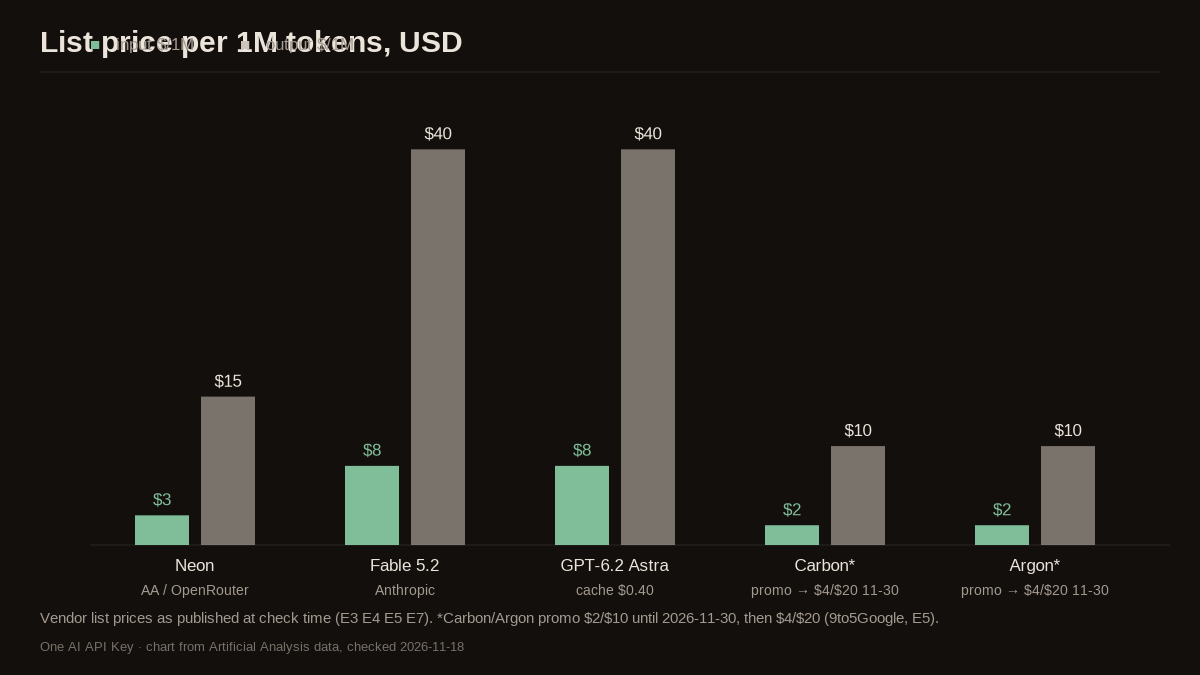
Artificial Analysis lists Gemini 4 Neon at $3 per million input tokens and $15 per million output, with a 1 million-token context window and a measured speed near 110 tokens per second. The Gemini 4 Neon on OpenRouter page shows the same $3 and $15 as one row among four pricing rows for google/gemini-4-neon. Agreement between two independent price surfaces is the most a buyer can confirm on launch day, and it is still a list rate, not a bill.
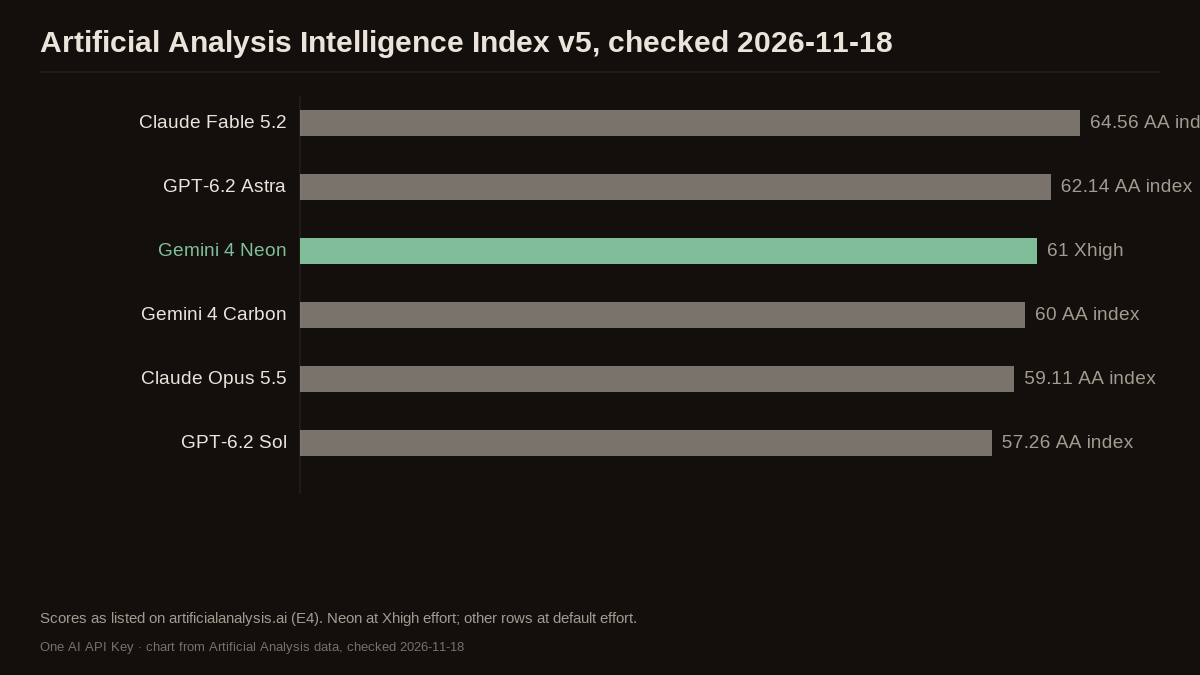
What neither surface publishes at check time is a separate cached-input rate for Neon. That gap matters, because agent loops resend the same system prompt, tool schemas and history on every turn, and cached input usually changes the bill. Every cached calculation in this post is therefore labeled as an assumption. For scale, the Artificial Analysis leaderboard places Neon at 61 on its Intelligence Index at Xhigh effort, sixth of 96 models, while 9to5Google reported that Google claims third overall. Both wordings are cited in our benchmarks post, with the rank conflict flagged there. On the Gemini 4 family ladder, Neon sits above Carbon at 60, Hydrogen at 54 and Argon at 50.
The OpenRouter listing conflict, date-stamped
The one genuine conflict in the pricing picture is availability, not price. 9to5Google’s launch report, dated 2026-11-18, said Gemini 4 Neon was “not yet on OpenRouter” at launch. The OpenRouter model page, checked on 2026-11-19, lists google/gemini-4-neon with its four pricing rows, including the $3 input and $15 output pair. Read as timing, both statements are true: the report described launch day, and the aggregator listing appeared after it. The ledger records no values for the other three OpenRouter rows, so budget from the $3 / $15 pair and re-check the page at purchase time.
Promo pricing: Argon and Carbon at $2 / $10 until 2026-11-30
Around the Neon rate card there is a family promotion. The 9to5 report says Gemini 4 Argon and Gemini 4 Carbon are listed at $2 in and $10 out per million until 2026-11-30, after which they move to $4 in and $20 out. Two pieces of arithmetic follow, both labeled as arithmetic on those reported rates. During the promo window, Carbon undercuts Neon on both legs, $2 against $3 on input and $10 against $15 on output. After 2026-11-30, the step to $4 / $20 puts Carbon above Neon on both legs. A workload that can run on Carbon has a cheap month and an expensive one. The same report places Neon in the picker ahead of Argon, with 3.1 Pro removed and Flash-Lite renamed Auto, and says Neon ships on AI Pro and AI Ultra plans with four thinking levels, so availability is plan-gated at Google’s own storefront.
On our side, the family member we serve is Argon, on our Gemini 4 Argon model page. Gemini 4 Neon is not listed on this gateway, and nothing here should be read as a claim that it is.
Cost per task: the $6.44 anatomy
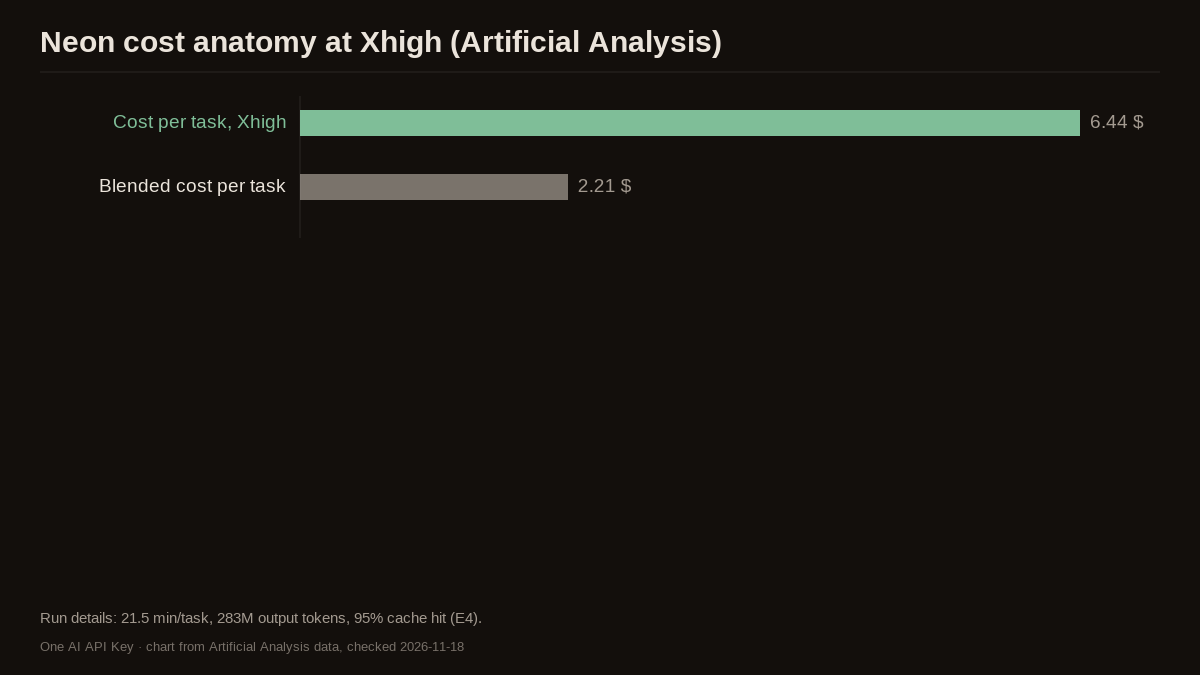
Artificial Analysis publishes a measured cost per task for Neon at Xhigh effort: $6.44. Four more numbers sit around it, all from the same Artificial Analysis page for Gemini 4 Neon: a blended $2.21 per task, a 95% cache hit rate, 283 million output tokens across the run, and 21.5 minutes per task. The anatomy reads like this. The $6.44 is the bill for a standard task at Xhigh, run with real cache behaviour. The $2.21 blended figure is lower because 95% of input cache hits, so most input tokens never bill at the fresh $3 rate. The 283 million output tokens and the 21.5 minutes describe the workload shape behind both numbers: output volume and wall time, not the input list rate, dominate an agent bill. Wall time is a cost even when it never appears on an invoice.
Keep the scope honest. The $6.44 is an Artificial Analysis measurement at Xhigh, not a Google quote, and the ledger holds no per-task figures at High, Medium or Low effort. Do not scale it linearly; savings at lower effort are unconfirmed.
Cache hits: what 95% does to the bill
The mechanism, briefly. A cache hit means a repeated input prefix is served without being processed as fresh input, which is why agent loops with stable system prompts benefit most. Our tokens, context windows and caching glossary covers the mechanic; here only the price consequence matters. Artificial Analysis measured a 95% cache hit rate on its Neon run. Because no cached-input rate for Neon is published, every cached total below assumes cache-hit input bills at $0, which makes those totals floors, not forecasts. Any published cached rate would add its rate times the cached volume.
Worked token math, assumptions labeled
Three examples, all arithmetic on the $3 / $15 list, all assumptions stated.
Example one. One call with 100,000 input tokens and 500,000 output tokens, no caching. Input is 0.1 million times $3, which is $0.30. Output is 0.5 million times $15, which is $7.50. The call costs $7.80.
Example two, a smaller shape: 100,000 input and 50,000 output, no caching. Input is $0.30, output is $0.75, total $1.05. Output here is a twentieth of the input volume, yet it more than doubles the bill, which is the $15 output leg at work.
Example three, the cache case. A 1 million-token prompt with a 95% cache hit leaves 50,000 fresh input tokens, which is $0.15, plus 500,000 output tokens, which is $7.50, for $7.65 per task. That total assumes cached tokens are free, because no cached rate is published, and it assumes the prompt exactly fills the 1 million context window. Compare the shape with the measured $6.44 at Xhigh. The measured run hit cache 95% of the time, which is why a blended $2.21 exists next to the $6.44; your workload’s cache rate, not this example’s, decides where between those two numbers you land.
Monthly cost at 20 tasks a day
A monthly estimate needs a workload, so state one. Assume 20 tasks a day, 30 days, each task shaped like the Artificial Analysis run at Xhigh. At the measured $6.44 per task, the month is 20 times $6.44 times 30, which is $3,864. At the blended $2.21 per task, the same month is 20 times $2.21 times 30, which is $1,326. The spread is the cache’s effect, and it is why the cache-hit rate, not the list rate, is the number to meter. Ten tasks a day halves both figures to $1,932 and $663, and fifty tasks a day raises them to $9,660 and $3,315, all arithmetic on the same assumptions.
Two cautions. The estimate assumes the Artificial Analysis task matches yours and that list prices hold for 30 days; neither is guaranteed. And the Argon and Carbon promo expires on 2026-11-30, per the 9to5 report, so family prices can move inside your billing month. The cost calculator and our guide to estimating monthly LLM API cost run this math on your own volumes, and the usage log in the console is where the metered numbers land.
Per-task math against Fable 5.2 and GPT-6.2 Astra
Same workload, three rate cards, all list rates, all labeled arithmetic. Workload: 100,000 input, 500,000 output, no cache. Neon is $0.30 plus $7.50, $7.80. Fable 5.2, at the $8 in and $40 out per million listed in Anthropic’s Fable 5.2 and Mythos 5.2 announcement, is $0.80 plus $20.00, $20.80; Anthropic’s fast mode at $16 / $80 makes the same call $1.60 plus $40.00, $41.60. GPT-6.2 Astra, at the $8 / $40 with $0.40 cached input listed in our GPT-6.2 cost-per-task post, is also $20.80 uncached, and $20.04 if every input token hits cache at $0.40, per the rates on our GPT-6.2 Astra model page.
On output-heavy work the output leg is the whole story. Neon’s $15 per million output is 2.67 times lower than the $40 both rivals list, arithmetic on list rates. Quality context, one line each, from the same Artificial Analysis pages: Neon scores 61 at Xhigh, Astra 62.14, Fable 5.2 64.56, with Anthropic quoting 65 and benchlm 64.6, a rounding difference flagged in our Neon vs Fable 5.2 comparison and our Neon vs GPT-6.2 Astra comparison. The price gap above is the price of roughly 1 to 3.5 index points, which is a trade-off, not a verdict. The Astra benchmarks post details the Astra row.
Kimi K3 earns one line because it shares the headline pair. Our catalogue’s Kimi K3 model page lists $3 in and $15 out, the same list rates as Neon, so the input leg cannot separate them. Output behaviour, speed and scores have to do that work.
Gemini 4 Neon API pricing: checks before you budget
Four checks before anyone budgets. First, effort. Google ships four thinking levels, per the 9to5 report, and the Artificial Analysis index moves with effort: 61 at Xhigh, 60 at High, 55 at Medium, 44 at Low. Lower effort should cost less, but no per-task figures at lower efforts are published in our ledger, so budget at Xhigh and treat savings as unconfirmed. Second, the model id. On OpenRouter the id is google/gemini-4-neon; ids decide billing, so confirm the exact string before purchasing. Third, the window. One million context tokens makes the big-prompt example above possible, and big prompts make caching the whole budget question. Fourth, the name. neon.com runs a Neon AI Gateway whose docs list a Databricks-hosted gemini-4-argon at $4 / $20 with a 1 million context since October 2026, on a /gemini/v1beta path with a Bearer key. That is a different product from Google’s Gemini 4 Neon, and its $4 / $20 is not Neon’s price.
Our position, stated plainly. One AI API Key does not list Gemini 4 Neon. The metered Gemini route here is Argon, and the free lane, 100 requests and 5,000,000 tokens daily with a 05:30 IST refill, is the $0 way to test other frontier models before committing budget to anyone’s list rate. New accounts carry a $10 trial credit. The rate table and the free models page show what the lane serves. The same labeled-arithmetic method, applied to another vendor’s tiers, is in our Qwen4-Max API pricing post, and our guide to choosing a model for coding agents covers the workload-fit side of the same decision.
Where to try it
Gemini 4 Neon is purchasable where Google and its aggregators list it, not here, and no line in this post should be read as saying otherwise. To put its $3 / $15 rate card next to models you can call today, open the chat playground, run the same prompt across a few models, then create an account in the console for the free lane and the $10 trial credit. Meter a week of real traffic before budgeting on anyone’s list price, including this one.