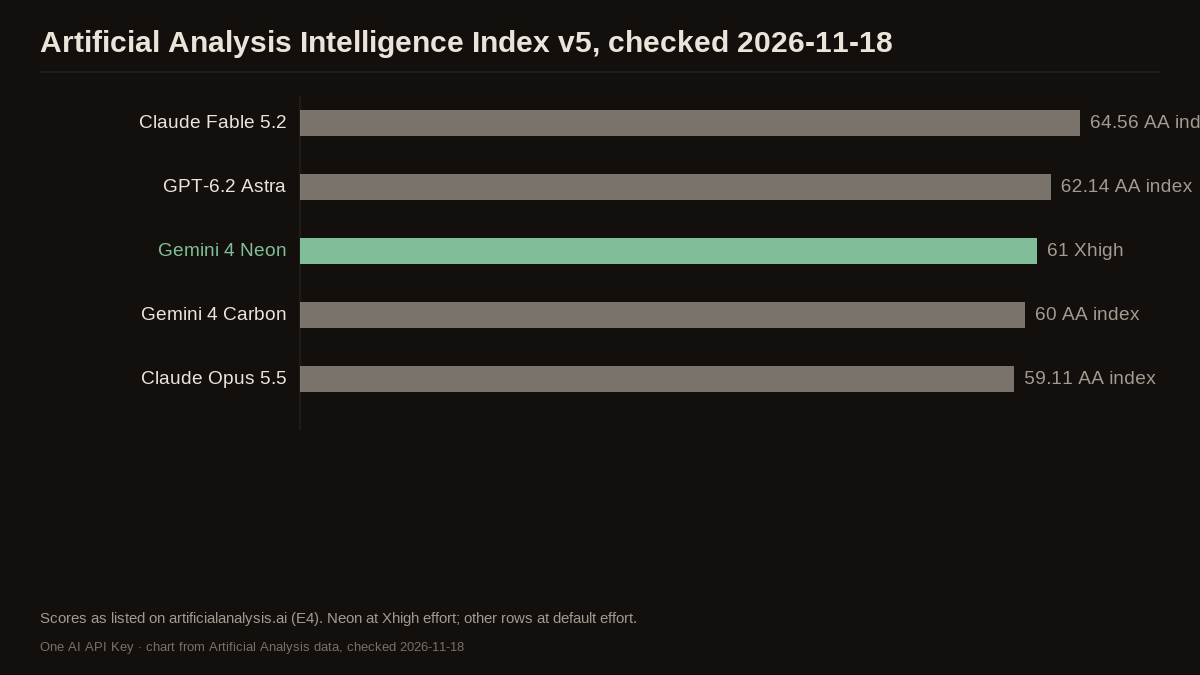
Google launched Gemini 4 Neon on November 18, 2026, and Artificial Analysis lists it at 61 on the Intelligence Index v5 at Xhigh effort, one point above Gemini 4 Carbon at 60. That single point is the whole upgrade question, and the price side of it changes on 2026-11-30, the day Carbon’s promotional rate ends. This post walks the upgrade math, the shared benchmarks with their flags, the published prices and the cost per task arithmetic, using only numbers we can attribute to Google, to 9to5Google or to Artificial Analysis, and every number is date-stamped to the 2026-11-18 and 2026-11-19 check window. For the launch context itself, see Google’s launch post for Gemini 4 Neon and our Gemini 4 Neon launch explainer.
The upgrade math: one index point for one dollar
Start with the ladder, because one point only means something against the family. Artificial Analysis lists the Gemini 4 family at 61 for Neon, 60 for Carbon, 54 for Hydrogen and 50 for Argon on the Intelligence Index, with Flash-Lite at 12 and the Gemma entries below that. Our Gemini 4 family ladder post maps those scores to the picker options, and the short version is that Neon is the flagship step while Carbon is the value step.
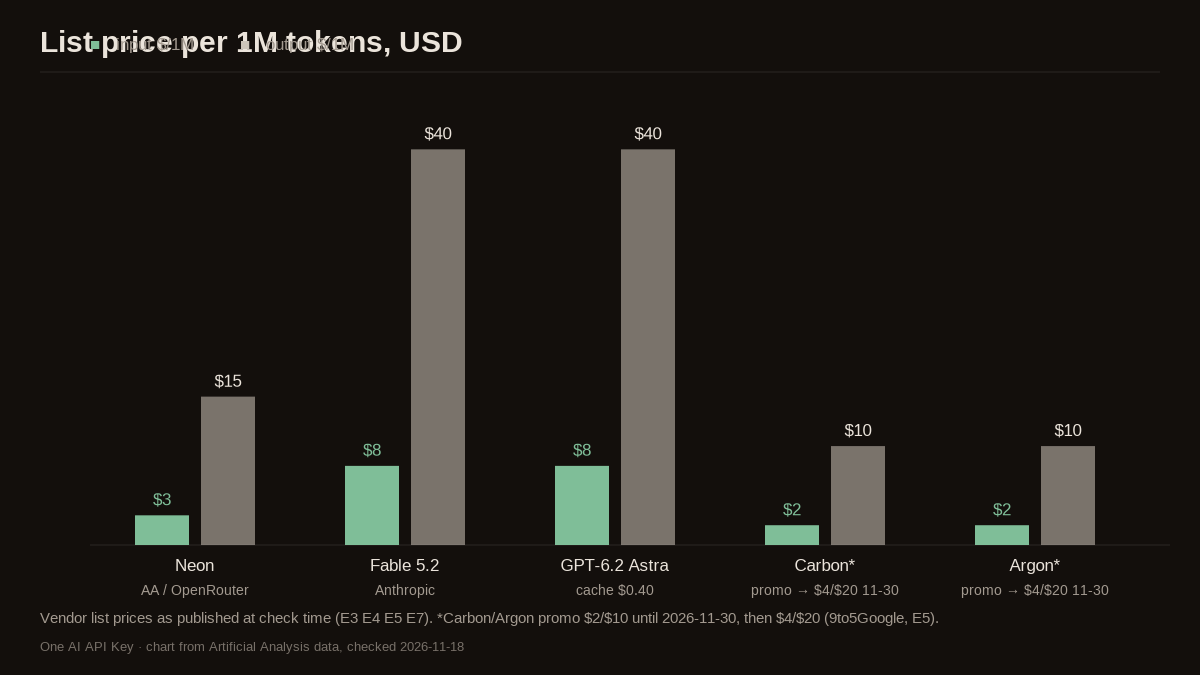
On price, the Artificial Analysis page for Gemini 4 Neon lists Neon at $3 per million input tokens and $15 per million output tokens. OpenRouter also lists the model with four pricing rows, which is a timing flag rather than a conflict: 9to5Google reported at launch that Neon was not yet available on OpenRouter, and the OpenRouter page carries a later date. We date-stamp both sides and use the Artificial Analysis rates as the reference.
Gemini 4 Carbon is promotional at $2 in and $10 out until 2026-11-30, after which it moves to $4 in and $20 out, per 9to5Google’s launch report. Before that date, stepping up from Carbon to Neon costs $1 more per million input and $5 more per million output for the one index point. After that date, Carbon’s own rate doubles, the $2/$10 floor disappears, and the upgrade gets more expensive in the only sense a buyer feels it: every route into the premium tier of the family costs more than it did the week before. At the same time, on list price alone Neon at $3/$15 becomes cheaper than Carbon at $4/$20, so the upgrade question flips from premium to discount on that calendar date.
One worked row makes it concrete. For 100,000 input tokens and 50,000 output tokens, our arithmetic from those list prices gives Neon $0.30 plus $7.50, which is $7.80. Carbon at the promotional rate is $0.20 plus $5.00, which is $5.20. Carbon after 2026-11-30 is $0.40 plus $10.00, which is $10.40. The same request costs about half as much on promotional Carbon as on Neon today, and about a third more on post-promo Carbon than on Neon once the window closes.
There is also an effort lever inside the Neon price. Artificial Analysis shows Neon at 61 at Xhigh, 60 at High, 55 at Medium and 44 at Low, and Carbon’s index is 60. Read literally, Neon at High effort meets Carbon’s index line while keeping Neon’s list rate, which is the best-case version of the upgrade math on paper, and its weak point too, because an index line is not your task.
One more caution on the ladder. The family scores are AA’s index at stated efforts, and Google’s launch claims use its own effort mix, so treat the 61 versus 60 as the AA framing of the gap rather than a universal constant. Neon’s $3/$15 also carries no expiry date in our ledger, while Carbon’s $2/$10 carries the 2026-11-30 expiry, and an upgrade priced against a rate with an expiry date is a moving target. That is the whole reason this post exists.
Benchmarks Neon and Carbon actually share
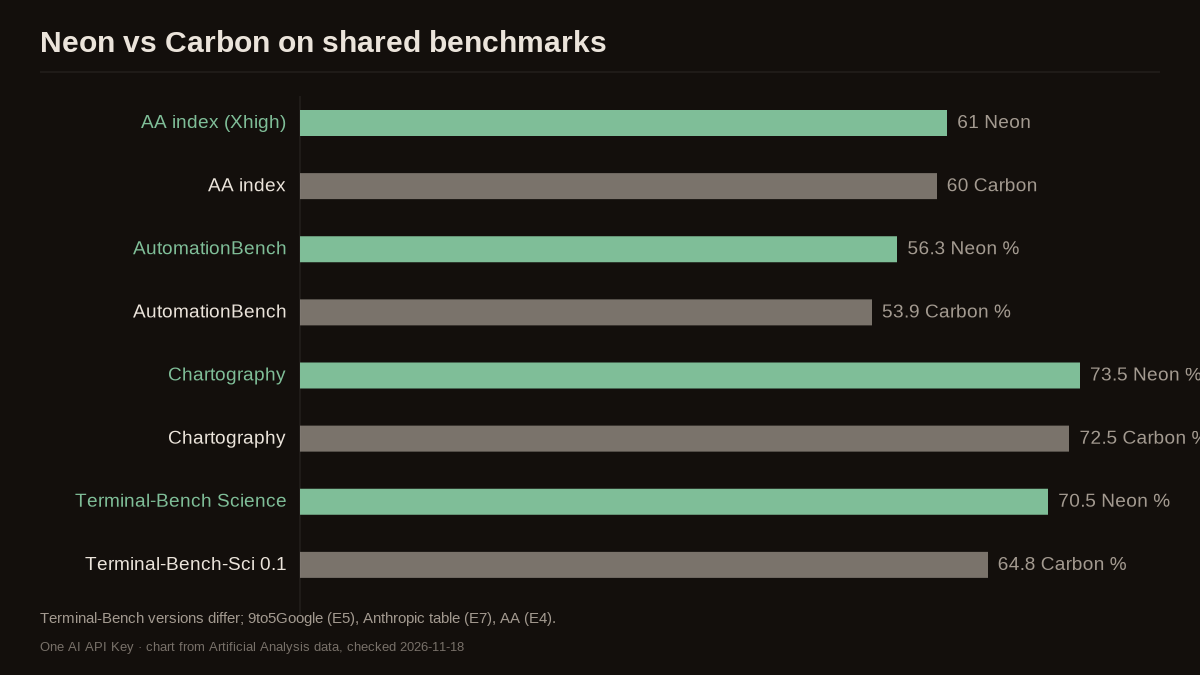
The clean comparison uses the rows where both models have published numbers. 9to5Google, citing Google’s launch material, puts Neon at 56.3% on AutomationBench, 73.5% on Chartography and 70.5% on Terminal-Bench Science. The Anthropic launch table, which also carries Carbon rows, lists Carbon at 53.9% on AutomationBench, 72.5% on Chartography and 64.8% on Terminal-Bench-Science 0.1.
| Benchmark | Gemini 4 Neon | Gemini 4 Carbon | Source and flag |
|---|---|---|---|
| AutomationBench | 56.3% | 53.9% | 9to5Google for Neon, Anthropic table for Carbon |
| Chartography | 73.5% | 72.5% | 9to5Google for Neon, Anthropic table for Carbon |
| Terminal-Bench Science | 70.5% | 64.8% | Version mismatch: Neon is Terminal-Bench Science, Carbon is Terminal-Bench-Science 0.1 |
The Terminal-Bench row needs the flag in plain text. The Neon figure is Terminal-Bench Science at 70.5%, and the Carbon figure is Terminal-Bench-Science 0.1 at 64.8%. Those are different benchmark versions, so the 5.7-point spread is not like-for-like, and we do not rank the models on it. The AutomationBench and Chartography rows also come from different tables, Google’s via 9to5Google and Anthropic’s, measured at effort levels the pages do not align, so we report each row with its source and do not blend them into a single score.
The index row sits above all of this. Neon’s 61 is an Xhigh effort score, and the Artificial Analysis leaderboard places it #6 of 96 models at check time, while Google’s own launch material claims third overall. Both numbers are real and both are correct on their own terms: one is the AA rank at Xhigh, the other is Google’s wording, and we flag the gap rather than pick a side. Our Gemini 4 Neon benchmarks post breaks the full launch list down, our rankings page tracks the index moves as they land, and our GPT-6.2 versus Gemini 4 Carbon post shows how Carbon held up against the OpenAI models on the same board.
Context, briefly. Both models sit in the 1M-token context class in Artificial Analysis listings, so long prompts are not the separator here, and throughput is covered in the cost section because it is unpublished on one side.
For completeness, Google’s launch material via 9to5Google also lists Neon rows with no Carbon counterpart in our ledger, including Agent Arena steerability at #2, Legal Research Bench at #1, Tax Agent Bench at #1, Vending-Bench 2 at $16,843 and the AA Coding Agent Index at 58.6, ranked #1. We report those as Google-published claims carried by 9to5Google, not as our measurements, and we do not use them to close the gap, because Carbon has no matching published rows in our ledger for them.
The Anthropic table also gives the Carbon rows context on the shared rows. It lists Fable 5.2 at 51.4 on AutomationBench and Opus 5.5 at 42.5, both below Carbon’s 53.9, and on Terminal-Bench-Science 0.1 it lists GPT-6.2 Astra at 68.1 above Carbon’s 64.8 and Opus 5.5 at 58.7 below. Those are Anthropic’s published rows, not ours, and they are context for where Carbon sits, not a ranking we built.
Pricing, the picker and the naming trap
The picker change decides who even sees this choice. 9to5Google reports that Neon replaces Argon in the model picker while Carbon stays, leaving Auto, Hydrogen, Neon and Carbon as the options, that 3.1 Pro is removed, that Flash-Lite becomes Auto, and that the family now shows four thinking levels, with the new options reserved for AI Pro and AI Ultra plans. If you are on a plan that cannot see Neon, the upgrade math is academic until that changes.
On our side, the gateway lists Gemini 4 Argon today, and at check time neither Neon nor Carbon appears in the served catalogue on /models. We are not taking sides in the upgrade question by availability, and we will not pretend otherwise: if you want Neon or Carbon now, you go to Google’s surfaces or a provider that lists them, and plan and rate detail for what we do serve is on /pricing. Our Gemini 4 Neon pricing post covers the full rate card and the cache math behind the blended figure.
One naming trap before the numbers. The Neon AI Gateway docs at neon.com describe a Databricks-hosted gemini-4-argon product at $4/$20 with a 1M context window, and it is a different product from Google’s Gemini 4 Neon despite the shared word. Search results for Neon pricing can mix the two, so check the URL before you quote a rate.
The same 9to5Google report puts Argon on the identical promo schedule, $2/$10 until 2026-11-30 and $4/$20 after, which is why the price chart in this post marks both Carbon and Argon with the promo asterisk and the same expiry date.
Cost per task: published numbers and honest gaps
Artificial Analysis publishes a full-task run for Neon at Xhigh: $6.44 per task, 21.5 minutes per task, 283M output tokens in the run, a 95% cache hit rate and a blended $2.21. Those are AA’s numbers for Neon’s Xhigh configuration, and they are the only cost-per-task figures we hold for either model. Carbon’s cost per task is not published at check time in our ledger, so any Carbon cost-per-task claim you see elsewhere is not something we can verify, and we will not manufacture one here.
What you can do with the published side is bound the decision. If your task mix resembles AA’s run, Neon’s blended $2.21 with a 95% cache hit is the working figure, and the list-rate arithmetic from the upgrade math section is the uncached number. The cost calculator lets you model both rows against your own volume, the compare tool lines the models up side by side, and our estimate monthly LLM API cost post walks the same arithmetic for a whole fleet. For coding-agent workloads specifically, our choosing a model for coding agents post covers what to measure, and the numbers land on your usage dashboard either way.
Throughput is part of cost per task in wall-clock terms, and here the ledger is thin. AA lists Neon at roughly 110 tokens per second. Carbon’s speed is not published at check time, so the honest line is that Neon’s published speed is the only one we can cite, and the 21.5 minute AA task is the only end-to-end timing we hold. Every number in this post was fetched on 2026-11-18 or 2026-11-19, and where a number is missing we say so rather than estimate it.
Where that leaves the upgrade is a range, not a point. At promo rates Carbon is the cheaper way to reach a 60, at post-promo list rates Neon is the cheaper way to reach a 61, and AA’s $6.44 Neon task figure is the only published end-to-end cost on either side of that trade.
Where to try it
Neither Gemini 4 Neon nor Gemini 4 Carbon is listed on our gateway at check time, so the practical move is to test the upgrade question on the models we do serve. The quickstart covers first-call setup, the API reference covers payload detail, and the config generator handles client wiring. The free lane gives every account 100 requests and 5,000,000 tokens daily, refilling at 05:30 IST, and free ids meter against the free models lane rather than your credit, with a $10 trial credit on new accounts. Try the models in the chat first, then when you are ready to route real traffic, sign up at /console/sign-up and meter what you ship.