Google launched Gemini 4 Neon on November 18, 2026, and with it the Gemini 4 family now sits on a readable ladder. Google’s launch post for Gemini 4 Neon carries the title Introducing Gemini 4 Neon, the date November 18, 2026 and the byline Koray Kavukcuoglu. 9to5Google’s launch report adds the positioning, the picker change and the promo pricing. This post is a family map. The four flagship tiers are Neon, Carbon, Hydrogen and Argon, and the chart below includes the lighter Flash-Lite and Gemma rungs for scale. It walks the Artificial Analysis scores for every tier, the new picker, the price window that ends on November 30, 2026, and what our gateway lists today. For the launch story itself, read our Gemini 4 Neon launch explainer. For the score-by-score breakdown, see our Neon benchmarks teardown.
Gemini 4 family benchmarks: the AA index ladder
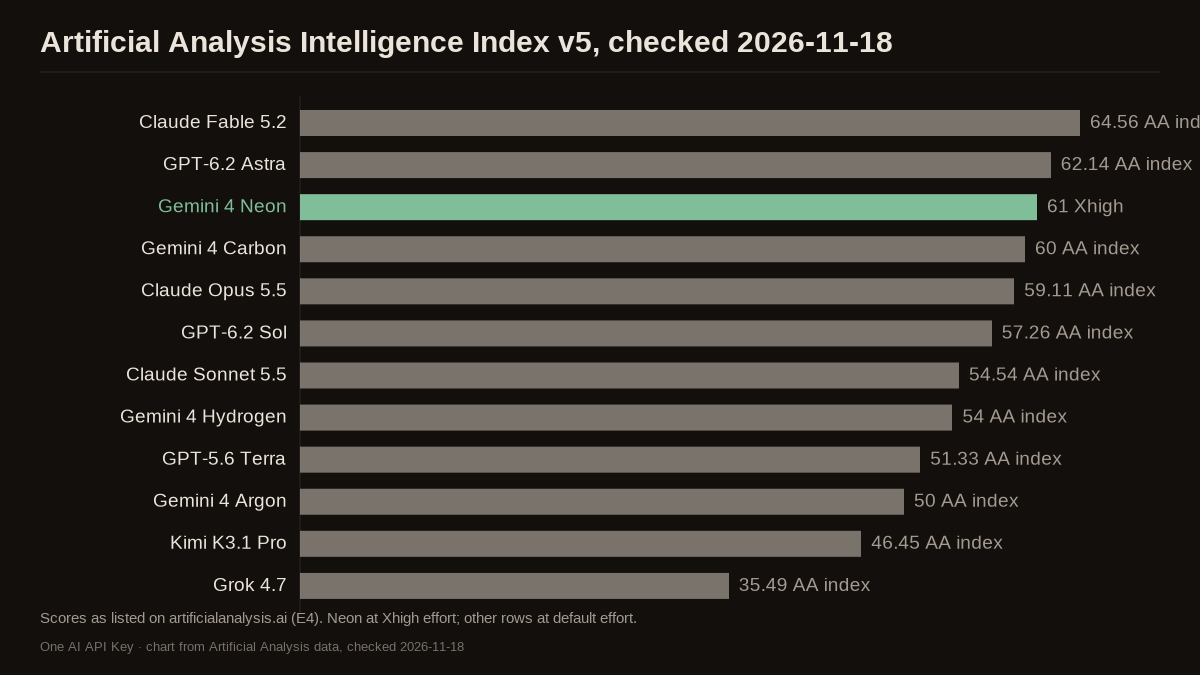
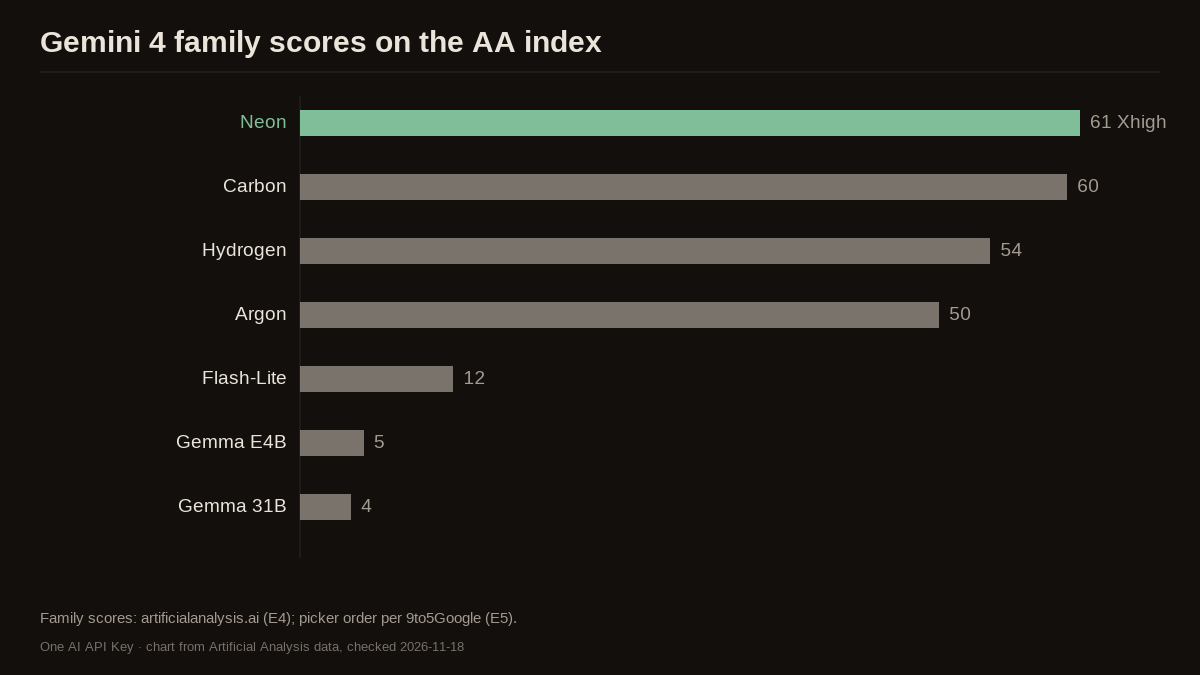
All scores below come from the Artificial Analysis Intelligence Index v5, checked on November 18 and 19, 2026, and they are vendor-board figures, not our measurements. Artificial Analysis lists Neon at 61 at Xhigh effort, Carbon at 60, Hydrogen at 54, Argon at 50, Flash-Lite at 12, Gemma E4B at 5 and Gemma 31B at 4. The same page splits Neon by effort: 61 at Xhigh, 60 at High, 55 at Medium and 44 at Low. That spread means one model can post very different scores depending on the setting, so compare tiers at the same effort before you trust a gap. Hydrogen at 54 sits six points below Carbon, and Argon at 50 sits six below Hydrogen, so the flagship steps read as a ladder, not a cliff.
Rank wording needs care. Artificial Analysis places Neon sixth of 96 models on its board, while Google says third overall, as reported by 9to5Google. We flag that as conflict C1 in our source notes and cite each claim with its source rather than merging them. At the top of the board, Anthropic’s Fable 5.2 scores 64.56. Anthropic says 65, and the difference to 64.56 is rounding, not a model gap, which we mark as conflict C3. GPT-6.2 Astra follows at 62.14, then Neon at 61, Claude Opus 5.5 at 59.11, GPT-6.2 Sol at 57.26, Claude Sonnet 5.5 at 54.54, GPT-5.6 Terra at 51.33, Kimi K3.1 Pro at 46.45, Claude Haiku 5.5 at 36.48 and Grok 4.7 at 35.49. Note the Kimi row: our ledger records the name as Kimi K3 pro in one place and K3.1 Pro in the Artificial Analysis listing, so we flag the spelling as conflict C4. The full board lives on the Artificial Analysis leaderboard. Our live rankings page tracks the board as it moves, and the compare tool lines up two models side by side.
Google’s own benchmark table, as reported by 9to5Google, puts Neon first on Legal Research Bench, first on Tax Agent Bench, first on Surge AI and second on Agent Arena steerability. The same table lists the AA Coding Agent Index at 58.6, which Google calls first, an Agent Arena Index of 1336 across more than 4,200 sessions, Chartography at 73.5%, Agents’ Last Exam v1.1 at 75.8%, Terminal-Bench 4.1 at 65.2%, Terminal-Bench Science at 70.5%, RiemannBench at 84.0%, HLE-Diamond at 71.3%, FrontierCode 2.0 at 46.2% at high effort and AutomationBench at 56.3%. One row to read carefully: Anthropic’s Fable 5.2 scores 51.4 on AutomationBench, but the effort levels differ between the two runs, so our ledger marks that conflict C5 and says do not rank models on that row alone. Vending-Bench 2 appears in the table as a dollar figure, $16,843, which is a cost per run, not a score. Our best frontier models roundup for November 2026 keeps the cross-vendor picture in one place.
The picker change: Auto, Hydrogen, Neon and Carbon
9to5Google reported that Google’s model picker now offers Auto, Hydrogen, Neon and Carbon. Neon replaces Argon in that picker. Gemini 3.1 Pro is removed, and Gemini 3.5 Flash-Lite becomes the Auto option. The same report says Neon targets complex coding, analytical reasoning and production-grade enterprise workflows, that it is limited to AI Pro and AI Ultra plans, that Antigravity is part of the announcement, and that Google ships four thinking levels. For API users the practical effect is that the default lane is now Auto, and the explicit choices are Hydrogen, Neon and Carbon. Google’s model guide for Gemini 4 Neon documents the model on the Gemini Enterprise Agent Platform and is the place to check model IDs and effort names. Two cautions from our ledger. First, Google’s four thinking levels and Artificial Analysis’s four effort tiers are different scales, and we do not claim they map one to one. Second, the report mentions Antigravity alongside the picker news, and we do not stretch that into a claim about how Antigravity routes requests, because the ledger does not say. Third, if you were on Gemini 3.1 Pro, this change moves you, so test your prompts again after any switch.
Gemini 4 family pricing: Neon list price and the Argon promo window
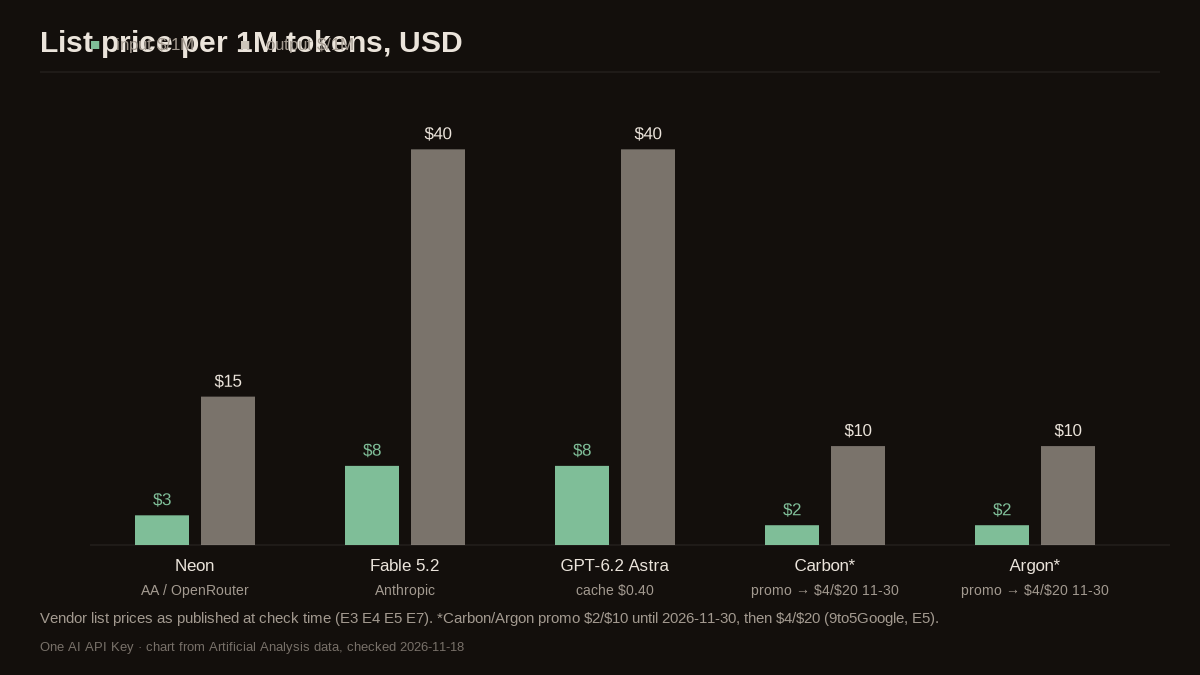
The Artificial Analysis page for Gemini 4 Neon lists $3 per 1M input tokens and $15 per 1M output tokens. OpenRouter now lists google/gemini-4-neon with four pricing rows, $3 in and $15 out among them. 9to5Google said at launch that Neon was not yet available on OpenRouter, so we treat the two checks as a timing difference, mark it conflict C2 and date-stamp both. All prices in this section were checked on November 18 and 19, 2026.
The promo matters more for the rest of the family. 9to5Google reported that Argon and Carbon sit at $2 per 1M input tokens and $10 per 1M output tokens until November 30, 2026, after which both return to $4 and $20. The same arithmetic on those prices: a call of 100K input tokens and 50K output tokens costs $0.20 plus $0.50, or $0.70 per call on the promo price, and $0.40 plus $1.00, or $1.40 after the window closes. On Neon list price the same call costs $0.30 plus $7.50, or $7.80. After November 30 the Argon and Carbon list prices match the $4 and $20 level that the neon.com service charges for its hosted Argon, a coincidence of numbers, not the same product, as the C6 section below explains.
Artificial Analysis also prices a full Neon run at Xhigh: $6.44 per task, about 21.5 minutes per task, 283M output tokens in the run, a 95% cache hit rate and a blended $2.21. Neon’s listed speed is about 110 tokens per second, and the context window is 1M tokens. Our Neon pricing breakdown walks through the per-task maths, and our Neon vs Carbon upgrade maths asks whether a one-point score gap is worth the price step. Our pricing page shows what we charge on the models we do list, and the cost calculator turns your own token counts into a monthly figure.
Which Gemini 4 model to pick for your workload
Our read of the ladder above, and it is our reading, not a vendor claim. Pick Neon for hard coding, long agent runs and analytical work where the top family score matters and $15 per 1M output tokens fits the budget. Pick Carbon while the promo holds, because 60 versus 61 is one point and the promo price sits a third below the post-promo list. Pick Hydrogen at 54 when the work is solid but not frontier, and Argon at 50 when you want Google quality at the lowest of the four flagship tiers on this chart. Flash-Lite at 12, Gemma E4B at 5 and Gemma 31B at 4 are the light lane on the same chart, suited to classification, extraction and high-volume cheap turns. If you are unsure, Auto is the new default in Google’s picker, and the four thinking levels let you trade cost for depth per request. The effort spread also matters at budget time. The same model posts 61 at Xhigh and 44 at Low on the AA index, so a team that drops effort to save money should expect the score to move with it, and should re-run its own evals after the change. On the measured Neon run the cache hit rate was 95%, so long system prompts behave very differently at cache-read prices than at full input prices, and you should measure your own cache rate before trusting any per-task figure, including ours. Our Neon API quickstart shows the request shape, and on our side the quickstart docs, the API reference and the config generator cover base URL, key format and request options for the models we do serve.
Same word, different product: neon.com and Neon AI Gateway
One naming trap needs its own section. neon.com publishes docs for a product also called Neon, and those docs cover a model called gemini-4-argon. That is Neon AI Gateway: a Databricks-hosted gemini-4-argon at $4 per 1M input tokens and $20 per 1M output tokens, with a 1M-token context window, live since October 2026, served at /gemini/v1beta/models/gemini-4-argon:generateContent with a Bearer token. It is not Google’s Gemini 4 Neon, it is not Google’s Gemini 4 Argon, and those prices belong to that service, not to Google. We mark this collision as conflict C6 in our source notes. The endpoint path and the Bearer scheme above are copied from that service’s docs so you can tell at a glance which response came from where. Read Neon AI Gateway’s gemini-4-argon docs (a different product) with that separation in mind, and if a price you found looks too high for Google’s Neon, check which Neon published it.
What our gateway lists today
At check time our gateway lists one model from this family, and it is only Gemini 4 Argon. The Gemini 4 Argon model page shows our published rate of $0.525 per 1M input tokens and $2.625 per 1M output tokens, with cache reads at $0.10, against a list price of $2 in and $10 out. The Argon row above is the only Gemini 4 row in our catalogue, and our price is a discounted rate against that list, not a vendor price. Gemini 4 Neon, Gemini 4 Carbon and Gemini 4 Hydrogen are not listed here at check time, and we add a model only after we have tested it through the gateway. The models page shows the full catalogue, the gateway overview explains routing and rate limits, and the free models page lists what costs nothing. If a request names a model we do not serve, our error guide explains what comes back and how to fix the model ID.
Where to try it: the free lane and the signup path
You can test the whole catalogue before paying anything. Our free lane gives 100 requests and 5,000,000 tokens daily, refilling at 05:30 IST, which is 00:00 UTC, and new accounts start with a $10 trial credit. If you hit the daily cap, the lane refills at the next 05:30 IST reset. Open web chat to compare models in a browser, or create an account on the console sign-up page. The API base is https://api.oneaiapikey.com/v1. Every number in this post was fetched live on November 18 and 19, 2026 and attributed to Google, 9to5Google, Artificial Analysis, OpenRouter or Anthropic as named, and where two sources disagree we print both and flag the conflict instead of averaging them. Prices and scores move, so re-check the Artificial Analysis page and our models page before you budget. One AI API Key is an independent service and is not affiliated with Google, Anthropic or Neon.