Google launched Gemini 4 Neon on November 18, 2026, and the practical questions come fast: where does the model actually live, what goes in the request, and what does a call cost before you build on it. This quickstart answers those three before you write any code. It is the practical companion to our launch writeup, our pricing teardown and our benchmarks teardown for the same model, and it follows one rule throughout: no endpoint strings we have not verified, and no availability claim about our own gateway. The only code on this page is one generic OpenAI-compatible snippet against our own gateway at the end, for a model we actually list, because we will not print a Google endpoint string we have not verified.
Where Gemini 4 Neon lives today
Start with what exists. Google’s launch post for Gemini 4 Neon is dated November 18, 2026 and carries Koray Kavukcuoglu’s byline. We cite it for the launch itself, not for quotes, because the body sits behind a login wall. Google’s model guide for Gemini 4 Neon is the document to follow for official access details on the Gemini Enterprise Agent Platform, and it is where the official endpoint names live. We do not reproduce an endpoint string here, because we have not verified one, and a guessed string is how production bugs start. The surfaces to check are Google AI Studio, Vertex AI and the Gemini API docs, and OpenRouter now carries rows for the model, which is the path this post covers in detail. 9to5Google’s launch report describes Neon as aimed at complex coding, analytical reasoning and production-grade enterprise workflows, replacing Argon in the picker, with 3.1 Pro removed and Flash-Lite renamed Auto. The same report mentions Antigravity in the launch coverage, and it puts Neon behind AI Pro and AI Ultra plans. For how Neon scores against the rest of the field, our best frontier models November 2026 roundup places it next to Fable 5.2, GPT-6.2 Astra and Opus 5.5.
Gemini 4 Neon model ids: what goes in the request
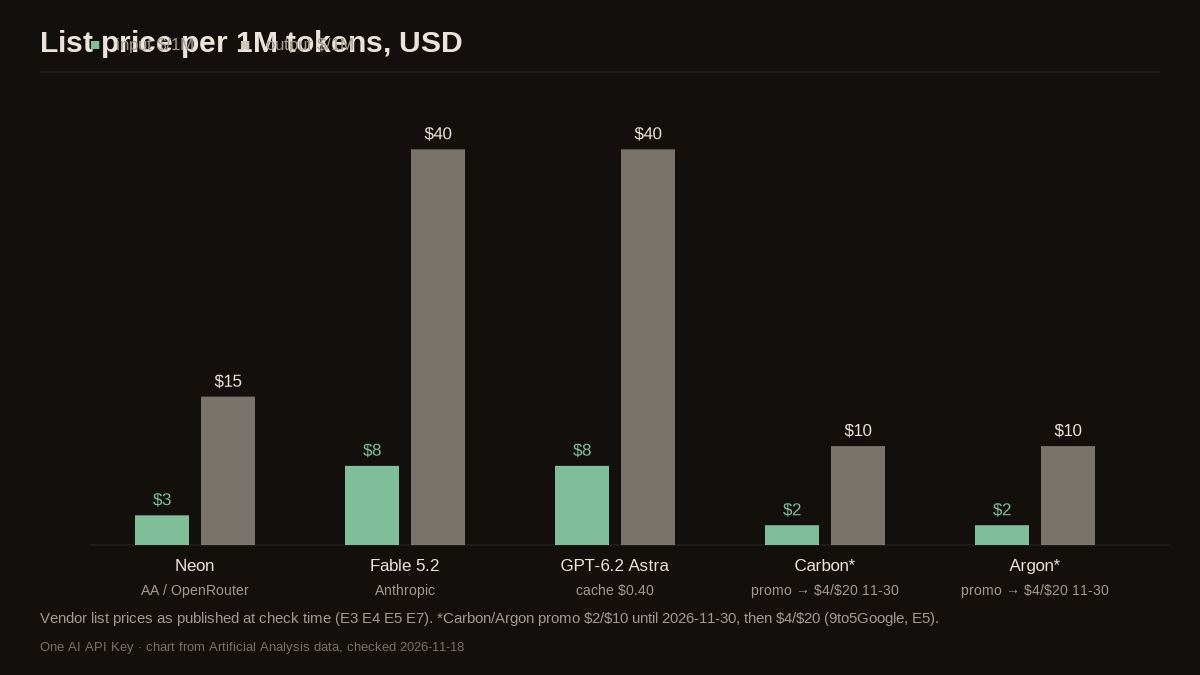
Gemini 4 Neon on OpenRouter lists google/gemini-4-neon with pricing rows that include $3 per 1M input tokens and $15 per 1M output tokens, among four rows on the page. The id is the whole route: copy it exactly, because OpenRouter routes on the full string, and a truncated id returns a model-not-found error instead of a bill.
One timing flag, date-stamped both ways. 9to5Google reported on launch day that Neon was not yet available on OpenRouter. The OpenRouter page lists it now, and we checked the page on 2026-11-18 and 2026-11-19. Both statements are true at their own dates; a launch-day story and a page checked a day later are not the same evidence.
Then the naming collision to know about. neon.com documents the Neon AI Gateway, which serves a Databricks-hosted model called gemini-4-argon at /gemini/v1beta/models/gemini-4-argon:generateContent with a Bearer key, priced $4 per 1M input and $20 per 1M output, live since October 2026. That is a different product from Google’s Gemini 4 Neon: same word, different company, different model, different endpoint shape. If a ticket says Neon and means the neon.com gateway, the fix is different, so read Neon AI Gateway’s gemini-4-argon docs (a different product) before you assume which system you are holding.
Three ids are now in play, and they are not the same product: google/gemini-4-neon on OpenRouter, gemini-4-argon on our catalog, and gemini-4-argon behind the neon.com gateway. Only the first is Google’s new flagship. On our side, the model catalog lists Gemini 4 Argon and not Neon, and our Gemini 4 Argon model page shows the exact id we serve. Neon is not live on our gateway, and nothing here should be read as saying otherwise.
The four thinking levels and their scores
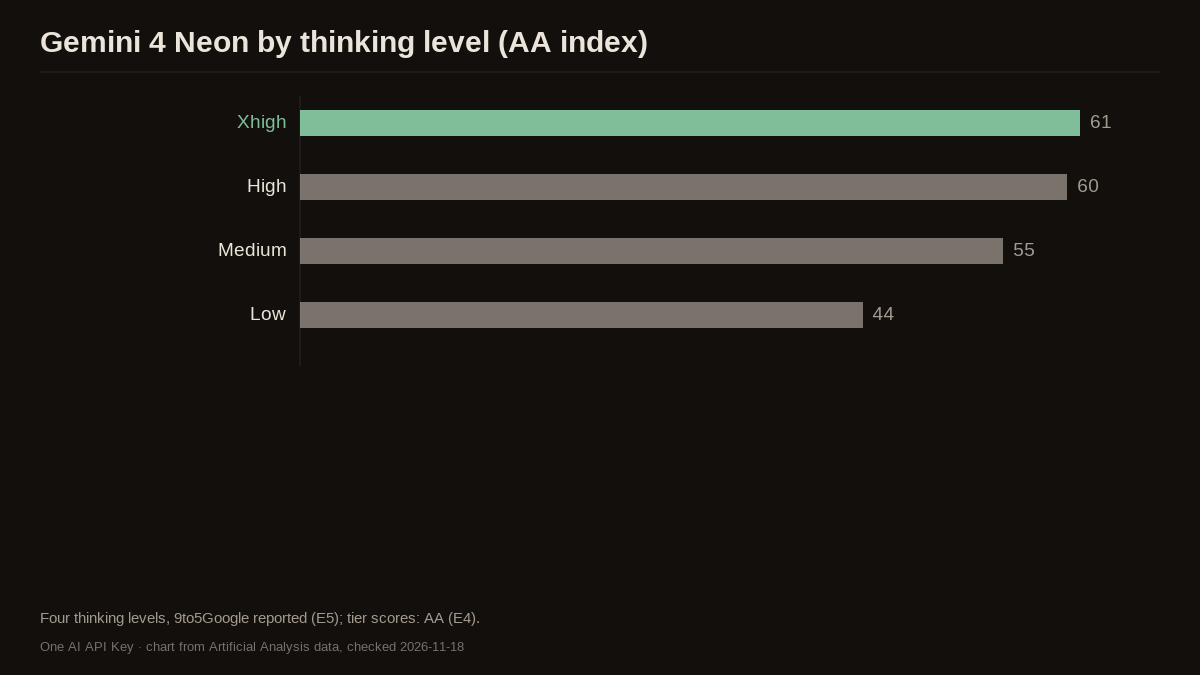
9to5Google reports four thinking levels for Neon, and the same report describes the picker in Google AI Studio as Auto, Hydrogen, Neon and Carbon. The Artificial Analysis page for Gemini 4 Neon scores Neon on Intelligence Index v5 at 61 for Xhigh effort, 60 for High, 55 for Medium and 44 for Low. The effort names are Xhigh, High, Medium and Low, and those scores are AA’s own runs, not Google’s table. Read the spread as the dial doing real work: 17 points of measured difference between the top and bottom rungs of one model. AA places Neon at number 6 of 96 models at Xhigh. Google claims third overall, as reported by 9to5Google. We flag the conflict and cite both; the wording differs, and the ranking depends on whose table you read.
| Thinking level | AA Intelligence Index v5 score |
|---|---|
| Xhigh | 61 |
| High | 60 |
| Medium | 55 |
| Low | 44 |
A practical default, from the same table: Low or Medium for drafting and summarizing, High for code review, Xhigh for proofs and hard debugging, because the score spread is what you are paying for. The family ladder around it, from Artificial Analysis, is Carbon 60, Hydrogen 54, Argon 50, Flash-Lite 12, Gemma E4B 5 and Gemma 31B 4. Our family ladder post maps those tiers, and our Neon vs Carbon post runs the upgrade math on the one-point gap between Neon at Xhigh and Carbon. If you generate request configs instead of writing them by hand, our config generator emits the effort and model fields for the models we serve.
Token math before you wire it in
Run the arithmetic before you commit. Artificial Analysis lists Neon at $3 per 1M input tokens and $15 per 1M output tokens, and OpenRouter’s rows include the same $3 and $15. Three assumptions apply to both examples below: list price, a cache-read split where stated, and no surcharge, because no verified surcharge appears in our sources.
Example one, no cache. Assumption: one call with 100,000 input tokens and 500,000 output tokens at list price. Input is 0.1 x $3, which is $0.30. Output is 0.5 x $15, which is $7.50. Total: $7.80. The cost calculator runs the same arithmetic against your own volumes.
Example two, cache read. Assumption: a 1,000,000-token prompt in which 95 percent of input tokens are cache reads, plus 500,000 output tokens. Fresh input is the remaining 5 percent, 50,000 tokens, which at $3 per 1M is $0.15. Output at $15 per 1M is $7.50. Total: $7.65. The cached 950,000 tokens are the point of the example, and this simplified total prices only fresh input and output.
Scale check: double the output to 1,000,000 tokens and example one becomes $0.30 plus $15.00, so $15.30, because output is the expensive side at $15 per 1M. Both examples are arithmetic on published list prices. They are not a quote, and your bill follows your own token counts, your own hit rate and your own effort level.
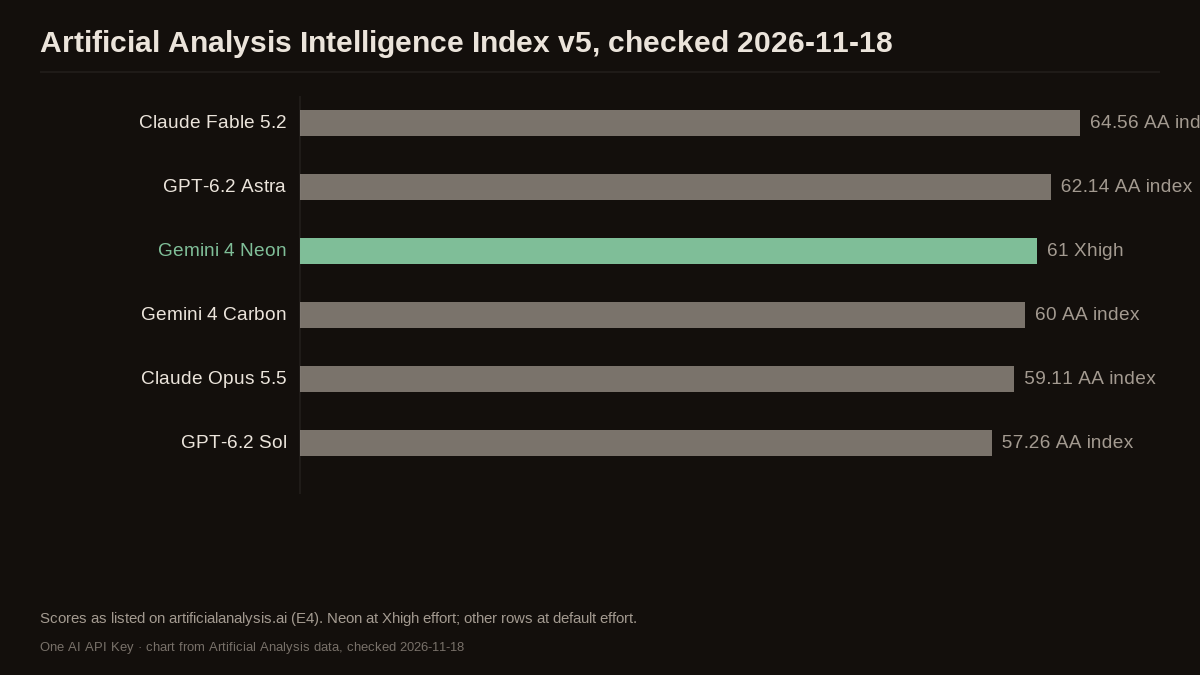
For score-per-dollar context, AA lists Fable 5.2 at 64.56 on the index, and Anthropic’s launch table says 65, a rounding difference we flag rather than average. AA lists GPT-6.2 Astra at 62.14, Opus 5.5 at 59.11 and Sol at 57.26. Anthropic lists Fable 5.2 at $8 in and $40 out per 1M, and AA records the same $8 and $40 for GPT-6.2 Astra. Our Neon vs Fable 5.2 post and our Neon vs GPT-6.2 Astra post run those comparisons in full. One more flag on cross-vendor rows: Google-published AutomationBench 56.3 for Neon and Anthropic’s 51.4 for Fable 5.2 run at different effort levels, so we do not rank on that row alone.
Cache reads and why they change the bill
The cache line is not a rounding error. In the Artificial Analysis task run at Xhigh effort, Neon posted a 95 percent cache hit, a cost per task of $6.44, a blended $2.21, 21.5 minutes per task and 283M output tokens across the run. Those are AA’s measurements, not ours, and the 95 percent figure is the one that moves money. A workload that re-sends a stable system prompt, the same few-shot block and the same retrieval header every call reads most of its input from cache, and pays the fresh-input price on a small slice. A workload that reshapes the prefix every call pays that price on all of it. Log the cached token count from the first request, the way our API reference describes the usage fields, so your eval table shows the hit rate next to the effort level. The 283M output tokens in the AA run are also why cost per task, not price per token, is the number to compare across vendors. If your hit rate sits near zero, example two becomes example one, and the bill follows.
Gemini 4 Neon pricing rows, and the OpenRouter timing flag
Collect the pricing facts in one place. Artificial Analysis lists $3 per 1M input and $15 per 1M output for Neon, at roughly 110 tokens per second, with a 1M-token context window. The context number is what lets you paste a repository into one prompt; the speed number is latency planning, not price. OpenRouter shows four pricing rows for google/gemini-4-neon, including $3 and $15, which matches AA on the two numbers that matter for the math above. The conflict is timing, not price: 9to5Google wrote on launch day that Neon was not yet on OpenRouter, and the page lists it at check time. Cite the launch-day story for launch day and the OpenRouter page for now.
For family context, 9to5Google reports Argon and Carbon at a promotional $2 in and $10 out per 1M until 2026-11-30, after which both move to $4 and $20. Note the echo: the neon.com gateway also lists $4 and $20, for its own argon product. Two different $4/$20 rows, two different vendors, one more reason to keep the names straight. At $15 per 1M output, every 100,000 output tokens adds $1.50. At $3 per 1M input, the same 100,000 input tokens adds $0.30. Output volume is the lever, which is why effort choice and cache choice matter more than the input row. While you eval, watch the usage console, and remember that the paid lane on our pricing page is what you fall back to when the trial credit is spent.
The on-us path: what our gateway actually serves
One honesty note before the snippet. We do not list Gemini 4 Neon on our gateway, and this post is an access guide, not an availability claim. What we serve is a set of frontier models behind one OpenAI-compatible base URL, https://api.oneaiapikey.com/v1, and the free lane covers the models on the free models page. AA scores Opus 5.5 at 59.11, and the snippet below is the on-us path: a generic OpenAI-compatible call against claude-opus-5-5, a model we actually list. It is not a Neon call, and it is not a Google endpoint. The quickstart docs walk through the first request, and the console keys page is where the key comes from.
curl https://api.oneaiapikey.com/v1/chat/completions \
  -H "Authorization: Bearer $ONEAI_API_KEY" \
  -H "Content-Type: application/json" \
  -d '{
    "model": "claude-opus-5-5",
    "messages": [{"role": "user", "content": "Summarize the tradeoffs between two frontier models in three bullets."}]
  }'
Is Neon on our gateway? No. What you can do today is run the same OpenAI-compatible shape against every id we list, and log five fields from call one: model id, effort level, input tokens, cached tokens and output tokens, so any later comparison has a chance of being honest. Every number above was fetched live on 2026-11-18 and 2026-11-19 from the sources in the frontmatter. Where two sources disagree, we print both with their names attached. Where we could not verify something, like an official Google endpoint string, we say so instead of guessing.
Where to try it
If you want the feel of the tier before the math, open the in-site chat and prompt a frontier model with no terminal at all. To go further, create an account at console sign-up. The free lane gives you 100 requests and 5,000,000 tokens daily, refilled at 05:30 IST, and new accounts start with a $10 trial credit. Gemini 4 Neon itself stays on Google’s surfaces and on OpenRouter; the token math above is what you run before you wire any model, Neon included, into production.