The short version: GPT-6.2 Astra is 1.14 index points ahead of Gemini 4 Neon on the Artificial Analysis board, lists at about 2.7 times the price, and is free to test here today on the free lane. Neon is the cheaper model per token, the faster one on the published speed row, and it is not served on our gateway.
Gemini 4 Neon and GPT-6.2 Astra shipped in the same week of November 2026, per Google’s launch post for Gemini 4 Neon, and on the Artificial Analysis Intelligence Index v5 they sit 1.14 points apart. Neon scores 61 at Xhigh effort, the Artificial Analysis page for Gemini 4 Neon lists, and Astra scores 62.14. The price gap is wider than the score gap. Neon lists at $3 per million input tokens and $15 per million output tokens, and Astra lists at $8 and $40, which is about 2.7 times higher on both rows. This is the head-to-head for engineering leads who need a routing decision, not a trophy case.
Two gateway facts, said plainly. GPT-6.2 Astra runs here on the free lane today as model id gpt-6.2-astra:free, added 2026-11-18, and it is listed at /models/gpt-6-2-astra. Gemini 4 Neon is not listed on our gateway. Our catalogue carries gemini-4-argon only, so a Neon test today runs through Google, OpenRouter or another provider, not through One AI API Key.
The comparison below uses the published rows that decide a deployment: the index, the benchmark card, the price list, the cost per task and the throughput. Our Gemini 4 Neon launch post covers the announcement, our Neon benchmarks teardown works every Google score, and our best frontier models for November 2026 puts both models on one board. The Astra side draws on our GPT-6.2 Astra benchmarks post, published 2026-11-18.
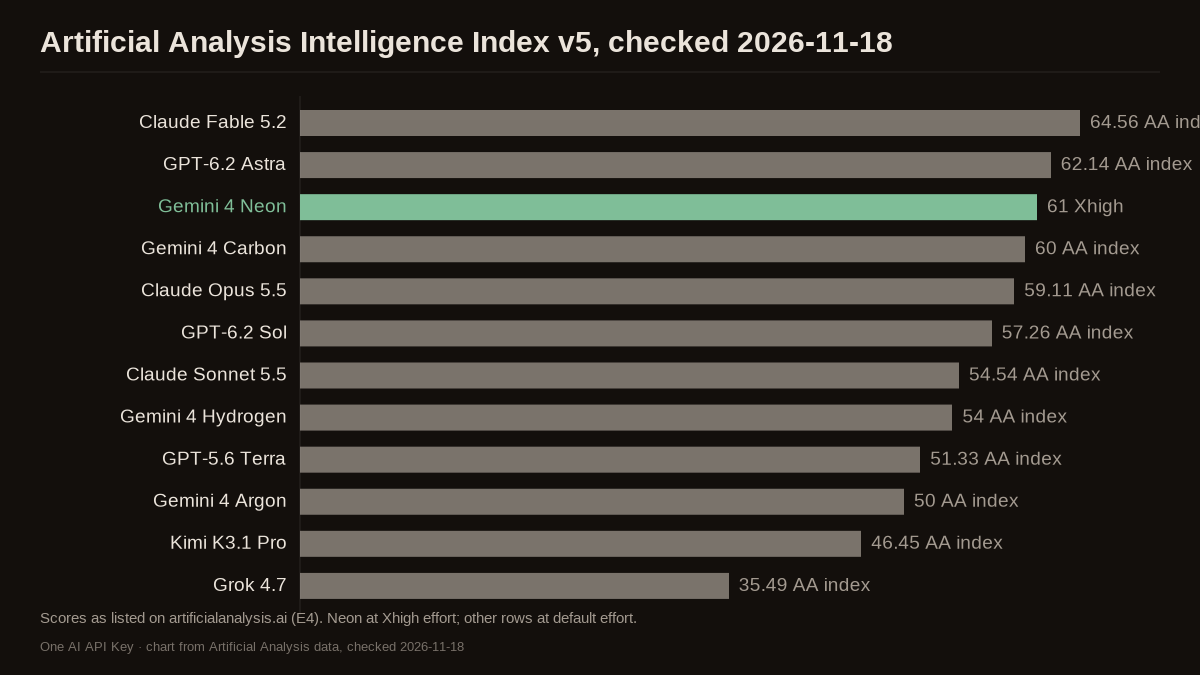
The AA index: 61 at Xhigh against 62.14
Artificial Analysis lists Neon at 61 on the Intelligence Index v5 at Xhigh effort, ranked #6 of 96 models, with tier scores of 61 at Xhigh, 60 at High, 55 at Medium and 44 at Low. Google’s own framing, carried by 9to5Google’s launch report, claims third overall. That is conflict C1 in our ledger, and both numbers are published, so we report both instead of picking one. The AA rank counts every scored model at every effort tier, while the Google claim uses a narrower cut of the same board. The same board puts Claude Fable 5.2 first at 64.56, a figure Anthropic rounds to 65, which is conflict C3 and another reason to read raw scores instead of rounded headlines. The full field sits on the Artificial Analysis leaderboard.
Astra scores 62.14 on the same index, raw 62.1387990593969, per our Astra benchmarks coverage, which also records the ranking nuance: the AA launch article headlines Astra as the #2 model behind Claude Fable 5.2, while the per-model page ranks it #3 of 91 across all providers and efforts. Both are AA numbers, and both are correct on their own terms.
| Effort | Neon index, AA via E4 | Astra index, AA via our Astra post |
|---|---|---|
| Xhigh | 61 | 62 |
| High | 60 | 60 |
| Medium | 55 | 57 |
| Low | 44 | 46 |
The table is the honest version of the headline. At High effort the two are level at 60. At Medium, Astra holds a 2-point edge, 57 to 55. At Low, the same 2-point shape holds, 46 against 44. The 16-point fall on Astra’s ladder, 62 down to 46, is the number our Astra post flags, and Neon’s 17-point fall from Xhigh to Low is the same story. On this board, the effort slider moves the score more than the model choice does across the middle tiers.
For routing across a fleet, our rankings page tracks the index as it moves, and the comparison tool puts price and context beside it.
Benchmarks: agentic coding, science and knowledge
Google’s published card, via 9to5Google, leads with agent work. Neon scores 58.6 on the AA Coding Agent Index, which Google says is first, and 1336 on the Agent Arena Index across more than 4,200 sessions, with steerability ranked second on Agent Arena. Terminal-Bench 4.1 is 65.2 percent, Terminal-Bench Science is 70.5 percent, and RiemannBench is 84.0 percent. On knowledge rows, HLE-Diamond is 71.3 percent, Chartography is 73.5 percent, and Agents’ Last Exam v1.1 is 75.8 percent. Vending-Bench 2 is reported as $16,843, which is a cost figure on a long-horizon agent task, not a score. Legal Research Bench and Tax Agent Bench are both claimed first. All of these are Google-published numbers reported by 9to5Google, not our measurements.
Astra’s card is a different shape. Our Astra benchmarks post records AA-3D at 1318, the top score on Artificial Analysis’ human-graded interactive 3D benchmark, ahead of Fable 5.2 at 1271 and Sol at 1259, and a lead on Terminal-Bench-Science 0.1 for agentic scientific research. On the Coding Agent Index, Astra is flat with GPT-6 Astra, meaning no gain over the previous generation under the Codex harness at max effort. At max effort Astra also hallucinates on 59 percent of AA-Omniscience factual probes, so the reasoning ceiling and the factual error rate rise together.
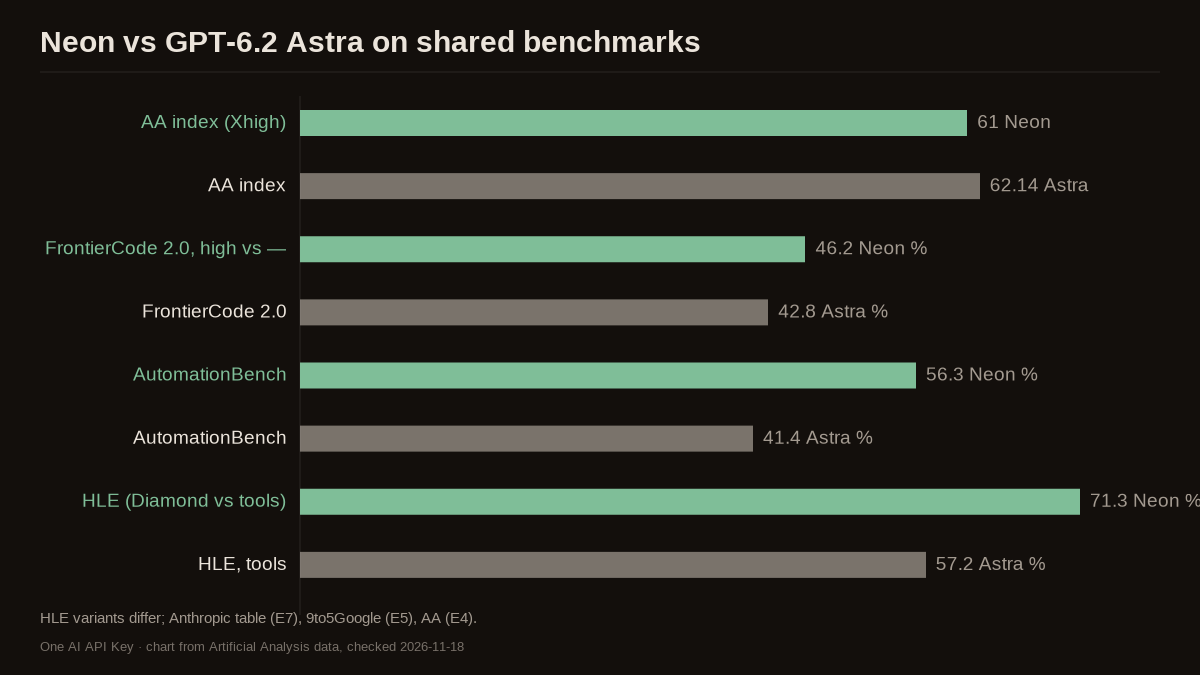
Where both vendors publish, the rows are close. FrontierCode 2.0 shows Neon at 46.2 percent at high effort, per Google via 9to5Google, against 42.8 percent for the Astra line in Anthropic’s launch table, which the third figure below charts. AutomationBench shows Neon at 56.3 percent against Astra’s 41.4 percent, but the two numbers come from different vendor tables at different effort settings, which is conflict C5 in our ledger and the reason we do not rank on that row alone. HLE is the same trap: Neon’s 71.3 percent is HLE-Diamond, Astra’s 57.2 percent is HLE with tools, and the variants are not interchangeable.
For the rest of the Neon family story, Gemini 4 Neon versus Claude Fable 5.2 covers the other head-to-head, and our Astra versus Carbon post covers the OpenAI side of the Gemini displacement.
Pricing: $3 and $15 against $8 and $40 per million tokens
Artificial Analysis lists Neon at $3 per million input tokens and $15 per million output tokens, and OpenRouter’s google/gemini-4-neon listing shows the same $3 and $15 among its four pricing rows. Astra lists at $8 input and $40 output, with a $0.40 cached input rate and a 95 percent cache discount, per our Astra benchmarks post, plus a long-context surcharge above 272,000 input tokens that doubles input and cache rates and raises output to 1.5 times for the whole request. On list price alone, Astra costs about 2.7 times Neon on both rows.
One timing flag, conflict C2. 9to5Google reported at launch that Neon was not yet available on OpenRouter, and the OpenRouter page now lists it with four pricing rows. We date-stamp both: the launch report is 2026-11-18, and the OpenRouter rows were checked on 2026-11-18 and 19. If you price a deployment this week, recheck the row you are quoted against the page, because the situation moved inside a day.
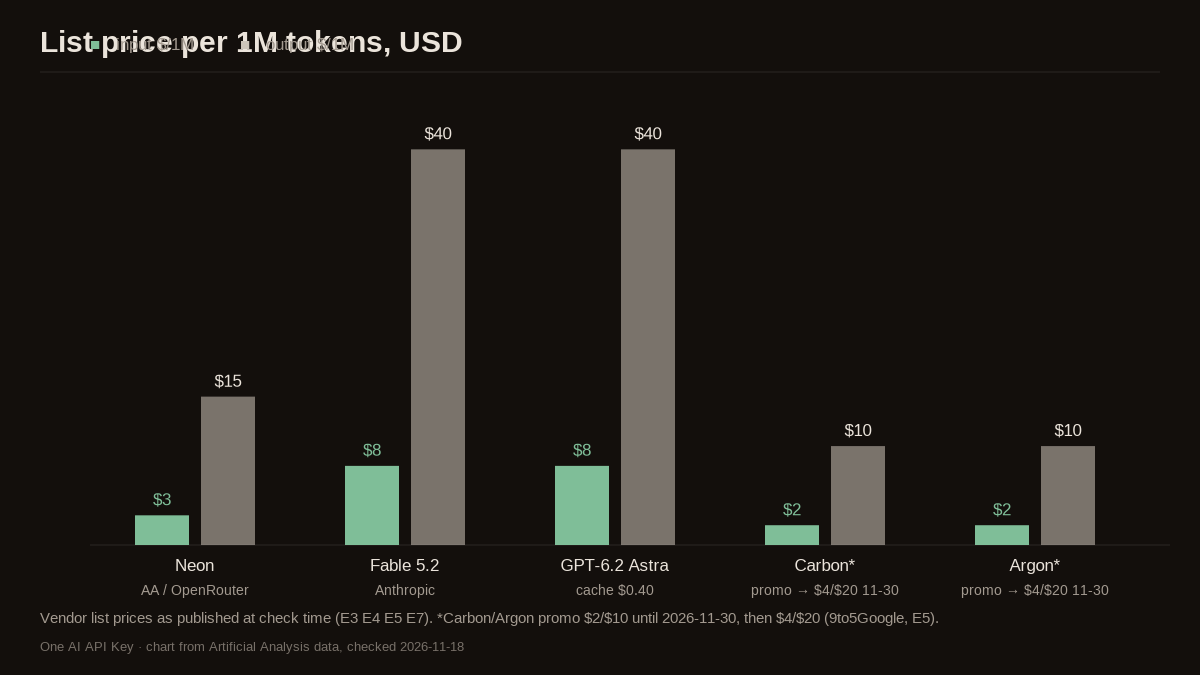
Neon’s cached input rate is not in our ledger, so we will not quote one. The cache row matters, because Astra’s $0.40 cached rate is what pulls its blended price down to $5.88 on AA’s 7:2:1 cache-heavy mix, and a fair Neon comparison needs the same row. Our Neon pricing post works the token math at list price.
Cost per task: $6.44 against $4.00
Per task, the order flips. Artificial Analysis prices Neon at $6.44 per task at Xhigh effort, with a blended price of $2.21, 21.5 minutes per task, 283 million output tokens in the run and a 95 percent cache hit rate, all from the AA Neon page. Artificial Analysis prices Astra at $4.00 per task at max effort, per our cost per task post, on a blended $5.88. So the cheaper model per million tokens is the dearer model per benchmark task, because the AA Neon run burned 283 million output tokens over 21.5 minutes a task while the Astra run is shorter at max effort. Verbosity, not list price, decides the bill on AA’s task mix, and both figures are AA’s harness on AA’s tasks, not quotes for your workload.
Your mix will differ. The cost calculator turns your own token counts into a monthly figure at list rates, and the config generator writes the effort settings into your integration file, which is where the 16-point effort swing from the index table gets decided.
Agentic coding: what actually differs
This is where the two cards diverge, and where an engineering lead should spend the eval budget. Neon’s coding rows are the ones Google claims as leads: a 58.6 AA Coding Agent Index called first, 65.2 percent on Terminal-Bench 4.1, and second on Agent Arena steerability, all Google-published via 9to5Google. Astra’s coding story is flat: our Astra post records no gain over GPT-6 Astra on the Coding Agent Index at max effort. If the workload is a coding agent fleet, the published rows favor Neon on coding-specific evals, and favor Astra on reasoning, science and 3D.
The honest counterweight is access and harness. Astra is live here on the free lane, so a 100-request eval costs nothing, and our coding agents guide covers the fleet setup. Neon needs a Google or OpenRouter account, and its four effort tiers mean the 61 at Xhigh is a setting, not a default. The quickstart docs cover the first call against our gateway, including effort headers and streaming.
Speed, context and throughput
Artificial Analysis lists Neon at roughly 110 tokens per second with a 1 million token context window. Our Astra coverage lists 1,050,000 tokens of context, 63 tokens per second at Xhigh effort and 35.96 seconds to first token at Xhigh, against 66 tokens per second and 134.86 seconds to first token at max. On the published speed row Neon looks faster, but AA measures both under its own harness, and your numbers will move with batch size, cache state and effort tier.
Context is close to a wash in headroom terms. One million against 1,050,000 is a 5 percent difference on the paper row, and both clear any real prompt. Astra’s long-context surcharge above 272,000 input tokens is the cost detail that bites, because it doubles input and cache rates for the whole request. Neon’s equivalent surcharge is not in our ledger, so treat that as a question for the quote, not a number.
The free lane, and what is actually served here
The practical difference today is access, and it runs one way. GPT-6.2 Astra is on the free lane as gpt-6.2-astra:free, added 2026-11-18, served under the gpt-6-2-astra slug. Gemini 4 Neon is not on the gateway, and the Gemini we do serve is Gemini 4 Argon, the budget tier of the same family, listed in the free lane model list where the daily allowance applies.
A naming note before you search, conflict C6. neon.com’s AI Gateway docs describe a Databricks-hosted gemini-4-argon at $4 per million in and $20 per million out, which is a different product from Google’s Gemini 4 Neon. Search results for Neon API pages will mix the two, and our ledger keeps them separate.
The third figure charts the shared rows side by side, with the HLE variants labelled as different benchmarks.
Where to try it
The cheapest way to settle any of this on your own prompts is the free lane. GPT-6.2 Astra runs as gpt-6.2-astra:free at base URL https://api.oneaiapikey.com/v1, and free ids meter against the free lane allowance of 100 requests and 5,000,000 tokens daily, refilling at 05:30 IST, which is 00:00 UTC. New accounts carry a $10 trial credit for paid volume past the allowance, and paid rates sit on the pricing page. Try Astra in the in-site chat with no terminal, or sign up, grab a key and run your own eval on the rows that decide your workload. Gemini 4 Neon is not served here, so a Neon eval needs a Google or OpenRouter key, and the index, price and speed rows above are the numbers to take into it.