Google launched Gemini 4 Neon on November 18, 2026, and Google’s launch post for Gemini 4 Neon, titled “Introducing Gemini 4 Neon” and written by Koray Kavukcuoglu, carries the announcement. OpenAI’s GPT-6.2 Sol shipped a day earlier, and our GPT-6.2 Sol coverage has already worked through its benchmark card, its price list and its effort ladder. This post puts the two side by side on the numbers a buyer checks: the Artificial Analysis Intelligence Index, the per-token price, the throughput, and the cost per task.
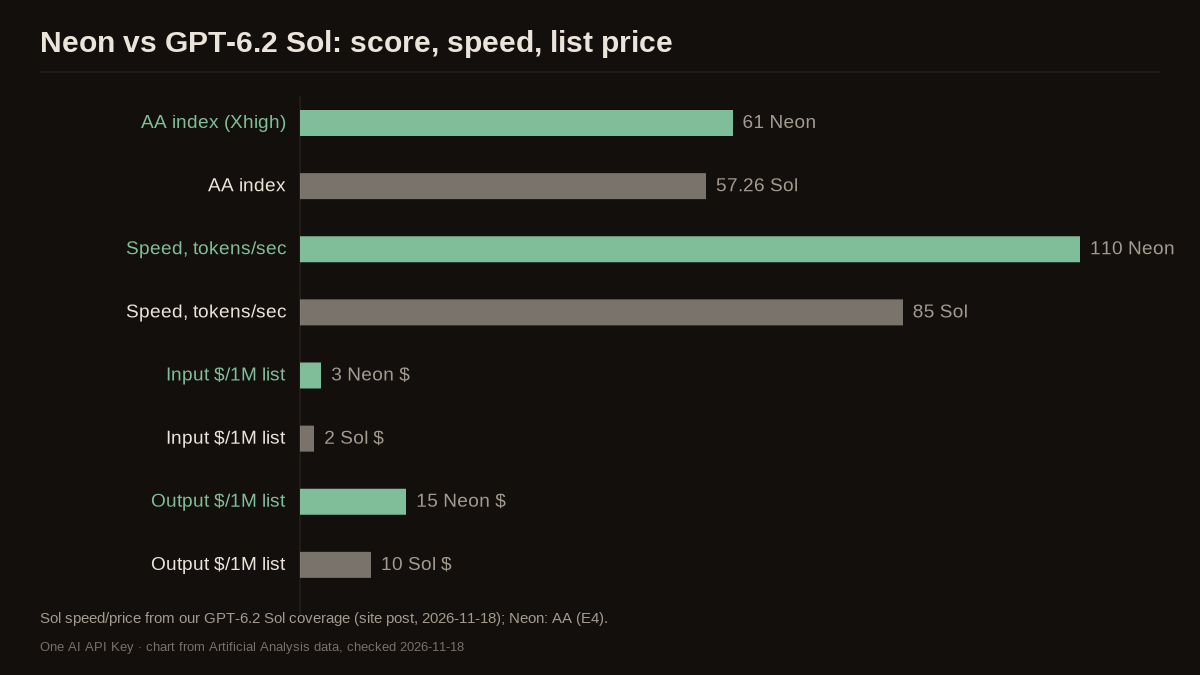
The short version. Artificial Analysis lists Neon at 61 on the Intelligence Index at Xhigh effort, against 57.26 for GPT-6.2 Sol, a 3.74-point lead. Sol’s side of the trade is the lower price card, the lower cost per task and a strong case on everyday work, where OpenAI positions it as the go-to model, per our Sol pricing post. Neon’s side is the higher score and the faster generation rate. Every one of those sentences carries a caveat, and this post attaches all of them. 9to5Google reports that Google positions Neon for complex coding, analytical reasoning and production-grade enterprise workflows, replacing Argon in the model picker, with 3.1 Pro removed and Flash-Lite renamed Auto, on AI Pro and AI Ultra plans only. Both launches landed inside the same week, and both are aimed at the same buyer: teams that want frontier reasoning without paying frontier-tier prices. For the family story, our Gemini 4 Neon launch post covers the picker change, and our best frontier models November 2026 roundup places both models in the full field.
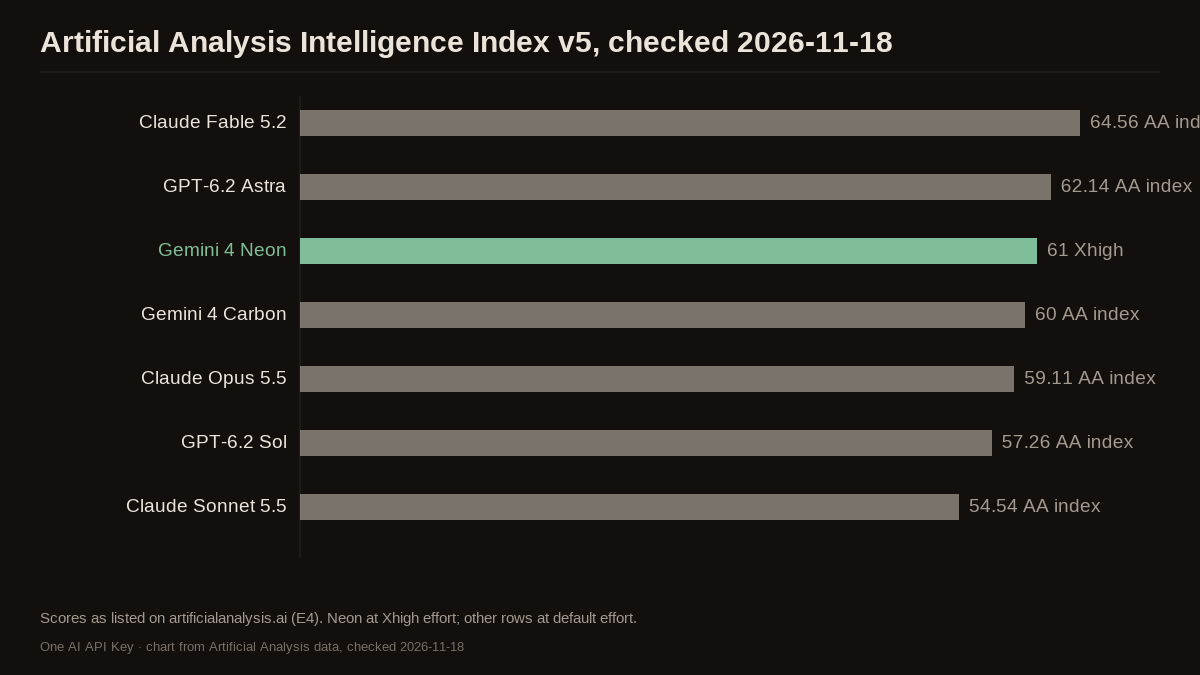
Benchmarks: the intelligence index gap is 3.74 points
Artificial Analysis lists Gemini 4 Neon at 61 on the Intelligence Index v5 at Xhigh effort, on a card that also shows High at 60, Medium at 55 and Low at 44, and the same Artificial Analysis page for Gemini 4 Neon places Neon at #6 of 96 models on the Artificial Analysis leaderboard. 9to5Google’s launch report carries a different rank claim, reporting that Google says Neon is third overall. We cite both with their sources and treat the rank wording as an open conflict, because the two outlets count different things on different dates and neither card explains the other.
Artificial Analysis lists GPT-6.2 Sol at 57.26 on the same index, and our GPT-6.2 Sol benchmarks post reports the rounded 57 at max effort. The 3.74-point gap is therefore a cross-effort reading, Neon at Xhigh against Sol’s published max-effort score, so treat it as directional rather than exact. The effort ladders add the rest of the picture. Neon runs 61, 60, 55 and 44 from Xhigh down to Low. Sol runs the 57-to-41 effort table from our Sol benchmarks post, 57 at Max down to 41 at Low, a 16-point fall, with the tier median across the field at 43 on the same card, per our coverage. Low-effort Sol at 41 sits below that median and low-effort Neon at 44 just above it, which is the practical difference between the two ladders.
Beyond the composite, the Google-published rows carried by 9to5Google give the shape of the Neon card: Agent Arena steerability at #2, Legal Research Bench and Tax Agent Bench at #1, Surge AI at #1, Chartography at 73.5%, Agents’ Last Exam v1.1 at 75.8%, HLE-Diamond at 71.3% and an Agent Arena Index of 1336 across more than 4,200 sessions. Those are Google’s own published benchmarks, reported by 9to5Google, not our measurements, and they sit behind the composite rather than beside it. The same caveat covers every row in this post: read the index as a summary of a card, not as proof on your workload.
Our Neon benchmarks teardown explains what each Google-published benchmark measures, from Agent Arena to Terminal-Bench Science, and our rankings page tracks the composite across the field so you can see both scores in context. One framing note that applies to everything below: the index is Artificial Analysis’s composite, not a vendor benchmark, and both cards inherit whatever sits inside it.
Pricing: $3 and $15 against $2 and $10 per million
Artificial Analysis lists Neon at $3 per million input tokens and $15 per million output, and Gemini 4 Neon on OpenRouter carries the same rows for google/gemini-4-neon among its four pricing lines. One timing conflict, flagged rather than smoothed over: 9to5Google reported at launch that Neon was not yet available on OpenRouter, and the OpenRouter page lists it at our check on November 18 to 19, 2026, so date-stamp both statements and read the OpenRouter rows as the later check.
GPT-6.2 Sol lists at $2 input and $10 output per million tokens, with cached input at $0.10, a blended $1.47 on Artificial Analysis’s 7:2:1 cache-hit, input and output mix, and a cost per Intelligence Index task of $1.01 at max effort, all from our GPT-6.2 Sol pricing post. The per-token arithmetic is simple, and I label it as my arithmetic: Neon’s $3 input is 50% above Sol’s $2, and Neon’s $15 output is 50% above Sol’s $10. On list price, Sol’s token is half of Neon’s on both lines, and Artificial Analysis notes that Sol’s pricing is unchanged from GPT-6.1 Sol, per our coverage.
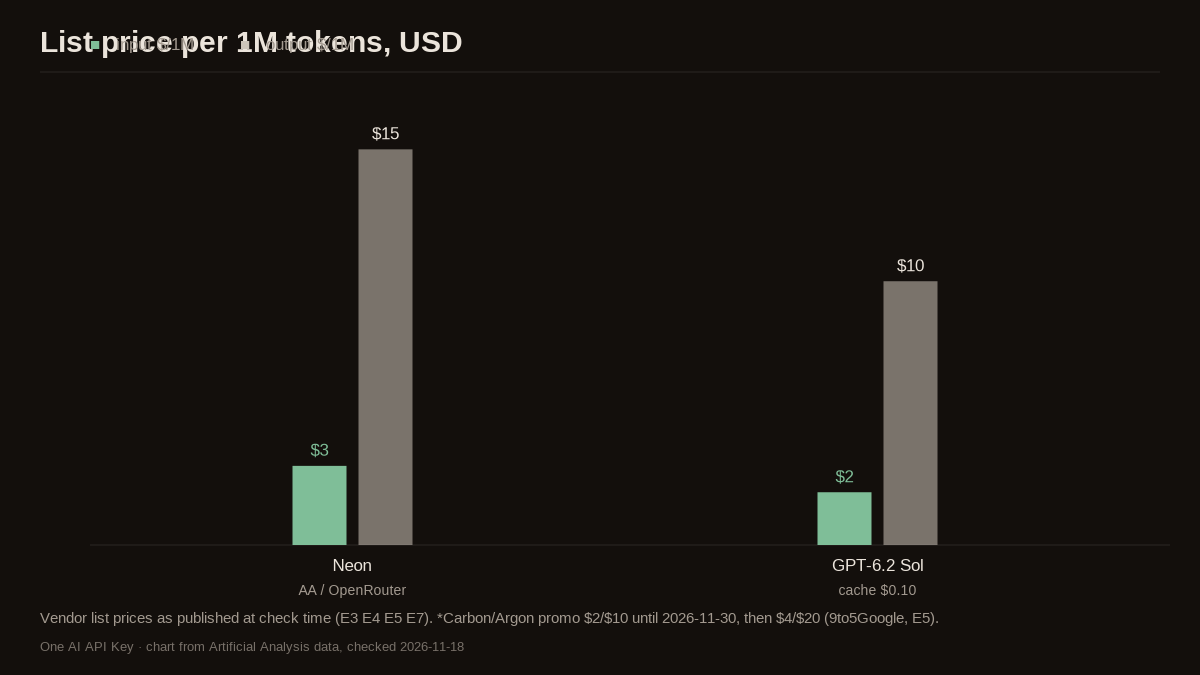
A worked example, same request on both cards, my arithmetic: one million input tokens and 100,000 output tokens at list rates cost Neon $3.00 plus $1.50, or $4.50, and Sol $2.00 plus $1.00, or $3.00. Add Sol’s cached line and the gap widens, because at $0.10 per million a cache hit costs a twentieth of fresh input, and agents re-send the same system prompt and repo context every turn, so a stable prefix moves most of the input bill onto the cheap line. Our Sol pricing post works that math at 70% and 90% hit rates. Two more rows from that post round out the Sol card: cache writes cost $2.50 per million at 30-minute retention and $5.00 at 12-hour retention, and the mode modifiers run batch at 50% of standard, fast at 2x and ultrafast at 3x until February 28, 2027, then 6x from March 1, 2027. A budget that ignores the mode it runs in can miss the bill by a factor of six, and that is my arithmetic on the same spread. For your own volumes, the API pricing page covers our paid rates and the cost calculator turns token counts into a monthly figure for either model.
Tokens per second: about 110 against 85
The Artificial Analysis page for Gemini 4 Neon lists Neon at roughly 110 tokens per second. Our Sol benchmarks post reports 85 tokens per second at max effort, stepping down through 80, 79, 74 and 72 across the effort ladder, and describes that 85 as the fastest in the 6.2 generation, above Astra’s 66 at max effort. On the throughput headline Neon leads by about 25 tokens per second, and this is the most directly comparable number in the post: same metric, same unit, both published by Artificial Analysis.
| Sol effort | AA index | tok/s | time to first token |
|---|---|---|---|
| Max | 57 | 85 | 61.56s |
| Xhigh | 56 | 80 | 22.98s |
| High | 55 | 79 | 7.90s |
| Medium | 53 | 74 | 2.81s |
| Low | 41 | 72 | 1.77s |
Two caveats keep it honest. First, tokens per second is generation speed, not start-up speed. Sol at max effort shows a 61.56-second time to first token in our coverage, because a reasoning model thinks before it writes its first answer token, and at high effort that falls to 7.90 seconds and at medium to 2.81. If your users wait on the answer, the advice in our Sol post is to drop effort rather than trust the 85 tok/s headline. We have no published Neon time-to-first-token figure at check time, so the start-up side of this comparison is a blank, not a win for either model. Second, throughput is a per-request number, not a concurrency promise, so meter it on your own prompt lengths before you size anything.
The practical read on both cards is the same one our Sol post draws: pick the lowest effort that passes your eval, because the top effort buys a single index point at a large latency cost. On Neon we have no effort-to-latency table at check time, only the index tiers, so the same advice becomes a question for the vendor’s documentation rather than a number we can quote.
Cost per task: $6.44 against $1.01, on different rulers
Here the comparison needs care, because the two numbers are not the same measurement. Artificial Analysis lists Neon at $6.44 per task at Xhigh effort, alongside 21.5 minutes per task, 283 million output tokens in the run, a 95% cache hit rate and a blended $2.21. Our Sol coverage lists $1.01 per Intelligence Index task at max effort, on the blended $1.47.
Neon’s $6.44 is Artificial Analysis’s Xhigh task. Sol’s $1.01 is the published max-effort index task. The workloads differ, the effort settings differ, and we will not rank the models on this pair. The narrower claims you can make are these: at list price, Sol’s per-token rates are half of Neon’s on both input and output, and Sol’s published per-task figure is the lower of the two. Artificial Analysis also describes Sol as on par with GPT-6 Astra at roughly 15% of the cost per task on their task mix, per our coverage, and that is a claim about OpenAI’s family, not about Neon. One more unit mismatch sits inside the cards: Neon’s 21.5 minutes per task is wall-clock time on Artificial Analysis’s run, and Sol’s published card carries 7.9 minutes per task at max effort, but again on a different task mix. Compare the ratios inside each card, not across them. For workload-level math, our GPT-6.2 cost per task post shows the method, and the monthly API cost estimator shows the budgeting pattern.
Agentic coding: one regression, one claim
Coding is where the two cards diverge most, and the divergence is asymmetric. Our Sol benchmarks post documents a regression: Sol loses 3 points on the Coding Agent Index against GPT-6.1 Sol, driven by a 14-point fall in SWE-Atlas-QnA-AA, where Sol is more likely than its predecessor to omit key facts. At max effort Sol also hallucinates on 55% of factual probes on AA’s Omniscience measure, per our coverage, and community reception points the same way, with an attributed r/codex thread arguing the 6.2 generation went backwards at coding. None of that makes Sol a bad coding model. It makes the migration decision workload-specific, and our GPT-6.2 coding agents guide and our choosing a model for coding agents post both argue the same next step: run your own repos through both ids and diff the answers for omitted facts, which is the documented failure mode. The GPT-6.1 Sol model page is the predecessor to test against, and our setup guides and code pages cover the harness and integration setup.
On the Neon side, 9to5Google’s report of Google’s published benchmarks lists an AA Coding Agent Index of 58.6 at #1, Terminal-Bench 4.1 at 65.2%, Terminal-Bench Science at 70.5% and FrontierCode 2.0 at 46.2% at high effort. Those are vendor-published figures carried by 9to5Google, not our measurements, and the harnesses differ from anything in our Sol coverage. The honest sentence is narrow: Neon’s coding card is a claim from the launch window, Sol’s coding card is a measured regression against its own predecessor, and only your eval on your repos decides which one your workload feels. Set the two cards together and the working rule is plain: Sol is the cheaper place to run everyday reasoning, Neon carries the higher coding-index claim, and the difference between a measured row and a vendor-published row is exactly the difference your eval exists to close.
How we would test this comparison
We cannot run Neon here, because it is not on our gateway, so every Neon number in this post is a published number we attribute to Artificial Analysis, OpenRouter, Google or 9to5Google, and none of it is our measurement. Every Sol number comes from our own coverage or from Artificial Analysis, and every ratio I computed is labeled as my arithmetic. The next step is yours rather than ours: same prompts, same repos, both model ids, and a diff of the outputs for omitted facts on the Sol side. Run each model at its default effort first, then move one step up and one step down, because the effort ladders above change both score and price. Log tokens per line, not just per request, because cache behavior moves the input line more than any list price does.
Context windows, and a name to avoid confusing
Both models publish a one-million-token class context window. Artificial Analysis lists Neon at a 1M-token context window, and our Sol pricing post lists Sol at 1,050,000 tokens, with 922,000 max input and 128,000 max output. Our GPT-6.2 1M context guide covers what happens above 272K input tokens on Sol, where the long-context surcharge doubles input and cache rates and multiplies output by 1.5 for the whole request. At Sol’s base rates the surcharge still lands below Neon’s list rates on input, by my arithmetic, but it reduces most of the gap. The 128,000 output ceiling matters too, because a reasoning model bills its thinking at the output rate, so a tight max_tokens can cut the reasoning off before the answer arrives. Sol’s knowledge cutoff is June 1, 2026, per our Sol pricing post, and its API rejects effort none, so every Sol request thinks at least a little before it answers. Neon’s four thinking levels, reported by 9to5Google, work the same way in principle, but we have no published Neon cutoff or rejection behavior at check time, and we do not borrow one from Sol.
One naming warning, because it costs real money to get wrong. neon.com is not Google. It is the Neon AI Gateway, which hosts a Databricks-deployed gemini-4-argon at $4 and $20 per million on a different endpoint path, per the Neon AI Gateway docs, and it is a different product from Google’s Gemini 4 Neon. Our gateway does not list Gemini 4 Neon at all. The catalog carries Gemini 4 Argon, and that is the page to read if you need a Gemini 4 family model on our route today.
Where to try it
Gemini 4 Neon is not on our gateway, so there is no Neon lane to try here. GPT-6.2 Sol is, and our Sol coverage reports gpt-6.2-sol:free at $0 on One AI API Key for 48 hours from November 18, 2026, owner-declared, metered against the free lane on our free models page: 100 requests and 5,000,000 tokens daily, refilling at 05:30 IST, with a $10 trial credit on new accounts. Try it in the in-site chat, or sign up and call gpt-6.2-sol:free at https://api.oneaiapikey.com/v1.