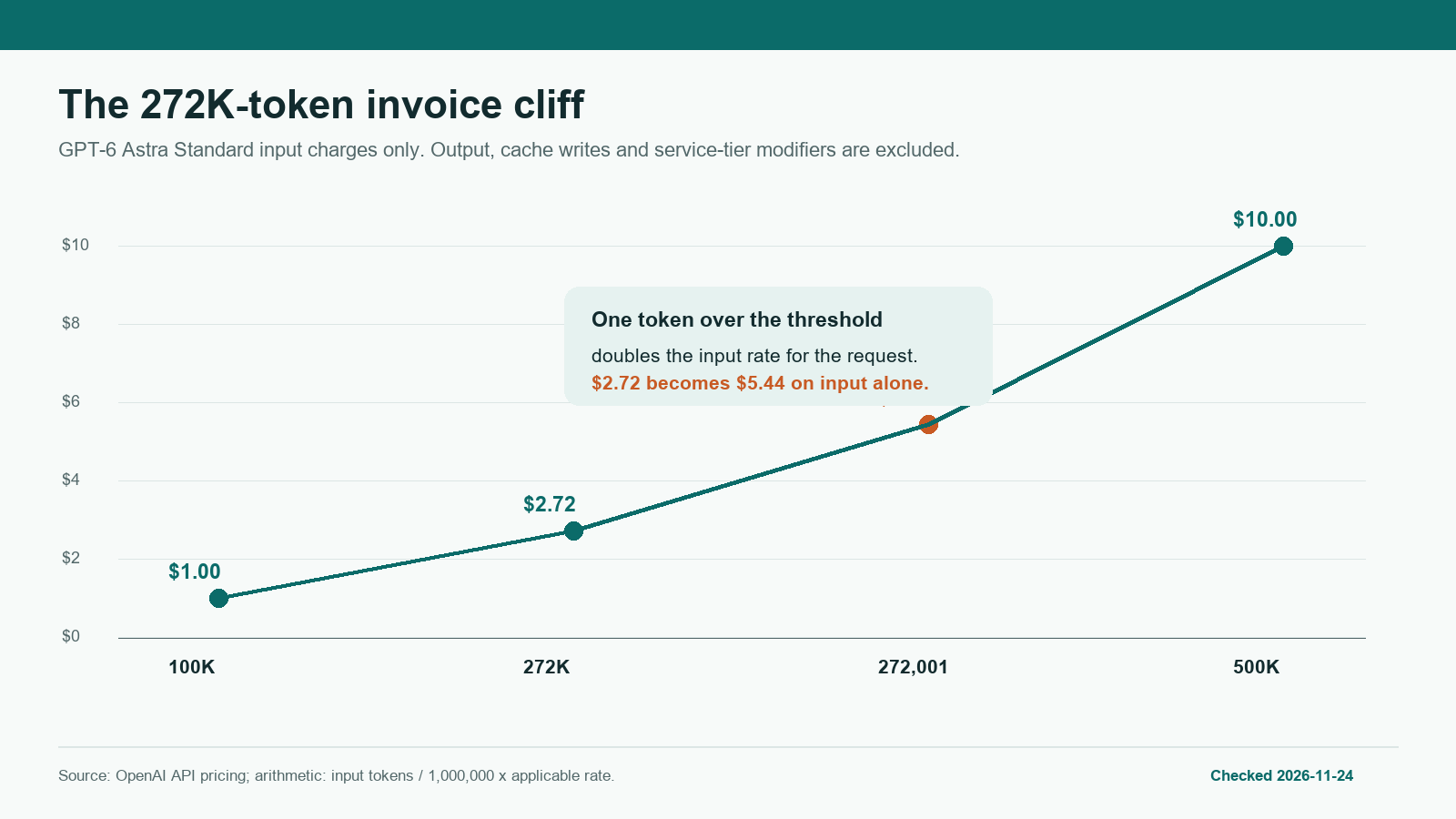
GPT-6 Astra Standard costs $10 per million uncached input tokens, $1 per million cached input tokens and $50 per million output tokens at or below 272K input tokens. Above 272K, those rates become $20, $2 and $75. The higher input tier applies to the whole request, not only the tokens above the boundary. Batch/Flex costs half of Standard. Fast costs twice Standard. These are list API rates from OpenAI’s pricing page, checked November 24, 2026, not gateway subscription prices. The sharpest loss is the threshold itself: a Standard request with 272,000 uncached input tokens costs $2.72 on input, while 272,001 costs $5.44002. GPT-6 Astra is also a predecessor, not GPT-6.2 Astra. Its context and output limits, knowledge cutoff and complete effort set remain UNKNOWN in the frozen evidence.
This guide is for developers and buyers who need to estimate a request before sending it. It separates official list rates from independent task costs, then works through cached input, Batch/Flex, Fast and requests that cross 272K. The goal is a bill you can explain, not a claim that one model wins every workload.
The short answer
- Official rate source: O01, OpenAI API pricing, checked 2026-11-24. All rates below are USD per 1,000,000 tokens.
- Main saving: Cached input is one tenth of uncached input in every GPT-6 Astra row and context tier.
- Main loss: One input token above 272K moves the entire request into the higher rate column.
- Independent snapshot: O04 reports $3.26 per Intelligence Index task and $7.09 per coding task at Max effort. Those are measured task economics, not API list rates.
- Availability: The gateway has a GPT-6 Astra model page. GPT-6 Sol does not have a gateway model page in the checked catalogue.
- Missing: Context/input/output limits, knowledge cutoff, the complete Astra effort set and a separate GPT-6 Astra cache-write rate are not established by the frozen evidence.
What OpenAI’s rate card actually says
The official table has three billing columns: uncached input, cached input and output. It also has two context-price bands. The boundary is 272K input tokens. At or below that count, use the lower column. Above it, use the higher column for the request.
| GPT-6 Astra mode | Input at or below 272K | Cached input at or below 272K | Output at or below 272K | Input above 272K | Cached input above 272K | Output above 272K |
|---|---|---|---|---|---|---|
| Standard | $10 | $1 | $50 | $20 | $2 | $75 |
| Batch/Flex | $5 | $0.50 | $25 | $10 | $1 | $37.50 |
| Fast | $20 | $2 | $100 | $40 | $4 | $150 |
Read the table as a rate card, not a subscription allowance. Do not convert these API rates into ChatGPT-plan token grants. Check the gateway pricing page for the gateway’s separate commercial layer.
The ratios are exact in the published GPT-6 Astra rows. Batch/Flex is 50% of Standard for input, cached input and output in both context bands. Fast is 200% of Standard in both bands. Cached input is 10% of uncached input for every mode and band. These are DERIVED observations from O01, not extra fees or discounts inferred from marketing copy.
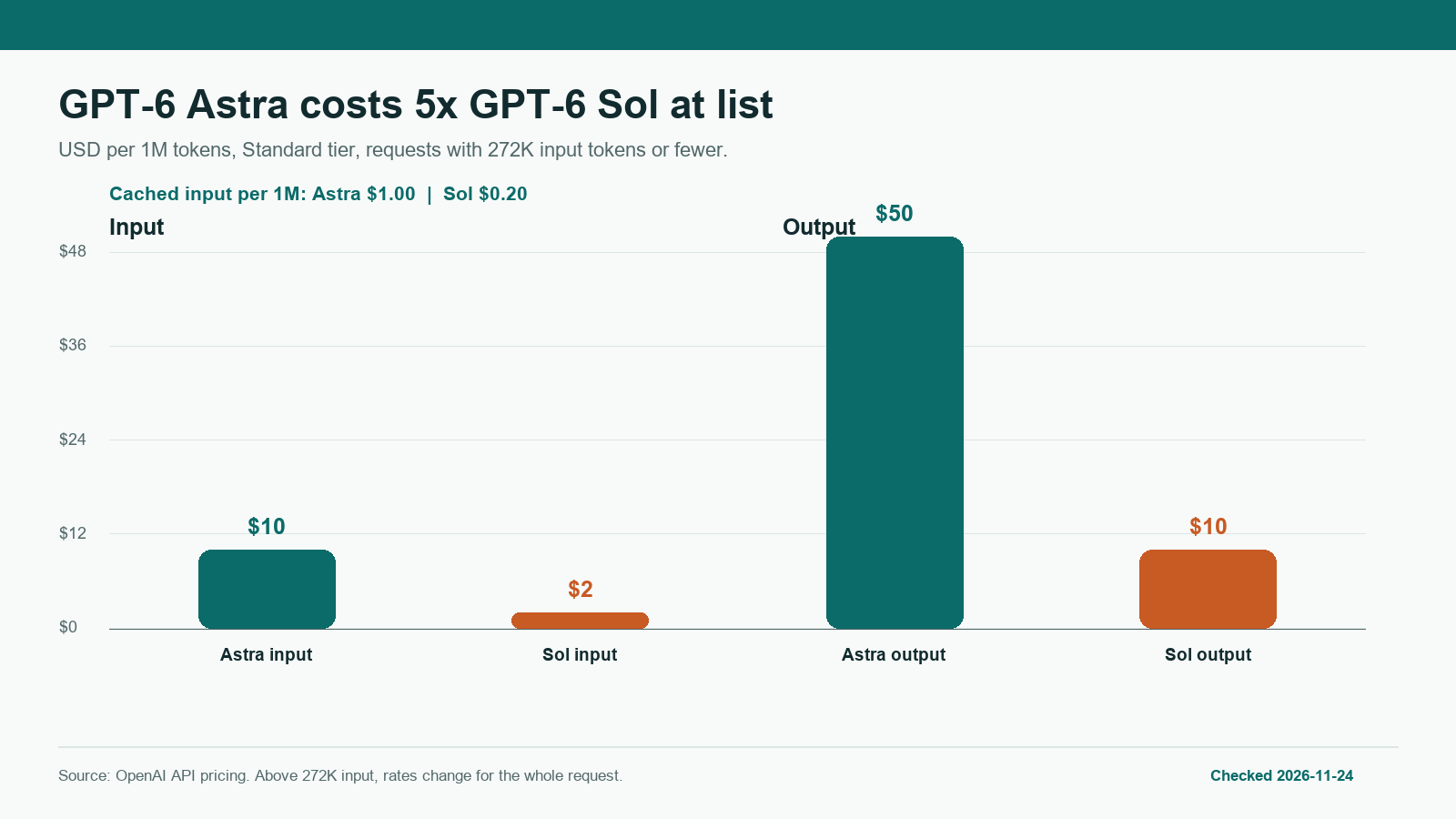
A rate is not a context limit. The 272K figure decides which price column applies. It does not prove that GPT-6 Astra accepts exactly 272K tokens, nor does it reveal the maximum input or output length. The frozen sources do not establish those limits. Keep the billing boundary and the model’s capacity boundary separate in code, documentation and forecasts.
For implementation details, use the model catalogue documentation and the API quickstart. Do not copy an ID from a newer model article. The model in this rate card is gpt-6-astra. The successor is gpt-6-2-astra, with different prices.
The 272K cliff, worked three ways
Start with the billing formula:
Request cost = input charge + output charge
Input charge = (uncached input tokens / 1,000,000) × input rate + (cached input tokens / 1,000,000) × cached-input rate
Output charge = (output tokens / 1,000,000) × output rate
Choose the rate for the request’s mode and context band before doing the multiplication. If total input exceeds 272K, the high-context rates apply to the input charge. The output charge uses the output rate from that same column.
Here is the official worked cliff with no cached tokens and no output:
| Uncached input tokens | Applied Standard input rate | Formula | Input cost |
|---|---|---|---|
| 100,000 | $10 per 1M | 0.1 × $10 | $1.00 |
| 272,000 | $10 per 1M | 0.272 × $10 | $2.72 |
| 272,001 | $20 per 1M | 0.272001 × $20 | $5.44002 |
| 500,000 | $20 per 1M | 0.5 × $20 | $10.00 |
The jump from 272,000 to 272,001 is not the price of one extra token. It is the price of moving every uncached input token from the $10 rate to the $20 rate. The input charge rises by $2.72002. That increase is more than twice the previous input charge.
Output makes the jump larger. Suppose both requests generate 4,000 output tokens:
- At 272,000 input tokens: $2.72 input + (0.004 × $50) output = $2.72 + $0.20 = $2.92.
- At 272,001 input tokens: $5.44002 input + (0.004 × $75) output = $5.44002 + $0.30 = $5.74002.
The total increase is $2.82002. The output count did not change. The higher context-price column raised both the input rate and the output rate.
This changes how to budget long prompts. A rough character-to-token estimate is not enough when a request sits close to the boundary. Count tokens with the implementation’s supported tokenizer or token-count path before dispatch. Leave a buffer for system instructions, retrieved passages, tool descriptions and the user’s newest message. If trimming a small amount of low-value context keeps the request at or below 272K, test whether that changes answer quality before adopting it as a cost control.
The cost-control documentation is the right place to turn this into request-level safeguards. A useful policy records input tokens, mode, cached-token count and output tokens alongside the resulting charge. Alert on requests near 272K rather than only on monthly spend. The threshold is sharp enough that a single request can distort a daily average.
Cached input math without inventing a write price
Cached input is cheaper in every GPT-6 Astra row. At or below 272K, Standard cached input is $1 instead of $10. Above 272K, it is $2 instead of $20. The same 90% input-side reduction holds for Batch/Flex and Fast.
For a mixed request, keep the two input classes separate:
Input charge = (uncached tokens / 1,000,000) × uncached rate + (cached tokens / 1,000,000) × cached rate
Take a Standard request with 200,000 uncached tokens, 72,000 cached tokens and 4,000 output tokens. Total input is 272,000, so the lower context column applies.
- Uncached input: 0.2 × $10 = $2.00.
- Cached input: 0.072 × $1 = $0.072.
- Output: 0.004 × $50 = $0.20.
- Total: $2.00 + $0.072 + $0.20 = $2.272.
If all 272,000 input tokens were uncached, the same request would cost $2.72 + $0.20 = $2.92. The cached prefix saves $0.648 in this example. That is a DERIVED comparison using published rates and a stated token mix.
The tier boundary still applies to mixed requests. Suppose a high-context Standard request contains 200,000 uncached tokens, 100,000 cached tokens and 4,000 output tokens:
- Uncached input: 0.2 × $20 = $4.00.
- Cached input: 0.1 × $2 = $0.20.
- Output: 0.004 × $75 = $0.30.
- Total: $4.50.
An all-uncached version would cost $6.00 + $0.30 = $6.30. Caching saves $1.80, but it does not return the request to the lower context-price column. Total input still exceeds 272K.
Repeated reads show why prefix design matters. Imagine ten Standard requests, each with the same 100,000-token cached prefix and 2,000 output tokens, all at or below 272K:
- Cached version per request: (0.1 × $1) + (0.002 × $50) = $0.10 + $0.10 = $0.20.
- Ten cached requests: 10 × $0.20 = $2.00.
- Uncached version per request: (0.1 × $10) + (0.002 × $50) = $1.00 + $0.10 = $1.10.
- Ten uncached requests: 10 × $1.10 = $11.00.
- Difference: $9.00, before any other charge.
This example assumes the prefix is already cached and remains eligible on every request. It does not include a cache-write or storage charge. The frozen GPT-6 Astra rate extract states cached-input prices but does not state a separate cache-write price. Without that number, an honest write-versus-read break-even calculation is impossible. Do not import another provider’s cache-write formula and label it OpenAI pricing.
The same caution applies to cache lifetime, minimum prefix size and eviction behavior. Those details are not established here. For gateway-side setup, read the prompt-caching documentation. For a provider with explicit write and read charges, the Opus 5.5 context-caching guide shows how a different cache contract changes the break-even math. It is a useful design comparison, not a substitute for missing Astra terms.
Batch/Flex: the same cliff at half the rate
O01 groups Batch and Flex in one price row. Every input, cached-input and output rate is exactly half of Standard in the same context band. The pricing reduction does not remove the 272K boundary.
Consider 100,000 uncached input tokens and 8,000 output tokens at or below 272K:
- Standard: (0.1 × $10) + (0.008 × $50) = $1.00 + $0.40 = $1.40.
- Batch/Flex: (0.1 × $5) + (0.008 × $25) = $0.50 + $0.20 = $0.70.
- Saving: $0.70, or 50% of the Standard request cost.
Now move the same request shape above the boundary, with 300,000 uncached input tokens and 8,000 output tokens:
- Standard: (0.3 × $20) + (0.008 × $75) = $6.00 + $0.60 = $6.60.
- Batch/Flex: (0.3 × $10) + (0.008 × $37.50) = $3.00 + $0.30 = $3.30.
- Saving: $3.30, again 50%.
These calculations assume the request is eligible for the listed Batch/Flex row. The frozen evidence does not provide a GPT-6 Astra completion window, throughput commitment or eligibility checklist. It also does not establish whether every integration path exposes the same mode. A lower rate is useful only if the workload can tolerate the service terms attached to it. Verify those terms in the current official documentation before moving an interactive feature to this row.
Use Batch/Flex for work that can wait and does not need an immediate response. Do not describe it as a universal discount. The rate card supplies a price relationship. It does not prove that two modes return identical answers, finish in the same time or support the same operational controls.
Fast: double the rate, no measured latency claim
Fast is exactly twice Standard in every GPT-6 Astra cell. At or below 272K, a request with 100,000 uncached input tokens and 8,000 output tokens costs:
- Standard: $1.40.
- Fast: (0.1 × $20) + (0.008 × $100) = $2.00 + $0.80 = $2.80.
Above 272K, with 300,000 uncached input tokens and 8,000 output tokens:
- Standard: $6.60.
- Fast: (0.3 × $40) + (0.008 × $150) = $12.00 + $1.20 = $13.20.
The arithmetic is clear. The performance benefit is not quantified in the frozen pack. No measured latency, tokens-per-second figure or completion-time comparison is provided for GPT-6 Astra Fast. Paying twice the list rate therefore needs a workload-specific test. Measure time to first token, total completion time and task success on your own prompts before treating Fast as a cost-effective choice.
There is no GPT-6 Ultrafast tier in this rate card. Ultrafast belongs to GPT-6.2 pricing. Do not attach the newer tier’s name or price to gpt-6-astra. The GPT-6.2 Astra pricing guide covers that separate model and its tier changes.
What the independent task costs do and do not prove
Artificial Analysis published its GPT-6 Astra benchmark snapshot on September 9, 2026. O04 used Max effort. It is an INDEPENDENT source for measured task economics and benchmark results, not an authority for API rates.
| O04 measure | September 2026 result | How to read it |
|---|---|---|
| Intelligence Index | 53 | Dated composite score; evaluator version not stated |
| Cost per Intelligence Index task | $3.26 | Measured task cost, not a list rate |
| Output tokens per task | About 27K | Approximate output volume in that evaluation |
| Coding Agent Index | 62 | Separate coding measure |
| Cost per coding task | $7.09 | Measured cost for that coding task set |
| Hallucination rate | 51% | Material reliability loss |
| Terminal-Bench v4.0 | 59% | Named benchmark and version |
| AutomationBench-AA | 69% | Independent automation measure |
| GDP.pdf | 31% | Separate document-task result |
The source did not state the Intelligence Index evaluator version. Do not label this snapshot v5.0.1 without evidence. Do not turn it into a current leaderboard rank. The GPT-6 Astra review covers the benchmark breakdown and the 51% hallucination result in more detail.
Task cost and token price answer different questions. If the roughly 27,000 output tokens were billed at the low-context Standard output rate, output alone would be:
(27,000 / 1,000,000) × $50 = $1.35
That does not reproduce O04’s $3.26 task cost. The snapshot does not disclose the input-token count, context-price band or complete billing mix needed to reconcile the two. The gap is useful: it shows why a per-task measurement cannot be reverse-engineered into an official token rate. Use O01 to price a known token mix. Use O04 to understand one dated evaluation’s economics.
There is also a snapshot conflict. O04 reports 53 at $3.26 per Intelligence Index task. The conflict ledger records a later November Eesel summary at 57 and $6.24 per task, but the Eesel URL is not in the verified source register, so that later pair remains UNCONFIRMED here. The available evidence does not establish matched evaluator versions, effort settings or task mixes. Keep both numbers visible and do not blend them into one trend. Neither row is a current rank.
GPT-6 Astra is not GPT-6.2 Astra
The names are close. The models and rate cards are not interchangeable. OpenAI’s GPT-6.2 announcement describes a separate release. Under the same O01 pricing source, GPT-6.2 Astra Standard is $8 input, $0.40 cached input and $40 output at or below 272K. Above 272K, it is $16, $0.80 and $60.
Compare that with GPT-6 Astra Standard at $10, $1 and $50 below the boundary, then $20, $2 and $75 above it. The successor’s Standard list rates are lower in all six cells. That does not establish that the successor is the better buy for a specific task. Quality, effort, latency, cache behavior and access still need a matched comparison.
Keep model IDs exact in routing rules, spend dashboards and evaluation logs. A cost alert attached to gpt-6-2-astra does not describe spending on gpt-6-astra. The November frontier-model landscape and the model comparison tool can help frame the choice, but neither replaces a test on your own workload.
Cross-model list rates are context, not a verdict
The same frozen evidence provides Standard list rates for several alternatives. These figures are useful for orientation:
| Model | Standard input | Cached input | Standard output |
|---|---|---|---|
| GPT-6 Astra at or below 272K | $10 | $1 | $50 |
| Claude Fable 5.2 | $8 | $0.20 | $40 |
| Claude Opus 5.5 | $4 | $0.20 | $20 |
| Gemini 4 Neon | $3 | $0.15 | $15 |
Sources: O01 for GPT-6 Astra, Anthropic pricing for Fable and Opus, and Google AI Studio pricing for Neon, all checked November 24, 2026.
The cached-input column does not mean the providers have identical cache contracts. Anthropic publishes explicit cache-write and cache-read charges with time-based retention. Neon’s frozen pricing entry describes implicit caching and shows no explicit storage price. GPT-6 Astra’s separate cache-write price is not established here. A simple three-column table cannot capture those differences.
Task suitability matters too. The Fable 5.2 pricing breakdown covers its write charges and Batch/Fast rows. The Opus 5.5 pricing analysis covers endpoint premiums and its no-separate-above-200K-surcharge boundary. The Fable 5.2 launch details and Fable 5.2 review explain safeguards and benchmark caveats that a price table cannot show.
If reliability or deployment constraints drive the decision, read the Opus 5.5 review, the Opus 5.5 alternatives guide and the GPT-6 Sol versus Claude Opus 5.5 comparison. OpenAI’s GPT-6 Sol launch page describes a different model, not a discount alias for Astra. The frozen pack does not give GPT-6 Sol a gateway model page.
Availability, routing and budget controls
The gateway catalogue has a page for gpt-6-astra at /models/gpt-6-astra. That is the truthful access destination for this model. GPT-6 Sol does not have a corresponding gateway model page in the checked catalogue. Official API existence and gateway listing are separate claims. Before sending production traffic, check the model status page for current availability.
Routing should consider more than price. Long prompts need token accounting and a 272K alert. Interactive features need measured latency. Batch work needs confirmed eligibility and acceptable completion terms. Cache-heavy agents need stable prefixes and verified cache behavior. Refusal-sensitive workloads need an explicit failure path.
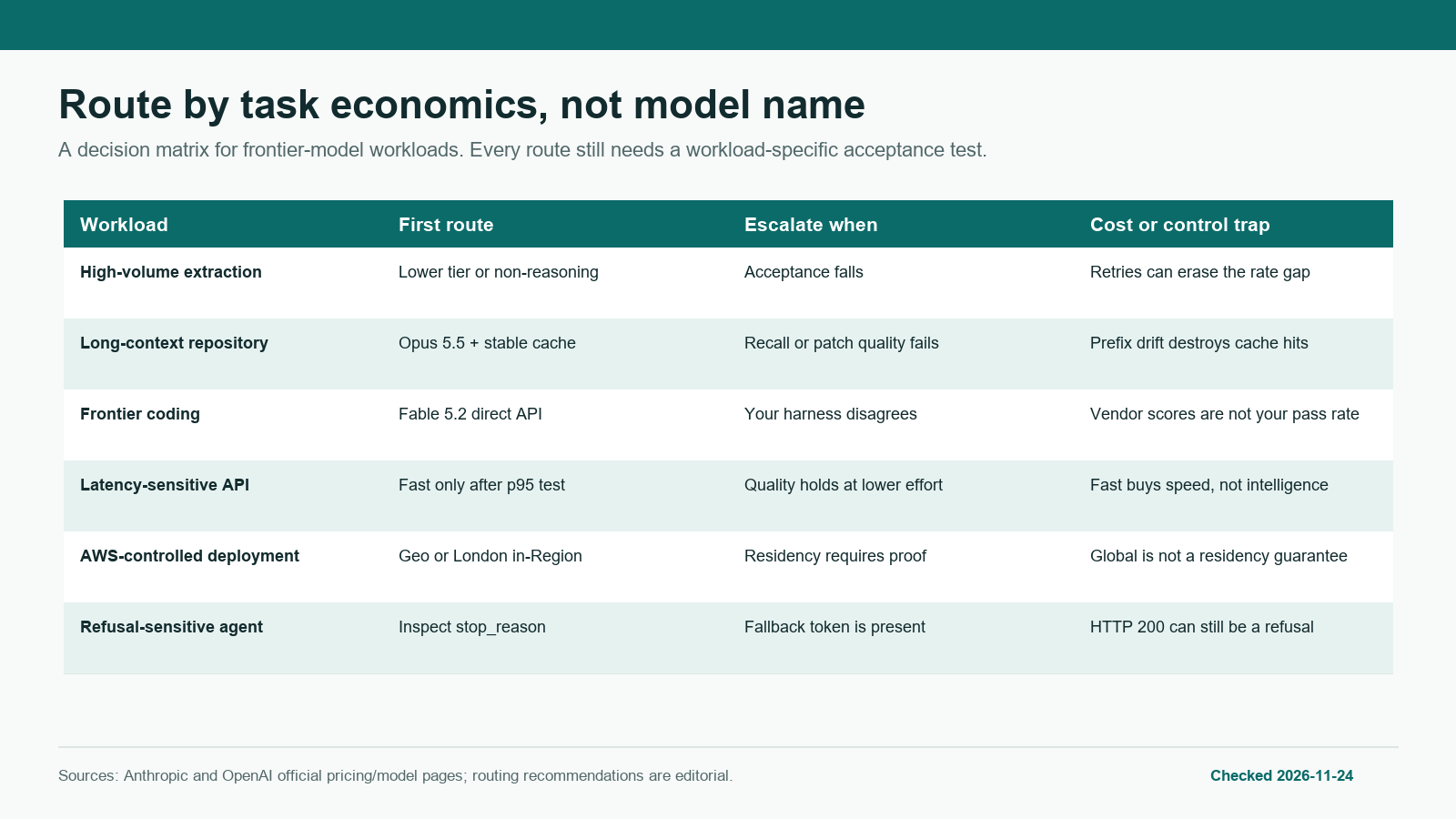
For AWS-specific deployment questions, the Opus 5.5 Bedrock routing guide explains a different provider’s inference profiles, London in-Region option and Mantle limitations. Do not assume those routes exist for GPT-6 Astra. For refusal handling on Claude, the Fable 5.2 production-routing guide explains why HTTP 200 alone is not a success check and why fallback credits have narrow eligibility. The lesson is transferable: inspect the response, not only the status code. The exact fallback rules are not.
A practical routing policy can be simple:
- Count total input before choosing a model and mode.
- Select the context-price band from that count.
- Split uncached and cached input tokens in the estimate.
- Estimate output from observed task history, with a safety margin.
- Choose Standard, Batch/Flex or Fast based on measured service needs.
- Record the actual token counts and reconcile the estimate after the request.
- Alert when a request approaches 272K or when actual cost diverges from the estimate.
The cost calculator is useful for scenario checks. Enter the token mix and the correct context band. A calculator fed only average input and output tokens can miss the cliff entirely.
What the public record still does not show
Several facts remain UNKNOWN for GPT-6 Astra in the frozen evidence:
- Context window: The maximum accepted context length is not verified.
- Input limit: The maximum input-token count is not verified.
- Output limit: The maximum output-token count is not verified.
- Knowledge cutoff: No cutoff date is established.
- Complete effort set: O04 identifies Max effort for its evaluation, but it does not enumerate every Astra effort setting.
- Cache write terms: A separate cache-write rate, retention period and minimum prefix size are not stated in the frozen rate extract.
- Batch/Flex service terms: Completion windows, eligibility and throughput commitments are not provided.
- Fast performance: No controlled latency comparison is included.
These gaps do not block arithmetic with known rates. They do block claims about capacity, freshness, the full reasoning ladder or cache break-even. The 272K pricing threshold cannot fill any of those cells. Update this article only when a dated official source supplies the missing value. Until then, UNKNOWN is the accurate answer.
The benchmark record also remains snapshot-dependent. O04 is a September Max-effort measurement without a named Intelligence Index evaluator version. The later Eesel summary disagrees on score and task cost. Preserve the disagreement rather than selecting the more convenient number.
A monthly estimate with the cliff included
A per-request formula becomes more useful when it feeds a monthly forecast. Suppose a team expects 1,000 requests per day for a 30-day month. Each request has 80,000 uncached input tokens, a reused 20,000-token cached prefix and 3,000 output tokens. Total input is 100,000, so the lower context column applies.
Standard per request = (0.08 × $10) + (0.02 × $1) + (0.003 × $50) = $0.80 + $0.02 + $0.15 = $0.97
Batch/Flex per request = (0.08 × $5) + (0.02 × $0.50) + (0.003 × $25) = $0.40 + $0.01 + $0.075 = $0.485
Fast per request = (0.08 × $20) + (0.02 × $2) + (0.003 × $100) = $1.60 + $0.04 + $0.30 = $1.94
At that stated volume, Standard is $970 per day and $29,100 for 30 days. Batch/Flex is $485 per day and $14,550 for the month. Fast is $1,940 per day and $58,200 for the month. The mode changes the estimate substantially even though the token mix stays fixed.
Now change only the input mix. Keep 1,000 requests per day, 3,000 output tokens and the 20,000-token cached prefix, but raise uncached input to 260,000 tokens. Total input is now 280,000, so the entire request uses the higher column.
Standard per request = (0.26 × $20) + (0.02 × $2) + (0.003 × $75) = $5.20 + $0.04 + $0.225 = $5.465
That is $5,465 per day and $163,950 over 30 days. The comparison is deliberately mechanical. It isolates the effect of crossing 272K rather than claiming that every workload will grow this way. It also assumes every cached token remains eligible and excludes any cache-write, storage or gateway charge not stated in the frozen evidence. Use the result as a scenario, not a quote.
How to use this without overbuying
For a small, latency-sensitive request at or below 272K, Standard is the base case. Estimate uncached input, cached input and output separately. If a stable prefix is reused, test the cached path and record the actual cached-token count. Do not assume every token in a repeated prompt qualifies.
For work that can wait, compare the Batch/Flex price with the operational cost of delay. The 50% rate reduction is real in the table. The missing service terms still need verification before you move a user-facing feature.
For a request near 272K, test whether removing low-value context preserves quality. If it does, the lower price band can outweigh a small reduction in prompt size. If it does not, budget for the high-context column from the start. Do not plan on the lower rate and hope the final token count stays under the boundary.
For latency-sensitive work, measure Fast on your own prompts. Its price is exactly double Standard, but the frozen evidence does not quantify the speed gain. A higher rate is not proof of a better outcome.
Before buying access, check the GPT-6 Astra model page, review the gateway pricing and confirm current status. You can also create an API key, browse the model catalogue or estimate a workload with the cost calculator. Use the rankings for dated evaluation context, not as a substitute for a matched task test.