Claude Opus 5.5 has a list API price of $4 per million input tokens and $20 per million output tokens. Its context window is 1M tokens and its maximum output is 128K tokens. Anthropic lists no separate surcharge above 200K input tokens. That is a statement about the published rate table, not a promise that every request will cost the same amount.
Cache writes cost $5 for five minutes or $8 for one hour. Cache reads cost $0.20 per million tokens. Batch cuts input and output to $2/$10. Fast raises them to $8/$40 across the full context window, and Fast cannot be combined with Batch. Applicable regional and multi-region endpoints carry a 10% premium over global endpoints.
The catch is simple. Thinking, output volume, cache writes and endpoint choice still raise the final bill. This article works through those charges for buyers and operators who need a budget, not a headline price. All rates below are Anthropic list rates in USD per 1M tokens unless stated otherwise. They are not gateway rates.
The short answer
- Base list price: $4 input and $20 output per 1M tokens.
- Long context: 1M-token context window, 128K maximum output, and no separate above-200K surcharge listed.
- Cache: $5 for a five-minute write, $8 for a one-hour write and $0.20 for a read.
- Batch: $2 input and $10 output, a 50% discount.
- Fast: $8 input and $40 output across the full context window. Batch and Fast cannot combine.
- Endpoint premium: 10% for applicable regional and multi-region endpoints, not a blanket charge on every US customer or every Bedrock request.
- Main loss: Flat input rates do not flatten the bill. Generation, thinking, cache writes and endpoint selection remain separate cost drivers.
- Gateway boundary:
/models/claude-opus-5-5exists in the checked catalogue. The frozen evidence pack does not provide a gateway rate, so this article does not quote one.
The Opus 5.5 list price sheet
Start with the official Anthropic pricing page. The relevant Opus 5.5 rows are compact, but they describe different events. An uncached input token, a cache write and a cache read are not interchangeable units.
| Charge | Opus 5.5 list rate |
|---|---|
| Uncached input | $4 per 1M tokens |
| Output | $20 per 1M tokens |
| Prompt-cache write, five minutes | $5 per 1M tokens |
| Prompt-cache write, one hour | $8 per 1M tokens |
| Prompt-cache read | $0.20 per 1M tokens |
| Batch input / output | $2 / $10 per 1M tokens |
| Fast input / output | $8 / $40 per 1M tokens |
| Applicable regional or multi-region endpoint | 10% above global |
The Opus 5.5 announcement and models overview establish the model identity and limits. Opus 5.5 uses the API ID claude-opus-5-5, launched on September 22, 2026, and has a June 2026 knowledge cutoff. Adaptive thinking is always on, with low, medium, high, xhigh and max effort settings. Medium is the default.
Those model details matter to a forecast because effort and generated volume can change the output side of a request. They do not create another input-price tier. For a neighboring Claude price comparison, the Fable 5.2 pricing breakdown covers the same charge categories at Fable’s higher list rates.
The distinction between list price and gateway price is worth stating before any arithmetic. Anthropic’s table describes the vendor API. A subscription allowance is a different product. A reseller or gateway may publish its own rate. The Claude Opus 5.5 model page confirms that the model has a catalogue entry here, while the current gateway pricing page is the place to check any hosted rate.
How the list price compares with Fable 5.2
Opus 5.5 sits at half of Fable 5.2’s Standard list rate for both input and output. Fable’s published rates are $8 input and $40 output, exactly twice Opus 5.5’s $4/$20. Its five-minute and one-hour cache writes are $10 and $16, also twice Opus 5.5’s $5 and $8. Cache reads are the same $0.20 for both models.
The same two-to-one relationship appears in the other modes. Fable Batch is $4/$20, while Opus 5.5 Batch is $2/$10. Fable Fast is $16/$80, while Opus 5.5 Fast is $8/$40. These are list-price comparisons only. They do not establish which model completes a particular task with fewer tokens or fewer retries.
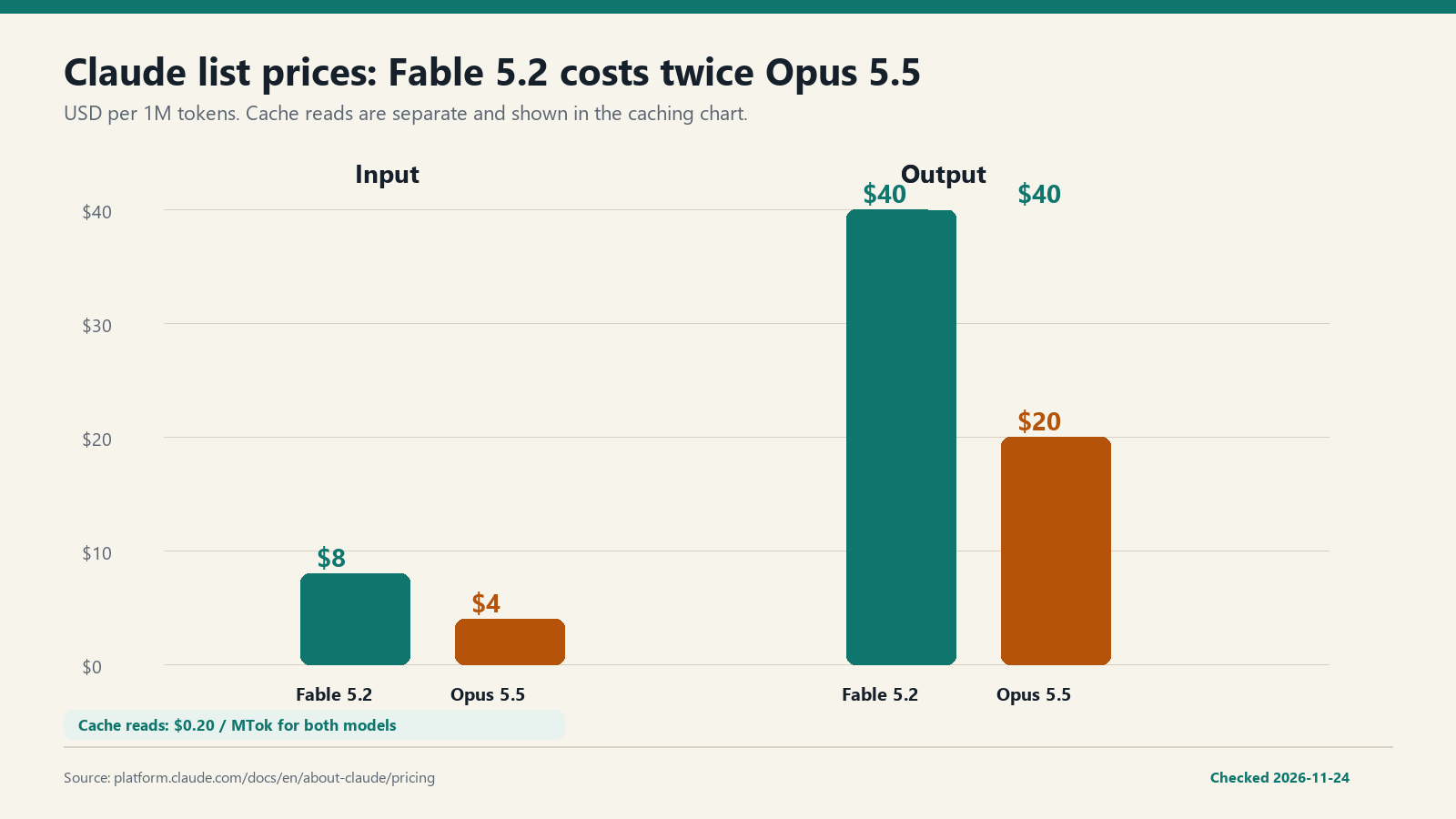
A lower rate is not automatically a lower task cost. If Fable finishes a workflow with materially less output or fewer attempts, the result could reverse. The frozen pricing evidence cannot settle that question. Use the Fable 5.2 review for the evidence boundaries around model quality, then price both models with token counts from the same task sample.
What 1M context changes, and what it does not
A 1M-token context window lets an application carry much more material into a request. It does not, by itself, introduce a higher Opus 5.5 input rate in the published table. Anthropic’s pricing text says a 900K-token request is billed at the same per-token rate as a 9K-token request.
Use the narrow claim: no separate above-200K surcharge is listed. Do not turn that into “the bill can never change.” A longer prompt still contains more billable input tokens. A longer answer still contains more billable output tokens. A cache write still has its own rate. An eligible endpoint still has its premium.
The chart below isolates uncached input cost. It is useful because it removes output and caching from the picture, but that is also its limitation.
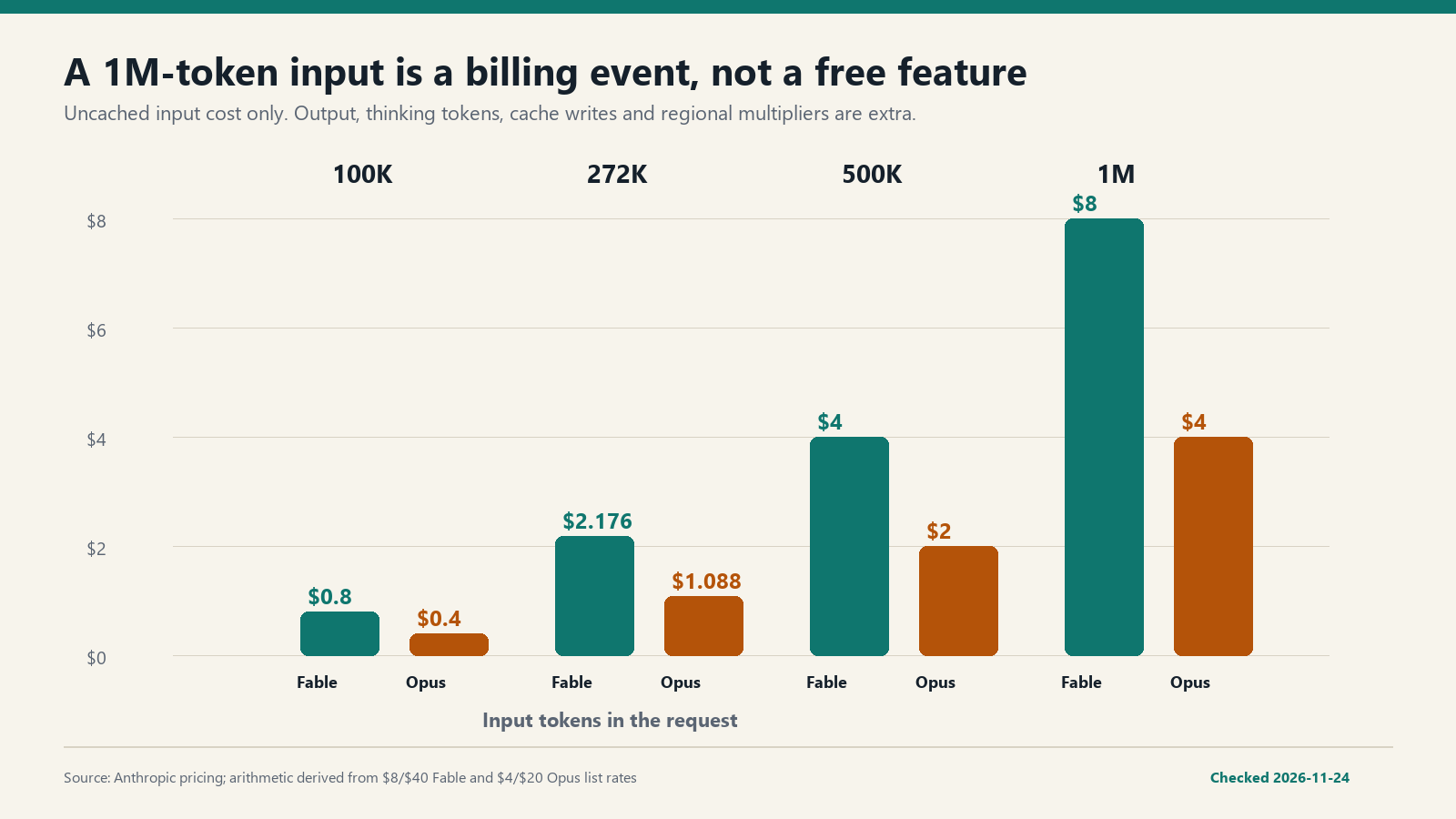
For Opus 5.5, the input-only values are straightforward:
| Uncached input | DERIVED input cost |
|---|---|
| 100K tokens | $0.40 |
| 272K tokens | $1.088 |
| 500K tokens | $2.00 |
| 1M tokens | $4.00 |
The formula is input tokens ÷ 1,000,000 × $4. The total rises with token count, while the rate per token stays flat in the listed table.
At 1M uncached input tokens and 50K output tokens, the DERIVED request totals are $5.00 Standard, $2.50 Batch and $10.00 Fast before cache charges or endpoint premiums. Output stays fixed at $1.00 Standard, $0.50 Batch or $2.00 Fast. This is arithmetic from the listed rates, not a guarantee that every deployment accepts that exact input-and-output combination at the same time. The published facts establish a 1M context window and a 128K maximum output separately. Check the current request limits before treating both maxima as one usable bundle.
That behavior differs from a genuine long-context price cliff. The GPT-6 Astra pricing guide explains the 272K threshold where Astra’s higher input rate applies to the whole request. The official OpenAI pricing page lists that threshold and its rates. Astra’s independent review keeps benchmark snapshots separate from the pricing rule. Opus 5.5 should not be described with the same cliff unless Anthropic publishes one.
Worked arithmetic: 100K input and 50K output
Assume one request has 100,000 uncached input tokens and 50,000 output tokens. Output is below the 128K maximum. Ignore caching and endpoint premiums for the first pass.
DERIVED, Standard:
0.1 × $4 + 0.05 × $20 = $0.40 + $1.00 = $1.40
DERIVED, Batch:
0.1 × $2 + 0.05 × $10 = $0.20 + $0.50 = $0.70
DERIVED, Fast:
0.1 × $8 + 0.05 × $40 = $0.80 + $2.00 = $2.80
| Mode | Input charge | Output charge | DERIVED total |
|---|---|---|---|
| Standard | $0.40 | $1.00 | $1.40 |
| Batch | $0.20 | $0.50 | $0.70 |
| Fast | $0.80 | $2.00 | $2.80 |
Output is 71.4% of the Standard total even though input has twice as many tokens. That is the first budgeting lesson. The $4 headline is not the price of the whole request.
If the selected endpoint is subject to the documented 10% premium, the illustrative Standard total becomes $1.40 × 1.10 = $1.54. That calculation is conditional. It does not mean every request from a US account pays 10% more. The endpoint, not the customer’s postal address, determines whether that line applies.
For a quick uncached input-and-output estimate, use the cost calculator. Its form does not accept separate cache-read, cache-write or retry fields, so add those charges outside the estimate. Combining token classes before pricing hides the cache effect.
Worked arithmetic: 500K input and 50K output
Now hold output at 50K tokens and raise uncached input to 500K tokens. Both examples fit within the stated context and output limits.
DERIVED, Standard:
0.5 × $4 + 0.05 × $20 = $2.00 + $1.00 = $3.00
DERIVED, Batch:
0.5 × $2 + 0.05 × $10 = $1.00 + $0.50 = $1.50
DERIVED, Fast:
0.5 × $8 + 0.05 × $40 = $4.00 + $2.00 = $6.00
| Mode | Input charge | Output charge | DERIVED total |
|---|---|---|---|
| Standard | $2.00 | $1.00 | $3.00 |
| Batch | $1.00 | $0.50 | $1.50 |
| Fast | $4.00 | $2.00 | $6.00 |
Moving from 100K to 500K input multiplies the input charge by five. The total rises from $1.40 to $3.00, or about 2.14 times, because output stays fixed. This is why a team can correctly report “flat long-context input pricing” and still see a much larger invoice after sending more context.
If the applicable endpoint premium is 10%, the DERIVED totals become $3.30 Standard, $1.65 Batch and $6.60 Fast. Use those only after confirming that the endpoint and mode qualify. Bedrock’s supported-mode rules are different, as covered below.
The model comparison page can help narrow candidates before this arithmetic begins. A lower rate on paper is not enough if the alternative needs more retries or longer output to complete the same task.
From one request to a monthly forecast
A rate becomes a budget only after it is multiplied by a measured request mix. Suppose a service sends 1,000 requests in a month, each with 500K uncached input tokens and 50K output tokens. This is a hypothetical workload, not a usage claim.
DERIVED monthly totals before premiums and caching:
| Mode | One request | 1,000 requests |
|---|---|---|
| Standard | $3.00 | $3,000 |
| Batch | $1.50 | $1,500 |
| Fast | $6.00 | $6,000 |
For that workload, Batch saves $1,500 against Standard. Fast adds $3,000. If every request used an eligible premium endpoint, the corresponding DERIVED totals would be $3,300, $1,650 and $6,600. That conditional is exactly why endpoint scope belongs in the forecast rather than in a footnote.
Output uncertainty deserves its own range. At 500K uncached input tokens, a 10K-output request costs $2.20 Standard, a 50K-output request costs $3.00, and a 128K-output request costs $4.56. Across 1,000 such requests, the DERIVED Standard range is $2,200 to $4,560 before cache charges or premiums. The input rate never changes in that range. The output count more than doubles the total.
Ask a usage report for five separate lines: uncached input, cache-write tokens by lifetime, cache-read tokens, output tokens, and the endpoint or mode used. A single “tokens processed” total cannot reproduce the bill. It also cannot show whether a caching project saved money or merely moved cost into writes.
Cache math: $5 and $8 writes, $0.20 reads
Prompt caching charges for storing a reusable prefix and then charges much less to read it. Opus 5.5 supports explicit caching with a minimum of 512 tokens per checkpoint and up to four checkpoints. The available lifetimes are five minutes and one hour.
At list price, a five-minute write costs 1.25 times an uncached input read of the same token count. A one-hour write costs twice as much. A cache read costs 5% of the uncached input rate: $0.20 ÷ $4 = 0.05.
That produces two break-even points:
- Five-minute cache: the write repays after approximately two reads.
- One-hour cache: the write repays after approximately three reads.
These are DERIVED input-side comparisons. They assume the prefix stays stable and every intended read hits the cache. Output is separate in every request.
A small prefix makes the arithmetic visible. For a 100K-token prefix, an uncached read costs $0.40. A five-minute write costs $0.50 and each cache read costs $0.02. The write plus two reads costs $0.54, below the $0.80 cost of two uncached reads. A one-hour write costs $0.80. The write plus two reads costs $0.84, just above two uncached reads. A third cache read takes the cumulative cost to $0.86, below $1.20 for three uncached reads.
A cached 500K-prefix example
Assume a stable 500K-token prefix, 100K fresh input tokens and 50K output tokens on each request. The first request writes the prefix. Later requests read it.
DERIVED, five-minute cache, first request:
500K ÷ 1M × $5 + 100K ÷ 1M × $4 + 50K ÷ 1M × $20
= $2.50 + $0.40 + $1.00 = $3.90
DERIVED, each later cache-hit request:
500K ÷ 1M × $0.20 + $0.40 + $1.00
= $0.10 + $0.40 + $1.00 = $1.50
Without caching, each request costs $3.40. After the first write and two reads, the five-minute path costs $6.90 across three requests, compared with $10.20 for three uncached requests. The DERIVED saving is $3.30.
With a one-hour write, the first request costs $5.40. Two later reads bring the three-request total to $8.40, compared with $10.20 uncached. The DERIVED saving is $1.80. Across these same three requests, the one-hour path costs $1.50 more than the five-minute path. Its advantage is keeping the prefix reusable beyond the five-minute window, not a lower cost when both checkpoints survive.
The Opus 5.5 context-caching guide goes deeper into prefix design. The prompt-caching documentation is the implementation reference. Measure hit rate before treating cache reads as guaranteed. A changed system prompt, reordered tools or edited history can turn an expected read into fresh input or another write.
Cache savings also do not erase generation cost. In the example, every request still has $1.00 of output at 50K tokens. If your application raises output length while improving cache hits, the output bill can offset the input saving.
Price the miss as well as the hit. In the 500K-prefix example, a cache-hit request costs $1.50. If the whole prefix misses and is billed as fresh input, the same request costs $3.40: $2.00 of prefix input, $0.40 of fresh input and $1.00 of output. The DERIVED difference is $1.90 per miss. Ten misses add $19.00 compared with ten hits, before any replacement write charge.
That is why hit rate belongs beside TTL choice in a forecast. A one-hour checkpoint only helps when the prefix remains stable and is reused after the five-minute window. The four-checkpoint limit also means an application cannot assign an independent cache entry to every changing section. Prioritize large, stable prefixes and measure the result. The 512-token minimum makes very small checkpoints a poor candidate for explicit caching.
Fast and Batch are different trades
Batch and Fast solve different problems. Batch discounts both input and output by 50%. Fast doubles the Standard input and output rates. They cannot be combined, so there is no valid “Fast Batch” rate of $1/$5 or $3/$15 in this price sheet.
Fast pricing applies across the full context window. There is no cheaper Fast rate for the first 200K tokens followed by a higher rate above it. For the 500K-input, 50K-output example, Fast costs $6.00 at list before any eligible endpoint premium.
The pricing evidence establishes the Fast rate, not a latency result. It is reasonable to evaluate Fast for work where response time matters, but this article does not claim a measured speedup. The frozen pack contains no controlled Fast-versus-Standard timing test.
Batch is useful when work can wait, but the pack does not specify a turnaround commitment. Do not attach an invented delivery window to the 50% discount. If a user is waiting for a result, compare the experience and the mode restrictions before choosing Batch on price alone.
Output remains the largest hidden multiplier in both modes. DERIVED: if a request generated the full 128K output allowance, output alone would cost $2.56 at Standard, $1.28 at Batch or $5.12 at Fast. Those figures exclude input, cache charges and any endpoint premium. Always-on adaptive thinking makes generated volume worth measuring rather than assuming.
The GPT-6 Sol versus Opus 5.5 comparison is useful when mode choice is only one part of a routing decision. The Opus 5.5 review separates official benchmark claims from an independent snapshot. Price per request becomes more meaningful when paired with cost per successful task.
The 10% regional premium has a scope
Anthropic lists a 10% premium for applicable regional and multi-region endpoints over global endpoints. The important word is applicable. The fact pack does not authorize a blanket statement that every US customer pays more, or that every AWS Bedrock request carries the premium.
For an eligible endpoint, the arithmetic is a 1.10 multiplier. The 500K/50K Standard example moves from $3.00 to $3.30. Fast moves from $6.00 to $6.60. A direct-API Batch example moves from $1.50 to $1.65, provided that endpoint supports the Batch mode being priced.
Do not infer the endpoint from the billing address. Do not infer it from the model ID alone. Check the selected endpoint’s price entry and routing configuration. The Bedrock routing guide for Opus 5.5 covers the AWS-specific IDs and constraints that sit beside this premium.
This is also a routing decision, not only a finance decision. A team may need a particular processing geography for policy reasons. The right comparison includes the endpoint’s documented behavior and the actual invoice line, not just the global headline rate.
Bedrock is a separate route, not a discount tier
The AWS Bedrock model card lists these Opus 5.5 identifiers:
anthropic.claude-opus-5-5global.anthropic.claude-opus-5-5us.anthropic.claude-opus-5-5eu.anthropic.claude-opus-5-5au.anthropic.claude-opus-5-5jp.anthropic.claude-opus-5-5
For the bare ID, in-Region inference is available only in eu-west-2 London. That is narrower than assuming that any bare model ID runs locally in any chosen Region.
Bedrock supports Standard only for Opus 5.5. Priority, Flex, Reserved and Batch are unsupported. Do not carry the direct Anthropic API Batch discount into a Bedrock Standard forecast. The supported bedrock-runtime APIs are Messages, Converse and Invoke. Responses and Chat Completions are unsupported.
Mantle is another route with its own boundaries. bedrock-mantle supports Messages in us-east-1, ap-southeast-4 and us-gov-west-1. It lacks Guardrails, Knowledge Bases, Agents, Flows, Prompt Management, Application Inference Profiles and Invocation Logs. Mantle supports Count tokens; bedrock-runtime does not support Count tokens for this model.
Mantle is billed through AWS Marketplace. Its charges appear under the model provider rather than Amazon Bedrock in AWS billing and Cost Explorer. That accounting difference matters when a finance team tries to reconcile a forecast with a cloud bill.
None of these Bedrock facts supplies a Bedrock-specific dollar rate in the frozen pack. The Anthropic list table is not an AWS invoice quote. Confirm the chosen route, Region, mode and current provider price before committing a budget.
What the gateway listing does and does not promise
The checked catalogue includes /models/claude-opus-5-5 for the official ID claude-opus-5-5. That supports a narrow statement: the model page exists. The frozen pack does not include the gateway’s current per-token rate, so no gateway price is quoted here.
Use the Opus 5.5 catalogue page to check access, the gateway pricing page to check hosted rates and the status page to check current availability. The model documentation explains the supported catalogue and API details. These are separate checks from reading Anthropic’s list price.
An independent snapshot from Artificial Analysis, checked November 24, 2026, lists Opus 5.5 at $4/$20 with 1M context. It reports an Intelligence Index of 59 at Max effort using evaluator v5.0.1, with Medium as the default effort. That is a useful cross-check of the public model profile. It is not a gateway quote and it is not a cost-per-success measurement for your workload.
For a broader buying view, the Opus 5.5 alternatives guide compares candidates without declaring a universal winner. The Qwen4 Max comparison and Gemini 4 Neon comparison cover two alternative routes. The November frontier-model shortlist provides the wider cluster context.
How to budget without overbuying
A defensible Opus 5.5 estimate needs five inputs:
- Fresh input tokens. Price these at $4 per 1M for Standard, $2 for Batch or $8 for Fast.
- Cached input tokens. Separate cache reads from cache writes. Reads are $0.20 per 1M.
- Cache writes. Count checkpoints and choose the five-minute or one-hour rate. Do not assume every request is a hit.
- Output tokens. Use observed generation length, including the effect of effort, rather than the 128K maximum as a default.
- Endpoint premium. Apply 10% only when the selected endpoint’s pricing makes it applicable.
Then compare modes on the same token counts. A 100K/50K request costs $1.40 Standard, $0.70 Batch or $2.80 Fast before premiums. A 500K/50K request costs $3.00, $1.50 or $6.00. Those pairs are more useful than a single headline rate because they show how much of the bill comes from output.
Set controls before sending a large batch of prompts. The cost-control documentation covers spend limits and usage controls. The cost calculator can estimate a monthly bill from average observed input and output counts. It does not model cache events or retry distributions, so keep those in the forecast. Track cache hit rate and output tokens per successful task alongside total spend.
Quality comparisons need the same discipline. The Fable 5.2 review keeps vendor-reported and independent evidence separate. The Fable 5.2 launch guide explains the neighboring model’s access and effort details. If your workload includes refusal-sensitive routing, the Fable 5.2 production-routing guide covers an adjacent operational case. Do not transfer one model’s access rules to another.
A practical review sequence is to price a real sample, measure successful-task cost, test the required mode, and only then apply an endpoint premium. This avoids optimizing the input rate while ignoring retries, longer output or cache misses.
What the frozen record does not show
The public record in this pack does not provide a current oneaiapikey.com rate for Opus 5.5. It also does not provide a controlled Fast-versus-Standard latency test, a Batch turnaround commitment or a Bedrock-specific dollar quote. Those gaps should remain gaps rather than become assumptions.
The long-context statement is equally bounded. The safe conclusion is that Anthropic lists no separate above-200K surcharge and says 900K and 9K requests use the same per-token input rate. The safe planning move is still to count every input token, every output token and every cache event.
If your estimate depends on one of the missing items, verify it in the current vendor or gateway documentation before purchase. Based on the frozen sources checked November 24, 2026, the confirmed position is $4/$20 list pricing, 1M context, 128K maximum output, defined cache charges, separate Batch and Fast modes, and a scoped 10% endpoint premium. Everything else needs its own evidence.