Route high-volume, well-bounded work toward GPT-6 Sol when its lower list price matters. Route harder agentic work and verified long-context requirements toward Claude Opus 5.5. GPT-6 Sol Standard costs $2 input, $0.20 cached input and $10 output per million tokens through 272K input. Opus 5.5 costs $4 input and $20 output, with cache reads at $0.20. The important limitation is that GPT-6 Sol is not GPT-6.2 Sol, its official context limits remain UNKNOWN in the checked evidence, and no shared benchmark establishes a universal winner.
Access is a separate decision. As checked on 2026-11-24, Opus 5.5 has a gateway model page. GPT-6 Sol does not. Its official direct-API existence does not create a gateway route. This article separates list-price arithmetic, vendor claims, independent measurements and deployment rules so a router does not silently substitute a different generation or promise access that is not there.
The short answer
- Main price win: GPT-6 Sol is half the Opus input and output rate at Standard short-context list prices.
- Main price trap: Above 272K input, Sol moves to $4 input, $0.40 cached input and $15 output for the whole request.
- Main evidence win for Opus: Artificial Analysis reports Intelligence Index 59 at Max, with evaluator v5.0.1, against a GPT-6 Sol snippet of 44 at Max.
- Main evidence loss for Sol: The accessed record does not verify its official context, input or output limits. A lower rate is not proof that a larger request is accepted.
- Main routing rule: Pin the exact generation, effort, service tier, cache policy and fallback. Never route on the word “Sol” alone.
- Availability: Opus is listed on the gateway. GPT-6 Sol is an official direct-API model without a gateway model page in this check.
First separate GPT-6 Sol from GPT-6.2 Sol
The names are close enough to create an expensive production mistake. GPT-6 Sol has Standard rates of $2 input, $0.20 cached input and $10 output per million tokens at or below 272K input. GPT-6.2 Sol has a $0.10 cached-input rate at the same tier, according to the frozen pricing record. Those are different products. A configuration that says only sol cannot tell an operator which generation will run, which cache rate applies or which evidence supports the choice.
The official identifier in the evidence pack is gpt-6-sol. Use it for direct-API configuration only after confirming the provider route. Do not turn it into a oneaiapikey.com identifier. The gateway catalogue currently exposes claude-opus-5-5, not GPT-6 Sol. That asymmetry belongs in the routing registry, not in a footnote.
Generation control also affects how you read older comparisons. The GPT-6.2 versus GPT-6 Astra version guide explains why a successor label cannot be treated as a silent upgrade. Likewise, the Qwen4-Max versus GPT-6.1 Sol comparison is evidence about a different model. Neither supplies a GPT-6 Sol result. Keep the exact model string, the provider and the evidence date in one record.
For a broader lineup view, use the November frontier model guide and the rankings hub. Use them to find candidate models, not to replace a workload-specific test. The model documentation index is the place to verify identifiers before a release.
The list-price split, line by line
All prices below are USD per 1,000,000 tokens. They are vendor list rates, not subscription allowances and not oneaiapikey.com gateway prices. OpenAI’s API pricing page is the source for GPT-6 Sol. Anthropic’s pricing documentation is the source for Opus 5.5. Both were checked on 2026-11-24.
| Charge | GPT-6 Sol Standard, input at or below 272K | GPT-6 Sol Standard, input above 272K | Claude Opus 5.5 |
|---|---|---|---|
| Uncached input | $2.00 | $4.00 | $4.00 |
| Cached input read | $0.20 | $0.40 | $0.20 |
| Output | $10.00 | $15.00 | $20.00 |
| Cache write | Not verified in the accessed Sol record | Not verified in the accessed Sol record | $5.00 for 5 minutes; $8.00 for 1 hour |
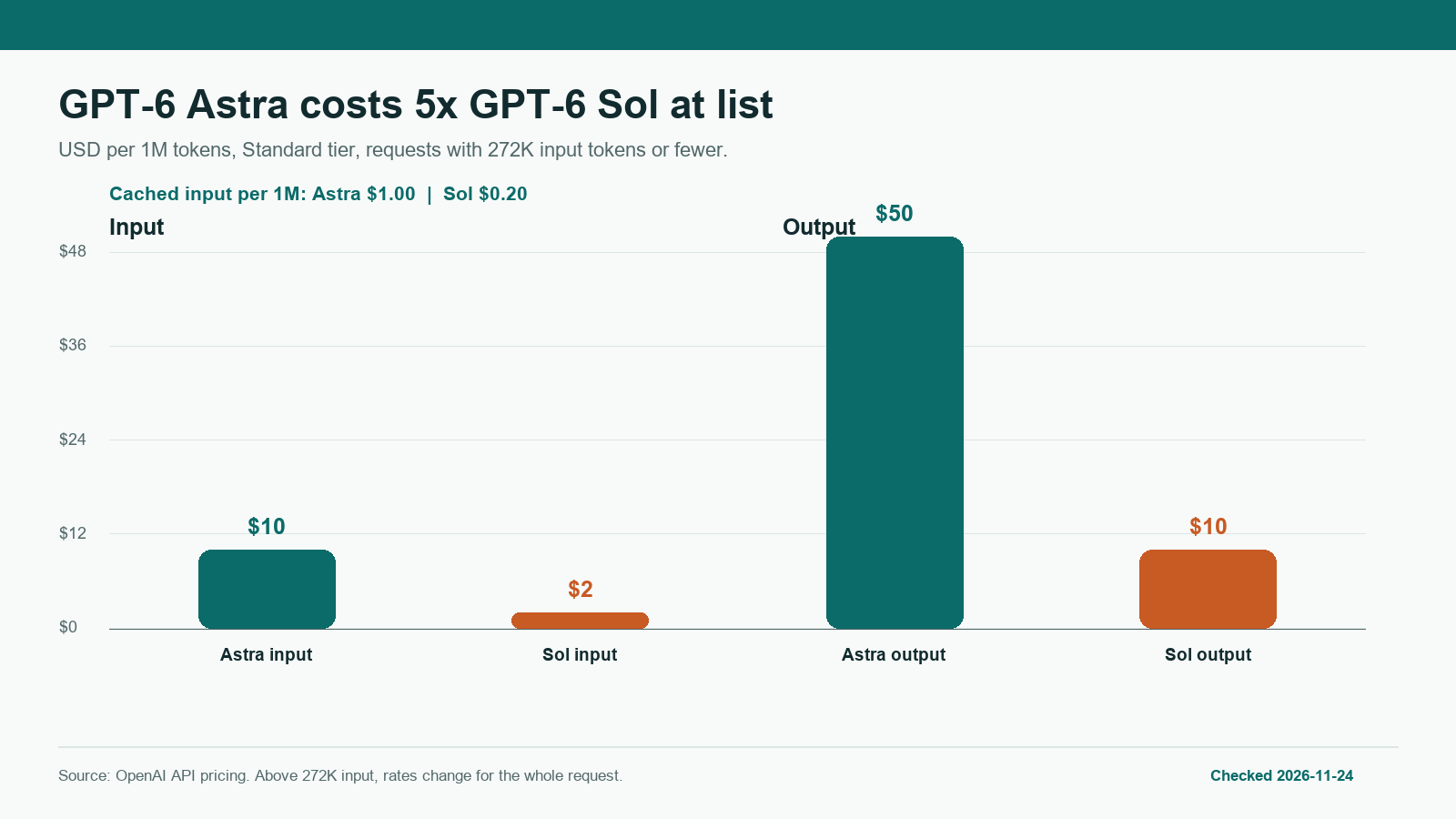
At short context, Sol is half of Opus on fresh input and output. Its cached-read rate is one tenth of its fresh-input rate. Opus has the same $0.20 cache-read rate as short-context Sol, but its fresh input costs twice as much. That makes cache design especially valuable for Opus. A router that compares only fresh-input prices will miss the most important repeated-prefix cost.
Above 272K input, the gap changes. Sol’s $4 input rate equals Opus’s $4 rate. Sol output is still lower at $15 versus $20, and Sol cached input is higher at $0.40 versus Opus’s $0.20. This is not a small modifier. OpenAI applies the above-272K input tier to the whole request, not just the tokens beyond the threshold.
The GPT-6 Astra pricing breakdown covers the same threshold for Astra. The Opus 5.5 pricing guide covers cache writes, Batch, Fast and endpoint premiums. Read them before copying a budget from one model family to another. The gateway’s pricing page describes gateway plans and should not be substituted for either vendor’s list-rate table.
Worked request math, including the 272K step
Take one request with 100,000 uncached input tokens and 20,000 output tokens. The arithmetic below is derived from the published rates. It excludes taxes, endpoint premiums, cache writes and any gateway charges.
| Model and tier | Input calculation | Output calculation | Total |
|---|---|---|---|
| GPT-6 Sol, Standard at or below 272K | 0.1 × $2 = $0.20 | 0.02 × $10 = $0.20 | $0.40 |
| Claude Opus 5.5, Standard | 0.1 × $4 = $0.40 | 0.02 × $20 = $0.40 | $0.80 |
On that request shape, Sol costs half as much. Now hold output at 20,000 tokens and move input from 272,000 to 272,001 tokens:
| Model | Input calculation | Output | Total |
|---|---|---|---|
| GPT-6 Sol at 272,000 input | 0.272 × $2 = $0.544 | $0.20 | $0.744 |
| GPT-6 Sol at 272,001 input | 0.272001 × $4 = $1.088004 | $0.30 | $1.388004 |
| Claude Opus 5.5 at 272,001 input | 0.272001 × $4 = $1.088004 | $0.40 | $1.488004 |
One additional input token raises the Sol example by $0.644004 because both the input tier and the output rate change for the request. The Sol-versus-Opus gap falls from $0.744 to about $0.10 on these examples. That does not make Sol universally cheaper in practice. It shows why a long-context budget cannot use the short-context headline.
These are billing calculations, not acceptance tests. The official GPT-6 Sol context, maximum input and maximum output limits were not verified in the accessed sources. A 272,001-token request may or may not be accepted. Do not infer a context window from the existence of a price tier.
Use the cost calculator to model your own token mix. Enter the correct generation and tier. A forecast that assumes 250K average input can still contain individual requests above 272K, so budget from the request distribution rather than the average alone.
Cache math needs the write, the read and the prefix
Opus 5.5 supports explicit prompt caching with a 512-token minimum per checkpoint, up to four checkpoints, and five-minute or one-hour retention. Its cache-read rate is $0.20 per million tokens. The write costs $5 per million for five minutes or $8 per million for one hour. The Opus context and caching guide explains stable-prefix design and the constraints around replaying thinking blocks.
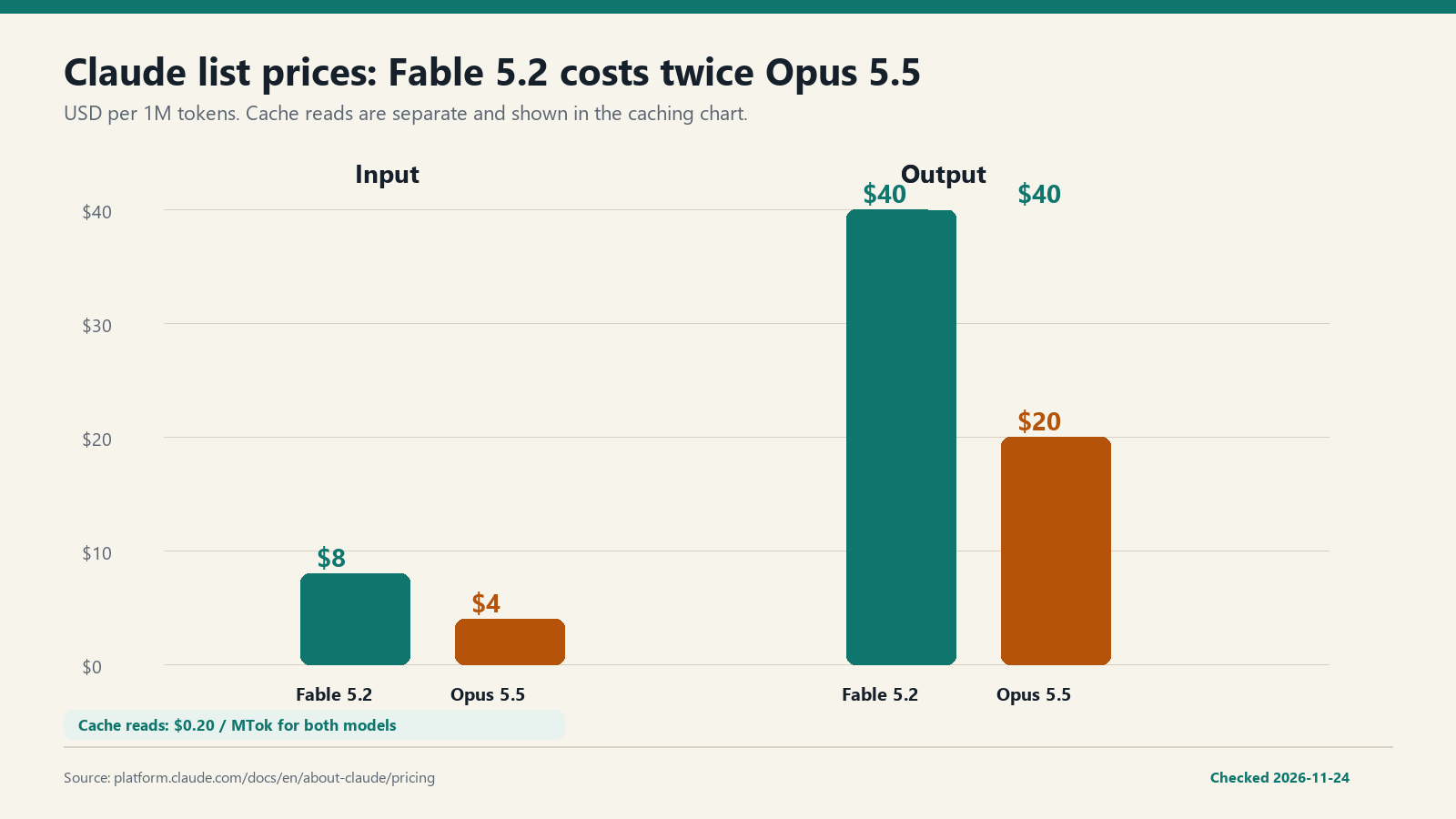
Here is an Opus lifecycle example. Each call reuses a 100,000-token prefix, adds 10,000 fresh input tokens and requests 2,000 output tokens. Assume the prefix is stable and every call fits the selected cache window.
With a five-minute cache, the first call costs $0.50 for the write, $0.04 for fresh input and $0.04 for output, totaling $0.58. Each later cache-hit call costs $0.02 for the read, $0.04 for fresh input and $0.04 for output, totaling $0.10. Three calls therefore cost $0.58 + $0.10 + $0.10 = $0.78.
Without caching, each call processes 110,000 fresh input tokens. That costs 0.11 × $4 = $0.44, plus $0.04 output, or $0.48 per call. Three calls cost $1.44. The cached pattern saves $0.66 in this example. The result depends on prefix stability, retention and how much fresh context each call adds. A cache-hit-only estimate omits the write and can reverse the conclusion for a short session.
For Sol, the same ongoing request shape costs $0.02 for a 100,000-token cache read, $0.02 for 10,000 fresh input tokens and $0.02 for output, totaling $0.06 at the short-context rates. That is a read-side calculation only. The accessed GPT-6 Sol record does not verify cache-write prices, retention options or checkpoint limits. Do not copy Anthropic’s cache lifecycle terms into a Sol budget. The prompt caching documentation can help structure a test, but provider-specific terms still need verification.
Opus’s 1,000,000-token context window and 128,000-token maximum output are verified in Anthropic’s models overview. Its default effort is Medium, and adaptive thinking is always on. Sol’s effort list includes non-reasoning, but the accessed official Sol pages do not verify a default effort or context limits. The reasoning configuration guide explains why effort and output budgets belong in the routing record.
What the benchmarks do and do not establish
OpenAI’s GPT-6 Sol announcement reports four official results. They are vendor claims, not independent measurements.
| GPT-6 Sol result | Score | Setting | Source class |
|---|---|---|---|
| AutomationBench | 33.2% | xhigh | OFFICIAL |
| Agents’ Last Exam v1 | 56.4% | max | OFFICIAL |
| DeepSWE v1.1 | 68.8% | max | OFFICIAL |
| OSWorld 2.0 offline | 60.5% | xhigh | OFFICIAL |
OpenAI also reports an official AutomationBench cost per task of $0.27 at xhigh. That figure belongs to OpenAI’s task setup. It is not a price you can reproduce by dividing list rates, and it is not a guarantee for your agent harness.
Artificial Analysis’s GPT-6 Sol model page lists max, xhigh, high, medium, low and non-reasoning. Its model-page snippet reports an Intelligence Index of 44 at Max. Keep that attribution exact. The accessed snippet does not establish the evaluator version, so this article does not assign it one.
Opus has a stronger independent composite result in the checked record. Artificial Analysis’s Opus 5.5 model page reports Intelligence Index 59 at Max, evaluator v5.0.1, with default effort Medium. A 15-point gap on the same index family is meaningful directional evidence. It still does not prove Opus will win every coding session, extraction job or support workflow.
Anthropic’s Opus 5.5 announcement reports Terminal-Bench 4.0 at 66.4% with xhigh effort, against 55.8% for Fable 5.1. It reports FrontierCode v1.1 Main at 54.4%, against 53.3% for GPT-6 Astra. Those are official vendor results with named comparators. They support Opus as a serious candidate for agentic coding. They do not supply a matched GPT-6 Sol comparator.
There is also an official loss to preserve. On AutomationBench, Anthropic reports Opus 5.5 at 40.0%, below GPT-6 Astra at 41.4%. On OSWorld 2.1, Anthropic’s launch page reports 81.8% using a partial-success metric. That metric must not be blended with a different OSWorld success definition from another table. The Opus 5.5 review keeps these definitions separate.
The GPT-6 Astra independent review shows why evaluator snapshots need dates. The Fable 5.2 review shows why comparator effort gaps matter. The Opus alternatives analysis reaches the same conclusion: compare cost per successful task on your workload. No shared benchmark in the accessed record makes either model a universal winner.
A routing policy that survives a model update
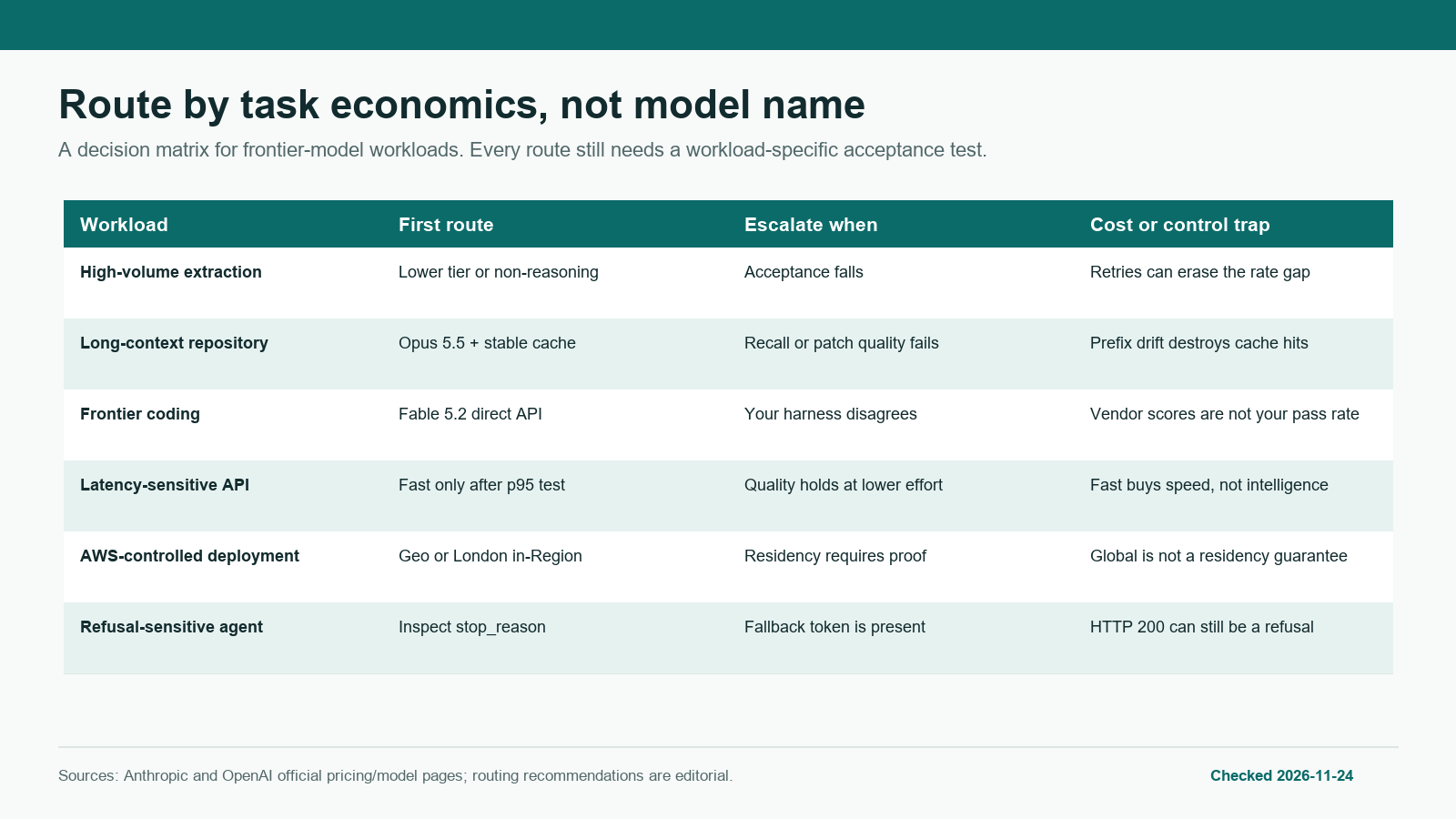
Use Sol as a candidate for bounded, repeatable work. Classification, extraction, drafting and high-volume summarization can benefit from the lower short-context rate. Start with low, medium or non-reasoning only after your own evaluation confirms the quality floor. The existence of a non-reasoning setting is not evidence that it meets your accuracy target or latency budget. Pin the chosen effort and reject accidental defaults.
Use Opus as a candidate for harder agentic work. Its independent composite result and official coding rows justify testing it for repository tasks, multi-step tool use and difficult analysis. The trade is a higher output rate and always-on adaptive thinking. Set an output ceiling and measure successful task cost, not just token cost. A cheap response that fails the task is not the cheaper route.
Use Opus when the context requirement is verified and exceeds what you can confirm for Sol. Opus has a checked 1M context window and 128K maximum output. Sol’s limits are UNKNOWN in this evidence set. If a workflow needs a large prompt, do not assume Sol accepts it because a long-input price tier exists. Confirm the official limit first.
Keep AWS routing separate from direct-API routing. The Opus Bedrock routing guide covers inference profiles, supported APIs, Mantle feature gaps and Marketplace billing. A direct Anthropic identifier and a Bedrock identifier are not interchangeable. For a gateway deployment, verify the catalogue entry and the status board instead of inferring availability from vendor documentation.
Treat refusal-sensitive work as a policy decision, not a model-shopping opportunity. Anthropic can return HTTP 200 with a body containing stop_reason: refusal. HTTP status alone is not a success check. The Fable production routing guide explains eligible fallback credits. The Fable launch guide explains access and safeguard differences. Do not route a refused task to another model merely to bypass the restriction.
Fallback rules: compatible does not mean eligible
A fallback needs two separate approvals. First, the destination must be technically compatible: same request shape, supported modalities, output schema, tool contract and context requirement. Second, it must be allowed by the provider’s billing and policy rules.
For Opus 5.5, the checked fallback-credit beta uses the header fallback-credit-2026-07-01. Valid fallback models are Opus 5 and Opus 4.8. Opus 5.5 and Fable are not valid fallback models. Not every refusal carries a fallback token. A retry can bill a cached prefix at cache-read rather than cache-write rates. None of this promises a free retry.
Do not generalize that beta to GPT-6 Sol. The accessed Sol sources do not define an equivalent fallback-credit mechanism. If your router sends a failed Sol request to Opus, record it as a new, separately billed model call unless the provider explicitly confirms otherwise. Preserve the original refusal category and do not mark the fallback as an automatic success.
The Fable pricing analysis is useful for understanding Anthropic cache charges across the family. It does not make every Claude model an eligible fallback for every other Claude model. The model comparison tool can help screen candidates. It cannot grant access or override a provider restriction.
Version-pinning checklist
Use this checklist before a routing change reaches production.
- Pin the generation. Store
gpt-6-solorclaude-opus-5-5, notsol,opusor “latest.” Record the provider and whether the route is direct API or gateway. - Verify access independently. Opus has a gateway model page in the 2026-11-24 check. GPT-6 Sol does not. Never synthesize a gateway ID from an official direct-API ID.
- Pin the snapshot only when verified. Sol snapshot aliases are UNKNOWN in the accessed record. If the vendor later publishes an alias, store the exact alias and its retirement policy. Do not guess a dated name.
- Pin effort. Record the exact setting per route. Sol includes
non-reasoning; Opus useslowthroughmax, defaults to Medium and always uses adaptive thinking. Do not map the two ladders by label alone. - Pin input and output limits. Record Opus’s verified 1M context and 128K maximum output. Keep Sol’s context, maximum input and maximum output marked UNKNOWN until an official source resolves them.
- Pin the service tier. Record Standard, Batch, Flex or Fast where supported. For Sol, mark whether input is at or below 272K or above it. The upper tier applies to the whole request.
- Pin cache behavior. Record provider, prefix hash, minimum checkpoint size, TTL, write rate and read rate. For Sol, do not fill unknown write or retention fields with Anthropic values.
- Pin response validation. Check the response body, finish or stop reason, schema and tool results. Treat an Opus HTTP 200 refusal as a refusal, not a completed task.
- Pin fallback eligibility. Store the allowed destination, trigger, attempt limit and billing expectation. For the Opus credit beta, valid fallbacks are Opus 5 and Opus 4.8 only.
- Pin the evidence date. Attach the price-sheet date, benchmark source, evaluator version when stated, effort and harness. A newer leaderboard row does not silently update an older evaluation.
- Canary before promotion. Replay a fixed task set, compare successful-task cost, check refusal rates and inspect tail latency. Keep the previous route available for rollback.
- Alert on configuration drift. Flag a changed model string, missing effort, unknown limit, cache-prefix change or unexpected fallback. Log the resolved provider model for every request.
This checklist turns a model preference into an auditable routing contract. It also makes upgrades deliberate. When GPT-6.2 Sol becomes relevant, create a new route rather than editing the meaning of the existing GPT-6 Sol route.
What the public record still leaves open
The official GPT-6 Sol context window, maximum input, maximum output, knowledge cutoff and snapshot aliases were not verified in the accessed sources. Its cache-write prices, retention options and checkpoint rules are also absent from the frozen Sol evidence. The default effort is not verified there. These are UNKNOWN fields, not zeros and not values borrowed from GPT-6.2.
The benchmark record is incomplete in a different way. Artificial Analysis supplies a shared index family, but the accessed Sol snippet does not state its evaluator version. Official Sol and Opus rows use different benchmark versions, effort settings and comparators. That is enough to form routing hypotheses, not enough to declare a universal winner. Latency and throughput figures for this exact pairing are not established by the checked pack.
Gateway access can change, so verify it at release time. The current model catalogue, the Opus 5.5 model page and the status board are the operational sources. This article will need an update when OpenAI publishes verified Sol limits or when a GPT-6 Sol gateway route appears. Until then, the honest configuration marks the gaps instead of hiding them.
How to use this without overbuying
Start with a small, representative task set. Run the same prompts through both candidates with fixed tools, output schemas and evaluation rules. Measure accepted tasks, successful tasks, output tokens, cache-hit rate, refusal rate and wall-clock time. Multiply successful-task volume by the real cost per success. The lower list rate is an input to that decision, not the decision itself.
For gateway users, create an account, inspect the current catalogue, follow the quickstart and estimate the workload with the cost calculator. Use the comparison view to narrow the shortlist. GPT-6 Sol requires a verified direct-provider route; this article does not claim it is callable through the gateway.
The practical split is straightforward. Sol is the cost-led candidate for bounded short-context work, subject to your quality test. Opus is the capability-led candidate for demanding agentic work and verified long-context requirements, with a gateway model page and a higher bill. Keep both routes pinned, keep the gaps visible and let successful-task economics decide the traffic share.
FAQ
Is GPT-6 Sol cheaper than Claude Opus 5.5?
On Standard list rates through 272K input, yes. Sol is $2 input and $10 output per million tokens, against Opus at $4 and $20. Above 272K input, Sol rises to $4 input and $15 output for the whole request. Cache terms, endpoint choice and failed tasks can narrow or reverse the practical gap.
Is GPT-6 Sol the same as GPT-6.2 Sol?
No. They are different generations. GPT-6 Sol’s checked cached-input rate is $0.20 per million at short context. GPT-6.2 Sol’s is $0.10. Never substitute one for the other under an unpinned “Sol” route.
Which model has the higher independent score?
Artificial Analysis reports Opus 5.5 at Intelligence Index 59 at Max with evaluator v5.0.1. Its GPT-6 Sol snippet reports 44 at Max, without an evaluator version in the accessed text. This favors Opus on that composite, not on every task.
Can I call GPT-6 Sol through oneaiapikey.com?
Not according to the 2026-11-24 catalogue check. GPT-6 Sol has an official direct API but no gateway model page. Opus 5.5 does have a gateway model page. Check the catalogue and status board for current access.
What should I pin before deploying either model?
Pin the exact generation, provider route, verified snapshot if any, effort, service tier, context and output limits, cache policy, response validation, fallback eligibility, evidence date and rollback route. Leave unverified fields explicitly marked UNKNOWN.
More production-routing coverage
- GPT-6 Astra pricing and the 272K input cliff
- GPT-6 Astra review and the dated independent snapshot
- Claude Fable 5.2 launch, access and safeguards
- Claude Fable 5.2 pricing and cache charges
- Claude Fable 5.2 review and comparator caveats
- Claude Fable 5.2 production routing and eligible fallbacks
- Claude Opus 5.5 pricing and endpoint premiums
- Claude Opus 5.5 review and benchmark definitions
- Claude Opus 5.5 alternatives and cost per success
- Claude Opus 5.5 context and caching
- Claude Opus 5.5 Bedrock routing constraints