Claude Opus 5.5 on AWS Bedrock has six inference profile IDs, plus a separate Mantle access path. According to the AWS Bedrock Claude Opus 5.5 model card, the bare anthropic.claude-opus-5-5 ID provides in-Region inference only in eu-west-2 London. The global. ID selects global routing. The us., eu., au. and jp. IDs select geographic profiles. Mantle supports Messages in us-east-1, ap-southeast-4 and us-gov-west-1, but it lacks several Bedrock features. Use bedrock-runtime for Messages, Converse or Invoke and the broader Bedrock integration set. Use Mantle only when its Count tokens support matters more than those features. Both paths are Standard only. Global routing is not a data-residency guarantee. Mantle charges appear under the model provider in AWS billing and Cost Explorer, not under Amazon Bedrock.
This article is for platform teams, security reviewers and finance owners choosing an AWS deployment path. It separates routing, API support, feature coverage and billing attribution before anyone changes a model ID. The routing facts are OFFICIAL, drawn from AWS and Anthropic documentation checked on 2026-11-24. Planning arithmetic is labeled DERIVED. Missing evidence is marked UNKNOWN rather than filled with assumptions.
This is an AWS deployment article. It does not describe Bedrock access through oneaiapikey.com. The Opus 5.5 model page records a gateway listing under the standard Anthropic ID. That listing does not turn the AWS inference profile IDs in this article into gateway aliases, and it does not establish Region selection or AWS Marketplace billing on the gateway.
The short answer
- What changed: Opus 5.5 has bare, global and four geo IDs on Bedrock, plus a narrower Mantle path.
- Who it is for: Teams that already need AWS, have a stated processing requirement and can choose between runtime APIs and a Messages-only integration.
- Main win: London is the documented in-Region option for the bare ID. The runtime path supports Messages, Converse and Invoke.
- Main loss: Global routing does not guarantee residency. Mantle lacks Guardrails, Knowledge Bases, Agents, Flows, Prompt Management, Application Inference Profiles and Invocation Logs.
- Availability: Bare in-Region inference is limited to
eu-west-2. Mantle listsus-east-1,ap-southeast-4andus-gov-west-1. - What is missing: The frozen sources do not provide a contractual geo-residency map, account-specific quotas, Marketplace unit prices or measured failover behavior.
Read the inference profile ID before the endpoint
The prefix is part of the model identifier. It is not decoration. AWS documents six Opus 5.5 IDs, and each one names a different routing choice.
| Bedrock ID | Documented routing choice | What not to assume |
|---|---|---|
anthropic.claude-opus-5-5 |
In-Region inference only in eu-west-2 London |
Do not treat it as a global default or assume another bare-ID Region. |
global.anthropic.claude-opus-5-5 |
Global routing | Do not treat global routing as a residency guarantee. |
us.anthropic.claude-opus-5-5 |
US geo routing | Do not infer an exact processing boundary from the prefix alone. |
eu.anthropic.claude-opus-5-5 |
EU geo routing | Do not substitute it for a documented London in-Region requirement. |
au.anthropic.claude-opus-5-5 |
Australia geo routing | Do not assume a specific source-Region list that the Opus evidence does not state. |
jp.anthropic.claude-opus-5-5 |
Japan geo routing | Do not assume the geographic label proves every processing step stays there. |
The practical distinction is simple. A bare ID is the documented in-Region route in this case, and London is the only Region given for it. A global ID asks Bedrock to use global routing. A geo ID asks for a named geographic profile. Those are routing selections, not interchangeable labels for the same compliance outcome.
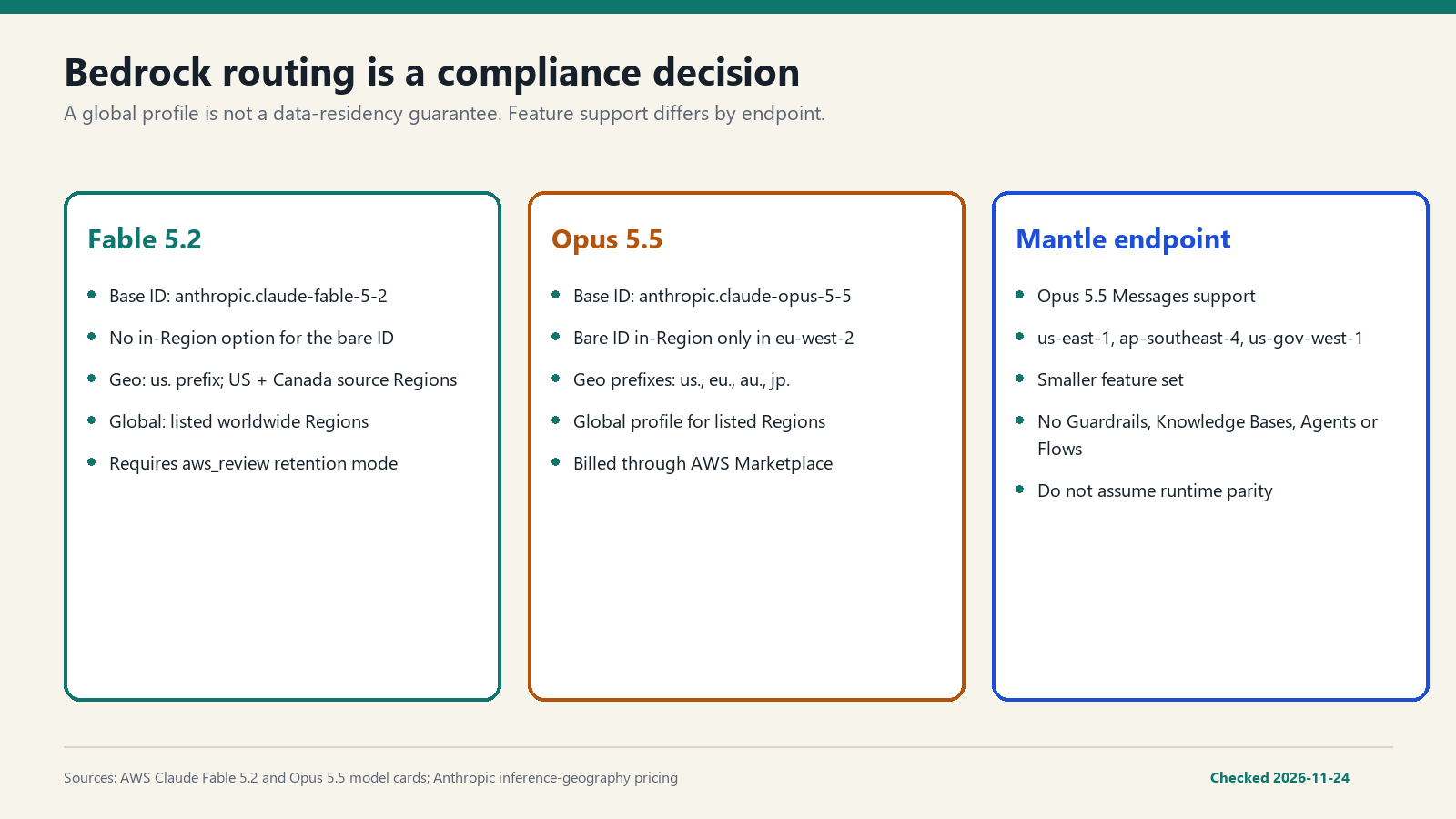
A common migration mistake is to copy another Claude model’s routing assumptions. The AWS Fable 5.2 model card says Fable has no bare in-Region option and that its geo routing covers US and Canadian source Regions. Those statements belong to Fable. Opus 5.5 instead has London for bare in-Region inference and four geo prefixes. The Fable 5.2 launch guide explains the model release, but its AWS routing details should not be transplanted into an Opus configuration.
London in-Region: the narrow documented option
For a requirement that explicitly names eu-west-2, the bare anthropic.claude-opus-5-5 ID is the documented in-Region choice. That is the strongest routing fact in the source pack. It is also narrow. The evidence does not list bare-ID in-Region inference in a US, Australian, Japanese or government Region for this model.
In-Region inference answers one question: where the documented inference route runs. It does not answer every compliance question. The frozen sources do not provide a complete AWS retention, logging, backup or training-data matrix for Opus 5.5. A security review still needs those terms. Do not convert the word in-Region into a claim that every related data handling activity has the same boundary.
Use a requirement statement that names both the Region and the operation. For example, “Opus 5.5 inference must use the bare ID in eu-west-2” is testable against the model card. “EU data must never leave the EU” is broader and cannot be validated from the ID alone. The second statement needs separate evidence about the full service and contract.
The gateway routing and privacy documentation covers controls in the oneaiapikey.com product. It is useful if the gateway is also part of the architecture, but it does not establish AWS processing terms. Keep the AWS review and the gateway review as two separate workstreams. A gateway privacy control cannot supply a missing Bedrock residency guarantee.
London also forces an API decision. Use the bedrock-runtime path if the application needs Converse or Invoke, or if it depends on Bedrock features that Mantle lacks. Mantle’s documented Regions do not include London. A London requirement and a requirement for Mantle Count tokens therefore cannot both be satisfied by the options in this evidence set.
Global and geo IDs: useful routing, limited proof
The global ID is appropriate when the application wants Bedrock’s global routing choice and does not claim a fixed residency boundary. AWS explicitly warns that global routing is not a data-residency guarantee. That warning belongs in the design document, not just in a footnote.
A global route can simplify an identifier across a distributed application. It does not tell you which Region will serve a particular request. It also does not prove a failover target, a latency outcome or a legal processing location. Those questions need service documentation or contractual terms beyond the frozen pack.
The four geo IDs are more specific in name. They still require careful wording. The Opus facts identify us., eu., au. and jp. as geo routing IDs, but they do not supply a complete contractual residency guarantee for each prefix. Treat the prefix as a routing requirement that can be recorded and reviewed. Do not present it as proof that all processing, storage and support activity remains inside that geography.
This matters most when a buyer says “EU” without naming a Region. The eu. profile is not the same documented choice as bare in-Region inference in London. If the requirement came from a regulator, customer contract or internal control owner, return to that text and ask which operation and boundary it actually names. The prefix should follow the requirement. It should not create the requirement after deployment.
There is also a pricing distinction in Anthropic’s documentation. The Anthropic pricing page lists Opus 5.5 at $4 input and $20 output per million tokens and says applicable regional and multi-region endpoints carry a 10% premium over global endpoints. Name the endpoint and the scope when using that statement. It is not evidence that every AWS request, every US customer or every Marketplace line receives the same uplift.
Do not apply that 10% statement directly to an AWS invoice without matching the actual AWS charge terms. The source pack verifies the Anthropic endpoint rule. It does not verify a universal Bedrock surcharge or a Marketplace price formula. The Opus 5.5 pricing guide works through the list rates and cache math without confusing them with an AWS quote.
bedrock-runtime: broader APIs, fewer routing options
AWS supports Opus 5.5 on bedrock-runtime through Messages, Converse and Invoke. Responses and Chat Completions are unsupported. This is an API surface decision as much as a routing decision. An application built around an unsupported interface needs an adapter or a different model path before the profile ID matters.
The runtime path also carries the broader Bedrock integration set that Mantle lacks. That matters when Guardrails, Knowledge Bases, Agents, Flows, Prompt Management, Application Inference Profiles or Invocation Logs are part of the production design. Choose the runtime path when those dependencies are real, not when they are merely listed in a platform catalog.
Bedrock supports Standard only for Opus 5.5. Priority, Flex, Reserved and Batch are unsupported. That limit applies to the documented Bedrock support for this model. Do not build a capacity or discount plan around a tier that the model card does not offer. The Fable 5.2 pricing analysis reaches the same Standard-only constraint for Fable, which is useful context but not permission to assume every Claude model has identical AWS capabilities.
Count tokens is the important exception in the other direction. bedrock-runtime does not support Count tokens for Opus 5.5. Mantle does. A team that needs Bedrock’s token-count operation for this model cannot assume it will be available simply because Messages, Converse or Invoke works.
For routing, the runtime choice still leaves three different patterns. The bare ID supplies London in-Region inference. The global ID supplies global routing. The four geo IDs supply their named geographic routing choices. Pick among them with the same residency test used above. Changing the API from Messages to Converse does not change the residency meaning of the prefix.
Mantle: smaller feature set, different billing path
Mantle supports Opus 5.5 Messages in exactly three documented Regions: us-east-1, ap-southeast-4 and us-gov-west-1. The source pack does not authorize adding another Region or a profile name. If a deployment requirement names a different Mantle location, the correct status is UNKNOWN, not an assumed equivalent.
The narrow API surface is only part of the trade-off. AWS lists seven Bedrock capabilities that Mantle lacks:
- Guardrails
- Knowledge Bases
- Agents
- Flows
- Prompt Management
- Application Inference Profiles
- Invocation Logs
The missing dependencies are the point. A workflow that requires Guardrails cannot silently move to Mantle and keep the same control. A workflow that requires Invocation Logs loses that Bedrock observability path. An Agents or Knowledge Bases integration needs to be reconsidered rather than treated as a drop-in model swap.
Mantle does support Count tokens. For some lean Messages integrations, that single capability can outweigh the broader runtime feature set. For a platform with centralized prompts, Bedrock agents or invocation logging, it usually will not. This is the honest loss of the Mantle option: it does not provide the full Bedrock feature set. It is a narrower service path with different capabilities and different billing attribution.
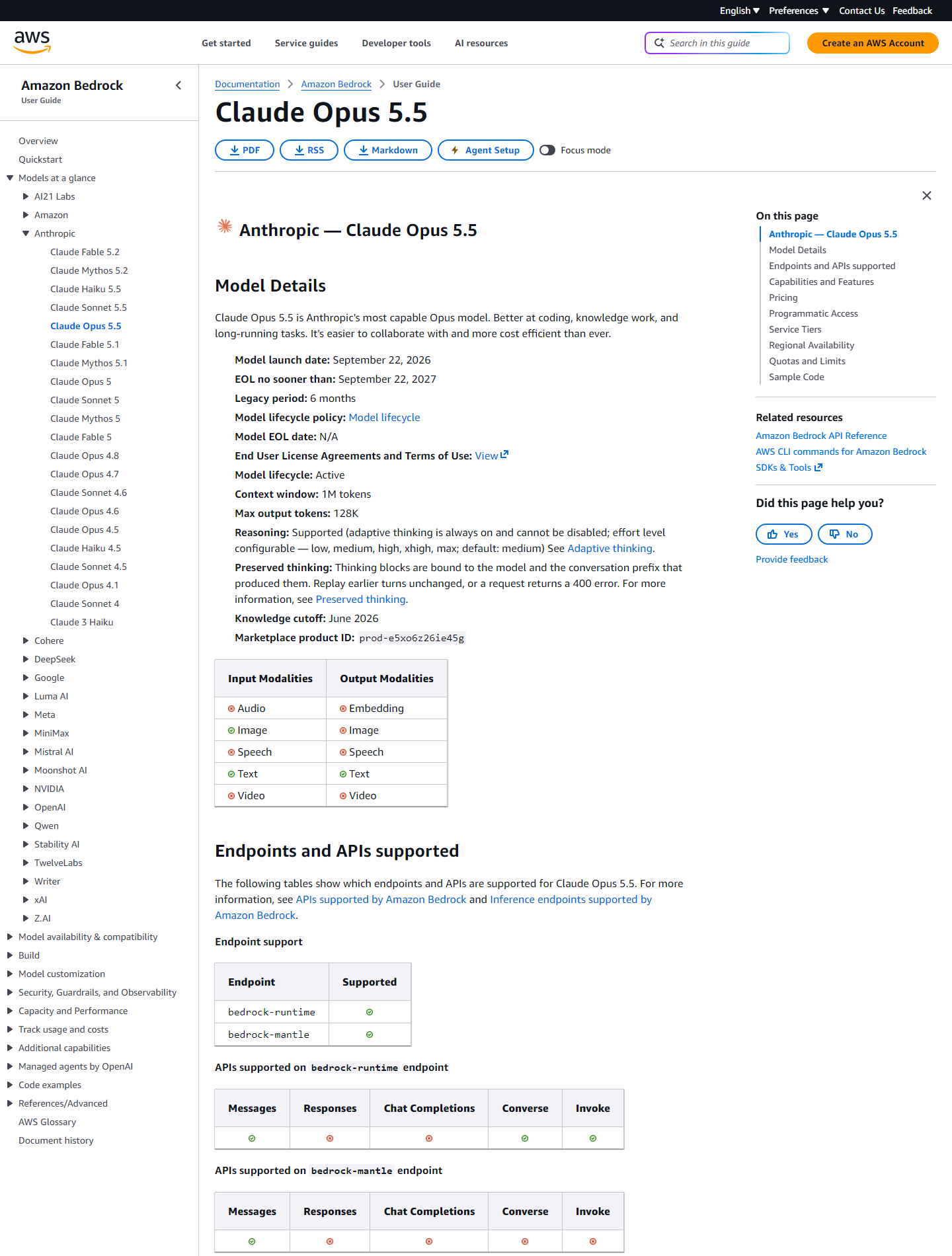
The government Region in the Mantle list deserves precise wording. us-gov-west-1 is documented as a Mantle Region for Messages. That fact does not establish a government compliance certification, a complete data boundary or suitability for a particular classified workload. A government buyer still needs the applicable service terms and authorization evidence. Never turn a Region name into a compliance conclusion.
Mantle is billed through AWS Marketplace. Charges appear under the model provider, not Amazon Bedrock, in AWS billing and Cost Explorer. A finance team that allocates spend by service will therefore see a different attribution pattern. The operational question is not only what the request costs. It is whether the cost lands in the report that the owner actually reviews.
Count tokens, context and request design
Anthropic’s models overview gives Opus 5.5 a 1,000,000-token context window and a 128,000-token maximum output. The Opus 5.5 announcement states that adaptive thinking is always on, with Medium as the default effort. Those model facts shape payload design, but they do not change the Bedrock feature matrix.
A runtime deployment still needs a token budgeting method even though Count tokens is unsupported for this model on bedrock-runtime. Do not assume an operation exists because another model supports it. Either account for tokens in the application or choose a documented path that provides the required operation. The frozen evidence does not specify an alternative runtime counting procedure, so this article does not invent one.
Mantle’s Count tokens support is useful for preflight checks on a Messages integration. It does not restore the missing Bedrock features. A successful count is not evidence that Guardrails, Invocation Logs or Agents will work on that path. Keep capability tests separate: one test for token counting, another for each Bedrock feature the application depends on.
Prompt stability also matters. Anthropic documents explicit caching with a 512-token minimum per checkpoint, no more than four checkpoints, and five-minute or one-hour TTLs. Thinking blocks are bound to the model and conversation prefix, so altered replay can fail. The Opus 5.5 context caching guide covers prefix design and replay constraints. Routing changes should not be used as a reason to rebuild a stable prefix or discard a valid cache design.
Decision table: residency, features and billing visibility
Use this table before selecting an ID. Every row is based on the documented AWS and Anthropic facts checked on 2026-11-24. Where the evidence stops, the table says so.
| Requirement | Choose | Reason | Caveat |
|---|---|---|---|
| Bare in-Region inference in London | anthropic.claude-opus-5-5 on bedrock-runtime |
AWS documents eu-west-2 as the only bare-ID in-Region option. |
It does not prove the full data lifecycle stays in London. |
| Global routing without a fixed residency claim | global.anthropic.claude-opus-5-5 |
Uses the documented global profile. | Global routing is not a residency guarantee. |
| A named US, EU, Australian or Japanese geo profile | The matching us., eu., au. or jp. ID |
Records a geographic routing choice. | The pack does not provide a contractual residency guarantee for each prefix. |
| Messages, Converse or Invoke | bedrock-runtime with an appropriate documented profile |
All three APIs are supported. | Responses and Chat Completions are unsupported. |
| Guardrails, Knowledge Bases, Agents, Flows, Prompt Management, Application Inference Profiles or Invocation Logs | bedrock-runtime |
Mantle lacks these capabilities. | Confirm the exact integration in the target Region and account. |
| Count tokens for Opus 5.5 | Mantle | Mantle supports Count tokens. | bedrock-runtime does not support it for this model, and Mantle loses several Bedrock features. |
| Messages-only integration in a documented Mantle Region | bedrock-mantle in us-east-1, ap-southeast-4 or us-gov-west-1 |
Matches the documented API and Region set. | Do not invent another Region or assume the full Bedrock feature set. |
| A Bedrock runtime path rather than Mantle Marketplace attribution | bedrock-runtime |
Uses the documented Bedrock runtime service path. | The pack does not provide a complete runtime invoice layout; verify the actual bill and allocation after a test request. |
| Spend visible under the model provider in AWS billing | Mantle | AWS says Marketplace charges appear under the model provider, not Amazon Bedrock. | Marketplace unit prices are not provided in the frozen sources. |
| Priority, Flex, Reserved or Batch | None of the documented Opus 5.5 Bedrock paths | Bedrock supports Standard only. | Redesign the capacity or discount assumption instead of selecting an unsupported tier. |
| Strict residency outside the documented London in-Region option | No verified choice in this evidence set | The pack does not document another bare-ID in-Region Region. | Do not substitute a global or geo prefix without separate residency evidence. |
The table makes the central trade-off visible. Runtime is the broader integration path. Mantle is the narrower Messages path with Count tokens and provider-level Marketplace billing. London is the narrow in-Region routing fact. Global and geo profiles are routing choices whose prefixes do not by themselves establish a complete compliance boundary.
Billing visibility is part of the architecture
A request can be technically successful and still land in the wrong cost report. That is a real operational risk with Mantle. AWS says its charges appear under the model provider in AWS billing and Cost Explorer. A dashboard that filters only Amazon Bedrock can miss that spend even though the model was invoked through an AWS service path.
Define the billing owner before launch. For bedrock-runtime, confirm that the test request appears where the Bedrock cost owner expects it. For Mantle, confirm that the finance owner can see provider-attributed Marketplace charges. Then decide how those charges map to the application, team and environment. The frozen sources do not prescribe tags, allocation rules or a Marketplace purchasing flow, so none are invented here.
Keep three price concepts separate. First, Anthropic publishes list rates for its API. Second, Anthropic states an endpoint premium for applicable regional and multi-region endpoints. Third, AWS presents the actual Bedrock or Marketplace charge. The first two can inform planning. They are not a substitute for the third.
The cost calculator and gateway pricing page are useful for oneaiapikey.com usage estimates. They are not AWS Marketplace calculators. Use them only after separating the gateway decision from the AWS decision. Mixing gateway rates, Anthropic list rates and AWS billing into one estimate would hide the very attribution problem this article is trying to prevent.
The same separation applies to model comparisons. The GPT-6 Astra pricing guide explains a different long-context threshold and rate structure. The GPT-6 Sol versus Opus 5.5 comparison compares token economics outside this AWS routing decision. Neither article establishes a Bedrock Region, a Mantle feature or an AWS billing line.
Deployment checklist and refusal handling
A safe rollout starts with a written routing requirement, not a copied model string.
- Name the required operation. Is it inference placement, geographic routing, a specific API or a billing attribution rule?
- Name the required Region. Use London only when
eu-west-2matches the requirement. Use the three Mantle Regions only when one of them is documented as suitable. - Select the API path. Runtime covers Messages, Converse and Invoke. Mantle’s documented support is Messages.
- Check every dependent Bedrock feature. Do not move an Agents, Guardrails or Invocation Logs workflow to Mantle without a redesign.
- Check Count tokens. If it is mandatory for Opus 5.5, the runtime path does not provide it in the frozen evidence.
- Record the exact inference profile ID in configuration review. A one-character prefix change is a routing change.
- Send a controlled test request and inspect the response body, not only the HTTP status.
- Verify the resulting charge in the expected billing view. For Mantle, look under the model provider rather than assuming an Amazon Bedrock line.
- Recheck access and Region support before a production rollout. Documentation availability is not proof of account-specific entitlement.
Refusal handling belongs in the same checklist. A refusal can return HTTP 200 with stop_reason set to refusal. HTTP status alone is not a success check. Billing depends on the refusal category and whether output started, so an application must preserve enough response detail to understand the outcome.
Opus 5.5 has a fallback-credit beta with the header fallback-credit-2026-07-01. Not every refusal carries a fallback token. Valid fallback models are Opus 5 and Opus 4.8. Opus 5.5 itself is not a valid fallback model. A retry can also bill a cached prefix at cache-read rather than cache-write rates. Do not promise a free retry.
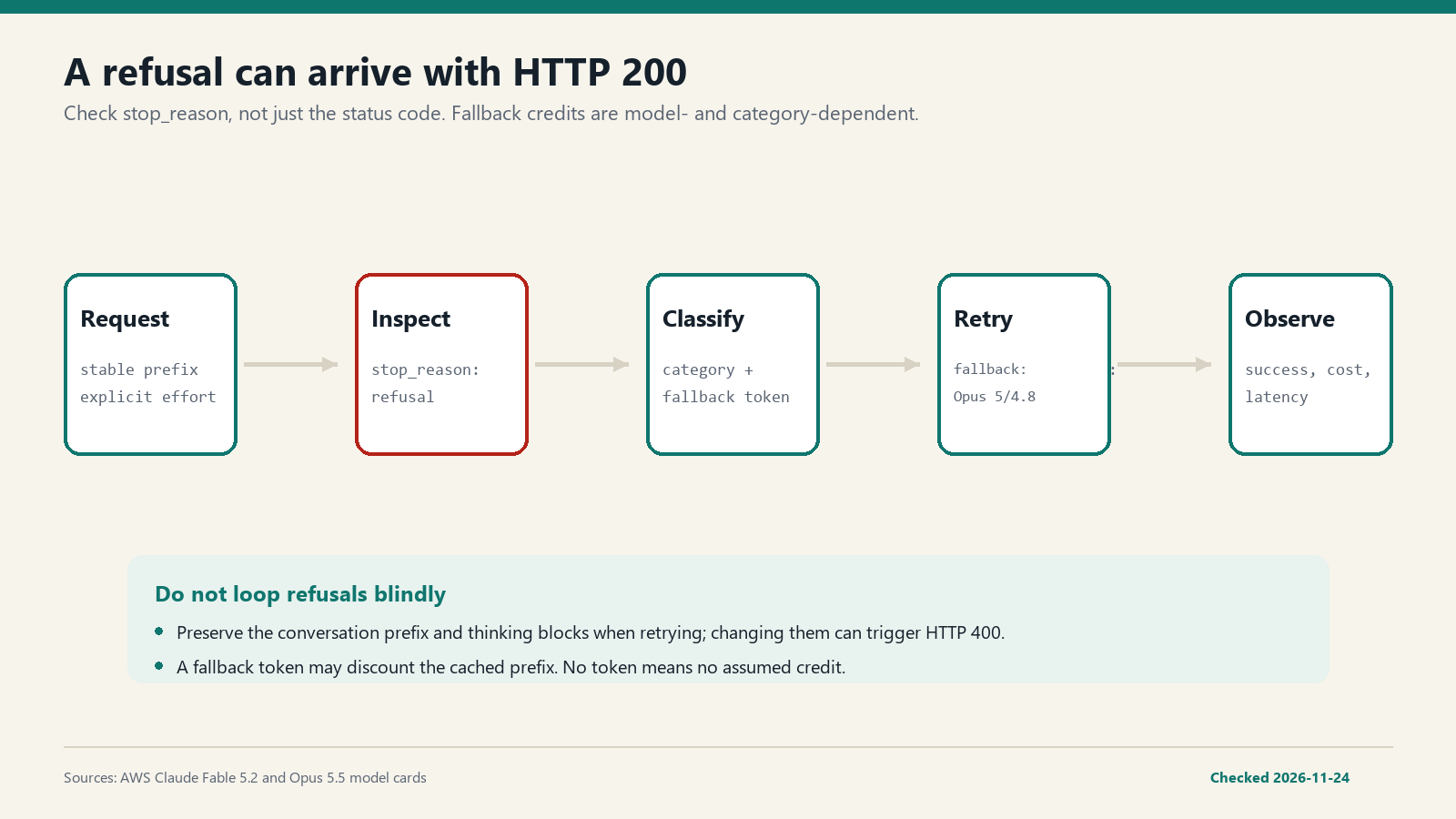
Do not route a refused request to another Opus 5.5 profile and label it an eligible fallback. Changing from global to geo, or from bare to global, changes routing. It does not change the model’s fallback eligibility. The Fable 5.2 production routing guide covers the same response-inspection discipline for a model with different safeguards and access rules.
What the public data does not show
The largest gap is residency detail. AWS states that global routing is not a data-residency guarantee. The frozen Opus evidence does not provide a complete map of where global or geo requests execute, nor a contractual guarantee for each geo prefix. It also does not give a full retention, logging, backup or training-data matrix. Those items remain UNKNOWN here.
The pack does not provide account-specific model access, quotas, throughput or measured latency. It does not provide Marketplace unit prices, purchasing terms or a complete invoice layout beyond the statement that charges appear under the model provider. It does not document failover behavior, health checks or a service-level outcome for any profile.
The geo coverage statement on the Fable card is also not transferable. Fable’s US and Canadian source-Region coverage does not establish the same coverage for Opus 5.5. If a deployment needs an exact source-Region list for an Opus geo profile, that list must come from additional AWS evidence. It should not be inferred from the prefix or from another model.
This section will change when AWS publishes more specific routing, residency or billing detail. Until then, the verified position is narrow but usable: London is the documented bare-ID in-Region Region, the four geo IDs exist, global routing carries an explicit residency caveat, and Mantle has a defined Region list with a smaller feature set. That is what is confirmed, not a prediction.
Choose the deployment path before the model
Routing constraints can rule out an otherwise attractive model. If the application requires a Bedrock feature that Mantle lacks, start with bedrock-runtime. If it requires Count tokens for Opus 5.5, Mantle is the documented path, but only inside its three listed Regions and with the feature losses accepted. If it requires bare in-Region inference, London is the only documented option in this evidence set.
Model quality is a separate decision. The Opus 5.5 review separates Anthropic’s official benchmark claims from the independent Artificial Analysis snapshot. The GPT-6 Astra review does the same for a competing model, including its hallucination caveat. The Fable 5.2 review explains why vendor-reported rows are not independent measurements. Use those pages before treating deployment fit as a quality verdict.
If AWS constraints eliminate Opus 5.5, the Opus 5.5 alternatives guide is the next comparison. The November frontier model roundup puts published scores and prices in one dated view. Check the model rankings and the side-by-side model comparison with a fixed workload in mind. A higher index does not supply a missing Region or restore a missing Bedrock feature.
The Claude 5.5 family guide provides release and behavior context if the model choice is still open. It is not an AWS routing matrix. Keep family-level behavior, model-level evidence and service-level availability as separate layers.
How to use this without overbuying
Start with the requirement that is hardest to change. A fixed Region, a required Bedrock control or a finance attribution rule should drive the path before token price does. After that, test the API surface and the billing view with a small, controlled workload. Standard-only support means there is no documented Priority, Flex, Reserved or Batch tier to buy around the constraint.
If your target is oneaiapikey.com rather than AWS, stop using the Bedrock IDs as gateway configuration. Start with the gateway model documentation, check the Opus 5.5 listing for current access, and review gateway pricing. Nothing in this article establishes that the gateway exposes AWS inference profiles, Mantle, AWS Region selection or AWS Marketplace billing.
For a hosted model comparison, use the cost calculator with your own token mix and compare the available models before choosing a route. That is a gateway planning exercise. The AWS decision still requires the documented Bedrock profile, the supported API and the billing owner to line up.
More Claude Opus 5.5 and frontier coverage
- Opus 5.5 pricing: list rates, cache charges and endpoint scope
- Opus 5.5 review: official claims versus the independent index
- Opus 5.5 alternatives: choose by task, cost and access
- Opus 5.5 context caching: stable prefixes, TTLs and replay rules
- GPT-6 Sol versus Claude Opus 5.5: version-specific economics
- GPT-6 Astra pricing: the 272K input cliff and cache rates
- GPT-6 Astra review: the independent snapshot and hallucination loss
- Claude Fable 5.2 launch: IDs, access and safeguards
- Claude Fable 5.2 pricing: Standard-only Bedrock support
- Claude Fable 5.2 review: vendor rows and comparator caveats
- Claude Fable 5.2 production routing: refusals and eligible fallbacks