Keep GPT-6 Astra for bounded coding and agent work that has a verification step. Migrate routine extraction, summarization and budget-sensitive work to a cheaper route only after a replay shows acceptable quality. Retire it from unsupervised factual workflows if your error budget cannot absorb the reliability risk. The relevant dated independent snapshot is not a current ranking: Artificial Analysis reported a 53 Intelligence Index, $3.26 per task and a 62 Coding Agent Index at Max effort in an article published on 2026-09-09. It also reported a 51% hallucination rate. That loss prevents a clean universal-quality verdict. Official list prices and current gateway access add separate constraints, not a tiebreaker.
This review is for engineers and buyers deciding whether Astra belongs in a production route. It separates launch-era claims, later independent measurements, arithmetic and missing evidence. All checks use the frozen 2026-11-24 fact pack. A model score is not a deployment decision until it survives your prompts, context sizes and acceptance tests.
Keep, migrate or retire: the short answer
- Keep: Astra remains a candidate for high-value coding and agent workflows where tests, compilers or reviewers catch errors before an output reaches a user.
- Migrate: Move predictable, lower-risk tasks to GPT-6 Sol or another verified route when a controlled replay preserves accepted-output quality at lower cost.
- Retire: Remove Astra from an unsupervised factual lane if the measured error rate exceeds the lane’s tolerance. A strong coding score does not cancel a 51% hallucination rate.
- Main win: The September independent snapshot reports a Coding Agent Index of 62 and $7.09 per coding task.
- Main loss: The same snapshot reports a 51% hallucination rate, and its Intelligence Index evaluator version is not stated.
- Availability: The oneaiapikey.com catalogue has a
/models/gpt-6-astrapage. It has no GPT-6 Sol page. Check current access rather than treating an official API listing as gateway availability. - Still missing: Verified GPT-6 Astra context limits, maximum output, knowledge cutoff, snapshot aliases and current matched rankings are not in the accessed evidence.
How to read the evidence
OFFICIAL means a vendor or primary service owner published the claim. OpenAI’s prices and GPT-6 Sol launch results are official. INDEPENDENT means a named third party measured or reported the result. Artificial Analysis is the independent evaluator used here. DERIVED means arithmetic from verified inputs, such as the long-context billing cliff below. COMMUNITY means an operator report, not a controlled measurement. No community measurement is used to rank Astra in this article.
UNKNOWN means the accessed sources do not establish the fact. The evaluator version behind Astra’s September Intelligence Index is UNKNOWN. It must not be labeled v5.0.1. The pack also contains a later Eesel figure that is UNCONFIRMED in this source set because the report’s URL is not in the verified register. Those labels matter because a number without its date, effort setting and evaluator can look more authoritative than it is.
Official pricing makes context length a billing event
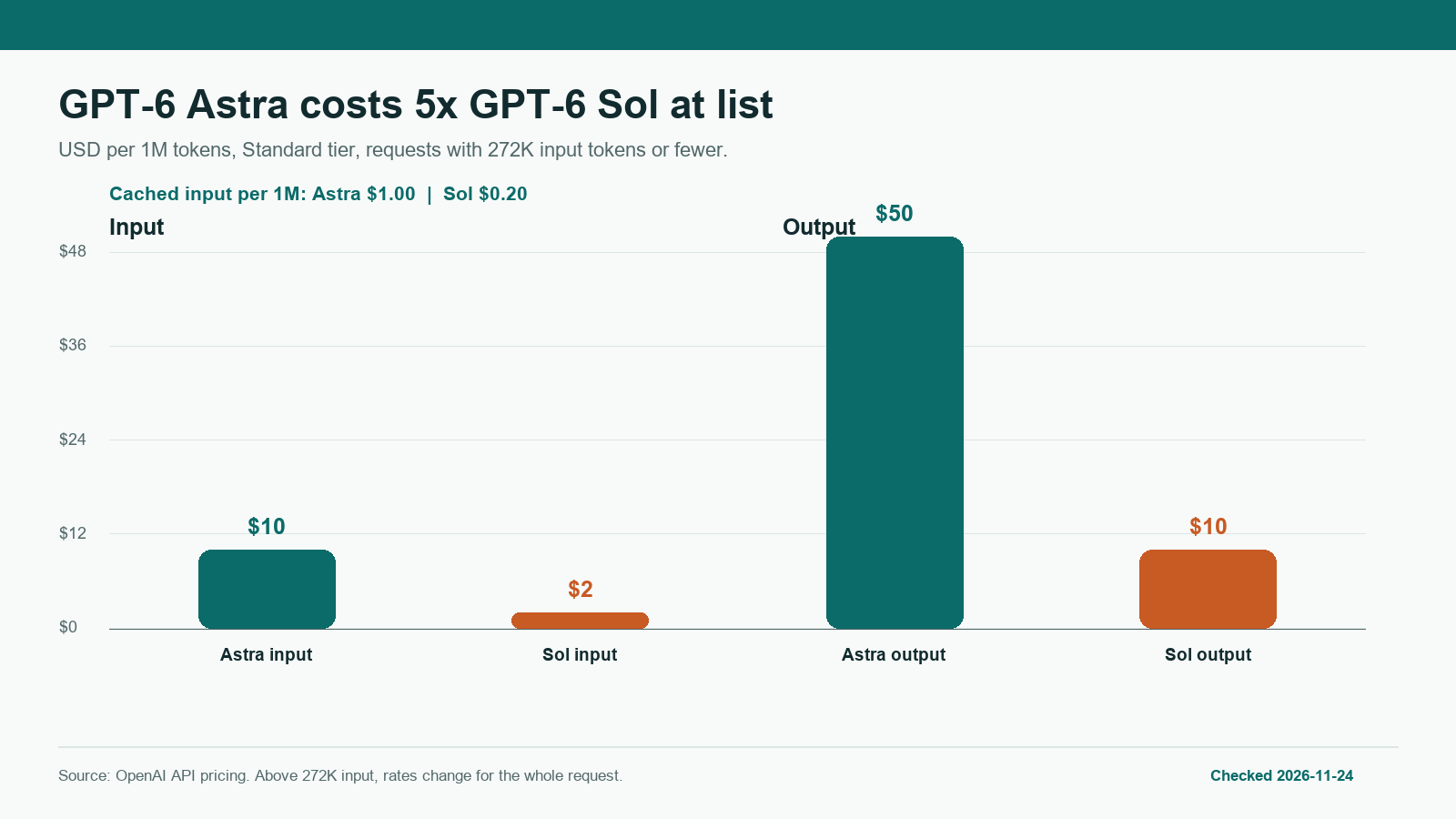
OpenAI’s API pricing, checked on 2026-11-24, lists GPT-6 Astra and GPT-6 Sol in USD per 1,000,000 tokens. These are official list API rates. They are not subscription allowances and they are not oneaiapikey.com gateway rates. Each cell below shows input, cached input and output in that order.
| GPT-6 Astra tier | Input / cached / output at ≤272K | Input / cached / output at >272K |
|---|---|---|
| Standard | $10 / $1 / $50 | $20 / $2 / $75 |
| Batch/Flex | $5 / $0.50 / $25 | $10 / $1 / $37.50 |
| Fast | $20 / $2 / $100 | $40 / $4 / $150 |
| GPT-6 Sol tier | Input / cached / output at ≤272K | Input / cached / output at >272K |
|---|---|---|
| Standard | $2 / $0.20 / $10 | $4 / $0.40 / $15 |
| Batch/Flex | $1 / $0.10 / $5 | $2 / $0.20 / $7.50 |
| Fast | $4 / $0.40 / $20 | $8 / $0.80 / $30 |
The above-272K input tier applies to the whole request when input exceeds 272K tokens. This is a threshold, not a small surcharge on the excess. For Astra Standard with uncached input, the DERIVED costs are $1.00 at 100,000 tokens, $2.72 at 272,000 tokens, $5.44002 at 272,001 tokens and $10.00 at 500,000 tokens. One token over the threshold doubles the input rate for the entire request. Output charges remain separate.
That cliff deserves a routing check before a capacity discussion. Measure the input length of real requests, including retrieved documents and tool results. A prompt that looks manageable before retrieval can cross the threshold after context assembly. The Astra pricing breakdown covers the same rate structure from a budgeting angle, while the cost calculator can test your own token assumptions. Do not treat either as a gateway quote.
No GPT-6 Ultrafast tier is listed for GPT-6 Astra or GPT-6 Sol. Ultrafast belongs to GPT-6.2 pricing. Prices also do not establish context limits, knowledge cutoffs, snapshot aliases or the complete Astra effort set. The cached-input column is not a complete cache-write policy, so do not import another model family’s checkpoint rules into this one.
Batch/Flex and Fast are billing and service tiers, not evidence of equal task quality. The pricing table does not map each tier to an effort setting or a latency guarantee. Choose a tier from the workload’s timing and budget needs, then verify the resulting outputs. A cheaper tier can still be a poor fit if deferred execution breaks an interactive workflow.
The independent snapshot: 53 is a dated measurement
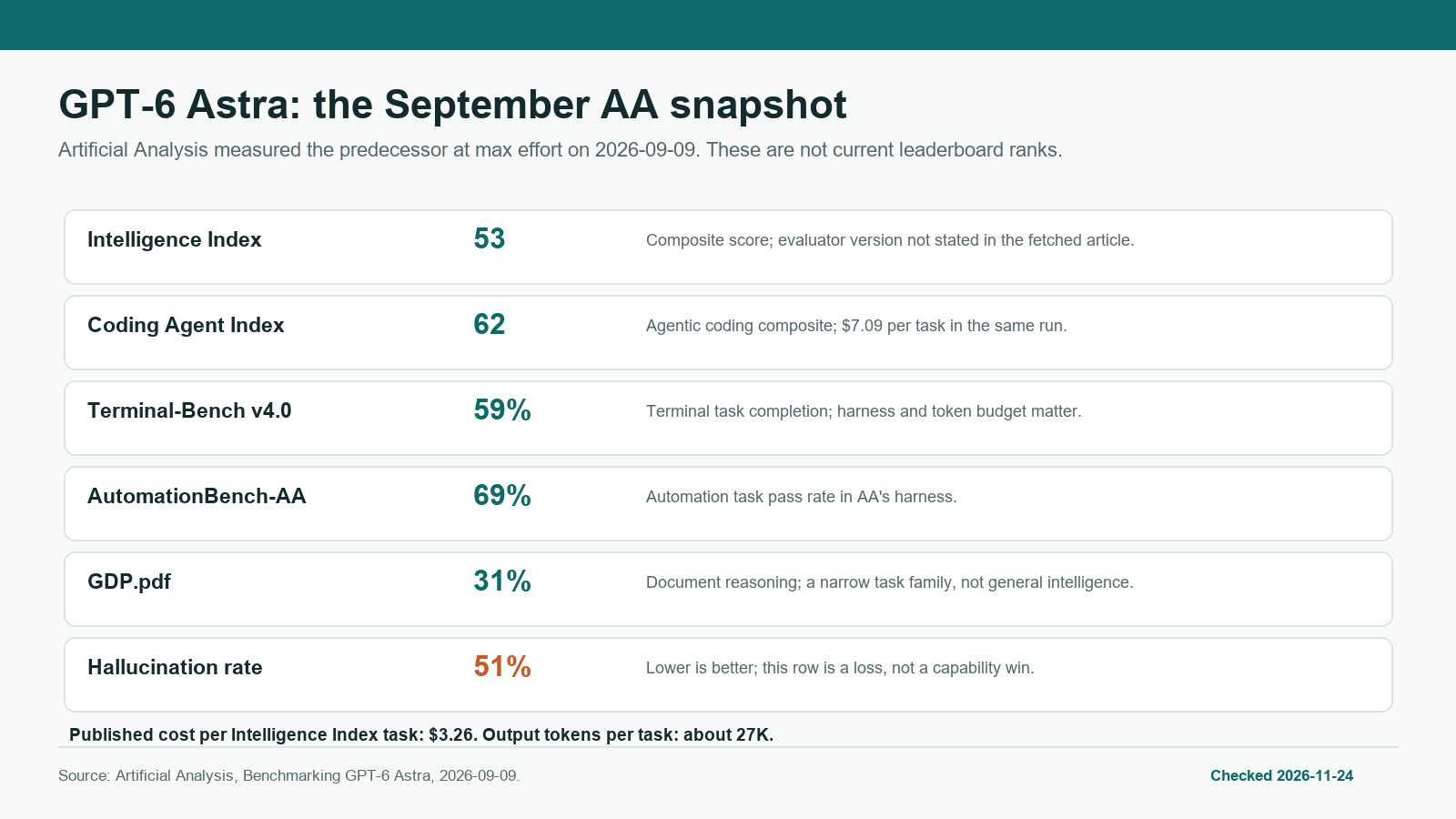
The central independent source is Artificial Analysis’s GPT-6 Astra benchmark article, published on 2026-09-09. Its snapshot uses Max effort. This is a September measurement, not Astra’s current leaderboard position. The fetched article does not state the Intelligence Index evaluator version, so this review leaves that field UNKNOWN.
| Measure | Astra result | Source and setting |
|---|---|---|
| Intelligence Index | 53 | INDEPENDENT, Max effort, 2026-09-09 |
| Cost per Intelligence Index task | $3.26 | INDEPENDENT task economics |
| Output tokens per task | About 27K | INDEPENDENT usage observation |
| Coding Agent Index | 62 | INDEPENDENT coding snapshot |
| Cost per coding task | $7.09 | INDEPENDENT task economics |
| Hallucination rate | 51% | INDEPENDENT reliability result |
| Terminal-Bench v4.0 | 59% | INDEPENDENT benchmark row |
| AutomationBench-AA | 69% | INDEPENDENT benchmark row |
| GDP.pdf | 31% | INDEPENDENT benchmark row |
The Coding Agent Index is the clearest reason to keep evaluating Astra. A score of 62 describes performance on the evaluator’s coding-agent suite, not every software task. The associated $7.09 per coding task is more useful than a token price alone because it reflects the evaluator’s task mix and token use. It still does not predict your repository, tool permissions or retry rate.
Terminal-Bench v4.0 is the terminal-work row. Its 59% result supports testing Astra in command-line and tool-using workflows, but the fact pack does not reproduce the task set. AutomationBench-AA is the automation row at 69%. GDP.pdf is the document-work row at 31%. The spread is important: Astra does not have one quality level that transfers unchanged across task types. A buyer should map each benchmark row to a real lane instead of averaging them into a universal verdict.
The roughly 27K output tokens per task also explain why output pricing matters. At Astra Standard’s ≤272K output rate of $50 per 1M tokens, that output volume alone represents DERIVED input-independent output charges of about $1.35. This is not a reconstruction of the $3.26 task cost. The evaluator’s complete cost composition is not in the pack, and input, retries or other charges cannot be inferred from the output count.
The 51% hallucination rate blocks a universal verdict
The unfavorable number is not a footnote. Artificial Analysis reports a 51% hallucination rate in the same Astra snapshot. This is a serious reliability warning for factual generation, research summaries and any workflow that can turn a plausible error into an action.
It is not a claim that every Astra response is wrong. The fact pack does not provide the hallucination test’s denominator, prompt distribution or category breakdown. Those gaps prevent a direct conversion into your product’s failure rate. They do not justify ignoring the result. The correct response is to measure verified claims and unsupported assertions on your own task set, then set a route-specific error budget.
The disagreement between snapshots reinforces the caution. The fact pack’s conflict ledger records the September Artificial Analysis result of 53 at $3.26 per task and a later November Eesel report of 57 at $6.24 per task. The Eesel URL is not in the verified source register, so the later pair remains UNCONFIRMED here. Even if it is accurate, it is a different snapshot. It cannot be blended with September’s score or used to claim that Astra improved by a measured amount.
A current rankings page can be useful for discovery, but it should not erase provenance. Store the evaluator, publication date, effort setting and evaluator version beside every imported score. If those fields are missing, the score belongs in a dated evidence note, not in a routing rule. This is why Astra can be a reasonable coding candidate and a poor unsupervised factual candidate at the same time.
GPT-6 Sol is a cost control, not a matched replacement
OpenAI’s GPT-6 Sol launch article provides official results. Artificial Analysis’s GPT-6 Sol model page lists effort settings max, xhigh, high, medium, low and non-reasoning, with an Intelligence Index snippet of 44 at Max.
| GPT-6 Sol result | Score or cost | Source and setting |
|---|---|---|
| Intelligence Index | 44 | INDEPENDENT snippet, Max |
| AutomationBench | 33.2%; $0.27 per task | OFFICIAL, xhigh |
| Agents’ Last Exam v1 | 56.4% | OFFICIAL, max |
| DeepSWE v1.1 | 68.8% | OFFICIAL, max |
| OSWorld 2.0 offline | 60.5% | OFFICIAL, xhigh |
Sol’s official Standard list rates are one-fifth of Astra’s at each ≤272K input, cached-input and output rate. That is DERIVED from $2 versus $10, $0.20 versus $1 and $10 versus $50. The same one-fifth relationship holds in the above-272K Standard column. It does not prove a fivefold reduction in your bill or a fivefold difference in cost per successful task. Prompt length, output length, retries and effort still decide the final amount.
Do not compare Sol’s official AutomationBench 33.2% with Astra’s independent AutomationBench-AA 69% as if they were a controlled head-to-head. The benchmark labels, source classes and settings differ. Likewise, the Sol Intelligence Index snippet and Astra’s September snapshot do not come with enough shared evaluator metadata to support a precise quality-gap claim.
Sol is therefore a migration candidate, not an automatic downgrade. Route suitable tasks there when a replay preserves accepted-output quality. Keep Astra where its measured task performance earns the higher cost. The GPT-6 Sol versus Claude Opus 5.5 comparison keeps the model versions and evidence classes separate. GPT-6 Sol is not GPT-6.2 Sol.
Official GPT-6 Sol context limits, input and output limits, knowledge cutoff and snapshot aliases were not verified in the accessed pack. They remain UNKNOWN. The gateway has no GPT-6 Sol model page, so an official Sol API listing must not be presented as callable access here.
Why Opus 5.5 and Fable 5.2 cannot settle this from one index
The Claude alternatives show why a single index is not a buying decision. Anthropic’s pricing page lists Opus 5.5 at $4 input and $20 output per 1M tokens, and Fable 5.2 at $8 input and $40 output. Artificial Analysis’s Opus 5.5 page reports an Intelligence Index of 59 at Max with evaluator v5.0.1. Its Fable 5.2 page reports 65 at Max with v5.0.1 in the dated earlier snapshot.
Those results are useful within their own evidence context. They cannot establish a clean ranking against Astra’s 53 because Astra’s evaluator version is UNKNOWN. A number should not be declared comparable merely because two sites use a similar index name. A matched comparison needs the same evaluator version, effort policy and task snapshot.
The Fable score needs its reproduction caveat. The 65 and v5.0.1 values come from an earlier Artificial Analysis fetch dated 2026-11-24. A later fetch reconfirmed pricing, context and the High default effort but did not reproduce the score and evaluator version in extracted text. Keep the earlier result as a dated snapshot. Do not describe the later fetch as independent confirmation of it.
The Claude Opus 5.5 review separates official launch benchmarks from the independent index. The Opus 5.5 pricing guide explains cache and endpoint charges. The Opus 5.5 alternatives overview frames the decision around cost per accepted task rather than a universal winner. For coding migrations, replay the same repository tasks before switching families.
The Claude Fable 5.2 launch analysis covers official capabilities and access boundaries. The Fable 5.2 pricing guide covers list rates and cache arithmetic. The Fable 5.2 review keeps vendor-reported benchmark rows separate from independent measurements. A higher dated index does not remove Astra’s need for task-level verification, and it does not make Fable a verified gateway option.
GPT-6.2 changes price and access, but not the evidence problem
The newer family belongs in a migration review because its official prices differ from GPT-6. OpenAI’s GPT-6.2 announcement and the Artificial Analysis launch analysis establish the boundary. Prices below are official list rates, checked 2026-11-24, in USD per 1M tokens.
| GPT-6.2 Astra tier | Input / cached / output at ≤272K | Input / cached / output at >272K |
|---|---|---|
| Standard | $8 / $0.40 / $40 | $16 / $0.80 / $60 |
| Batch/Flex | $4 / $0.20 / $20 | $8 / $0.40 / $30 |
| Fast | $16 / $0.80 / $80 | $32 / $1.60 / $120 |
| Ultrafast through 2027-02-28 | $24 / $1.20 / $120 | $48 / $2.40 / $180 |
| Ultrafast from 2027-03-01 | $48 / $2.40 / $240 | $96 / $4.80 / $360 |
| GPT-6.2 Sol tier | Input / cached / output at ≤272K | Input / cached / output at >272K |
|---|---|---|
| Standard | $2 / $0.10 / $10 | $4 / $0.40 / $15 |
| Batch/Flex | $1 / $0.05 / $5 | $2 / $0.10 / $7.50 |
| Fast | $4 / $0.20 / $20 | $8 / $0.40 / $30 |
| Ultrafast through 2027-02-28 | $6 / $0.30 / $30 | $12 / $0.60 / $45 |
| Ultrafast from 2027-03-01 | $12 / $0.60 / $60 | $24 / $1.20 / $90 |
GPT-6.2 Standard explicit-cache writes are listed for 30 minutes and 12 hours. For Astra, the 30-minute/12-hour rates are $10/$20 at or below 272K input and $20/$40 above 272K. For Sol, they are $2.50/$5 and $5/$10. Eligible background requests are 30% below Standard for two hours and 40% below Standard for eight hours. Regional-processing endpoints for post-2026-03-05 models carry a 10% uplift. Flex remains available while its beta winds down. ChatGPT-plan Ultrafast access varies by plan and model and is not an API entitlement.
The GPT-6.2 benchmark record is also snapshot-dependent. Artificial Analysis’s launch article reports GPT-6.2 Astra at 65 and Sol at 57 at Max. Its live Astra model page shows a different ladder: 62 at Max/Xhigh, 60 at High, 57 at Medium and 46 at Low. An Eesel summary, UNCONFIRMED in this source set, reports Astra at 62 and $4.00 per task, and Sol at 57 and $1.01 per task. Treat 62 versus 65 as unresolved. Do not put those rows into one chart or declare a current rank.
A 1,050,000-token context, 922,000 maximum input, 128,000 maximum output and 2026-05-18 cutoff are eesel-reported, not verified on an accessed official model page. This review therefore treats GPT-6.2 limits as UNKNOWN. The GPT-6.2 versus GPT-6 Astra analysis examines the version choice without converting those reported limits into official guarantees.
Access is a separate gate. On 2026-11-24, the gateway catalogue had a GPT-6.2 Astra page marked unavailable. Do not use a callable :free call to action for it. An official direct-API model and a gateway-served model are not the same claim.
Production fit: route by workload, not leaderboard
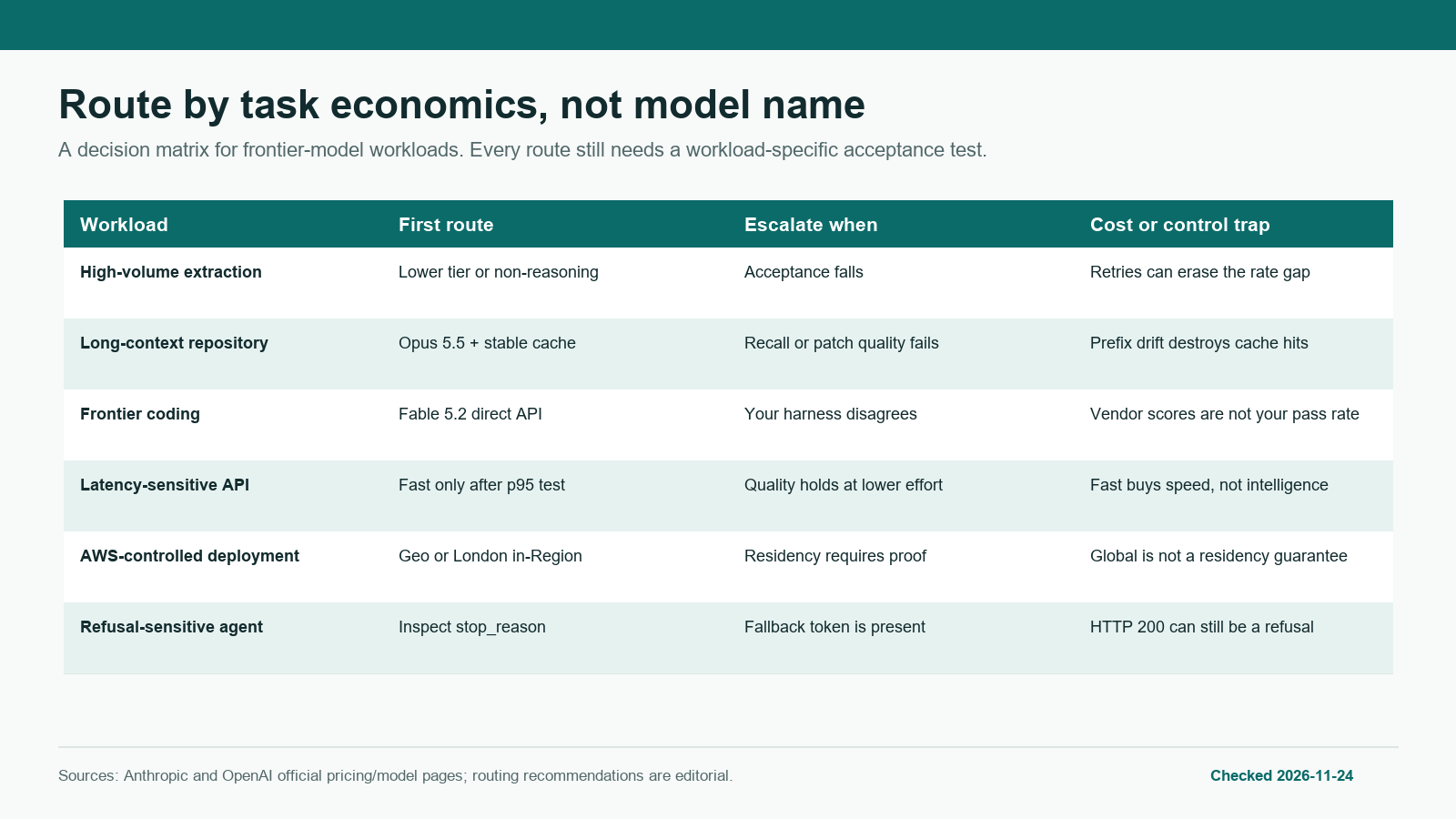
The decision should follow the failure mode of each lane. Astra’s coding evidence earns a trial. Its hallucination evidence requires verification. Its price structure requires token measurement. None of those facts supports a universal keep or retire instruction.
| Workload | Initial decision | Required gate |
|---|---|---|
| Coding agents with tests or review | Keep as a candidate | Replay repository tasks; count accepted changes and repair cost |
| Document analysis with citations | Conditional keep | Verify claims and sources; track unsupported assertions |
| High-volume extraction | Migrate candidate | Compare accepted-field accuracy and total cost with a cheaper route |
| Customer-facing factual answers | Retire from unsupervised use unless verified | Enforce retrieval, citations and human or automated review |
| Interactive latency-sensitive requests | UNKNOWN until measured | Measure your own latency distribution; the pack has no Astra speed figure |
| AWS-specific deployment | Evaluate separately | Verify the exact model, API and region support before routing |
For coding, use the reasoning controls documentation to understand configuration, and the tool-calling documentation to review tool boundaries. A tool-capable route still needs permissions, output validation and a rollback path. The coding index is a reason to test that design, not proof that it is safe.
For context-heavy work, instrument the assembled prompt. The 272K threshold can change the bill before a model-limit discussion begins. If Claude is a fallback candidate, the Opus 5.5 context and caching guide explains stable-prefix design and thinking-block replay constraints for that family. Those rules must not be copied to Astra as if they were OpenAI requirements.
Speed remains a separate measurement. The Fast tier’s name does not establish Astra’s latency, and the roughly 27K output-token observation does not establish tokens per second. Measure time to first token, total completion time and retry frequency under your own concurrency. Until those results exist, latency-sensitive routing remains an evidence gap rather than a reason to prefer or reject Astra.
For AWS deployments, do not infer Bedrock support from a model name. The Opus 5.5 Bedrock routing guide documents model-specific IDs, APIs, regions and billing constraints. The Fable 5.2 production-routing guide covers Anthropic refusal handling and eligible fallback behavior. Neither guide establishes GPT-6 Astra deployment support on AWS.
The model comparison tool can organize a shortlist, and the model documentation should be the place to verify current identifiers. The November frontier-model overview places Astra beside the newer releases. Use those routes to narrow options, then replay tasks. Do not select a route from a comparison page alone.
A replay plan before you change the default
Start with a fixed set of real requests from each production lane. Keep the prompts, retrieved context, tool results and acceptance criteria stable across candidate routes. Record the model version, effort setting, evaluator or test harness, date and token counts. This creates a comparison you can audit later.
Run candidates in shadow mode before moving user traffic. Score task success separately from fluency. For factual work, verify claims against the supplied evidence and count unsupported assertions. For coding, count accepted changes, failed tests and repair effort. For extraction, count accepted fields rather than tokens generated. These measures map more closely to production value than a composite index.
Compute cost per accepted output as DERIVED total billed cost divided by accepted outputs. Include retries and review effort when they are part of the real workflow. A lower list price does not win if the replacement needs more repair. A higher task score does not win if its errors escape the verification layer.
Then route by lane. Keep Astra where accepted quality justifies its cost. Migrate routine work where the replay shows equivalent accepted quality at lower total cost. Retire it where the verification burden or error rate is unacceptable. Preserve a rollback route and recheck when the vendor, evaluator or workload changes. This is a controlled decision process, not a prediction about a future leaderboard.
What the public data does not show
- GPT-6 Astra limits: Context window, maximum input, maximum output, knowledge cutoff and snapshot aliases are UNKNOWN. The 272K figure is a pricing threshold, not a verified context limit.
- Effort coverage: The independent snapshot uses Max effort. The complete Astra effort set is not established by the pricing page.
- Speed: Astra latency, throughput and runtime per task are UNKNOWN in this pack. Output token count is not a speed measurement.
- Reliability detail: The hallucination test’s denominator, categories and sub-scores are not supplied. The 51% result cannot be converted directly into your failure rate.
- Current rank: The September 53 is not a current placement. The evaluator version is not stated, and later reported snapshots are not matched.
- Matched alternatives: Sol, Opus 5.5, Fable 5.2 and GPT-6.2 do not have a shared evaluator-and-effort comparison with Astra in the accessed evidence.
- Gateway operations: Gateway-specific rates, throughput, uptime and rate limits are UNKNOWN. The catalogue and status pages establish access boundaries, not service-level performance.
This section should be updated when an official GPT-6 Astra model page verifies its limits and when independent evaluators publish a same-version, same-effort comparison. Based on the named sources available on 2026-11-24, the confirmed position is narrower: Astra has a dated coding result, a serious dated reliability loss and official prices that make request size material. That is enough to design a trial, not enough to declare universal superiority.
Access and next action
The GPT-6 Astra model page exists on oneaiapikey.com. GPT-6 Sol does not have a gateway page in this research. GPT-6.2 Astra is marked unavailable. Check the model status page before changing a live route, and use the cost calculator to test official list-price scenarios. If you need another hosted route, browse the model catalogue. None of those links turns an unavailable direct-API model into a callable gateway model.
The practical answer is conditional. Keep Astra for verified coding and agent work. Migrate lower-risk work when a replay proves the replacement is adequate. Retire it from factual lanes that cannot tolerate its measured reliability risk. The evidence supports that routing policy. It does not support a clean universal-quality verdict.
More GPT-6 Astra coverage
- GPT-6 Astra pricing and the 272K input cliff
- Claude Fable 5.2 launch facts and access boundaries
- Claude Fable 5.2 pricing, cache writes and Batch rules
- Claude Fable 5.2 review with vendor and independent evidence separated
- Claude Fable 5.2 production routing and refusal handling
- Claude Opus 5.5 pricing and endpoint costs
- Claude Opus 5.5 review across official and independent benchmarks
- Claude Opus 5.5 alternatives by workload and cost per success
- GPT-6 Sol versus Claude Opus 5.5 without version confusion
- Claude Opus 5.5 context and caching constraints
- Claude Opus 5.5 Bedrock routing, regions and billing