Claude Fable 5.2 launched on 2026-11-09. Its official Anthropic API ID is claude-fable-5-2. It has a 1,000,000-token context window, a 128,000-token maximum output, and five effort settings from low to max. Adaptive thinking is always on.
Fable and Mythos 5.2 use the same underlying model. They differ in safeguards and access. Fable blocks high-risk cybersecurity and most research-biology tasks. Mythos requires Cyber Verification or Life Sciences Verification. The evidence pack contains no verified standalone Mythos API ID.
One conflict affects integration planning. The launch article says the default effort is Medium. The models overview and AWS card say High. Set the effort explicitly instead of relying on the default. Fable and Mythos are not available through this gateway, and /models/claude-fable-5-2 does not exist.
This guide is for developers, platform teams and buyers who need the exact identifiers, request constraints and access boundary. It separates official specifications, vendor benchmark claims, one independent snapshot and arithmetic derived from published prices. All evidence was checked on 2026-11-24.
The short answer
- What changed: Anthropic shipped Fable 5.2 and described Mythos 5.2 as the same model with different safeguards and access.
- Who it is for: Teams evaluating long-context reasoning and coding through Anthropic’s direct API or AWS Bedrock.
- Main published capability: A 1M-token context window, up to 128K output tokens and five effort settings.
- Main loss: Fable refuses high-risk cyber work and most research biology. Mythos is not a general-purpose escape hatch because it requires verification.
- Availability: The Fable API and Bedrock IDs are verified. A standalone Mythos API ID is not.
- What is missing: The frozen sources do not provide a verified Mythos API ID, a settled default-effort answer or independent production latency and cost-per-task measurements.
What shipped on 2026-11-09
The Anthropic launch announcement establishes the release date and the Fable/Mythos relationship. The models overview supplies the API ID, limits, effort ladder and lifecycle information. Those are official sources, but they do not agree on one important default.
| Specification | Published value |
|---|---|
| Launch date | 2026-11-09 |
| Anthropic API ID | claude-fable-5-2 |
| Context window | 1,000,000 tokens |
| Maximum output | 128,000 tokens |
| Effort settings | low, medium, high, xhigh, max |
| Adaptive thinking | Always on; cannot be disabled |
| Knowledge cutoff | June 2026 |
| End of life | No sooner than 2027-11-09 |
| Input modalities | Text and image |
| Output modality | Text only |
The lifecycle date is a floor, not a scheduled shutdown. “No sooner than” gives a minimum support horizon. It does not promise that the model will retire on that date or remain unchanged until then. Teams still need a migration path and a way to pin the model version they tested.
The June 2026 cutoff is also separate from the November launch date. Do not treat the model’s stored knowledge as a live source of current facts. If an application needs recent information, supply it through the application’s own retrieval or tool path and verify the result there.
The 128K output ceiling is a limit, not a recommended response length. Longer answers incur output charges. Text-only output means the application owns presentation, audio and any conversion into another modality. Image input does not create image output.
Fable and Mythos: one model, two access policies
The most important distinction is not a hidden performance tier. Anthropic says Fable and Mythos are the same underlying model with different safeguards and access. A team should choose between them based on permitted work and verification status, not on an assumed difference in raw capability.
Fable blocks high-risk cybersecurity and most research-biology tasks. That is a concrete product limitation. A security team that needs vulnerability discovery, or a life-sciences team that needs research-biology assistance, cannot assume the general Fable endpoint will complete the task. The restriction can appear as a refusal even when the HTTP request succeeds.
Mythos requires Cyber Verification or Life Sciences Verification. The verification requirement is part of access, not a parameter to add to a prompt. A team without the relevant approval should not build a production dependency on Mythos. The supplied evidence names the two verification routes but does not verify their application process, approval criteria or timing.
There is also an identification gap. No verified standalone Mythos API ID was found in the frozen sources. Do not manufacture one by replacing fable with mythos in the known Fable ID. Do not treat the Mythos name as permission to call an undocumented endpoint. Until Anthropic publishes or confirms an identifier through an authorized access channel, the correct entry in an integration inventory is “ID not verified.”
The benchmark record makes the access difference visible. Anthropic reports Mythos 5.2 at 89.6% on CVE Rediscovery, compared with 81.3% for Opus 5.5. That row reflects vetted Mythos access. It is not an equivalent-access comparison, and it is not evidence that an unverified Fable request can reproduce the Mythos result.
This is the honest loss in the launch: broader access comes with narrower permitted work, while the less restricted lane has a verification gate. Neither name solves every safety-sensitive workload. If your evaluation depends on cyber or research-biology tasks, resolve access before running a benchmark or choosing a deployment route.
Exact API and Bedrock IDs
Use the identifiers exactly as published. The direct Anthropic API model is claude-fable-5-2. AWS Bedrock publishes three IDs for Fable 5.2:
| Channel | Exact ID | Scope stated in the evidence |
|---|---|---|
| Anthropic API | claude-fable-5-2 |
Official direct-API model |
| Bedrock base ID | anthropic.claude-fable-5-2 |
No in-Region option for the bare Fable ID |
| Bedrock US geo profile | us.anthropic.claude-fable-5-2 |
Geo routing for US and Canadian source Regions |
| Bedrock global profile | global.anthropic.claude-fable-5-2 |
Global routing; not a data-residency guarantee |
| Mythos | Not verified | No standalone API ID found |
The Bedrock IDs come from the AWS Fable 5.2 model card. The bare ID does not have an in-Region inference option. Geo routing covers US and Canadian source Regions. Choosing a global profile does not, by itself, establish where data will be processed. Review the card and your organization’s data-handling requirements before treating a routing choice as a residency control.
Keep three access questions separate. First, does an official vendor API exist? For Fable, yes. Second, does a Bedrock inference profile exist? For Fable, yes. Third, does this gateway serve the model? For Fable and Mythos, no.
The site catalogue was checked on 2026-11-24. It has no Fable 5.2 model page. The route /models/claude-fable-5-2 does not exist. Readers can inspect the current model catalogue and the model status page, but neither an official launch nor a Bedrock ID creates a gateway listing.
For request-field details, use the API reference. For model-selection rules that apply across providers, use the models documentation. Those routes explain the gateway’s supported interface; they do not add Fable to the catalogue.
The default-effort conflict: Medium or High
The published effort ladder is low, medium, high, xhigh and max. Adaptive thinking is always on and cannot be disabled. Low effort therefore does not mean non-reasoning mode. It is still an adaptive-thinking setting.
The default is disputed across official sources:
- The Anthropic launch article says Medium.
- The Anthropic models overview says High.
- The AWS Bedrock model card says High.
- Artificial Analysis also listed High as the default in its 2026-11-24 snapshot.
This article preserves the conflict rather than selecting a winner. Medium is the launch-page statement. High is the models-overview and AWS-card statement. The count of sources does not explain why they differ, and the frozen evidence does not resolve whether the change reflects timing, channel behavior or documentation drift.
The practical fix is to set effort explicitly in every evaluation and production request. Record that setting with the model ID, prompt version and test date. If a result moves after an SDK or endpoint change, the explicit setting gives you a stable comparison point.
Effort also changes the meaning of a benchmark score. A Max-effort score is not the same measurement as a Medium-effort score. The reasoning documentation is the right place to review the gateway’s effort controls. When comparing Fable with another model, compare the same task at named effort levels, not two unlabeled headline numbers.
1M context, 128K output and thinking-block replay
Fable 5.2 accepts text and image input and returns text. Its context window is 1,000,000 tokens. Its maximum output is 128,000 tokens. These are different limits. A 1M context window does not grant a 1M-token answer, and the output ceiling does not reserve the entire context window for the prompt.
Budget the request in separate parts. The prompt and prior conversation consume context. The answer has its own maximum and its own output price. Thinking is always on, and the pricing evidence says thinking affects the final bill. An application that plans only for visible answer tokens can underestimate both usage and cost.
Long context also raises the value of a stable prefix. Explicit caching has a 512-token minimum per checkpoint and a maximum of four checkpoints. The published time-to-live options are five minutes and one hour. Those constraints matter when a system tries to cache several independent documents or tool traces. Split the work deliberately instead of assuming every useful segment can become its own checkpoint.
Thinking blocks are bound to the model and conversation prefix. Altered replay can return HTTP 400. In practice, preserve the model identity and the prior prefix when reusing a response that contains thinking blocks. Editing earlier turns and then replaying the old thinking content can break the request. A conversation store should keep the original sequence intact when the application depends on replay.
The Opus 5.5 context-caching guide covers the same cache constraints in more depth. Fable and Opus 5.5 share the published 512-token checkpoint minimum, four-checkpoint maximum and five-minute or one-hour TTL choices. Use that guide to design stable prefixes before using a million-token window as a reason to resend an entire history on every turn.
A large window is useful only when the application can select the right material. It does not remove the need for retrieval, deduplication or a token budget. Test recall on your own document set and measure the cost of the prompt you actually send.
List pricing and the long-context bill
All prices below are official list prices in USD per 1,000,000 tokens. They are not subscription allowances and they are not gateway rates.
| Charge | Fable 5.2 / Mythos 5.2 | Opus 5.5 |
|---|---|---|
| Input | $8 | $4 |
| Output | $40 | $20 |
| Prompt-cache write, 5 minutes | $10 | $5 |
| Prompt-cache write, 1 hour | $16 | $8 |
| Prompt-cache read | $0.20 | $0.20 |
| Batch input / output | $4 / $20 | $2 / $10 |
| Fast input / output | $16 / $80 | $8 / $40 |
Source: Anthropic pricing, checked 2026-11-24.
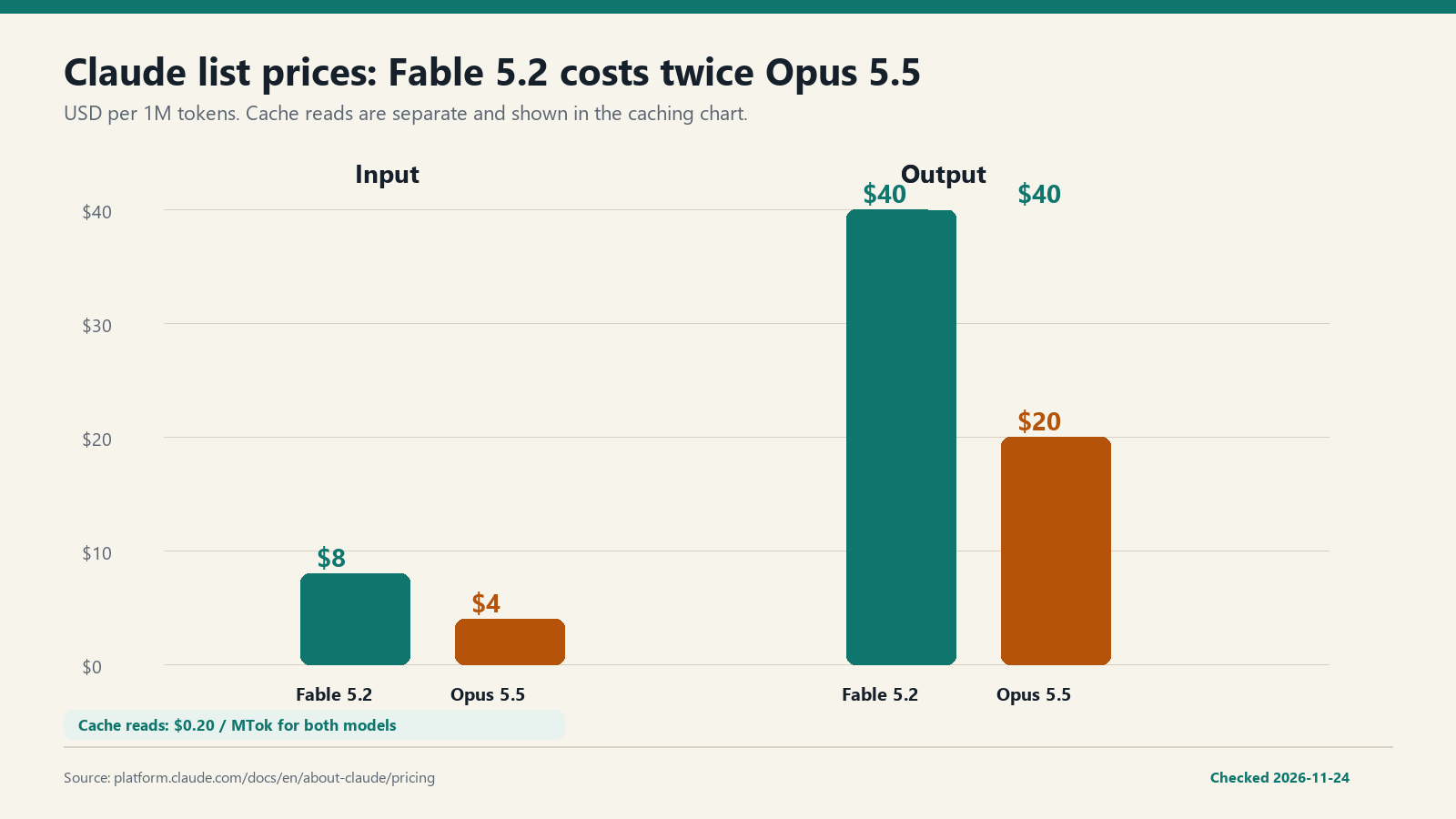
Fable’s Standard input rate is twice Opus 5.5’s, and its Standard output rate is also twice as high. That does not make Opus the automatic choice. Task success, output length, cache reuse and effort all affect cost per completed job. It does mean that a Fable evaluation needs a token budget, not just a request counter.
Batch receives a 50% discount. Fast mode is unavailable with Batch. Fast-mode pricing applies across the full context window, not only to a premium slice of a long prompt. Applicable regional and multi-region endpoints carry a 10% premium over global endpoints. Do not generalize that premium to every US customer or every Bedrock request. Name the endpoint and its scope.
Anthropic’s official text says a 900K-token request is billed at the same per-token rate as a 9K-token request. The safe conclusion is that no separate above-200K surcharge is listed. It is not a promise that the final bill cannot change. Output, thinking, cache writes, cache reads and endpoint choice still affect the total.
Cache economics are input-side arithmetic. A five-minute cache write costs 1.25 times an uncached input read. Two cache reads plus the write cost 2.5 uncached reads, so the write breaks even after approximately two reads. A one-hour write costs twice an uncached input read. Three reads plus the write cost 3.6 uncached reads, so that write breaks even after approximately three reads. These comparisons exclude output and assume a reusable prefix.
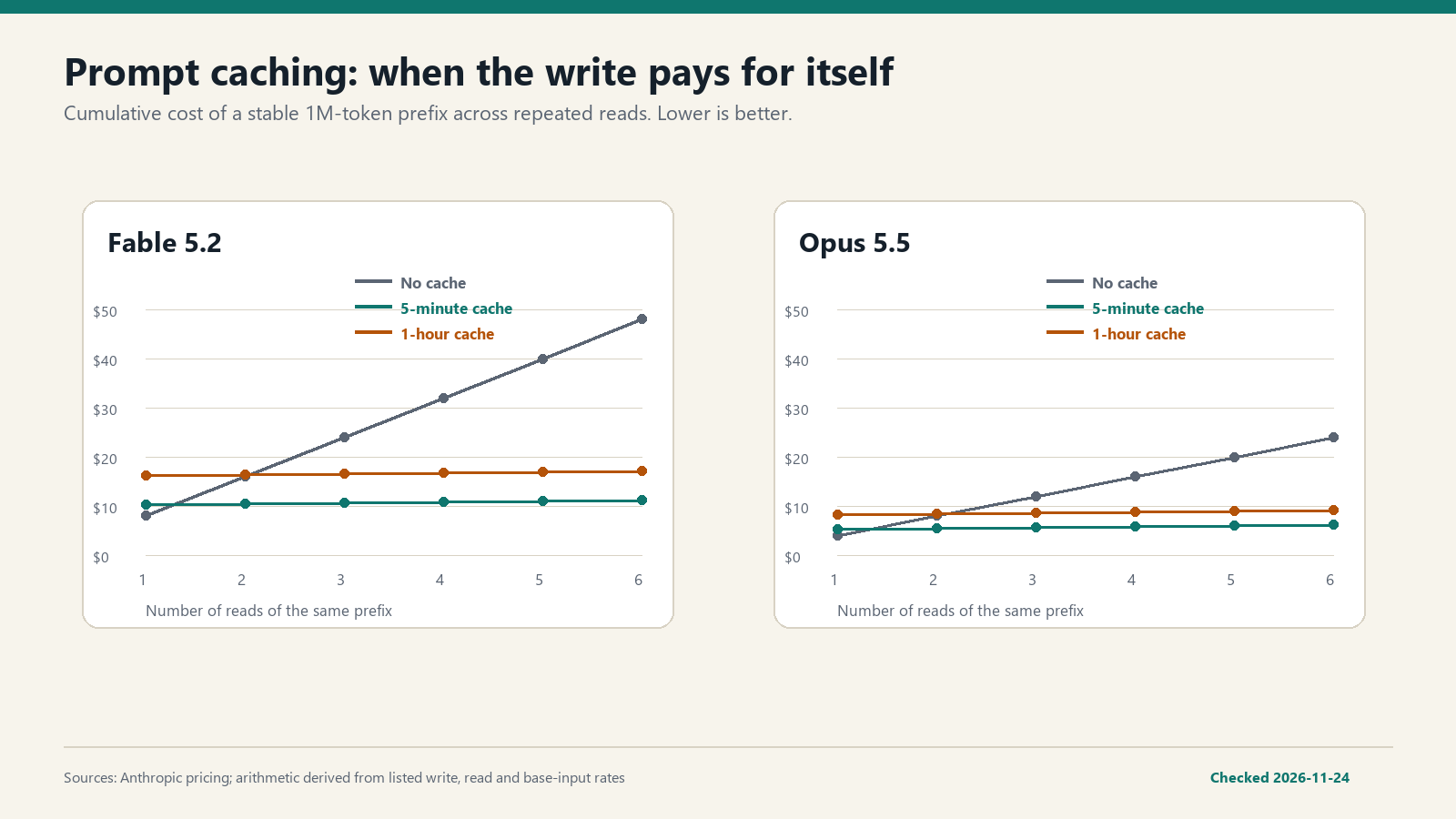
The Fable 5.2 pricing breakdown works through those rules in more detail. The Opus 5.5 pricing guide provides the lower-cost Claude comparison. If your current baseline is OpenAI, the GPT-6 Astra pricing analysis explains its separate 272K input-price cliff. Do not transfer that cliff to Claude or assume the two providers price long context the same way. Use the cost calculator with your own input, output and cache mix.
Benchmarks: official claims and one independent snapshot
Anthropic’s launch tables are vendor-reported results. They are useful evidence of what Anthropic measured, but they are not independent replication. The Fable 5.2 review examines the individual rows and their comparator limits.
| Benchmark | Published result | Comparator and caveat |
|---|---|---|
| FrontierCode 2.0 | Fable 5.2 49.1% at xhigh | Opus 5.5 45.5%; comparator effort not fully disclosed |
| FrontierSWE v2 | Fable 5.2 69.9% | Opus 5.5 62.3%; vendor-reported |
| RoboDojo Sim | Fable 5.2 64.9% | GPT-6 Astra 29.8%; vendor-reported |
| OSWorld 2.1 | Fable 5.2 89.3% | Opus 5.5 87.2% in the Fable table; Opus’s own page reports 81.8% partial success |
| CVE Rediscovery | Mythos 5.2 89.6% | Opus 5.5 81.3%; vetted Mythos access makes this an unequal-access comparison |
The names point to coding, software engineering, robotics simulation, computer use and vulnerability rediscovery. The frozen pack verifies the published scores, not every detail of each harness. Before treating a row as a production forecast, inspect the task distribution, tool access, success definition and effort setting.
The FrontierCode row is the cleanest illustration of an effort caveat. Fable is identified at xhigh. The comparator effort is not fully disclosed. A percentage-point lead is still a published result, but it is not a controlled statement that Fable wins every coding task at equal effort.
The OSWorld rows need a separate warning. The Fable table gives Opus 5.5 87.2%, while the Opus 5.5 launch page reports 81.8% using a partial-success metric. Those figures use different success definitions. Do not place them in one chart as if they were the same measurement.
The independent evidence is narrower. An earlier direct fetch of the Artificial Analysis Fable 5.2 page, date-stamped 2026-11-24, reported an Intelligence Index of 65 at Max effort using Intelligence Index v5.0.1. The same snapshot listed High as the default, $8/$40 pricing and a 1M context window.
A later fetch reconfirmed the default, context and pricing but did not reproduce the score or evaluator version in the extracted text. Keep the earlier snapshot with its date. Do not claim the later fetch independently confirmed 65, and do not turn the number into a current leaderboard rank. A composite index is not a universal intelligence measurement.
For a measured counterpoint, the GPT-6 Astra review uses a separate September Artificial Analysis snapshot and keeps its own evaluator caveats. The November frontier-model roundup places models side by side without erasing effort differences. If the decision is specifically Fable against another recent release, start with the Gemini 4 Neon versus Fable 5.2 comparison or the GPT-6.2 Astra versus Claude Fable 5.2 comparison.
Refusals can return HTTP 200
A refusal can arrive with HTTP 200 and a response body containing stop_reason: "refusal". The stop_details object can include a restriction_category. HTTP status alone is therefore not a success check.
For application logic, inspect the stop reason before counting a response as completed work. A request that returns 200 with a refusal may still consume tokens. Billing depends on the refusal category and whether output started. Do not infer a zero-cost refusal from the status code, and do not assume every refusal has the same billing treatment.
The fallback-credit beta uses the header fallback-credit-2026-07-01. Not every refusal carries a fallback token. A retry can bill the cached prefix at cache-read rather than cache-write rates. The valid fallback models are Opus 5 and Opus 4.8. Opus 5.5 and Fable are not valid fallback models.
That eligibility rule closes a tempting but incorrect routing pattern. Do not refuse a Fable request, send it to another Fable ID or an Opus 5.5 ID, and label the retry an eligible fallback. Do not promise a free retry. The beta, the category and the token all matter.
Mythos is not an automatic fallback either. It has no verified standalone API ID in this evidence, and it requires the relevant verification. A refusal path that silently changes the safeguard policy would create an access problem, not just a reliability problem.
The Fable 5.2 production-routing guide covers refusal handling, eligible fallback models and operational checks. Treat restriction_category as telemetry for understanding failures. Keep the application’s user-facing behavior separate from the billing decision.
Bedrock access has its own constraints
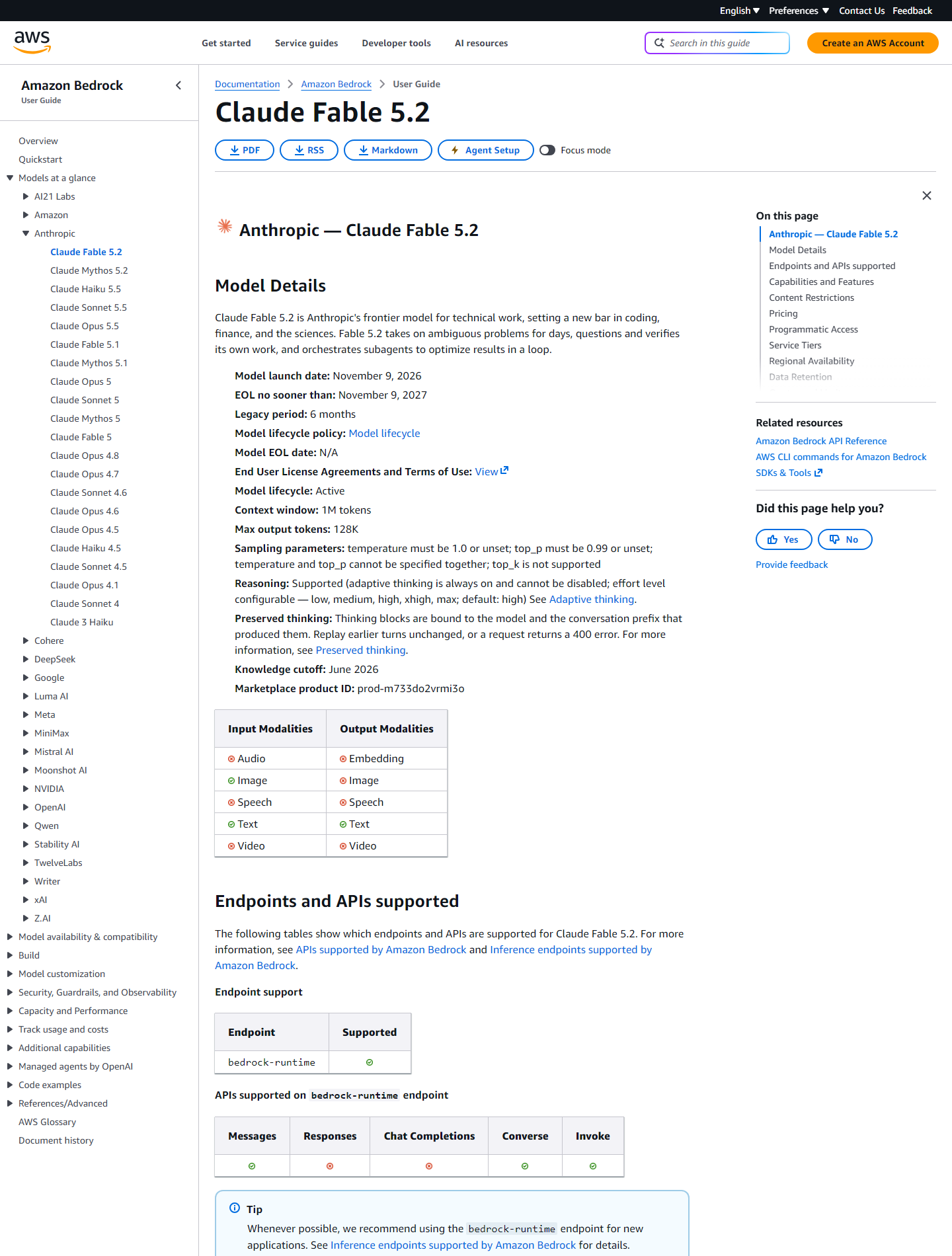
The AWS Fable 5.2 model card adds requirements that do not appear in the short Anthropic API ID.
Fable requires Bedrock retention mode aws_review. Geo routing covers US and Canadian source Regions. The bare Fable ID has no in-Region option. The global profile is a routing choice, not a data-residency guarantee.
Bedrock supports Standard only for Fable. Priority, Flex, Reserved and Batch are unsupported. The direct API’s Batch and Fast price rows must not be copied into a Bedrock cost model as available options. A deployment that depends on Fast mode or Batch throughput needs a different plan.
Opus 5.5 is a useful Bedrock comparison because it exposes the routing differences. Its bare-ID in-Region inference is limited to eu-west-2 London. It also publishes US, EU, Australian and Japanese geo IDs. Like Fable, it supports Standard only on Bedrock, without Priority, Flex, Reserved or Batch.
For Opus 5.5, bedrock-runtime supports Messages, Converse and Invoke. Responses and Chat Completions are unsupported. The separate bedrock-mantle option supports Messages in us-east-1, ap-southeast-4 and us-gov-west-1. Mantle lacks Guardrails, Knowledge Bases, Agents, Flows, Prompt Management, Application Inference Profiles and Invocation Logs. It supports Count tokens, while bedrock-runtime does not support Count tokens for this model. Mantle is billed through AWS Marketplace, and its charges appear under the model provider rather than Amazon Bedrock in AWS billing and Cost Explorer.
Those Mantle facts are Opus facts. The supplied evidence does not establish equivalent Mantle support for Fable. The Opus 5.5 Bedrock-routing guide covers the profiles, API surface and billing split in detail. Do not infer Fable parity from the family name.
What the public record does not settle
Several gaps should stay visible in an integration decision.
Mythos identification and access. No verified standalone API ID was found. The two verification routes are named, but their application process, approval criteria and timing are not verified in the frozen pack. Treat all three as open items until Anthropic or an authorized access channel supplies them.
The default-effort conflict. The launch article says Medium. The models overview and AWS card say High. The evidence does not explain the disagreement. Explicit effort is the safe implementation choice.
Independent score reproduction. Artificial Analysis’s earlier 2026-11-24 fetch produced 65 at Max with Intelligence Index v5.0.1. A later fetch did not reproduce the score or version in extracted text. The earlier snapshot remains useful, but it is not a live rank or a twice-confirmed measurement.
Benchmark comparability. Some comparator effort settings are not fully disclosed. OSWorld figures use different success definitions. The Mythos CVE Rediscovery row reflects vetted access. These rows cannot be merged into one clean head-to-head table.
Production measurements. The frozen sources do not provide independent Fable latency, throughput, cache-hit rate or cost-per-task results for this gateway or a controlled customer workload. Vendor prices and benchmark scores do not fill that gap.
This record will change when Anthropic publishes a Mythos identifier, reconciles the default or when an independent evaluator reproduces the Fable snapshot with a stated harness. Until then, use the dated claims as dated claims. A missing value is more useful than a guessed one.
How to evaluate Fable without overbuying
Start with access. If the workload includes high-risk cybersecurity or most research biology, Fable is not the appropriate unrestricted endpoint. Check whether the team can obtain the relevant Mythos verification. Do not begin with a model-ID substitution.
Next, pin the integration facts. Use claude-fable-5-2 for the Anthropic API. Use the exact Bedrock profile that matches the routing requirement. Set effort explicitly and record it. Keep adaptive thinking enabled because it cannot be disabled. Preserve thinking blocks and the conversation prefix when replaying a response.
Then test the workload you actually run. Use representative documents, images and tool outputs. Measure accepted answers, refusals, output length, latency and token use. A benchmark lead on FrontierCode does not establish success on your repository. A 1M window does not establish good retrieval. A list price does not establish cost per completed task.
Finally, separate vendor access from gateway access. If you need a hosted model through this service today, browse the model catalogue, compare listed options on the model comparison page, and confirm current access on the status page. The quickstart explains how to use models that are listed. Fable 5.2 and Mythos 5.2 are not among them.
For a lower-cost Claude option, read the Opus 5.5 review and the Opus 5.5 alternatives guide. If you are comparing OpenAI’s Sol naming across generations, the GPT-6 Sol versus Claude Opus 5.5 analysis keeps the versions separate. These are starting points for a shortlist, not claims of a universal winner.
You can create an API key, review gateway pricing, or estimate a workload with the cost calculator. Those routes offer access to the models the gateway actually lists. They do not provide Fable or Mythos access.