Claude Opus 5.5 has a 1M-token context window, a 128K maximum output and Standard list rates of $4 per 1M input tokens and $20 per 1M output tokens. No separate above-200K input surcharge is listed. Cache writes cost $5 per 1M tokens for five minutes or $8 for one hour. Cache reads cost $0.20.
The important limit is reuse. Savings require the same prefix to remain reusable. Changing thinking blocks or tool ordering can invalidate that prefix, and altered thinking-block replay can return HTTP 400. Cache pricing is not a discount applied to every long prompt.
This article is for developers and operators budgeting repeated requests over large document sets. It works through 100K, 500K and 1M-token examples, then turns the rates into a prefix design and TTL decision. All prices are Anthropic list prices in USD, checked November 24, 2026. They are not gateway rates.
The short answer
- Context: 1M tokens, with a 128K maximum output.
- Standard input: $4 per 1M tokens. Output: $20 per 1M tokens.
- Cache writes: $5 per 1M tokens for five minutes, or $8 for one hour.
- Cache reads: $0.20 per 1M tokens.
- Checkpoint rules: at least 512 tokens per explicit checkpoint, with no more than four checkpoints.
- Break-even: a five-minute write repays itself after about two reads; a one-hour write after about three reads. These are DERIVED input-side comparisons.
- Main loss: a long context is not automatically a cheap context. Exact prefix reuse, output volume and cache lifetime decide the result.
- Gateway boundary:
/models/claude-opus-5-5exists. The frozen evidence does not provide a gateway rate or a gateway cache endpoint.
What 1M context costs before caching
Start with the official Anthropic pricing table. Opus 5.5 charges by token volume and charge type. An uncached input read, a cache write and a cache read are three different events.
| Charge | Opus 5.5 Standard list rate |
|---|---|
| Uncached input | $4 per 1M tokens |
| Output | $20 per 1M tokens |
| Prompt-cache write, five minutes | $5 per 1M tokens |
| Prompt-cache write, one hour | $8 per 1M tokens |
| Prompt-cache read | $0.20 per 1M tokens |
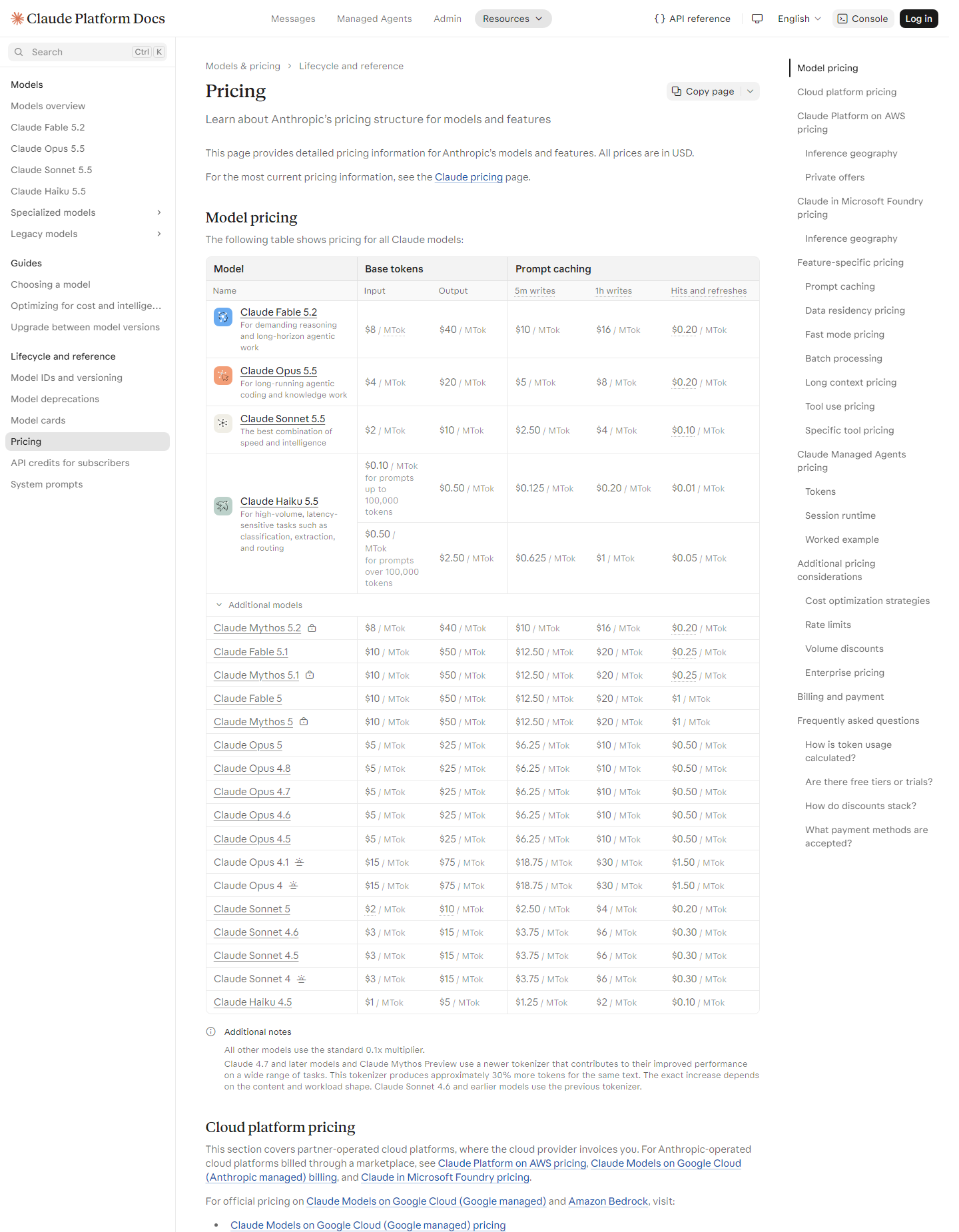
The models overview and Opus 5.5 announcement establish the 1M context window and 128K maximum output. They also list low, medium, high, xhigh and max effort settings, with Medium as the default. Adaptive thinking is always on.
Those limits do not create a second input-price tier. Anthropic’s pricing text says a 900K-token request is billed at the same per-token rate as a 9K-token request. The precise claim is no separate above-200K surcharge is listed. Do not rewrite that as “the bill can never change.” More input still costs more. Thinking, output, cache writes and endpoint choice still affect the total.
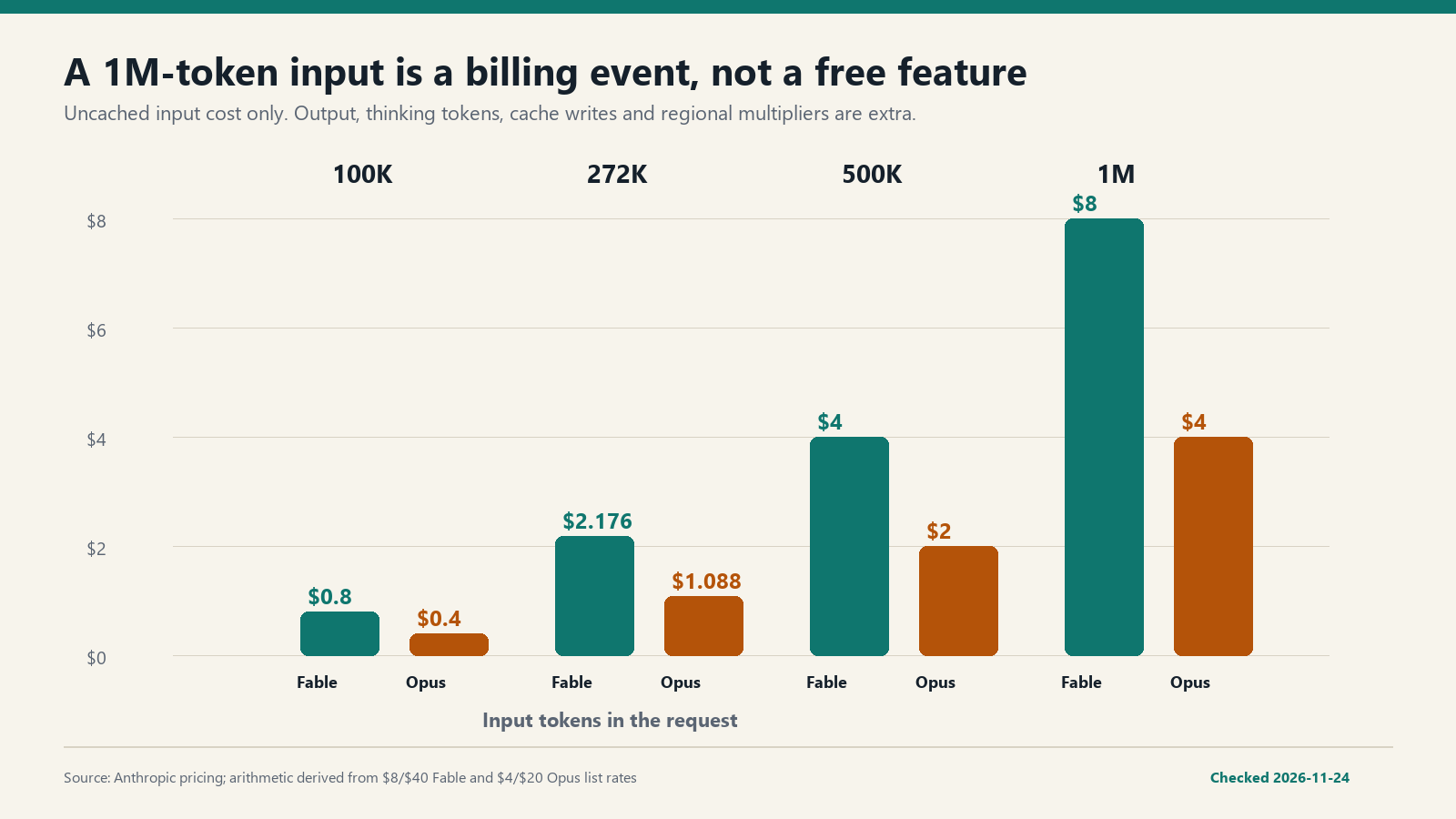
The curve is linear because the listed input rate is flat. A 100K-token uncached input costs $0.40. A 500K-token input costs $2.00. A 1M-token input costs $4.00. The window size changes how much material fits, not the published rate per token.
Output is separate. If a response bills 128K output tokens, the output charge alone is 0.128 × $20 = $2.56. That is DERIVED arithmetic for the maximum output count, not a forecast that every request will generate that much. Adaptive thinking and effort choices can also affect generated volume. The frozen evidence gives no typical output count for a particular long-context task.
A useful budget therefore has at least two columns: input-side charges and generated-token charges. Adding them too early can hide a cache mistake. If a prefix misses, the input side can look like a fresh write or a fresh uncached read even when output stayed short.
Worked arithmetic at 100K, 500K and 1M
The following tables are DERIVED from Anthropic’s published rates. They isolate input-side charges. Output, thinking, Batch, Fast, regional premiums and taxes are excluded.
First, calculate the cost of one request at each context size:
| Input size | Uncached input | Five-minute write | One-hour write | Cached read |
|---|---|---|---|---|
| 100K tokens | $0.40 | $0.50 | $0.60 | $0.02 |
| 500K tokens | $2.00 | $2.50 | $4.00 | $0.10 |
| 1M tokens | $4.00 | $5.00 | $8.00 | $0.20 |
The formulas are direct. At 100K tokens, uncached input is 0.1 × $4 = $0.40. A five-minute write is 0.1 × $5 = $0.50. A one-hour write is 0.1 × $8 = $0.60. A cached read is 0.1 × $0.20 = $0.02.
At 500K tokens, the same calculations use 0.5 million tokens. At 1M, the multiplier is 1. These numbers assume the entire stated input is the reusable prefix. Real requests may contain a smaller stable prefix plus changing material.
One write followed by two reads
Now compare three requests that each carry the same prefix. Without caching, all three pay the uncached input rate. With caching, the first request pays the write rate and the next two pay the read rate.
| Prefix size | Three uncached requests | 5m write + 2 reads | 1h write + 2 reads |
|---|---|---|---|
| 100K | 3 × $0.40 = $1.20 | $0.50 + 2 × $0.02 = $0.54 | $0.60 + 2 × $0.02 = $0.64 |
| 500K | 3 × $2.00 = $6.00 | $2.50 + 2 × $0.10 = $2.70 | $4.00 + 2 × $0.10 = $4.20 |
| 1M | 3 × $4.00 = $12.00 | $5.00 + 2 × $0.20 = $5.40 | $8.00 + 2 × $0.20 = $8.40 |
At 1M tokens, the five-minute sequence costs $5.40 instead of $12.00, a DERIVED input-side saving of $6.60. The one-hour sequence costs $8.40, saving $3.60. The shorter TTL wins this comparison because both writes survive long enough to serve both reads.
This is the practical meaning of the approximately two-read break-even. A five-minute write costs 1.25 uncached reads. Add two reads at 0.05 uncached-read equivalents each, and the sequence costs 1.35 uncached reads versus three without cache. The write alone costs more than one uncached request. The source pack summarizes the five-minute case as break-even after approximately two reads.
One write followed by three reads
A fourth request changes the result:
| Prefix size | Four uncached requests | 5m write + 3 reads | 1h write + 3 reads |
|---|---|---|---|
| 100K | $1.60 | $0.56 | $0.66 |
| 500K | $8.00 | $2.80 | $4.30 |
| 1M | $16.00 | $5.60 | $8.60 |
At 1M tokens, four uncached requests cost $16.00 on the input side. The five-minute cache sequence costs $5.60. The one-hour sequence costs $8.60. Both now beat no cache. The source pack uses approximately three reads as its conservative break-even marker for the one-hour write.
The one-hour write costs twice an uncached read. Three reads add 0.05 uncached-read equivalents each, for a total of 2.15 versus four uncached reads. The pack describes break-even after approximately three reads. It is not a promise about the whole invoice.
The cold request and the warm request
A cache budget must show the first request separately. For a 1M-token prefix, a five-minute write costs $5.00 versus $4.00 uncached. A one-hour write costs $8.00 versus $4.00 uncached. If no later request reuses the prefix, the write costs more.
After a successful write, a later read of that same prefix costs $0.20 at 1M tokens. The repeated-request advantage is large, but it starts only when reuse happens. A cache hit rate is therefore a billing input, not a cosmetic metric.
The same distinction applies at smaller sizes. At 100K tokens, a five-minute write costs an extra $0.10 over an uncached request, while each valid read costs $0.02 instead of $0.40. At 500K, the extra write cost is $0.50 and each read costs $0.10 instead of $2.00. Use the cost calculator to combine these input assumptions with your own output estimates.
Why five-minute and one-hour writes break even differently
The break-even calculation compares one write with the uncached requests it replaces. It does not compare the two TTLs directly. That second comparison matters when traffic is steady enough to keep using a prefix.
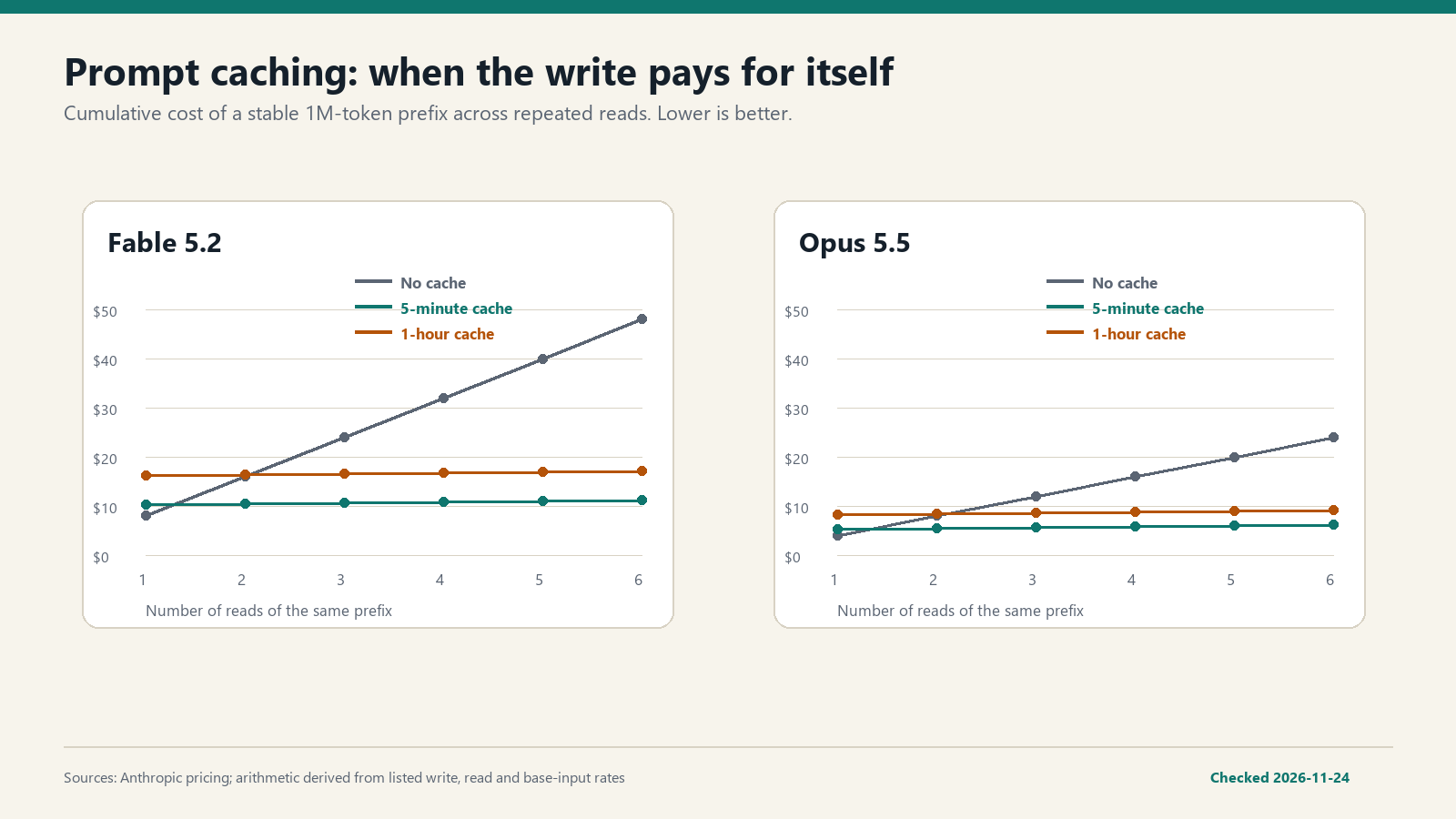
For each 1M-token prefix, moving from a five-minute write to a one-hour write adds $3.00. Both TTLs charge the same $0.20 per 1M cached-read tokens. Reads that both options can serve therefore do not repay the longer write’s premium. The one-hour option can justify that premium only by preserving reuse that the five-minute window would lose. The frozen evidence does not quantify that traffic pattern.
This does not change the approximately three-read marker for a one-hour write against an uncached baseline. That marker compares one write plus reads with repeated uncached input. Keep the two baselines separate in a budget review, and do not treat either as a promise about the whole invoice.
Use a five-minute write for tight bursts. If several requests reuse the same prefix within minutes, the lower write rate is easier to justify. The risk is a gap longer than five minutes, after which the planned read may no longer be available.
Use a one-hour write when reuse is spread across a longer interval and the prefix is genuinely stable. A quiet hour can still produce enough reads to repay the larger write. A changing prefix can waste the longer commitment without ever reaching those reads.
TTL selection should follow observed request spacing, not team working hours. Measure the gaps between requests that carry the prefix. If most gaps sit near the expiry boundary, a five-minute cache will be fragile. If gaps are short and frequent, paying for an hour may add little value.
The frozen evidence establishes the two TTL options and their prices. It does not provide a general rule for extending or refreshing an existing cache. Do not assume that a late read renews the original write. Build the forecast around the confirmed write and read events, and verify behavior in your own integration.
Design a prefix that is worth caching
A prefix is the ordered material at the start of a conversation that you intend to reuse. Exact reuse matters more than semantic similarity. Two prompts that mean the same thing can still be different prefixes.
The strongest candidates are usually stable instructions, fixed tool definitions, policy text, reference documents and a fixed output schema. Place changing user questions, timestamps, session identifiers and freshly retrieved results after the reusable material. This is design guidance, not a claim that every token category has identical billing treatment.
For tool-enabled work, keep tool names, descriptions, schemas and ordering deterministic. The tool-calling guide is the relevant implementation reference. For structured responses, keep the requested schema in the stable section when it does not change. The structured-output guide covers that contract. Both routes help you separate stable configuration from per-request variation.
Stable-prefix checklist
- Put instructions and policy before any per-user content.
- Serialize the prefix the same way on every request.
- Remove timestamps, random IDs and volatile counters from the prefix.
- Keep tool definitions and their order fixed for each prefix version.
- Keep reference documents in a deterministic order with stable chunk boundaries.
- Place the changing question and fresh retrieval results after the reusable prefix.
- Make every explicit checkpoint at least 512 tokens.
- Use no more than four explicit checkpoints.
- Replay stored thinking blocks unchanged with the same model and prefix.
- Match the five-minute or one-hour TTL to observed request gaps.
- Record actual cache usage from responses or billing data instead of assuming a hit.
- Re-test reuse after any prompt, schema, document or tool change.
The 512-token minimum is a checkpoint eligibility rule, not a minimum size for the whole request. The four-checkpoint maximum is a limit on explicit checkpoints, not a requirement to create four. More checkpoints do not automatically produce more savings if the underlying prefix keeps changing.
The prompt-caching documentation should be the implementation source for request structure. This article does not invent a cache endpoint or a checkpoint field. The verified API identity remains claude-opus-5-5, and the models reference is the place to confirm model capabilities.
A prefix version is a useful operational concept. When a stable instruction or tool definition changes, create a new version and let the old one expire. That makes invalidation visible in logs and budgets. It also prevents a deployment from silently changing every request’s prefix at once.
A cache invalidation example
Suppose a support workflow sends a 500K-token prefix in this order:
- Fixed system instructions.
- Tool definitions for account lookup and ticket search.
- A reference bundle of product policies.
- The user’s current question.
The application writes a five-minute checkpoint on the first request, then reuses it for the next two. The planned input charges are a $2.50 write plus two $0.10 reads, or $2.70. Three uncached requests would have cost $6.00.
A developer then changes the tool order. Ticket search now appears before account lookup. The text is semantically similar, but the ordered prefix differs near the beginning. The application should not budget on the old checkpoint being reused.
If it creates a new 500K-token five-minute checkpoint, that write costs $2.50. If it sends the same 500K tokens without a reusable checkpoint, uncached input costs $2.00. Neither outcome is the $0.10 read in the original plan. The exact miss behavior depends on the request, so measure the resulting usage rather than assuming one charge path.
Changing a thinking block creates a different problem. Thinking blocks are bound to the model and conversation prefix. Altered replay can return HTTP 400. Treat that as a request-construction failure, not merely a lost discount. Preserve the stored block exactly, or follow the official integration guidance for constructing a valid new conversation.
The Opus 5.5 review covers model-level evidence. For cache work, its most relevant lesson is narrower: model quality and cache stability are separate controls. A capable model cannot rescue a prefix that the application rewrites on every turn.
Thinking blocks make replay a correctness concern
Adaptive thinking is always on for Opus 5.5. Effort settings run from low through max, and Medium is the default. Those settings describe model behavior, but they do not make a stored thinking block portable across changed prefixes or different models.
The verified constraint is simple. Thinking blocks are bound to the model and conversation prefix. Altered replay can return HTTP 400. A retry path that edits, reorders or regenerates those blocks can fail before normal response handling begins.
Keep the original model ID with the stored conversation. Do not swap in another Claude model while replaying a bound thinking block. Do not rewrite reasoning text to make logs prettier. If you need a different model or a different prefix, treat it as a new request structure and validate it against the models overview.
The reasoning documentation is a useful companion for implementation review. The frozen evidence does not specify a universal repair procedure for an invalid thinking-block replay. That remains an integration question to test, not a reason to edit the block until the error disappears.
Streaming interfaces add another reason to preserve state carefully. A partial response does not prove that the full output has been billed or that the next request will reuse the prefix. The streaming guide covers response handling. Cache forecasts should use completed usage records where available.
Refusals can keep cache charges moving
A refusal does not always look like an HTTP error. Anthropic documents that a refusal can return HTTP 200 with a body containing stop_reason: refusal and restriction details. Billing depends on the refusal category and whether output started. HTTP status alone is not a success check.
That matters to a cache budget. A request may write or read a prefix and still refuse the task. A retry may bill the cached prefix at cache-read rather than cache-write rates. Neither outcome makes the retry free.
The fallback-credit beta uses the header fallback-credit-2026-07-01. Not every refusal carries a fallback token. For Opus 5.5, the valid fallback models are Opus 5 and Opus 4.8. Opus 5.5 and Fable are not valid fallback models. Do not route a refused request to another Opus 5.5 ID and call it an eligible fallback.
The Fable 5.2 production-routing analysis covers the same refusal and fallback boundary from the Fable side. The cost-control guide is the right place to review how retries and usage limits fit your application policy.
For this article’s arithmetic, treat refusals as requests that can consume input, cache and output charges. Count them in the denominator when calculating effective reuse. Excluding failed attempts can make a cache plan look better than the invoice.
Batch, Fast and endpoint choice stay outside these tables
The worked examples use Standard global list rates. Other modes change the budget and should be modeled separately.
Batch receives a 50% discount, putting Opus 5.5 Batch input and output at $2 and $10 per 1M tokens. Fast is unavailable with Batch. Fast-mode pricing applies across the full context window, with Opus 5.5 Fast input and output at $8 and $40 per 1M tokens.
Applicable regional and multi-region endpoints carry a 10% premium over global endpoints. That is a scoped rule. It does not mean every US customer or every Bedrock request receives the premium. Name the endpoint in the budget rather than applying a blanket uplift.
The frozen pricing evidence does not establish separate Batch or Fast cache-write and cache-read rates. Do not multiply the Standard cache rows by the Batch discount or Fast multiplier without a verified rate. Keep the mode decision and the cache decision as separate assumptions until the applicable pricing is confirmed.
The Opus 5.5 pricing breakdown covers these modes in more detail. The Fable 5.2 pricing guide shows how the same charge categories differ at Fable’s higher list rates. Neither comparison establishes which model will use fewer tokens on your workload.
What the independent and gateway evidence does not show
The Artificial Analysis Opus 5.5 snapshot, checked November 24, 2026, lists 1M context, Medium as the default effort and $4/$20 pricing. That is an independent catalogue snapshot. It is not a controlled measurement of cache hit rates, TTL behavior or prefix invalidation.
The AWS Bedrock model card confirms model and routing facts. It does not turn the Standard cache arithmetic into a gateway quote or an AWS invoice estimate. Bedrock support for Standard only is a separate constraint from Anthropic’s direct-API Batch and Fast modes.
The frozen record leaves several workload questions open:
- What percentage of your intended prefixes will match exactly?
- How many reads occur before each TTL expires?
- How often do tool definitions, documents or thinking blocks change?
- Which endpoint and mode will each request use?
- What output and thinking volume accompanies the input?
Those are UNKNOWN until measured in your application. They are also the variables most likely to reverse an attractive forecast. A plan that assumes every request hits the same 1M-token cache is not a production budget.
The gateway boundary is equally specific. The catalogue page at /models/claude-opus-5-5 exists. No gateway rate is supplied in the frozen evidence, so this article does not quote one. It also does not invent a gateway cache endpoint or a separate cache product ID.
Check /status for current availability and /pricing for hosted rates. The model catalogue is the place to compare available models. Official API availability and gateway availability are separate claims, even when the model ID is identical.
How to use this without overbuying
Begin with one workflow that already repeats a large, unchanged prefix. Document sets, fixed policy, stable tool schemas and consistent output contracts are better starting points than conversations that rewrite their entire history.
Measure three things before choosing a TTL: the prefix size, the number of valid reuses and the time between them. At 100K tokens, the five-minute write costs $0.50 and each read $0.02. At 500K, those figures are $2.50 and $0.10. At 1M, they are $5.00 and $0.20. Small prefixes may not generate enough savings to justify complex checkpoint maintenance.
Use five-minute writes while traffic is bursty and reuse is frequent. Test one-hour writes only where the longer gaps justify the higher initial charge. Review the actual mix of writes, reads and misses after a representative traffic period. Do not substitute total request count for cache-read count.
Keep a separate output budget. At $20 per 1M output tokens, generation can outweigh the input-side savings in a long workflow. The cost calculator can combine measured input patterns with output estimates. The quickstart is the implementation starting point if you are building a new integration.
If you are comparing Claude Opus 5.5 with another model, use the model comparison tool and the frontier rankings as navigation aids, not as proof of cache economics. The Qwen4 Max versus Opus 5.5 comparison adds another workload and price reference without treating cache reuse as a universal tiebreaker. The GPT-6 Astra pricing analysis and GPT-6 Astra review show why rate cards and task evidence answer different questions.
The same caution applies to adjacent Claude coverage. The Fable 5.2 launch guide and Fable 5.2 review provide context for the newer family member. The Opus 5.5 alternatives guide and GPT-6 Sol versus Opus 5.5 comparison frame model selection without assuming one universal winner.
For deployment on AWS, the Opus 5.5 Bedrock routing guide explains the separate region, API and billing constraints. A long context does not remove those routing decisions.
The practical rule is to pay for a cache write only when a stable prefix has a credible reuse plan. Keep the prefix deterministic, preserve thinking blocks, choose the TTL from measured gaps and count failed requests. That is how the published rates become a useful budget rather than a headline.
More Opus 5.5 and frontier coverage
- Opus 5.5 pricing, Fast and regional endpoint math
- Opus 5.5 review, with official and independent evidence separated
- Opus 5.5 alternatives by workload and cost per success
- GPT-6 Sol versus Claude Opus 5.5
- Opus 5.5 Bedrock routing and Mantle constraints
- Qwen4 Max versus Opus 5.5 workload and price comparison
- Fable 5.2 launch facts and access boundaries
- Fable 5.2 pricing and cache charges
- Fable 5.2 review and benchmark caveats
- Fable 5.2 production routing and refusal handling
- GPT-6 Astra pricing and the 272K input cliff
- GPT-6 Astra review and independent task evidence