The short answer: the premium is plausible, not proven. Claude Fable 5.2 has the stronger published coding case against Claude Opus 5.5 in the two Fable-specific rows preserved in the frozen pack. Anthropic reports 49.1% versus 45.5% on FrontierCode 2.0 and 69.9% versus 62.3% on FrontierSWE v2. An earlier Artificial Analysis fetch on 2026-11-24 also gave Fable 65 against Opus 59 on Intelligence Index v5.0.1 at Max effort. Those are useful signals. They are not independent proof that Fable will complete more of your tasks.
The main problem is the harness. Anthropic names Fable’s FrontierCode setting as xhigh but does not fully disclose Opus’s comparator effort. The OSWorld 2.1 rows use conflicting success definitions: Fable’s table shows 89.3% against Opus 87.2%, while Opus’s launch page separately reports 81.8% partial success. The later Artificial Analysis fetch did not reproduce Fable’s score or evaluator version. Buy Fable for a specific measured workload, not because a vendor table looks decisive.
This review is for developers and technical buyers deciding whether the higher list rate earns its place. It separates official claims, independent snapshots and derived arithmetic, then turns the caveats into an evaluation plan. Fable has an official direct API, model ID claude-fable-5-2. It did not have a oneaiapikey.com catalogue page on 2026-11-24, so nothing here should be read as gateway availability.
The decision in six lines
- What changed: Anthropic launched Fable 5.2 on 2026-11-09 with a 1,000,000-token context window, 128,000-token maximum output and effort settings from
lowthroughmax. - Published coding evidence: FrontierCode 2.0 at 49.1% versus Opus 5.5 at 45.5%, and FrontierSWE v2 at 69.9% versus 62.3%. Both are vendor-reported.
- Independent signal: Artificial Analysis recorded Intelligence Index 65 at Max on evaluator v5.0.1 in an earlier 2026-11-24 fetch. A later fetch omitted the score and version.
- Main loss: comparator effort is not always matched, and the OSWorld 2.1 rows cannot support a clean 89.3% versus 87.2% comparison.
- Cost: standard list pricing is $8 per million input tokens and $40 per million output tokens, twice Opus 5.5’s $4/$20.
- Availability: official direct API yes; current oneaiapikey.com gateway listing no. Check the live model status before planning an integration.
What Fable 5.2 actually changes
The model facts matter before the scores. According to Anthropic’s models overview and the AWS Bedrock Fable 5.2 model card, Fable accepts text and image input and returns text. Its context window is 1,000,000 tokens. Its maximum output is 128,000 tokens. Adaptive thinking is always on and cannot be disabled. The knowledge cutoff is June 2026, and the stated end of life is no sooner than 2027-11-09.
The effort ladder has five settings: low, medium, high, xhigh and max. That is not a cosmetic picker. Effort changes how much work the model can spend before it answers, which means a benchmark result without an effort label is incomplete. A production integration should pin the setting rather than inherit an undocumented default. The reasoning configuration guide explains why that choice belongs in the request design, not only in a dashboard.
There is also a real documentation conflict. Anthropic’s launch article says the default effort is Medium. The models overview and AWS model card say High. We preserve both statements because they come from official sources checked on 2026-11-24. Do not silently choose one and describe it as settled. If a regression test depends on repeatable behavior, send the effort value explicitly and record it with the request.
Fable and Mythos 5.2 are the same underlying model with different safeguards and access. Mythos requires Cyber Verification or Life Sciences Verification. No verified standalone Mythos API ID was found in the accessed material. Fable blocks high-risk cybersecurity and most research-biology tasks. For this review, the practical boundary is simple: a benchmark or workflow that depends on those restricted domains is not evidence for ordinary Fable access.
The Fable 5.2 launch explainer covers the release facts in more detail. The production routing guide deals with refusal handling and eligible fallbacks. This article asks a narrower question: do the published results justify the model’s premium for coding, long-context and computer-use work?
The independent score has a reproduction gap
Artificial Analysis is the independent source in this evidence set, not Anthropic. An earlier direct fetch of its Claude Fable 5.2 model page, date-stamped 2026-11-24, recorded an Intelligence Index of 65 at Max effort. The evaluator was Intelligence Index v5.0.1. The same snapshot listed High as the default, $8/$40 pricing and a 1M-token context window.
A later fetch reconfirmed the High default, 1M context and pricing, but its extracted text did not reproduce the score or evaluator version. That omission does not prove the earlier score was wrong. It does mean we cannot say the later fetch independently confirmed it. The correct statement is that an earlier same-day snapshot recorded 65 on v5.0.1, and a later extraction omitted those fields.
The closest independent comparison in the pack is Opus 5.5. Artificial Analysis’s Opus 5.5 page, checked 2026-11-24, records 59 at Max on Intelligence Index v5.0.1, with Medium as the default, $4/$20 pricing and a 1M-token context window.
| Model | Evaluator and unit | Effort | Score | Source and snapshot |
|---|---|---|---|---|
| Claude Fable 5.2 | Intelligence Index v5.0.1, index points | Max | 65 | Artificial Analysis, earlier direct fetch on 2026-11-24; not reproduced in later extracted text |
| Claude Opus 5.5 | Intelligence Index v5.0.1, index points | Max | 59 | Artificial Analysis model page, checked 2026-11-24 |
This is the cleanest cross-model comparison available because evaluator version and effort match. It is still a composite, not a direct measure of your task success. A six-point index gap does not tell you whether Fable will close six percent more support tickets, merge six percent more pull requests or reduce computer-use failures. It also does not provide a matched cost per completed task in the accessed evidence.
Use the rankings page to follow the board over time, but keep the snapshot date attached. Leaderboards move as evaluators change and new models enter. The November frontier model roundup is useful for context across vendors; it is not a substitute for a controlled Fable-versus-Opus run.
FrontierCode 2.0: a coding gain with an incomplete label
FrontierCode 2.0 is the first highlighted row because coding is a common reason to pay for a premium model. Anthropic’s Fable and Mythos 5.2 announcement reports Fable at 49.1% and Opus 5.5 at 45.5%. The unit is percent score. The source is OFFICIAL. Fable’s setting is xhigh. Comparator effort is not fully disclosed.
| Model | Benchmark version | Unit | Setting | Comparator and source |
|---|---|---|---|---|
| Claude Fable 5.2 | FrontierCode 2.0 | Percent score | xhigh | Opus 5.5 at 45.5%; Anthropic announcement |
| Claude Opus 5.5 | FrontierCode 2.0 | Percent score | Not fully disclosed | Fable 5.2 at 49.1%; Anthropic announcement |
The raw difference is 3.6 percentage points. That is DERIVED arithmetic from the two published percentages, not an independently measured improvement. It supports the claim that Fable scored higher in Anthropic’s table. It does not establish that Fable is 3.6 percentage points better under equal effort, equal tool access and equal task coverage.
This distinction changes the buying decision. If your coding agent already runs at xhigh and your comparator is Opus 5.5, Fable’s row is relevant enough to test. If your production agent runs at High or Medium, the table does not tell you what happens at those settings. If your harness gives one model a different shell, file editor, retry policy or context budget, the published row does not control for that difference either.
The honest loss is not that Fable failed. The loss is evidentiary: the strongest coding row is vendor-reported and the comparator setting is incomplete. That is why the GPT-6 Astra review remains a useful comparison point. Its September Artificial Analysis snapshot is explicitly separate from Anthropic’s coding table, and its 51% hallucination rate is a reminder that a coding score is not a reliability score.
FrontierSWE v2: a second gain, still vendor-reported
FrontierSWE v2 is the second coding row. Anthropic reports Fable 5.2 at 69.9% and Opus 5.5 at 62.3%. The unit is percent score. The source is OFFICIAL. The accessed fact pack does not disclose the effort setting for either model on this row.
| Model | Benchmark version | Unit | Setting | Comparator and source |
|---|---|---|---|---|
| Claude Fable 5.2 | FrontierSWE v2 | Percent score | Not disclosed in the accessed pack | Opus 5.5 at 62.3%; Anthropic announcement |
| Claude Opus 5.5 | FrontierSWE v2 | Percent score | Not disclosed in the accessed pack | Fable 5.2 at 69.9%; Anthropic announcement |
The difference is 7.6 percentage points, again derived from vendor percentages. A larger gap on a software-engineering suite is a stronger reason to run Fable on your own repository tasks. It still does not convert the row into independent proof. Both models were measured inside a vendor-published comparison, and the evidence available here does not show matched effort, retries, tool permissions or task selection.
Treat FrontierSWE v2 as a screening signal. Build a fixed set of repository tasks from your own domain. Give both models the same starting state, tool definitions, timeout, token budget and retry policy. Run the same tasks at the same disclosed effort. Score merge correctness, tests, regressions and human review time. That is the experiment that answers whether the premium changes completed work.
The model comparison workspace is the right place to organize alternatives once your task set exists. The GPT-6.2 Astra versus Fable 5.2 comparison is also relevant if the challenger matters to your shortlist. Neither article should be used to infer that a cross-vendor row is matched when its effort settings differ.
Humanity’s Last Exam: no Fable row in the frozen pack
The frozen record preserves one Humanity’s Last Exam comparison. Anthropic reports Opus 5.5 at 67.7% with tools against Opus 5 at 63.6% with tools. The unit is percent score. The source is OFFICIAL. The accessed pack does not state the benchmark version, subset or effort for this row. It also does not preserve a Fable 5.2 result, so this review cannot claim a Fable lead or calculate a Fable-versus-Opus 5.5 gap on this benchmark.
| Model | Benchmark | Unit | Setting | Comparator and source |
|---|---|---|---|---|
| Claude Opus 5.5 | Humanity’s Last Exam, version not stated | Percent score | With tools; effort not stated | Opus 5 at 63.6%; Anthropic Opus 5.5 announcement |
| Claude Opus 5 | Humanity’s Last Exam, version not stated | Percent score | With tools; effort not stated | Opus 5.5 at 67.7%; Anthropic Opus 5.5 announcement |
The 4.1-point difference is DERIVED from the two vendor scores. It compares Opus 5.5 with Opus 5, not Fable with Opus 5.5. It says nothing about whether Fable would score higher on the same evaluator. Keeping the row separate prevents a missing Fable cell from turning into an implied win.
Tools are part of any result that explicitly names them. If your product lacks an equivalent tool surface, a with-tools number does not describe your deployment. The tool-calling documentation belongs in the evaluation plan for that reason. Record which tools were available, how failures were retried and whether the model could call them more than once. A knowledge result is comparable only when the surrounding tool harness is comparable.
OSWorld 2.1: the row that blocks a clean victory claim
OSWorld 2.1 is a computer-use benchmark. It is also the place where this review’s central caveat becomes concrete. Anthropic’s Fable table reports 89.3% for Fable 5.2 and 87.2% for Opus 5.5. The unit is percent score. The source is OFFICIAL. The table row does not disclose an effort setting in the accessed pack.
The Opus 5.5 launch page separately reports 81.8% on OSWorld 2.1, explicitly as partial success. It compares that result with Opus 5 at 74.0% partial success. These are different success definitions from the Fable table. The 87.2% table row and the 81.8% partial-success row cannot be treated as the same measurement.
| Source row | Benchmark version | Unit | Metric and setting | Comparator and caveat |
|---|---|---|---|---|
| Anthropic Fable announcement table | OSWorld 2.1 | Percent score | Table metric; effort not stated | Fable 89.3%, Opus 5.5 87.2%; not matched to the Opus partial-success row |
| Anthropic Opus 5.5 announcement | OSWorld 2.1 | Percent score | Partial success; effort not stated | Opus 5.5 81.8%, Opus 5 74.0%; different success definition |
This is the honest loss. If a buyer subtracts 81.8 from 89.3 and claims a 7.5-point Fable win, the arithmetic mixes metrics. If a buyer uses 87.2 as though it were an independent reproduction of 81.8, the comparison is still wrong. Neither difference measures Fable’s advantage on a common OSWorld definition.
The responsible conclusion is narrower. Fable’s table is higher than the Opus table row. Opus’s separately reported partial-success result is lower. The public evidence does not show a clean, matched OSWorld head-to-head. Do not use either number alone to forecast computer-use reliability in your product.
For a real computer-use evaluation, define success before the run. Decide whether opening an app counts, whether reaching an intermediate screen counts and whether the final state must be verified. Then run both models on the same environment, with the same permissions, screenshot cadence, retry budget and scorer. Report full success and partial success separately. This is exactly the kind of harness detail the public tables omit.
Effort is part of the model you are buying
A benchmark setting is not just metadata. It is an input to the system. Fable exposes five effort settings, and adaptive thinking cannot be disabled. That means a buyer cannot strip reasoning away to create a cheaper mode. The practical levers are effort selection, prompt design, tool design, caching and routing.
The effort settings in the reasoning configuration guide and the chart below describe a sensible starting policy, not a benchmark result. Use a lower setting for bounded classification or extraction. Use a higher setting for difficult coding or reasoning work. Escalate only after a logged validator rejection, a documented failure or a measured quality gap. Record the effort on every request so an apparent regression can be traced to a setting change.
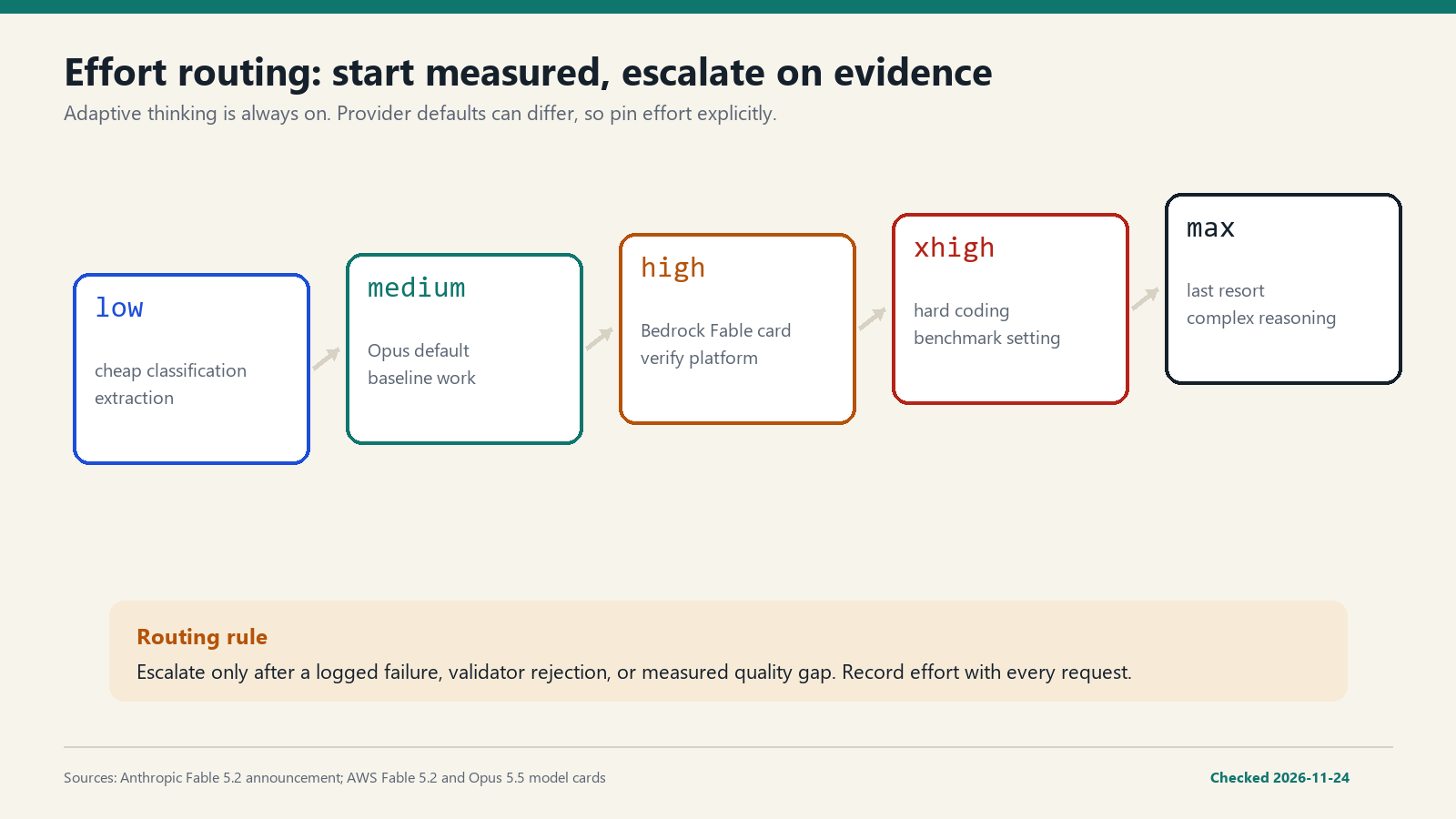
There are two common failure modes. The first is starting every task at Max because the headline score used Max. That spends effort on work that may not need it and makes cost comparisons harder. The second is assuming Medium and High are interchangeable because both sound moderate. The documentation conflict makes that assumption unsafe. Pin the setting and evaluate quality and cost at two levels before choosing a default.
The Claude Opus 5.5 review is a useful control for this exercise. Opus 5.5 has the same five effort settings, a Medium default and a 1M-token context window. Its independent Intelligence Index snapshot is lower at Max, but its list price is half of Fable’s. A fair routing test should ask where that price difference changes cost per accepted result.
The premium is real, but cost per success is unknown
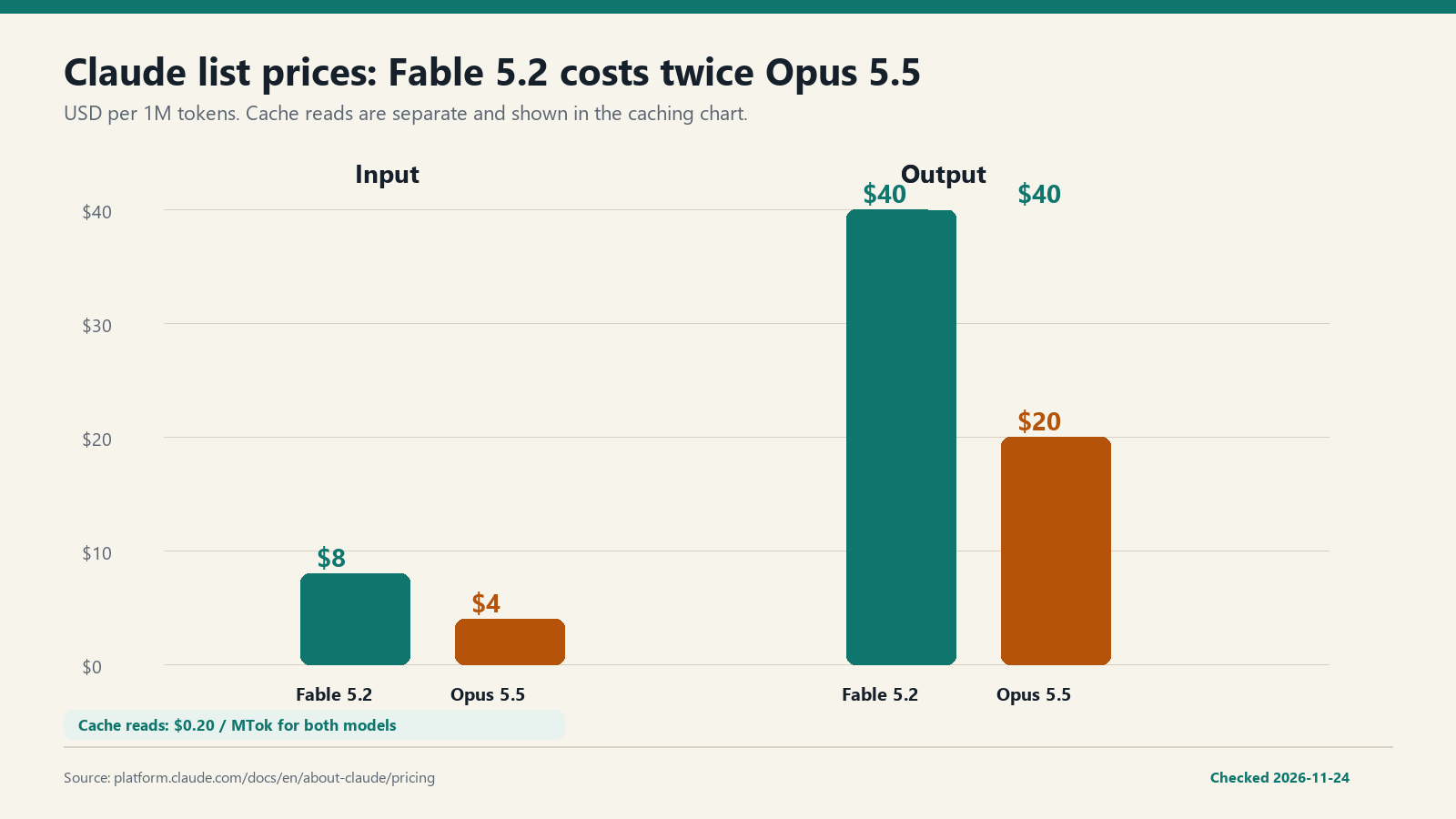
Anthropic’s official pricing page, checked 2026-11-24, lists Fable 5.2 at $8 per million input tokens and $40 per million output tokens. Opus 5.5 lists at $4 and $20. These are standard API list prices, not subscription allowances and not oneaiapikey.com gateway rates.
| Charge, USD per 1M tokens | Fable 5.2 | Opus 5.5 | Relationship |
|---|---|---|---|
| Standard input | $8 | $4 | Fable is 2x |
| Standard output | $40 | $20 | Fable is 2x |
| Prompt-cache read | $0.20 | $0.20 | Same listed rate |
The 2x relationship is DERIVED from the published list rates. It does not mean every Fable request costs exactly twice as much as an Opus request. Effort can change output length, cache hits change input charges and tool loops change the number of billed turns. The missing variable is completed work per dollar.
A simple example shows the shape of the decision. At 100,000 uncached input tokens and 20,000 output tokens, Fable’s standard list charge is $1.60: 0.1 × $8 + 0.02 × $40. Opus is $1.20: 0.1 × $4 + 0.02 × $20. The $0.40 difference is arithmetic, not measured task value. Fable earns that difference only if it avoids enough retries, review or failed work to recover it.
The cost calculator can model your own token mix. The Fable pricing breakdown covers cache writes, Fast mode and endpoint scope. The Opus pricing guide supplies the lower-cost comparison. Neither guide can fill the missing cost-per-success cell, because the accessed evidence does not publish one for matched Fable and Opus tasks.
For a buyer, this is the central economic question. A higher score at twice the token rate can still be the better option if it reduces human review or retries. It can also be the worse option if the extra score appears only on a narrow benchmark subset. The public tables do not settle that trade-off for your workload.
Access and production boundaries
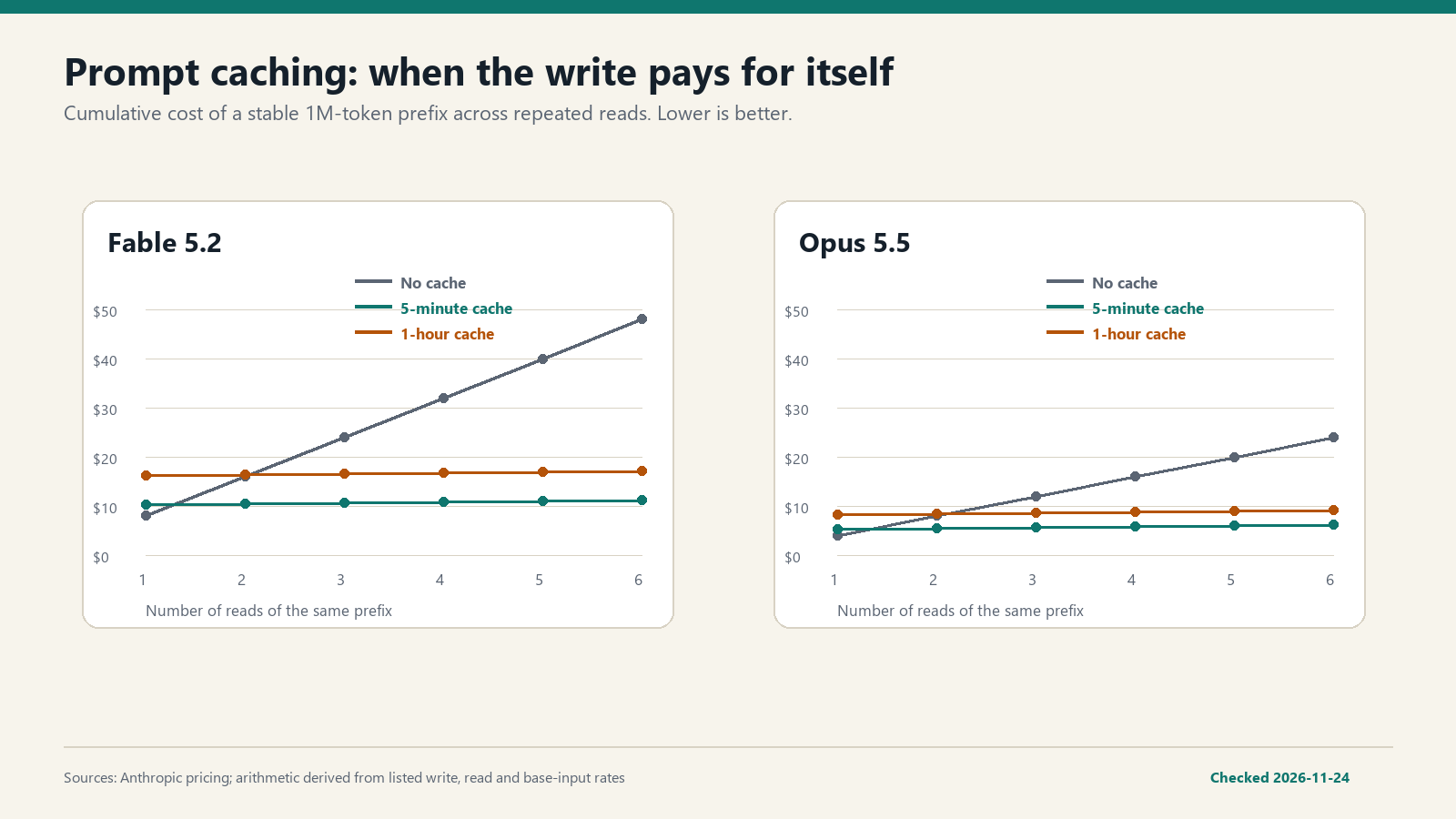
Fable’s official API ID is claude-fable-5-2. It supports text and image input, text output, explicit caching and adaptive thinking. Explicit caching requires at least 512 tokens per checkpoint, allows up to four checkpoints and offers five-minute or one-hour time-to-live options. Thinking blocks are bound to the model and conversation prefix. Altered replay can return HTTP 400.
Those constraints matter for agents. A cache-friendly system keeps a stable prefix and changes only the task-specific suffix. A brittle system rewrites the system prompt or reorders tools on every turn, which can undermine reuse. The Opus context and caching guide explains the shared Claude cache design in more detail.
Availability is separate. The official direct API exists, but the oneaiapikey.com catalogue check on 2026-11-24 found no Fable model page. There is no current gateway claim for claude-fable-5-2 here. Do not build a gateway integration by assuming that an official model ID is also a local catalogue ID. Use the model documentation for integration references and the model catalogue to confirm what is actually served.
AWS Bedrock is another official route, with its own constraints. The Fable Bedrock model card requires retention mode aws_review and supports Standard only. Priority, Flex, Reserved and Batch are unsupported on Bedrock. That is a different deployment envelope from the direct API. The Opus Bedrock routing guide compares the two families’ regional and Mantle constraints.
A refusal can return HTTP 200 with stop_reason: refusal, so status code alone is not a success check. The fallback-credit beta does not make Fable or Opus 5.5 eligible fallback targets. Its valid fallback models are Opus 5 and Opus 4.8. The production routing sibling covers that flow in detail. For this review, the relevant point is that task success must include refusal handling, not just answer quality.
Who should test Fable, and who should stay with Opus
Fable deserves a controlled trial if your work is dominated by difficult coding or long-context document analysis, and if failed attempts are expensive. It also deserves a trial if your evaluator can measure accepted work rather than token output. In those settings, the vendor-reported coding gains are large enough to justify the test even though they are not independent proof.
Opus 5.5 remains the safer default if your tasks are routine, your traffic is high-volume or your current Opus workflow already meets its quality bar. Its $4/$20 list rate is half of Fable’s, and its independent Intelligence Index result is not trivial. The Opus alternatives guide lays out the broader shortlist without declaring a universal winner.
Other comparisons can sharpen the test. The Gemini 4 Neon versus Fable 5.2 review is relevant when price, speed and multimodal work matter. The GPT-6 Sol versus Opus 5.5 comparison is useful for cost-sensitive text and coding workloads, provided the version distinction between GPT-6 Sol and GPT-6.2 Sol stays visible. The GPT-6 Astra pricing analysis is a reminder that long-context pricing structures can dominate a bill before model quality does.
None of those routes supports a blanket ranking. The right choice depends on the task, the effort setting, the tool harness and the cost of failure. That is why the model comparison workspace should hold a workload-specific decision, not a copied leaderboard row.
What a matched evaluation needs
A credible Fable-versus-Opus test does not need a new public benchmark. It needs a fixed local workload and a visible record of the settings. Start with tasks that represent accepted production work: repository changes, support resolutions, document analysis or computer-use flows. Use the same task set for both models.
Pin effort. The default conflict makes an implicit setting unacceptable. Record the model ID, effort, context size, tool definitions, timeout, retry count and scorer version with every run. If a model refuses, count that outcome according to a rule written before the test. Do not discard refusals after seeing the results.
Measure outcomes in the units your team uses. For coding, record tests passed, regressions, review changes and time to merge. For computer use, separate full success, partial success and failure. For knowledge work, verify answers against a fixed key and count unsupported claims. For every category, record total billed tokens and cost per accepted task.
Run at least two effort settings before picking a default. That reveals whether the score gain survives at a setting your product can afford. It also reveals whether a lower-effort Fable matches or beats a higher-effort Opus on your task set. Keep latency and cache hit rate in the report, because they change both user experience and cost.
Finally, reproduce the result. A single favorable run is not enough for a premium decision. Repeat the suite, preserve failures and report the spread. If the gain disappears under a matched harness, keep Opus. If it persists after retries and human review are counted, Fable has earned its premium on that workload.
What the public data does not show
Several gaps remain unresolved as of 2026-11-24. The accessed evidence does not provide matched comparator effort for FrontierCode 2.0, FrontierSWE v2 or the OSWorld rows. It does not preserve a Fable 5.2 Humanity’s Last Exam row. The Opus Humanity’s Last Exam row lacks an exact version or subset and an effort label. The evidence also does not provide an independent reproduction of Fable’s 65 Intelligence Index score on v5.0.1 after the earlier Artificial Analysis fetch, a matched Fable-versus-Opus cost per completed task, a latency distribution or a cache hit rate.
The OSWorld disagreement is not a rounding issue. It is a difference between a table metric and a separately reported partial-success metric. Until the scoring definitions are aligned, neither row can serve as a clean head-to-head result. The Opus Humanity’s Last Exam row also needs the exact evaluator version or subset and effort setting before it can be reproduced precisely. A Fable result on that benchmark is absent from the frozen record.
These are reasons to limit the claim, not reasons to ignore the model. Fable’s official results point in the same direction across the two coding rows preserved in the pack. The independent snapshot points the same way. What is missing is the bridge from published scores to accepted work under a controlled harness.
This section will be updated if Artificial Analysis reproduces the Fable score with the evaluator version visible, if Anthropic publishes matched effort labels, or if OSWorld results are restated under one success definition. Based on the frozen sources checked on 2026-11-24, the confirmed position is a promising premium model with an incomplete public comparison, not a proven universal upgrade.
How to use this without overbuying
Start with a small, fixed evaluation rather than a full migration. Compare Fable and Opus at two explicitly pinned effort settings. Score accepted work, total cost and human review. Escalate only the task classes where Fable’s measured advantage covers its higher rate. Keep the rest on the cheaper model.
For gateway-hosted alternatives, browse the current model catalogue, confirm availability on the status page, or estimate a workload with the cost calculator. Review the gateway pricing surface for those alternatives. Fable itself is not listed on this gateway in the 2026-11-24 evidence, so these routes are for alternatives, not a call to action for Fable access.
The buying rule is straightforward: pay for Fable when your own harness shows more accepted work per dollar. Do not pay for it merely because a vendor table places it above Opus, and do not dismiss it merely because the public comparison is imperfect. The scores justify a serious test. The caveats determine how that test must be run.
More Fable 5.2 coverage
- Fable 5.2 launch facts, access boundaries and model IDs
- Fable 5.2 list pricing, cache charges and Fast mode
- Fable 5.2 production routing, refusals and eligible fallbacks
- Claude Opus 5.5 review with official and independent evidence separated
- Claude Opus 5.5 pricing and cache arithmetic
- Claude Opus 5.5 alternatives by workload and cost