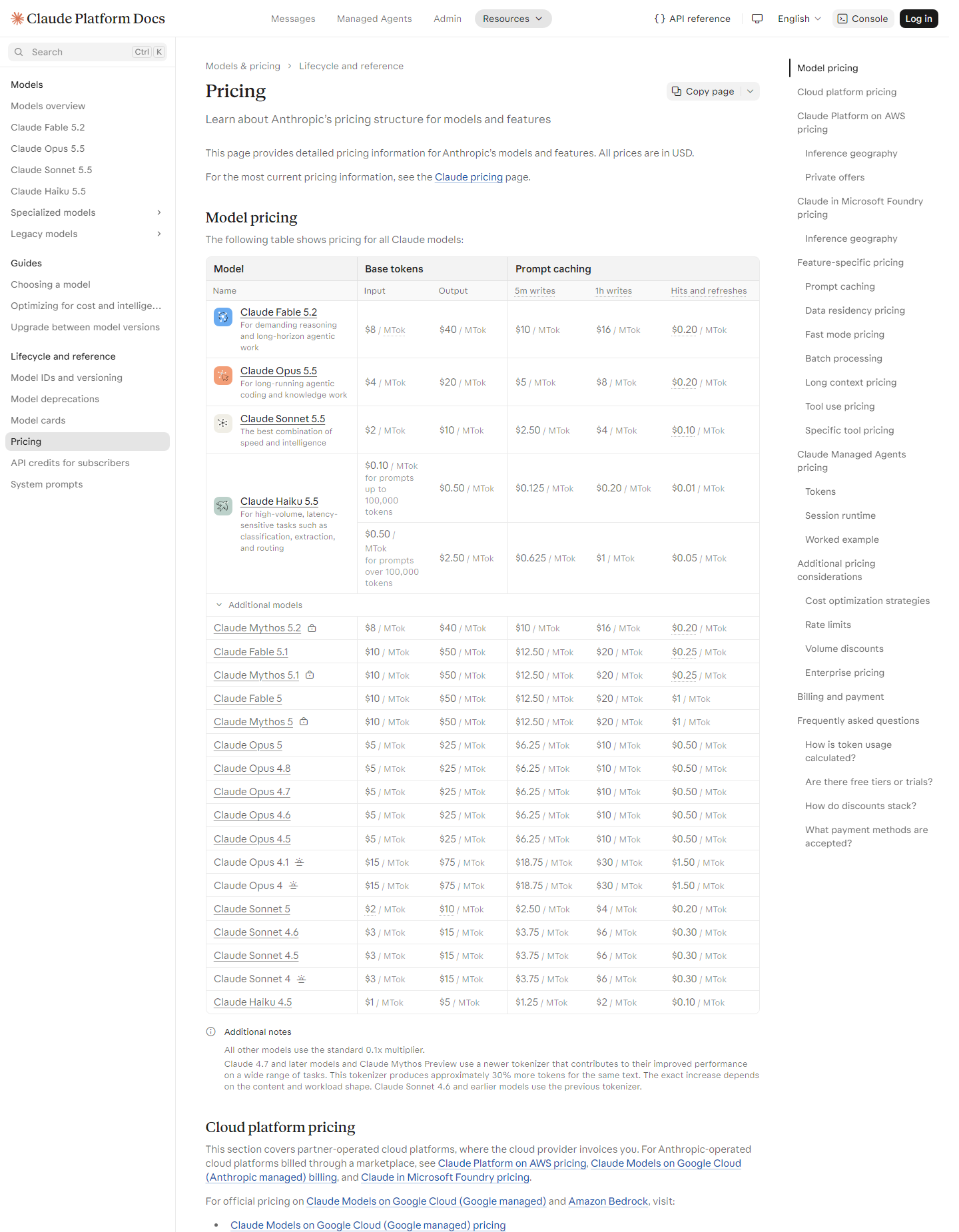
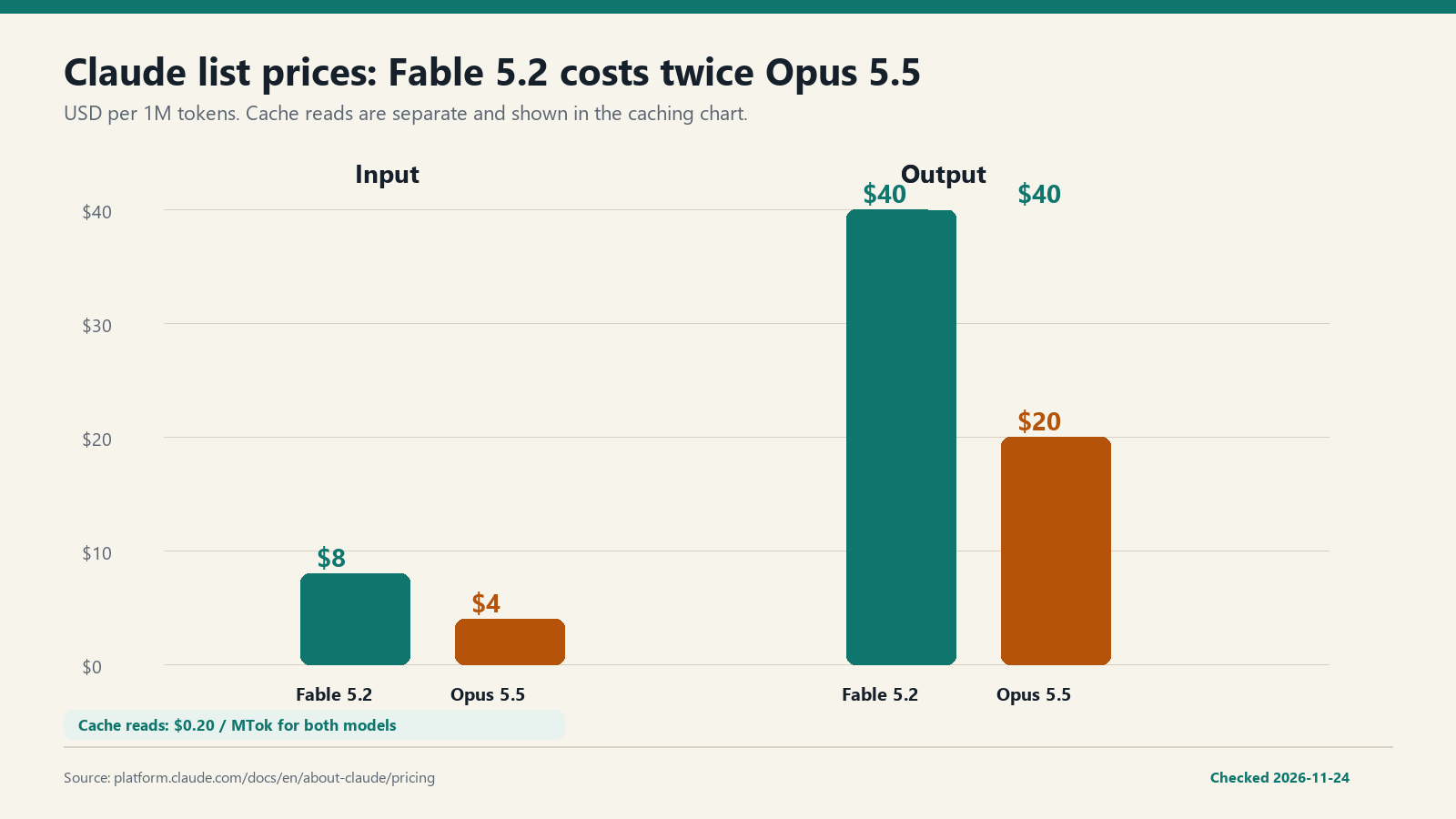
Claude Fable 5.2 lists at $8 per million input tokens and $40 per million output tokens on Anthropic’s first-party API. A five-minute prompt-cache write costs $10 per million tokens, a one-hour write costs $16, and a cache read costs $0.20. Batch reduces input and output by 50% to $4/$20. Fast raises them to $16/$80 and cannot be combined with Batch. Applicable regional and multi-region endpoints carry a 10% premium over global endpoints. That premium is not a blanket charge for every US customer.
The main availability loss is AWS Bedrock. Its Fable 5.2 offering supports Standard only, so first-party Batch and Fast are not Bedrock service tiers. The gateway also has no Fable 5.2 model page. Official direct-API availability does not mean the model is callable here.
This guide is for developers and buyers who need to turn that rate card into a budget. Every price is USD per 1,000,000 tokens, checked on 2026-11-24. Vendor statements are identified as official. Worked calculations are labeled DERIVED. Missing prices and service parity stay marked as gaps rather than being filled with assumptions.
The short answer
- Standard: Use $8/$40 when you need ordinary interactive requests and cannot rely on a reusable prefix.
- Cache: Write a stable prefix once, then pay $0.20 per million tokens for each read. The write must earn back its premium.
- Batch: Use $4/$20 when the work can wait. It is 50% below Standard input and output.
- Fast: Use $16/$80 only when lower latency is worth roughly double the Standard token charge. Fast and Batch cannot stack.
- Endpoint: Add 10% only when the selected endpoint is one of the applicable regional or multi-region profiles.
- Bedrock: Plan for Standard only. Do not budget as though AWS offers Anthropic’s Batch or Fast tiers.
What the $8/$40 list actually covers
The word list matters. These are Anthropic API prices, not a subscription allowance and not a oneaiapikey.com gateway rate. The Anthropic pricing page is the primary source for the figures below. It lists the same rates for Fable 5.2 and Mythos 5.2. Those names describe the same underlying model with different safeguards and access. Mythos requires Cyber Verification or Life Sciences Verification, and no verified standalone Mythos API ID appears in the frozen record.
Fable’s direct API ID is claude-fable-5-2. The models overview gives it a 1,000,000-token context window and a 128,000-token maximum output. Adaptive thinking is always on. Output and thinking still affect the final bill, even when the visible answer is short.
There is also a source conflict that affects expectations. Anthropic’s Fable and Mythos announcement says the default effort is Medium. The models overview and AWS model card say High. Keep both attributions. The Fable 5.2 launch guide covers the release details, while the Fable 5.2 review explains why effort settings and evidence sources must travel with benchmark claims. For a bill, the practical point is simpler: do not assume a default effort, record the setting you send, and meter the output it produces.
| Charge, USD per 1M tokens | Fable 5.2 / Mythos 5.2 | Opus 5.5 |
|---|---|---|
| Standard input | $8 | $4 |
| Standard output | $40 | $20 |
| Cache write, 5 minutes | $10 | $5 |
| Cache write, 1 hour | $16 | $8 |
| Cache read | $0.20 | $0.20 |
| Batch input / output | $4 / $20 | $2 / $10 |
| Fast input / output | $16 / $80 | $8 / $40 |
Opus 5.5 is half the Fable rate on Standard input and output, at $4/$20. Its cache-read rate is also $0.20. The Opus 5.5 announcement supplies the model context, and the Opus 5.5 pricing breakdown works through the same billing categories. A lower token rate is not proof of a lower cost per successful task. Read the Opus 5.5 review beside the Opus 5.5 alternatives before treating price as the whole decision. If version naming is already confusing, the GPT-6 Sol versus Claude Opus 5.5 comparison keeps those model identities separate.
Cache writes are an investment, not a discount on the first call
Prompt caching works best when a large part of the input stays identical across requests. A system instruction, a fixed document bundle, tool schemas or a stable conversation prefix can qualify. Fable’s explicit caching requires at least 512 tokens per checkpoint and allows up to four checkpoints, with a five-minute or one-hour time to live. The prompt caching implementation guide covers the mechanics. The Opus 5.5 context-caching patterns are useful design references because the checkpoint limits and TTL choices match.
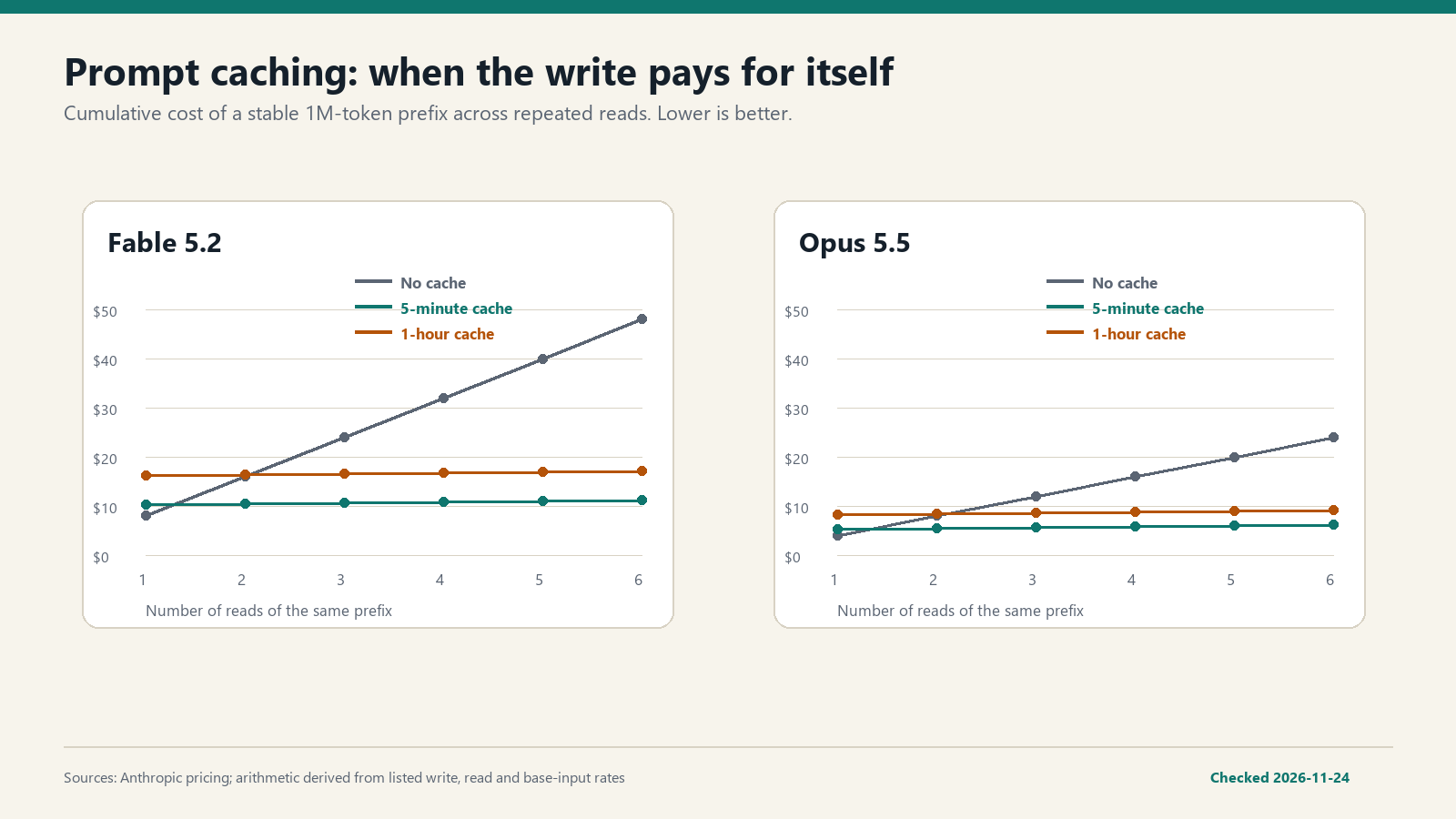
The first request pays a write premium. A five-minute write is $10 against $8 for fresh input, or 1.25 times the uncached input rate. A one-hour write is $16, or twice the uncached rate. Every later read is $0.20, which is 2.5% of the $8 fresh-input rate. That makes reuse valuable, but only after the write has been recovered.
Prefix stability is not optional. Thinking blocks are bound to the model and conversation prefix. Altering a replayed thinking block can return HTTP 400. A cache design that rewrites the system prompt on every turn can miss the cache and still pay write costs. Put stable material first and keep volatile request details later where the API allows it.
Worked cache arithmetic (DERIVED)
Assume three requests. Each has a reusable 100,000-token prefix and 10,000 output tokens. Use global Standard rates, with no endpoint premium. Output is billed on every request.
DERIVED: uncached. Input per request is 0.1 × $8 = $0.80. Output per request is 0.01 × $40 = $0.40. One request costs $1.20. Three requests cost 3 × $1.20 = $3.60, made up of $2.40 input and $1.20 output.
DERIVED: five-minute cache. The first request writes the prefix for 0.1 × $10 = $1.00. The next two read it for 2 × 0.1 × $0.20 = $0.04. Output remains $1.20. The three-request total is $1.00 + $0.04 + $1.20 = $2.24, a saving of $1.36 against uncached input and output.
DERIVED: one-hour cache. The write costs 0.1 × $16 = $1.60. Two reads cost $0.04. Output costs $1.20. The total is $2.84, a saving of $0.76 against the uncached $3.60.
The crossover is clearer if output is removed, because output is identical in every scenario. Let n be the total number of requests using the prefix, W the write rate, R the read rate and U the uncached input rate. Cached input is cheaper when W + (n - 1) × R is below n × U. For five-minute caching, (10 - 0.20) / (8 - 0.20) = 1.26, so the second request is already cheaper. For one-hour caching, (16 - 0.20) / (8 - 0.20) = 2.03, so the third request is the first clear win.
That is why five-minute caching breaks even after about two uses and one-hour caching after about three. If the prefix arrives only once, a one-hour write costs twice as much as fresh input before any output is counted. If it changes before expiry, the intended read may never happen. The break-even chart is a planning aid, not a promise about your hit rate. The cost calculator can test the same shape with your own token counts.
Batch: 50% off, with no Fast stacking
Batch is the straightforward discount. Anthropic lists Fable input at $4 and output at $20 per million tokens, exactly half of Standard. That is a 50% reduction on both billable legs. It does not make output equal to input, and it does not erase cache or endpoint considerations.
DERIVED: Batch request. Use the same 100,000 input tokens and 10,000 output tokens. Input is 0.1 × $4 = $0.40. Output is 0.01 × $20 = $0.20. The request costs $0.60, compared with $1.20 at Standard. The saving is $0.60, or 50%.
The frozen pricing table gives Batch input and output rates. It does not itemize separate Batch cache-write or cache-read prices. This article therefore uses uncached Batch arithmetic and does not halve the cache rates by assumption. Confirm the applicable cache terms before building a forecast around a cached Batch workload.
Batch also has a hard compatibility rule: Fast cannot be combined with Batch. There is no valid calculation that starts with the $4/$20 Batch rates and then applies Fast. If a job needs the lower-latency tier, it uses Fast rates. If it can tolerate the Batch workflow, it uses Batch rates. The public record in this pack does not supply a Batch completion window, so do not turn the discount into a delivery-time promise.
For another vendor’s long-context budget, compare the GPT-6 Astra pricing guide and the GPT-6.2 Astra pricing guide. The same checklist applies: verify whether a higher rate applies to the whole request or only to a slice before comparing headline prices. Use cost controls to cap the traffic you send to a discounted but still paid tier.
Fast: double the token rate across the context window
Fast mode lists Fable input at $16 and output at $80 per million tokens. Both are twice Standard. The important rule is that Fast pricing applies across the full context window. There is no separate Fast price only for a small initial slice of a long prompt.
DERIVED: Fast request. For 100,000 uncached input tokens and 10,000 output tokens, input is 0.1 × $16 = $1.60. Output is 0.01 × $80 = $0.80. The total is $2.40, exactly double the $1.20 Standard request. On that shape, choosing Fast adds $1.20. Whether that is worthwhile depends on the value of the latency reduction, not on a published token discount.
DERIVED: long Fast request. For 900,000 uncached input tokens and 10,000 output tokens, Standard costs 0.9 × $8 + 0.01 × $40 = $7.20 + $0.40 = $7.60. Fast costs 0.9 × $16 + 0.01 × $80 = $14.40 + $0.80 = $15.20. Fast does not become relatively cheaper merely because the prompt is large.
The frozen table does not give separate Fast cache-write or cache-read rates. These Fast examples therefore use uncached input. It also does not provide a measured latency gain for a customer workload. Treat the rate as the price of the tier and the actual time saved as something you must measure.
Fast changes the price, not the response contract. Fable can return HTTP 200 with a stop_reason of refusal. Billing depends on the refusal category and whether output started, so status code alone is not a success check. The fallback-credit beta does not promise a free retry. Only Opus 5 and Opus 4.8 are eligible fallback models; Fable and Opus 5.5 are not valid fallbacks. The Fable 5.2 production-routing guide covers refusal inspection and fallback eligibility in detail.
Long context and the scoped 10% endpoint premium
Fable has a 1,000,000-token context window. Anthropic’s official text says a 900K-token request uses the same per-token rate as a 9K-token request. The safe conclusion is narrow: no separate above-200K surcharge is listed. Do not rewrite that as a promise that the bill can never change. Output length, thinking, cache writes and endpoint choice still affect the final charge.
This differs from pricing models that move the entire request into a higher input tier after a threshold. When comparing Fable with another model, check whether the higher rate applies to the whole request or only to a slice. The model comparison view is a useful starting point, but the vendor pricing page remains the authority for the billing rule.
The endpoint premium is also narrower than the phrase “10% more” suggests. Anthropic says applicable regional and multi-region endpoints carry a 10% premium over global endpoints. It does not say every US customer pays more. It does not say every Bedrock request carries the same uplift. Name the endpoint in the budget and apply the premium only where the official terms make it applicable.
DERIVED: endpoint example. The 100,000-input, 10,000-output Standard request costs $1.20 on the global baseline used above. If the chosen endpoint is one of the applicable 10%-premium profiles, the same request costs $1.20 × 1.10 = $1.32. The $0.12 difference is real, but it is conditional on endpoint selection. This example does not establish how every AWS inference profile is priced.
Before approving a long-context budget, record five things: the model ID, fresh input volume, cache-write volume, cache-read volume, and output plus thinking volume. Then add the selected tier and endpoint. That order prevents a low cached-input number from hiding an expensive output leg. The model documentation is the place to verify IDs and request limits, while the November frontier model roundup puts pricing beside quality evidence without pretending that one list rate decides the winner.
Bedrock parity: Standard only, with routing constraints
Here is the honest loss. AWS Bedrock supports Standard only for Claude Fable 5.2. Priority, Flex, Reserved and Batch are unsupported. Fast is not a Bedrock service tier either. A team that needs Anthropic’s first-party Batch discount or Fast mode cannot get those tiers by moving the same Fable workload to Bedrock. The AWS Bedrock Fable 5.2 model card is the primary source for the AWS constraints.
Fable has three listed Bedrock IDs:
| Profile | Fable 5.2 ID | Routing note |
|---|---|---|
| Base | anthropic.claude-fable-5-2 |
No in-Region option exists for the bare ID |
| US geo | us.anthropic.claude-fable-5-2 |
Geo routing covers US and Canadian source Regions |
| Global | global.anthropic.claude-fable-5-2 |
Global routing is not a data-residency guarantee |
Fable also requires Bedrock retention mode aws_review. That is a deployment requirement, not a pricing tier. Confirm it before treating an AWS architecture as ready. Global routing can simplify an endpoint decision, but it does not prove where data will reside.
Opus 5.5 has broader Bedrock profile coverage. Its IDs include anthropic.claude-opus-5-5, global.anthropic.claude-opus-5-5, and US, EU, AU and JP geo profiles. Bare-ID in-Region inference is available only in eu-west-2 London. The AWS Bedrock Opus 5.5 model card documents those differences. The Opus 5.5 Bedrock routing guide goes deeper on profiles and operational trade-offs.
API parity is not complete. For Opus 5.5 on bedrock-runtime, Messages, Converse and Invoke are supported. Responses and Chat Completions are unsupported. The frozen Fable facts do not enumerate an equivalent API list, so this article does not assume that Fable matches Opus feature for feature. Check the Fable model card for the API your application needs.
Mantle creates another asymmetry. bedrock-mantle supports Opus 5.5 Messages in us-east-1, ap-southeast-4 and us-gov-west-1. It lacks Guardrails, Knowledge Bases, Agents, Flows, Prompt Management, Application Inference Profiles and Invocation Logs. It supports Count tokens, while bedrock-runtime does not support Count tokens for this model. Mantle is billed through AWS Marketplace, and charges appear under the model provider rather than Amazon Bedrock in AWS billing and Cost Explorer. The pack documents this route for Opus 5.5, not Fable 5.2. Do not invent a Fable Mantle profile.
There is one more procurement gap. The frozen Bedrock facts establish profiles and supported tiers, but they do not supply a separate AWS price table for Fable. Do not assume that the first-party $8/$40 list, the first-party endpoint premium or a Batch discount automatically describes an AWS invoice. Verify the selected inference profile and current AWS pricing before purchase. The gateway rate table is a separate surface again and does not establish either Anthropic or AWS pricing.
Bedrock procurement checklist
Treat the AWS decision as a separate configuration review. First, confirm that aws_review retention mode is enabled for the account and workload. Second, choose the exact Fable profile ID and record the source Region. The bare ID has no in-Region option, the US geo profile routes from US and Canadian source Regions, and the global profile does not guarantee data residency. Third, verify the API you need against the Fable model card rather than copying the Opus API list.
Fourth, keep the service tier at Standard in the forecast. A Batch discount or Fast rate from Anthropic’s direct pricing page does not belong in the Bedrock column. Fifth, obtain the AWS price for that profile before purchase. The first-party rate card is not a substitute for an AWS quote. Sixth, decide how refusals will be handled. A retry can bill a cached prefix at cache-read rather than cache-write rates, but only eligible Opus 5 or Opus 4.8 fallbacks can use the fallback-credit beta. Neither Fable nor Opus 5.5 is an eligible fallback model.
These checks do not make Bedrock a poor choice. They make its boundaries visible. A Standard-only workload with the required retention and routing profile can still be a fit. The mistake is buying it with a feature list copied from a different service tier.
Which route fits which workload
Start with the workload, not the brand name.
- Stable interactive prefix: Direct Standard with five-minute caching is a sensible first test when the same large prefix returns within the TTL. Measure the hit rate before assuming the break-even point.
- Occasional long-lived prefix: One-hour caching can pay off across three or more uses. It is a poor first-call discount if reuse is uncertain.
- Delay-tolerant volume: Batch halves Standard input and output. Keep Fast out of the calculation because the tiers cannot combine.
- Latency-sensitive volume: Fast doubles the token rate across the context window. Measure whether the time saved justifies that difference on your own requests.
- AWS-standard deployment: Bedrock can host Fable in Standard mode, subject to the profile, retention and API constraints. It does not provide first-party Batch or Fast parity.
- Price-sensitive model choice: Compare Fable with Opus on cost per successful task, not just $8/$40 against $4/$20. Quality, output length and refusal rate belong in the denominator.
If your decision starts from leaderboard numbers, read the evidence pages as well as the pricing pages. The GPT-6 Astra review is a useful example of keeping an independent snapshot separate from vendor claims. The same discipline applies to Fable. None of the arithmetic in this article measures model quality, and a cheaper failed request is not a saving.
Build a budget you can audit
A useful forecast has one line per billable category. Do not compress everything into a single token count. Start with fresh input at the selected tier’s input rate. Add cache writes at the chosen TTL rate. For the verified Standard direct-API case, add cache reads at $0.20 per million tokens; confirm the rate before forecasting cached Batch or Fast work. Add output and thinking at the output rate. Then apply the endpoint premium only if the selected profile requires it. Keep retries and refusals in a separate line until you have measured them.
That structure makes the expensive assumptions visible. A forecast with 90% cache reads still needs a write line. A long prompt still needs an output line. A Fast request still needs the Fast output rate, not the Standard output rate. A regional endpoint needs to be named rather than described as “US traffic.” The cost-control documentation can help turn those categories into limits and alerts.
Use cost per accepted task as the final comparison. The formula is total spend divided by tasks that met your acceptance criteria. Retries, refusals and malformed responses belong in total spend even when they do not produce a usable answer. This is DERIVED decision arithmetic, not a measured Fable quality result. A lower list price only wins if the task outcome and output volume stay comparable.
Cache cadence changes the answer (DERIVED)
The following table isolates input charges for a 100,000-token prefix. Output is excluded because it is the same in each scenario. “Uses” means the initial write plus later reads before the cache expires.
| Prefix uses | Uncached input | Five-minute cached input | One-hour cached input |
|---|---|---|---|
| 1 | $0.80 | $1.00 | $1.60 |
| 2 | $1.60 | $1.02 | $1.62 |
| 3 | $2.40 | $1.04 | $1.64 |
| 10 | $8.00 | $1.18 | $1.78 |
| 30 | $24.00 | $1.58 | $2.18 |
The formula is write + (uses - 1) × read. Five-minute caching needs a second use to beat fresh input. One-hour caching needs a third. The larger the stable prefix, the larger the dollar effect, but the break-even point in uses stays the same because every term scales with prefix size.
Cadence matters as much as count. Thirty uses spread across thirty hours are not thirty reads from a five-minute cache. They may create repeated writes or fall back to fresh input. A one-hour TTL can fit a longer working session, but it still expires. Estimate the reuse pattern before choosing the write TTL, and do not treat the last row as a monthly guarantee.
One session, five rate choices (DERIVED)
Assume 100 requests share a 100,000-token prefix and each produces 10,000 output tokens. All requests occur within one five-minute window, so the prefix can be written once and read 99 times. Use global Standard rates with no endpoint premium.
Uncached Standard costs 100 × $1.20 = $120.00. Five-minute cached Standard costs $1.00 for the write, 99 × $0.02 for reads, and 100 × $0.40 for output, totaling $42.98. One-hour cached Standard costs $1.60 + $1.98 + $40.00 = $43.58. Uncached Batch costs 100 × $0.60 = $60.00. Uncached Fast costs 100 × $2.40 = $240.00.
This is a rate comparison, not a recommendation to run 100 requests in five minutes. It shows why cache design, Batch and Fast must be modeled separately. The Batch row is uncached because separate Batch cache prices are not itemized in the frozen table. The Fast row is uncached because separate Fast cache prices are not listed there. For the Standard baseline, an applicable endpoint premium would increase the total by 10%. Do not extend that sentence to every Batch or Fast combination without checking the selected endpoint terms.
What the public data does not show
Several pricing details remain unresolved in the frozen record:
- Separate Fast cache-write and cache-read rates are not listed in the table used here.
- Separate Batch cache-write and cache-read rates are not itemized, so the worked Batch example is uncached.
- A distinct AWS Fable price table is not included in the Bedrock facts, so AWS invoice totals remain unverified here.
- The pack does not explicitly establish premium stacking for every combination of endpoint, Batch and Fast.
- No customer-specific Fast latency gain or Batch completion window is supplied.
- No production cache-hit rate is available for your workload. The break-even examples are arithmetic, not measurements.
- The Fable default-effort conflict remains open: the launch article says Medium, while the models overview and AWS card say High.
This article will be updated when official documentation resolves those cells. Until then, the confirmed position is the published rate card, the explicit incompatibility of Fast and Batch, the scoped endpoint premium, and Bedrock’s Standard-only support.
How to use this without overbuying
Begin with a small, representative request sample. Count fresh input, cache writes, cache reads and output separately. Record the exact endpoint and effort setting. Compare the resulting Standard, cached, Batch and Fast totals on the same token shape. A model that produces fewer output tokens can beat a lower list price, but that claim requires task results rather than token-price arithmetic alone.
For Fable specifically, do not create a gateway budget line as if the model were listed here. There is no Fable 5.2 model page on the gateway. Browse the live model catalogue and check current model status before choosing an available alternative. If you are evaluating hosted options, use the cost calculator, review the gateway pricing surface, and compare candidates in the model comparison view. Those tools describe what this service offers. They do not convert Anthropic’s direct-API price into a gateway rate or make an unlisted model callable.