Direct answer
A branch protection rule is only real once you have seen it block something. Write the intended merge policy in plain language, translate each line into a required check or review rule, and then prove the rule with a deliberately incomplete pull request on a safe branch. If the test pull request merges, the policy is not enforced, and the gap is where broken code gets in.
Claude Code can help read the settings and draft the intended policy. It cannot change GitHub settings by itself, and it does not replace the human decision about which checks the branch requires.
Why untested protection rules fail quietly
A protection rule that nobody has tested is a document, not a control. Settings drift. A required check gets renamed, a new workflow reports a status that nothing requires, or an administrator bypass becomes the routine path. Each drift leaves the branch looking protected while the enforcement is gone.
The cost arrives as an incident. A change that the policy was supposed to catch lands on the protected branch, and the review afterward finds that the rule was configured but not effective. That discovery is more expensive than the test that would have caught it, because it usually happens at the same time as the breakage it was meant to prevent.
Claude Code adds a reason to test rather than assume. The agent can produce pull requests quickly, and a fast-moving branch with a stale rule is the exact combination where a missing check goes unnoticed until the change is already merged.
Write the intended merge policy first
Before opening settings, write down what the branch requires. Plain language is enough. “Every change needs a green build, a green test suite, and one approval from a code owner. History is linear. Direct pushes are blocked.” That sentence is the policy, and the settings are its implementation.
Writing first prevents a common failure: configuring whatever settings the interface exposes and calling the result a policy. The interface lists options; it does not know which risks the repository cares about.
Official, F070: GitHub documents branch protection rules and pull-request requirements for protected branches. Available settings depend on repository ownership, plan, and policy, so the settings you can use may differ from another repository’s.
The written policy also gives you the test cases. Each line should produce at least one pull request that should be blocked. If a line cannot be tested, it is probably a preference rather than a rule.
| Policy rule | Repository risk | Required check or setting | Owner |
|---|---|---|---|
| Build must pass | Broken main blocks everyone | Required status check: build | Platform owner |
| Test suite must pass | Regression reaches production | Required status check: test | QA contact |
| One approval required | Single-person mistakes | Required review: 1 | Engineering lead |
| Code owners review their area | Unfamiliar edits merge unreviewed | Required review: code owners | Engineering lead |
| History stays linear | Hard-to-read history, risky reverts | Require linear history | Release owner |
| Direct pushes blocked | Changes bypass review | Block direct pushes | Platform owner |
The last row is the one most often skipped on small teams, where a direct push is convenient. It is also the row whose absence makes every other rule optional.
Map each rule to a repository risk
A rule earns its place by addressing a specific risk. Mapping them explicitly keeps the list short and makes it defensible when someone asks why a change needs three approvals.
A rule without a named risk tends to become ceremony. It stays configured after the risk is gone, and it slows every pull request for no benefit. Review the mapping when the team changes or the branch’s role changes.
| Policy rule | Risk if absent | Test that proves it works | Review cadence |
|---|---|---|---|
| Build required | Broken main | Pull request with a failing build is blocked | Quarterly |
| Tests required | Regressions merge | Pull request that breaks a test is blocked | Quarterly |
| Approval required | Unreviewed changes | Pull request with no approval cannot merge | Quarterly |
| Linear history | Ambiguous history | Merge commit attempt is rejected | On policy change |
| Direct push blocked | Review bypass | Direct push to the branch is rejected | On team change |
The cadence column matters because settings and teams drift. A rule tested once at setup and never again is a rule waiting to fail.
Configure required status checks
A required status check names a specific check that must report success before a merge. The check has to exist and report reliably, or the rule either blocks everything or nothing.
Official, F071: GitHub merge queues use required checks to validate grouped changes before merging. A queue is optional and is not the same as branch protection by itself.
Two configuration mistakes are common. The first is requiring a check name that no workflow produces, which blocks every pull request until someone notices. The second is requiring a check that only runs on some paths, which leaves the rest unvalidated. Read the workflow triggers against the required check list.
Ask Claude Code to compare the two. “List every check name reported by the workflows in this repository and flag any required check that no workflow produces” is a short, useful prompt. Verify the answer in the repository settings, because effective configuration can include defaults the files do not show.
| Required check | Workflow that reports it | Trigger coverage | Gap |
|---|---|---|---|
| build | ci.yml | pull_request, merge_group | None |
| test | ci.yml | pull_request, merge_group | None |
| lint | lint.yml | pull_request only | Not run on queue groups |
| deploy-preview | deploy.yml | push to main | Not a pull request check |
The gaps in that table are the ones the test pull request will find. A check that only runs on some events is a check that does not protect the branch in every path to a merge.
Choose review and history rules
Review rules decide who can approve. History rules decide what shape the branch’s history takes. Both belong in the written policy, and both are testable.
History rules interact with the integration method. Choosing merge or rebase from the branch policy covers how a contributor picks an operation; the protection setting is what enforces the choice. A branch that requires linear history will reject a merge commit, which is the enforcement the contributor’s workflow depends on.
Official, F070: The available review and history settings depend on the repository’s plan and ownership, so a rule available in one repository may be absent in another. Check what the settings page offers before writing a policy that depends on a specific option.
Squash merging interacts with review too. GitHub’s commit squashing documentation describes configurable squash merging, which changes the published history regardless of how the contributor structured the branch.
| History setting | Effect on contributors | Interaction with tests | When to choose it |
|---|---|---|---|
| Require linear history | Rebase or squash before merge | Test pull request must avoid merge commits | Readability matters |
| Allow merge commits | Merge is one option | Merge commit path is testable | Convergence matters |
| Allow squash merging | Branch commits collapse | Squash message becomes the record | Noisy branches are common |
| Allow rebase merging | Host applies a rebase | Local rebase still applies | Contributors rebase anyway |
Test with an incomplete pull request
The test is a pull request that should be blocked. Open it on a safe branch, on a branch you own, or in a throwaway repository, and make it fail one rule at a time. The point is to observe the block, not to land the pull request.
Pick the safest branch available. A protected branch on a personal project or a disposable repository is ideal. Testing on a production branch produces noise that the team will remember longer than the lesson.
| Test pull request | Missing condition | Observed block | Evidence recorded |
|---|---|---|---|
| PR-1: failing build | Build passes | Merge button disabled with a reason | Screenshot or run link |
| PR-2: no approval | One approval | Merge blocked pending review | Approval requirement shown |
| PR-3: failing test | Tests pass | Merge blocked on the test check | Failing check name |
| PR-4: direct push | Reviewed pull request | Push rejected | Rejection message |
Derived, F072: Testing a protection policy with a safe incomplete pull request, confirming the block, and restoring the test state without bypassing controls is a derived validation exercise. It is not a recommendation to create noisy pull requests in production repositories.
Four tests cover the main rules. A repository with more rules needs more tests, one per rule that should block. A rule you cannot write a blocking test for is a rule you cannot verify.
Confirm the merge is blocked
Observing the block is the evidence. A disabled merge button with a stated reason is the confirmation that the rule works. Record it: a screenshot, a link to the blocked run, or a short note in the policy document.
A rule that does not block the pull request you built to test it is misconfigured. Fix the setting and rerun the test. Do not move on with a rule you could not confirm, because an unconfirmed rule is the gap that lets the next bad change through.
The confirmation also catches the opposite failure: a rule so strict that nothing can merge. A test pull request that is blocked for a reason the policy did not intend is a configuration error in the other direction.
Restore the test state safely
After the test, close the incomplete pull requests and delete any branches created for them. Restore any setting you changed for the test to its intended value. Leave the protected branch exactly as the policy says it should be.
Do not bypass a control to clean up. Closing a pull request and deleting its branch requires no bypass. If a test somehow landed on the protected branch, the recovery is a forward fix or a revert through the normal review path, not a history rewrite.
Record what was tested, what was observed, and when. The record is what lets the next person know the rule was verified rather than assumed.
Document policy exceptions
Every policy eventually needs an exception. A hotfix during an outage, an administrator merge for a broken build, an emergency change from someone without review access. Document each one with an approver, a duration, and a follow-up.
An undocumented exception becomes a precedent. The next person finds the bypass in the audit log and assumes it is allowed. A documented exception with a follow-up review stays an exception.
| Exception | Approver | Duration | Follow-up review |
|---|---|---|---|
| Administrator merge during an outage | Incident lead | Duration of the incident | Review in the post-incident note |
| Direct push to fix a broken pipeline | Platform owner | One change | Confirm the pipeline is fixed |
| Emergency review skip for a security fix | Security owner | One pull request | Retrospective within a week |
The follow-up column is what keeps an exception from becoming the routine path. Planning a rollback with revert covers the recovery decision when an exception lands something that needs to come back out.
Worked example: testing a new required check
Suppose a team adds a new lint workflow and wants to require it on the main branch. The written policy says every change needs a green build, a green test suite, and a green lint.
The configuration adds lint to the required checks. The test pull request introduces a deliberate lint violation on a disposable branch. The merge button stays disabled with lint listed as a failing required check. The evidence is recorded.
A second test removes the lint workflow’s trigger for pull requests. The required check never reports, and the pull request is blocked indefinitely. That is the misconfiguration the test exists to find: a required check that no longer runs on the path to a merge. The trigger is restored, the test pull request is closed, and the disposable branch is deleted.
Derived arithmetic for the validation: The policy had 3 required checks. The validation used 2 test pull requests: one for the intended block and one for the misconfiguration found. Rules confirmed enforced: 3 of 3 after the trigger fix. Rules that would have silently failed without testing: 1, the lint check on the queue path. This arithmetic tracks the validation; it is not a benchmark of protection strength.
The concrete win is that a misconfigured required check was found in a controlled test rather than during an incident. The concrete loss is that the validation required a disposable branch and a deliberately broken change, which is noise the team has to tolerate once per policy review.
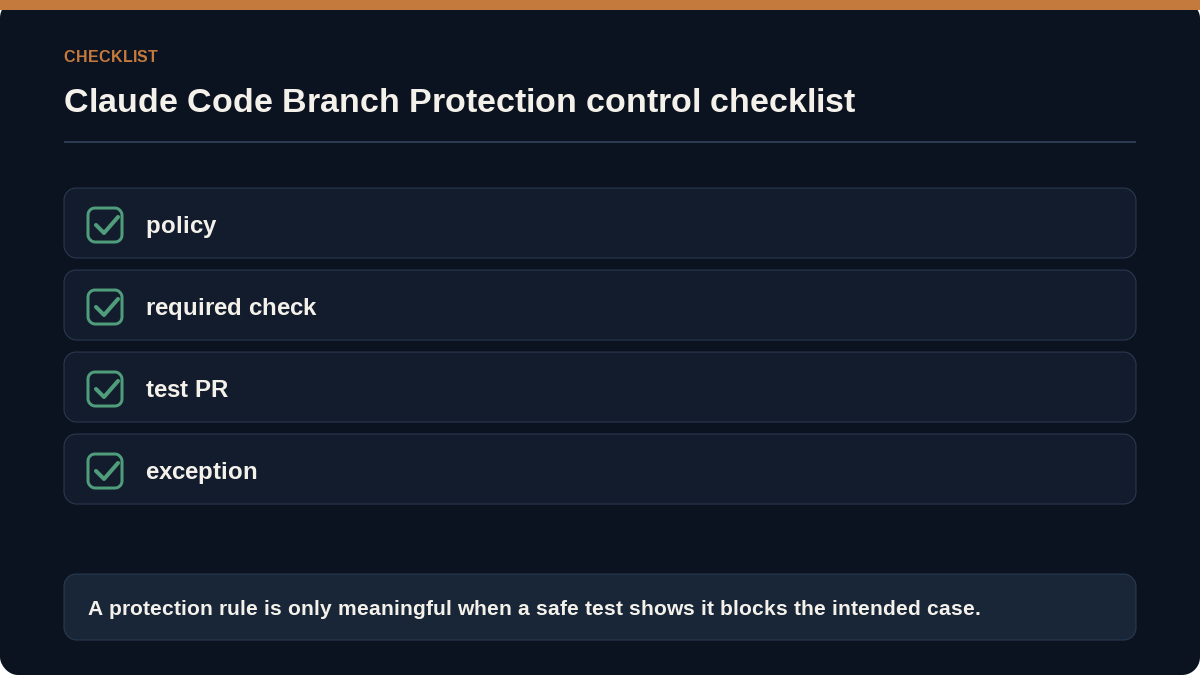
Practical checklist and runbook
- Write the merge policy in plain language before opening settings.
- Map each rule to a named risk and drop rules without one.
- Configure required status checks and confirm each one is reported by a workflow.
- Choose review and history rules that match the written policy.
- Check trigger coverage so a required check runs on every path to a merge.
- Build a test pull request that should be blocked, on a safe branch.
- Observe the block and record the evidence.
- Fix any rule that did not block and rerun the test.
- Close test pull requests and restore settings without bypassing controls.
- Document exceptions with an approver, a duration, and a follow-up.
| Review gate | Pass condition | Failure response |
|---|---|---|
| Policy written | Every rule names a risk | Remove or justify the rule |
| Check coverage | Every required check reports on every merge path | Fix the workflow trigger |
| Block observed | The test pull request is blocked for the intended reason | Reconfigure and retest |
| Cleanup complete | Test pull requests closed, settings restored | Finish the cleanup |
| Exceptions recorded | Each exception has an owner and a follow-up | Add the missing record |
Concrete win, honest loss, and practical implication
Win: A required check that no longer ran on the merge path was found during a controlled test, and the branch is now protected by rules someone has actually observed blocking a change. The evidence is recorded for the next review.
Loss: The validation creates noise: a deliberately broken pull request, a disposable branch, and a settings change that has to be restored. On a production repository the noise is real, and the exercise is only worth repeating at a review cadence rather than continuously.
Implication: Test a protection rule when you first configure it and re-test at a review cadence or whenever the team or the workflows change. Between tests, treat the rule as assumed rather than verified. For a small team, the two highest-value rules are usually a required build and a block on direct pushes.
Where this connects in the batch
The contributor-side workflow that these settings enforce is covered in choosing merge or rebase from the branch policy. The queue that uses required checks to validate combinations is covered in recovering failed merge-queue groups.
The history a protection rule shapes is produced by the contributors. Resolving merge conflicts by behavior covers the decisions that shape each change, making changes revertible with atomic commits covers the unit structure, and encoding change intent in commit messages covers the record each unit leaves.
Release-facing topics continue in choosing a version impact with SemVer, annotated release tags, hotfix backports and cherry-picks, planning a rollback with revert, preparing a changelog from consumer-visible changes, and running a release checklist. The testing lane starts at selecting tests for changed code and triaging flaky tests.
Adjacent library posts on review and enforcement include the code review bottleneck, verification done proof, false success from passing tests, repository hooks security, GitHub Actions secrets, overengineering large diffs, and generated tests and oracle bias. Estimating monthly LLM API cost is the non-blog companion for the spend side of running continuous integration.
Data gap and future update
The fact pack contains no measured link between branch protection testing and incident rates, no benchmark for pull request friction, and no reproducible community study of misconfigured required checks. No such figure is claimed here.
The official evidence covers that branch protection rules and pull-request requirements exist, that merge queues use required checks, and that available settings depend on plan and ownership. It does not quantify enforcement effectiveness. A specific repository may offer different options than the documented default.
Recheck the cited GitHub pages before relying on specific rule names, because hosting settings change across plans. Until stronger evidence exists, treat the test-with-an-incomplete-pull-request method as a validation exercise with a known cost in temporary noise.
One AI API Key option for OpenAI-format agents
Claude Code uses an Anthropic-format route, so the One AI free model IDs are not a Claude Code model source. The research packet records Claude IDs as unavailable on 2026-11-27.
For a separate OpenAI-format agent, One AI API Key offers https://api.oneaiapikey.com/v1, one key, and 46 live free IDs. That option concerns a different client and request format, not a workaround for Claude Code authentication. Review the free model list and eligibility details before choosing an agent route, or start from the quickstart.
FAQ
Can Claude Code change branch protection settings for me?
No. Claude Code can read settings, draft a policy, and help interpret a test result, but repository settings require administrative access. Someone with that access configures the rule.
Are all branch protection rules available on every plan?
No. Available settings depend on repository ownership, plan, and policy. Check what the settings page offers before writing a policy that depends on a specific option.
Why test with a broken pull request instead of trusting the settings?
Settings drift and misconfiguration is common, especially when a workflow is renamed or its trigger changes. A test pull request that should be blocked is the only direct evidence that the rule is enforced.
Is administrator bypass a problem?
It is a risk when it becomes the routine merge path. Bypass exists for emergencies. Document each use with an approver and a follow-up so it stays an exception rather than becoming the default.
How often should protection rules be re-tested?
At setup, and then at a review cadence such as quarterly, or whenever a workflow is renamed, a check is added, or the team changes. The cadence is a policy decision, not a fixed rule.
More Claude Code troubleshooting
- Claude Code Deterministic Tests: Control Time and Randomness
- Claude Code Contract Tests: Check API Expectations
- Claude Code Snapshot Review: Inspect the Diff, Not the Green
- Claude Code Property Tests: Generate Edge Cases
- Claude Code Mutation Testing: Find Weak Assertions
- Claude Code Test Fixtures: Isolate Shared State
- Claude Code Minimal Repro: Shrink the Failure
- Claude Code Debug Log: Separate Facts from Hypotheses
- Claude Code Async Races: Make Scheduling Deterministic
- Claude Code Memory Leaks: Compare Allocation Snapshots
- Claude Code Git Bisect: Automate Regression Hunts
- Claude Code Complexity: Refactor Hotspots, Not Metrics
- Claude Code Duplication: Choose Reuse or Independence
- Claude Code Static Analysis: Baseline the Noise
- Claude Code Dead Code: Prove Usage Before Removal
- Claude Code Git Stash: Recover Work Without Dropping It
Sources
- Official: GitHub branch protection rules, documenting branch protection and pull-request requirements (F070, F072).
- Official: GitHub merge queues, documenting required checks in grouped validation (F071).
- Official: GitHub commit squashing, documenting configurable squash merging.
- Official: Git rebase, supporting the history-shape interaction with linear-history rules.
- Official: Claude Code best practices, supporting check-driven verification.
- Official: Jest configuration, referenced for test configuration behind a required check.
- Derived: F072 supports testing a policy with a safe incomplete pull request and confirming the block.