Direct answer
A commit message should record why the change was made, what behavior changed, and what risk it carries. Generated messages tend to describe files instead. Read the diff, then rewrite the message as a compact decision record: a type and scope if the repository uses them, a specific summary, and a line about risk or migration when either applies. That record is what makes history searchable, changelogs honest, and release review fast.
Claude Code can draft messages, and the drafts are a starting point rather than a finished product. Review each draft against the diff before accepting it. The message outlives the session; the prompt that produced it does not.
Why file-list messages fail later
“Update files” tells a future reader nothing. Six months after a change, the useful questions are: why was this done, what behavior changed, who was affected, and what should I check before touching it again. A message that lists files answers none of them, because the diff already lists files.
The cost lands in three places. History search fails because the message has no keywords tied to intent. Changelog generation produces entries nobody can read. Release review slows down because the reviewer has to open every diff to classify the change.
Claude Code makes this worse by default and better on request. A generated message summarizes the diff mechanically. Asked to explain intent, it can produce something useful, but only if the intent exists in the session context. If you never told the agent why the change was needed, the draft will invent a plausible reason or describe the files.
State the behavior that changed
The first line of the body should name the observable change. “Rejected saves now keep the user’s input and show an inline error” is a behavior. “Fix save handling” is a gesture toward one.
Use the same verb discipline as requirements work. Show, reject, preserve, return, record, and remove are clearer than improve, optimize, support, and handle. The verb should point at something a reviewer can check in the diff.
Official, F066: Reviewing each generated message against the diff and adding the reason, risk, and migration note when relevant is a derived editorial workflow. It is not a Claude Code commit-message guarantee.
The behavior line also constrains the agent. When you write it first, the generated summary has a target to match. When you let the draft lead, the summary drifts toward whatever the diff shows most of.
| Diff theme | Message type | Scope | Concise summary |
|---|---|---|---|
| Rejected saves keep input | fix | save | Keep entered values when a save is rejected |
| New retry backoff | feat | http-client | Add exponential backoff to request retries |
| Format helper rename | refactor | formatting | Rename formatDate to formatDateForUser |
| Broken dependency resolved | fix | deps | Pin transitive dependency to a working version |
| Coverage for the save path | test | save | Cover the rejected-save error state |
The type and scope columns assume the repository has adopted a conventional structure. Where it has not, the summary column still stands on its own.
Explain why the change was needed
The reason is the part the diff cannot supply. A reader can see that the retry loop changed. Only the message can say that the previous fixed delay caused timeouts under a slow upstream.
One sentence is usually enough. “The previous fixed delay caused timeouts under slow upstreams reported in the support queue” gives the motivation, the evidence source, and the scope of the problem without turning the commit into a design document.
Keep incident details, customer names, and secrets out of the message. A commit message is public history in most repositories and is copied into changelogs and release notes. “A support queue report” carries the motivation without exposing anything.
Choose a consistent type and scope
A type is a short label for the kind of change. A scope names the area. Together they let a reader filter history and let a tool group changes into a changelog.
Official, F065: The Conventional Commits specification URL returned a successful response during the research pass. The full specification was not re-fetched within the research budget, so this post asserts no detailed format rule from it.
Use whatever structure the repository already has. If commits already carry types and scopes, match the existing vocabulary rather than inventing a parallel set. If they do not, a two-line convention in the contribution guide is enough, and a strict specification is optional.
Do not present any convention as mandatory for every repository. A small project with a readable history and no tooling depending on message structure may gain nothing from adding prefixes.
| Reason | Risk | Migration note | Verification reference |
|---|---|---|---|
| Slow-upstream timeouts | Retry loop can mask a hard failure | None | Retry path tests |
| Duplicate submissions under retry | Idempotency key now required | Callers must send the key | API contract test |
| Locale-aware formatting | Output format changes for existing users | Document in release notes | Formatting snapshot |
| Dependency pinned | Behavior differs from upstream default | None | Full suite |
The migration column is the one most often skipped and most often needed later. A caller who must change their code deserves a line in the message that says so.
Keep the summary specific
A summary line earns its place when a reader can tell what changed without opening the diff. Specificity is not length. “fix: save” is short and useless. “fix(save): keep entered values when a save is rejected” is longer and useful.
Avoid summaries that would fit any commit in the repository. Update, improve, adjust, and handle are signs that the message describes a category rather than a change. Ask Claude Code to flag those words in a draft and propose a specific replacement.
Add risk and migration notes
Two lines cover most cases. A risk line names what could go wrong and where the danger lives. A migration line names what a caller or operator must do differently.
The risk line is not a substitute for testing. It is a signpost for the reviewer and for the future engineer who modifies the same area. “Retry can mask a permanent failure; the breaker bounds the retry count” tells the next reader what to preserve.
For changes that affect compatibility, the release-facing classification matters more than the message itself. Choosing a version impact with SemVer covers that analysis. The message can carry the signal, but the analysis decides it.
Official, F064: Semantic Versioning defines major, minor, and patch increments through compatibility impact. A message convention can carry signals about compatibility, but it cannot replace the analysis of what actually changed for consumers.
Review generated messages against the diff
The review step is where generated messages earn their keep or get rewritten. Read the diff first, form your own statement of the change, then read the draft and compare.
Three checks catch most problems. Does the summary name a behavior or only files? Does the message claim a reason that the session never established? Does it omit a migration step that the diff requires?
Claude Code can perform the comparison if asked directly. “Compare this commit message with the diff and list any behavior in the diff that the message does not mention” produces a short list. Verify the list yourself, because the agent can flag stylistic differences as well as real omissions.
Rewrite rather than accept a vague draft. The few seconds of editing are cheaper than a history that cannot be searched.
| Generated message problem | What it hides | Fix |
|---|---|---|
| Lists files only | The reason and the behavior | Write the behavior and reason lines |
| Claims an invented reason | The actual motivation | Replace with the stated motivation or remove it |
| Omits a migration step | A caller-breaking change | Add the migration line |
| Uses a vague verb | What actually changed | Replace with a state-changing verb |
| Overstates the change | Reviewer expectations | Narrow the summary to the diff |
Ask Claude Code to detect vague language
A second pass catches the drift you normalized while writing. Two prompts cover it. First, ask which words in the message are vague and propose specific replacements. Second, ask whether the message would let a reader classify the change for a changelog without opening the diff.
The second question is the release-facing test. If the answer is no, the message is missing either the type or the behavior. Fix that before the commit lands.
Treat the agent’s suggestions as proposals. It does not know the repository’s conventions or the team’s vocabulary. The final wording is yours.
Connect the message to release notes
A changelog entry and a commit message serve different readers. The commit message addresses a future engineer modifying the code. The changelog addresses a user of the software deciding whether to upgrade.
Keep a Changelog documents a structure for project changelogs and distinguishes Added, Changed, Deprecated, Removed, Fixed, and Security sections. That structure is a useful target when deciding what belongs in release notes versus what belongs only in the commit.
| Commit message element | Belongs in changelog | Stays in commit only |
|---|---|---|
| Behavior summary | Yes, in the matching section | Also in the commit |
| Reason and evidence source | Sometimes, as context | Yes |
| Internal file names | No | Yes |
| Migration step for callers | Yes, prominently | Also in the commit |
| Risk note for future editors | Rarely | Yes |
| Incident details | No | No, and often omitted entirely |
The mapping explains why a good commit message does not automatically produce a good changelog entry. It produces the raw material. Preparing a changelog from consumer-visible changes covers the extraction in detail.
Official, F064: The version decision follows from compatibility impact, not from the presence of a particular message prefix. Squash merging also affects what the published history looks like, so a release tool that reads messages needs to know whether the target branch preserves them.
Official, F065: The Conventional Commits specification was reachable during research. Teams that adopt it usually feed commit messages into changelog generation, but the version decision still comes from compatibility analysis of the change.
Worked example: a retry feature and a breaking caller change
Suppose a session adds exponential backoff to an HTTP client and, to prevent duplicate submissions, requires callers to send an idempotency key. The diff touches the client, three callers, and the tests.
The behavior line: “Add exponential backoff to request retries and require an idempotency key from callers.” The reason line: “Fixed delays caused timeouts under slow upstreams, and retries without a key produced duplicate submissions.” The type and scope: feat, http-client.
The risk line: “Retries can mask a permanent upstream failure; the retry count is bounded.” The migration line: “Callers must send an idempotency key; requests without one are rejected.”
Reading the diff against the message finds one omission on the first draft: the draft mentioned the backoff and skipped the key requirement. The migration line is the fix, because that is the part a caller needs to see.
Derived arithmetic for the example: The change affected 1 client, 3 callers, and 2 test files, for 6 paths across 2 logical behaviors. The message carries 2 behaviors, 1 migration step, and 1 risk note. Callers requiring a code change: 3. Changelog sections touched: 1 Added entry and 1 Changed entry. This arithmetic tracks the message contents; it is not a benchmark of review time.
The concrete win is a history entry that a release reviewer can classify without opening the diff and a caller who learns about the key requirement before their request fails. The concrete loss is that the message is longer than most and depends on the session actually knowing the reason; a message written without that context would have invented a weaker version.
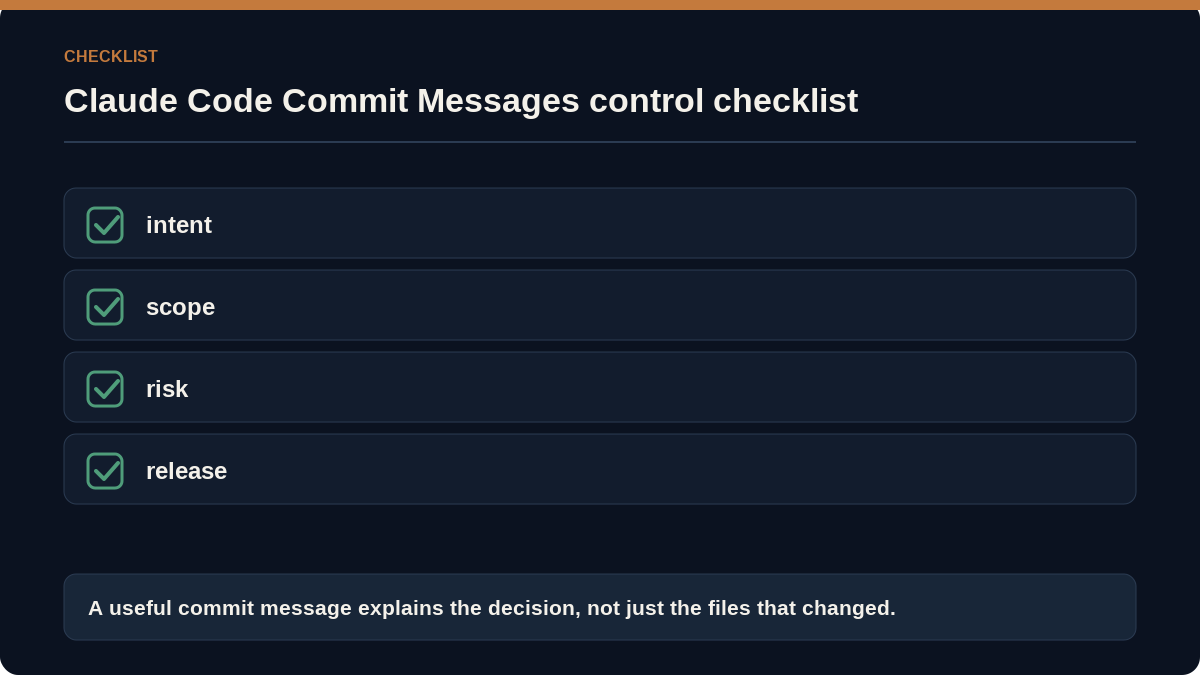
Practical checklist
- Read the diff before reading any generated draft.
- Write the behavior line using a state-changing verb.
- Write the reason line with the motivation and, where safe, the evidence source.
- Choose a type and scope that match the repository’s existing vocabulary.
- Keep the summary specific enough to classify without the diff.
- Add a risk line naming what could go wrong and what bounds it.
- Add a migration line when callers or operators must change anything.
- Ask Claude Code to compare the draft with the diff and list omissions.
- Keep secrets, customer names, and incident details out of the message.
- Map the message to a changelog entry when the change is user-visible.
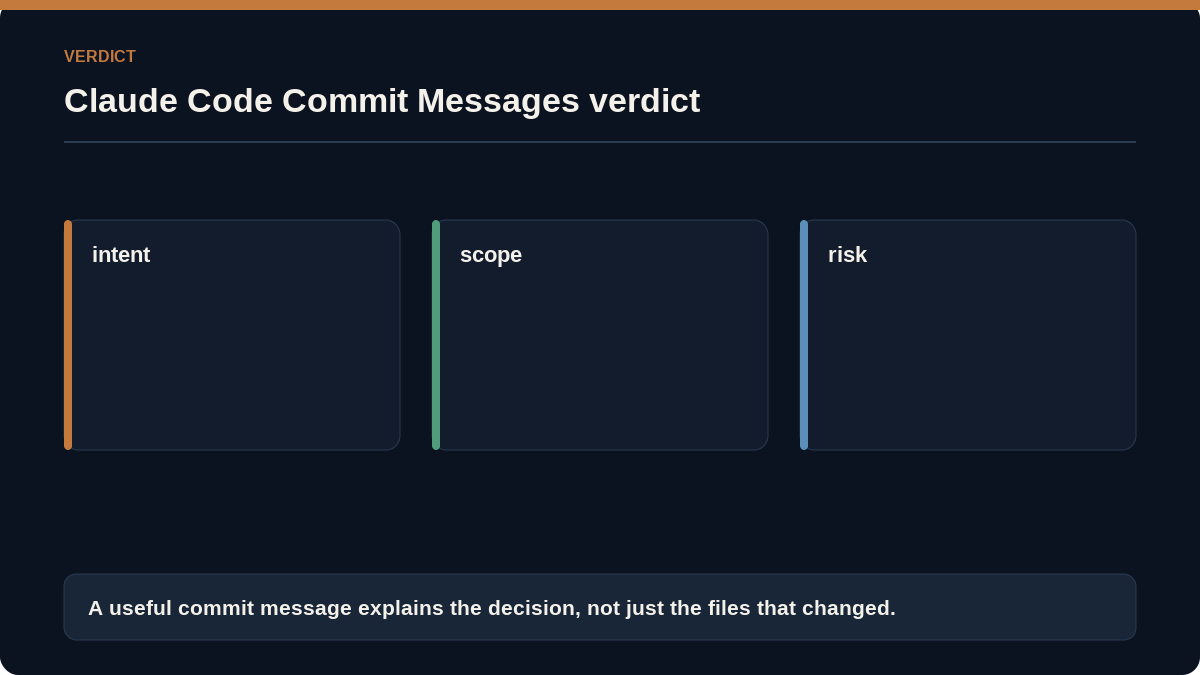
Concrete win, honest loss, and practical implication
Win: The message records the behavior, the reason, the risk, and the migration step. History search finds it, the changelog extraction has raw material, and the caller who needs to change their code finds out from the commit rather than from a failed request.
Loss: The method depends on knowing the reason at commit time. A change made for reasons nobody wrote down produces a message that describes the diff accurately and explains nothing. The message also costs more to write than a file list, and a team that squash-merges may publish only the squash message.
Implication: Write intent into the message whenever the change affects behavior, compatibility, or callers. For a formatting-only or dependency-lock change with no behavioral effect, a short specific summary is enough, and the extra lines add nothing.
Where this connects in the batch
The structure that makes messages mappable starts with the commits themselves. Making changes revertible with atomic commits covers giving each unit one purpose, which is what makes one message per purpose possible.
Release-facing decisions build on the message signal. Choosing a version impact with SemVer covers the compatibility analysis, preparing a changelog from consumer-visible changes covers the extraction, and running a release checklist covers the gate where messages get read.
For the mechanics of getting the commits to the target branch, choosing merge or rebase from the branch policy covers integration, and defining merge checks with branch protection covers the settings that decide whether the messages reach the protected branch intact.
Adjacent reading includes the code review bottleneck for the review-side cost of unclear changes and verification done proof for why a message claim still needs evidence.
Related reading across the batch and the library
The six posts in this batch form one sequence. Making changes revertible with atomic commits covers the unit structure that gives each message one purpose. Choosing merge or rebase from the branch policy covers how the units reach the target branch. Resolving merge conflicts by behavior covers the decisions whose rationale belongs in the message. Recovering failed merge-queue groups covers the queue that validates the combination. Defining merge checks with branch protection covers the settings that protect the history the messages form.
Release-facing topics continue in choosing a version impact with SemVer, annotated release tags, hotfix backports and cherry-picks, planning a rollback with revert, preparing a changelog from consumer-visible changes, and running a release checklist. The wider testing and debugging lane starts at selecting tests for changed code and triaging flaky tests.
Adjacent library posts on review and history include the code review bottleneck, overengineering large diffs, verification done proof, legacy code and tribal knowledge, session handoff for team context, false success from passing tests, and generated tests and oracle bias. Estimating monthly LLM API cost is the non-blog companion for the spend side of generating and reviewing changes.
Data gap and future update
The fact pack contains no measured link between message quality and review time, changelog accuracy, or release defects. No benchmark is claimed here.
The official evidence covers SemVer’s compatibility-based increments, the reachability of the Conventional Commits specification, and the Keep a Changelog structure. It does not quantify the effect of intent-rich messages. The Conventional Commits specification was not re-fetched in full, so no detailed format rule is asserted.
Until a public case study exists, treat intent-rich messages as a reviewable editorial practice rather than a measured improvement.
One AI API Key option for OpenAI-format agents
Claude Code uses an Anthropic-format route, so the One AI free model IDs are not a Claude Code model source. The research packet records Claude IDs as unavailable on 2026-11-27.
For a separate OpenAI-format agent, One AI API Key offers https://api.oneaiapikey.com/v1, one key, and 46 live free IDs. That option concerns a different client and request format, not a workaround for Claude Code authentication. Review the free model list and eligibility details before choosing an agent route, or start from the quickstart.
FAQ
Does a commit prefix determine the version number?
No. A prefix can carry a signal about compatibility, but the version decision comes from analyzing what actually changed for consumers. Treat the prefix as an input to that analysis, not as the decision.
Is Conventional Commits required?
No. It is one widely used convention. A repository without it can still write intent-rich messages. Adopt a structure only when the team and any tooling benefit from it.
What if Claude Code’s draft is already good?
Accept it after reading the diff. The review step is what makes a generated message trustworthy, and reading the diff is the step that cannot be skipped.
How long should a commit message be?
As long as the change requires and no longer. A behavior line, a reason line, and optional risk and migration lines cover most changes. A formatting-only change may need one line.
Can I fix a bad message after the fact?
On an unpublished private branch, amend freely. On a shared or protected branch, rewriting history requires the branch policy to allow it. When a rewrite is not permitted, the correction is a new commit, and the original message stays as history.
More Claude Code troubleshooting
- Claude Code Deterministic Tests: Control Time and Randomness
- Claude Code Contract Tests: Check API Expectations
- Claude Code Snapshot Review: Inspect the Diff, Not the Green
- Claude Code Property Tests: Generate Edge Cases
- Claude Code Mutation Testing: Find Weak Assertions
- Claude Code Test Fixtures: Isolate Shared State
- Claude Code Minimal Repro: Shrink the Failure
- Claude Code Debug Log: Separate Facts from Hypotheses
- Claude Code Async Races: Make Scheduling Deterministic
- Claude Code Memory Leaks: Compare Allocation Snapshots
- Claude Code Git Bisect: Automate Regression Hunts
- Claude Code Complexity: Refactor Hotspots, Not Metrics
- Claude Code Duplication: Choose Reuse or Independence
- Claude Code Static Analysis: Baseline the Noise
- Claude Code Dead Code: Prove Usage Before Removal
- Claude Code Git Stash: Recover Work Without Dropping It
Sources
- Official: Conventional Commits 1.0.0, reachable during research; no detailed format rule asserted (F065).
- Official: Semantic Versioning 2.0.0, defining major, minor, and patch through compatibility impact (F064).
- Official: Keep a Changelog, documenting changelog structure and section types.
- Official: Git log, supporting history reads and message search.
- Official: GitHub commit squashing, documenting how squash affects published history.
- Official: Claude Code best practices, supporting review of generated output against the diff (F066).