Direct answer: settings env can replace the inherited value
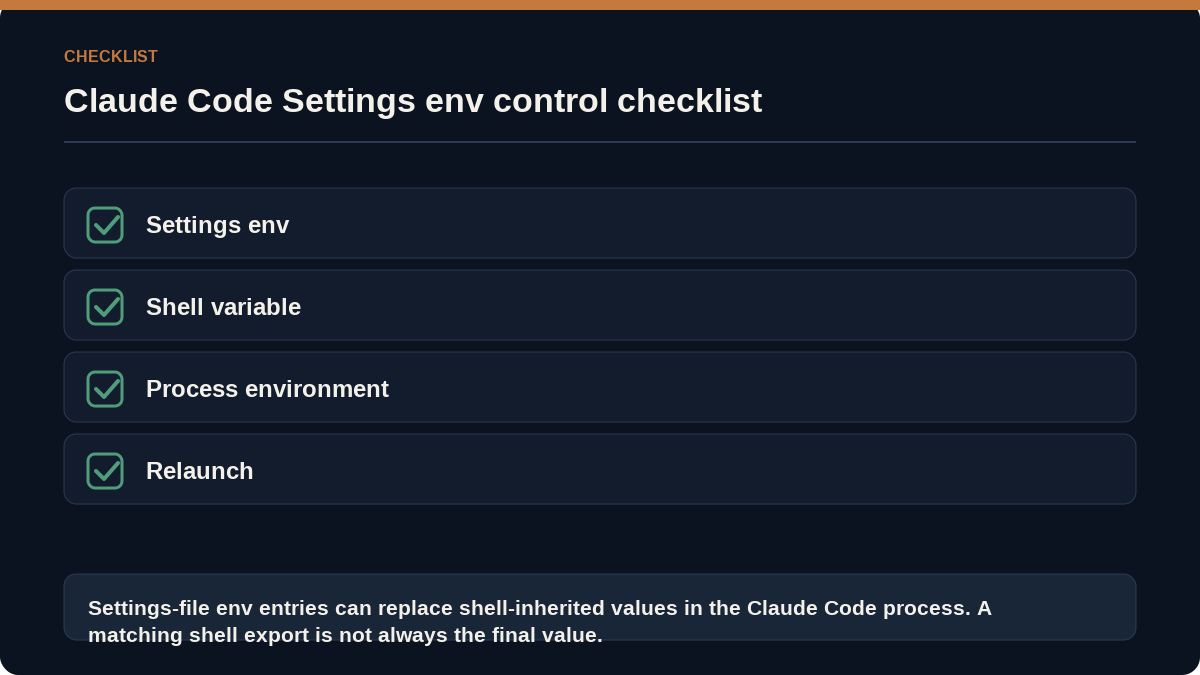
Settings-file env entries are written into the Claude Code process environment and replace shell-inherited values in most sessions. A matching shell export is therefore not always the final value. Shell variables are read at startup, while settings env changes can apply immediately unless the feature reads its variable only at startup. ANTHROPIC_MODEL is a separate exception: it overrides file-based model settings regardless of settings-file scope. Reconcile the two surfaces by inventorying variable names, locating effective env definitions, checking startup-sensitive features, and relaunching when required. Never print secret values to prove which source is present.
Why the shell value is not always the process value
A developer exports a variable, checks it in the terminal, and expects Claude Code to use the same value. The terminal check describes the shell environment. Claude Code can then apply a settings-file env entry inside its own process, replacing the inherited value in most sessions.
Official. The environment-variable documentation makes that process-level distinction. It does not say every settings change applies immediately. Some features read their variable only at startup, which creates a second timing boundary after source selection is resolved.
A second source of confusion is file precedence. ANTHROPIC_MODEL overrides file-based model settings regardless of settings-file scope. A user can edit a model value in settings.json and still observe the environment-selected value. That is a documented key-specific exception, not evidence that the five-level order failed.
The cost of guessing is a configuration loop. A developer may change a shell startup file while a settings env entry keeps replacing the value. Another may edit settings while an already running feature still uses its startup value. Each change can look reasonable in isolation and fail in the combined process.
The settings precedence runbook explains the five file and launch scopes. This article handles the environment branch that sits beside that map. The settings validation guide helps when an entry is rejected rather than applied.
Inventory inherited variables
Begin with names and presence, not values. Identify which documented variables matter to the symptom, then determine whether the launching shell provides them. For a credential, record only that the variable is present and which launch surface supplied it.
Official. ANTHROPIC_API_KEY and ANTHROPIC_AUTH_TOKEN are distinct credential variables. One is sent as X-Api-Key, while the other supplies a Bearer authorization value. Their presence can affect credential selection, but presence alone does not prove every approval or precedence condition.
A terminal session is not the only possible source. An IDE, wrapper, container, or managed launcher may provide a different environment. The WSL IDE environment-variable guide covers a related launch-context problem without implying that every IDE loses variables.
Record the project directory and execution surface alongside the inventory. A variable present in one terminal may be absent from the process that starts the editor panel. The VS Code settings and relaunch runbook explains why startup timing matters for CLAUDE_CODE_AUTO_CONNECT_IDE.
Do not paste a full environment dump into a ticket. The secrets in logs and transcripts guide explains how diagnostic output can expose credentials. The GitHub Actions secrets guide provides adjacent guidance for keeping secrets out of shared automation records.
Find settings env entries
The env key can be set in any settings file. That flexibility means several scopes may define environment values, and effective settings precedence still matters. A project-local env block can therefore deserve attention before a personal user block.
Official. Most settings keys live in settings.json files, while a short group has global-config scope in ~/.claude.json. The env key belongs to the settings-file surface. The global config versus settings.json guide prevents a misplaced edit before the environment trace begins.
| Variable source | Documented role | Inspection question |
|---|---|---|
| Launching shell | Supplies inherited process values | Is the variable present in this launch context? |
Settings-file env |
Writes values into the process environment | Which effective settings scope defines the entry? |
ANTHROPIC_MODEL |
Overrides file-based model settings | Is the environment supplying a model choice? |
CLAUDE_CODE_AUTO_CONNECT_IDE |
Overrides automatic IDE connection | Is a shell or settings value controlling connection behavior? |
| Managed or launch context | May sit above ordinary file scopes | Does a higher-priority configuration surface apply? |
Official. CLAUDE_CODE_AUTO_CONNECT_IDE overrides automatic IDE connection and takes precedence over the global autoConnectIde setting. Documented values are false to prevent automatic connection and true to force an attempt. Those values illustrate control behavior, not a guarantee that an IDE is available or connected.
Inspect the effective env definition rather than every mention of the variable. If several settings files define it, return to the scope order. The project-local merge guide explains why file presence alone does not identify the winning definition.
Keep real credentials out of the example. The API key security reference for AI applications is useful adjacent reading, but it does not change Claude Code’s process replacement rule.
Understand process replacement
Think of the shell as the parent environment and Claude Code as a process that can receive additional values from settings. In most sessions, a settings-file env entry replaces the inherited value for the same variable inside that process. The shell’s value can remain unchanged outside Claude Code.
Official. The documentation qualifies replacement with “most sessions.” That wording does not support an absolute claim that every feature reads the updated process value immediately. Source replacement and feature timing are separate questions.
Suppose a shell provides CLAUDE_CODE_AUTO_CONNECT_IDE=true, while an effective settings file provides false. In a session covered by the documented replacement behavior, the process value becomes false. A terminal check of the inherited value would still show what the shell supplied, not what the Claude Code process uses.
Changing the shell value later does not automatically rewrite an already running process. Conversely, changing settings may affect the process without changing the parent shell. The environment-variable documentation is the source for both the replacement and startup qualifications.
A related credential example requires extra care. ANTHROPIC_AUTH_TOKEN and ANTHROPIC_API_KEY rank above apiKeyHelper in the documented direct Anthropic subset. Replacing one inherited value does not by itself prove which credential source is active. The credential precedence runbook preserves gateway and cloud-provider exceptions.
Separate startup-only variables
Shell variables are read at startup. A change in the shell startup context therefore requires a new launch before the new process can inherit it. Settings env changes can apply immediately, but only when the affected feature does not read its variable exclusively at startup.
Official. CLAUDE_CODE_AUTO_CONNECT_IDE is a documented example of a shell variable read at startup. Changing it requires relaunching Claude Code. Settings-file env entries have different timing unless the feature reads the variable only at startup.
| Change location | When it can take effect | Required check |
|---|---|---|
| Shell environment | At process startup | Launch a new Claude Code process |
Settings-file env |
Can apply immediately in most sessions | Check whether the feature is startup-sensitive |
| Startup-sensitive feature | When the feature initializes | Relaunch even if the setting is valid |
| File-based model setting | Subject to ANTHROPIC_MODEL exception |
Inspect the environment before another file edit |
A relaunch is not a universal explanation for every failure. It is a targeted response to startup timing. If an entry is rejected, relaunching repeatedly will not correct its documented placement. The status and doctor runbook covers that validation branch.
Use the same project and launch surface after relaunch. A fresh terminal does not prove that an editor-launched process received the same environment. The VS Code installation and standalone CLI guide explains that the panel and terminal are distinct execution surfaces.
Check ANTHROPIC_MODEL precedence
ANTHROPIC_MODEL overrides file-based model settings regardless of settings-file scope. A project-local, shared project, or user file cannot outrank that environment choice for file-based model settings.
Official. This is a key-specific exception. It does not mean every environment variable ignores the ordinary settings precedence map. Model-related keys such as fallbackModel and modelPicker also have special resolution rules, which require their own reference check.
Suppose a user file contains one model setting and the process receives ANTHROPIC_MODEL from the environment. Editing the user file again will not resolve the mismatch because the environment variable overrides file-based model settings. The corrective action is to identify which surface should own the model choice.
Do not invent a model ID for an example. Record the variable name and source, then consult the settings documentation for the current rule. If the selected value is not sensitive, a redacted comparison may be useful, but this article does not assert a specific available model.
The settings env section of the all settings reference confirms that env can appear in any settings file. That placement flexibility does not weaken the ANTHROPIC_MODEL exception.
Choose shell or settings ownership
Decide which surface should own the variable before editing both. A shell-owned value is appropriate when the launch environment deliberately supplies it. A settings-owned value is appropriate when the Claude Code configuration should define it for the relevant scope. Duplicate ownership needs a documented reason.
Official. A settings-file env entry can replace a shell-inherited value in most sessions. If both surfaces define the same variable, the process result may differ from the shell result even though both configurations are valid. That is why “the export is correct” is not a complete verification.
For a personal default, user settings may be the intended surface. For a project-specific override, project-local settings have higher precedence than shared project and user settings. For a launch-specific value, the invocation or managed context may be the correct owner. The five-scope settings map supplies the rank order.
Managed context deserves a separate check. The SSO organization and login-method guide shows that some controls are enforceable only through managed settings. Do not assume a personal env entry can override an organizational launch context.
Write an ownership sentence before making the change. For example: “The project-local settings file owns automatic IDE connection for this repository.” That sentence makes the next edit specific and gives the verification step a clear expected source.
Relaunch when required
Relaunch when the variable is read at startup or when the feature initializes only once. Keep the project directory and launch surface stable so the new process is comparable with the old one.
Official. Shell variables are read at startup. Settings env changes can apply immediately unless the feature reads its variable only at startup. A correct setting can therefore require a relaunch without being rejected or shadowed.
After relaunch, repeat the inspection. Check loaded configuration sources with /status and rejected entries with claude doctor. The fetched summary does not enumerate every output field, so record only what the current tools expose.
/status
claude doctor
These commands inspect configuration and report loaded or rejected entries, but this article does not verify exactly which fields each command prints in every version. Treat their output as potentially sensitive: review it before pasting into an issue, a note or a screenshot, and redact anything that looks like a credential. Neither command automatically repairs an entry. The settings validation article explains the difference between loaded sources and rejected entries.
If the symptom persists, check whether the new process actually inherited the intended shell environment. An IDE or wrapper may start Claude Code through another surface. The WSL IDE environment guide provides a related diagnostic path without establishing a universal IDE defect.
Record the effective value without exposing secrets
For a nonsecret control such as CLAUDE_CODE_AUTO_CONNECT_IDE, record the documented value and its source when useful. For a credential, record presence, source, and scope only. Never record the credential itself to prove that replacement occurred.
Official. ANTHROPIC_API_KEY is sent as X-Api-Key, while ANTHROPIC_AUTH_TOKEN supplies a Bearer authorization value. Treat both as sensitive. A screenshot that proves one is present may also disclose it, so redaction must happen before sharing.
A compact record can say, “Credential variable present in launch environment; settings env definition inspected; value redacted.” That supports precedence work without creating a new secret exposure. The settings files and exposed secrets article explains a related configuration risk.
If an inspection tool does not reveal the effective process value, say so. Do not infer it from the parent shell alone. The global config and settings file guide helps confirm that the key was edited in a documented location.
Worked example: inherited true, settings false
Suppose the launching shell provides CLAUDE_CODE_AUTO_CONNECT_IDE=true. An effective project-local settings file defines the same variable as false inside env. No higher-priority source defines it, and the entry is accepted.
{
"env": {
  "CLAUDE_CODE_AUTO_CONNECT_IDE": "false"
}
}
Official. The documented values are false to prevent automatic connection and true to force an attempt. In a session covered by the process replacement rule, the settings value replaces the inherited shell value inside Claude Code. The parent shell can still carry true.
Because shell variables are read at startup, a change made only in the shell requires a new Claude Code process. A settings change can apply immediately unless the feature reads the variable only at startup. If connection behavior was initialized earlier, relaunch before judging the result.
Derived. The source trace has two candidate values and one documented replacement rule: inherited true, settings false, then process false in the qualified case. This is a configuration trace, not a measured connection success rate. The VS Code auto-connect and relaunch runbook provides the matching startup example.
Practical ownership matrix
| Symptom | First surface to inspect | Next check |
|---|---|---|
| Shell export differs from Claude Code behavior | Effective settings env definitions |
Process replacement and startup timing |
| Shell change has no effect in an existing session | Startup state | Relaunch Claude Code |
| Model file edit has no effect | ANTHROPIC_MODEL |
Environment source and intended ownership |
| Settings change works in terminal but not editor | Actual editor launch environment | Execution surface and inherited variables |
| Entry is reported as rejected | Key reference and defining file | Correct validation before another relaunch |
| Credential behavior ignores a helper | Credential precedence | Higher static variables, gateway and cloud context |
Use the matrix to avoid changing both surfaces at once. A single-owner correction produces a clearer result than simultaneous shell and settings edits. The apiKeyHelper refresh guide applies the same discipline to credential generation.
The OpenAI versus Anthropic compatible APIs reference is relevant only when a separate gateway integration is also in scope. API format compatibility does not change Claude Code’s environment replacement behavior.
Concrete win, honest loss and practical implication
Win. A developer can explain why a correct shell export does not control Claude Code by finding the effective settings env entry. The process model also gives a precise reason to relaunch startup-sensitive features.
Loss. Replacement is documented for most sessions, not as an absolute rule for every feature. The supplied evidence does not provide a complete list of startup-only variables or a universal command that prints every effective process value safely.
Implication. Give each variable one intended owner, inspect both shell and settings surfaces, and relaunch only when startup timing requires it. Record presence rather than secret values. The uninstall and configuration retention guide is a reminder that environment cleanup and configuration deletion are separate decisions.
Data gaps and future update triggers
Unknown. The fetched evidence does not enumerate every startup-sensitive variable, every session qualifier behind process replacement, or a complete safe effective-value inspection command. It also does not establish cloud-provider environment behavior, which remains outside this guide.
Update this runbook when official documentation publishes a variable timing table or a safe inspection method. Recheck the environment-variable and settings pages before publication. Do not add provider-specific setup steps without a verified source.
Related batch runbooks
- The five Claude Code settings scopes in exact order
- Project-local settings versus user values
- Status and doctor for loaded and rejected settings
- Global config in ~/.claude.json versus settings.json
- Dynamic apiKeyHelper credentials and refresh timing
- Credential precedence across keys, helper and OAuth
- Absolute CLAUDE_CONFIG_DIR paths for auth storage
- Managed SSO organization and login-method controls
- Stable, latest and minimumVersion update controls
- Browser sign-in, first-launch state and logout
- Uninstall ownership and configuration retention
- VS Code settings, auto-connect and relaunch timing
One AI option for OpenAI-format agents
If your separate agent uses OpenAI-format requests, One AI offers one key for the 46 live free IDs at https://api.oneaiapikey.com/v1. Review the free model route and the OpenAI-format quickstart. Those IDs are not Claude Code credentials. Claude IDs were unavailable on 2026-11-27, and this article does not present One AI as a Claude Code model source.
FAQ
Does a settings env entry always override the shell value?
It replaces shell-inherited values in most sessions, according to the official documentation. Feature startup timing still matters, so do not turn the qualified rule into an absolute claim.
Why does changing a shell variable require a relaunch?
Shell variables are read at startup. A new Claude Code process is needed before the changed shell environment can be inherited.
Can a settings env change apply without relaunching?
It can apply immediately unless the feature reads the variable only at startup. Relaunch when the feature is startup-sensitive.
Why does ANTHROPIC_MODEL ignore my settings file?
ANTHROPIC_MODEL overrides file-based model settings regardless of settings-file scope. Inspect the environment source instead of editing another file blindly.
How can I verify a credential variable without exposing it?
Record its name, presence, source and scope. Do not print or paste the value. Use loaded-source and rejected-entry inspection for configuration evidence.
More Claude Code troubleshooting
- Claude Code Native Install: Verify PATH and Binary Ownership
- Claude Code Homebrew Install: Manage Cask Updates Manually
- Claude Code WinGet Install: Locate the Binary and Maintain PATH
- Claude Code npm Install: Node 22, Global Prefix and PATH
- Claude Code Linux Packages: Compare apt, dnf and apk Updates
- Claude Code Credential Storage: macOS, Linux and Windows Paths
- Claude Code Terminal Keybindings: Shift+Enter Compatibility Guide
- Claude Code tmux Setup: Passthrough Keys and Notification Bells
- Claude Code Terminal Theme: Light, Dark and Custom JSON
- Claude Code JetBrains Install: CLI Plus Marketplace Plugin
- Claude Code JetBrains External Terminal: Host Install and /ide
- Claude Code Dev Container Feature: Install and Node Fallback
- Claude Code Dev Container Auth: Persist Config With a Volume
- Claude Code Docker Config Mount: Permissions and Write Access
- Claude Code VS Code Dev Containers: Align CLAUDE_CONFIG_DIR
- Claude Code Container User: Align HOME, Config and Workspace
Sources
- Environment variables - Claude Code Docs, official, checked 2026-11-28. Process replacement, startup timing and helper TTL.
- Settings files and precedence - Claude Code Docs, official, checked 2026-11-28.
ANTHROPIC_MODELexception and scope order. - All settings - Claude Code Docs, official, checked 2026-11-28.
envplacement and global-config distinctions. - Authentication - Claude Code Docs, official, checked 2026-11-28. Credential variable headers and precedence.
- Troubleshooting - Claude Code Docs, official, linked in the research register. Troubleshooting boundary.
- CLI reference - Claude Code Docs, official, linked in the research register. Command reference boundary.