Direct answer: refresh is not credential selection
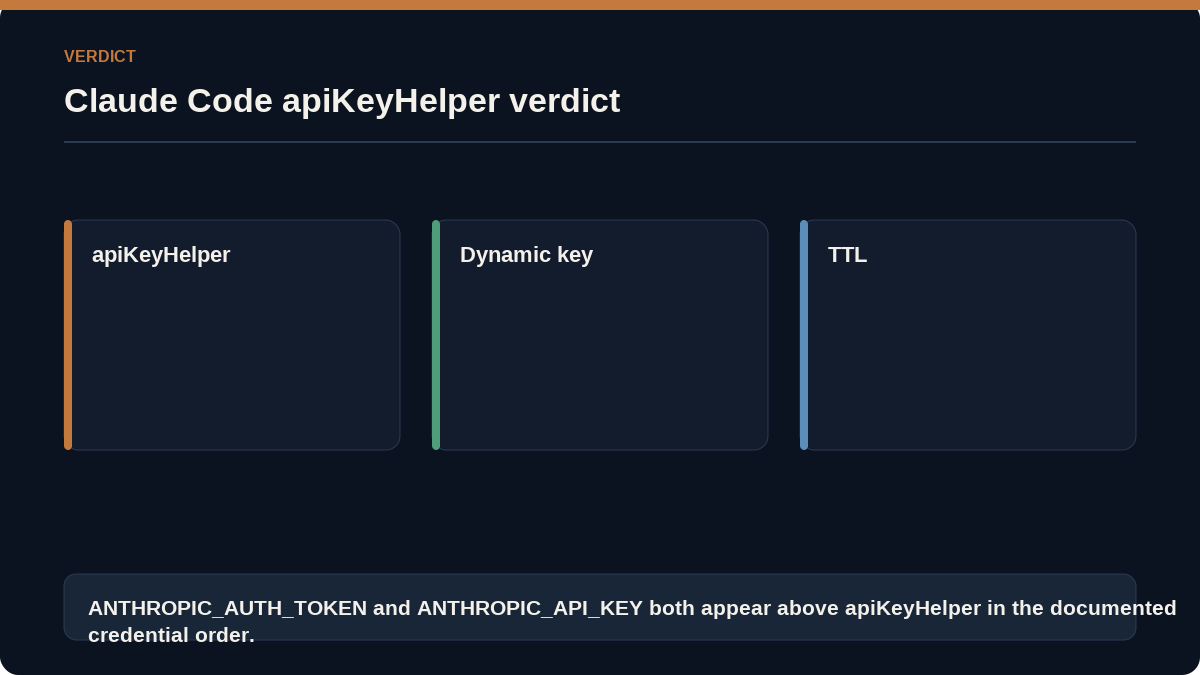
apiKeyHelper runs a user command that generates an API credential, and the setting can appear in any Claude Code settings file. CLAUDE_CODE_API_KEY_HELPER_TTL_MS controls the helper refresh interval in milliseconds. Neither fact makes the helper the active credential source. In the documented direct Anthropic credential order, ANTHROPIC_AUTH_TOKEN and ANTHROPIC_API_KEY both rank above apiKeyHelper, after higher-priority gateway and cloud-provider sources. If a refreshed helper value never appears to take effect, inspect credential precedence before changing the refresh interval. Treat the TTL as a refresh control, not a promise that a credential remains valid.
Why a fresh key can still look stale
A developer can watch a helper issue a new value, set a short refresh interval, and still see the same authentication behavior. That sequence does not prove the refresh mechanism failed. Selection and refresh are separate decisions. Selection chooses which credential source Claude Code consults. Refresh decides when the helper command runs again to replace its generated value.
Official. The authentication documentation puts gateway sessions above other sources and lists cloud-provider variables before the direct Anthropic subset. Within that subset, ANTHROPIC_AUTH_TOKEN precedes ANTHROPIC_API_KEY, then apiKeyHelper, CLAUDE_CODE_OAUTH_TOKEN, profiles or federation credentials, and subscription OAuth. The credential precedence runbook preserves those outer exceptions rather than flattening them into one environment-variable rule.
A second source of confusion is scope. apiKeyHelper may be written in any settings file, yet the effective settings order still decides which definition survives when several files define it. A project-local command can therefore shadow a personal command without any change to the credential ladder. The five-scope settings map is the right companion check before blaming the TTL.
The cost is not only a delayed fix. Teams may rotate a helper, edit the wrong file, or leave a static credential active while believing automation is in control. The result is an unreliable account of which system issued the credential. Keep secret values out of screenshots and tickets; the secrets in logs and transcripts guide explains why a diagnostic paste can create a second incident.
Choose the helper use case
Start with the requirement, not the command. A helper is useful when a credential must be produced by a user-controlled command instead of stored as a static value in the setting. It is not required for every Claude Code setup. A subscription login, an approved API key, or another documented source may already satisfy the intended workflow.
Official. apiKeyHelper generates an API credential with a user command. That description leaves the command implementation to the operator. This article does not prescribe a secret store, a token service, or a custom gateway. It also does not claim that a helper can manufacture access which the credential provider has not granted.
A practical use case has a clear owner. Someone must maintain the command, know how it fails, and understand which provider rules govern the resulting credential. If the command depends on a machine-local path, record that dependency. If it depends on a network service, its availability becomes part of the authentication path, but this fact pack contains no uptime evidence for such a service.
Unknown. No public evidence in the supplied research establishes one helper architecture that fits every team. The correct choice depends on requirements outside this configuration guide. Use the API key security reference for AI applications as adjacent reading, not as proof that a particular helper design is safe.
Before editing, write a one-sentence acceptance condition. For example: “The helper command is the selected direct Anthropic source, and its generated value refreshes on the configured schedule.” That sentence gives you two testable parts. A successful command run alone does not prove selection. A selected source alone does not prove refresh.
Helper setting versus the documented scope
| Setting or control | Where it can be defined | What it changes | What it does not prove |
|---|---|---|---|
apiKeyHelper |
Any settings file | The user command that generates an API credential | That the helper outranks a static credential |
CLAUDE_CODE_API_KEY_HELPER_TTL_MS |
Environment variable surface | The helper refresh interval, expressed in milliseconds | A provider-approved interval or guaranteed validity |
ANTHROPIC_AUTH_TOKEN |
Environment variable surface | A Bearer authorization value | That a helper value will be used |
ANTHROPIC_API_KEY |
Environment variable surface | A value sent as X-Api-Key |
That presence alone settles interactive approval |
Official. The two static variables are not interchangeable labels. ANTHROPIC_AUTH_TOKEN supplies a Bearer authorization value, while ANTHROPIC_API_KEY is sent as X-Api-Key. An interactive API key also requires a one-time approval before it overrides subscription access. Those distinctions matter when cleaning up a setup that appears to ignore its helper.
Use this table as a classification tool. It tells you which mechanism you are changing, but it does not replace inspection of the effective configuration. The settings validation runbook covers loaded sources and rejected entries without inventing command output fields.
Select the settings scope
Any-file placement is flexibility, not anonymity. If the same key appears in user settings, shared project settings, and project-local settings, the documented precedence order decides which value has priority. Managed settings and command-line arguments remain above those file scopes.
Official. User settings live at ~/.claude/settings.json. Shared project settings live at .claude/settings.json, while personal project overrides live at .claude/settings.local.json. On Windows, the user path expands under %USERPROFILE%\.claude. A configured CLAUDE_CONFIG_DIR changes the configuration base path, so path inspection should begin with the launch context rather than an assumption about the home directory.
A personal helper often belongs in user settings when it should follow the developer across projects. A repository-specific helper may belong in shared project settings when the repository intentionally defines that behavior. A private local override belongs in project-local settings when it should not become the shared project definition. These are placement choices, not a claim that one scope is universally correct.
Suppose a user file defines a helper and a project-local file defines another helper. The project-local definition has higher precedence than the user definition, unless a higher scope supplies the key. Editing the user command again would not change the winning project-local definition. The project-local versus user merge guide explains why list values and ordinary values need separate treatment.
For relocated configuration, follow the absolute-path CLAUDE_CONFIG_DIR runbook. Do not assume a terminal-launched session and an IDE-launched session inherited identical environments. The WSL IDE environment guide is useful background when the same repository behaves differently in two launch surfaces.
Configure the helper command
Keep the example small. The command below names a helper that already exists on the machine. It does not create the helper, define its output contract, or contain a credential. Replace the illustrative path only after you have identified the command you intend to own.
{
"apiKeyHelper": "node /opt/credential-helper/issue-key.mjs"
}
Official. This setting is valid in any settings file because the reference gives apiKeyHelper that scope flexibility. The example does not establish that /opt/credential-helper/issue-key.mjs exists, that Node is the right runtime for your helper, or that the command returns a provider-accepted credential. Those are properties of your implementation.
Check the command in the same user context that launches Claude Code. A path readable in an administrator shell may be unavailable to the ordinary process. A command that works in one project may rely on a relative path in another. These are operational checks, not new Claude Code precedence rules.
Avoid placing the generated credential directly in a settings example, a shell history command, or a shared issue. The GitHub Actions secrets guide and the settings files and exposed secrets article cover adjacent secret-handling mistakes. Neither source changes the helper selection order.
After editing, preserve a record of the file path and command path without recording the output. A useful note says, “Project-local helper points to the maintained command; generated value not captured.” That record supports later comparison while keeping the credential out of the evidence packet.
Understand helper output precedence
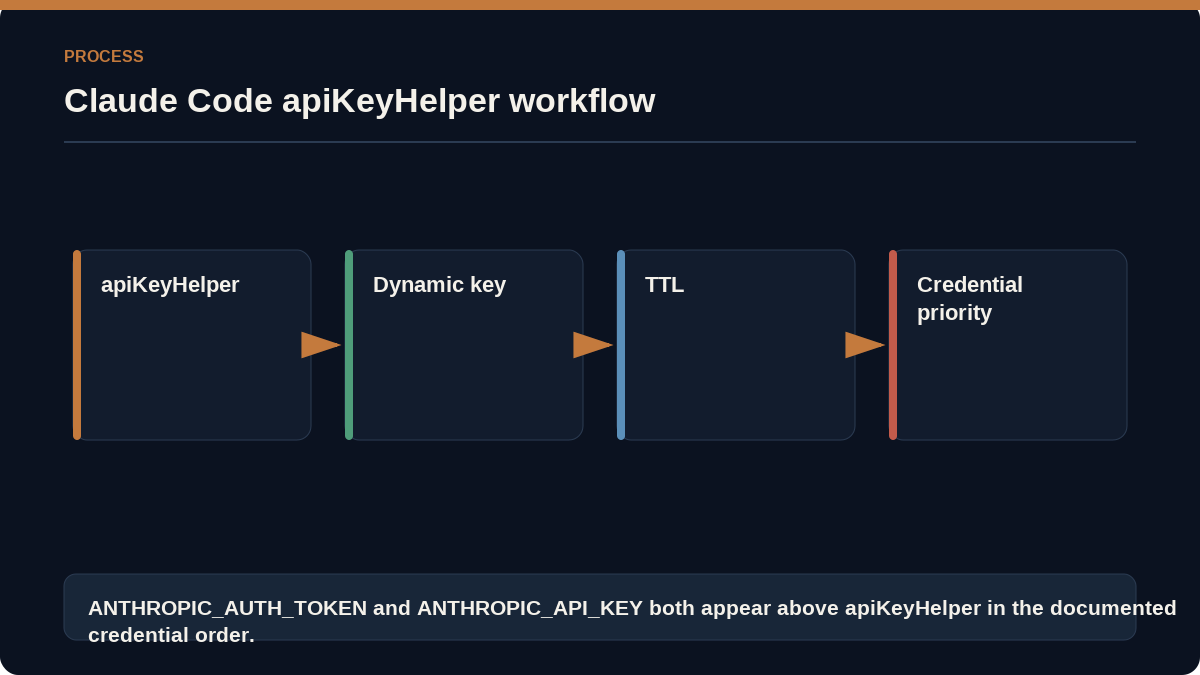
Refreshing a lower-priority source cannot promote it. A new value from apiKeyHelper remains below ANTHROPIC_AUTH_TOKEN and ANTHROPIC_API_KEY in the documented direct subset. Gateway sessions and cloud-provider sources require their own checks before that subset.
| Credential source | Priority relative to apiKeyHelper |
Inspection question |
|---|---|---|
| Gateway session | Above the helper and the direct subset | Is this launch operating through a gateway session? |
| Cloud-provider variables | Above the direct Anthropic subset | Are provider-specific variables present in the launch context? |
ANTHROPIC_AUTH_TOKEN |
Above the helper | Is an inherited or settings-provided Bearer value active? |
ANTHROPIC_API_KEY |
Above the helper | Is a static key present, and has interactive approval occurred where required? |
apiKeyHelper |
The source under test | Which effective settings definition supplies its command? |
CLAUDE_CODE_OAUTH_TOKEN |
Below the helper | Is another documented source relevant only after higher sources are absent? |
| Profiles, federation, subscription OAuth | Below the helper in the listed subset | Does the session use one of these lower-priority paths? |
Official. This ordering is not a universal rule that environment variables always win. It is a credential ladder with explicit higher-priority exceptions. The authentication documentation is the source for the ladder and the header distinction.
Consider a session with both an inherited ANTHROPIC_AUTH_TOKEN and a healthy helper. A refresh can succeed while the inherited token remains the selected source. Removing the token is a configuration decision that requires confirming it is unintended. Do not delete credentials merely to make a hypothesis test pass.
If ANTHROPIC_API_KEY is present, also consider the documented interactive approval step. Presence of the variable alone does not prove approval state. The browser sign-in and logout runbook explains the first-launch flow, while the SSO organization controls guide covers a separate managed identity constraint.
Set the refresh interval deliberately
CLAUDE_CODE_API_KEY_HELPER_TTL_MS controls the helper refresh interval in milliseconds. A value therefore needs unit discipline. The variable name does not describe credential lifetime, and a refresh timer does not extend a provider’s expiration policy.
Derived. For an illustrative input of 60000 milliseconds, the conversion is 60000 ms / 1000 ms per second = 60 seconds, which is 1 minute. This arithmetic demonstrates the unit only. It is not a recommended interval, a default, or evidence that a credential issued by your provider remains usable for that period.
| Refresh choice | Operational effect | Evidence still required |
|---|---|---|
| Set the TTL variable | Changes when the helper is scheduled to refresh | Provider guidance for the intended credential |
| Leave the TTL unset | Avoids adding an explicit interval in this setting | Documentation of the behavior that applies in your setup |
| Shorten the interval | Requests more frequent helper refreshes | Failure cost and provider constraints |
| Lengthen the interval | Allows more time between helper refreshes | Acceptable staleness for the credential provider |
Official. The fetched environment-variable page gives no recommended interval for every credential provider. A short TTL can cause more helper executions without making the helper the active source. A long TTL can delay a refresh without guaranteeing that the previous value stayed valid. The honest recommendation is to derive the interval from provider requirements and measured operational constraints, neither of which is supplied here.
The settings env and process replacement guide explains another timing boundary. A settings-file env entry can replace an inherited value in the process, while some features read variables only at startup. Do not assume a TTL edit and a process restart solve the same problem.
Recognize repeated helper failures
Official. The authentication page says helper failures trigger errors after three attempts. That count is evidence of a retry boundary, not evidence of exact retry timing. It also does not establish a universal recovery procedure.
When failures repeat, separate command failure from source selection. A command that cannot execute, returns an error, or produces an unusable value belongs to the helper path. A command that succeeds while another credential remains active belongs to precedence. A setting rejected during loading belongs to validation. These categories need different corrections.
Record the command path, the settings file that defines it, and whether the failure appeared during startup or a later refresh. Do not record the generated value. If the helper depends on external state, note the relevant provider status without claiming that an outage caused the failure unless evidence supports it.
The status and doctor comparison helps identify loaded configuration sources and rejected entries. It does not turn claude doctor into an automatic repair tool. Use the troubleshooting documentation for the official troubleshooting boundary rather than inventing an exit code or output schema.
Remove conflicting higher-priority credentials
Begin with an inventory of names, not values. Check whether ANTHROPIC_AUTH_TOKEN or ANTHROPIC_API_KEY is present in the shell that launches Claude Code. Then inspect effective settings definitions for apiKeyHelper. Finally, consider gateway and cloud-provider context if the documented direct subset does not explain the session.
Official. A settings-file env entry can replace a shell-inherited value in most sessions. That means editing a shell startup file alone may not remove an override supplied by settings. Conversely, removing a settings entry may reveal an inherited shell value on the next launch. Trace both surfaces before deciding which one owns the credential.
The global config versus settings.json guide helps prevent a misplaced edit. Most settings belong in settings.json files, but a short group has global-config scope in ~/.claude.json. Do not move credential material into that global file as a workaround.
For a managed machine, coordinate with the owner of managed policy. The managed SSO login guide shows why some identity controls are enforceable only at managed scope. A local override is not a general method for removing an organizational restriction.
Verify the helper is the active source
Use a controlled sequence. First, identify the effective apiKeyHelper definition and its scope. Second, confirm that no unintended higher-priority source applies. Third, exercise the helper command without publishing its output. Fourth, observe behavior across a refresh boundary using the interval you deliberately configured.
Official. /status is recommended for seeing loaded configuration sources, and claude doctor is recommended for identifying rejected entries. The fetched summary does not enumerate every /status field, so this article does not promise a specific credential-source field or a definitive per-key winner display. If the available output does not answer the selection question, retain the gap and use the documented precedence map.
A compact verification record can contain the launch surface, project directory, settings paths inspected, presence or absence of conflicting variable names, helper command path, and observed error category. Presence checks should not become value dumps. For credentials, record only whether a named source is configured and where its definition came from.
The VS Code settings and relaunch guide is relevant when terminal and editor launches disagree. Its central lesson applies here: shell variables are read at startup, while settings changes can have different timing. Relaunch when the feature is startup-sensitive, then repeat the same inspection.
Worked example: the successful refresh that changes nothing
Suppose a user settings file defines a helper command. A project-local settings file defines the same key with a different command. The shell also exports ANTHROPIC_AUTH_TOKEN. The helper runs successfully and the TTL is set to an illustrative 60000 milliseconds.
Apply the rules in order. Project-local settings outrank user settings, so the local helper definition wins among those files. The local command is therefore the helper under test. The inherited auth token still ranks above apiKeyHelper in the direct credential subset, so helper refresh alone cannot make its output active. The TTL conversion is 60000 / 1000 = 60 seconds; it changes refresh timing, not priority.
The corrective action depends on intent. If the local helper is unintended, remove or correct that scoped definition. If the inherited token is unintended, change the surface that supplies it and relaunch as required. If both are intended, document the expected source instead of treating the helper as selected. This example contains no real credential and makes no claim about a provider’s accepted token lifetime.
Concrete win, honest loss and practical implication
Win. A team can centralize credential generation in a maintained command and control refresh timing without embedding the generated value in the setting. That gives the operator a clear command to inspect and a specific timer to reason about.
Loss. A correct helper can remain unused because a higher-priority credential is present. More frequent refresh does not fix that selection problem, and the available documentation does not supply a universal TTL for every provider. Helper failures also surface after three attempts without a documented exact retry schedule in the fetched evidence.
Implication. Put source selection before timer tuning. For each launch surface, name the intended credential source, identify its winning settings scope, and remove only confirmed conflicts. Then choose a provider-informed refresh interval and record failures without secret output. The uninstall and configuration retention guide is a reminder that executable removal and configuration cleanup are separate decisions.
Data gaps and future update triggers
Unknown. The supplied evidence does not establish a recommended TTL for each credential provider, exact retry timing after helper failures, or a complete per-key display in /status. It also contains no measured refresh success rate. Those gaps should remain visible rather than becoming invented defaults.
Update this runbook when official documentation publishes provider-specific refresh guidance, a documented inspection field that identifies the active credential source, or a changed retry description. Recheck the authentication and environment-variable pages before publication because configuration behavior can drift. A community report may justify a new test case, but it should not become a universal defect without reproduction and maintainer evidence.
Related batch runbooks
- Credential precedence across API keys, helpers and OAuth
- Credential storage paths across macOS, Linux and Windows
- Absolute CLAUDE_CONFIG_DIR paths for auth storage
- Managed SSO organization and login-method controls
- The five Claude Code settings scopes in exact order
- Project-local settings versus user values
- Loaded sources and rejected entries with status and doctor
- Settings env values versus shell process replacement
- Global config in ~/.claude.json versus settings.json
- Browser sign-in, first-launch state and logout
- Uninstall ownership and configuration retention
- VS Code settings, auto-connect and relaunch timing
One AI option for OpenAI-format agents
The OpenAI versus Anthropic API compatibility reference explains why an OpenAI-format agent is a separate integration from Claude Code credential selection. If your separate agent uses OpenAI-format requests, One AI offers one key for the 46 live free IDs through https://api.oneaiapikey.com/v1. Review the free model route and the OpenAI-format quickstart. Those IDs are not a Claude Code credential source. Claude IDs were unavailable on 2026-11-27, and this article does not route Claude Code through One AI.
FAQ
Does a shorter TTL make apiKeyHelper win credential precedence?
No. The TTL controls helper refresh timing in milliseconds. Credential precedence is a separate documented order, with ANTHROPIC_AUTH_TOKEN and ANTHROPIC_API_KEY above the helper in the direct Anthropic subset.
Can apiKeyHelper be defined only in user settings?
No. The official settings reference says it can be placed in any settings file. Effective settings precedence still determines which definition applies when several scopes contain the key.
Why does the helper run but authentication still use another source?
A higher-priority credential may be active. Gateway sessions and cloud-provider variables sit above the direct subset, and the two static Anthropic variables sit above the helper. Inspect selection before changing refresh timing.
What should I record after three helper failures?
Record the command path, defining settings scope, launch context and error category. The official page says errors occur after three attempts, but the fetched evidence does not establish exact retry timing or one universal recovery procedure. Do not record the generated credential.
More Claude Code troubleshooting
- Claude Code Native Install: Verify PATH and Binary Ownership
- Claude Code Homebrew Install: Manage Cask Updates Manually
- Claude Code WinGet Install: Locate the Binary and Maintain PATH
- Claude Code npm Install: Node 22, Global Prefix and PATH
- Claude Code Linux Packages: Compare apt, dnf and apk Updates
- Claude Code Update Channels: Stable, Latest and Minimum Version
- Claude Code Terminal Keybindings: Shift+Enter Compatibility Guide
- Claude Code tmux Setup: Passthrough Keys and Notification Bells
- Claude Code Terminal Theme: Light, Dark and Custom JSON
- Claude Code VS Code Install: Extension Panel and Standalone CLI
- Claude Code JetBrains Install: CLI Plus Marketplace Plugin
- Claude Code JetBrains External Terminal: Host Install and /ide
- Claude Code Dev Container Feature: Install and Node Fallback
- Claude Code Dev Container Auth: Persist Config With a Volume
- Claude Code Docker Config Mount: Permissions and Write Access
- Claude Code VS Code Dev Containers: Align CLAUDE_CONFIG_DIR
- Claude Code Container User: Align HOME, Config and Workspace
Sources
- Authentication - Claude Code Docs, official, checked 2026-11-28. Credential order, static-variable headers, interactive approval and helper failure attempts.
- All settings - Claude Code Docs, official, checked 2026-11-28.
apiKeyHelperplacement and global-config distinctions. - Environment variables - Claude Code Docs, official, checked 2026-11-28. Helper TTL and process environment timing.
- Settings files and precedence - Claude Code Docs, official, checked 2026-11-28. Scope order, list behavior and model exceptions.
- Troubleshooting - Claude Code Docs, official, linked in the research register. Further troubleshooting context, not a source for invented output fields.
- CLI reference - Claude Code Docs, official, linked in the research register. Command reference boundary for the inspection workflow.