Choose Bonsai 2.5 27B when a compact local model and offline operation matter more than the highest published score. Choose Qwen3.8 FP16 when quality is the priority and the larger weight footprint is acceptable. In PrismML’s vendor-published comparison, Bonsai nearly matches Qwen on the five-row tool-calling average, at 77.2 versus 77.7, but trails by 6.3 points on agentic coding and 2.20 points across the broad capability average.
The important qualification is that the Qwen baseline is specifically Qwen3.8 FP16. It is not a quantized Qwen GGUF, and its scores should not be transferred to a smaller Qwen file. The PrismML Bonsai 2.5 27B launch announcement supplies the comparison, while the Ternary Bonsai 2.5 27B GGUF model card supplies the Bonsai files, commands and runtime boundaries. Neither source provides a matched speed test against Qwen.
What are Bonsai 2.5 27B and Qwen3.8 27B?
PrismML identifies the local model as Ternary Bonsai 2.5 27B, with the public repository prism-ml/Ternary-Bonsai-2.5-27B-GGUF. The launch article is dated November 24, 2026. Apache-2.0 licensing is recorded across the vendor announcement, model card, documentation and third-party overview. Public weights make local inspection and deployment possible, but they do not create a hosted API.
The local model is a ternary vision-language model based on Qwen3.8-27B, according to PrismML. The vendor reports 27.36 billion total parameters: 24.35 billion language parameters, a 0.47-billion-parameter vision tower and 2.54 billion embedding and language-model-head parameters. A hybrid attention design is approximately 75 percent linear attention and 25 percent full attention, and the documented context length is 262,144 tokens.
The weight representation is ternary g128 at about 1.76 bits per weight, with FP16 group-wise scaling in a blockwise Hadamard basis. Native tool calling and image input are documented. Reasoning defaults to xhigh; medium is available, while low is unsupported and behaves like xhigh. Thinking is on by default, and a short output cap can truncate reasoning before the final answer appears.
Qwen3.8 27B plays two distinct roles in this comparison. First, Qwen3.8-27B is the stated base for Bonsai. Second, Qwen3.8 FP16 is the reference model in PrismML’s score tables, with a listed reference weight footprint of 53.8 GB. The supplied material does not include a Qwen quantized file list, quantization quality scores, runtime matrix or matched throughput measurements. Those omissions matter: a 53.8 GB FP16 reference and a future 7 GB-class Qwen GGUF would be different deployment candidates.
This distinction prevents a common selection error. Bonsai’s compact ternary files can be compared with the published FP16 baseline on quality and reference footprint, but that does not prove Bonsai is smaller, faster or better than every quantized Qwen. For the broader release context, use the Bonsai 2.5 27B launch verdict and setup router. For exact artifact selection within Bonsai, use the PTQ1_0 versus PQ2_0 versus Q2_0 quantization guide.
How do their published benchmarks compare?
The fairest short answer is mixed. Bonsai 2.5 27B wins three of the five individual tool-calling rows but loses the other two and the average. All three individual agentic coding rows and the coding average go to Qwen, and Qwen3.8 FP16 also leads every broad capability category. These are directional results from one vendor’s tables, not proof of a controlled quality difference on your repository.
ExplainX’s Bonsai 2.5 27B agentic coding overview explicitly says the scores were vendor-run and not independently reproduced. The supplied tables omit evaluation hardware, prompts, scaffolds, seeds, category weighting, confidence intervals and pass@1 settings. The delta column below is simple arithmetic from the displayed values, with Bonsai minus Qwen. It is not a new experiment.
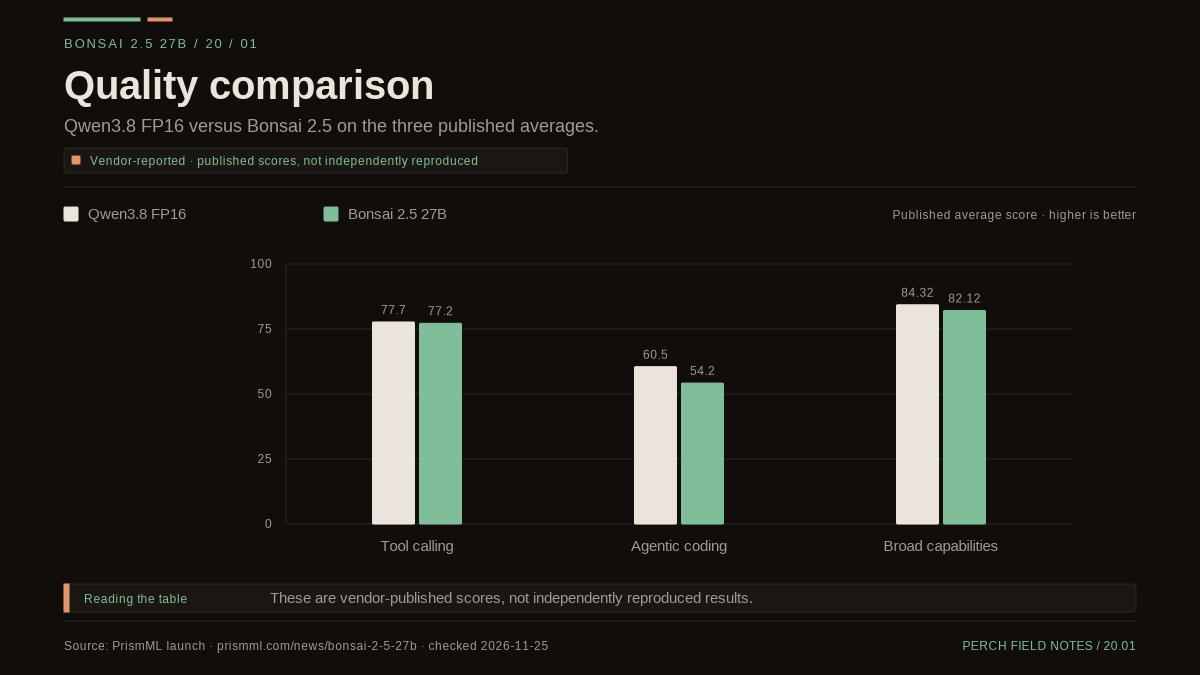
| Benchmark | Qwen3.8 FP16 | Bonsai 2.5 27B | Delta |
|---|---|---|---|
| Tau2-Bench | 80.6 | 82.0 | +1.4 |
| Tau3-Bench | 72.8 | 73.9 | +1.1 |
| BFCL v3 native | 71.2 | 72.6 | +1.4 |
| BFCL v4 | 70.8 | 67.2 | -3.6 |
| AppWorld | 93.2 | 90.5 | -2.7 |
| Tool-calling average, 5 rows | 77.7 | 77.2 | -0.5 |
| Terminal-Bench 2.1 | 70.8 | 60.1 | -10.7 |
| SWE-bench Verified | 80.6 | 75.6 | -5.0 |
| DeepSWE | 30.1 | 27.0 | -3.1 |
| Agentic coding average, 3 rows | 60.5 | 54.2 | -6.3 |
| Knowledge and reasoning | 86.67 | 84.27 | -2.40 |
| Math | 93.15 | 90.10 | -3.05 |
| Coding | 74.55 | 71.65 | -2.90 |
| Instruction following | 81.15 | 80.90 | -0.25 |
| Vision | 86.07 | 83.66 | -2.41 |
| Broad average, 5 categories | 84.32 | 82.12 | -2.20 |
What does the tool-calling result mean?
Bonsai’s tool average is close enough to Qwen’s to justify a workload test rather than an automatic rejection. Tau2-Bench, Tau3-Bench and BFCL v3 native favor Bonsai in the published rows. However, BFCL v4 trails by 3.6 points and AppWorld by 2.7 points. The average therefore conceals a real split rather than establishing uniform equivalence.
For a local agent, the relevant question is whether your schemas, multi-turn state and error recovery resemble the tasks in those evaluations. A near-average result does not guarantee reliable JSON arguments or recovery from a failed tool. The Tau, BFCL and AppWorld tool-calling analysis covers the schema and harness details that the headline average leaves out.
Where is the coding quality gap largest?
Terminal-Bench 2.1 is the largest single coding loss at 10.7 points. SWE-bench Verified is 5.0 points behind, DeepSWE is 3.1 points behind, and the three-row average is 6.3 points behind. The vendor page and ExplainX label the last benchmark DeepSWE v1.1, while the screenshot shortens it to DeepSWE.
There is still a substantial improvement over Bonsai 2 27B. The coding average rises from 37.9 to 54.2, SWE-bench Verified from 60.8 to 75.6, and Terminal-Bench 2.1 from 52.8 to 60.1. That predecessor gain is not the same as beating Qwen. Read the SWE-bench Verified 75.6 repository-repair analysis for patch evaluation and the Terminal-Bench 2.1 long-horizon terminal analysis for shell-agent demands.
Do broad capabilities change the verdict?
They strengthen the case for Qwen FP16 when general quality is the priority. Qwen leads knowledge and reasoning, math, coding, instruction following and vision, and Bonsai’s broad average is 82.12 versus 84.32. Instruction following also drops 1.65 points against Bonsai 2, so the release is not an across-the-board improvement even against its predecessor.
The row-by-row Bonsai 2.5 27B benchmark teardown examines every published row and the missing methodology. Until an independent reproduction exists, treat the size of these gaps as vendor-reported estimates rather than stable rankings across all prompts and harnesses.
How do memory and footprint compare?
Bonsai’s clearest advantage is the published weight footprint. The model card lists Qwen3.8 FP16 at 53.8 GB. Bonsai’s base PTQ1_0 file is 5.99 GB, roughly one ninth of that reference, while the larger PQ2_0 and Q2_0 base files are 7.25 GB and 7.67 GB. MTP variants add about 0.24 GB to each corresponding base file.
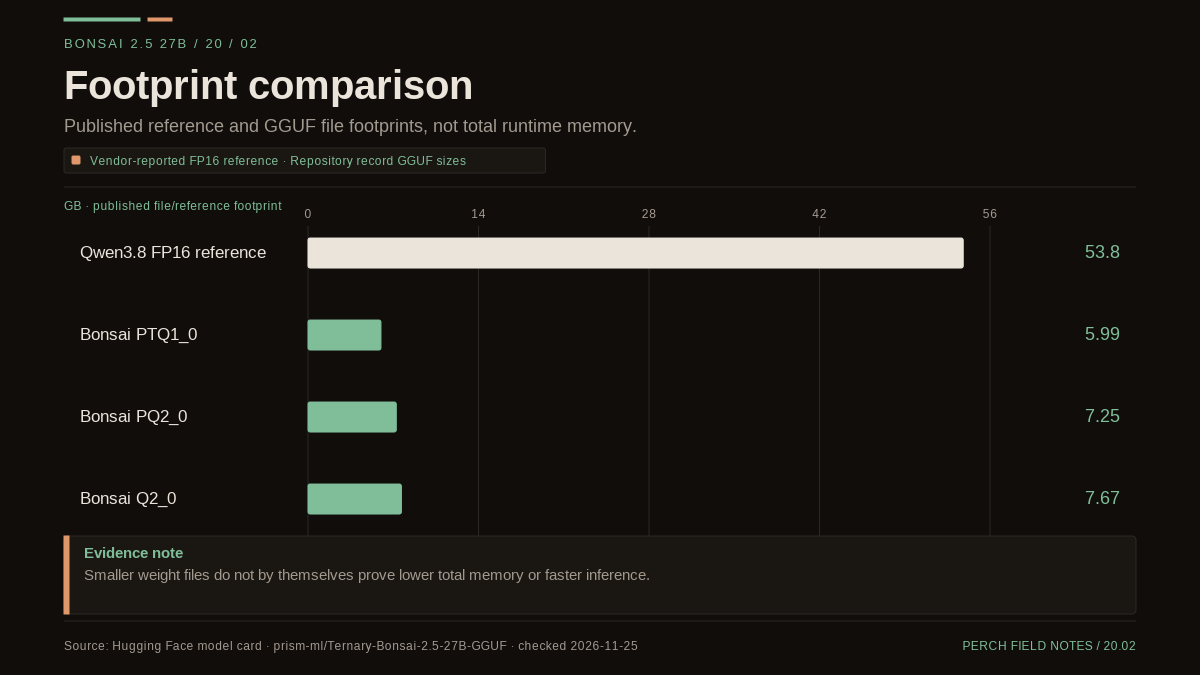
| Option | Exact filename or reference | Weight size | Runtime boundary | Selection note |
|---|---|---|---|---|
| Qwen3.8 FP16 | Exact filename not supplied | 53.8 GB | No Qwen runtime details supplied | Quality baseline in the published tables, not a compact-file claim |
| Bonsai PTQ1_0 | Ternary-Bonsai-2.5-27B-PTQ1_0.gguf |
5.99 GB | PrismML llama.cpp fork | Smallest published base file |
| Bonsai PTQ1_0 MTP | Ternary-Bonsai-2.5-27B-PTQ1_0-mtp.gguf |
6.23 GB | PrismML llama.cpp fork | Adds about 0.24 GB; test prefill and generation separately |
| Bonsai PQ2_0 | Ternary-Bonsai-2.5-27B-PQ2_0.gguf |
7.25 GB | PrismML llama.cpp fork | Larger fork-only option; no quality score supplied |
| Bonsai PQ2_0 MTP | Ternary-Bonsai-2.5-27B-PQ2_0-mtp.gguf |
7.49 GB | PrismML llama.cpp fork | Adds about 0.24 GB over the base file |
| Bonsai Q2_0 | Ternary-Bonsai-2.5-27B-Q2_0.gguf |
7.67 GB | Stock llama.cpp b11556+ |
Stock-runtime route; older builds may generate garbage |
| Bonsai Q2_0 MTP | Ternary-Bonsai-2.5-27B-Q2_0-mtp.gguf |
7.91 GB | Stock llama.cpp b11556+ |
Adds about 0.24 GB; MTP is not a free speed upgrade |
The marketing language alternates between 5.9 GB and 5.93 GB, while repository byte counts round the base PTQ1_0 file to 5.99 GB. Use the exact filename and repository size when planning storage. Do not describe every Bonsai file as 5.9 GB, because PQ2_0 and Q2_0 are larger.
Weight size is not total VRAM. The KV cache grows with context, and the runtime, agent history, tool definitions and concurrency also consume memory. Vision adds a separate projector: the published suffixes -mmproj-BF16.gguf and -mmproj-Q8_0.gguf correspond to approximately 0.93 GB and 0.63 GB. The supplied factpack does not give exact KV-cache bytes, so no precise 262K-context memory total can be calculated here.
One concrete vendor observation is roughly 9.5 GB VRAM before -np 1 on a 10 GB RTX 3080, dropping to about 7.8 GB afterward. That is a specific configuration, not a universal minimum or a promise that every 10 GB card will fit every context length. The Bonsai VRAM and RAM worksheet by quantization and 262K Bonsai context-window memory guide explain what to measure without fabricating cache sizes.
Which runtimes support each option?
Several documented routes exist for Bonsai, but the exact GGUF determines the safest starting point. PTQ1_0 and PQ2_0 require PrismML’s llama.cpp fork. Q2_0 requires stock llama.cpp b11556 or newer; older builds may load the file but produce garbage. This is a compatibility requirement, not a quality ranking.
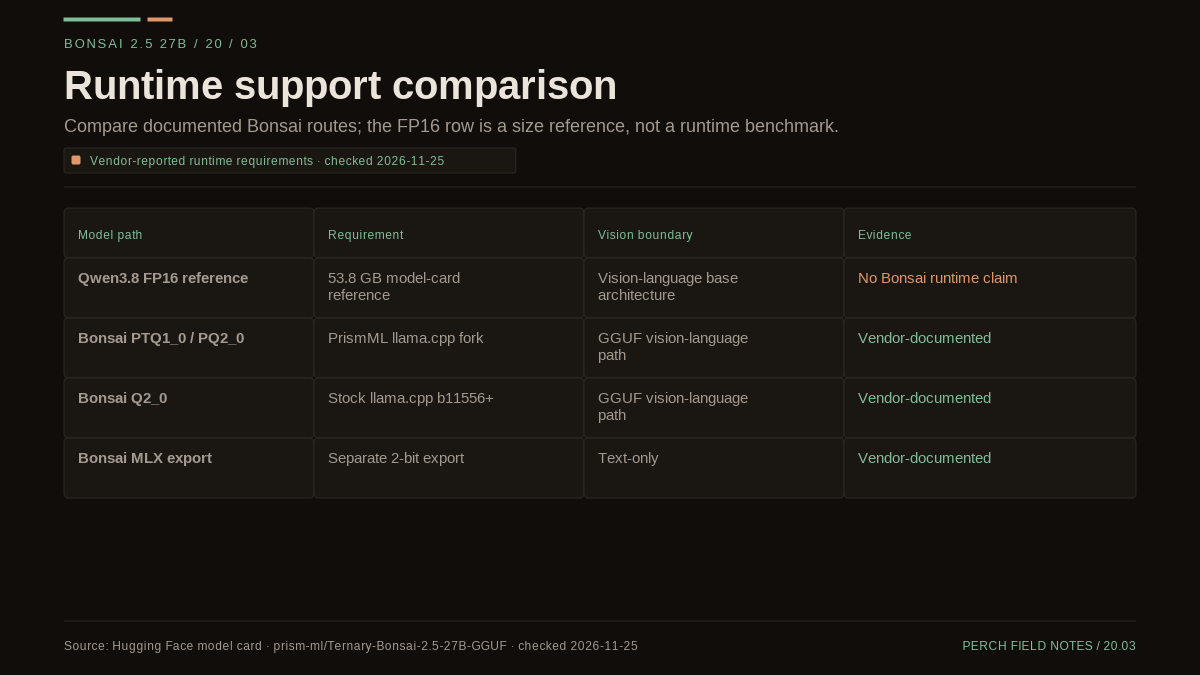
The PrismML getting-started documentation documents llama.cpp, MLX and OpenAI-compatible serving. PrismML’s llama.cpp fork lists CUDA, Metal, CPU and SYCL backends. Ollama and vLLM are documented, and the model card gives these exact server examples:
llama serve -hf prism-ml/Ternary-Bonsai-2.5-27B-GGUF:Q2_0
ollama run hf.co/prism-ml/Ternary-Bonsai-2.5-27B-GGUF:Q2_0
vllm serve "prism-ml/Ternary-Bonsai-2.5-27B-GGUF"
Do not infer that PTQ1_0 works in Ollama simply because it is the smallest Bonsai file. The documented Ollama command uses Q2_0. The PTQ1_0 and Q2_0 local installation walkthrough keeps the fork and stock paths separate. The Ollama Q2_0 commands and coding-agent connection and vLLM OpenAI-compatible Bonsai server setup cover client integration without promising unmeasured throughput.
On Apple Silicon, the documented MLX export is prism-ml/Ternary-Bonsai-2.5-27B-mlx-2bit, and it is text-only. That limits its fit for image workflows even though Bonsai is described as a vision-language model. The Apple Silicon MLX setup for Bonsai 2.5 27B covers that boundary. A Hexagon preset exists, but PrismML says the Galaxy S26 Ultra configuration requires an unreleased fix, so it should not be treated as a current supported promise.
For Qwen, the supplied comparison establishes the FP16 reference size and benchmark role, but not a file-by-file runtime support matrix. Selecting a quantized Qwen therefore requires checking that exact artifact’s own model card and runtime version. It would be unsupported to claim here that Qwen has universal GGUF, Ollama, vLLM or MLX compatibility, or that its quantized versions retain the FP16 scores.
What speed evidence is actually comparable?
There is no reliable Bonsai-versus-Qwen head-to-head speed result in the supplied sources. Bonsai’s own figures are not all measured under the same conditions. The launch page and model card report different generation rates, MTP appears to explain part of the difference, and context, backend and prompt processing are not held constant.
For H100, the launch page claims 291 generated tokens per second and 3,200 prompt tokens per second. The model card’s plain-decode PTQ1_0 table reports 186 generated tokens per second. ExplainX attributes the higher launch figure to MTP, but that is a third-party interpretation rather than an independent measurement. The model card also warns that MTP can slow NVIDIA prefill by 9 to 23 percent.
For RTX 4090, the launch page claims 204 generated tokens per second and about 3,060 prompt tokens per second. The model card’s plain-decode PTQ1_0 table lists 112 generated tokens per second. Do not quote 204 without the MTP context, and do not compare prompt-processing speed with generation speed as if they were the same metric. The RTX 4090 Bonsai configuration and speed claims keeps those measurements separate.
Two lower-end reports require stronger caution. A Hacker News discussion includes a commenter reporting 22.3 tokens per second on a Mac Mini M5 Pro. That is a community anecdote with incomplete configuration. ExplainX also relays an unsourced claim of about 74 tokens per second at 262K context on a 12 GB RTX 3060 with MTP. It is unverified and should not be used as a planning guarantee. The Mac Mini M5 Pro Bonsai setup and 22.3 tok/s audit and RTX 3060 12GB Bonsai feasibility and context tuning audit both claims.
No reliable CPU-only tokens-per-second figure is supplied, and no Qwen speed baseline is supplied. CPU inference is documented for Bonsai, but calling it fast for agentic coding would invent evidence. The cross-hardware Bonsai tokens-per-second comparison defines a fair test, while the CPU-only Bonsai setup and memory tuning starts with measurement rather than a fabricated estimate.
A fair local comparison should fix the exact model file, runtime version, backend, MTP state, context length, prompt length and generation length. Record prompt speed and generation speed separately, then measure resident memory. Repeat the same workload with the chosen Qwen artifact. Until that matched test exists, the honest speed verdict is unknown, not “Bonsai is faster because it is smaller.”
Which model fits a local coding agent?
The published material frames this as Bonsai’s target workload: native tool calling, image input, a 262,144-token context and an offline llama.cpp path are documented. Its tool-calling average is close to Qwen FP16, and its gains over Bonsai 2 are substantial. Those facts make it a serious candidate for a local repository agent, especially when keeping weights and prompts on your own hardware is a requirement.
The vendor demo reports 180 tool calls in an entirely offline investigation of a pytest 9.1 regression. The failing test passed alone but failed alongside other tests. The model inspected the repository, built a minimal reproduction, traced the failure, implemented a patch and passed a previously unseen maintainer test. This is useful workflow evidence, but no dataset, complete transcript, harness or independent verification is supplied. The prominent “65” has no reliably legible metric label and should not be interpreted as a score. The 180-tool-call Bonsai coding-agent workflow focuses on reproducing the loop safely.
Qwen FP16 remains the quality-first choice on the published coding rows. If an agent frequently performs long-horizon terminal work or repository repair, the 10.7-point Terminal-Bench gap and 5.0-point SWE-bench gap deserve attention. Smaller weights do not remove the need for patch review, tests, bounded retries or sandboxed shell permissions. A compact model can still produce an incorrect patch, and a high tool-calling average does not establish safe autonomy.
Agent configuration also matters. Reasoning defaults to xhigh, thinking is on by default, and short output caps can truncate reasoning. Tool definitions, repository files, test output and conversation history all compete for context. Use retrieval and bounded tool output rather than assuming the full 262K window is practical on your hardware. Validate arguments, keep writes inside the workspace and escalate failed tasks instead of allowing unlimited retries.
Vision is another selection boundary. Bonsai’s broad vision score is 83.66 versus Qwen FP16’s 86.07, and local image input requires a GGUF path with the separate projector. The text-only MLX export cannot satisfy a vision workflow. The Bonsai vision mmproj setup and benchmark limits explains the projector choices and evidence limits.
The supplied LocalLLaMA discussion pointer was inconsistently accessible. It is not used as evidence for quality, compatibility or speed. Community reports can suggest tests to run, but they cannot replace a recorded configuration and repeatable result.
Which should you choose?
Choose Qwen3.8 FP16 if your priority is the highest published quality in this comparison and you can accommodate the 53.8 GB reference weight footprint plus runtime memory. It leads the coding average, Terminal-Bench 2.1, SWE-bench Verified and every broad category. The supplied evidence does not establish how a quantized Qwen would compare, so make that a separate evaluation rather than assuming FP16 quality at a smaller size.
Choose Bonsai 2.5 27B if you need a compact local agent, offline operation, native tools or image input and can accept the published quality losses. Start with PTQ1_0 when the smallest base file and PrismML’s fork are acceptable. Choose Q2_0 when stock llama.cpp b11556+, Ollama or the documented serving route is the better fit. Treat MTP as an experiment: it adds about 0.24 GB, may improve generation and can reduce NVIDIA prefill speed.
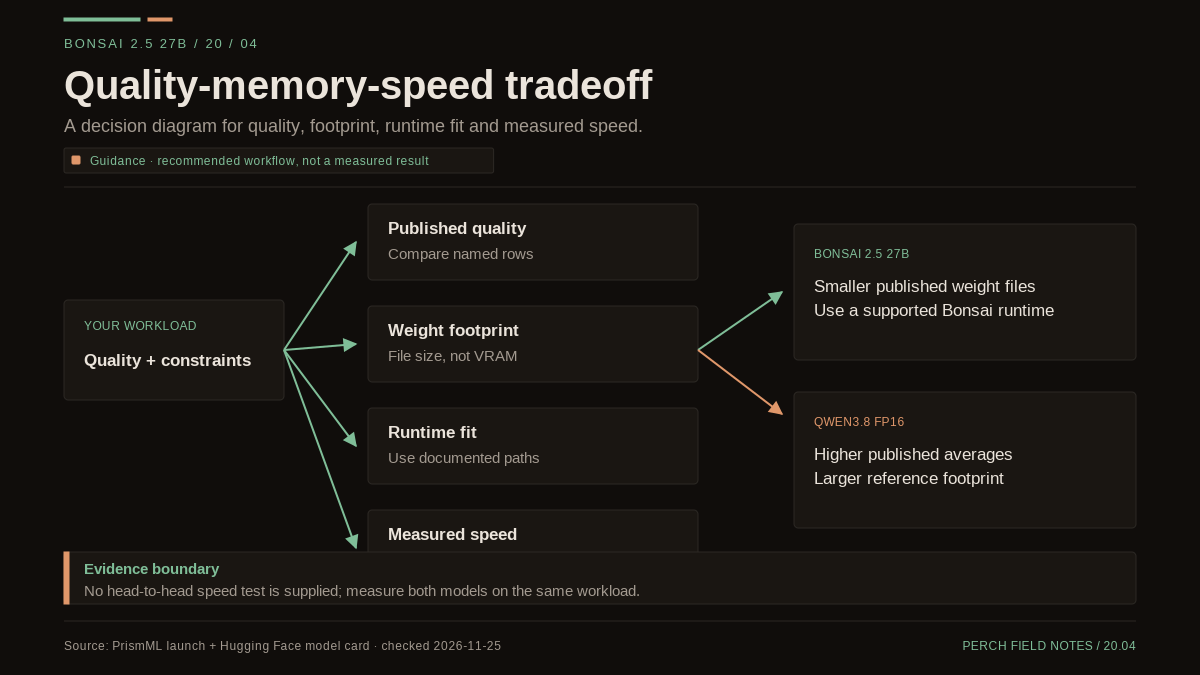
| Priority or constraint | First choice | Why | Tradeoff to accept |
|---|---|---|---|
| Highest published quality with ample memory | Qwen3.8 FP16 | Leads coding and every broad category | 53.8 GB reference weights plus runtime memory |
| Smallest Bonsai base file for offline use | Bonsai PTQ1_0 |
5.99 GB base weights and native tool support | Requires PrismML’s llama.cpp fork; coding average trails by 6.3 points |
| Stock llama.cpp or documented Ollama path | Bonsai Q2_0 |
7.67 GB base file and stock b11556+ support |
Larger than PTQ1_0; older builds may produce garbage |
| Higher generation rate experiment on NVIDIA | Bonsai MTP variant | Higher launch figures are attributed to MTP by ExplainX | About 0.24 GB extra and a vendor-warned 9 to 23 percent prefill penalty |
| Apple Silicon text-only workflow | Bonsai MLX export | Documented text-only local path | No vision through this export; no verified Mac speed guarantee |
| Local image input | Bonsai GGUF plus mmproj | Native image support and published projector files | Extra 0.63 GB or 0.93 GB projector; vision score trails FP16 |
| CPU-only deployment | Run a measured pilot | Bonsai CPU support is documented | No reliable CPU tok/s figure and no matched Qwen speed baseline |
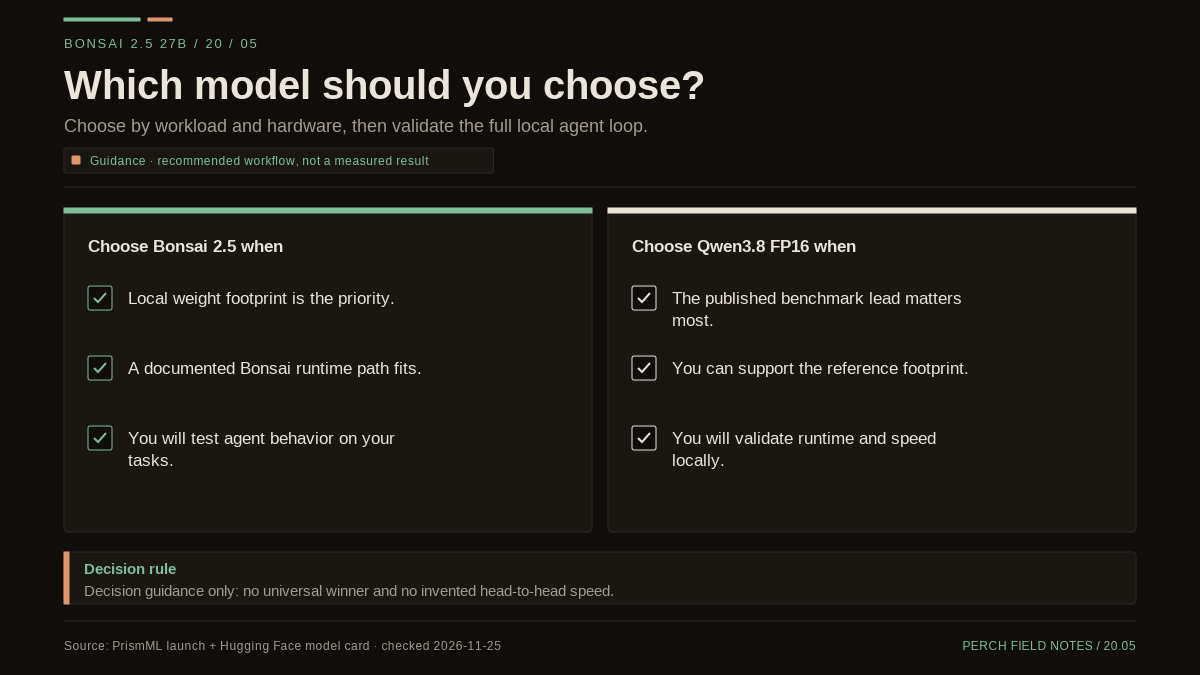
The final verdict is a tradeoff, not a universal winner. When compact weights, local control and offline agent execution justify accepting lower published coding and broad-capability scores, Bonsai 2.5 27B is the stronger fit. Qwen3.8 FP16 is the stronger fit when those published scores matter more than footprint. A quantized Qwen remains an evidence gap, not a straw man to defeat.
This comparison should be updated when independent benchmark reproductions, a defined quantized-Qwen artifact or matched throughput tests become available. For now, test both candidates on the same repository tasks, tool schemas, context budget and hardware before making a production decision.
This model is not currently a hosted One AI API Key model, and the supplied model card says no inference provider currently deploys it. If your actual requirement is hosted inference rather than local weights, compare hosted models currently available through One AI API Key instead of treating this local GGUF release as an API listing.
Sources
- PrismML: Bonsai 2.5 27B announcement supports the vendor benchmark tables, launch positioning, speed claims and offline pytest demo. It is not independent verification.
- Hugging Face: Ternary Bonsai 2.5 27B GGUF supports architecture details, exact file sizes, commands, runtime requirements, memory observations and provider status.
- PrismML: getting started supports the ternary vision-language description, tool and image support, Apache-2.0 licensing and documented llama.cpp, MLX and OpenAI-compatible paths.
- ExplainX: Bonsai 2.5 27B agentic coding overview is a third-party overview that states the vendor-run benchmark caveat and offers the MTP interpretation. Its relayed RTX 3060 claim is unverified.
- Hacker News discussion is a community pointer for the anecdotal Mac Mini M5 Pro speed report and skepticism, not benchmark evidence.
- LocalLLaMA discussion is an inconsistently accessible community pointer, not evidence for any quality, memory or speed claim.
Complete Bonsai 2.5 27B guide
- Bonsai 2.5 27B launch verdict and setup router
- row-by-row Bonsai 2.5 27B benchmark teardown
- 180-tool-call Bonsai coding-agent workflow
- Tau, BFCL and AppWorld tool-calling analysis
- SWE-bench Verified 75.6 repository-repair analysis
- Terminal-Bench 2.1 long-horizon terminal analysis
- PTQ1_0 and Q2_0 local installation walkthrough
- Ollama Q2_0 commands and coding-agent connection
- vLLM OpenAI-compatible Bonsai server setup
- Apple Silicon MLX setup for Bonsai 2.5 27B
- Bonsai VRAM and RAM worksheet by quantization
- cross-hardware Bonsai tokens-per-second comparison
- RTX 4090 Bonsai configuration and speed claims
- RTX 3060 12GB Bonsai feasibility and context tuning
- Mac Mini M5 Pro Bonsai setup and 22.3 tok/s audit
- CPU-only Bonsai setup and memory tuning
- 262K Bonsai context-window memory guide
- PTQ1_0 versus PQ2_0 versus Q2_0 quantization guide
- Bonsai vision mmproj setup and benchmark limits