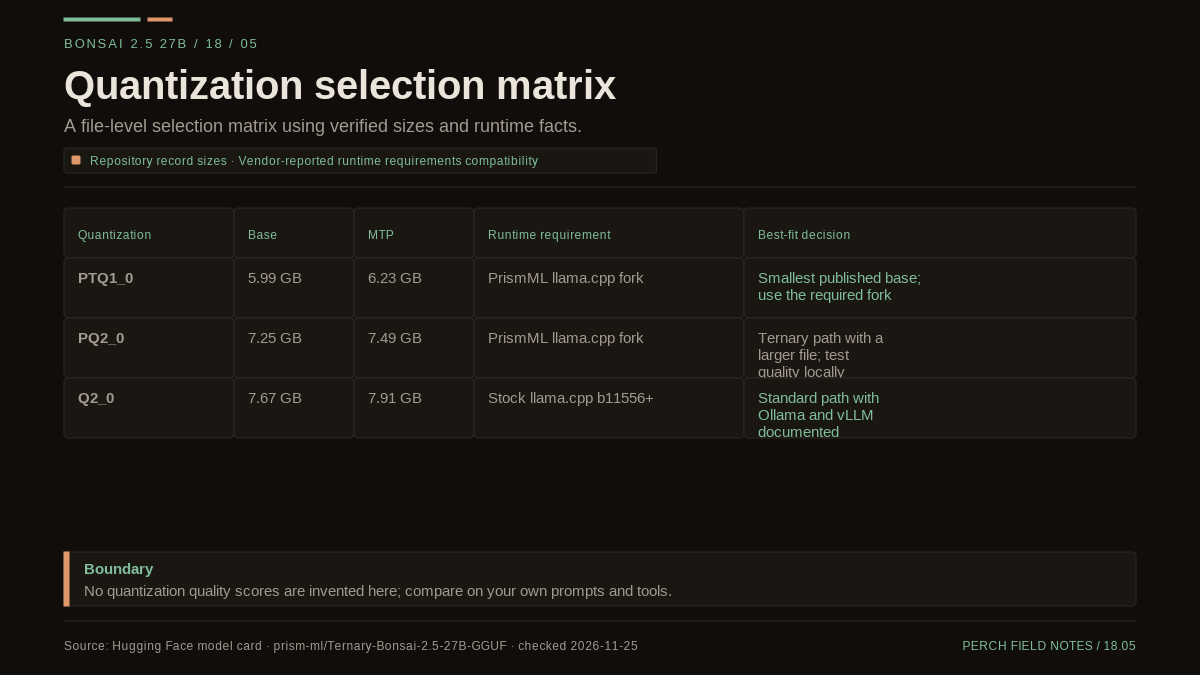
Choose PTQ1_0 for the smallest published base GGUF if you can run PrismML’s llama.cpp fork. For the documented stock llama.cpp route or the documented Ollama command, choose Q2_0. Treat PQ2_0 as a larger fork-only option, not as a proven quality upgrade: the supplied evidence does not publish a controlled PTQ1_0 versus PQ2_0 versus Q2_0 quality comparison.
Start with a base file before adding MTP. Each -mtp file adds about 0.24 GB, and PrismML warns that MTP can slow NVIDIA prefill by 9 to 23 percent. The correct choice is therefore a file-and-runtime decision, not a contest to find the smallest number in the filename.
The published Ternary Bonsai 2.5 27B GGUF repository lists six model files across three quantization families, plus separate vision projectors. All sizes below are rounded decimal GB from repository byte counts. They describe downloaded weights, not total VRAM or system memory; context, KV cache, runtime overhead, MTP and image input still need room.
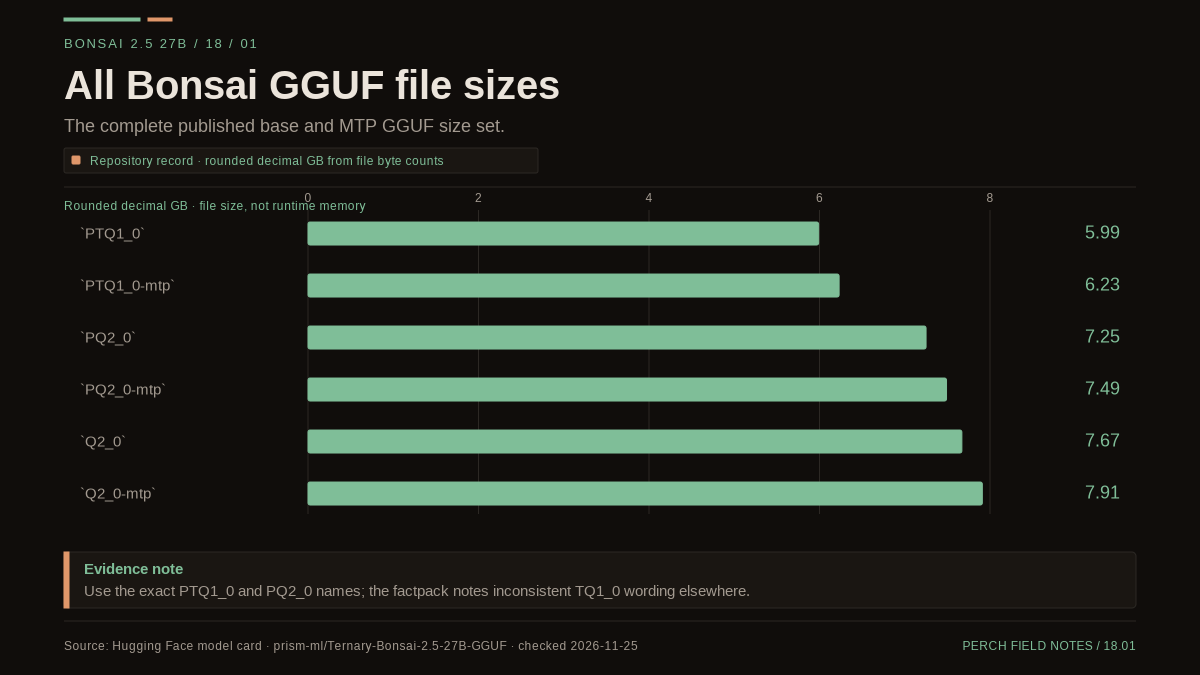
Which Bonsai 2.5 27B GGUF files are published?
Use the exact repository filename when downloading, scripting or reporting a problem. The model card’s compatibility material also uses the shorter name TQ1_0 and pairings that do not cleanly match the actual PTQ1_0 base and MTP filenames. Use the shorter name TQ1_0 as a cue to verify the artifact, not as permission to rename your local file.
All published GGUF files
| Exact filename | Role | Published size | Runtime boundary |
|---|---|---|---|
Ternary-Bonsai-2.5-27B-PTQ1_0.gguf |
PTQ1_0 base model | 5.99 GB | Requires PrismML’s llama.cpp fork |
Ternary-Bonsai-2.5-27B-PTQ1_0-mtp.gguf |
PTQ1_0 with MTP | 6.23 GB | Fork required; no universal MTP launch command is supplied |
Ternary-Bonsai-2.5-27B-PQ2_0.gguf |
PQ2_0 base model | 7.25 GB | Requires PrismML’s llama.cpp fork |
Ternary-Bonsai-2.5-27B-PQ2_0-mtp.gguf |
PQ2_0 with MTP | 7.49 GB | Fork required; no universal MTP launch command is supplied |
Ternary-Bonsai-2.5-27B-Q2_0.gguf |
Q2_0 base model | 7.67 GB | Documented route is stock llama.cpp b11556+ |
Ternary-Bonsai-2.5-27B-Q2_0-mtp.gguf |
Q2_0 with MTP | 7.91 GB | Use the matching runtime family; MTP selection is not shown by the base Ollama tag |
Ternary-Bonsai-2.5-27B-mmproj-BF16.gguf |
Optional BF16 vision projector | 0.93 GB | Separate image-input component, not a standalone text model |
Ternary-Bonsai-2.5-27B-mmproj-Q8_0.gguf |
Optional Q8_0 vision projector | 0.63 GB | Separate image-input component, not a standalone text model |
The base-file differences are straightforward arithmetic. PQ2_0 is 1.26 GB larger than PTQ1_0. Q2_0 is 0.42 GB larger than PQ2_0 and 1.68 GB larger than PTQ1_0. Those differences can matter for storage transfers and memory headroom, but they do not establish a quality ordering.
The marketed 5.9 GB footprint is also not an exact filename-size promise. PrismML’s launch announcement uses 5.9 GB-class language, while the repository’s rounded PTQ1_0 byte count is 5.99 GB. A running process needs more than either figure. The Bonsai VRAM and RAM worksheet by quantization separates weights from context and runtime costs without inventing a KV-cache byte table.
The two mmproj files belong to a different decision. Bonsai 2.5 27B is a vision-language model, but the projector is optional for text-only use. Add one only when your runtime and workflow support image input. The MLX export is text-only, so possession of a projector does not make that export multimodal. The Bonsai vision mmproj setup and benchmark limits covers the image path separately.
Should you choose PTQ1_0?
PTQ1_0 is the smallest published base option and the closest repository match to the compact-footprint pitch. Its exact base filename is Ternary-Bonsai-2.5-27B-PTQ1_0.gguf, at 5.99 GB. The MTP alternative is Ternary-Bonsai-2.5-27B-PTQ1_0-mtp.gguf, at 6.23 GB.
The hard requirement is PrismML’s llama.cpp fork. The supplied material does not document stock llama.cpp loading this family, so treat the fork as mandatory for PTQ1_0. If your deployment depends on an unmodified stock runtime, select Q2_0 instead.
PTQ1_0 makes sense when the smaller weight file leaves useful headroom for context, the operating system, a vision projector or other GPU work. It also makes sense when you already intend to use the PrismML fork and want the fewest moving parts in the initial download. The PTQ1_0 and Q2_0 local installation walkthrough provides the platform-specific path rather than mixing fork and stock instructions.
There is a concrete vendor speed table for plain-decode PTQ1_0: 186 generated tokens per second on an H100 and 112 on an RTX 4090. These are vendor-published figures, not independent tests, and they should not be merged with the higher launch-page numbers that ExplainX associates with MTP. The cross-hardware Bonsai tokens-per-second comparison explains why runtime, MTP state, context and prompt length must stay attached to every speed claim.
PTQ1_0 is not automatically the quality winner. The supplied model-level benchmarks do not identify a controlled quantization bake-off, and they omit evaluation hardware, prompts, scaffolds, seeds and independent reproduction. A smaller file is a verified footprint advantage. Better answers on your repository are a hypothesis to test, not a published result.
A clean baseline is worth protecting: choose the base PTQ1_0 file first. Add the MTP file only after you can measure both prompt processing and generation on representative work. For memory-constrained NVIDIA systems, the RTX 3060 12GB Bonsai feasibility and context tuning guide shows why file size alone cannot promise a given context window.
What is PQ2_0, and when does it make sense?
PQ2_0 sits between PTQ1_0 and Q2_0 in published size. Ternary-Bonsai-2.5-27B-PQ2_0.gguf is 7.25 GB, while Ternary-Bonsai-2.5-27B-PQ2_0-mtp.gguf is 7.49 GB. Both require PrismML’s llama.cpp fork. Stock llama.cpp does not provide the documented compatibility path for this family.
The important distinction is between a published option and a demonstrated improvement. PQ2_0 is unquestionably a published fork-compatible file. The supplied evidence does not show that it outperforms PTQ1_0 on the same prompts, runtime build, context and sampling settings. It also does not show that Q2_0 is a quality substitute for it merely because Q2_0 has a familiar name.
PQ2_0 is therefore a conditional choice. It can be reasonable when you have already committed to the PrismML fork, can accommodate the extra 1.26 GB over base PTQ1_0, and have a workload-specific reason to evaluate it. Those reasons might include an existing internal comparison or a reproducibility requirement. An assumed rule that every larger low-bit file must be better is not among them.
The same caution applies to MTP. Selecting PQ2_0-mtp changes two variables at once if your reference run uses base PTQ1_0: the quantization family and the presence of the MTP head. Such a result is hard to interpret. Compare base PQ2_0 with base PTQ1_0 first, then test MTP within the chosen family.
Do not confuse the separate MLX export with a PQ2_0 GGUF runtime. The documented Apple Silicon artifact is prism-ml/Ternary-Bonsai-2.5-27B-mlx-2bit, and it is text-only. The Apple Silicon MLX setup for Bonsai 2.5 27B covers that route without claiming that MLX loads these GGUF files or accepts the vision projector.
A sensible PQ2_0 evaluation is narrow: keep the task set, runtime version, context, output allowance and sampling configuration fixed; run the base file; inspect correctness rather than fluency alone; then repeat with the matching MTP file if generation speed is the question. This is a proposed test method, not a claim that such a comparison has already been published.
When should you choose Q2_0?
Q2_0 is the clearest choice when runtime compatibility matters more than saving the last 1.68 GB relative to PTQ1_0. The base artifact is Ternary-Bonsai-2.5-27B-Q2_0.gguf at 7.67 GB. The MTP artifact is Ternary-Bonsai-2.5-27B-Q2_0-mtp.gguf at 7.91 GB.
The documented stock requirement is llama.cpp b11556 or newer. Older stock builds may load Q2_0 without an obvious warning and then produce garbage output. Treat coherent output as a verification step, not as proof that any build exposing the filename is adequate. Record the runtime version alongside the exact GGUF when you report a problem.
Q2_0 also has the documented Ollama route:
ollama run hf.co/prism-ml/Ternary-Bonsai-2.5-27B-GGUF:Q2_0That command selects the base Q2_0 tag. The supplied material does not give an equivalent MTP-specific Ollama command, so do not assume that editing the tag name correctly activates the MTP file. The Ollama Q2_0 commands and coding-agent connection guide keeps the base route and the MTP uncertainty separate.
The model card also gives a repository-level vLLM command:
vllm serve "prism-ml/Ternary-Bonsai-2.5-27B-GGUF"This establishes a documented serving route, but the supplied command does not show a per-file quantization selector. Verify which artifact your installed vLLM path resolves before treating it as a controlled Q2_0, PQ2_0 or PTQ1_0 deployment. The vLLM OpenAI-compatible Bonsai server setup covers endpoint use and concurrency without inventing flags or throughput.
Q2_0’s practical advantage is compatibility, not a published quality crown. If stock llama.cpp is already part of your workflow, the extra download size may be a fair trade for avoiding a custom fork. If you have only a narrow memory margin, PTQ1_0 may be the better starting point, subject to actual measurement.
For a first coding check, use a repository issue whose correct behavior you can verify. Reasoning defaults to xhigh; medium is available, while low is unsupported and behaves like xhigh. Thinking is on by default, and a short output cap can truncate the reasoning trace before the final answer. Keep those model behavior details constant when comparing files. The 180-tool-call Bonsai coding-agent workflow provides a bounded way to inspect patches and tool use.
What do the MTP variants change?
Each quantization family has a matching -mtp file. The size increase is approximately 0.24 GB in all three cases: PTQ1_0 moves from 5.99 to 6.23 GB, PQ2_0 from 7.25 to 7.49 GB, and Q2_0 from 7.67 to 7.91 GB. MTP is therefore a separate layer on top of the base-file decision.
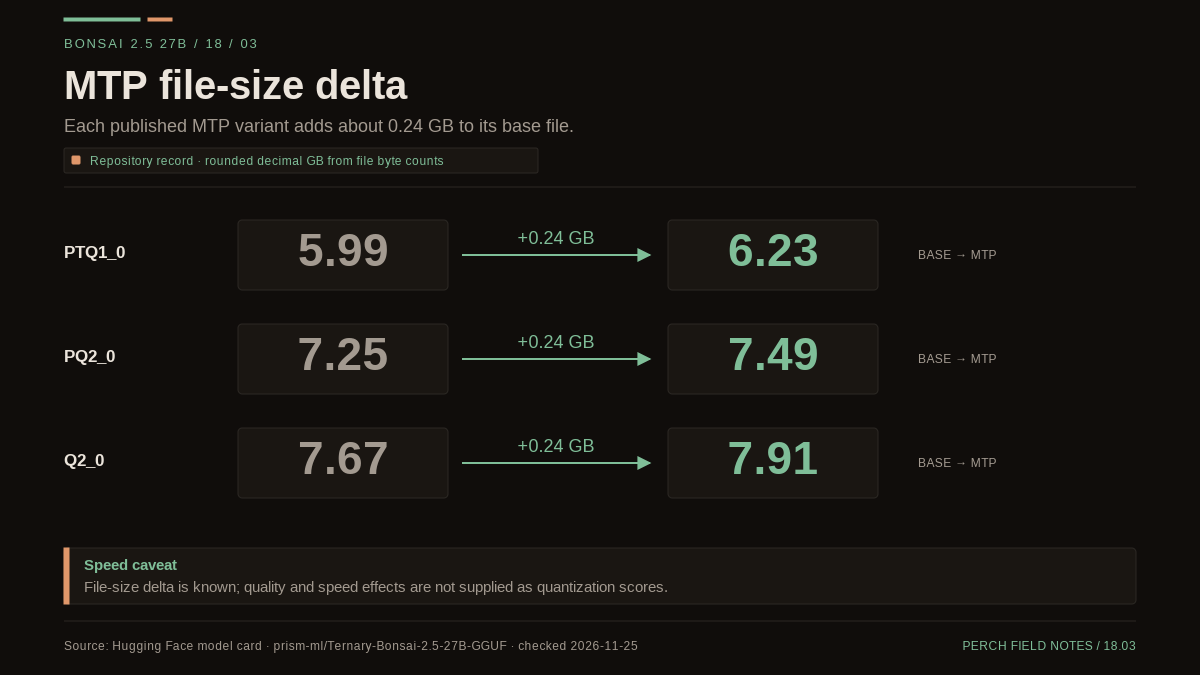
The published rationale is faster decoding. PrismML’s model card warns, however, that MTP can slow NVIDIA prefill by 9 to 23 percent because the additional head does its own prompt pass. An MTP file is therefore not a universal throughput upgrade. A workload with long prompts and short answers can experience a different balance from one with shorter prompts and long generated outputs.
The speed figures illustrate the danger of comparing unlike configurations. The launch page claims 291 generated tokens per second and 3,200 prompt tokens per second on an H100, plus 204 generated tokens per second and about 3,060 prompt tokens per second on an RTX 4090. The model card’s plain-decode PTQ1_0 table instead lists 186 on H100 and 112 on RTX 4090. ExplainX’s Bonsai 2.5 27B overview attributes the higher launch generation figure to MTP, but these remain vendor claims without a common disclosed configuration.
Do not convert that attribution into a guaranteed 1.5 times speedup for your application. Prompt length, acceptance of drafted tokens, context, backend and runtime build all matter. Synthetic decode numbers also do not establish agent-loop latency, which includes prompt processing, tool execution, test time and review.
MTP file selection is not the same as documented MTP activation. The supplied model-card commands show base PTQ1_0 and base Q2_0 routes. No universal command covers all three MTP files and every serving wrapper. Follow the exact runtime’s current MTP instructions, and verify that the loaded artifact is the -mtp filename before measuring it.
For an RTX 4090, the RTX 4090 Bonsai configuration and speed claims guide is the appropriate place to examine the launch figure and plain-decode figure together. For any hardware, measure prompt speed and generation speed separately. A higher generation number accompanied by slower prefill may still be useful, but it is a different tradeoff rather than a free gain.
Which runtimes support each Bonsai quantization?
The base-file rule comes first: PTQ1_0 and PQ2_0 require PrismML’s llama.cpp fork; Q2_0 has a documented stock llama.cpp b11556+ route. Apply the matching family requirement to its -mtp variant, then check whether the serving wrapper exposes the needed MTP behavior.
Runtime compatibility by quantization family
| Runtime or route | PTQ1_0 | PQ2_0 | Q2_0 | Evidence boundary |
|---|---|---|---|---|
| PrismML llama.cpp fork | Required | Required | Not the required stock route | Vendor specifies the fork for PTQ1_0 and PQ2_0; use the stock instructions for Q2_0 |
Stock llama.cpp b11556+ |
Requires the PrismML fork | Requires the PrismML fork | Supported at b11556+ |
Older stock builds may load Q2_0 but produce garbage |
| Ollama | Not documented | Not documented | Documented :Q2_0 command |
No equivalent MTP-specific Ollama command is supplied |
| vLLM | Per-file support not established | Per-file support not established | Repository-level command documented | The supplied command does not expose a per-file quantization selector |
| MLX Python or Swift | Not a GGUF loading route | Not a GGUF loading route | Not a GGUF loading route | Separate mlx-2bit export is text-only |
| CUDA, Metal, CPU and SYCL | Vendor-listed backend families | Vendor-listed backend families | Use a compatible stock build | No controlled per-backend quantization speed table is supplied |
PrismML’s llama.cpp fork is the compatibility pivot. The model card gives this exact clone and CUDA build sequence:
git clone https://github.com/PrismML-Eng/llama.cpp && cd llama.cpp
cmake -B build -DGGML_CUDA=ON && cmake --build build -j
The CUDA flag belongs to that example. Do not copy it unchanged to a Metal, CPU or SYCL system and assume the result is correct. The local installation walkthrough is the better route for platform prerequisites and troubleshooting.
For file acquisition, the model card supplies these exact base-file commands:
hf download prism-ml/Ternary-Bonsai-2.5-27B-gguf Ternary-Bonsai-2.5-27B-PTQ1_0.gguf --local-dir .
hf download prism-ml/Ternary-Bonsai-2.5-27B-gguf Ternary-Bonsai-2.5-27B-Q2_0.gguf --local-dir .
Notice the lowercase gguf in the hf download repository argument and the uppercase GGUF in the Hugging Face page URL. Preserve the command as documented rather than normalizing case by guesswork. These acquisition commands identify artifacts; they are not a replacement for a complete platform build guide.
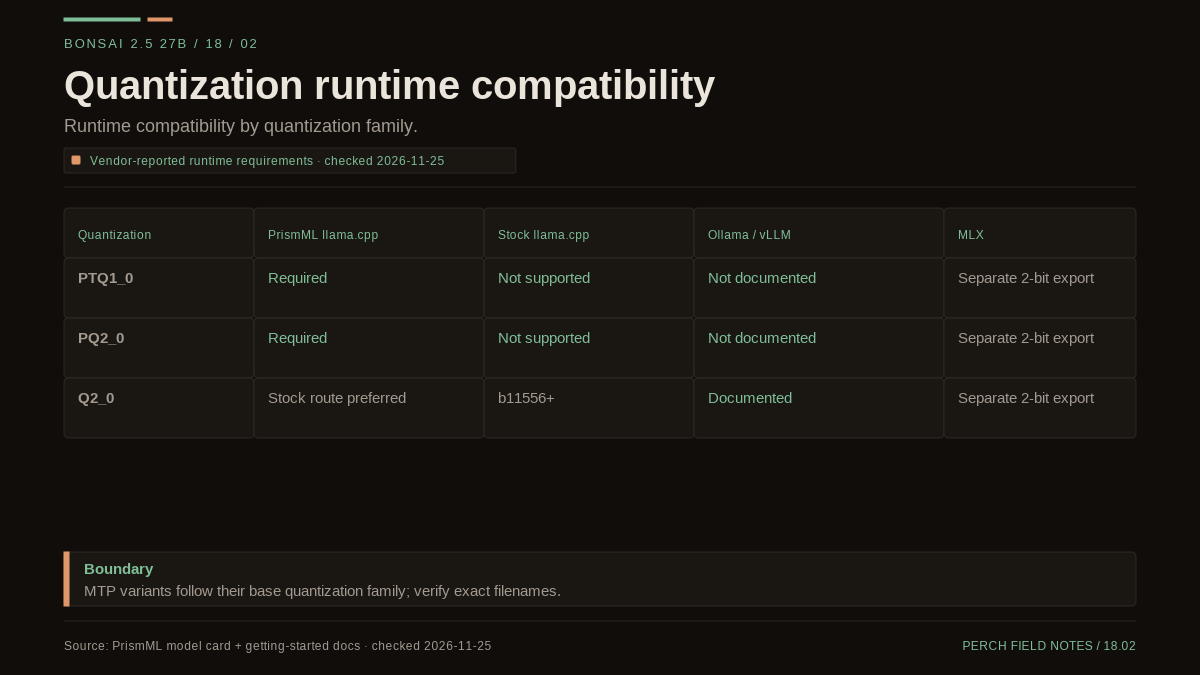
The PrismML getting-started documentation describes llama.cpp, MLX and OpenAI-compatible serving as documented paths. It does not make every GGUF interchangeable across those paths. CUDA, Metal, CPU and SYCL are listed backend families, not evidence that each backend has been benchmarked with every quantization and MTP combination.
CPU inference is documented, but no reliable CPU-only tokens-per-second figure is supplied. For CPU, plan the configuration around available system memory and measured prompt behavior, not around an invented speed estimate. The CPU-only Bonsai setup and memory tuning guide starts with that limitation explicitly.
A Hexagon preset also exists, but PrismML says the Galaxy S26 Ultra configuration requires an unreleased fix. No current compatibility promise comes with it. Likewise, a runtime loading a file successfully is not enough: verify coherent output, the expected filename, the runtime version and the intended MTP state.
Which GGUF should you download? A selection checklist
Work through these checks in order. The purpose is to prevent the most common file-level mistakes: choosing a quantization before choosing a runtime, treating MTP as free, or budgeting only for the downloaded weights.
- Name the runtime first. If it is stock llama.cpp, plan around Q2_0 and confirm
b11556+. If it is PrismML’s fork, PTQ1_0 and PQ2_0 are available. If it is Ollama, use the documented base Q2_0 tag. If it is MLX, leave the GGUF decision and use the separate text-only export. - Choose a base file before an MTP file. Establish that the base model loads, generates coherent text and completes your task. Only then measure whether the matching MTP artifact improves the workload enough to justify its size and prefill tradeoff.
- Budget beyond the weight file. Include the selected context, KV cache, runtime, other GPU work and any agent history. Add a projector only for image input. No exact KV-cache byte table is supplied, so measure resident memory instead of inventing one.
- Decide whether compatibility or footprint is the tighter constraint. PTQ1_0 saves 1.68 GB over Q2_0 but requires the fork. Q2_0 costs more disk space and provides the documented stock route. PQ2_0 costs 1.26 GB more than PTQ1_0 without a published quality advantage.
- Verify the loaded artifact. Record the full filename, runtime version, backend, context length and MTP state. A friendly model name in a client does not prove which local file produced the answer.
- Test quality on tasks with known answers. Keep prompts, output allowance and sampling settings fixed where the runtime permits. For coding work, inspect the patch, run relevant tests and review unintended changes. Fluency alone is not a quantization evaluation.
Selection matrix
| Your constraint or goal | Recommended starting point | Why | What to verify before committing |
|---|---|---|---|
| Smallest published base GGUF | PTQ1_0 base, 5.99 GB | Lowest listed weight footprint | PrismML fork availability and actual runtime memory |
| Stock llama.cpp workflow | Q2_0 base, 7.67 GB | Documented stock route | llama.cpp b11556+ and coherent output |
| Documented Ollama workflow | Q2_0 base :Q2_0 |
Exact base command is supplied | Resolved artifact; do not infer MTP from an edited tag |
| Fork available and PQ2_0 evaluation required | PQ2_0 base, 7.25 GB | Published fork-compatible option | Workload-specific result against base PTQ1_0 |
| Generation speed is the priority | Matching base or MTP family | MTP may improve decode | Separate prompt and generation timing on real prompts |
| Long prompts or prefill-heavy agent work | Base file first | MTP can slow NVIDIA prefill by 9 to 23 percent | End-to-end task time, not decode alone |
| Image input through a compatible GGUF path | Supported base GGUF plus one mmproj |
Vision uses a separate projector | Runtime image support; MLX export is text-only |
| CPU-only or tight-memory system | PTQ1_0 base if the fork is acceptable | Smallest listed base file | System RAM, measured memory and acceptable latency |
| vLLM serving | Documented repository command, then verify artifact | Serving route is published | Exact GGUF resolved by the installed setup |
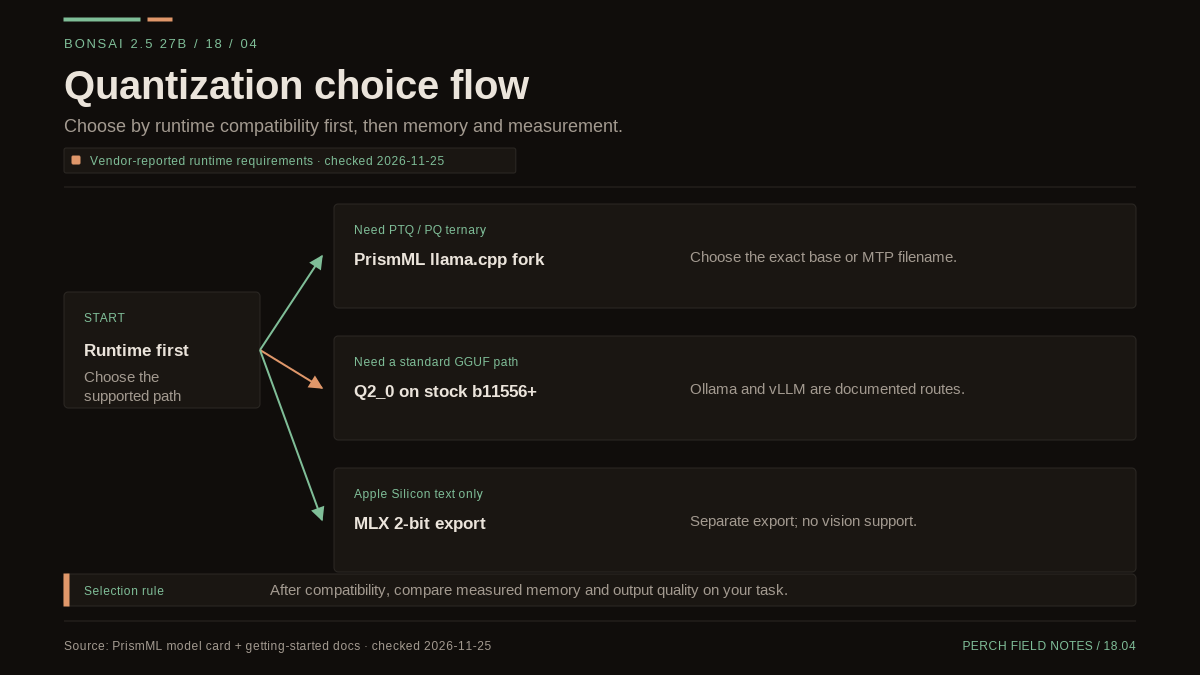
The 262K Bonsai context-window memory guide is essential if long context is part of the selection. A 262,144-token documented context does not mean every GPU can allocate it with every file. Repository retrieval, bounded tool output and summarization can be better choices than maximizing the context allocation.
What quality tradeoffs are actually known?
The known tradeoffs are file size, runtime compatibility, optional MTP overhead and the possibility of changed prefill performance. The unknown tradeoff is the relative answer quality of PTQ1_0, PQ2_0 and Q2_0 under controlled conditions. No supplied source provides a reproducible head-to-head quantization quality table. That absence matters because the model’s published benchmark scores are not per-quantization results. PrismML reports a tool-calling average of 77.2, a coding average of 54.2 and a broad average of 82.12 for Bonsai 2.5 27B. Against Qwen3.8 FP16, the coding average is 6.3 points lower, Terminal-Bench 2.1 is 10.7 points lower, SWE-bench Verified is 5.0 points lower and the broad average is 2.20 points lower. These are vendor-published model-level results, not independent reproductions and not evidence that one Bonsai GGUF preserves those scores better than another.
The row-by-row Bonsai 2.5 27B benchmark teardown documents the missing hardware, prompts, scaffolds, seeds, weighting and confidence intervals. The Bonsai 2.5 27B versus Qwen3.8 27B decision matrix provides the broader model comparison. Neither source fills the quantization-specific gap.
Community reports do not close it. The Hacker News discussion includes an anecdotal 22.3 tokens-per-second Mac Mini M5 Pro report with incomplete configuration. It is useful as a pointer for further testing, not a benchmark. The LocalLLaMA Hugging Face thread is an inconsistently accessible community pointer and is not used as evidence for any compatibility or quality claim here.
We will revisit this file-level guide when PrismML publishes a controlled comparison that names the exact GGUFs, runtime builds, hardware, prompts, decoding settings and quality metric. Until then, the honest position is to recommend by verified footprint and compatibility, then require a local evaluation for quality. No CPU throughput, exact KV-cache size or independent quantization score should be added to the decision without new evidence.
Which quantization is the final recommendation?
For a footprint-first user who can maintain the PrismML fork, start with Ternary-Bonsai-2.5-27B-PTQ1_0.gguf. It is the smallest published base file at 5.99 GB and avoids adding MTP variables before the basic runtime is proven.
For a compatibility-first user who wants stock llama.cpp or the documented Ollama experience, start with Ternary-Bonsai-2.5-27B-Q2_0.gguf. Confirm llama.cpp b11556+, verify coherent output and measure memory at the context length you actually plan to use.
Choose Ternary-Bonsai-2.5-27B-PQ2_0.gguf only when the fork is already acceptable and you have a specific evaluation reason. Its 7.25 GB size is verified; a quality advantage over PTQ1_0 is not. Add a matching -mtp file only after separate prompt and generation measurements show a benefit for your workload.
Bonsai 2.5 27B is a local GGUF release, not a currently hosted One AI API Key model. If your decision is actually about hosted access rather than local file compatibility, compare hosted models currently available through One AI API Key. The catalogue is separate from this repository and should not be read as an inference-provider listing for Bonsai.
Complete Bonsai 2.5 27B guide
- Bonsai 2.5 27B launch verdict and setup router
- row-by-row Bonsai 2.5 27B benchmark teardown
- 180-tool-call Bonsai coding-agent workflow
- Tau, BFCL and AppWorld tool-calling analysis
- SWE-bench Verified 75.6 repository-repair analysis
- Terminal-Bench 2.1 long-horizon terminal analysis
- PTQ1_0 and Q2_0 local installation walkthrough
- Ollama Q2_0 commands and coding-agent connection
- vLLM OpenAI-compatible Bonsai server setup
- Apple Silicon MLX setup for Bonsai 2.5 27B
- Bonsai VRAM and RAM worksheet by quantization
- cross-hardware Bonsai tokens-per-second comparison
- RTX 4090 Bonsai configuration and speed claims
- RTX 3060 12GB Bonsai feasibility and context tuning
- Mac Mini M5 Pro Bonsai setup and 22.3 tok/s audit
- CPU-only Bonsai setup and memory tuning
- 262K Bonsai context-window memory guide
- Bonsai vision mmproj setup and benchmark limits
- Bonsai 2.5 27B versus Qwen3.8 27B decision matrix
Sources
- PrismML’s Bonsai 2.5 27B announcement supports the launch framing, 5.9 GB-class footprint claim, model-level benchmark tables and vendor throughput claims.
- The Ternary Bonsai 2.5 27B GGUF model card supports exact filenames, rounded sizes, fork and stock-runtime requirements, MTP prefill warning, commands, memory example and provider status.
- PrismML’s getting-started documentation supports the documented llama.cpp, MLX and OpenAI-compatible paths, including the text-only MLX boundary.
- ExplainX’s Bonsai 2.5 27B agentic coding overview supports the third-party summary, vendor-run benchmark caveat and MTP interpretation of the higher launch generation figures.
- The Hacker News discussion supports community questions and the anecdotal Mac Mini report only, not independent benchmark or compatibility verification.
- The LocalLLaMA discussion is an inconsistently accessible community pointer. It is not used as evidence.