GLM-5.4 enters a frontier field that is unusually crowded and unusually well measured. GPT-6.2 Astra, Claude Opus 5.5 and Gemini 4 Neon all have published index scores, published token prices and published input modality lists. GLM-5.4 has none of those three things yet, which makes a direct comparison partly a comparison of a model against a set of numbers. That is not a reason to skip the exercise. It is a reason to be clear about what is measured and what is not, because the honest position for GLM-5.4 is easy to state and easy to overstate.
The position is this. GLM-5.4 is the strongest open model in the one independent run available, it sits behind the closed flagships on the measured index because it has no index entry at all, and its value case against them depends entirely on a token price Z.ai has not published. Here is how that breaks down model by model.
Where GLM-5.4 ranks on the measured index
The Artificial Analysis Intelligence Index v5.0.1 is the cleanest single number for placing these models, and it is the number to start from. GLM-5.4 has no entry, so its rank is unmeasured there. The models that do have entries, at their top reasoning settings, score:
| Model | AA Intelligence Index v5.0.1 (Max) |
|---|---|
| GPT-6.2 Astra Max | 62 |
| Gemini 4 Neon Xhigh | 61 |
| Claude Opus 5.5 Max | 59 |
| Kimi K3.1 Pro | 46 |
| DeepSeek V4.1 Flash 1017 Max | 33 |
| GLM-5.3 Max | 32 |
| GLM-5.3-Flash | 28 |
| GLM-5.4 | not listed |
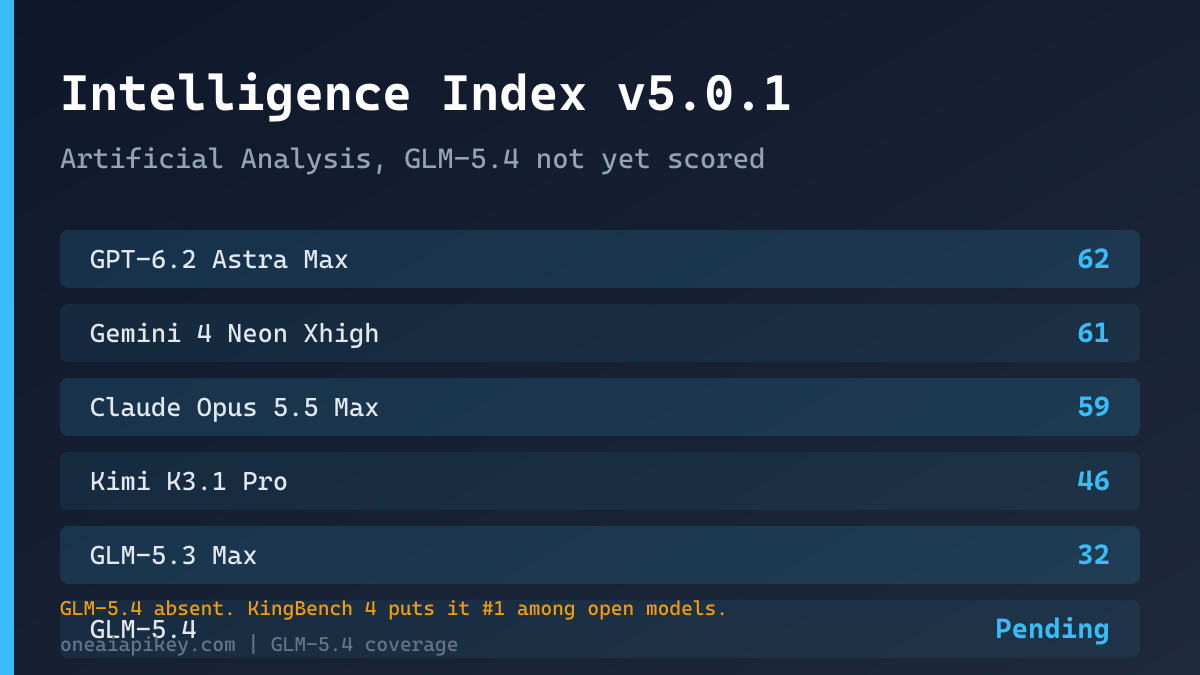
The closed flagships cluster between 59 and 62. That is a tight band at the top, and it is well clear of the open pack, which starts with Kimi K3.1 Pro at 46 and drops to the GLM-5.3 generation around 28 to 32. The nearest anchor for GLM-5.4 is GLM-5.3 at 32. If GLM-5.4 meaningfully improves on its predecessor, it moves up that lower cluster. There is no published evidence it closes the 27-point gap to Claude Opus 5.5, and nobody should claim it does until there is a score.
Why no entry? Because the index measures models it can route, and GLM-5.4 is only available to GLM Coding Plan subscribers. It is not on the pay-as-you-go API, so the index maintainers cannot call it. The entry arrives when access widens, not before. Our GLM-5.4 benchmarks piece covers this absence in full, and the index gap is the single clearest expression of it.
The tight 59-to-62 band at the top is worth a note of its own, because it says something about how the field is shaped. Three closed models from three different labs sit within three points of each other. That is close enough that differences in evaluation methodology, or a single strong sub-task, could reorder them. It also means the top of the index is not a ladder with clear rungs. It is a cluster. When GLM-5.4 eventually gets a score, the more meaningful question may not be whether it reaches that cluster but where it lands in the much more spread-out open tier beneath it.
The one head-to-head GLM-5.4 does have: the Neon comparison
There is a single independent benchmark run for GLM-5.4, and it is the reason to think the model is competitive rather than a reason to rank it against the closed flagships. AICodeKing ran it through his KingBench 4 harness and placed it seventh overall, first among open models, at 55.3%, calling it the “best open model you can use right now” in his launch coverage. That is covered in detail in GLM-5.4 KingBench 4.
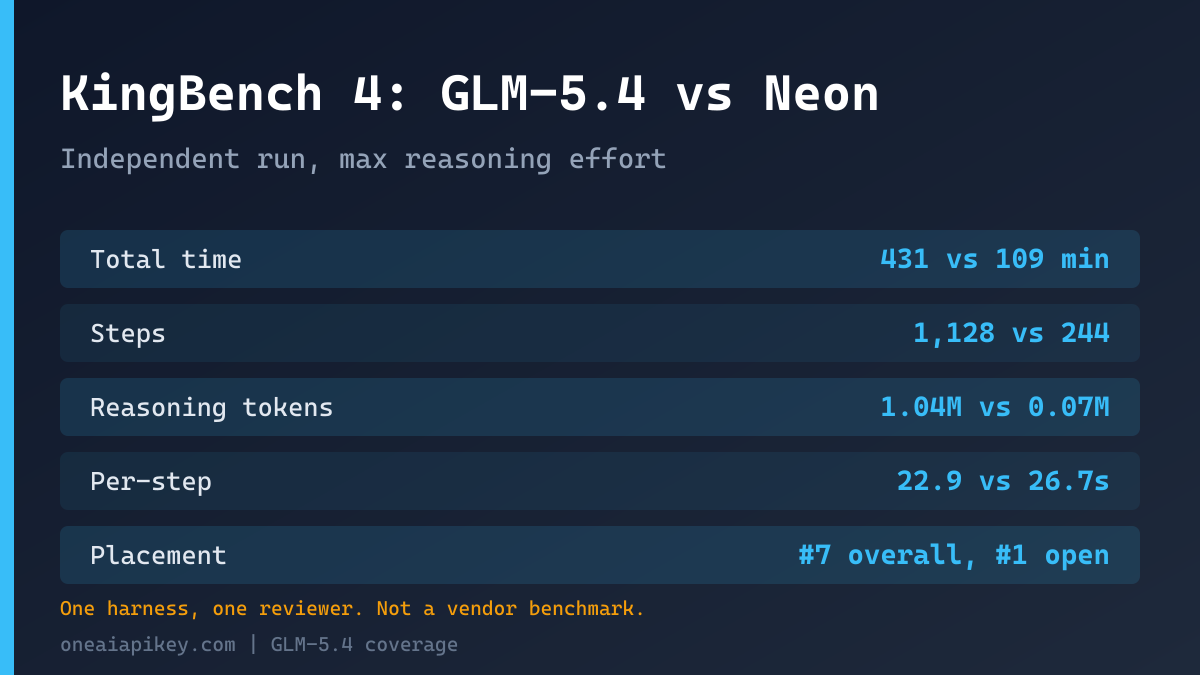
The most relevant part of that run for a frontier comparison is that the comparator, which AICodeKing calls Neon, is a Google model, and the head-to-head numbers are unusually revealing. GLM-5.4 was about four times slower at maximum reasoning effort, 431 minutes to Neon’s 109. But its per-step speed was actually faster: 22.9 seconds per step against Neon’s 26.7. GLM-5.4 got to a comparable place by taking far more, individually quicker, steps.
| KingBench 4 metric | GLM-5.4 | Neon (comparator) |
|---|---|---|
| Total time (max effort) | 431 min | 109 min |
| Per-step speed | 22.9s | 26.7s |
| Reasoning steps | 1,128 | 244 |
| Reasoning tokens | ~1.04M | ~0.07M |
| Steps with near-zero reasoning | under 1% | GPT models 14 to 39% |
That is a strange and specific result, and it is worth reading carefully rather than flattening into “GLM-5.4 is slower.” On a per-decision basis GLM-5.4 was the quicker of the two. It finished four times later because it chose to think four times as much, taking 1,128 steps to Neon’s 244 and generating about fifteen times the reasoning tokens, roughly 1.04 million against 70,000. TheBlockBeats picked up exactly that framing for its audience, reporting that “reasoning tokens nearly 15x more than Google’s Neon” was the defining feature of the seventh-place result.
So the honest head-to-head against Neon is that GLM-5.4 is not slower at thinking, it is more expensive in total compute to reach an answer. On a benchmark like KingBench 4 that extra thinking bought a first-among-open-models placement and, in AICodeKing’s read, a model that catches “bugs and security vulnerabilities that competitors missed.” Whether that trade is worth it depends entirely on the task. For a security review where finding the subtle bug is the whole point, four times the wall-clock time in exchange for deeper reasoning may be a good deal. For a bulk generation task it would not be. Our GLM-5.4 coding performance piece covers that trade in depth.
It is important not to over-read this as a GLM-5.4 versus Gemini 4 Neon verdict. KingBench 4 is one coding and agentic harness run by one reviewer, not the multi-domain evaluation behind the Artificial Analysis index, and the “Neon” comparator in KingBench is not the same measurement as Neon’s index score of 61. What the head-to-head does establish is a behavioral contrast: against a closed Google model on the same tasks, GLM-5.4 thinks deeper and slower rather than shallower and faster, and it placed first among open models doing it.
Pricing: the axis where GLM-5.4 is a blank
Price is where the frontier comparison becomes concrete, because the closed flagships all have published rates and GLM-5.4 does not. Per 1 million tokens:
| Model | Input | Output |
|---|---|---|
| DeepSeek V4.1 Flash 1017 | $0.15 / $0.60 off-peak | $0.30 / $1.20 peak |
| GLM-5.3-Flash | $0.15 | $0.50 |
| GLM-5.3 | $1.40 | $4.40 |
| Kimi K3.1 Pro | $2 | $10 |
| Gemini 4 Neon | $3 | $15 |
| Claude Opus 5.5 | $4 | $20 |
| GPT-6.2 Astra | $8 (≤272K) / $16 above | $40 (≤272K) / $60 above |
| GLM-5.4 | not published | not published |
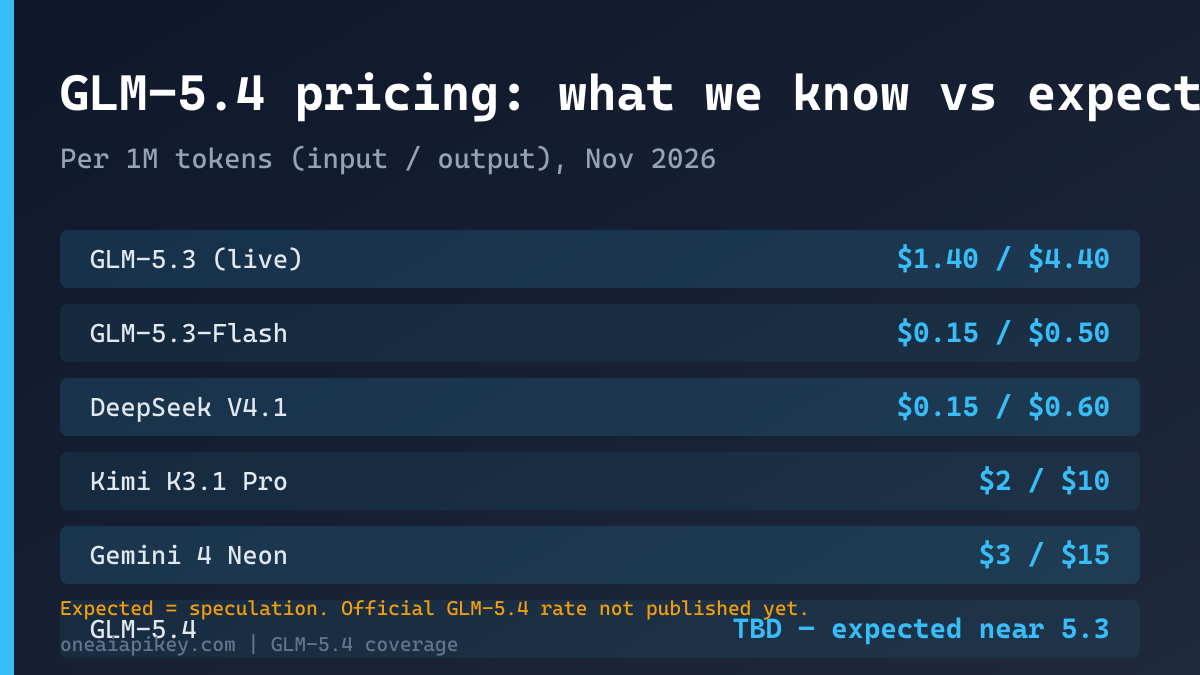
GLM-5.3, at 1.40 in and 4.40 out, sits in the value tier, well below Gemini 4 Neon at 3 and 15, below Claude Opus 5.5 at 4 and 20, and far below GPT-6.2 Astra at 8 and 40. If GLM-5.4 is priced like its predecessor, it is the cheapest of the four by a wide margin, and its value case against the closed flagships is straightforward. If it is priced higher, that case weakens. Nobody knows, because there is no rate-card entry. Our GLM-5.4 pricing and quota piece tracks the gap, and the GPT-6.2 Astra pricing and Gemini 4 Neon pricing guides set the frontier rates side by side.
This section will be updated once Z.ai publishes the official GLM-5.4 token price. Based on Z.ai’s pricing history, GLM-5.1, 5.2 and 5.3 all launched at 1.40 dollars input and 4.40 output per million tokens, and Z.ai held that flagship anchor flat across three generations, so a reasonable expectation is that GLM-5.4 lands at or near 1.40 and 4.40 when it reaches the pay-as-you-go API. That is inference from Z.ai’s own track record, not an announced price, and no analyst has published a numeric GLM-5.4 prediction. Until the rate card updates, the value case against the closed flagships is a hypothesis, not a fact.
The pricing hole interacts with GLM-5.4’s known profile in a way that matters. A model that generates a million reasoning tokens on a hard task is a model whose output-token price dominates the bill if it is metered like GLM-5.3. The Coding Plan quota may absorb that for subscribers, which is the one group that can use the model today. Anyone waiting on pay-as-you-go access is waiting on a number that decides whether GLM-5.4 competes on value or only on capability.
Modalities: GLM-5.4 catches up, Gemini still leads
Input modality is a clearer comparison because more of it is known. GLM-5.3 was text-only at the flagship tier, with image input reserved for the smaller GLM-5.3-Flash. GLM-5.4 adds image input at the flagship for the first time, which closes a real gap with the closed flagships. Both GPT-6.2 Astra and Claude Opus 5.5 accept text and image. Gemini 4 Neon goes further, accepting text, image, video, audio and PDF, and our Gemini 4 Neon launch piece covers that breadth.
| Model | Input modalities |
|---|---|
| GLM-5.4 | text, image (formats and size limits not documented) |
| GLM-5.3 | text only |
| DeepSeek V4.1 | text, image |
| Kimi K3.1 Pro | text, image |
| Claude Opus 5.5 | text, image |
| GPT-6.2 Astra | text, image |
| Gemini 4 Neon | text, image, video, audio, PDF |
GLM-5.4 now matches the OpenAI, Anthropic, DeepSeek and Kimi models on modality, and trails Gemini 4 Neon, which is the most multimodal of the set. Two caveats apply. Z.ai has not documented the supported image formats or size limits for GLM-5.4, and there is no published vision benchmark, so capability within that input list is unmeasured. No third party has tested GLM-5.4’s vision yet, and AICodeKing’s KingBench 4 run did not cover it. Our GLM-5.4 vision piece covers what the new input unlocks and what is still unknown.
Weights: GLM-5.4’s potential advantage over the closed three
The clearest structural difference between GLM-5.4 and the closed flagships is weights, and it is the one place GLM-5.4 could hold a lasting advantage. GPT-6.2 Astra, Claude Opus 5.5 and Gemini 4 Neon are all closed. GLM-5.3 shipped with open weights under a custom license, and the smaller GLM-5.3-Flash shipped under MIT. GLM-5.4 has no published weights as of launch, so whether it inherits that openness is unknown.
The community is not assuming it. One reply to the launch coverage, from @teortaxesTex, asked simply “will it be open though?”, which reflects a reasonable skepticism about a flagship that launched plan-only. Our GLM-5.4 open weights piece tracks the question, GLM-5.4 self-hosting covers what changes if the weights go public, and GLM-5.4 alternatives covers the open models already shipping, including DeepSeek V4.1 which is MIT licensed.
If Z.ai open-sources GLM-5.4, it becomes the only flagship-tier model in this comparison that can be self-hosted, audited and fine-tuned, and that is a category the closed three cannot enter at any price. That is the structural card GLM-5.4 holds. It is unconfirmed, but it is the one axis where GLM-5.4 could beat all three closed models on something they cannot match regardless of score.
Against each closed flagship individually
Because the three closed models are not interchangeable, it is worth taking them one at a time.
Against GPT-6.2 Astra, GLM-5.4 is the clear underdog on measured capability. Astra Max sits at 62 on the index, the top of the field, and it has the highest price to match at 8 dollars per million input and 40 per million output up to 272K context, rising above that. What Astra offers that GLM-5.4 cannot yet match is a published score, a published price, and a track record at the very top of reasoning benchmarks. GLM-5.4’s case against it rests entirely on price, and only if the eventual token price lands well below Astra’s. Our GPT-6.2 Astra pricing guide covers the rate structure in detail, and GPT-6.2 Astra vs Claude Opus 5.5 places Astra against Opus directly.
Against Claude Opus 5.5, the gap on the index is 59 to an unmeasured GLM-5.4, and Opus is priced at 4 and 20. Opus has historically been the model people reach for on long, careful agentic coding work, and GLM-5.4’s deep-reasoning profile is aimed at exactly that kind of task. That makes Opus the most interesting of the three comparisons, because the two models are being positioned for similar work. AICodeKing’s read that GLM-5.4 excels as a reviewer for bugs and security is, notably, the same use case Opus is most associated with. Whether GLM-5.4 competes there depends on the same two unknowns: a published score and a price.
Against Gemini 4 Neon, the comparison is the clearest on modality and the most nuanced on measured behavior. Neon Xhigh sits at 61 on the index, is priced at 3 and 15, and accepts the broadest input set in the field. GLM-5.4 matches it on text and image but not on the rest, and Neon has a published price where GLM-5.4 does not. On the measured index Neon leads. On the KingBench 4 head-to-head, the picture is genuinely mixed, with Neon four times faster end to end and GLM-5.4 slightly faster per step and far deeper. Our Gemini 4 Neon launch and Gemini 4 Neon pricing pieces cover that model, and Gemini 4 Neon vs Claude Opus 5.5 places it against Opus.
In all three cases the shape of the comparison is the same. The closed model has a score and a price. GLM-5.4 has neither, a potentially lower price of unknown size, and the one structural card of possible open weights. That is a coherent position, but it is a hypothesis until the price and the score land.
The honest position, stated plainly
On everything measurable today, GLM-5.4 is the top open model on one independent harness and absent from the index that would place it against the closed flagships. Against Gemini 4 Neon specifically, it is four times slower end to end and slightly faster per step, with about fifteen times the reasoning tokens. It matches most of the field on input modality, trails Gemini 4 Neon there, and has a potential structural advantage on weights that is unconfirmed. It has no published price, which means its value case against models that cost 3 to 8 dollars per million input tokens is a hypothesis, not a fact.
That is a weaker evidentiary position than the closed flagships, and it is worth being honest about rather than papering over. The three closed models have index scores, prices and documented modalities. GLM-5.4 has a vendor direction, a single harness placement, and a set of open questions. What makes it worth taking seriously anyway is the KingBench 4 result, the family’s track record, and the possibility that an open flagship at a value price is a genuinely new option in the field.
The two things that will settle the comparison are the token price and the technical report. The price decides the value case. The report, and the index entry that follows wider access, decide whether GLM-5.4 competes on measured capability or stays a promising open bet. When either lands, this page and GLM-5.4 benchmarks get updated. Until then, the accurate summary is that GLM-5.4 is the strongest open option in early testing, behind the closed flagships on measured index, and its value depends on a number nobody has published. For the architecture behind the reasoning style, GLM-5.4 loop transformer covers the Loop, and GLM-5.4 context window covers the 1M window. For what changed within Z.ai’s own line, GLM-5.4 vs GLM-5.3 walks the two flagships side by side.
Sign up for a key to call GLM models through hosted access, browse the model catalogue, or run your own volumes through the cost calculator before committing to a plan or an API integration.
More GLM-5.4 coverage
This post is part of a series on the GLM-5.4 launch. The rest of the cluster goes deeper on the areas the launch only sketched:
- GLM-5.4 launch is the hub post on what shipped and what did not
- GLM-5.4 benchmarks on the missing scores and the one independent run
- GLM-5.4 vs GLM-5.3 on what actually changed model to model
- GLM-5.4 coding performance on the Loop architecture and the reviewer profile
- GLM-5.4 vision on the new image input and screenshot-to-code use
- GLM-5.4 pricing and quota on the 50% bump and the missing token rate
- GLM-5.4 API guide on calling
glm-5.4and the Coding Plan path - GLM-5.4 context window on the 1M window and long-context coding
- GLM-5.4 open weights on whether the vision upgrade ships as open source
- GLM-5.4 self-hosting if the weights go public
- GLM-5.4 KingBench 4 on the early independent run in full
- GLM-5.4 loop transformer on the architecture and the technical report
- GLM-5.4 for code review on the planner and reviewer deployment pattern
- GLM-5.4 alternatives on the open models competing for the same work