Z.ai shipped GLM-5.4 without benchmark scores, so the first real numbers came from outside the company. AICodeKing ran the new model through KingBench 4, his own independent coding harness, and posted the results on launch day. The headline is that GLM-5.4 landed at position 7 overall and first among open models, which he summarized as the best open model you can use right now. The detail underneath that headline is more interesting than the placement, because it shows how the model is built and what it is actually good for.
This post walks that run in full. We cover the overall placement, the head-to-head numbers against the model he calls Neon, the step and token behavior that makes GLM-5.4 unusual, the reliability and latency figures, and the reviewer and planner verdict that follows from all of it. We also carry the most important caveat in benchmarking, which is that this is one harness, one reviewer, and not a vendor benchmark. It is a useful signal, not a settled measurement.
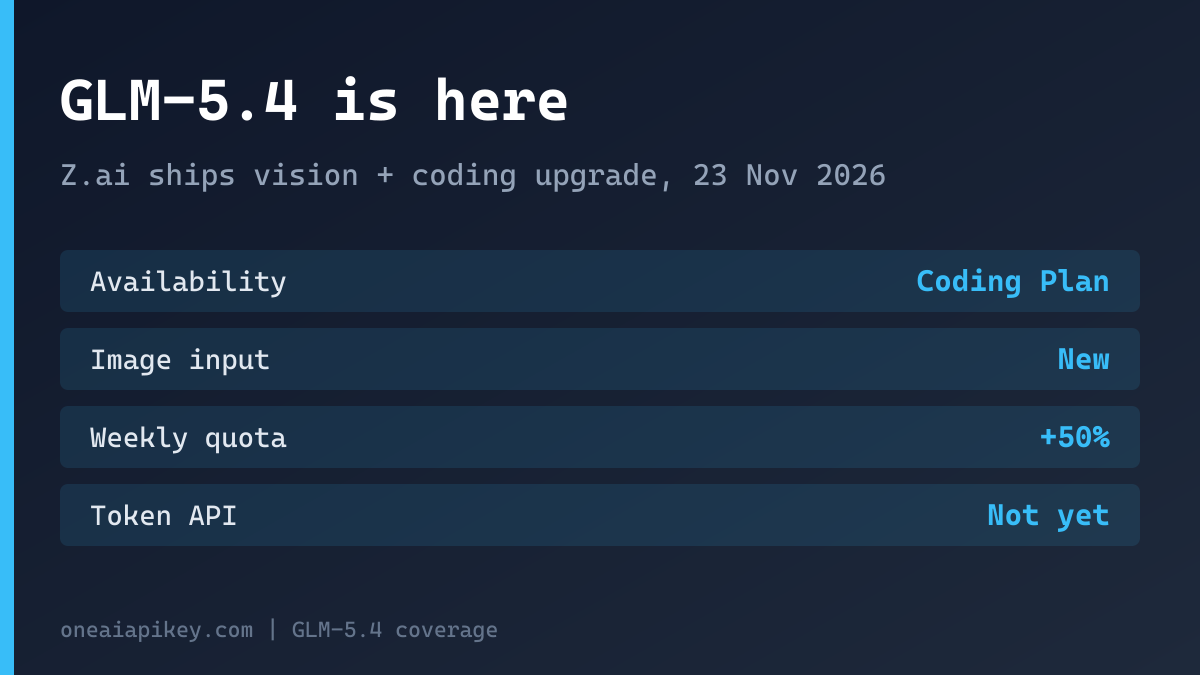
The context for why an independent run matters so much here is that Z.ai launched the model without a benchmark table of its own.
Reading a benchmark without being fooled by it
Before the numbers, a word on how to read them, because KingBench 4 is easy to misread in both directions. The failure mode on the optimistic side is treating position 7 overall as proof that GLM-5.4 beats six frontier models, or that first-among-open means it leads every open model on every task. It does not mean either. It means that on this harness, scored by this reviewer, on this set of tasks, on launch day, it landed there.
The failure mode on the pessimistic side is dismissing the run because it is not a vendor benchmark, and that is backwards. An independent run has value precisely because the vendor did not produce it. A vendor benchmark picks the tasks and the scoring that flatter its model. An independent reviewer has no such incentive, which makes a strong independent result more informative, not less, than a vendor table. The right posture is neither blind trust nor dismissal. It is treating one detailed independent run as a real but provisional data point, and waiting for corroboration before treating it as settled.
There is also the question of what KingBench 4 actually measures, and the honest answer is that a coding harness measures coding and agentic task completion, not everything a model can do. GLM-5.4’s new vision capability, for instance, is not what this run was testing. A model can be excellent on a coding harness and still have unmeasured strengths or weaknesses elsewhere. Our GLM-5.4 vision guide covers the capability this run did not touch.
What KingBench 4 is, and why the source matters
KingBench is an independent coding benchmark run by AICodeKing, a reviewer who evaluates frontier models on real coding tasks and publishes the results. It is not Z.ai’s benchmark, not a lab-run evaluation, and not a score the vendor submitted. That independence is the reason the numbers are worth reading closely, and also the reason they need a caveat. One harness measures one thing well, on one reviewer’s tasks, scored by one person. It is evidence, not ground truth.
The run landed on launch day, 23 November 2026, and it is the only independent placement available for GLM-5.4 today. Z.ai has said a technical report is coming with official numbers, and until that lands, KingBench 4 is the best public data we have. Our GLM-5.4 benchmarks guide covers what the official tables will add when they arrive.
The headline placement
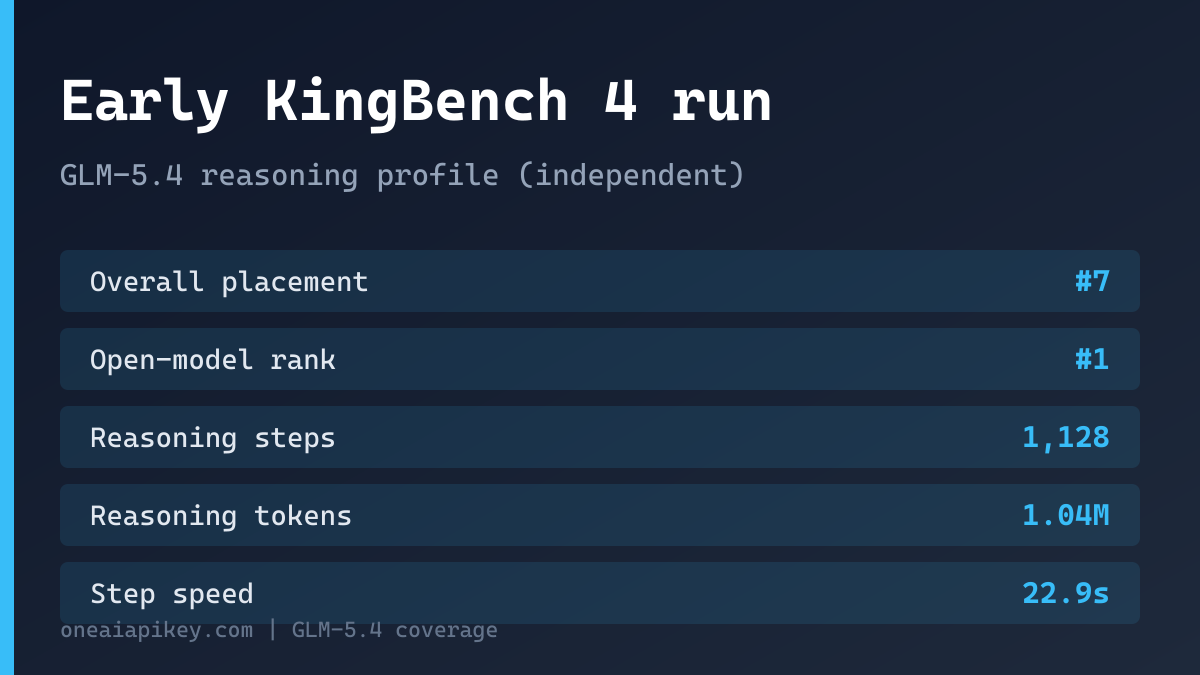
GLM-5.4 placed 7 overall on KingBench 4. Among open models, it placed first, and AICodeKing called it the best open model you can use right now. That is a strong result for a model that shipped the same day, and it is consistent with the GLM series’ track record of doing well on coding and agentic tasks.
It is worth being precise about what “first among open models” means here. It is a statement about quality among the models you can access, not about whether you can download GLM-5.4. As our GLM-5.4 open weights guide covers, the weights are not published at launch, so “open model” in this context reflects the series’ open heritage and positioning rather than a download you can grab today. The capability result is real. The availability is more complicated.
Behind GLM-5.4 on the overall board sit the closed flagships, which is where the placement gets its context. The published Artificial Analysis Intelligence Index v5.0.1, a different measurement, has GPT-6.2 Astra Max at 62, Gemini 4 Neon Xhigh at 61, and Claude Opus 5.5 Max at 59, with GLM-5.3 Max at 32. GLM-5.4 has no entry on that index yet. KingBench 4 and the Intelligence Index measure different things, so they are not directly comparable, but together they sketch the same shape: the closed frontier is ahead on measured scores, and GLM-5.4 is the strongest open-model option. Our GLM-5.4 vs frontier guide sets it against those closed models directly.
The head-to-head: GLM-5.4 against Neon
The most useful part of the run is the comparison AICodeKing drew against a model he calls Neon, at maximum reasoning effort. Neon is a frontier comparator, and the numbers are a study in two models solving the same task in completely different ways. Here is the breakdown he published.
| Metric | GLM-5.4 | Neon |
|---|---|---|
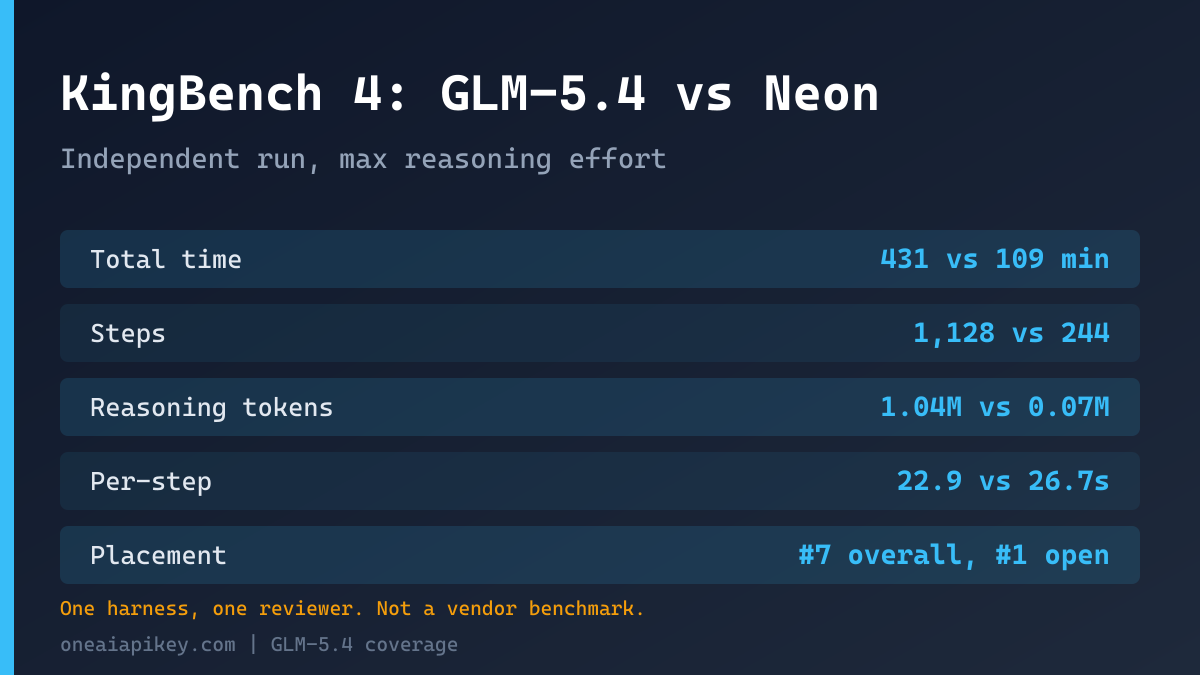
| Total time (max effort) | 431 min | 109 min |
| Time per step | 22.9s | 26.7s |
| Steps | 1,128 | 244 |
| Reasoning tokens | 1.04M | ~0.07M |
| Tool-call failure rate | 1.56% | not given |
| Cache hit rate | 96-99% | not given |
| Median time to first token | 4.1s | not given |
Read the time row and the step row together, because that is where the story is. GLM-5.4 took 431 minutes to Neon’s 109, roughly four times slower overall. But per step, GLM-5.4 was actually faster, 22.9 seconds against Neon’s 26.7. The slowdown came entirely from taking far more steps: 1,128 against 244. GLM-5.4 did not think slowly. It thought in many more, smaller increments.
Many small steps, not a few large ones
The reasoning token count makes the same point from a different angle. GLM-5.4 generated about 1.04 million reasoning tokens against Neon’s roughly 70,000. That is around fifteen times the reasoning output for the same task. Combined with the step count, it describes a model that narrates its thinking extensively at each stage rather than reasoning briefly and acting.
AICodeKing also noted that GLM-5.4 reasons on nearly every step, with under 1% of steps showing near-zero reasoning. He contrasted that with GPT models, which he said show a 14 to 39% near-zero reasoning rate. In plain terms, GLM-5.4 almost never acts without thinking first, while some competitors frequently skip explicit reasoning and act directly. At maximum effort, GLM-5.4 produced about 1.5 times the reasoning of its high-effort setting, so the effort dial does change how much the model thinks, but even at high effort it is a heavy reasoner.
This behavior is not accidental, and it connects to the architecture. Z.ai has said the past three months went into scaling what it calls the Loop, and that the Loop Transformer is the first improvement users notice. A looped architecture runs the model through multiple passes, which is consistent with a model that produces many reasoning steps naturally. Our GLM-5.4 loop transformer guide explains the architecture, and GLM-5.4 coding performance covers what the behavior means for real workloads.
The step count is not the only cost. The reasoning-token appetite shows up as overthinking on some tasks, and a second independent observer saw the same pattern. 思维怪怪 (@0xLogicrw), posting about the run, called GLM-5.4 the “most cautious model” and said it “suffers from overthinking,” adding that “High is the choice that combines ability and speed.” The BlockBeats report put the same finding in numbers: reasoning tokens nearly fifteen times higher than Google’s Neon.
Overthinking, and why effort level matters so much
The clearest evidence for overthinking came from a single security task in the run. At both high and maximum effort, GLM-5.4 hit a 180-second timeout while it was still thinking, and never produced an answer. At medium effort, it passed the same task in 95 seconds. More thinking was not more capability here. It was the opposite.
AICodeKing’s conclusion was that “High is the best sweet spot,” and @0xLogicrw landed on the same recommendation independently. That is an unusual result and worth internalizing. Most models improve monotonically with more reasoning effort, or at least plateau. GLM-5.4 can get worse when given more room to think, because it will spend that room and still not finish. If you deploy it, the effort setting is not a free dial to turn up. At maximum effort the model produced about 1.5 times the reasoning tokens of high effort, which is more cost and more time for a result that is not reliably better and can be worse on tasks that trip the overthinking loop.
Reliability and latency: the numbers that get overlooked
The step and token counts get the attention, but the reliability figures are arguably more important for anyone deciding whether to deploy this model. The tool-call failure rate came in at 1.56%, which placed 11th of 17 harnesses. That is mid-pack, not best-in-class, and it matters because agentic coding depends on tool calls landing correctly. The mitigating detail is that 66% of those failures were recovered by retry, so the model often corrects itself rather than failing the task. Mid-pack raw failure with strong recovery is a better profile than the raw number suggests.
Cache hit rate was 96 to 99%, which is excellent and matters for cost and speed on repeated work. Median time to first token was 4.1 seconds, which is the latency you feel at the start of a response. For a model generating over a million reasoning tokens on hard tasks, a 4.1 second start is reasonable, and the high cache hit rate suggests the runtime is doing real work to avoid recomputing.
AICodeKing also broke down where the time went: roughly 75% generating and 25% on builds and tests. That is a model that spends most of its budget thinking and writing rather than running verification, which is what you would expect from a heavy reasoner.
One gap worth naming came up in the replies to the run. The user @asifroyal noted that this was “the first number I’ve seen for 5.4” and observed that “Z.ai hasn’t put out a model card,” also asking whether the run was at maximum effort. Both points are fair. AICodeKing confirmed the run was at max reasoning effort for the headline comparison, and the missing model card is a genuine absence: Z.ai shipped no official scorecard, so an independent tester had no published numbers to check his work against. That is exactly why Kingy AI’s writeup flagged that there was “no first-party scorecard” for this launch, and why corroboration from a second harness would matter.
The verdict: reviewer and planner, not raw generator
The most actionable part of the run is AICodeKing’s use-case read, and it follows directly from the behavior profile. He found GLM-5.4 best used as a reviewer for bugs and security, as a planner, or for big-picture work. He did not find it best as an end-to-end state-of-the-art code generator that you point at a task and let run.
His exact framing was deliberately two-sided. On the positive side he called it the “best Open Model you can use right now,” “an honest effort,” “not benchmaxxed,” and “the most careful model that I have ever used,” noting that it catches “bugs and security vulnerabilities that competitors missed.” On the tempering side he said “I wouldn’t recommend you to just use this model” as an end-to-end coder, that it is “not recommended for 3D or frontend,” and that it is “not the absolute best overall.” Reading both halves together is the honest take. This is a genuinely strong, unusually careful model with a specific shape, not a universal replacement for the frontier flagships.
The reasoning is visible in the numbers. A model that takes 1,128 steps and generates 1.04 million reasoning tokens to solve a task is a model that thinks deeply, and deep thinking is exactly what you want in a reviewer scanning for bugs and security issues or a planner breaking a large task into steps. It is also what makes the model expensive and slow as a raw generator, where you mainly want correct code fast. The same trait is a strength in one role and a cost in another.
This is a genuinely useful deployment hint, and it is the kind of conclusion that only comes from watching a model work on real tasks rather than reading a score. It is also one reviewer’s observation on one harness, so treat it as a strong hypothesis rather than a law. Our GLM-5.4 for code review guide turns this deployment pattern into concrete guidance.
How the profile fits the GLM series
It is worth asking whether the reviewer-and-planner profile is new or a continuation, and the honest answer is that it looks like a continuation of a direction the GLM series was already taking. GLM-5.3 sat at 32 on the Artificial Analysis Intelligence Index v5.0.1, behind the closed flagships and competitive with the open models around it. The series has a documented track record on coding and agentic tasks, which is exactly the territory KingBench 4 measures. GLM-5.4 moving to first among open models is an increment on that base, not a leap from nowhere.
What does look new is the intensity of the reasoning behavior. The many-small-steps, reason-on-every-step profile is tied to the Loop architecture that Z.ai spent three months scaling, and that architecture is the headline technical change in this release. So the fair read is that GLM-5.4 is GLM-5.3’s coding pedigree plus a new architecture that pushes the reasoning depth further, which produces both the stronger open-model placement and the token appetite. Our GLM-5.4 vs GLM-5.3 guide covers what changed model to model, and GLM-5.4 coding performance covers the behavior in workload terms.
The caveat you should not skip
Every number in this post comes from one independent run, on one harness, scored by one reviewer, on launch day. That is both the value and the limit of the data. It is valuable because it is independent, detailed, and the only public measurement of GLM-5.4 today. It is limited because a single harness measures a specific slice of capability, a single reviewer’s task selection shapes the result, and a single run has variance.
Carry three specific caveats. First, one harness. KingBench 4 is AICodeKing’s own setup, and a model can look different on a second harness with different tasks. Second, one reviewer. The reviewer/planner verdict is a skilled human judgment from watching one model work, not a scored metric, and another tester might weight the trade-offs differently. Third, no first-party numbers to compare against. Z.ai published no model card and no benchmark table, so this run is the only public data and there is nothing official to check it against. Treat the whole thing as a strong early signal from a credible independent tester, not a settled measurement.
Future update: official benchmarks and corroboration
This section will be updated once Z.ai publishes an official benchmark table and once a second independent harness runs GLM-5.4. As of 23 November 2026, GLM-5.4 has no entry on the Artificial Analysis Intelligence Index, no SWE-Bench, Terminal-Bench, LiveCodeBench, Aider, LMArena or Design Arena rows, and no first-party scorecard at all. KingBench 4 is the only public measurement.
Based on Z.ai’s history, a reasonable expectation is that official numbers arrive with the technical report Z.ai has said is coming, and that broader independent coverage follows once the model reaches the pay-as-you-go API and routers, which broadens who can test it. For calibration, GLM-5.3 Max scored 32 on the Artificial Analysis v5.0.1 index, a figure GLM-5.4 does not have yet. Whether the KingBench reviewer/planner profile holds on other harnesses, whether the 1.56 percent tool-call failure rate reproduces, and where it lands on the intelligence indexes are all open until more data exists. That is a statement about what is missing, not a prediction of specific scores. We will update this section with official and corroborating numbers as they appear.
A few things would change the picture. Z.ai’s technical report, when it lands, will give official numbers on whatever benchmarks Z.ai chooses to publish, and those will be directly comparable to other models on the same harnesses. Broader independent testing across more harnesses would show whether the reviewer-and-planner profile holds or is specific to KingBench 4’s tasks. And placement on the Artificial Analysis Intelligence Index, which GLM-5.4 does not have yet, would allow a cleaner comparison to the closed frontier. Until then, the honest read is that KingBench 4 is a strong early signal, not a final verdict.
We would rather carry that caveat than present one run as settled fact. For how GLM-5.4 compares on the indexes it is absent from, see GLM-5.4 benchmarks, and for the models it now competes against, see our best frontier models roundup and GLM-5.4 vs GLM-5.3 for what changed from the prior generation.
What this means for getting access
If the KingBench 4 run makes you want to try GLM-5.4, the path today is a GLM Coding Plan subscription, from 18 US dollars a month, because the model is not on the pay-as-you-go token API yet and the weights are not published. Our GLM-5.4 API guide covers calling glm-5.4, and GLM-5.4 pricing covers the plan quota and the token price that has not been announced.
If you are deploying it based on this run, take the reviewer and planner hint seriously. Route code review, security review, and planning work to GLM-5.4, and be more careful about using it as an autonomous generator where its step count and token appetite will cost you time and money. And budget for the token usage: a model that produced 1.04 million reasoning tokens on one hard task will drive output-token costs if it is metered like GLM-5.3. For the architecture behind the behavior, see GLM-5.4 loop transformer, and for whether you could host it yourself, see GLM-5.4 self-hosting. For the models competing for the same reviewer and planner work, see GLM-5.4 alternatives.
Sign up for a key to call GLM models through hosted access, or browse the model catalogue to see what is available today.
More GLM-5.4 coverage
This is part of a series on GLM-5.4. The rest of the cluster goes deeper on the areas this launch only sketched:
- GLM-5.4 launch on what shipped and what did not
- GLM-5.4 benchmarks once Z.ai publishes the official tables
- GLM-5.4 vs GLM-5.3 on what actually changed model to model
- GLM-5.4 vs frontier against the closed flagships
- GLM-5.4 coding performance on the Loop architecture and the reviewer profile
- GLM-5.4 vision on the new image input and screenshot-to-code use
- GLM-5.4 pricing on the 50% bump and the missing token rate
- GLM-5.4 API guide on calling
glm-5.4and the Coding Plan path - GLM-5.4 context window on the 1M window and long-context coding
- GLM-5.4 open weights on whether the vision upgrade ships as open source
- GLM-5.4 self-hosting if the weights go public
- GLM-5.4 loop transformer on the architecture and the technical report
- GLM-5.4 for code review on the planner and reviewer deployment pattern
- GLM-5.4 alternatives on the open models competing for the same work