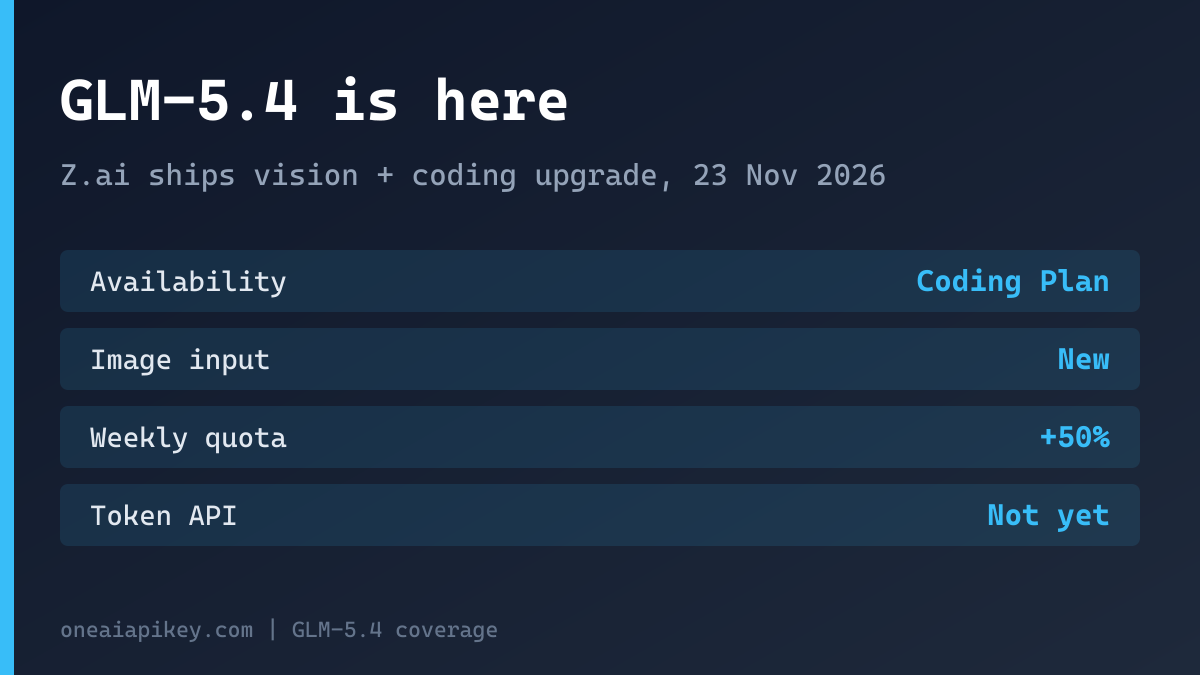
The single clearest change in GLM-5.4 is that it can see. On 23 November 2026 Z.ai shipped image input on a flagship GLM model for the first time. The previous flagship, GLM-5.3, was text-only. Image input in that generation lived down in the smaller GLM-5.3-Flash tier. With GLM-5.4 the modality moves up, and the top of the GLM line joins the rest of the frontier in accepting pictures.
Z.ai’s lead on the model, Zixuan Li, put vision first when he announced the release. His words were that GLM-5.4 is “now available to all GLM Coding Plan users” with “new vision capabilities and stronger all-round coding performance.” Vision leading the sentence, and leading the release, is not an accident. It is the headline feature of this launch, and it is the reason a lot of people who were not watching GLM are now paying attention.
But the vision upgrade ships with real gaps, and this post is as much about those as the capability itself. Z.ai has not documented the supported image formats or the size limits. There is no published vision benchmark, and as of launch day no third-party tester has put GLM-5.4’s image understanding through any harness at all. The one independent evaluation that exists, AICodeKing’s KingBench 4 run, was a coding and agentic test that did not touch vision. So everything here about what the vision can do is drawn from what Z.ai has said and from what the capability generally enables, not from anyone who has scored it. Here is what is confirmed, what the community is saying, what is missing, and how GLM-5.4’s vision compares to the multimodal models it now competes with.
What exactly shipped
GLM-5.4 accepts text and image input. That is confirmed, and it is new at the flagship level. Z.ai’s own framing put improved vision capabilities alongside stronger all-round coding performance as the two headline changes, and Zixuan Li highlighted both in the launch message quoted above.
The context around that change matters, because it was an odd gap in the last generation. GLM-5.3, the flagship released before GLM-5.4, accepted text only. Image, video and file input in the GLM-5.3 generation were features of GLM-5.3-Flash, the smaller and cheaper model in the same family. That is an unusual split. Most model families either keep multimodality across the whole line or leave it out entirely, and Z.ai had put vision in the small model while leaving the flagship blind. GLM-5.4 closes that gap. Whatever reasons Z.ai had for the split last generation, the flagship no longer sits below its own cheaper sibling on modality.
One thing worth flagging before going further: Kingy AI, in his launch write-up, noted that there is “no first-party scorecard” for GLM-5.4 and that the model was “not tested by Kingy yet.” That is the state of play for vision specifically. Z.ai has confirmed the capability exists. Nobody outside Z.ai has published a measurement of how well it works.
What image input unlocks for coding
The reason vision on a coding model matters is that a large share of developer context is visual. Here are the uses that come up most, and why each one is more than a novelty. These are the workflows a multimodal coding model generally enables. Treat them as what the feature is for, not as a tested guarantee of GLM-5.4’s quality at each one.
Screenshot to code. The most obvious use is turning a picture of a user interface into working code. A designer hands you a mock, or you screenshot a page you want to rebuild, and you pass the image straight to the model with a prompt asking for the component. Before GLM-5.4 you would have had to describe the layout in text, route the image to a different multimodal model, or transcribe it yourself. Now the flagship can take the pixels directly. This is the workflow most people mean when they say screenshot-to-code, and it is the one the vision upgrade is aimed at.
Reading error dialogs. A lot of the information a developer needs is trapped in a picture. A stack trace in a screenshot, a modal error dialog, a crash report captured as an image in a bug ticket. A text-only model cannot read any of that unless somebody copies it out first. A model with image input reads the dialog directly and reasons about the error in the same step. For debugging, where the error message is often the whole clue, that removes a copying step that is easy to get wrong.
Design mocks and visual reasoning. The third use is broader. Design mocks, architecture diagrams, whiteboard photos, annotated screenshots from a reviewer. A coding model that can look at a mock can reason about layout, spacing and component structure before it writes anything. It can also compare what a screenshot shows against what the code should produce, which is the beginning of visual verification.
Visual verification and review. This fourth use follows from the third and changes how you work rather than just what you can build. Once a model can read a screenshot, it can look at the result of something and tell you what it sees. You run your app, screenshot the page, and pass it to the model alongside the component that produced it. It can flag that a button is misaligned, that a label is overflowing, that an error state is showing when it should not be. That closes a loop that was previously manual, where you were the only one who could see the rendered output and describe it back. A reviewer that can see is a different tool from one that can only read code, and for frontend work in particular the rendered result is where a lot of the real bugs live.
The value of getting all of this on GLM-5.4 specifically is that it now sits on a model that also has GLM’s coding track record and a one million token context window. You can load a large slice of a codebase and a screenshot of the UI it produces in the same request and ask the model to connect them. That pairing, big context and image input on the same model, is the concrete thing the vision upgrade buys you that you could not get from the GLM flagship a week ago. Our GLM-5.4 context window post covers what the million-token window enables.
What the community is saying
Because no third party has scored the vision yet, the community conversation about GLM-5.4 is mostly about the model as a whole, and the vision feature is read in that context. It is worth hearing the range, because it is more mixed than the announcement alone would suggest.
The most positive signal comes from AICodeKing, a YouTuber with around 100,000 subscribers who runs independent evaluations and states he is not sponsored. After his KingBench 4 run he called GLM-5.4 the “best Open Model you can use right now,” and described it as “an honest effort” that was “not benchmaxxed.” He also called it “the most careful model that I have ever used,” and said it catches “bugs and security vulnerabilities that competitors missed.” None of that is about vision. But it matters for the vision feature, because it establishes that the underlying model he tested is genuinely strong, and vision now rides on that same model.
Zixuan Li’s official announcement, which put “new vision capabilities” at the front, is the only first-party statement on the vision feature itself. There is no expansion of it anywhere in Z.ai’s published material as of launch day.
The skepticism is worth hearing too. In the replies to AICodeKing’s thread, @teortaxesTex asked simply “will it be open though?”, reflecting a broader doubt about whether Z.ai will release the vision-capable weights at all. Our GLM-5.4 open weights post covers that question. @asifroyal, in the same thread, noted “that’s the first number I’ve seen for 5.4. Z.ai hasn’t put out a model card,” which is the sharpest way to state the measurement gap: there is no model card, so there is nothing official to read the vision capability against.
On the Chinese side, 思维怪怪 (@0xLogicrw) posted a detailed reaction calling GLM-5.4 the “most cautious model” and noting that it “suffers from overthinking,” while rating the High reasoning setting as “the choice that combines ability and speed.” Again, that is about the reasoning style rather than vision. The BlockBeats, a Chinese outlet, summarized the KingBench result as GLM-5.4 ranking seventh in a coding test with “reasoning tokens nearly 15x more than Google’s Neon.” Every one of those community data points is about the text and reasoning side. On vision specifically, the honest summary is that the community has not evaluated it yet, because nobody has had a benchmark or a test to evaluate it against.
There is no published vision benchmark, and no third-party test yet
This is the section to take most seriously. There is no public vision benchmark score for GLM-5.4. Z.ai did not publish one in the launch announcement. There is no model card. There is no independent score from any external harness as of launch day.
That includes the testers who have been most active on this model. AICodeKing’s KingBench 4 run placed GLM-5.4 seventh overall and first among open models, but that harness tested coding and agentic ability, not image understanding. He did not test vision. Kingy AI explicitly wrote that the model was “not tested by Kingy yet.” The community posters quoted above were reacting to coding results and to the announcement, not to any vision evaluation, because no vision evaluation exists for them to react to.
So the position is this: image input is easy to claim and hard to score. A model can accept images and still be mediocre at reading dense UI screenshots, small text in a dialog, or an intricate design mock. Without a benchmark and without a single third-party test, you cannot tell where GLM-5.4’s vision lands on that spectrum. The only thing you can say honestly is that the capability is confirmed to exist and its quality is unmeasured by anyone outside Z.ai.
This matters because image understanding varies enormously between models that all technically “support images.” The gap between a model that reads a dense dashboard screenshot accurately and one that hallucinates half the labels is the difference between a usable screenshot-to-code tool and a toy, and no announcement tells you which side a model falls on. Only a benchmark or your own testing does. Until one of those exists, GLM-5.4’s vision is a confirmed feature with unknown quality.
How GLM-5.4 vision compares to the field
GLM-5.4 is catching up on modality, not pulling ahead. The rest of the frontier already accepts images, and several accept more than images. Here is where it sits.
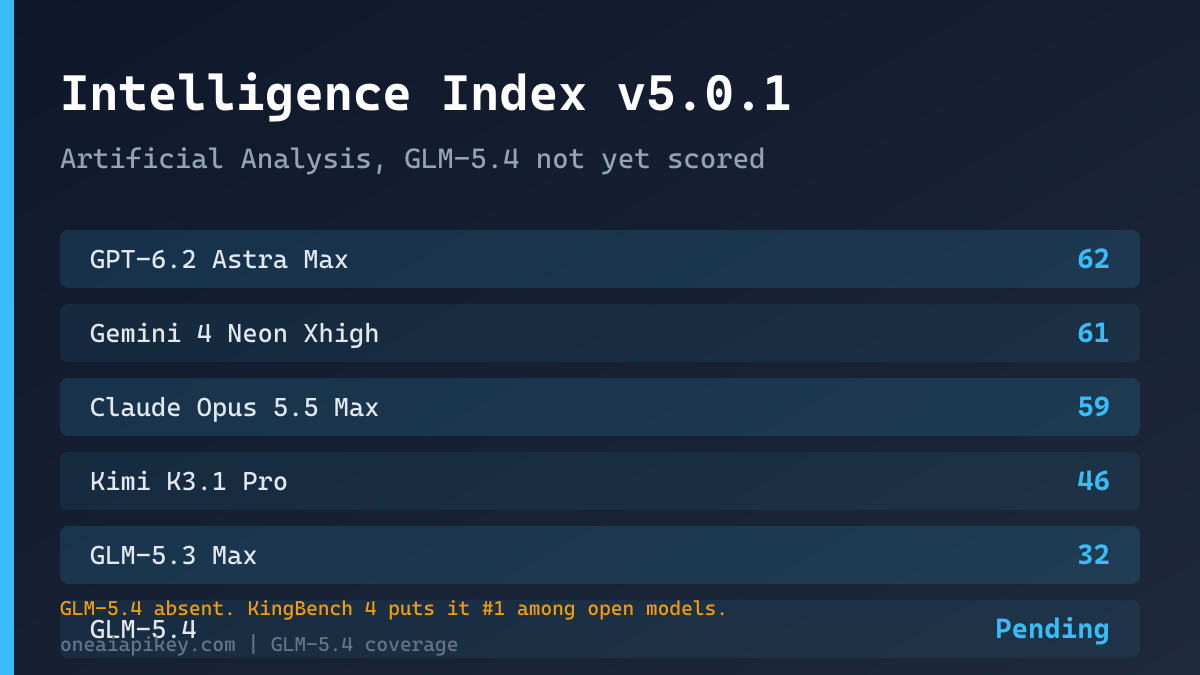
Gemini 4 Neon is the broadest multimodal model in the current group. It accepts text, image, video, audio and PDF input, which makes GLM-5.4’s text-plus-image look narrow by comparison. Neon covers the modalities GLM-5.4 does not, including video and audio, and its image understanding is part of a package that has been multimodal for several generations. Our Gemini 4 Neon launch post covers the full modality set, and Gemini 4 Neon vs Claude Opus 5.5 shows how its multimodality stacks against a closed rival.
GPT-6.2 Astra and Claude Opus 5.5 both accept text and image input, the same combination GLM-5.4 now offers. Against those two, GLM-5.4 is matching modality rather than trailing it. The open question is image understanding quality, which brings us back to the missing benchmark. For the fuller spread, our GLM-5.4 vs frontier comparison lines them up model by model.
The smaller GLM tier is an interesting internal comparison. GLM-5.3-Flash already accepted text, image, video and file input, which is more modalities than the new flagship has. That means if you need video or file understanding today, the smaller model technically still covers more ground, though it is a weaker coder. Our Hy4 Flash vs GLM-5.3-Flash comparison maps the small-model tier, and GLM-5.4 vs GLM-5.3 shows exactly what changed between the two flagships.
The honest summary is that GLM-5.4 closes a gap rather than opening one. A week ago the GLM flagship was the odd one out among coding flagships for being text-only. Now it accepts images like GPT-6.2 Astra and Claude Opus 5.5 do, and it trails Gemini 4 Neon, which still covers more modalities. For the broader field, our best frontier models roundup covers the closed side and GLM-5.4 alternatives covers the open models competing for the same work.
Availability, quota, and the vision cost question
GLM-5.4 vision is only reachable through the GLM Coding Plan right now, which starts at 18 US dollars a month. The model is not on the pay-as-you-go token API yet, so if you are not on a plan you cannot try the image input today. The model ID is glm-5.4 inside the plan. Our GLM-5.4 API guide covers how to call it, and GLM-5.4 pricing explains the plan path and the missing token rate.
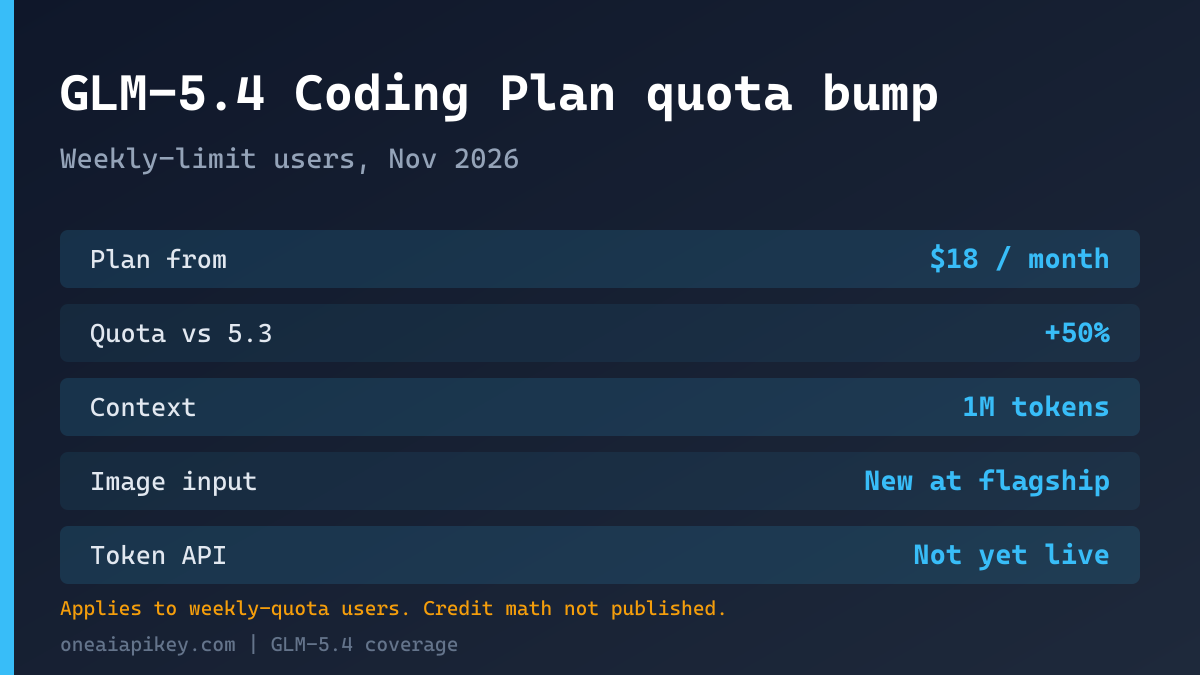
One concrete incentive for plan users is a quota change. Z.ai says subscribers with weekly limits get 50% more GLM-5.4 quota than they got with GLM-5.3. That is directly relevant to vision, because image inputs typically consume more tokens than text. A screenshot is worth many hundreds or thousands of tokens depending on its resolution, so a vision workflow eats quota faster than a text-only one. The extra 50% of weekly headroom means you can push more screenshots through the model before hitting the ceiling. The exact token math is not published, so treat the 50% as a real but imprecise gain.
There is also a cost question specific to vision on this model, and it comes from the reasoning behavior. Early testing showed GLM-5.4 generating over a million reasoning tokens on hard text coding tasks, reasoning on nearly every step. If that heavy reasoning carries over to image inputs, then processing a screenshot could be an expensive operation in tokens, not a cheap one. That is a real concern for anyone imagining a high-volume screenshot-to-code pipeline, and it is unresolved until Z.ai publishes token pricing and someone tests how many tokens an image actually triggers. It is one more reason to treat the first weeks as an evaluation period rather than committing a production pipeline.
How the vision upgrade fits the rest of the release
It is worth seeing the vision change as one part of a coherent release rather than an isolated feature. Z.ai described two headline improvements, improved vision and stronger all-round coding, and a third change underneath them: the model got bigger and the way it reasons changed. Z.ai said three months of work went into scaling what it calls the Loop and the model size, and that the Loop Transformer is the first improvement users will notice. Separately and unconfirmed, AICodeKing reported the model may be a looped transformer with roughly 700 billion parameters, with the explicit caveat that he was not certain.
The reason that architecture detail belongs in a vision post is that adding image input to a text model is not a small change. You need an image encoder and a way to project what it sees into the same space the text side reasons in. Doing that on top of a scaled-up, looped architecture is a real piece of engineering, and it explains why the vision upgrade landed on the flagship now rather than a generation earlier. Whatever the confirmed parameter count turns out to be, the shape of the release is that Z.ai scaled the model and gave it eyes in the same pass. Our GLM-5.4 loop transformer post covers the architecture, and GLM-5.4 coding performance covers how the reasoning style shows up in practice.
What to think about the vision upgrade today
The right mental model is that GLM-5.4 vision is a confirmed capability with unmapped edges and no external measurement. The image input is real, it is on the flagship, and it enables workflows that were impossible on GLM-5.3. Screenshot-to-code, reading error dialogs, reasoning over design mocks, and visual review are all now available on the top GLM model. That is genuinely useful, and it closes the largest modality gap the line had.
The edges are what to respect. Formats and size limits are undocumented. There is no vision benchmark and no third-party test, so quality is unproven externally. The model is plan-only for now. And the heavy reasoning that defines GLM-5.4 on text may make image processing more expensive in tokens than you expect once metered pricing lands. Treat the first weeks as an evaluation period. Run your own screenshots through it, compare the output to what you get from Gemini 4 Neon or Claude Opus 5.5 on the same images, and let that comparison, rather than the announcement, decide whether it earns a place in your pipeline.
If you are choosing a model specifically for vision-heavy coding work today, Gemini 4 Neon is the safer pick on documented capability, since its modality set is broader and its image understanding has a longer track record. GLM-5.4 is the pick if you want a strong open-model coder that also happens to see now, especially if you are already inside the Coding Plan and the quota bump covers your image volume.
Future update: vision benchmarks and third-party tests
This section will be updated once Z.ai publishes a vision benchmark or once an independent tester scores GLM-5.4’s image understanding. Neither exists as of 23 November 2026. Based on Z.ai’s history with GLM-5.3 and the timing of this launch, a reasonable expectation is that a technical report and a first-party evaluation appear in the weeks after launch, since Z.ai has said a technical report is coming. It is also reasonable to expect AICodeKing or a similar independent tester to extend a vision harness to the model once the API access widens beyond the Coding Plan. That is inference from Z.ai’s stated plans and from how these launches normally unfold, not an announced benchmark or a confirmed test. Until one appears, nobody outside Z.ai can tell you how good GLM-5.4’s vision actually is.
More GLM-5.4 coverage
This post is part of a series on the GLM-5.4 launch. The rest of the cluster goes deeper on what the launch only sketched:
- GLM-5.4 launch is the overview of what shipped and what did not
- GLM-5.4 benchmarks once Z.ai publishes the official tables
- GLM-5.4 vs GLM-5.3 on what changed model to model
- GLM-5.4 vs frontier against the closed flagships
- GLM-5.4 coding performance on the Loop architecture and the reviewer profile
- GLM-5.4 pricing and quota on the 50% bump and the missing token rate
- GLM-5.4 API guide on calling
glm-5.4and the Coding Plan path - GLM-5.4 context window on the 1M window and long-context coding
- GLM-5.4 open weights on whether the vision upgrade ships as open source
- GLM-5.4 self-hosting if the weights go public
- GLM-5.4 KingBench 4 on the early independent run in full
- GLM-5.4 loop transformer on the architecture and the technical report
- GLM-5.4 for code review on the planner and reviewer deployment pattern
- GLM-5.4 alternatives on the open models competing for the same work