GLM-5.4 launched on 23 November 2026 with a stronger-coding claim and no benchmark table behind it. That is not a small gap in the coverage. It is the story. Every other number people will quote about this model over the next few weeks traces back to either a vendor statement or a single independent run, and if you read those two things as if they carried the same weight you will get a wrong picture of where GLM-5.4 actually sits.
There is no official Z.ai scorecard for this model. That is not a delay, not a partial table, not a few benchmarks pending. As of launch day Z.ai has published no benchmark numbers of any kind for GLM-5.4. The model has no entry on the Artificial Analysis Intelligence Index. It has no row on SWE-Bench, Terminal-Bench, LiveCodeBench, Aider, LMArena, Design Arena or WebDev Arena. What it does have is one serious independent run, AICodeKing’s KingBench 4, and that run is genuinely rich. It has step counts, token counts, timeout behavior, tool-call reliability and a clear verdict. This post covers what that run found in full, why the official table is missing, and what you can and cannot say about GLM-5.4’s measured performance today.
The launch claim, stated exactly
Z.ai describes GLM-5.4 as having stronger all-round coding performance than GLM-5.3. That is the whole official claim. It came through the Z.ai announcement and the launch coverage that followed it. What did not come with it is a number. There is no SWE-Bench score, no Terminal-Bench score, no pass rate on any coding suite, and no side-by-side against GLM-5.3 run on the same harness.
Zixuan Li, the Z.ai lead on the model, put the launch in these terms: “GLM-5.4 is now available to all GLM Coding Plan users. New vision capabilities and stronger all-round coding performance.” That is a capability statement, not a measurement. Z.ai has said a technical report is coming later, and that is the document that would carry the official numbers. Until it lands, the coding improvement is a vendor claim, and the honest way to treat it is as a direction rather than a measurement.
Kingy AI’s launch writeup flagged this directly, noting that Z.ai had published “no first-party scorecard” for the model. That framing is worth holding onto, because it is the difference between a model that has been measured and a model that has been announced. The rest of the launch had plenty of substance: vision input at flagship level, 50% more quota for weekly-limit subscribers, a 1M context window. What it did not have was a score to attach to any of it.
The one independent run: KingBench 4 in full
The single most data-rich evidence on GLM-5.4 available today comes from AICodeKing, who ran the model through his KingBench 4 harness and published the results with his launch analysis. KingBench 4 is one harness, run by one reviewer, on one set of tasks. That is a real limit, and it is worth stating up front. But within that limit the run is thorough, and it is the only measured placement the model has.
The headline placement: GLM-5.4 scored 55.3%, finishing seventh overall and first among the open models in the field. AICodeKing called it the “best open model you can use right now,” and separately described it as “an honest effort” and “not benchmaxxed.” Those last two phrases matter. A model that is “not benchmaxxed” is one that was not tuned specifically to game the benchmark, which is exactly the criticism you would want to rule out before trusting a good placement.
The reaction to that 55.3% figure tells you something about the information vacuum around this launch. One reply from @asifroyal put it plainly: “That’s the first number I’ve seen for 5.4. Z.ai hasn’t put out a model card.” Another commenter, 思维怪怪 (@0xLogicrw), referenced the same 55.3% KingBench score when weighing the model. When a single independent number becomes the most-cited figure for a flagship launch, it is because there is nothing official to cite instead.
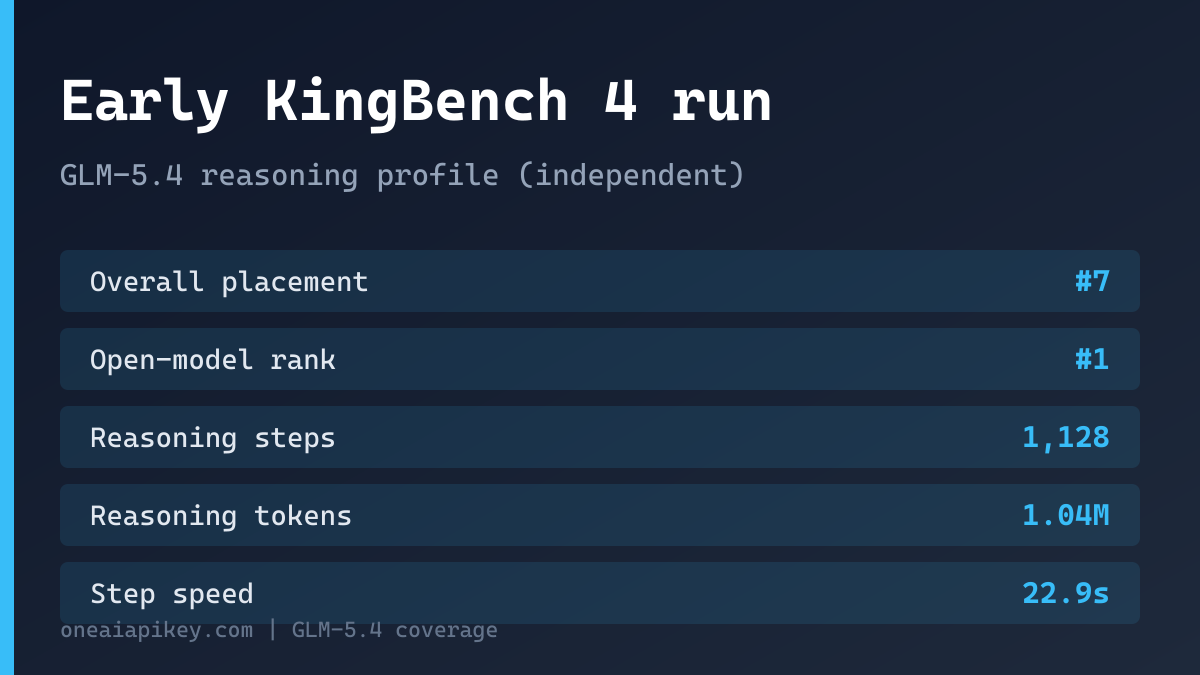
The most striking finding in the run is not the score. It is how GLM-5.4 got there. Set against a comparator AICodeKing calls Neon, run at maximum reasoning effort, GLM-5.4 took 431 minutes to Neon’s 109, roughly four times as long. But the per-step speed was almost identical: 22.9 seconds per step for GLM-5.4 against 26.7 for Neon. GLM-5.4 was not thinking slowly. It was thinking far more often. The entire time gap came from step count.
| KingBench 4 metric | GLM-5.4 | Neon (comparator) |
|---|---|---|
| Placement | #7 overall, #1 open | comparator |
| Score | 55.3% | not stated |
| Total time (max effort) | 431 min | 109 min |
| Per-step speed | 22.9s | 26.7s |
| Reasoning steps | 1,128 | 244 |
| Reasoning tokens | ~1.04M | ~0.07M |
| Steps with near-zero reasoning | under 1% | GPT models 14 to 39% |
GLM-5.4 took 1,128 steps to Neon’s 244, close to five times as many. It generated about 1.04 million reasoning tokens against Neon’s roughly 70,000, about fifteen times as many. And it reasoned on nearly every one of those steps: under 1% of GLM-5.4’s steps showed near-zero reasoning, where GPT models in the same run showed a 14 to 39% near-zero rate, meaning they frequently take a step without much thought behind it.
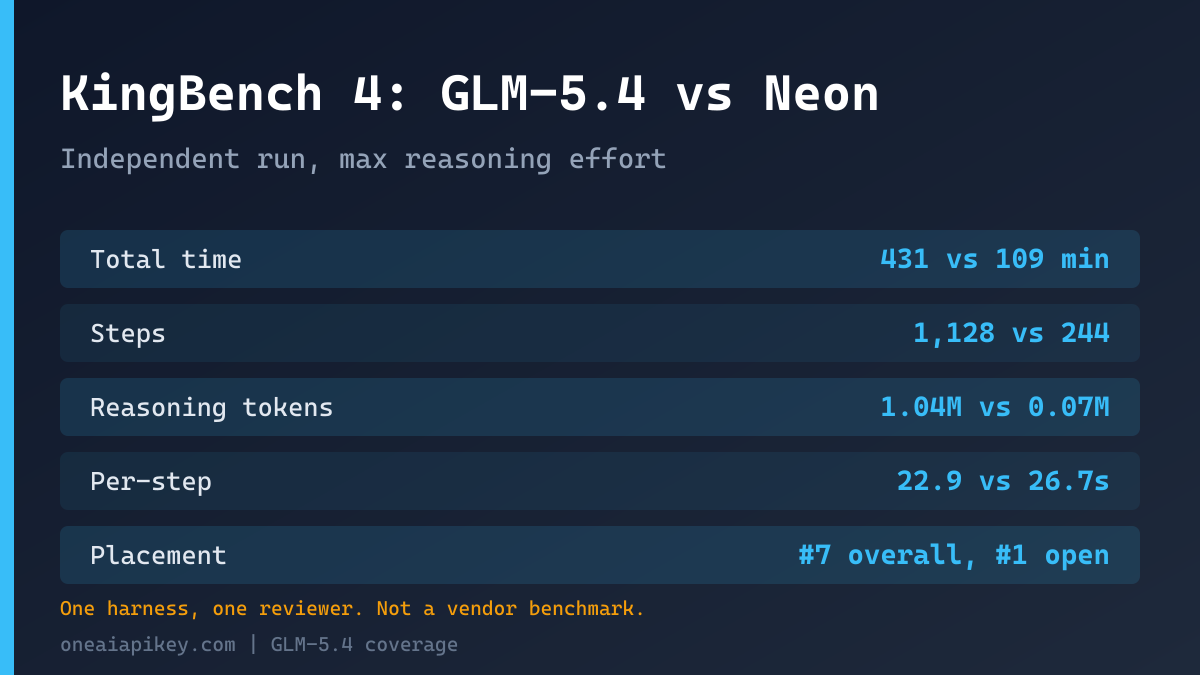
The distinction between total time and per-step speed is the most useful single thing to take from this run, and it is easy to misread. A model that finishes in 431 minutes looks slow. A model whose individual steps take 22.9 seconds is not slow at all, it is in the same band as the comparator. The four-fold difference is a difference in how many steps the model chooses to take, not in how fast it thinks. That points to a model designed for depth, and it is the basis for AICodeKing’s read that GLM-5.4 is best used as a reviewer for bugs and security, a planner, or for big-picture work, and explicitly not as an end-to-end code generator you point at a task and let run. Our GLM-5.4 coding performance piece covers that behavioral profile in depth.
The Chinese outlet TheBlockBeats summarized the same run for its audience with the framing “GLM-5.4 coding test ranks 7th: reasoning tokens nearly 15x more than Google’s Neon,” which matches the 1.04M to 70K ratio in the table above. That a fifteen-fold difference in reasoning tokens is the detail that traveled furthest says a lot about how unusual this profile is.
Overthinking, timeouts and the effort setting
One of the most practically useful findings in KingBench 4 did not show up in the headline score at all. It showed up in how GLM-5.4 behaved at different reasoning effort settings, and it is the kind of thing you only learn from a real run.
On a security task, both the High and Max effort settings hit the harness’s 180-second timeout while the model was still thinking. It had not failed to solve the problem. It had simply not stopped reasoning before the clock ran out. At Medium effort, the same task passed in 95 seconds. AICodeKing’s verdict on this was direct: “High is the best sweet spot.”
思维怪怪 (@0xLogicrw) landed on the same conclusion independently, calling GLM-5.4 the “most cautious model” and noting that it “suffers from overthinking.” Their recommendation was that “High is the choice that combines ability and speed,” which lines up with the timeout data. Two independent readers of the same run reaching the same setting advice is a stronger signal than either alone.
The effort scaling data reinforces the point. AICodeKing found that max effort produces about 1.5 times the reasoning tokens of high effort, while the per-step speed barely changes between settings. So turning the dial up to max buys you more depth, but on a task where the model is already inclined to reason at length, that extra depth can push it past a timeout without producing a better answer. The practical takeaway for anyone testing the model is to start at High, not Max, and only reach for Max on tasks where you specifically want exhaustive reasoning and can afford the wall-clock time.
There is no published throughput figure for GLM-5.4 to add here, and it is worth saying so because the number is easy to get wrong. The 490 to 500 tokens-per-second figures that circulate in GLM coverage belong to GLM-5.3 HighSpeed, not GLM-5.4. AICodeKing’s run reported per-step timing and total wall-clock time, not a tokens-per-second rate. Anyone quoting a tok/s number for GLM-5.4 right now is borrowing it from a different model.
Tool-call reliability and the rest of the run
The remainder of the KingBench 4 numbers round out a picture of a workable, if not standout, engineering foundation underneath the unusual reasoning style.
Tool-call failure rate came in at 1.56%, placing it eleventh of the seventeen harnesses in the field. That is a middling rank, but the recovery behavior is the more interesting half: 66% of those failures were recovered on retry. AICodeKing noted that this recovery rate was better than every Claude and Codex model he tested, which is a meaningful point in the model’s favor given how much agentic coding depends on tool calls succeeding or cleanly retrying.
Cache hit rates ran 96 to 99%, and the median time to first token was 4.1 seconds. Roughly 75% of the run’s time went to generating output and about 25% to builds and tests. None of these numbers is exceptional on its own. Together they describe a model that is dependable in the plumbing and distinctive in the thinking.
The 1.56% failure rate deserves a caveat rather than a celebration. Eleventh of seventeen is not a leading rank, and the reason the recovery number matters is that it partially compensates for a failure rate that is only average. A model that fails tool calls slightly more often but recovers two-thirds of the time is a different engineering proposition from one that fails rarely and never recovers, and for long agentic runs the recovery behavior is arguably more valuable. But it is not the same as having the lowest failure rate, and the rank should be read honestly.
The Artificial Analysis index gap
The most cited independent ranking for this field is the Artificial Analysis Intelligence Index, currently at version 5.0.1. GLM-5.4 is not on it. There is no score, no partial entry, no provisional rank. The model is simply absent.
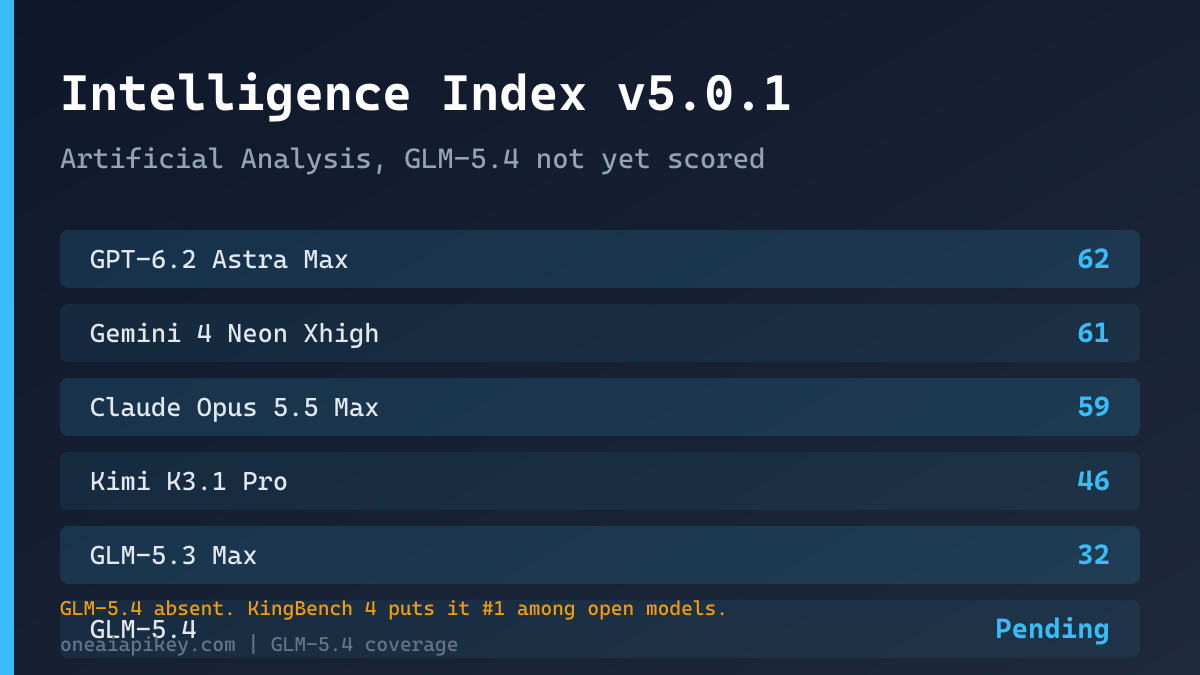
The models that are on the index, at their top reasoning settings, score like this:
| Model | AA Intelligence Index v5.0.1 (Max) |
|---|---|
| GPT-6.2 Astra Max | 62 |
| Gemini 4 Neon Xhigh | 61 |
| Claude Opus 5.5 Max | 59 |
| Kimi K3.1 Pro | 46 |
| DeepSeek V4.1 Flash 1017 Max | 33 |
| GLM-5.3 Max | 32 |
| GLM-5.3-Flash | 28 |
| GLM-5.4 | not listed |
The nearest anchor is GLM-5.3 at 32, sitting just above its own Flash variant at 28 and just below DeepSeek V4.1 Flash at 33. The closed flagships cluster tightly between 59 and 62, well clear of the open pack. Kimi K3.1 Pro sits between the two tiers at 46. For how GLM-5.4 lines up against the top of the field, GLM-5.4 vs frontier works through each closed model individually, and our best frontier models for November 2026 roundup covers the field as a whole.
Why is GLM-5.4 missing from the index? The mechanical reason is access. The index scores models its maintainers can route and call, and GLM-5.4 is not on the pay-as-you-go API. It is available only to GLM Coding Plan subscribers, starting at 18 US dollars a month. An index cannot measure a model it cannot call, so the entry arrives when access widens, not before. That is not a knock on the model, but it does mean there is no measured index rank to quote today.
The absence also shapes every comparison you will see between GLM-5.4 and the closed flagships right now. The usual proxy is GLM-5.3’s score, on the assumption that the new model improves on the old one. Given Z.ai’s own claim, that assumption is reasonable, but a proxy score is not the model’s score. A 32 for GLM-5.3 tells you the neighborhood GLM-5.4 is stepping into. It does not tell you GLM-5.4’s number.
It is worth noticing what the table implies about the shape of the field rather than about GLM-5.4 specifically. The closed models are separated from each other by only three points, a narrow band at the top where small methodological differences could reorder them. The open models spread across a much wider range, from Kimi at 46 down to GLM-5.3-Flash at 28, which means the open tier is less settled and one strong release can move it. GLM-5.4 is the release most likely to do that, which is exactly why its absence is felt.
Prior-generation coding numbers, for context only
The one place you can point to published GLM coding numbers is the previous generation, and those numbers belong to GLM-5.3, not GLM-5.4. On DeepSWE v1.1, GLM-5.3 scored 66.9 against DeepSeek’s 77.0. On Terminal-Bench 4.0, GLM-5.3 scored 37.9 against DeepSeek’s 42.3. GLM-5.4 has no entry on either benchmark.
| Benchmark | DeepSeek | GLM-5.3 | GLM-5.4 |
|---|---|---|---|
| DeepSWE v1.1 | 77.0 | 66.9 | not published |
| Terminal-Bench 4.0 | 42.3 | 37.9 | not published |
Read those two rows as a floor for the family, not a forecast for the new model. They tell you GLM-5.3 trailed DeepSeek on both coding harnesses, and they give you a baseline the technical report will eventually be measured against. They do not tell you whether GLM-5.4 closes that gap, because nobody has published a GLM-5.4 score on either benchmark. Anyone quoting a GLM-5.4 DeepSWE or Terminal-Bench figure right now is guessing, and you should treat it that way.
The same honesty applies across the rest of the standard suite. There are no LiveCodeBench, Aider, LMArena, Design Arena or WebDev Arena numbers for GLM-5.4. There are no third-party vision test results either, even though vision input is the headline feature of the launch, and AICodeKing did not test vision in his run. The model has one independent data point, and it is a coding and agentic harness, nothing more.
Why the missing official table is the real story
It is tempting to treat the absent scorecard as a footnote and move on to vision and quota. That would be the wrong read, for three reasons.
First, the GLM family has a real track record on coding and agentic benchmarks, which is exactly why a missing GLM-5.4 score stands out. This is not a family that historically hides from evaluation. GLM-5.3 has published DeepSWE and Terminal-Bench numbers and an AA index entry. The silence around 5.4 is a change from that pattern, not a continuation of it.
Second, the one strong piece of evidence, KingBench 4, shows a model with an unusual profile. A model that spends fifteen times the reasoning tokens of its comparator can look very different depending on the harness. A benchmark that rewards deep per-step reasoning will favor it. A benchmark that rewards fast end-to-end completion may not. Without an official table across standard suites, you cannot know which kind of model you are getting on which task, and the single-harness 55.3% cannot be converted into an index score or a DeepSWE score.
Third, the pricing hole connects directly to the missing data. GLM-5.4 has no public token price. The rate card still lists GLM-5.3 at 1.40 US dollars per million input tokens and 4.40 per million output as the flagship you can call by the token, and GLM-5.4 pricing and quota covers that gap. A model that generates a million reasoning tokens on a hard task is a model whose value case depends entirely on what its output tokens cost. You cannot judge whether the claimed coding improvement is worth paying for until you have both a price and a score to weigh against each other. Right now you have neither.
What will change the picture, and when
This section will be updated once Z.ai publishes its official benchmark table and technical report. Based on Z.ai’s history, GLM-5.1, 5.2 and 5.3 all shipped with published scores on coding and agentic harnesses and index entries once they reached the pay-as-you-go API, so a reasonable expectation is that GLM-5.4 gets a technical report carrying official coding numbers, followed by an Artificial Analysis entry once the model is broadly callable. That is inference from Z.ai’s own track record, not an announced date or score. Until then there is no official number to report, and this page will carry the honest gap rather than a placeholder.
Three things will move this page. The technical report should carry official coding and architecture numbers and settle whether the stronger-coding claim holds against GLM-5.3 on the same harness. The pay-as-you-go listing unlocks index measurement and lets you weigh a real price against a real score. Wider independent runs either confirm or complicate the KingBench 4 profile, especially the overthinking and timeout behavior, which is the finding most likely to look different on a second harness.
Until those land, the accurate state of the evidence is this: one vendor direction, one credible and unusually detailed independent run placing GLM-5.4 seventh overall and first among open models at 55.3%, a behavioral profile of a deep many-small-steps reasoner, and an open question about how that profile translates to harnesses nobody has run it on yet. That is not a reason to dismiss the model. It is a reason to be precise about what you know.
For what changed model to model, GLM-5.4 vs GLM-5.3 walks the two side by side, and GLM-5.4 context window covers the 1M window both share. For the architecture behind the reasoning style, GLM-5.4 loop transformer covers the Loop, and GLM-5.4 KingBench 4 covers the run in full.
Sign up for a key to call GLM models through hosted access, browse the model catalogue, or run your own volumes through the cost calculator before committing to a plan.
How to evaluate it yourself in the meantime
Since there is no official score to rely on, the practical question is what you can do today to get a real read on GLM-5.4 for your own work. The answer depends on whether you can reach the model at all, and right now that means being a GLM Coding Plan subscriber, since the plan is the only way in.
If you are, build a small fixed set of your own tasks and run both GLM-5.4 and GLM-5.3 against it. Keep the tasks identical across models and across weeks so the comparison means something. Pick a mix that matches how you actually work: a code review task where the model has to find a bug you already know about, a planning task where it has to break a feature into steps, and a generation task where it has to produce working code from a spec. Score them yourself on correctness and on how much you had to fix afterward.
Pay attention to two things the KingBench 4 data says will show up. First, how the model behaves at different reasoning effort settings, since max effort buys about 1.5 times the reasoning of high effort and the per-step speed barely changes. Start at High and watch for the timeout behavior on hard tasks. Second, how it treats the reviewer and planner tasks versus raw generation, because the profile suggests it will do better on the first two. If your own small benchmark confirms that shape, you have a task-specific read more useful to you than any published score.
If you are not on a plan, you cannot reach GLM-5.4 yet. The options are to wait for the pay-as-you-go listing, or to watch for a third-party router that picks the model up. Until you can call it yourself, the honest position is the one this post has described: a vendor direction, one independent run, and no official scores.
More GLM-5.4 coverage
This post is part of a series on the GLM-5.4 launch. The rest of the cluster goes deeper on the areas the launch only sketched:
- GLM-5.4 launch is the hub post on what shipped and what did not
- GLM-5.4 vs GLM-5.3 on what actually changed model to model
- GLM-5.4 vs frontier against the closed flagships
- GLM-5.4 coding performance on the Loop architecture and the reviewer profile
- GLM-5.4 vision on the new image input and screenshot-to-code use
- GLM-5.4 pricing and quota on the 50% bump and the missing token rate
- GLM-5.4 API guide on calling
glm-5.4and the Coding Plan path - GLM-5.4 context window on the 1M window and long-context coding
- GLM-5.4 open weights on whether the vision upgrade ships as open source
- GLM-5.4 self-hosting if the weights go public
- GLM-5.4 KingBench 4 on the early independent run in full
- GLM-5.4 loop transformer on the architecture and the technical report
- GLM-5.4 for code review on the planner and reviewer deployment pattern
- GLM-5.4 alternatives on the open models competing for the same work