GLM-5.4 shipped on 23 November 2026 with a real upgrade and a real limitation. It is live for GLM Coding Plan subscribers, it adds image input to the flagship, and it profiles as a strong reviewer and planner in early testing. What it does not have, on launch day, is a published token price, a place on the pay-as-you-go API, or an entry on the Artificial Analysis intelligence index. That combination pushes a specific question to the front: if you need one of those things today, what should you use instead?
This post lines up the open and coding models competing for the same work, with the published prices and index scores we actually have. The honest starting point is that GLM-5.4’s exact standing is partly unmeasured, because it is not on the index yet and has no public rate card. Where a competitor has a number GLM-5.4 lacks, we say so and let you decide whether it matters for your workload. Our GLM-5.4 launch post covers what shipped, and GLM-5.4 vs frontier sets it against the closed flagships.
What third-party testers say about the gap GLM-5.4 leaves
It is worth grounding the “alternatives” framing in what testers actually observed, because the case for looking elsewhere is not a judgment about quality. It is about what is published and callable. Kingy AI’s review of the launch noted that there is “no first-party scorecard” from Z.ai and “no documented standard API entitlement or token price in Z.ai’s published rate card.” That is the root of the alternatives question. The model is real and reachable, but the two things a procurement decision usually needs, a price and a measured score, are both absent on launch day.
The one strong independent number comes from AICodeKing’s KingBench 4 run, which placed GLM-5.4 seventh overall and first among open models, and led him to call it the “best Open Model you can use right now.” He also named it “the most careful model that I have ever used” and said it catches “bugs and security vulnerabilities that competitors missed.” That is a genuinely strong showing, and it is the reason GLM-5.4 is worth taking seriously at all. But it is one harness, one reviewer, run at max reasoning effort, and when he posted it a reply from @asifroyal captured the situation exactly: “That’s the first number I’ve seen for 5.4. Z.ai hasn’t put out a model card.” There is no second tester, no Artificial Analysis entry, and no official table to set beside it.
There is also a live question about openness that affects the alternatives choice. When AICodeKing’s run circulated, @teortaxesTex asked simply, “will it be open though?” No answer has come from Z.ai. The weights are not published, and nothing has been said about whether they will be. For anyone whose decision turns on open weights, that unanswered question is itself the reason to keep a published-weights alternative in the picture. The models in this post all have weights you can inspect today, or in GLM-5.3’s case a released open-weights license, and our GLM-5.4 open weights post tracks whether that changes.
So the honest read is not that GLM-5.4 is weak. It is that GLM-5.4 asks you to accept three gaps on launch day, no published price, no index score, and no published weights, and the four models below each close at least one of those gaps. Which one fits depends on which gap is binding for you.
The models in the frame
Four models are the closest substitutes for GLM-5.4 right now, each published and callable today:
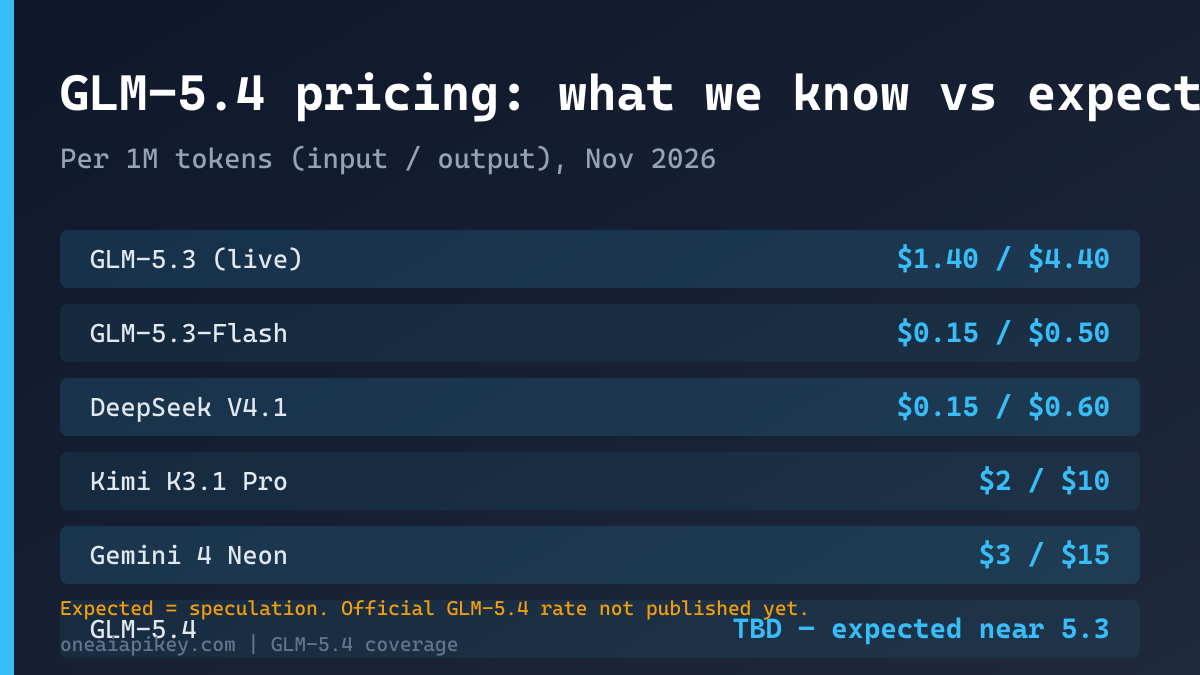
- DeepSeek V4.1 Flash 1017. MIT-licensed, 0.15 dollars per million input tokens and 0.60 per million output off-peak, and an Artificial Analysis index score of 33 at Max reasoning.
- Kimi K3.1 Pro. Custom license, 2 dollars input and 10 output per million tokens, and an index score of 46, the highest of the open and open-weights group.
- GLM-5.3. Z.ai’s prior flagship, custom open-weights license, 1.40 dollars input and 4.40 output, index score of 32 at Max.
- GLM-5.3-Flash. MIT-licensed, 0.15 dollars input and 0.50 output, index score of 28, and multimodal with text, image, video and file input.
GLM-5.4 has none of those published figures yet: no token price, no index score, and no published weights. That is not a flaw in the model, it is a fact about launch day, and it is the whole reason an alternatives post is useful this week.
The pricing and index picture in one table
The fastest way to see why the alternatives matter is to put the published numbers side by side. Everything in this table is official, from provider rate cards or the Artificial Analysis index v5.0.1, except the GLM-5.4 row, which is the point of this post.
| Model | Input $/1M | Output $/1M | AA index (Max) | Weights |
|---|---|---|---|---|
| GLM-5.4 | not published | not published | not on index | not released |
| GLM-5.3 | $1.40 | $4.40 | 32 | custom open |
| GLM-5.3-Flash | $0.15 | $0.50 | 28 | MIT |
| DeepSeek V4.1 Flash 1017 | $0.15 off-peak / $0.30 peak | $0.60 off-peak / $1.20 peak | 33 | MIT |
| Kimi K3.1 Pro | $2.00 | $10.00 | 46 | custom open |
The GLM-5.4 row being empty is not a formatting accident. It is the factual state of launch day, and it is why each alternative below is framed around the specific thing it publishes that GLM-5.4 does not. For the Coding Plan cost picture, which is the only way to reach GLM-5.4 today, our GLM-5.4 pricing post has the tier detail.
DeepSeek V4.1 Flash 1017: when you need a published token price now
DeepSeek V4.1 Flash 1017 is the model to reach for when the thing you need is a price you can put in a budget today. Its rates are printed and public: 0.15 dollars per million input tokens and 0.60 per million output off-peak, rising to 0.30 and 1.20 at peak. It is MIT-licensed, so the weights are open and you can self-host if you want to. Its Artificial Analysis index score is 33 at Max, which puts it just above GLM-5.3’s 32.
That is a strong value case. For a fraction of a cent per token you get an open model with a measured index score, and for high-volume work the off-peak rates are among the cheapest in the group. The peak and off-peak split also gives you a scheduling lever most of this group lacks: shift batch and non-urgent jobs to off-peak and the effective rate drops by half. Our hy4-flash-vs-glm-5-3-flash comparison covers how the budget open-model tier lines up more broadly, and the pricing mechanics are the same shape as what our AI API pricing guide walks through.
The trade is capability at the top end. DeepSeek V4.1 Flash’s index score of 33 is well below Kimi K3.1 Pro’s 46 and below every closed flagship, so on measured reasoning it is a value pick rather than a frontier one. It also carries a real prior-generation record: on the DeepSWE v1.1 coding benchmark DeepSeek scored 77.0 against GLM-5.3’s 66.9, and on Terminal-Bench 4.0 DeepSeek scored 42.3 against GLM-5.3’s 37.9, so the DeepSeek coding line has a measured lead over the last GLM flagship on those two boards. GLM-5.4 has no entries on either benchmark, and no published index score to compare against, so we cannot say from any published number whether it beats DeepSeek on capability. What we can say is that DeepSeek publishes a price and GLM-5.4 does not, and that if a published rate is what unblocks your project this week, DeepSeek is the open model with one.
Pick DeepSeek V4.1 Flash 1017 over GLM-5.4 when a fixed, budgetable token price matters more than reaching GLM-5.4’s Coding Plan, or when MIT licensing and self-hosting are requirements GLM-5.4 cannot meet today.
Kimi K3.1 Pro: when you want the strongest measured open model
Kimi K3.1 Pro is the model to pick when measured capability matters more than price and you want the highest index score available among the open and open-weights options. Its Artificial Analysis score is 46, well ahead of DeepSeek’s 33 and GLM-5.3’s 32, and it carries a custom license with published weights. The price is 2 dollars per million input tokens and 10 per million output, which makes it the most expensive model in this group by a clear margin.
The 46 is the number to take seriously. It sits below the closed flagships, GPT-6.2 Astra Max at 62, Gemini 4 Neon Xhigh at 61 and Claude Opus 5.5 Max at 59, but it is a genuine step above the rest of the open field. If your workload is hard reasoning or complex coding and you need an open-weights model, Kimi is the strongest measured option in this comparison, and our inkling-2-mini-vs-frontier and best-frontier-models-november-2026 pieces show where the closed models above it sit.
GLM-5.4’s case against Kimi rests on early independent testing rather than the index. AICodeKing’s KingBench 4 run placed GLM-5.4 seventh overall and first among open models, and he called it the best open model you can use right now. That is a different harness from the index, one reviewer rather than a published composite, so the two claims are not directly comparable. The honest read is that Kimi has the highest published index score in this group and GLM-5.4 has the strongest early KingBench placement, and which matters more depends on whether you trust a composite index or a single harness. Our GLM-5.4 KingBench 4 post covers that run in detail.
Pick Kimi K3.1 Pro over GLM-5.4 when you need the highest published capability score among open models and can absorb the 2 and 10 dollar rates, or when a decision has to be defended with a published composite score rather than a single reviewer’s run.
GLM-5.3: when you need a model on the pay-as-you-go API today
GLM-5.3 is the model to pick when what you need is a GLM flagship you can call by the token right now. It is on the pay-as-you-go API, it is priced at 1.40 dollars per million input tokens and 4.40 per million output, and it carries an index score of 32 at Max. It is text-only, and its weights were released under a custom open license. This is the model Z.ai’s rate card still lists as the newest flagship you can call by the token.
For teams already building on GLM, GLM-5.3 is the path of least disruption. You keep the same model family, the same API shape and the same open-weights license, and you get a published price and a measured index score today rather than waiting for GLM-5.4’s rate-card entry. Our GLM-5.4 vs GLM-5.3 post covers exactly what changed between the two, and it is the place to start if you are deciding whether to stay on GLM-5.3 or move plan traffic to the new flagship.
The limitation is that GLM-5.3 is text-only. If your workload needs image input, GLM-5.3 cannot do it, and neither could GLM-5.4’s predecessor in the flagship tier. That gap is the main reason to look at GLM-5.3-Flash instead, and our GLM-5.4 vision post covers what the new flagship’s image input adds.
There is also a quota angle that matters if you are on a plan rather than the token API. Z.ai gives weekly-quota users 50% more GLM-5.4 quota than GLM-5.3, so subscribers who run both will see the new flagship consume their weekly pool faster per task, especially given how reasoning-heavy it is in testing. On the token API that does not apply, and GLM-5.3’s published 1.40 and 4.40 rates are simply what you pay. Our GLM-5.4 context window post covers the shared 1M window both flagships carry.
Pick GLM-5.3 over GLM-5.4 when you need a GLM flagship on the pay-as-you-go API today with a published price, or when you want to stay on an open-weights model whose license and weights are already released.
GLM-5.3-Flash: when you need cheap, open and multimodal
GLM-5.3-Flash is the model to pick when you need three things at once: a very low price, an MIT license, and multimodal input. It runs 0.15 dollars per million input tokens and 0.50 per million output, the same input price as DeepSeek V4.1 Flash and slightly cheaper on output. It is MIT-licensed, which is the most permissive license in this group and the simplest to build a product on. Its index score is 28 at Max, the lowest here. And it accepts text, image, video and file input, which neither GLM-5.3 nor the text-only flagship tier offered before GLM-5.4.
That combination makes GLM-5.3-Flash the default for high-volume multimodal work on a budget. If you are building screenshot-to-code, document parsing, or any pipeline that reads images and runs at scale, it is the cheapest open multimodal option in this comparison and its license leaves you the most freedom. Our hy4-flash-vs-glm-5-3-flash comparison shows how it stacks against the prior small GLM tier, and our GLM-5.4 open weights post covers the licensing picture across the family.
The trade is capability. At 28 on the index it is the weakest measured model here, so for hard reasoning or complex coding it is not the pick. GLM-5.4’s multimodal upgrade is the direct answer to it at the flagship level, and the early KingBench placement suggests a large capability gap, but GLM-5.4 has no published price to compare against GLM-5.3-Flash’s 0.15 and 0.50.
Pick GLM-5.3-Flash over GLM-5.4 when you need cheap, MIT-licensed, multimodal input at scale today, and measured reasoning capability is not the top requirement.
Choosing by what you need today
The cleanest way to pick is to start from the constraint you actually have, not from the model with the best headline. If the constraint is a published token price for a budget or a cost model, DeepSeek V4.1 Flash 1017 is the open pick and GLM-5.3-Flash is the cheap multimodal pick. If the constraint is the highest measured capability among open models, Kimi K3.1 Pro has the best published index score. If the constraint is staying on a GLM flagship you can call by the token today, GLM-5.3 is already there. If the constraint is an MIT license, both DeepSeek V4.1 Flash and GLM-5.3-Flash qualify.
GLM-5.4 is the right pick in a different situation: you are already a Coding Plan subscriber, you want the flagship’s new image input, and your workload matches the reviewer and planner profile from the KingBench run. Our GLM-5.4 for code review post covers that deployment pattern, and GLM-5.4 coding performance covers the coding picture more broadly. For pure availability, the Coding Plan is the only way to reach it today, and our GLM-5.4 API guide walks the plan path.
None of this is a permanent ranking. The two facts most likely to change it are a published GLM-5.4 token price and an index entry, and both are the kind of thing that arrives in the weeks after a launch. Our GLM-5.4 pricing post tracks the rate card, and GLM-5.4 benchmarks will cover official scores once Z.ai publishes them. Until then, the models above are the published, callable alternatives.
Licenses and open weights, compared
Price and capability are only two of the three things that decide whether a model fits a product. The third is the license, and in this group it separates the field more cleanly than either of the other two. DeepSeek V4.1 Flash 1017 and GLM-5.3-Flash are both MIT-licensed, which is the most permissive option here and the easiest to build a commercial product on. Kimi K3.1 Pro and GLM-5.3 both use custom licenses with open weights, which means you can inspect and run the weights but the terms carry conditions you need to read before shipping. The closed flagships are not in this comparison on weights at all.
That distinction matters most for two kinds of team. If you are self-hosting, the MIT models are the simple case: no negotiation, no legal review, weights in and a server out. Our GLM-5.4 self-hosting post covers what that path looks like when a model’s weights are available. If you are building a hosted product and want the freedom to redistill, fine-tune and ship without a bespoke agreement, MIT is again the cleaner starting point.
GLM-5.4 sits outside this part of the comparison entirely. Its weights are not published as of launch day, so there is no license to evaluate and no way to self-host it. That is one more thing the alternatives have that GLM-5.4 does not, and it is a real reason to pick one of them if local deployment is a requirement. The question is genuinely open rather than answered either way. As @teortaxesTex asked on the launch thread, “will it be open though?” Z.ai has not said, and our GLM-5.4 open weights post tracks whether and when the new flagship ships as open source. GLM-5.4 vs GLM-5.3 covers how the licensing changed across the flagship line.
The input-modality split
One more axis separates these models, and it is easy to miss when the focus is on price and index scores. GLM-5.3 is text-only. DeepSeek V4.1 Flash 1017, Kimi K3.1 Pro and the closed flagships all accept text and image. GLM-5.3-Flash accepts text, image, video and file, which makes it the most broadly multimodal model in this group despite being the weakest on measured reasoning. GLM-5.4 brings image input up to the flagship for the first time, which is the headline change that most directly answers GLM-5.3’s text-only gap.
The practical consequence is that modality can decide the pick before price does. If your workload reads screenshots, documents, or design mocks, GLM-5.3 drops out of the running no matter how convenient its price and API access are. If you need video or file input and you are staying on published, callable models, GLM-5.3-Flash is the only model in this group that takes them, which is a genuine reason to accept its lower index score. Our GLM-5.4 vision post covers what the flagship’s new image input adds, and our hy4-flash-vs-glm-5-3-flash comparison shows how the small multimodal GLM tier lined up before this release.
The closed frontier, for context
None of the models above are the strongest measured models available. That context is worth stating plainly so the open-model comparison is not mistaken for the whole field. The published Artificial Analysis index v5.0.1 has GPT-6.2 Astra Max at 62, Gemini 4 Neon Xhigh at 61 and Claude Opus 5.5 Max at 59, all well above Kimi K3.1 Pro’s 46 and far above the rest of this group. Those are closed models with closed weights and materially higher prices, 4 and 20 dollars for Claude Opus 5.5, 3 and 15 for Gemini 4 Neon, and 8 and 40 for GPT-6.2 Astra within its lower context tier. Our best-frontier-models-november-2026 roundup lines them up in full.
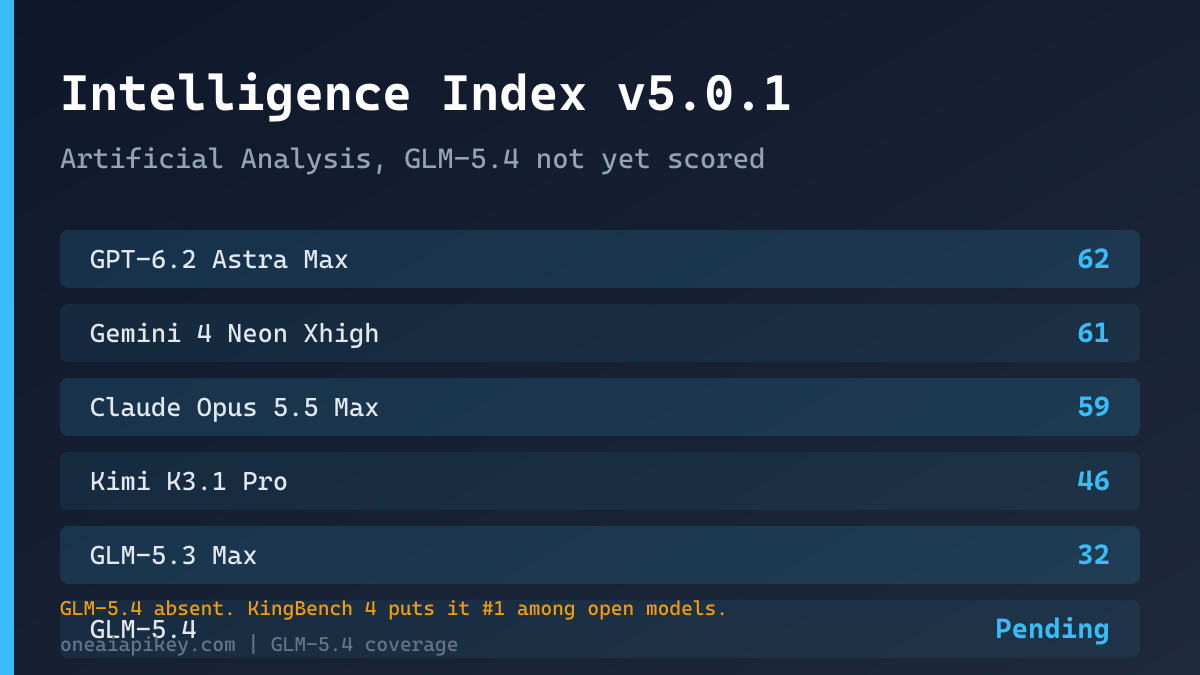
Where GLM-5.4 fits against that closed tier is unresolved, because it has no index entry. Its strongest published signal is the KingBench placement first among open models, which says it leads the open field on one harness without saying where it lands against the closed flagships on measured composite scores. Until an index entry or official benchmarks land, the closed tier remains the measured ceiling and the models in this post are the open and affordable field below it. Our GLM-5.4 vs frontier post tracks that gap directly, and gpt-6-2-astra-vs-claude-opus-5-5 covers the top of the closed field.
Access paths, and where GLM-5.4 is not yet
Availability is the last axis, and it is the one GLM-5.4 is furthest behind on. The four alternatives above are all callable through a published, metered API today. GLM-5.4 is not. It is reachable only through the GLM Coding Plan, which starts at 18 dollars a month for the Lite tier with 2,000 five-hour credits and 10,000 weekly credits, and rises through Pro at 80 dollars and Max at 168 dollars. Subscribers must select glm-5.4 manually, there is no auto-upgrade, and OpenRouter, TeamoRouter and Artificial Analysis all returned unavailable or placeholder pages when checked on launch day.
That gating is a real cost to adopting GLM-5.4 for anything beyond personal experimentation. A team that needs an API key it can hand to a CI pipeline, a hosted product, or a procurement process cannot use a model that only exists behind a developer subscription. For those teams, GLM-5.3 is the GLM answer, DeepSeek and Kimi are the open answers, and the closed flagships are the measured ceiling. Our GLM-5.4 API guide covers the plan path and what is not live yet.
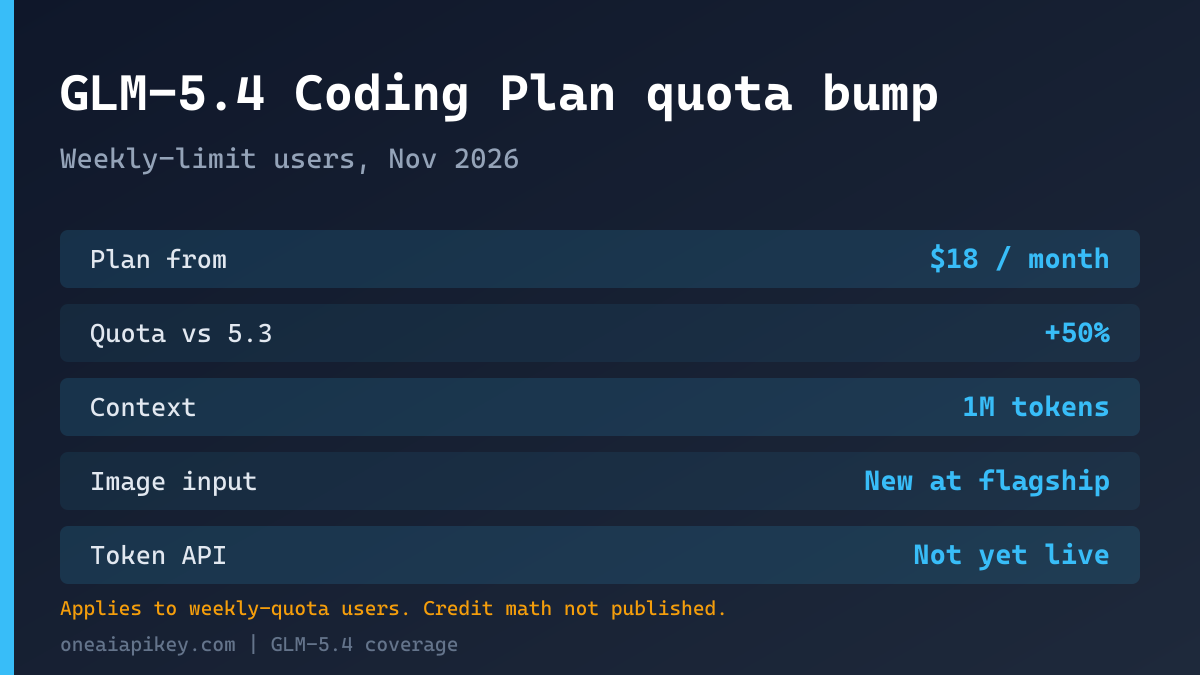
The quota bump is the counterweight, and it is the single concrete cost benefit GLM-5.4 offers over every alternative in this post. Weekly-quota users get 50% more GLM-5.4 quota than GLM-5.3, which means a Lite subscriber’s effective weekly pool for the new flagship is 15,000 credits rather than 10,000. That does not make GLM-5.4 cheaper than DeepSeek’s 0.15 and 0.60 rates, because a plan quota and a metered rate are not the same unit, but it does mean an existing subscriber can run more GLM-5.4 than GLM-5.3 before hitting the wall. For a team already paying for the plan, that is a genuine reason to route the reviewer-and-planner work to GLM-5.4 rather than one of the alternatives. Our GLM-5.4 pricing post has the full tier and dual-pool breakdown.
Future update: the pricing and index gaps
This section will be updated once Z.ai publishes the official token price and Artificial Analysis adds GLM-5.4 to the index. Both are the missing pieces that make this comparison incomplete. Based on Z.ai’s pricing history, GLM-5.1, 5.2 and 5.3 all launched at 1.40 dollars input and 4.40 dollars output per million tokens, a reasonable expectation is that GLM-5.4 lands at or near that anchor when it reaches the pay-as-you-go API. That is inference from Z.ai’s own track record, not an announced price. No analyst has published a numeric GLM-5.4 prediction, and we are not going to invent one, so treat the 1.40 and 4.40 anchor as a reasoned expectation rather than a figure you can budget against.
On capability, the same honesty applies. GLM-5.4 is absent from the Artificial Analysis index v5.0.1, where GLM-5.3 sits at 32 and GLM-5.3-Flash at 28. Based on Z.ai’s history of each flagship landing on the index within weeks of launch, a reasonable expectation is an entry in the low-to-mid 30s or higher, given the KingBench placement ahead of the open field. That is inference, not a published score, and it could land anywhere until Artificial Analysis runs it. We will replace both expectations with real numbers in this post the moment they are published.
A note on what is not yet measured
It is worth being explicit about the gaps one more time, because this post leans on published numbers heavily and it is easy to over-read what they cover. GLM-5.4 is not on the Artificial Analysis intelligence index v5.0.1, so it has no composite score to set beside Kimi’s 46 or DeepSeek’s 33. It has no public token price, so cost comparisons against DeepSeek’s 0.15 and 0.60 or Kimi’s 2 and 10 are not possible yet. Its weights are not published, so the licensing comparison against DeepSeek’s MIT and GLM-5.3-Flash’s MIT is incomplete. And Z.ai’s coding claim for the model is a vendor claim with no benchmark table behind it, which is the “no first-party scorecard” gap Kingy AI flagged.
What we do have is AICodeKing’s KingBench 4 run, which placed it first among open models on one harness, and a reasoning profile that is genuinely distinctive. That is a real signal, and it is enough to justify trying GLM-5.4 inside a plan you already pay for. It is not enough to declare it the winner on value, because value needs a price and there is not one yet. The prior-generation benchmark record also cuts in DeepSeek’s favor on the measured coding boards, where DeepSeek leads GLM-5.3 on both DeepSWE v1.1 at 77.0 to 66.9 and Terminal-Bench 4.0 at 42.3 to 37.9, and GLM-5.4 has no entries. We will update this comparison when the rate card, the index entry and the official benchmark tables land.
Sign up for a key to call GLM models through hosted access, browse the model catalogue, or run your own volumes through the cost calculator before committing to a plan or an API integration.
More GLM-5.4 coverage
This post is part of a series on GLM-5.4. The rest of the cluster goes deeper on the areas this one only sketched, and each links back to the launch hub:
- GLM-5.4 launch on what shipped and what did not
- GLM-5.4 benchmarks once Z.ai publishes the official tables
- GLM-5.4 vs GLM-5.3 on what actually changed model to model
- GLM-5.4 vs frontier against the closed flagships
- GLM-5.4 coding performance on the Loop architecture and the reviewer profile
- GLM-5.4 vision on the new image input and screenshot-to-code use
- GLM-5.4 pricing on the quota bump and the missing token rate
- GLM-5.4 API on calling
glm-5.4and the Coding Plan path - GLM-5.4 context window on the 1M window and long-context coding
- GLM-5.4 open weights on licensing across the GLM family
- GLM-5.4 self-hosting if the weights go public
- GLM-5.4 KingBench 4 on the early independent run in full
- GLM-5.4 loop transformer on the architecture and the technical report
- GLM-5.4 for code review on the reviewer and planner deployment pattern