Z.ai shipped GLM-5.4 on 23 November 2026, and the release is deliberately narrow. It is live for GLM Coding Plan subscribers today, it adds image input to a flagship that was text-only, and it gives weekly-quota users 50% more headroom than GLM-5.3. What it does not do yet is appear on the pay-as-you-go API, publish a model card, or release benchmark scores. That combination, a real upgrade wrapped in a limited rollout, is the whole story of this launch, and it is the part most coverage will skip.
This post walks what actually shipped, the vision and coding changes, the quota math, the early KingBench 4 numbers that put GLM-5.4 near the top of the open-model pack, the pricing picture that is still a hole, and how it stacks against GLM-5.3 and the current frontier. If you want the deep benchmark teardown, that comes once Z.ai publishes official numbers, and we will cover it then.
What GLM-5.4 is, in one paragraph
GLM-5.4 is the newest flagship in Z.ai’s GLM series, announced by Z.ai lead Zixuan Li and released to GLM Coding Plan subscribers on 23 November 2026. It accepts text and image input, targets stronger all-round coding performance, keeps the 1 million token context window of GLM-5.3, and carries the model ID glm-5.4 inside the Coding Plan. It is not yet on the standard pay-as-you-go API, and Z.ai has not published a model card, benchmark table, or public weights as of launch day. The GLM series has a long history, and the closest predecessor in spirit is Hy4 Flash vs GLM-5.3-Flash, which maps how the smaller GLM tier competed before this release. GLM-5.4 is the most aggressive multimodal step the flagship line has taken.
The launch, as it happened
The release came through Z.ai’s own channels and a wave of community reaction. Zixuan Li highlighted two things in the announcement, improved vision capabilities and stronger all-round coding performance, building on a series that already benchmarks well on coding and agentic tasks. Community members met the news with visible relief. One post that circulated widely read, simply, “After such a long wait, GLM 5.4 is finally out!” That reaction tells you something about the gap between GLM-5.3 and GLM-5.4: this was a waited-for release, not a surprise drop.
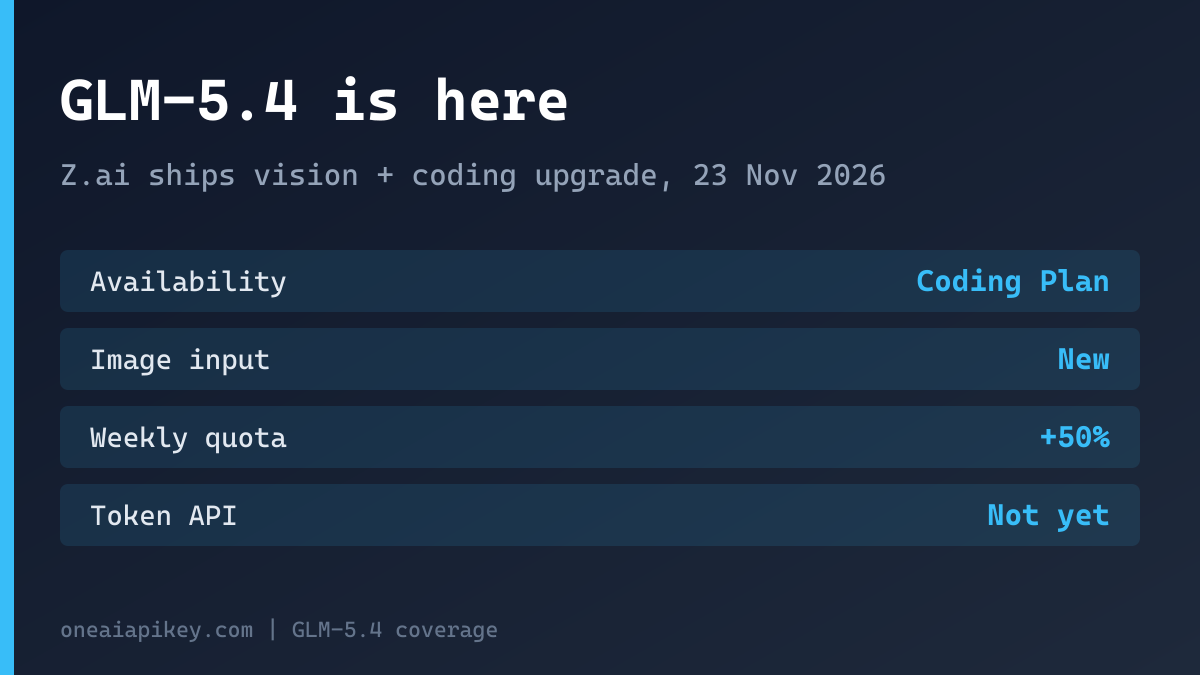
The rollout is the restrictive part. GLM-5.4 is available to Coding Plan subscribers, which start at 18 US dollars a month, and it is not on the pay-as-you-go API yet. Z.ai’s public price page still lists GLM-5.3 as the newest model you can call by the token. That means if you are on a plan, you can try glm-5.4 right now. If you are not, you cannot, and that is the single most important availability fact about this launch. GLM-5.3 is the model still on the token API today, and GLM-5.4 vs GLM-5.3 will cover the handoff as the rollout widens.
Vision is the headline change
The clearest upgrade is modality. GLM-5.3, the flagship, is text-only. Image input in the GLM-5.3 generation lived in the smaller GLM-5.3-Flash, which accepted text, image, video and file input. With GLM-5.4, image input moves up to the flagship for the first time, and GLM-5.4 vision covers what that unlocks.
That matters for coding more than it first appears. A coding model that can read an image can take a screenshot of a UI and turn it into code, read an error dialog in a screenshot, or reason over a design mock. This is the same direction the rest of the frontier has already moved. Gemini 4 Neon accepts text, image, video, audio and PDF input. GPT-6.2 Astra and Claude Opus 5.5 both accept text and image. GLM-5.4 closes a real gap by bringing the flagship to image input, though Z.ai has not yet documented the supported image formats or size limits, which is worth knowing before you build a screenshot-to-code pipeline on it. Our GLM-5.4 vs frontier piece tracks this gap model by model.
Coding performance: claimed, not yet measured
Z.ai describes GLM-5.4 as having stronger all-round coding performance than GLM-5.3, and the series has a genuine track record on coding and agentic benchmarks to build on. But there is no benchmark table in the launch announcement. No SWE-Bench score, no Terminal-Bench score, no side-by-side against GLM-5.3 on any public harness. Z.ai says a technical report is coming later, and until it does, the coding claim is a vendor claim.
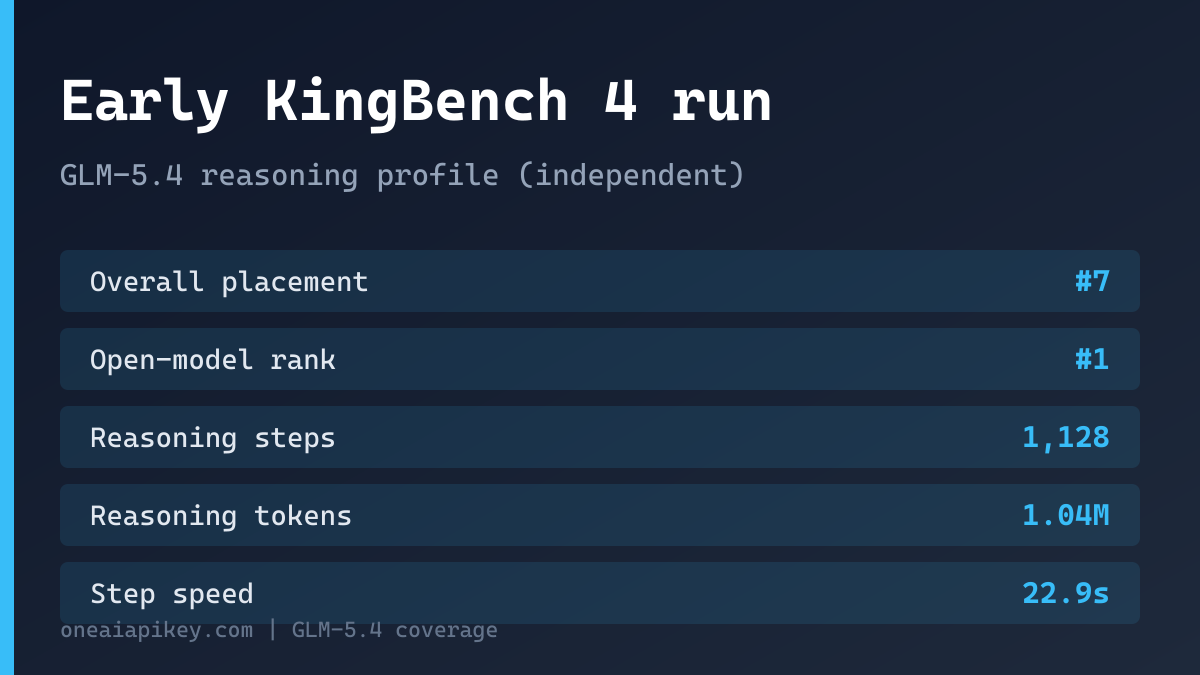
There is one early independent signal, and it is worth reading carefully. AICodeKing ran GLM-5.4 through KingBench 4 and reported it landing at position 7 overall, which he called the top placement for an open model and “the best open model you can use right now.” His run also surfaced a distinctive behavioral profile that tells you how the model is built, which we come back to below. For context on how the open-model field lines up more broadly, our frontier models roundup covers the models GLM-5.4 is now competing against.
The 50% quota bump, decoded
The most concrete day-one benefit for subscribers is a quota change. Z.ai states that users with weekly limits get 50% more GLM-5.4 quota than they got with GLM-5.3. That is a real increase in how much work you can push through the plan in a week, and it is the clearest incentive Z.ai is offering to move plan users onto the new model.
Two caveats keep this from being a clean number. First, the 50% applies to users on weekly quotas specifically; if your plan is metered some other way, the announcement does not spell out your gain. Second, Z.ai did not publish the underlying credit math, the per-tier credit totals, or a token-to-credit formula, so you cannot yet compute exactly how many more tokens 50% more quota buys you. The honest read is that plan users get meaningfully more room on GLM-5.4 than on GLM-5.3, and the exact figure depends on your tier. Our AI API pricing guide explains how to read plan quotas against pay-as-you-go rates when the numbers are not printed side by side.
The architecture hint: a loop, and a big parameter count
One technical detail surfaced early and it shapes how you should think about the model. Z.ai has said the past three months of work went into scaling both what it calls the Loop and model size, and that the Loop Transformer is the first improvement users will notice. Separately, AICodeKing reported, with the explicit caveat that he was not certain, that GLM-5.4 is a looped transformer with roughly 700 billion parameters and that a technical report is coming.
If that holds, it reframes the coding behavior. A looped architecture runs the same weights through multiple passes rather than scaling width, which lets a model reason for more steps without the parameter count exploding. That is consistent with what the early KingBench 4 run showed, where GLM-5.4 took far more reasoning steps than a comparable frontier model. Treat the 700 billion figure as unconfirmed until Z.ai publishes the technical report, but the Loop framing is from Z.ai itself.
What the early KingBench 4 run actually showed
The most data-rich early signal is AICodeKing’s KingBench 4 run, and it is more interesting for what it reveals about how GLM-5.4 works than for the headline placement. Set against a model he calls “Neon,” GLM-5.4 was roughly four times slower on max reasoning effort, 431 minutes against Neon’s 109. But the per-step speed was similar, 22.9 seconds a step against Neon’s 26.7. The difference was that GLM-5.4 took 1,128 steps to Neon’s 244, and generated about 1.04 million reasoning tokens against Neon’s roughly 70,000.
That is a model that thinks in many small steps rather than a few large ones. AICodeKing also noted that GLM-5.4 reasons on nearly every step, with under 1% of steps showing near-zero reasoning, against a 14 to 39% near-zero rate for GPT models. At max effort it produces about 1.5 times the reasoning of high effort. Tool-call reliability came in at a 1.56% failure rate, 11th of 17 harnesses, with 66% of those failures recovered by retry, and cache hit rates of 96 to 99% with a 4.1 second median time to first token.
His use-case read follows directly from that profile. GLM-5.4 is best used as a reviewer for bugs and security, a planner, or for big-picture work, not as an end-to-end state-of-the-art coding model that you point at a task and let run. A model that reasons deeply on every step is a strong reviewer and a strong planner, and an expensive one to run as a raw code generator. That is a genuinely useful deployment hint, and it is one reviewer’s observation rather than a vendor benchmark, so weight it accordingly. For a broader read on the models at the top of the coding boards, see our Inkling 2 Mini vs frontier and GLM-5.4 coding performance breakdowns.
The pricing picture is the open question
Here is the friction. GLM-5.4 has no public token price. Z.ai’s rate card still lists GLM-5.3, at 1.40 US dollars per million input tokens and 4.40 per million output tokens, as the flagship on the pay-as-you-go API. Until GLM-5.4 gets a rate-card entry, the only way to use it is through a Coding Plan, and the only published plan price is the 18 dollar a month entry tier.
That matters because GLM-5.4’s early profile is token-hungry. A model that generates a million reasoning tokens on a hard task is a model whose output-token price will dominate your bill if it is metered like GLM-5.3. The plan quota may absorb that for subscribers, but anyone waiting for pay-as-you-go access should watch the rate card closely. For comparison, DeepSeek V4.1 Flash runs 0.15 dollars input and 0.60 output off-peak, and Kimi K3.1 Pro runs 2 and 10, both visible in the GPT-6.2 Astra pricing breakdown that sets them side by side. GLM-5.4’s eventual token price, when it lands, will decide whether it competes on value or only on capability. Our Gemini 4 Neon pricing guide shows how to read per-token rates across providers when the numbers are not printed together.
How GLM-5.4 stacks against the field
Set against the current frontier, GLM-5.4’s position is “top of the open models, behind the closed flagships, with caveats.” The published Artificial Analysis Intelligence Index v5.0.1 has GPT-6.2 Astra Max at 62, Gemini 4 Neon Xhigh at 61, Claude Opus 5.5 Max at 59, Kimi K3.1 Pro at 46, DeepSeek V4.1 Flash 1017 Max at 33 and GLM-5.3 Max at 32. GLM-5.4 has no entry on that index yet, so its exact rank is unmeasured there. AICodeKing’s KingBench 4 placement at 7 overall, and first among open models, is the only independent placement available today, and it is one harness.
The honest summary is that GLM-5.4 is the strongest open-model coding option in its early testing, it is not yet competing with the closed frontier on measured index scores, and its value case depends entirely on a token price Z.ai has not published. For a fuller spread, our best frontier models roundup lines up the closed models, and GLM-5.4 vs GLM-5.3 shows exactly what changed model to model.
Should you switch today
If you are a GLM Coding Plan subscriber with a weekly quota, the case for switching is straightforward. You get image input on the flagship, a claimed coding improvement, and 50% more quota on a model that is live now. There is no downside to routing plan traffic to glm-5.4 and comparing it to GLM-5.3 on your own tasks, and the quota bump means you lose nothing by trying.
If you use GLM-5.3 through the pay-as-you-go API, nothing changes today. GLM-5.4 is not on the token API, GLM-5.3 remains the newest model there, and you should not expect to call glm-5.4 by the token until Z.ai adds it to the rate card. If you are not on a plan at all, the fastest way to use GLM-5.4 right now is through a Coding Plan subscription, or through one of the third-party routers that have already picked it up, several of which we cover in our Inkling 2 Mini cheapest hosted guide to router access.
If you are evaluating it for a screenshot-to-code or vision workflow, hold one beat. The image input is real and confirmed, but Z.ai has not documented supported formats or size limits, and there is no published vision benchmark yet. Build a small test before you commit a pipeline to it. And if you are weighing it purely as a coding model, remember AICodeKing’s deployment hint: it profiles as a reviewer and planner, not a raw generator, so the highest-value use is likely code review and planning rather than autonomous code generation.
The five questions this launch leaves open
GLM-5.4 ships with a set of unanswered questions that will define how it is judged over the next few weeks. First, what is the token price, and when does it hit the pay-as-you-go API. Second, what does the official model card say about parameter count, and does the 700 billion looped-transformer figure hold. Third, what are the official coding and vision benchmark scores, and how do they compare to GLM-5.3 on the same harness. Fourth, will the weights be open-sourced, as GLM-5.3 was, or does the vision upgrade stay behind the plan. Fifth, what are the supported image formats and size limits for the new vision input.
Each of those gets its own treatment as the picture fills in. We are covering the benchmark question in depth once Z.ai publishes numbers, and the deployment and self-hosting question if the weights go open. For now, GLM-5.4 is a real, waited-for upgrade that lives behind a plan wall, and the strongest open-model coding option in early independent testing. The technical report and the token price are the two things to watch.
Sign up for a key to call GLM models through hosted access, browse the model catalogue, or run your own volumes through the cost calculator before committing to a plan or an API integration.
More GLM-5.4 coverage
This is the first post in a series on GLM-5.4. The rest of the cluster goes deeper on the areas this launch only sketched, and each links back here:
- GLM-5.4 benchmarks once Z.ai publishes the official tables
- GLM-5.4 vs GLM-5.3 on what actually changed model to model
- GLM-5.4 vs frontier against the closed flagships
- GLM-5.4 coding performance on the Loop architecture and the reviewer profile
- GLM-5.4 vision on the new image input and screenshot-to-code use
- GLM-5.4 pricing and quota on the 50% bump and the missing token rate
- GLM-5.4 API guide on calling
glm-5.4and the Coding Plan path - GLM-5.4 context window on the 1M window and long-context coding
- GLM-5.4 open weights on whether the vision upgrade ships as open source
- GLM-5.4 self-hosting if the weights go public
- GLM-5.4 KingBench 4 on the early independent run in full
- GLM-5.4 loop transformer on the architecture and the technical report
- GLM-5.4 for code review on the planner and reviewer deployment pattern
- GLM-5.4 alternatives on the open models competing for the same work