GLM-5.4 replaces GLM-5.3 as the flagship of Z.ai’s GLM series, and on the surface the two look close. Same maker, same model family, same 1 million token context window, same home inside the GLM Coding Plan. The real differences are concentrated in a few places: vision, quota, coding, price and access. Two of those are upgrades you can use today, one is a claim, and two are holes. Comparing them honestly means knowing which is which.
This post walks the two models side by side on everything that matters when you decide which one to route work to. The short version is that GLM-5.4 adds image input at the flagship level, gives weekly-quota subscribers 50% more room, and claims stronger coding. GLM-5.3 keeps two advantages for now: it is the only one of the pair on the pay-as-you-go token API, and it is the only one with a published price. Here is the full comparison.
The comparison at a glance
| Dimension | GLM-5.4 | GLM-5.3 |
|---|---|---|
| Released | 23 November 2026 | earlier in the GLM-5.3 generation |
| Input | text and image | text only |
| Context window | 1M tokens | 1M tokens |
| Coding Plan quota | 50% more than GLM-5.3 | baseline |
| Coding performance | stronger, claimed, no scores | published track record |
| Token price | not published | $1.40 in / $4.40 out per 1M |
| Pay-as-you-go API | not yet | yes |
| Weights | not published | custom license, open weights |
| Model ID | glm-5.4 |
glm-5.3 |
Every row in that table traces to Z.ai’s own launch announcement or to published GLM-5.3 material. Where a cell says not published, that is the actual state, not a placeholder for a number we skipped.
Reading the table as a whole, the pattern is that GLM-5.4 wins on capability and GLM-5.3 wins on openness and measurability. Three rows go to GLM-5.4: the vision input, the quota bump and the claimed coding gain. Two go to GLM-5.3: the published price and the open weights. One is a tie, the context window. That is a genuinely mixed comparison, and it is more honest than the usual framing of a new model simply replacing its predecessor. GLM-5.3 is not obsolete. It is the more accessible and better-documented model, and it stays that way until Z.ai closes the gaps.
Vision: the clearest difference
The biggest change between the two flagships is modality. GLM-5.3 is a text-only model. In the GLM-5.3 generation, image input lived in the smaller GLM-5.3-Flash variant, which accepted text, image, video and file input, while the flagship stayed text-only. With GLM-5.4, image input moves up to the flagship for the first time.
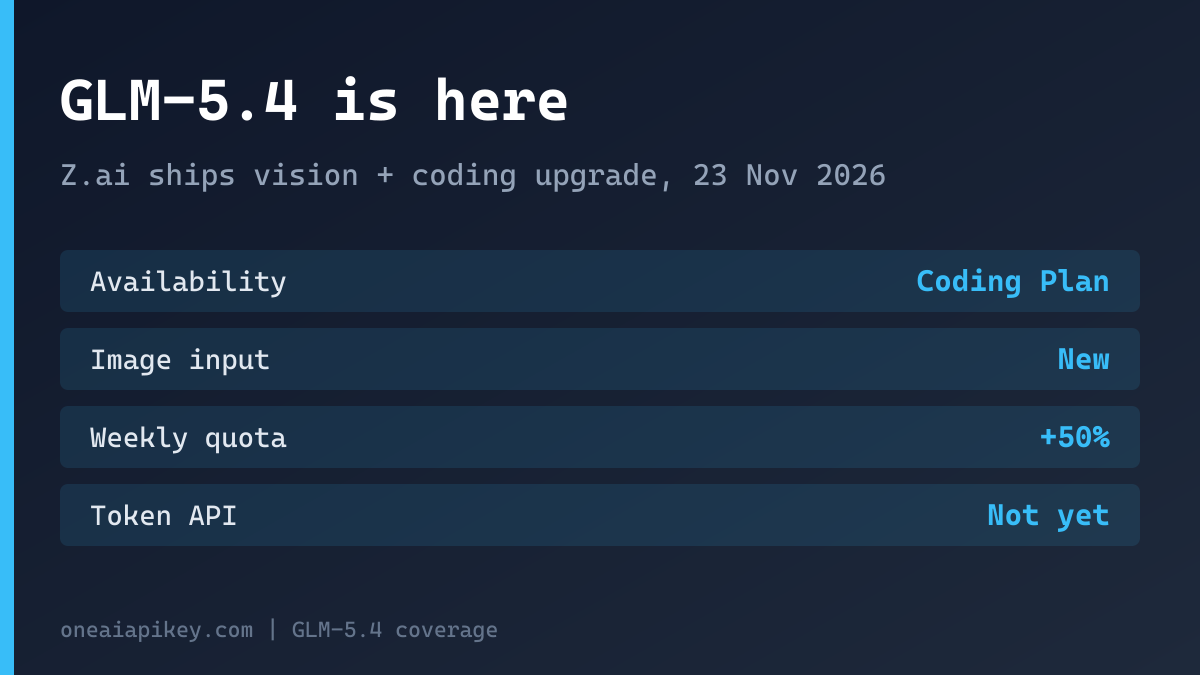
Zixuan Li, the Z.ai lead on the model, framed the launch around exactly two capability changes: “New vision capabilities and stronger all-round coding performance.” The vision upgrade is the first of those, and it is the one you can verify by using the model. It matters for coding work more than it first appears. A model that can read an image can turn a UI screenshot into code, read an error dialog out of a screenshot, or reason over a design mock without you transcribing it first. It closes a gap the rest of the frontier had already closed, since GPT-6.2 Astra and Claude Opus 5.5 both accept text and image, and Gemini 4 Neon accepts text, image, video, audio and PDF. Our GLM-5.4 vision piece covers what the new input unlocks and what is still undocumented.
One caveat keeps this from being a clean win. Z.ai has not yet documented the supported image formats or size limits for GLM-5.4. The input is confirmed, its boundaries are not written down. If you are planning a screenshot-to-code pipeline, build a small test before committing.
The vision upgrade also changes the shape of the flagship line, not just the new model. Before this release, anyone who wanted image input in the GLM family had to drop down to the smaller Flash tier and accept its lower capability in exchange. That was a real trade, and it pushed multimodal work off the flagship entirely. With GLM-5.4 the choice disappears. You no longer pick between the strongest model and the multimodal one, because the strongest model is now the multimodal one. For teams that had been splitting work between GLM-5.3 for hard reasoning and GLM-5.3-Flash for anything involving an image, GLM-5.4 consolidates both onto a single model, and that consolidation is arguably worth as much as the vision feature itself. For how the smaller GLM-5.3-Flash model compares against newer cheap options, our HY4 Flash vs GLM-5.3-Flash piece covers where it sits now.
Quota: the concrete day-one gain
For subscribers on weekly limits, GLM-5.4 comes with 50% more quota than GLM-5.3. This is the most tangible benefit of switching, and it is the clearest incentive Z.ai is offering to move plan traffic onto the new model. On the same plan tier, you can push meaningfully more GLM-5.4 work through a week than GLM-5.3 work.
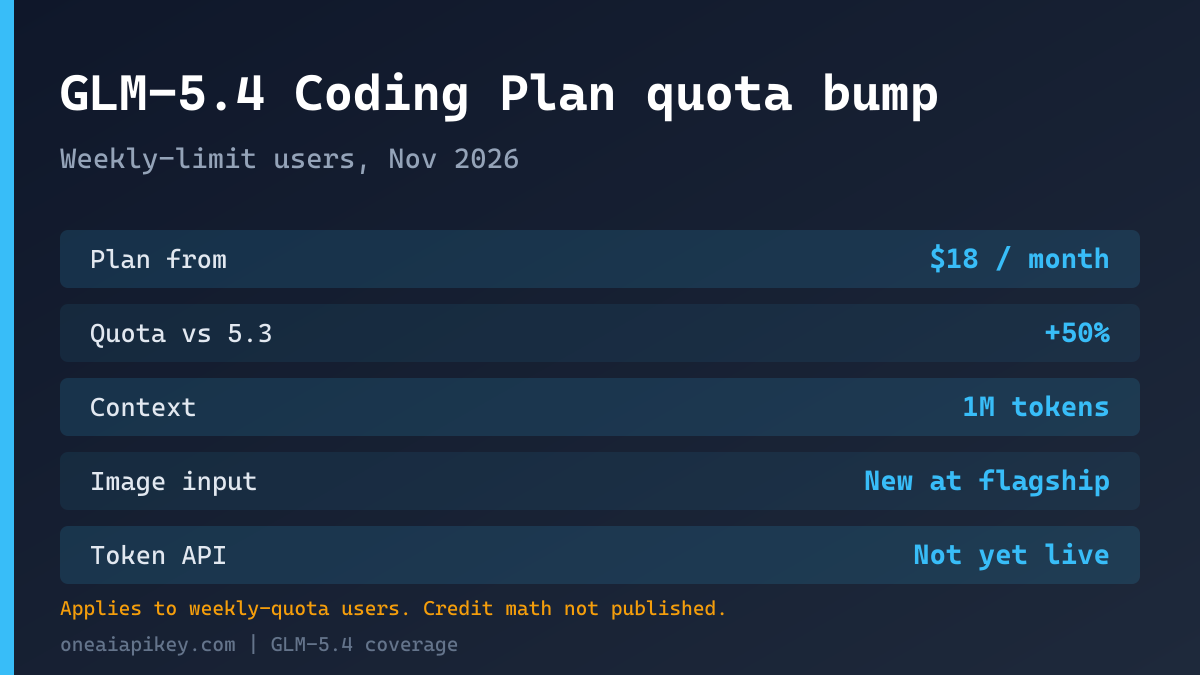
Zixuan Li stated the quota change directly in the launch note: “For users with weekly quotas, GLM-5.4 now comes with 50% more quota compared to GLM-5.3.” The plan runs a dual pool, a 5-hour rolling allowance and a weekly allowance, and the increase applies to the weekly pool. As a concrete illustration, the Lite tier’s weekly credit allowance of 10,000 becomes an effective 15,000 when you are running GLM-5.4 rather than GLM-5.3. The 5-hour pool is unchanged.
Two limits on that number are worth naming. The 50% applies specifically to users on weekly quotas, and the announcement does not spell out the gain for plans metered some other way. Z.ai also did not publish the underlying credit math, a token-to-credit formula for GLM-5.4, or the per-tier credit multipliers. GLM-5.3’s multipliers are published, at 6.9 credits per 10k input tokens, 1.7 per 10k cached and 24 per 10k output, but the equivalent GLM-5.4 figures are not. So you cannot compute exactly how many more tokens 50% more quota buys you at your tier. The honest read is that it is a real increase in headroom, and the exact figure depends on your plan. Our GLM-5.4 pricing and quota piece covers the quota mechanics in detail.
There is also a billing detail that interacts with the quota gain. Off-peak usage is billed at a 50% credit rate, while peak hours are Monday to Friday, 14:00 to 18:00 SGT (UTC+8). Running GLM-5.4 work off-peak stretches the increased weekly allowance further, which effectively compounds the quota advantage for users with flexible schedules.
Context: identical, at 1M tokens
There is no difference here. Both GLM-5.4 and GLM-5.3 carry a 1 million token context window, and the label appears on the Coding Plan picker for both. If you are choosing between them on the basis of how much code or context you can load in a single call, there is nothing to choose.
That shared window is worth understanding, because a million tokens is large enough that the binding constraint in practice is often not the window but the cost and speed of filling it. Our GLM-5.4 context window piece covers long-context coding on the model, and the GLM-5.4 API guide covers how to call it through the plan.
Coding: an improvement you cannot yet measure
Z.ai describes GLM-5.4 as having stronger all-round coding performance than GLM-5.3. That is a claim about direction, and it is consistent with the family’s track record on coding and agentic tasks. What it is not, yet, is a measurement. There is no benchmark table in the launch announcement, no side-by-side against GLM-5.3 on any public harness, and no published GLM-5.4 score on DeepSWE or Terminal-Bench, both of which have GLM-5.3 entries. Our GLM-5.4 benchmarks piece covers exactly what has and has not been measured.
There is one independent signal, and it is more interesting for how the model works than for a headline score. AICodeKing ran GLM-5.4 through KingBench 4 and placed it seventh overall, first among open models, at 55.3%, calling it the “best open model you can use right now.” The same run showed GLM-5.4 taking 1,128 reasoning steps against a comparator’s 244, generating about 1.04 million reasoning tokens against roughly 70,000, and reasoning on nearly every step with under 1% of steps showing near-zero reasoning. It profiles as a deep, many-small-steps reasoner. That is the basis for the claim that it codes better, but it is one harness and one reviewer, so weight it against the absence of an official table. For how to deploy that profile, see GLM-5.4 coding performance and GLM-5.4 for code review.
What makes the coding comparison between the two Z.ai flagships unusually hard is that there is no GLM-5.4 score to set against GLM-5.3’s published record. GLM-5.3 has entries on DeepSWE v1.1 at 66.9 and Terminal-Bench 4.0 at 37.9, both behind DeepSeek. GLM-5.4 has no entry on either. The claim that the new model is stronger comes from Z.ai, and the strongest independent support for it is a good placement on a different harness, not a head-to-head. So the honest answer to “does GLM-5.4 code better than GLM-5.3” is that Z.ai says so, an early independent run is consistent with it, and nobody has measured the two against each other on the same benchmark. If you are on a plan, you can settle it for your own tasks by running both, and the 50% quota bump gives you the headroom to do that.
The architecture story also carries a caveat when comparing the two. Z.ai says three months went into scaling what it calls the Loop and model size, and that the Loop Transformer is the first improvement users will notice. That is the engineering behind the coding claim. AICodeKing has reported, with an explicit caveat that he was not certain, that GLM-5.4 is a looped transformer with roughly 700 billion parameters. Z.ai has not confirmed that figure, so treat it as unverified. Our GLM-5.4 loop transformer piece covers the architecture and keeps the number clearly labeled.
Pricing: where GLM-5.3 still wins, for now
This is the axis where the comparison flips. GLM-5.3 has a published token price: 1.40 US dollars per million input tokens and 4.40 per million output tokens, with a cached input rate of 0.26. GLM-5.4 has no public token price at all. Until Z.ai adds GLM-5.4 to the rate card, GLM-5.3 remains the newest model you can call by the token, and that makes GLM-5.3 the only one of the pair you can use outside a Coding Plan.
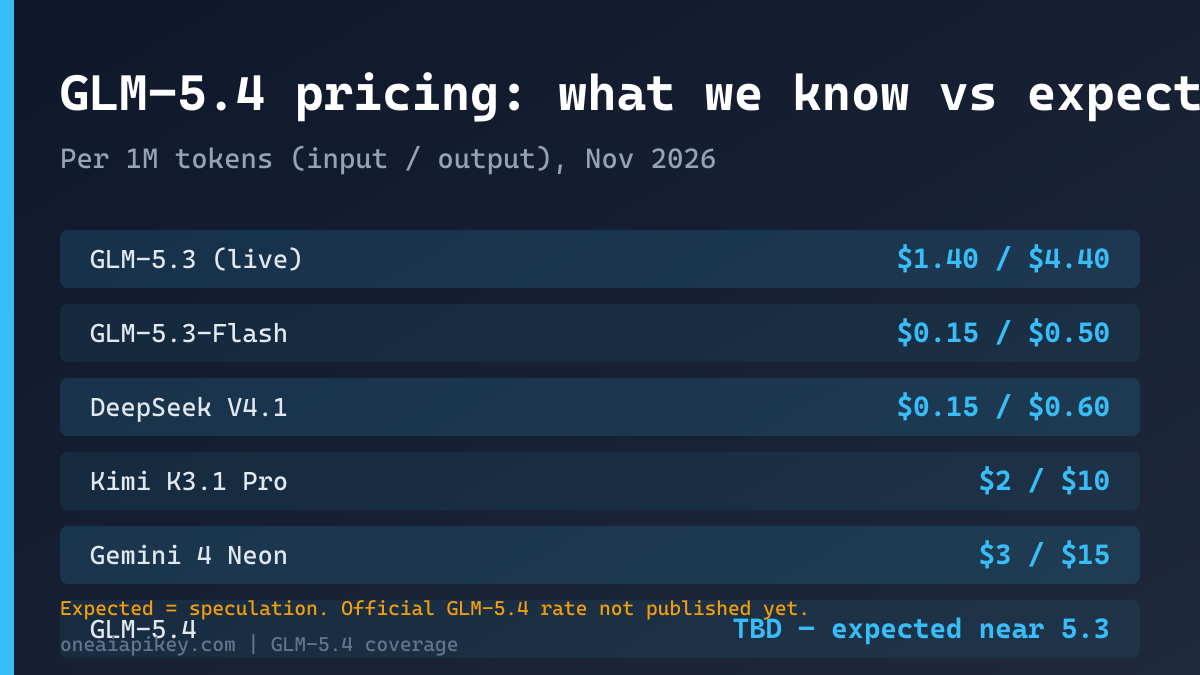
The availability split follows from the pricing split. GLM-5.4 is available to GLM Coding Plan subscribers only, and it is not on the pay-as-you-go API. GLM-5.3 is on the pay-as-you-go API. So if you are on a plan, you can call both glm-5.4 and glm-5.3 today. If you are not on a plan, GLM-5.4 is not reachable for you yet and GLM-5.3 is. Kingy AI’s launch writeup flagged this precisely, noting there is “no documented standard API entitlement or token price in Z.ai’s published rate card” for the new model.
This section will be updated once Z.ai publishes the official GLM-5.4 token price. Based on Z.ai’s pricing history, GLM-5.1, 5.2 and 5.3 all launched at 1.40 dollars input and 4.40 output per million tokens, and Z.ai held the flagship price flat across those three generations, so a reasonable expectation is that GLM-5.4 lands at or near that anchor when it reaches the pay-as-you-go API. That is inference from Z.ai’s own track record, not an announced price, and no analyst has published a numeric GLM-5.4 prediction. Until the rate card updates, GLM-5.3’s price is the only concrete number in this comparison.
The pricing hole matters more for GLM-5.4 than it would for most models, because its early profile is token-hungry. A model that generates a million reasoning tokens on a hard task is a model whose output-token price will dominate the bill if it is metered like GLM-5.3. The plan quota may absorb that for subscribers, but anyone waiting on pay-as-you-go access should watch the rate card. For context on where GLM-5.3’s price sits in the field, our Gemini 4 Neon pricing and GPT-6.2 Astra pricing guides set the frontier rates side by side, and GLM-5.4 vs frontier covers the value case model by model.
There is a second-order point about the two models sharing a plan that is easy to miss. Because GLM-5.4 and GLM-5.3 both live inside the Coding Plan and the new model gets 50% more quota, the effective cost of running GLM-5.3 work through the plan has quietly gone up in relative terms. A subscriber who keeps routing traffic to GLM-5.3 is now spending quota that would buy 50% more GLM-5.4 work. That does not make GLM-5.3 a bad choice, and for pay-as-you-go users nothing changes at all. But for plan subscribers the quota math now favors the new model beyond its capability improvements, and that is a real incentive to at least test it before deciding where to route.
Access: the Coding Plan tiers both models share
Because GLM-5.4 is plan-only, the Coding Plan tiers are effectively the pricing table for the new model today. GLM-5.4 is available on every tier, and you must manually select glm-5.4 in the picker. There is no automatic upgrade from GLM-5.3.
| Plan | Monthly price | 5-hour credits | Weekly credits |
|---|---|---|---|
| Lite | $18 | 2,000 | 10,000 |
| Pro | $80 | 12,000 | 60,000 |
| Max | $168 | 28,000 | 140,000 |
Two discounts apply across the tiers: 20% off for quarterly billing and 30% off for annual billing. Because the weekly pool is the one that gets the 50% increase when you run GLM-5.4, the effective weekly capacity at each tier is 15,000 on Lite, 90,000 on Pro and 210,000 on Max, measured in the same credits against a GLM-5.3 baseline of 10,000, 60,000 and 140,000.
The tiers matter to the comparison in a specific way. If you are on Lite, the 50% weekly bump is the difference between 10,000 and 15,000 credits a week, which for a single developer can be the difference between running out on Thursday and covering the full week. At the higher tiers the absolute gain is larger but the proportional benefit is identical. The plan structure also means the comparison is not purely a capability question. A GLM-5.3 user who is regularly exhausting the weekly pool has a concrete reason to try GLM-5.4 that has nothing to do with benchmark scores.
One access note for completeness. GLM-5.4 is not yet available through the usual third-party routes. OpenRouter returns a 404 for the model, TeamoRouter lists it as coming soon, and Artificial Analysis has no entry. There is no AWS or Fireworks availability either. That reinforces the plan-only status and means the Coding Plan is currently the only way to reach the model at all.
Weights and licensing: an open question for the new model
GLM-5.3 was released with open weights under a custom license, which made it one of the stronger open options in its class, and the smaller GLM-5.3-Flash shipped under MIT. GLM-5.4 has no published weights as of launch day. A search for a GLM-5.4 repository on Hugging Face or ModelScope returns nothing, and those platforms currently top out at GLM-5.3 and GLM-5.3-Flash. Z.ai has made no statement about open-sourcing the new model.
The community is already asking the question. One reply to the launch coverage, from @teortaxesTex, was simply: “will it be open though?” That skepticism is reasonable given the plan-only launch, and it is the right question to keep asking. Our GLM-5.4 open weights piece tracks it, and GLM-5.4 self-hosting covers what changes if the weights go public.
This is one of the more consequential unknowns, because open weights are what let a model be run on your own hardware, audited, and fine-tuned. If GLM-5.4 ships open, it inherits the strongest part of GLM-5.3’s positioning. If it does not, the vision upgrade stays plan-gated, and GLM-5.3 keeps its open-weights advantage indefinitely. It is worth noting that GLM-5 moving to GLM-5.3 eventually shipped as open weights, so an eventual open release for 5.4 is a reasonable inference from the family’s pattern. That is inference, not a commitment from Z.ai, and nothing has been announced. For the models already shipping open, GLM-5.4 alternatives covers the field, including DeepSeek V4.1 which is MIT licensed.
Which one should you use
If you are a GLM Coding Plan subscriber, the answer leans toward GLM-5.4 for new work. You get image input on the flagship, a claimed coding improvement, and 50% more weekly quota on a model that is live now. There is no quota downside to routing plan traffic to glm-5.4 and comparing it to GLM-5.3 on your own tasks. Remember to select it manually, since there is no auto-upgrade, and start at the High reasoning effort setting rather than Max. The one reason to stay on GLM-5.3 inside a plan is if your work depends on something GLM-5.4 changes, and the only confirmed change of that kind is the modality shift, which cuts the other way.
If you use GLM-5.3 through the pay-as-you-go API, nothing changes today. GLM-5.4 is not on the token API, so you cannot switch to it by the token even if you want to. You keep GLM-5.3, its published price, and its open weights. The moment to revisit is when GLM-5.4 gets a rate-card entry and a technical report, at which point you can weigh a real price against a real score.
The two changes to watch that will move this comparison are the token price and the technical report. The price decides whether GLM-5.4 competes on value or only on capability. The report decides whether the stronger-coding claim holds up against GLM-5.3 on the same harness. Until both land, GLM-5.4 is the stronger plan model and GLM-5.3 is the more open and more measurable one, and which you pick depends on which of those you value. For the frontier context, GLM-5.4 vs frontier places the new model against the closed flagships, and GLM-5.4 KingBench 4 covers the one independent run in full.
Sign up for a key to call GLM models through hosted access, browse the model catalogue, or run your own volumes through the cost calculator before committing to a plan or an API integration.
More GLM-5.4 coverage
This post is part of a series on the GLM-5.4 launch. The rest of the cluster goes deeper on the areas the launch only sketched:
- GLM-5.4 launch is the hub post on what shipped and what did not
- GLM-5.4 benchmarks on the missing scores and the one independent run
- GLM-5.4 vs frontier against the closed flagships
- GLM-5.4 coding performance on the Loop architecture and the reviewer profile
- GLM-5.4 vision on the new image input and screenshot-to-code use
- GLM-5.4 pricing and quota on the 50% bump and the missing token rate
- GLM-5.4 API guide on calling
glm-5.4and the Coding Plan path - GLM-5.4 context window on the 1M window and long-context coding
- GLM-5.4 open weights on whether the vision upgrade ships as open source
- GLM-5.4 self-hosting if the weights go public
- GLM-5.4 KingBench 4 on the early independent run in full
- GLM-5.4 loop transformer on the architecture and the technical report
- GLM-5.4 for code review on the planner and reviewer deployment pattern
- GLM-5.4 alternatives on the open models competing for the same work