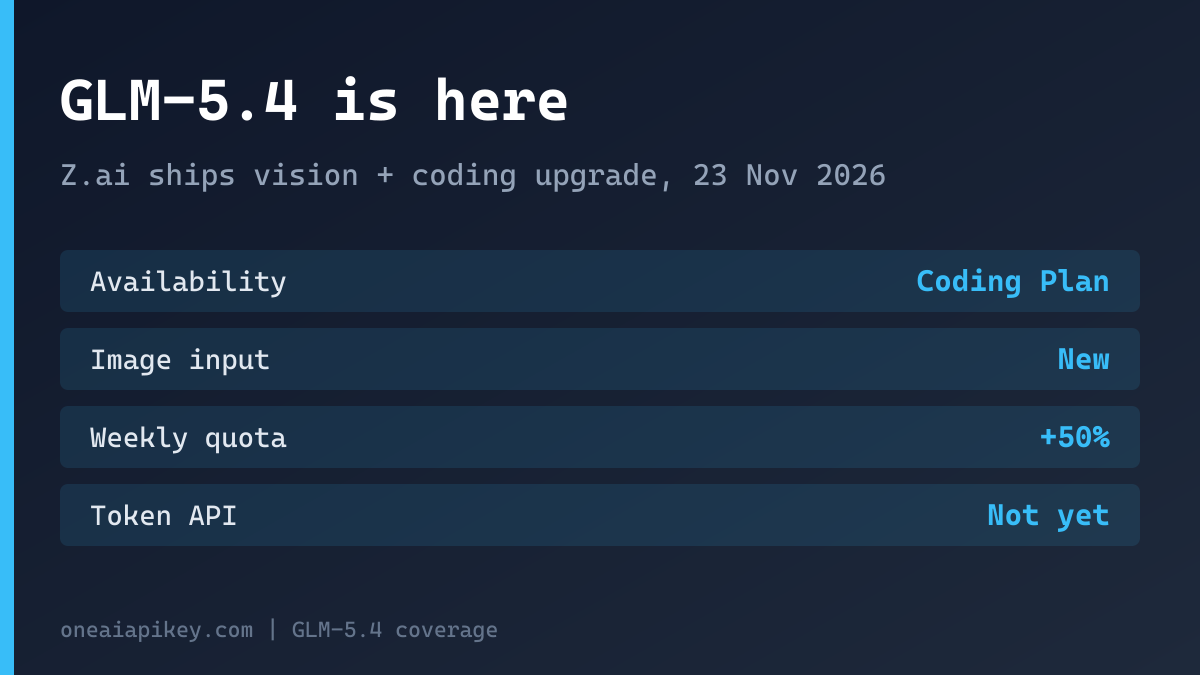
The pricing story of GLM-5.4 is short to state and important to understand. The new flagship from Z.ai has no public token price. It is not on the pay-as-you-go API at all. The only way to use it today is a GLM Coding Plan subscription, which starts at 18 US dollars a month, and subscribers on weekly quotas get 50% more GLM-5.4 quota than they got on GLM-5.3. That is the entire confirmed pricing picture on launch day.
Most of what follows is context around those facts, because the missing token price is not a footnote. It is the number that decides whether GLM-5.4 is a value play or only a capability play, and it interacts badly with one thing the early testing revealed: this model is token-hungry. A model that generated roughly 1.04 million reasoning tokens on a single hard task in independent testing is a model whose output price would dominate a metered bill. The plan quota may absorb that for subscribers. Anyone waiting for pay-as-you-go access should watch the rate card closely.
This post walks the confirmed pricing facts, the full Coding Plan tier table with its discounts and dual-pool structure, the quota bump and its caveats, the per-token comparison table across the models GLM-5.4 competes with, the community reaction to the pricing, and why the missing rate matters more for this model than it would for most.
The confirmed pricing facts
Here is everything Z.ai has actually said about GLM-5.4 pricing as of launch on 23 November 2026.
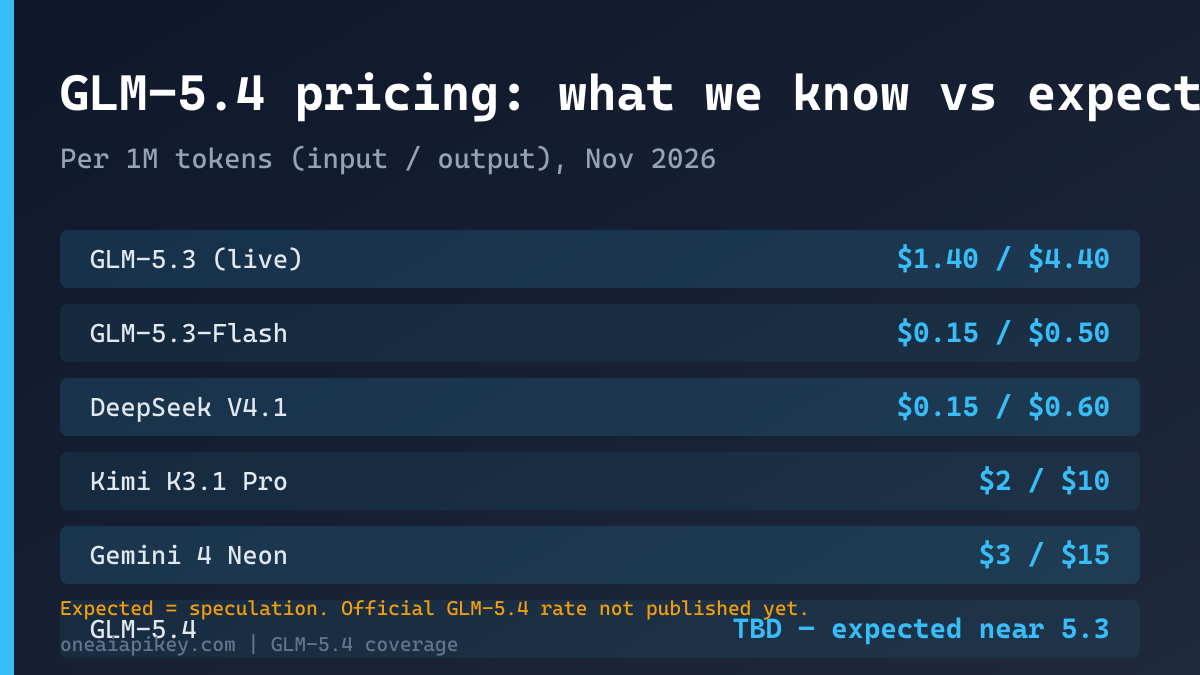
GLM-5.4 has no public token price. There is no per-million input and output rate published anywhere. The Z.ai rate card at docs.z.ai, which is where token prices live, still lists GLM-5.3 as the newest model you can call by the token, at 1.40 dollars input and 4.40 dollars output per million tokens, with a cached input rate around 0.26 dollars. GLM-5.4 is not on it.
Kingy AI, in his launch write-up, put the gap plainly: there is “no documented standard API entitlement or token price in Z.ai’s published rate card.” That is an independent confirmation that the absence is real and not a case of the price hiding somewhere unintuitive.
GLM-5.4 is available to GLM Coding Plan subscribers only, and the plan starts at 18 US dollars a month. You cannot buy GLM-5.4 by the token today. If you want to use it, you subscribe to the plan, and the entry tier is the only published price point.
That is the whole list. No token rate, no rate-card entry, one plan price. Everything else in this post is either context, comparison, or a caveat on the quota bump.
The full Coding Plan tier table
Because the plan is the only way to get GLM-5.4, the plan tiers are the real price list for this model. Here is the full structure. All three tiers carry GLM-5.4.
| Tier | Monthly price | 5-hour credits | Weekly credits |
|---|---|---|---|
| Lite | $18 | 2,000 | 10,000 |
| Pro | $80 | 12,000 | 60,000 |
| Max | $168 | 28,000 | 140,000 |
Two discount options apply on top of those monthly prices. Paying quarterly takes 20% off, and paying annually takes 30% off. So the Lite tier is effectively around 14.40 dollars a month on the quarterly plan and around 12.60 dollars a month on the annual one, before you get into exactly how Z.ai bills the discount. The same proportional discount applies up the tiers, which makes the annual Max tier meaningfully cheaper per month than the 168 dollar headline figure.
The structure that matters most is the dual pool. Each tier has two separate allowances, a 5-hour rolling pool and a weekly pool. The 5-hour pool is for burst usage and refreshes on a rolling five-hour window. The weekly pool is the larger allowance that carries you through the week. You draw from both, and understanding which one a given request hits is the key to not running out unexpectedly. A heavy afternoon of work can drain the 5-hour pool while leaving your weekly pool mostly intact, and then you wait for the rolling window to refresh even though you have plenty of weekly allowance left.
There is also a time-of-day element. Off-peak usage is billed at a 50% credit rate, meaning a request made off-peak consumes half the credits it would consume at peak. Peak hours are defined as Monday to Friday, 14:00 to 18:00 Singapore time, which is UTC+8. That is a real lever for heavy users. If you can schedule batch work, long agent runs, or bulk evaluation outside that peak window, you effectively double what your credits buy. For a model as token-hungry as GLM-5.4, running your hardest tasks off-peak is the single best way to stretch a tier.
The 50% quota bump, and its caveats
The clearest day-one benefit for existing plan subscribers is a quota change. Zixuan Li stated it directly in the launch announcement: for users with weekly quotas, GLM-5.4 “now comes with 50% more quota compared to GLM-5.3.” In plain terms, if your plan meters usage weekly, you can push half again as much work through the new flagship in a week as you could through the old one.
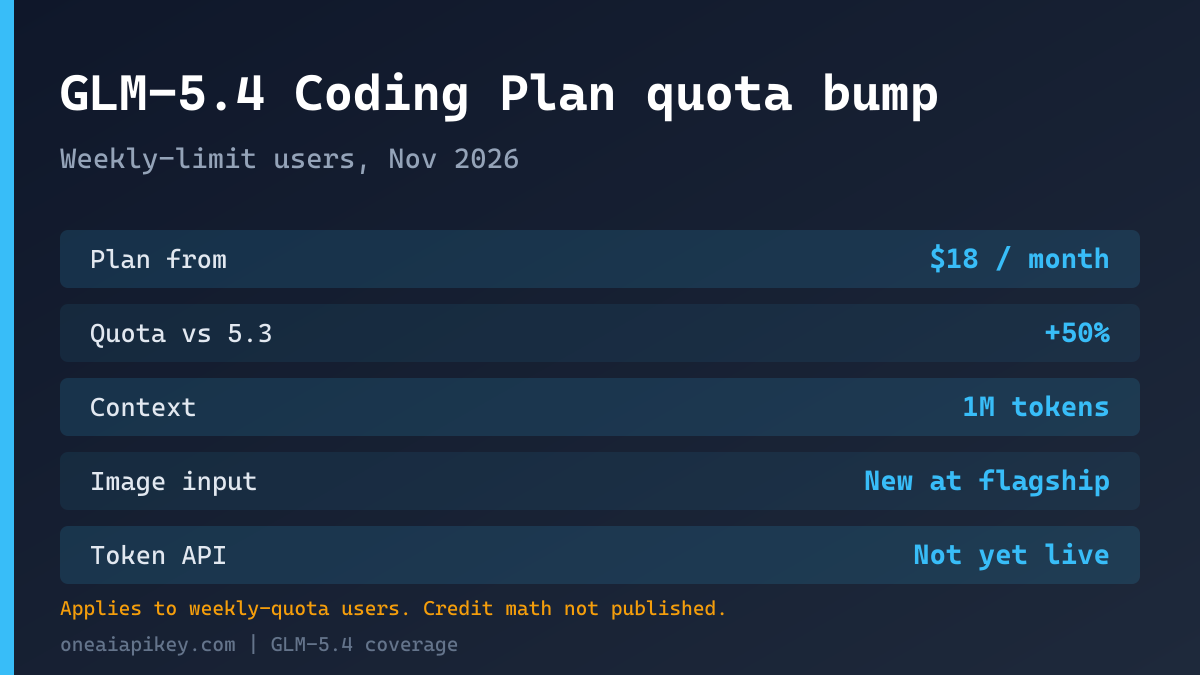
Concretely, that means the weekly pool on each tier grows by half when you are running GLM-5.4 rather than GLM-5.3. The Lite tier’s 10,000 weekly credits become an effective 15,000 for GLM-5.4 work. The same proportional increase applies to the Pro and Max weekly pools. The 5-hour pool, importantly, does not change. The bump is specifically on the weekly side.
Two caveats keep this from being a clean number, and both are worth stating plainly.
First, the 50% applies specifically to users on weekly quotas. Z.ai’s announcement is explicit about weekly limits. If your usage is metered some other way, the announcement does not spell out what your gain is. The safe assumption is that the bump is designed around the weekly-quota structure.
Second, Z.ai did not publish the underlying credit math for GLM-5.4. There is no worked example showing how many tokens 50% more quota actually buys you at a given tier, and no token-to-credit formula. That means you cannot compute the concrete benefit in tokens. You know it is more, you do not know how much more in units you can plan against.
What the community is saying about the price
The community reaction to GLM-5.4 pricing splits along a clear line: people already on the plan are happy, and people watching from outside are waiting on the token price.
The plan-side reaction is straightforwardly positive, because the 50% quota bump is a real gain at an unchanged plan price. Zixuan Li’s framing of the quota increase is the official version, and for subscribers it is the main reason to move traffic onto the new model immediately rather than waiting.
The outside reaction is more skeptical, and it centers on the missing rate card. Kingy AI’s observation that there is “no documented standard API entitlement or token price” is the most quoted formulation of the problem, because it names the specific thing a pay-as-you-go buyer needs and cannot find. @asifroyal, reacting to the first KingBench numbers, noted “that’s the first number I’ve seen for 5.4. Z.ai hasn’t put out a model card,” which captures the broader information gap: no model card, no token price, no first-party scorecard. AICodeKing’s thread drew the same theme in replies, with @teortaxesTex asking “will it be open though?” about weights, a question that is really about what you get for your money if you are not on the plan.
There is also a cost-side worry running through the technical discussion, and it is about token consumption rather than the sticker price. 思维怪怪 (@0xLogicrw) called GLM-5.4 the “most cautious model” and said it “suffers from overthinking,” which is a polite way of saying it spends a lot of tokens reasoning. The BlockBeats reported the KingBench finding that GLM-5.4 used “reasoning tokens nearly 15x more than Google’s Neon.” For anyone on a metered plan, that consumption pattern is the number that actually determines cost, and it is the reason the missing per-token rate matters so much here. A cheap-looking token price on a model that uses fifteen times the tokens is not a cheap model.
One more piece of community context worth naming. Before launch, the r/ZaiGLM subreddit had grown frustrated with the existing model, with posts calling GLM-5 “effectively unusable” for a stretch and asking when an update would land. That is pre-launch context rather than a review of 5.4 pricing, but it explains the appetite for the release and why plan users were ready to move onto it quickly.
Full API pricing comparison per 1M tokens
Because GLM-5.4 has no token price, the useful comparison is against the models that do have one. This table lists the published pay-as-you-go rates per 1 million tokens, input and output, for the models in GLM-5.4’s competitive set. GLM-5.4 appears with no rate because none is published.
| Model | Input per 1M | Output per 1M | Notes |
|---|---|---|---|
| GLM-5.4 | not published | not published | Coding Plan only, from $18/mo |
| GLM-5.3 | $1.40 | $4.40 | newest flagship on the token API, $0.26 cached input |
| GLM-5.3-Flash | $0.15 | $0.50 | small tier, multimodal |
| DeepSeek V4.1 Flash 1017 | $0.15 | $0.60 off-peak, $1.20 peak | open weights, MIT |
| Kimi K3.1 Pro | $2 | $10 | custom license |
| Claude Opus 5.5 | $4 | $20 | closed |
| Gemini 4 Neon | $3 | $15 | text/img/video/audio/PDF |
| GPT-6.2 Astra | $8 (≤272K) / $16 above | $40 (≤272K) / $60 above | closed |
Reading the table, GLM-5.3 at 1.40 and 4.40 sits in the middle of the pack. It is far cheaper than the closed flagships, Claude Opus 5.5 at 4 and 20 and GPT-6.2 Astra at 8 and 40, and meaningfully more expensive than the budget open models, DeepSeek V4.1 Flash at 0.15 and 0.60 off-peak and GLM-5.3-Flash at 0.15 and 0.50. Kimi K3.1 Pro at 2 and 10 and Gemini 4 Neon at 3 and 15 bracket it from above.
A few patterns in that spread frame where GLM-5.4 will land. The budget tier, DeepSeek V4.1 Flash and GLM-5.3-Flash, clusters around 0.15 input and 0.50 to 0.60 output, and that is where high-volume, lower-value-per-token work belongs. The middle tier, GLM-5.3 and Kimi K3.1 Pro, runs roughly 1.40 to 2 input and 4.40 to 10 output, and that is where strong open-model coding lives. The premium tier, Gemini 4 Neon, Claude Opus 5.5 and GPT-6.2 Astra, runs 3 to 16 input and 15 to 60 output, with GPT-6.2 Astra charging more above 272K tokens. Those tiers map to how much capability each model is expected to deliver per token.
Where GLM-5.4 lands in that spread is genuinely open. If Z.ai prices it near GLM-5.3, it stays a value option against the closed flagships and the natural upgrade for anyone comfortable in the middle tier. If it prices it higher to reflect the vision upgrade and the larger model, the value case narrows. There is a third possibility too, that Z.ai prices GLM-5.4 above GLM-5.3 because the heavy reasoning makes its effective cost per task higher even at a similar token rate. Any of the three fits what is published, which is nothing. Our GPT-6.2 Astra pricing and Gemini 4 Neon pricing breakdowns show how to read these rates across providers, and GLM-5.4 vs frontier covers the capability comparison the price needs to justify.
The token-hungry problem, and what a million reasoning tokens costs
Here is why the missing price matters more for GLM-5.4 than for a typical model, and it comes straight from the early independent testing.
AICodeKing ran GLM-5.4 through KingBench 4 and, set against a frontier comparator he calls Neon, found that GLM-5.4 generated about 1.04 million reasoning tokens where Neon generated roughly 70,000. It took 1,128 reasoning steps to Neon’s 244. It was roughly four times slower overall at max reasoning effort, 431 minutes against 109, even though the per-step speed was similar at 22.9 seconds against 26.7 seconds. The model reasons on nearly every step, with under 1% of steps showing near-zero reasoning.
That profile describes a model that thinks in many small, token-expensive steps. On a metered API, output tokens are almost always the expensive side of the bill. A model that emits a million reasoning tokens on a hard task, at an output rate even close to GLM-5.3’s 4.40 per million, generates several dollars of output cost on a single task before you have seen a line of final answer.
It is worth putting rough arithmetic on that, because the order of magnitude is what matters. Take GLM-5.3’s output rate of 4.40 per million as a stand-in, since it is the closest confirmed number. A single hard task producing 1.04 million reasoning tokens at that rate is roughly 4.58 dollars of output before any final answer is written. Run that shape of task ten times in a day and you are near 46 dollars, at a token rate nobody has confirmed for GLM-5.4. At the closed-flagship rates the same token count is several times that. This is not a prediction and the real rate may be lower or the plan may absorb it entirely. It is a demonstration that for this specific model, the reasoning-token volume is large enough that the price per token stops being a detail and becomes the whole cost story.
There is a second way to see the same cost, and it is through the credit multipliers Z.ai does publish, for GLM-5.3. On the Coding Plan, GLM-5.3 consumes credits per 10,000 tokens at these rates: 6.9 credits for input, 1.7 credits for cached input, and 24 credits for output. Those multipliers show that output is by far the most expensive direction, costing roughly three and a half times what input costs per token. GLM-5.4’s multipliers are not published, but the shape of the GLM-5.3 table tells you what to expect: a model that emits a million output tokens is drawing down your credit pool far faster than one that merely reads a million input tokens. For a reasoning-heavy model, the output multiplier is the number that decides how long your plan lasts. Our GLM-5.4 context window post covers the long-context side of the same budget question.
The plan quota is what stands between subscribers and that cost. If the plan meters by credits and the 50% bump gives you more credits, the token-hungry behavior may be absorbed by the plan rather than passed to your wallet. But the credit math is not published for GLM-5.4, so nobody outside Z.ai can say how a million-token reasoning run maps to plan consumption.
There is a deployment answer that helps. AICodeKing’s use-case read was that GLM-5.4 profiles best as a reviewer, planner, or big-picture tool, not as an end-to-end code generator. If you follow that advice, you use it where its deep reasoning earns its keep and route bulk generation to a cheaper model. That is also the cost-efficient way to use a token-hungry model. Our GLM-5.4 for code review post covers that pattern, and GLM-5.4 coding performance covers the architecture behind the heavy reasoning.
What this means depending on who you are
If you are already a GLM Coding Plan subscriber, the pricing change is simple and positive. You get 50% more weekly quota on a model that is live now, at the same plan price you are already paying, starting at 18 dollars a month with 20% and 30% discounts for quarterly and annual commitment. There is no new cost to try GLM-5.4, and no downside to routing some plan traffic to it and comparing. Run your heaviest tasks off-peak to take the 50% credit-rate discount and the quota stretches further. The token-hungry behavior is the plan’s problem to absorb, not yours, at least until the credit formula is published.
If you are on the pay-as-you-go API using GLM-5.3, nothing changes today. GLM-5.4 is not on the token API. GLM-5.3, at 1.40 and 4.40, remains the newest model you can call by the token. You should not expect to buy GLM-5.4 by the token until Z.ai adds a rate-card entry. When it does, compare the new rate against GLM-5.3 and against DeepSeek V4.1 Flash and Kimi K3.1 Pro before assuming the upgrade is worth the delta. Our GLM-5.4 API guide covers the access paths in detail.
If you are evaluating GLM-5.4 against the closed flagships on value, you are comparing a known price against an unknown one, which you cannot settle yet. What you can say is that GLM-5.3 already undercuts Claude Opus 5.5 and GPT-6.2 Astra substantially on token price, and GLM-5.4’s value case depends entirely on where in that spread Z.ai lands. For a broader read on the top of the market, our best frontier models roundup and Inkling 2 Mini vs frontier comparison cover the field, and GLM-5.4 alternatives covers the open models you can price and use by the token right now.
Why the plan-only path changes how you evaluate cost
The plan-only availability changes the whole way you think about what GLM-5.4 costs. A per-token price is a unit price. You can compare it to other unit prices, multiply it by your expected volume, and get a bill you can budget. A subscription is not a unit price. It is a fixed monthly cost that buys some amount of usage, and the value depends entirely on whether your actual volume fits inside what the plan allows.
That distinction matters more here than usual, for two reasons. First, the plan is the only path, so there is no rate to compare even if you wanted to. Second, GLM-5.4’s reasoning-heavy behavior means usage per task is unusually high and hard to predict, which makes it hard to judge whether a given tier will hold your workload. A predictable model lets you estimate tasks per month against a plan. A model that can emit a million reasoning tokens on one task and a few thousand on another does not, so you are guessing whether the plan fits until you have run your real tasks against it.
The practical approach is to treat the first month as a measurement period. Route a representative slice of your real workload through glm-5.4, watch how quickly the weekly pool moves, and use that observed rate rather than any published number to decide whether the tier fits. That is not the clean evaluation a per-token price would allow, but it is the honest one given what is published.
What to watch
Two numbers will resolve the pricing picture. The first is the token rate, whenever Z.ai adds GLM-5.4 to the rate card and opens pay-as-you-go access. The second is the credit formula behind the plan, which turns the 50% quota bump from a headline into a number you can budget against. Until both appear, GLM-5.4 pricing is a plan from 18 dollars a month, a real quota bump with unpublished math, and a token-hungry model whose metered cost is anyone’s guess. Our GLM-5.4 benchmarks post tracks the measurement picture broadly.
Sign up for a key to call GLM models through hosted access, browse the model catalogue, or run your own volumes through the cost calculator before committing to a plan.
Future update: the official token price
This section will be updated once Z.ai publishes the official token price for GLM-5.4 and adds it to the rate card. Based on Z.ai’s pricing history, in which GLM-5.1, 5.2 and 5.3 all launched at 1.40 dollars input and 4.40 dollars output per million tokens, a reasonable expectation is that GLM-5.4 lands at or near that same anchor when it reaches the pay-as-you-go API, likely with a cached-input rate near the 0.26 dollars GLM-5.3 carries. That is inference from Z.ai’s own track record, not an announced price, and no analyst has published a numeric GLM-5.4 prediction. It is also worth noting the LINUX DO community speculation that GLM-5.4 may be a “transitional” release ahead of a rumored larger model, which is unconfirmed. Until the rate card entry appears, treat every per-token figure for GLM-5.4 as a guess, including the arithmetic in this post.
More GLM-5.4 coverage
This post is part of a series on the GLM-5.4 launch. The rest of the cluster goes deeper on what the launch only sketched:
- GLM-5.4 launch is the overview of what shipped and what did not
- GLM-5.4 benchmarks once Z.ai publishes the official tables
- GLM-5.4 vs GLM-5.3 on what changed model to model
- GLM-5.4 vs frontier against the closed flagships
- GLM-5.4 coding performance on the Loop architecture and the reviewer profile
- GLM-5.4 vision on the new image input and screenshot-to-code use
- GLM-5.4 API guide on calling
glm-5.4and the Coding Plan path - GLM-5.4 context window on the 1M window and long-context coding
- GLM-5.4 open weights on whether the upgrade ships as open source
- GLM-5.4 self-hosting if the weights go public
- GLM-5.4 KingBench 4 on the early independent run in full
- GLM-5.4 loop transformer on the architecture and the technical report
- GLM-5.4 for code review on the planner and reviewer deployment pattern
- GLM-5.4 alternatives on the open models competing for the same work