Most coding models are judged on whether they produce the right code. The interesting thing about GLM-5.4 is that its early testing says more about how it thinks than about how much code it writes. In the one independent run available, it did not win by being fast or by writing more code per step. It won by taking a very large number of small reasoning steps and reasoning on nearly every one of them. That behavioral profile, and the architecture Z.ai says produces it, is the real story of GLM-5.4’s coding performance.
This post covers the Loop, the architecture Z.ai says it scaled for three months, the many-small-steps reasoning style that showed up in KingBench 4, the overthinking problem that comes with it, and what the whole profile means for where the model helps and where it does not. The practical conclusion is that GLM-5.4 profiles as a reviewer and planner rather than a raw code generator, and deploying it against that grain is how you get value from it.
The Loop: what Z.ai actually said
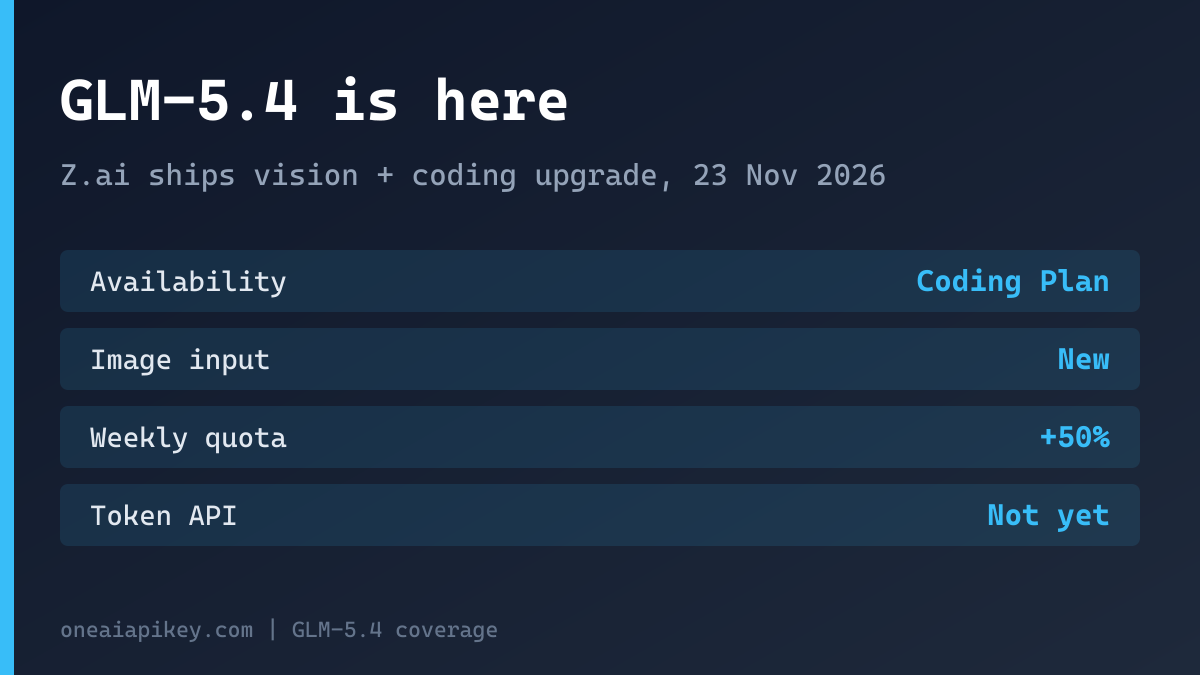
Z.ai has been specific about where the effort went. It says the past three months of work went into scaling two things, what it calls the Loop and model size, and that the Loop Transformer is the first improvement users will notice. That framing came through the Z.ai launch announcement and the launch coverage that followed it, and a technical report is promised for later.
The idea behind a looped architecture is different from the usual way of scaling a model. A conventional transformer scales by getting wider or deeper, adding parameters and layers so it can hold more capability in a single forward pass. A looped architecture instead runs the same weights through multiple passes, feeding the output of one pass back in as input to the next. Rather than storing more capability in the weights, it buys more compute per decision by reusing what it already has.
That trade has a consequence that matters for coding. A looped model can reason for more steps without the parameter count exploding, because the depth comes from iteration rather than from added layers. It is a design that naturally produces a model that thinks in many small steps, which is exactly the behavior the early testing surfaced. Our GLM-5.4 loop transformer piece covers the architecture in more depth.
On the parameter count, an important caveat. AICodeKing reported that GLM-5.4 is a looped transformer with roughly 700 billion parameters, and he attached an explicit caveat that he was not certain, framing it as “as much as I know.” Z.ai has not confirmed the figure, and the number echoes the 754 billion parameter count used for GLM-5.1, so there is a real possibility of conflation. Treat 700 billion as unverified until the technical report lands. The Loop framing itself is from Z.ai and is solid. The number is not.
It is also worth noting that looped architectures are a broader 2026 trend rather than a Z.ai novelty. OpenAI’s Astra and MiniMax M2.7 have also been reported as looped designs. So the interesting question for GLM-5.4 is not whether it uses a loop but how Z.ai’s version of it behaves in practice, which is what the KingBench 4 run speaks to.
What KingBench 4 showed about how it thinks
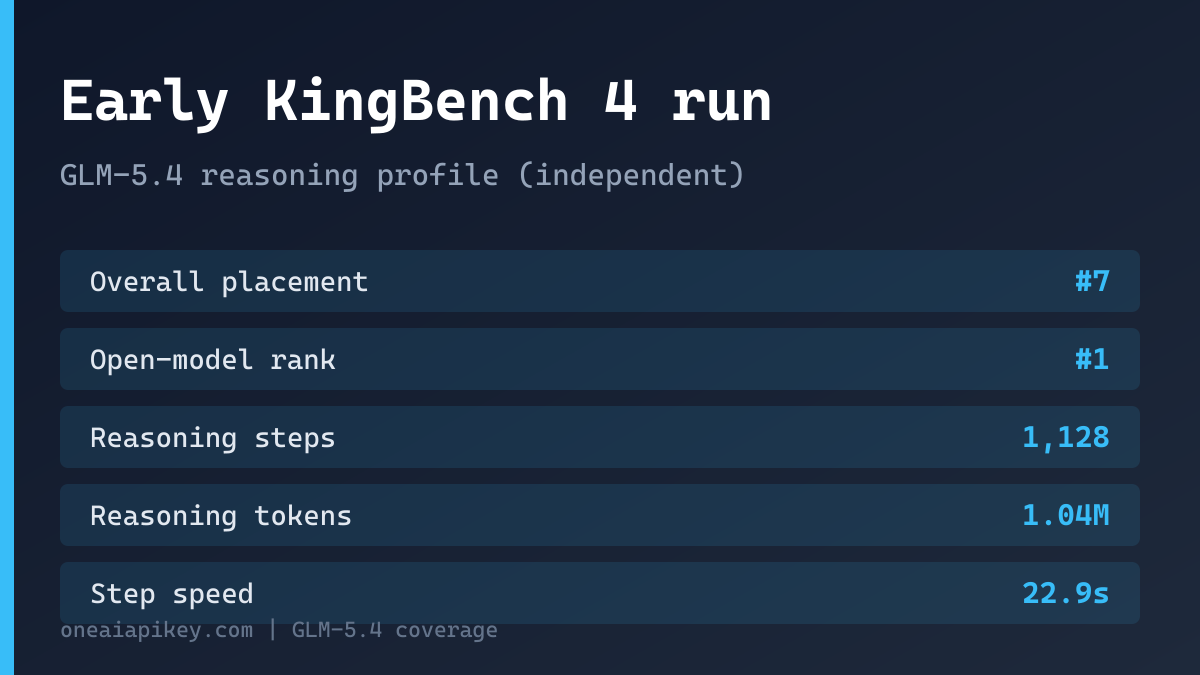
The most data-rich evidence on GLM-5.4’s coding behavior is AICodeKing’s KingBench 4 run, published in his launch analysis. The headline placement was seventh overall and first among open models at 55.3%, which he called the best open model you can use right now. The placement is covered in GLM-5.4 KingBench 4. What matters here is the shape of the run behind it.
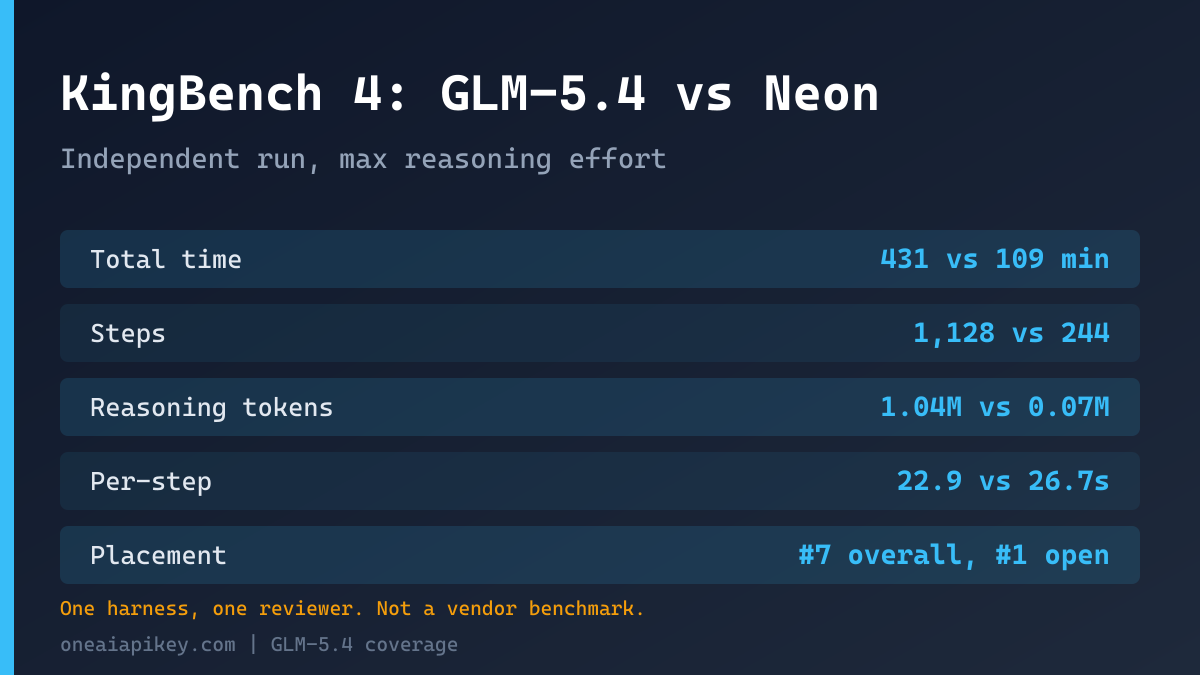
Set against a comparator he calls Neon, GLM-5.4 looked slow at first glance. At max reasoning effort it took 431 minutes to Neon’s 109, roughly four times longer. But the per-step speed was almost the same, 22.9 seconds a step against Neon’s 26.7, and actually faster on a per-step basis. The model was not thinking slowly. It was thinking more often. The gap came entirely from step count.
| KingBench 4 metric | GLM-5.4 | Neon (comparator) |
|---|---|---|
| Total time (max effort) | 431 min | 109 min |
| Per-step speed | 22.9s | 26.7s |
| Reasoning steps | 1,128 | 244 |
| Reasoning tokens | ~1.04M | ~0.07M |
| Steps with near-zero reasoning | under 1% | GPT models 14 to 39% |
GLM-5.4 took 1,128 steps to Neon’s 244, nearly five times as many, and generated about 1.04 million reasoning tokens against Neon’s roughly 70,000, about fifteen times as many. TheBlockBeats summarized the run for its audience with exactly that ratio as the headline: “reasoning tokens nearly 15x more than Google’s Neon.” At max effort the model produces about 1.5 times the reasoning of its own high-effort setting, so the depth scales with the setting you choose.
The most telling number is the near-zero reasoning rate. GLM-5.4 reasons on nearly every step, with under 1% of steps showing near-zero reasoning. AICodeKing compared that to GPT models, which show a 14 to 39% near-zero rate, meaning those models often take a step without really thinking about it. GLM-5.4 almost never takes a step it does not reason through. That is the many-small-steps style in its purest form, and it is the behavioral fingerprint of the Loop design.
It is worth unpacking that metric because it is the least familiar of the set and the most important for how you deploy the model. When a model takes a tool call or an intermediate step, it can either reason about what it is doing or simply act. A near-zero reasoning step is one where the model essentially skips the thinking and fires the next call. Some skipping is fine, and you would not want a model to write a paragraph of reasoning before every trivial file read. But a high near-zero rate means the model is acting on autopilot for a meaningful share of its steps, which is where mistakes slip through unnoticed. GPT models, on AICodeKing’s numbers, spend 14 to 39% of their steps on autopilot. GLM-5.4 spends under 1%. For a reviewer or planner, where the whole value is catching things a faster pass would miss, that near-total reasoning coverage is the metric that matters most, and it is the one GLM-5.4 leads on.
The overthinking problem and the effort setting
The clearest downside of a model that reasons on every step showed up in the effort-setting data, and it is the single most actionable finding in the whole run.
On a security task, both the High and Max effort settings hit the harness’s 180-second timeout while the model was still thinking. The model had not failed to solve the problem. It had simply not stopped reasoning before the clock ran out. At Medium effort, the same task passed in 95 seconds. AICodeKing’s verdict was direct: “High is the best sweet spot.”
思维怪怪 (@0xLogicrw) reached the same conclusion from outside the run, calling GLM-5.4 the “most cautious model” and noting that it “suffers from overthinking.” Their recommendation was that “High is the choice that combines ability and speed,” which lines up with the timeout data exactly. Two independent readers of the same behavior arriving at the same setting advice is a stronger signal than either alone, and it is the advice to take: start at High.
The effort-scaling data explains why. Max effort produces about 1.5 times the reasoning tokens of High, while per-step speed barely changes between settings. On a task where the model is already inclined to reason at length, that extra depth does not buy a better answer. It buys a longer answer that runs out of clock. The overthinking is not a bug in the sense of producing wrong output. It is a failure to stop, and on a hard security task the model will happily reason past a two-minute limit without converging.
For anyone testing the model, this is the thing to watch. If you run GLM-5.4 at Max on difficult tasks and see it time out, that is not the harness being harsh. That is the model’s documented behavior, and the fix is to step down to High rather than to assume the task is beyond it. Medium passing in 95 seconds where High and Max both time out is a genuinely counterintuitive result, and it is the kind of thing you would only learn from a real run.
Tool-call reliability: the quiet strength
The run’s least glamorous numbers turned out to be one of GLM-5.4’s genuine strengths. Tool-call failure rate came in at 1.56%, which ranked eleventh of the seventeen harnesses in the field. That is a middling rank on its own. The interesting half is what happened next: 66% of those failures were recovered on retry, and AICodeKing noted that this recovery rate was better than every Claude and Codex model he tested.
That combination is worth understanding, because agentic coding depends on tool calls either succeeding or failing cleanly. A model that never fails a tool call is ideal. A model that fails occasionally but recovers two-thirds of the time on a simple retry is workable, because the retry is cheap relative to a human having to intervene. GLM-5.4 is the second kind. It is not the most reliable model in the field on raw failure rate, but it is the best at failing gracefully, and for long agentic runs where you cannot babysit every step, graceful failure may matter more than a slightly lower failure rate.
The rest of the plumbing numbers were workable rather than standout. Cache hit rates ran 96 to 99%, and the median time to first token was 4.1 seconds. About 75% of the run’s time went to generating output and about 25% to builds and tests. None of these is exceptional. Together they describe a model with a dependable engineering foundation underneath an unusual reasoning style, which is what you want if you are going to let it run long enough to think deeply.
The reviewer and planner verdict
All of this builds to the single most useful deployment conclusion available for GLM-5.4, and it comes straight from AICodeKing’s read of his own data. He found the model best used as a reviewer for bugs and security, a planner, or for big-picture work, and explicitly not as an end-to-end state-of-the-art code generator you point at a task and let run. He tempered the recommendation further, saying “I wouldn’t recommend you to just use this model” as a general-purpose coder, and he was specific about two domains to avoid: “Not recommended for 3D or frontend.”
The reasoning follows directly from the profile. Review and planning are tasks where depth per step is the whole point. A reviewer that reasons carefully on every step catches bugs and security issues that a faster model skims past. AICodeKing put it concretely, saying GLM-5.4 catches “bugs and security vulnerabilities that competitors missed,” and called it “the most careful model that I have ever used.” A planner that reasons on every step produces a more thorough breakdown of a task before any code is written. In both cases you are paying for thought, and GLM-5.4 spends a lot of thought, so the value lines up with the cost.
Raw code generation is the opposite case. If you point GLM-5.4 at a task and let it run end to end, it takes many steps and generates a large volume of reasoning tokens to produce code a faster model could produce more cheaply. The depth is not wasted, but it is not the highest-value use of it either. Our GLM-5.4 for code review piece covers the reviewer and planner deployment pattern in detail, including how to pair it with a faster generator.
The 3D and frontend exclusions deserve a note of their own, because they are unusually specific. They suggest the many-small-steps style does not translate to work that is more about spatial reasoning and visual iteration than about careful step-by-step logic. A frontend task rewards fast visual feedback loops; a 3D task rewards spatial reasoning that a text-heavy reasoner may not be built for. Whatever the underlying cause, the advice is practical and easy to follow: do not route 3D or frontend work to this model. For teams that need a model for that kind of work, GLM-5.4 alternatives covers the open models competing in those areas.
There is also a cost dimension to the deployment advice. GLM-5.4 has no published token price yet, which GLM-5.4 pricing and quota tracks. A model that generates a million reasoning tokens on a hard task is a model whose output-token cost will dominate the bill if it is metered like GLM-5.3, which runs 1.40 US dollars per million input and 4.40 per million output. The plan quota may absorb that for subscribers. But the deployment advice is partly cost advice: use the deep reasoning where depth pays, and use a cheaper model where it does not.
Reading the style honestly
Two limits on this analysis are worth stating plainly. First, all of it comes from one harness, KingBench 4, run by one reviewer. The step counts, token counts, timeout behavior and reliability numbers are his observations on his task set, not a vendor benchmark, and they have not been replicated by a second source. They are consistent with the Loop architecture Z.ai describes, which makes them credible, but consistency is not confirmation. Our GLM-5.4 benchmarks piece covers why there is no official score to cross-check against.
Second, Z.ai’s own coding claim is a vendor statement. The company says GLM-5.4 has stronger all-round coding performance than GLM-5.3, and there is no published table behind it. The KingBench 4 run supports the claim in spirit, in that it shows a model that reasons deeply and placed first among open models, but it does not measure GLM-5.4 against GLM-5.3 on the same harness. For how the two flagships compare directly, see GLM-5.4 vs GLM-5.3. The technical report, when it comes, is the document that would settle that.
This section will be updated once Z.ai publishes its technical report and any official coding benchmark results. Based on Z.ai’s history, GLM-5.1, 5.2 and 5.3 all eventually had published coding scores on standard harnesses, so a reasonable expectation is that GLM-5.4 gets equivalent entries once the technical report lands and the model reaches the pay-as-you-go API. That is inference from Z.ai’s track record, not an announced result. Until then there is no official coding score to report, and the KingBench 4 profile is the best available evidence.
The practical read for coding work
If you are a GLM Coding Plan subscriber, the profile points to a specific way of using GLM-5.4. Use it where thinking is the product. Point it at code review, security review, and planning a task before you implement it, and run it at the High effort setting, since the data shows that is where ability and speed balance and where the timeout risk is lowest. Those are the uses where a million reasoning tokens earns its keep.
Do not use it as a bulk generator, and do not route 3D or frontend work to it. For high-volume code production, a faster and cheaper model is a better fit. The strongest setup is likely a pair, with a faster model generating and GLM-5.4 reviewing and planning. If you want to see how that pairing works in practice, GLM-5.4 for code review covers the pattern.
The architecture and the behavior line up cleanly here. Z.ai scaled the Loop, the Loop produces a model that reasons in many small steps, and many small steps make a strong reviewer and planner, an overthinker at Max effort, and an expensive raw generator. That coherence, between what the maker built and what the independent run observed, is the best reason to take the deployment advice seriously. What would sharpen it is a second independent run and the official technical report, and either would be worth waiting for before building a large pipeline around this profile. For the frontier context, GLM-5.4 vs frontier places it against the closed flagships, and GLM-5.4 context window covers the 1M window that lets it review large codebases in one pass.
Sign up for a key to call GLM models through hosted access, browse the model catalogue, or run your own volumes through the cost calculator before committing to a plan or an API integration.
More GLM-5.4 coverage
This post is part of a series on the GLM-5.4 launch. The rest of the cluster goes deeper on the areas the launch only sketched:
- GLM-5.4 launch is the hub post on what shipped and what did not
- GLM-5.4 benchmarks on the missing scores and the one independent run
- GLM-5.4 vs GLM-5.3 on what actually changed model to model
- GLM-5.4 vs frontier against the closed flagships
- GLM-5.4 vision on the new image input and screenshot-to-code use
- GLM-5.4 pricing and quota on the 50% bump and the missing token rate
- GLM-5.4 API guide on calling
glm-5.4and the Coding Plan path - GLM-5.4 context window on the 1M window and long-context coding
- GLM-5.4 open weights on whether the vision upgrade ships as open source
- GLM-5.4 self-hosting if the weights go public
- GLM-5.4 KingBench 4 on the early independent run in full
- GLM-5.4 loop transformer on the architecture and the technical report
- GLM-5.4 for code review on the planner and reviewer deployment pattern
- GLM-5.4 alternatives on the open models competing for the same work