You cannot self-host GLM-5.4 today. That is the whole conclusion of this post, stated up front so nobody reads three thousand words hoping for a deployment recipe that does not exist. Z.ai has not published the weights. There is no download, no license, and no model card you can point an inference server at. The only way to use glm-5.4 right now is through a GLM Coding Plan subscription, which starts at 18 US dollars a month.
What this post can do honestly is the next best thing. It can tell you what self-hosting this model would require if the weights do land, using real deployment lessons from the open models that are actually downloadable today. A reported 700 billion parameter looped mixture-of-experts is a serious infrastructure project, and the hardware realities are not forgiving. We will lean on the deployment economics of two models you can host right now, and be explicit about which numbers for GLM-5.4 are confirmed and which are not.
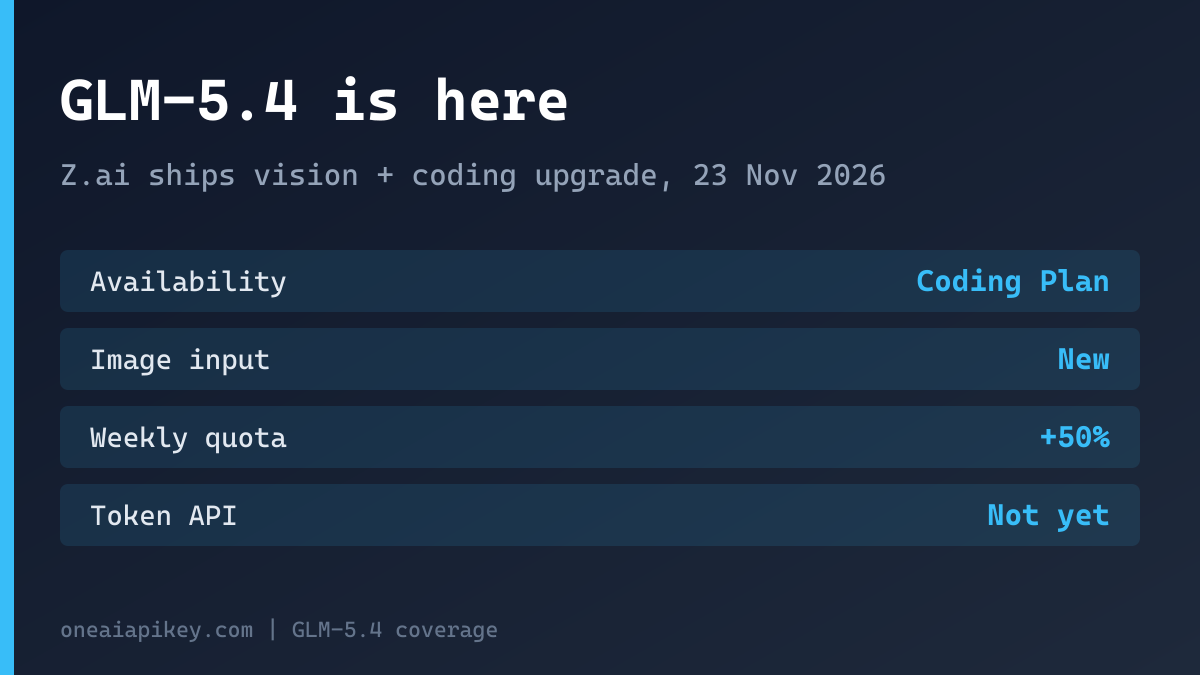
The launch announcement is where the gap is easiest to see. Z.ai listed the vision upgrade, the coding gains, the context window and the quota bump, and said nothing about weights or a license.
Why self-hosting is off the table at launch
The blocker is simple and it is the same blocker covered in our GLM-5.4 open weights guide. Self-hosting requires weights. Weights require a release. Z.ai shipped GLM-5.4 to Coding Plan subscribers on 23 November 2026 without one. GLM-5.3, the previous flagship, shipped with open weights under a custom license, and GLM-5.3-Flash shipped under MIT, so there is precedent for openness in the series. But precedent is not a release, and as of launch day GLM-5.4 has neither a license nor a download.
Until that changes, no amount of hardware budget gets you a self-hosted GLM-5.4. If your project has a hard requirement for on-prem deployment, for data that cannot leave your network, or for weights you can audit and fine-tune, GLM-5.4 does not meet that requirement today. The models that do are the ones with published weights, and we point you at those below.
What a 700B looped MoE would demand
Now the forward-looking part, with the caveats attached. AICodeKing reported, with the explicit caveat that he was not certain, that GLM-5.4 is a looped transformer with roughly 700 billion parameters. Z.ai has not confirmed that figure. Treat it as unverified. What Z.ai has said on the record is that three months of work went into scaling what it calls the Loop and model size, and that the Loop Transformer is the first improvement users will notice. A technical report is coming. Our GLM-5.4 loop transformer guide covers the architecture in accessible terms.
If the 700B figure holds and the model is a looped mixture-of-experts, the deployment math looks a lot like the large MoE models you can already download, and those are not small deployments. The reason is memory, not compute. In a mixture-of-experts model, only a fraction of the parameters activate per token, which keeps per-token compute manageable. But every expert has to live in VRAM, because you cannot predict which experts a given token will route to. The total parameter count, not the active count, is what sets your memory bill.
That is the lesson written all over the large open models shipping today, and it is worth reading the real numbers rather than guessing. Our LingSante-3.1-flash self-hosting guide covers a 560B MoE, and its conclusion is blunt: a 560B MoE at FP8 does not fit on any single card you can buy, and the reference deployment is 8x H200 or 4x GB300. That is a cluster, not a workstation. A 700B model, if that number is right, would be in the same class or heavier. Cluster-scale VRAM, quantized weights, and a serving runtime built for MoE are the baseline, not the stretch goal.
The other lesson from that deployment is the software stack. Large MoE models need runtimes that understand expert routing and memory tiering. The LingSante deployment leans on SGLang and vLLM with FP8 weights and speculative decoding to hit usable throughput, and those same runtimes are the likely path for a large GLM MoE if weights land. None of that is optional. The gap between running a model and running a model usefully is exactly the tooling these projects document.
Why large models are a memory problem, not a compute problem
It is worth slowing down on one point, because it is the single biggest thing people get wrong when they estimate what self-hosting a large model costs. The instinct is to think about how big the model is in terms of speed. A big model must be slow, so you budget for a powerful GPU and assume that solves it. That instinct is wrong for large mixture-of-experts models, and GLM-5.4 is reported to be one.
The reason is the split between active and total parameters. In a mixture-of-experts design, each token only routes through a small subset of the model’s experts, so the compute per token stays close to a much smaller dense model. That is the efficiency trick that makes these models economical to run per token. But memory does not care about routing. Every expert has to sit in VRAM at all times, because you cannot predict which experts the next token will need. A model with 700 billion total parameters, active or not, has to fit hundreds of gigabytes of weights into memory before you add the KV cache, activations, and the overhead of serving many requests at once.
That is why the reference deployments for large open MoE models are clusters. Our LingSante-3.1-flash self-hosting guide covers a 560B MoE and puts the requirement at 8x H200 or 4x GB300 at FP8, with the explicit warning that it does not fit on any single card you can buy. The lesson generalizes. Quantization shrinks the footprint but does not eliminate it, and FP8 is roughly where these deployments land as the practical floor. For GLM-5.4, if the 700B figure holds, expect the same class of requirement, and treat any single-GPU claim as marketing until proven otherwise.
The context window compounds this. GLM-5.4 carries a 1 million token context, the same as GLM-5.3, and long-context serving multiplies KV cache size. A model that can hold a million tokens of context needs memory tiering strategies, not just raw HBM, which is exactly why serious deployments lean on tools that page cache between fast and slow memory. Our GLM-5.4 context window guide covers the window itself, and it is one more reason a self-hosted deployment is a systems project rather than a model download.
The software stack you would need
Hardware is the visible cost. The software stack is the hidden one, and it is where most self-hosting projects actually spend their engineering time. A large MoE model does not run on a vanilla inference server. It needs a runtime that understands expert routing, quantized weight loading, continuous batching, and memory management for long contexts.
The two runtimes that dominate serious self-hosting today are SGLang and vLLM, and both are covered in depth in the LingSante-3.1-flash self-hosting guide, because that deployment uses both. SGLang publishes dedicated images with the custom kernels these architectures need, and vLLM supports them on specific branches with model-specific parsers for tool calls and reasoning traces. The detail that surprises people is how model-specific this gets. The parsers and kernels are not generic. They are tuned to the exact way a given model emits structured output, which means a new model like GLM-5.4 would need its own integration work before it runs well, even after weights exist.
The shape of a reference deployment looks like this, illustrated with the kind of SGLang configuration the large MoE models use. Treat this as the shape of the answer, not a working GLM-5.4 command, because there is no official recipe to copy yet:
# Illustrative shape only - GLM-5.4 has no official recipe yet
python -m sglang.launch_server \
--model-path <GLM-5.4-weights> \
--tp-size 8 \
--quantization fp8 \
--context-length 1000000 \
--mem-fraction-static 0.9
Every line of that would need to come from Z.ai’s actual release: the model path, the tensor-parallel size, the quantization format, and the context flags. The tensor-parallel size in particular depends on the real parameter count and memory footprint, which is exactly the number we do not have. That is why this post gives you the shape rather than a command you could paste today. Copying a deployment config for a model whose weights do not exist would be worse than useless.
On top of the runtime, production deployments add speculative decoding to raise throughput, quantization tooling to fit weights into available VRAM, and monitoring to catch the failures that come with running a complex distributed system. A team that already operates GPU clusters has most of this. A team that does not is underestimating the project if they are budgeting only for hardware. That is the honest framing, and it is the reason self-hosting a frontier-class model is a capability most organizations rent rather than build.
The Inkling lesson: economics decide, not capability
Hardware is only half the story. The other half is whether self-hosting is worth it for your workload, and that is a question the small-model deployments answer more usefully than the large ones.
Our inkling-2-mini-cheapest-hosted guide covers the cheapest ways to access a small model through hosted routers, and the Inkling 2 Mini vs frontier comparison shows where a small open model competes and where it does not. The pattern that emerges is the one that matters here. Hosted access is almost always cheaper for bursty, low-volume, or experimental workloads, because you are renting inference by the token rather than buying GPUs that idle. Self-hosting wins when you have steady, high-volume traffic, a hard data-residency requirement, or spare cluster capacity you already own.
A 700B looped model pushes that break-even far out. The capital cost of a multi-GPU cluster is high, the operational cost of running it is high, and you need enough utilization to justify it. For most teams, most of the time, hosted access to GLM-5.4 through a plan or a router is the rational default even if weights land, purely on economics. Self-hosting becomes the right call for a specific slice: regulated workloads, very high steady volume, or organizations that already operate GPU clusters.
What we cannot tell you yet
Honesty requires a list of the numbers we do not have, because inventing them would be worse than useless.
We do not have a confirmed parameter count for GLM-5.4. The 700B figure is a reporter’s unverified read, not a Z.ai statement. We do not have a confirmed memory footprint, VRAM requirement, or quantization size, because no weights exist to measure. We do not have a recommended GPU configuration, because there is no official deployment recipe and any number we gave you would be a guess dressed up as guidance. We do not have a confirmed license, so we cannot tell you what you would be allowed to do with the weights even if you had them. And we do not have a release date for weights, because Z.ai has not given one.
Any self-hosting guide that gives you a firm GPU count for GLM-5.4 today is guessing. We would rather give you the shape of the answer and mark the unknowns than hand you a spec sheet built on an unconfirmed parameter count. When Z.ai publishes the technical report, and if weights follow, this post gets updated with real numbers.
Future update: hardware numbers when weights land
This section will be updated once Z.ai publishes the GLM-5.4 weights and, ideally, an official deployment recipe. As of 23 November 2026 there is no parameter count on the record, no memory footprint, no recommended GPU configuration, and no license, so every hardware figure in circulation is either a reporter’s estimate or a guess.
Based on Z.ai’s history and the deployment math of comparable large open mixture-of-experts models, a reasonable expectation is a cluster-scale requirement. The best public reference point is the 560B LingSante-3.1-flash, which needs 8x H200 or 4x GB300 at FP8 and does not fit on any single card. A looped MoE reported at around 700B, if that unconfirmed figure holds, would sit in the same class or heavier, served through runtimes like SGLang or vLLM with FP8 weights and memory tiering for the 1M context. That is inference from the deployment economics of similar models, not an official Z.ai specification, and the 700B figure itself is unverified. If the real parameter count or active-parameter split differs, the hardware picture changes with it. We will replace this section’s estimates with measured numbers the day weights and a recipe exist.
What to do in the meantime
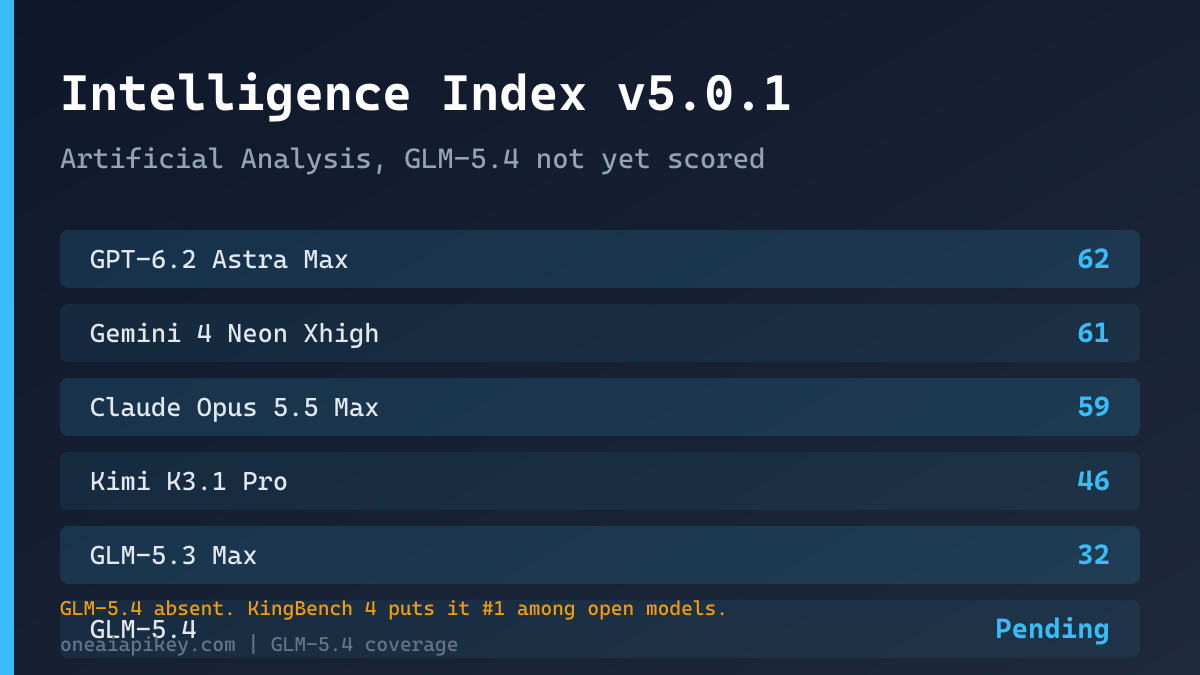
If you need a self-hostable open coding model today rather than someday, you have real options, and they are covered elsewhere on this site. DeepSeek V4.1 ships under MIT, the most permissive license in this generation, and it is the most open strong coding model you can download. GLM-5.3 ships with open weights under a custom license and is the strongest GLM you can actually host. GLM-5.3-Flash ships under MIT and is the cheapest GLM to run yourself. None of them match GLM-5.4’s early KingBench 4 result, where it placed 7 overall and first among open models, but all of them are downloadable, which GLM-5.4 is not.
That capability gap is the temptation, and it is worth seeing it clearly against the closed frontier before deciding whether to wait.
Our GLM-5.4 vs GLM-5.3 guide shows exactly what GLM-5.4 adds, and GLM-5.4 alternatives lines up the models competing for the same self-hosted work.
If your goal is to evaluate GLM-5.4 at all, the path today is hosted, not self-hosted. Subscribe to a Coding Plan and test it on your tasks, or access it through a router. Our GLM-5.4 API guide covers calling glm-5.4, and the GLM-5.4 pricing guide covers the plan quota and the token price that has not been published yet. Get a real sense of whether the model earns its place in your stack through hosted access first. If it does, and the weights land, you will have a much clearer idea of whether self-hosting is worth the cluster.
If you are evaluating it specifically as a reviewer or planner, which is the deployment AICodeKing’s run points to, note that a self-hosted deployment has to budget for that behavior. The model reasons deeply on nearly every step and used about 1.04 million reasoning tokens on a hard task in his run, so a self-hosted deployment needs headroom for long generations and high token throughput, not just enough VRAM to load the weights.
The per-step latency from that run is the other half of the hardware question. A self-hosted cluster serving a heavy reasoner has to sustain generation speed across long sequences of reasoning steps, not just load the model.
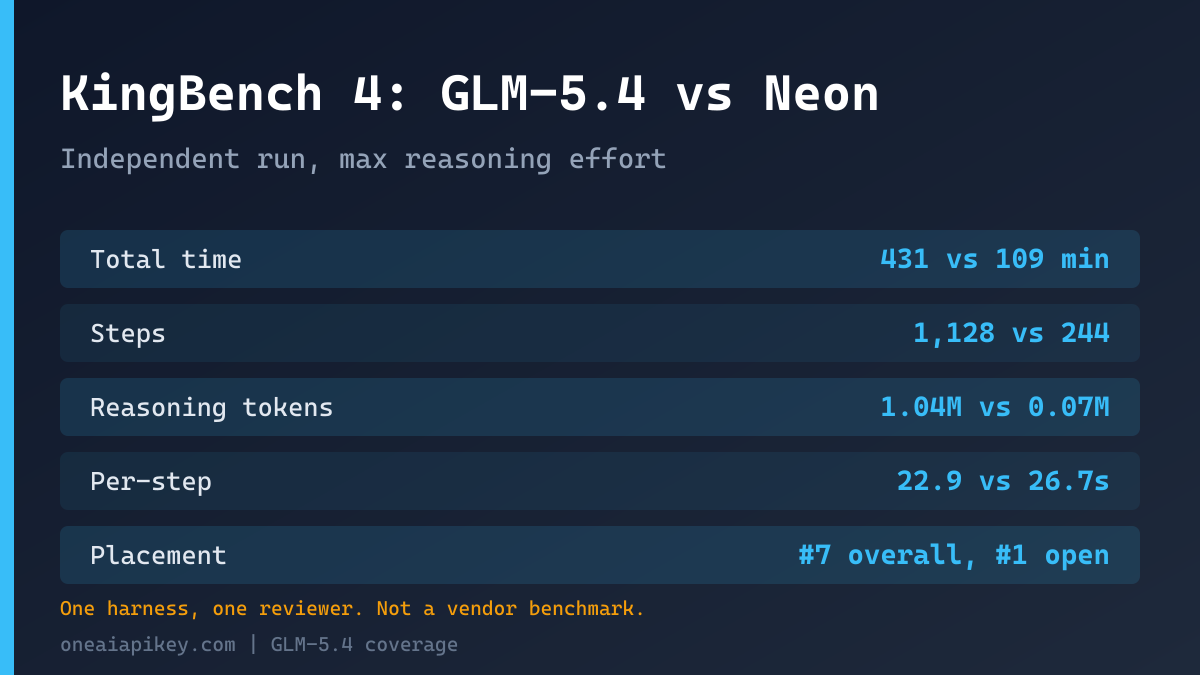
Our GLM-5.4 KingBench 4 deep dive has the full token and latency breakdown, and GLM-5.4 coding performance covers what that means for real workloads.
For the architecture that drives these hardware demands, see GLM-5.4 loop transformer. For how GLM-5.4 compares once you can access it, see GLM-5.4 vs frontier, and for the context window implications on memory, see GLM-5.4 context window. For the vision capability that would matter most in a self-hosted on-prem deployment, see GLM-5.4 vision.
A checklist for the day weights land
If you are the kind of team that would self-host GLM-5.4 on day one of a weight release, it is worth deciding now what you would actually need, because a weight drop moves fast and the teams that benefit are the ones with a plan. Here is the honest checklist, built from what the large open MoE deployments teach.
First, confirm the license before you plan anything around the weights. A custom license can restrict commercial use, redistribution, or specific fields, and our GLM-5.4 open weights guide covers why the license is not guaranteed to be permissive even if weights ship. Second, read the official deployment recipe rather than improvising one, because the maintainers’ reference path will save you days of bring-up pain. Third, budget for the cluster honestly, including the memory headroom for long contexts and concurrent requests, not just the raw weight footprint. Fourth, pick SGLang or vLLM based on your existing stack and stick with the documented integration rather than hand-rolling configs for a first deployment. Fifth, test on your real workload before committing, especially if you are routing reviewer and planner tasks to it, because the token and latency profile is demanding in a way that only shows up under real load.
None of that checklist is actionable today, because there are no weights. But having it written down means that if Z.ai publishes, you can move in days rather than weeks, and you will not have made commitments based on the unconfirmed 700B figure in the meantime. Planning for a release you cannot date is a discipline, and the teams that do it well are the ones that separate what they know from what they are guessing.
The bottom line on self-hosting GLM-5.4
The honest summary is short. You cannot self-host GLM-5.4 today, because the weights are not published, and no amount of hardware changes that. If the weights land, hosting a model of this reported size and design is a cluster-scale project with real capital and operational cost, and it is worth it for a specific slice of teams: those with regulated-data requirements, steady high-volume workloads, or existing GPU capacity. For everyone else, hosted access through a plan or a router is the rational default, and it lets you evaluate the model before deciding whether self-hosting is ever worth it. We will update this guide with real numbers when Z.ai publishes the technical report and, if it happens, the weights.
Sign up for a key to call GLM models through hosted access, browse the model catalogue, or price a deployment through the cost calculator before committing to hardware.
More GLM-5.4 coverage
This is part of a series on GLM-5.4. The rest of the cluster goes deeper on the areas this launch only sketched:
- GLM-5.4 launch on what shipped and what did not
- GLM-5.4 benchmarks once Z.ai publishes the official tables
- GLM-5.4 vs GLM-5.3 on what actually changed model to model
- GLM-5.4 vs frontier against the closed flagships
- GLM-5.4 coding performance on the Loop architecture and the reviewer profile
- GLM-5.4 vision on the new image input and screenshot-to-code use
- GLM-5.4 pricing on the 50% bump and the missing token rate
- GLM-5.4 API guide on calling
glm-5.4and the Coding Plan path - GLM-5.4 context window on the 1M window and long-context coding
- GLM-5.4 open weights on whether the vision upgrade ships as open source
- GLM-5.4 KingBench 4 on the early independent run in full
- GLM-5.4 loop transformer on the architecture and the technical report
- GLM-5.4 for code review on the planner and reviewer deployment pattern
- GLM-5.4 alternatives on the open models competing for the same work