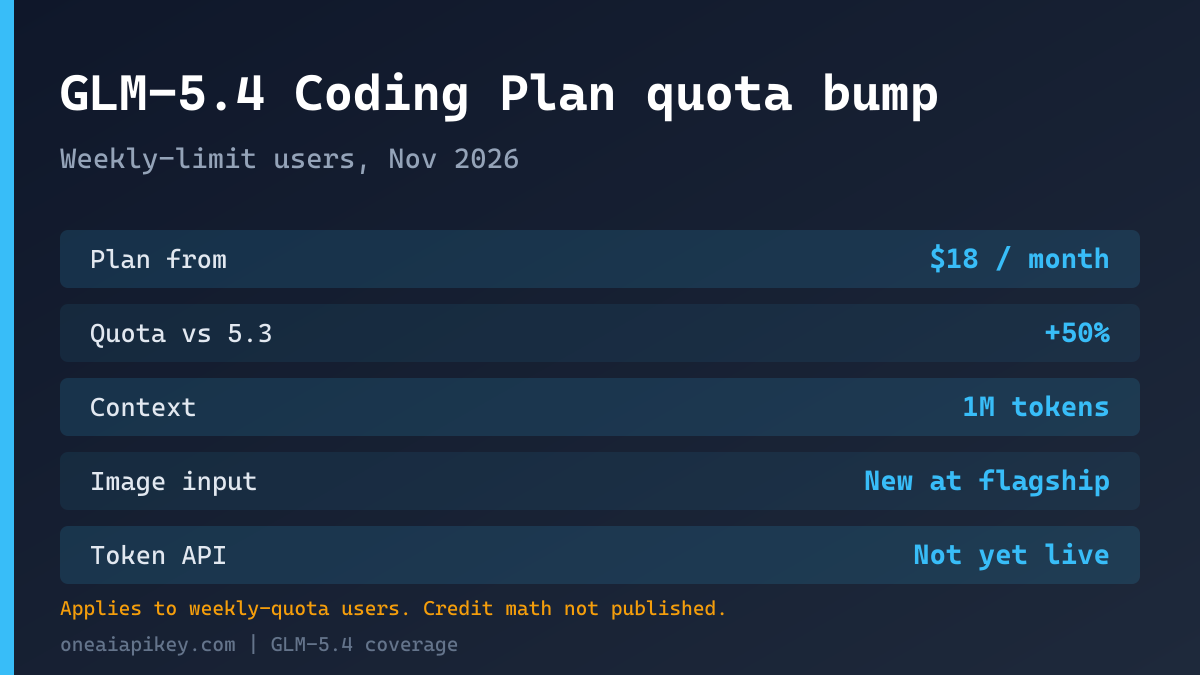
GLM-5.4 keeps the one million token context window that GLM-5.3 had. The figure appears on the Coding Plan picker next to the model, reported by IT Home from the plan’s model selector, and it is the same number the previous flagship carried. For a coding model that is the spec that decides what kind of work you can hand it in a single request, and a million tokens is enough to hold a real codebase, a long conversation, or an agent run that has been working for a while.
But the headline number hides two gaps worth knowing about. Z.ai has not published the exact input limits, and it has not published an output cap. And there is an interaction between long context and the way GLM-5.4 actually behaves that turns a generous window into a quota question. Early testing showed this model generates a very large number of reasoning tokens on hard tasks, which means the context window is not the only budget you are spending against. This post covers what is confirmed, what the window enables, what the community found about how the model uses that room, what is not published, how it compares to rivals, and why long context plus token-hungry reasoning is a combination to watch on a metered plan.
What is confirmed
The context window is one million tokens. It is labeled on the GLM Coding Plan picker alongside the glm-5.4 model ID, and it is the same one million figure GLM-5.3 carried. That continuity is worth noting. Z.ai did not change the window in this release, so if you were already working within GLM-5.3’s limits, nothing about your input size changes when you move to GLM-5.4.
A million tokens is a large window by any measure. As a rough sense of scale, source code is dense in tokens, and a million tokens is enough to hold many thousands of lines across many files. It is not a number you reach by pasting a few documents. It is a number you reach by loading a repository, or by running an agent long enough that its accumulated context grows past what a smaller window could hold.
It is also worth being clear about what the confirmation is. The million-token label comes from the Coding Plan interface, not from a detailed technical specification. Z.ai has not published a model card for GLM-5.4, and Kingy AI noted in his launch write-up that there is “no documented standard API entitlement” and “no first-party scorecard” for the model. So the window is confirmed at the level of “the plan says 1M,” which is enough to plan against, but the finer structure underneath that number is not documented.
What 1M context enables for coding
The reason context length matters for a coding model is that real software work is not single-file work. Here is where a million-token window earns its size.
Whole-repo reasoning. The clearest use is pointing the model at an entire codebase, or a large slice of one, and asking it to reason across files. Refactoring a function means knowing every caller. Adding a feature means knowing the modules it touches. Tracing a bug means following a path through files that may be far apart in the tree. A model with a million-token window can hold all of that in context at once, so it reasons about the codebase as a whole rather than reasoning about a fragment you pasted and guessing at the rest. This is the difference between a model that answers about your code and one that answers from your code.
It is worth being concrete about what fits. A million tokens is enough to hold a mid-sized service in full, including its tests and configuration, with room to spare for a detailed instruction. It is enough to hold a large monorepo’s most important directories, though perhaps not every file in a very large one. And it is enough to hold a single file that is itself enormous, which matters more than it sounds, because the largest files in a real codebase are often exactly the ones that are hardest to reason about and the ones a small window forces you to truncate.
Long agent runs. The second use is agents, and it is the one that makes the window genuinely valuable rather than just large on paper. An autonomous coding agent accumulates context as it works. It reads files, runs commands, gets tool output, edits, tests, and repeats. Every one of those steps adds to the context. On a model with a small window, the agent eventually runs out of room and has to summarize or drop earlier work, which is where agents lose the thread. On a model with a million-token window, the agent can work much longer before it hits that wall.
The tool-output side of this is easy to underestimate, and it is exactly where GLM-5.4’s behavior makes the window matter. A single command in an agent run can produce thousands of tokens of output, a test suite can produce more, and a build log on a failure can produce a great deal more. Over a run of dozens or hundreds of steps, that accumulated output is what fills the window, and it is exactly the material an agent needs to keep in order to avoid repeating work it has already done. A large window lets the agent keep its own history rather than compress it.
Large refactors and migrations. The third use is the kind of task that spans a codebase deliberately. A framework migration, an API version bump across many files, a rename that touches dozens of call sites. These are tasks where the model needs to see the whole surface it is changing, and where a smaller window forces you to feed it pieces and hope the pieces connect. A million tokens lets you frame the whole migration in one request.
Cross-file review. The fourth use follows from the reviewer profile. A code review that only sees a diff is a weaker review than one that sees the diff and everything around it. With a large window you can give the model the change and the modules it touches, so it can check the change against its real context rather than against a guess. This is where the reviewer deployment pattern and the large window reinforce each other. Our GLM-5.4 for code review post covers that pattern.
These overlap with what the rest of the large-context field offers, and GLM-5.4 is not unique in having a big window. What is notable is that it keeps the window while adding vision and a claimed coding improvement, so you are not trading context for the new features. Our GLM-5.4 vision post covers the image input, which lets you load a screenshot of a UI alongside the large codebase that produces it in the same request.
What the community found about how it uses the room
The context window tells you how much you can put in. The community testing tells you what the model does once it is in there, and that is where GLM-5.4’s profile gets interesting and a little expensive.
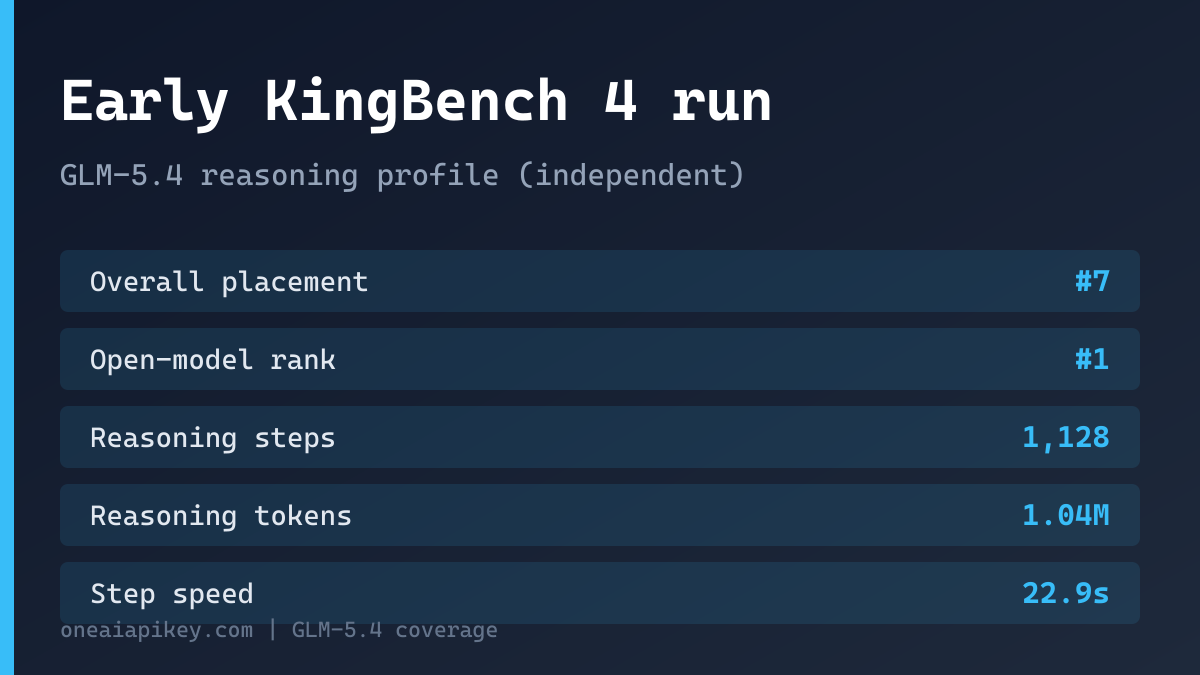
AICodeKing, who ran the one independent evaluation of this model, placed it seventh overall in his KingBench 4 harness and first among open models, calling it the “best Open Model you can use right now.” The detail that matters for context is how it got there. On a hard task, GLM-5.4 took 1,128 reasoning steps against 244 for the frontier comparator he calls Neon, and generated about 1.04 million reasoning tokens against Neon’s roughly 70,000. The model reasons on nearly every step, with under 1% of steps showing near-zero reasoning.
Think about what that means for the window. A thousand-plus reasoning steps in a single task means the model is building up a very long internal working context as it goes. Each step adds reasoning, tool calls, and tool output. That is exactly the long-agent-run pattern the big window is designed to support, and it is also why the window and the token budget are the same question on this model. A model that thinks in 1,128 steps needs the window to hold its own reasoning, and it burns tokens doing it.
思维怪怪 (@0xLogicrw), posting a detailed reaction, called GLM-5.4 the “most cautious model” and said it “suffers from overthinking,” while rating the High reasoning setting as “the choice that combines ability and speed.” That is the same finding from the user side. A model that reasons on nearly every step is careful, and it is also expensive in tokens and time. The BlockBeats summarized the KingBench result as GLM-5.4 using “reasoning tokens nearly 15x more than Google’s Neon,” which is the sharpest one-line version of the cost.
AICodeKing also found the overthinking has a failure mode worth knowing about for long runs. On a security task, both the High and Max reasoning settings hit a 180-second timeout while still thinking, while the Medium setting passed in 95 seconds. His verdict was that “High is the best sweet spot.” For anyone planning long agent runs, that is practical: the most thorough setting is not always the one that finishes, and a model with a big window will happily keep reasoning until something external stops it.
His overall read was that GLM-5.4 profiles best as a reviewer, planner, or big-picture tool rather than an end-to-end code generator, and he specifically said it is not recommended for 3D or frontend work. For context-window purposes, the reviewer and planner roles are exactly the ones that benefit from a big window, because they need to see the whole codebase at once. So the window and the recommended deployment reinforce each other. Our GLM-5.4 coding performance and GLM-5.4 KingBench 4 posts cover the testing in more depth.
What is not published
Here is the honest part. Z.ai has confirmed the one million token window but has not published the exact limits around it. There is no documented maximum input in tokens separate from the headline, no documented output cap, and no documented behavior when a request approaches the ceiling.
That matters for two reasons. First, many large-context models have a tiered structure where the headline window is the maximum but practical limits or pricing tiers kick in below it. Without a documented input limit you cannot tell whether all one million tokens are usable in a single request or whether there is a softer practical ceiling. Second, without a documented output cap you cannot plan the largest response you might receive. For a model that reasons as heavily as GLM-5.4 does, the output side of the budget is the side most likely to surprise you.
There is a third unknown that is specific to how this model works. Because GLM-5.4 generates a very large number of reasoning tokens, the question of whether reasoning tokens count against the context window, and how the model manages its context as those tokens accumulate across 1,128 steps, is not documented. Some models keep reasoning in a separate working space that does not consume the same window. Some fold it in. Z.ai has not said which GLM-5.4 does, and it changes how much of the million tokens is actually available for your input versus the model’s own thinking.
The practical guidance is to build against the confirmed number and test the edges yourself. Push a request close to the ceiling with your actual workload and see whether it is accepted, how long it takes, and how complete the response is. Do not assume a behavior Z.ai has not documented, and treat any limit you discover empirically as the real one. Our GLM-5.4 benchmarks post tracks the measurement picture, and the official numbers, when they arrive, will replace the empirical approach.
Long context plus token-hungry reasoning is a quota question
Here is the interaction that turns this spec into a budget question, and it is the most practical thing in this post.
GLM-5.4 has a million-token window, which means you can feed it a lot. It also reasons heavily, which means it produces a lot. Put those together. A big window lets you load a large repo. A token-hungry reasoning style means the model then thinks at length about what you loaded, generating over a million reasoning tokens on a hard task across more than a thousand steps. On a plan that meters usage, or on a future pay-as-you-go rate, the reasoning tokens are a real cost, and the long context is what enables the large reasoning runs. A request that uses a lot of context is likely to also trigger a lot of reasoning, so the two budgets compound rather than standing apart.
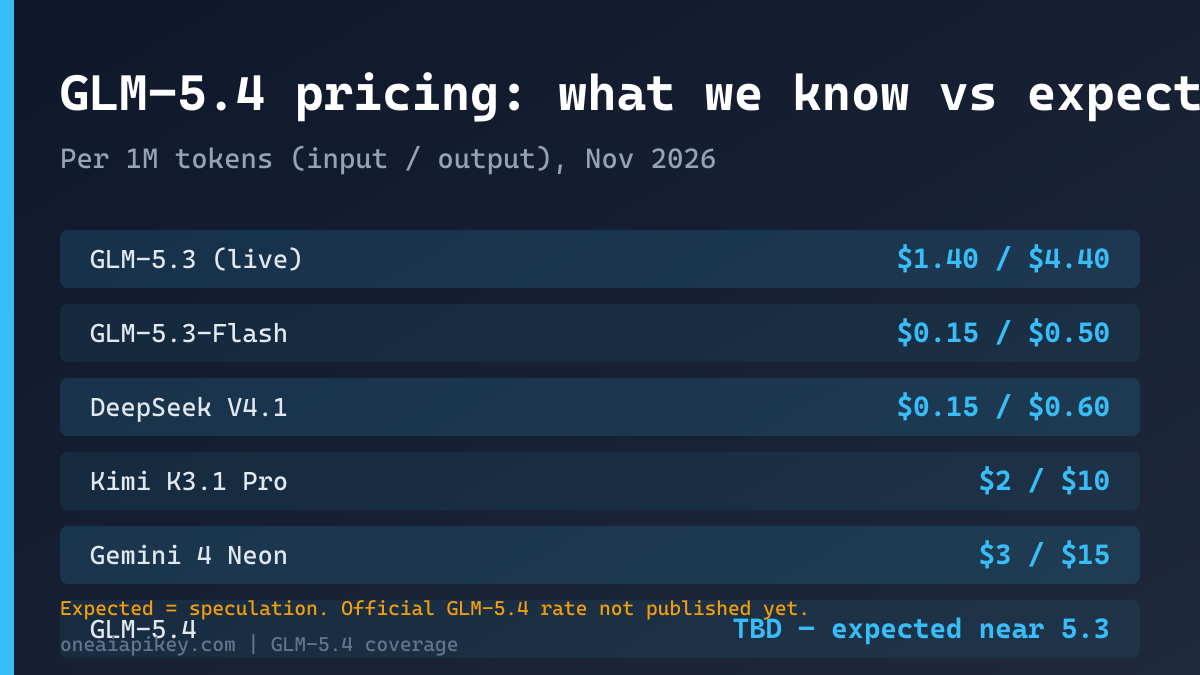
The cost structure makes it worse, and this is where the credit multipliers matter. Z.ai publishes multipliers for GLM-5.3 showing that output costs 24 credits per 10,000 tokens against 6.9 for input. Output is roughly three and a half times as expensive as input. A model that reasons its way to a million output tokens is therefore drawing down your credits far faster than its input size alone would suggest. GLM-5.4’s multipliers are not published, but the shape of the GLM-5.3 table tells you output is the direction to watch. Our GLM-5.4 pricing post covers the multipliers and the quota structure in detail.
The 50% weekly quota bump that Z.ai gives GLM-5.4 subscribers is the cushion that absorbs this for plan users, and it is a meaningful one. The Lite tier’s weekly pool grows from 10,000 to an effective 15,000 credits when you run GLM-5.4. There is also a timing lever: off-peak usage is billed at a 50% credit rate, with peak defined as Monday to Friday, 14:00 to 18:00 Singapore time. Running long agent jobs off-peak halves their credit cost, which for a token-hungry model is the difference between a tier lasting a week and lasting a few days.
But the credit math behind the quota is not published for GLM-5.4, and a model that can emit a million reasoning tokens on one task can burn through a quota faster than its context window suggests. Budget for the reasoning tokens, not just the input size.
How 1M compares to other models
A million tokens is a large window, and it puts GLM-5.4 in the group of models built for whole-repo and long-agent work. The exact context figures for every rival are not all published in one place, and where a number is not confirmed here we say so rather than guess.
GLM-5.3 had the same one million token window, so GLM-5.4 does not gain ground on context over its own predecessor. That makes the window a place where the two models are identical, and the GLM-5.4 vs GLM-5.3 comparison is where the actual differences, vision and the coding claim, live.
Among the closed flagships, several compete at or near this scale, and the models differ more in how they use the window than in the raw number. Gemini 4 Neon, with its broad multimodal input that includes PDF, is aimed at long documents as much as long code, and our Gemini 4 Neon launch post covers that modality set. Claude Opus 5.5 and GPT-6.2 Astra are the closed coding flagships GLM-5.4 is most often set against, and our best frontier models roundup and GLM-5.4 vs frontier comparison line up the field model by model. GPT-6.2 Astra notably charges more above 272K tokens, which is a reminder that a large window and a cheap large window are not the same thing.
For the smaller open tier, our Hy4 Flash vs GLM-5.3-Flash comparison shows how the budget models handle context, and GLM-5.4 alternatives covers the open models competing for the same long-context work.
The fair summary is that a million tokens is competitive but not exceptional at the top of the market in late 2026, where large windows are common. GLM-5.4’s window is a baseline expectation for a flagship coder rather than a differentiator. The differentiators are the vision input, which the closed flagships already have, and the open-model coding placement, which is where GLM-5.4 stands out.
Practical habits for using a large window
A large window is easy to waste, and a few habits get more out of it than simply filling it up.
Load the files that matter rather than everything you can fit. A focused context produces better reasoning than a padded one, even when the window could hold more. The model has to attend across everything you give it, and irrelevant files dilute the relevant ones. A million tokens is a ceiling, not a target.
Give the model the whole relevant surface for the task rather than a summary of it. This is the point of the window. For a refactor, include the callers. For a bug trace, include the path. Summaries save tokens but they also remove the detail the model reasons from, and on a window this size the detail is usually affordable.
Keep your instructions close to the end of the context for long requests. Long-context models tend to attend most reliably to instructions near the end of the input, so putting your actual question after the large block of code rather than before it tends to get a cleaner response.
Pick the reasoning setting deliberately. AICodeKing’s finding that High beat Max on a timed security task, because Max kept thinking past a 180-second timeout while High finished, is the clearest guidance here. The most thorough setting is not always the one that completes, and on a long agent run a setting that never stops thinking is worse than one that stops at the right moment.
Set streaming on your requests. A model that generates a million reasoning tokens on a hard task is one where you want to see progress rather than wait on a complete response.
And watch the quota as you scale, because the window invites large requests and the reasoning style makes them expensive. A request that loads a big repo is likely to also trigger a long reasoning run, so the input tokens and the output tokens grow together. Run heavy jobs off-peak for the half-rate credits. That is the single most effective way to keep a large-window workload affordable on this model.
The one million token context window is confirmed, it matches GLM-5.3, and it is a real capability for whole-repo reasoning and long agent runs. The exact limits and output cap are not published, so test the edges with your own workload. And because GLM-5.4 reasons heavily, treat the window and the token budget as one combined question rather than two separate ones.
Future update: exact context limits and output cap
This section will be updated once Z.ai publishes the precise input limits, the output token cap, and how reasoning tokens interact with the context window for GLM-5.4. None of that is documented as of 23 November 2026, and there is no model card to read it from. Based on Z.ai’s history, GLM-5.3 carried the same one million token window with a broadly similar structure, so a reasonable expectation is that GLM-5.4’s detailed limits, when published, look like GLM-5.3’s, with a technical report filling in the finer behavior around reasoning tokens. Z.ai has said a technical report is coming. That is inference from Z.ai’s own track record and its stated plans, not an announced specification. Until the detailed numbers appear, treat the one million figure as the confirmed headline and test the practical edges yourself.
More GLM-5.4 coverage
This post is part of a series on the GLM-5.4 launch. The rest of the cluster goes deeper on what the launch only sketched:
- GLM-5.4 launch is the overview of what shipped and what did not
- GLM-5.4 benchmarks once Z.ai publishes the official tables
- GLM-5.4 vs GLM-5.3 on what changed model to model
- GLM-5.4 vs frontier against the closed flagships
- GLM-5.4 coding performance on the Loop architecture and the reviewer profile
- GLM-5.4 vision on the new image input and screenshot-to-code use
- GLM-5.4 pricing and quota on the 50% bump and the missing token rate
- GLM-5.4 API guide on calling
glm-5.4and the Coding Plan path - GLM-5.4 open weights on whether the upgrade ships as open source
- GLM-5.4 self-hosting if the weights go public
- GLM-5.4 KingBench 4 on the early independent run in full
- GLM-5.4 loop transformer on the architecture and the technical report
- GLM-5.4 for code review on the planner and reviewer deployment pattern
- GLM-5.4 alternatives on the open models competing for the same work