GLM-5.4 launched on 23 November 2026 without published weights. As of launch day, Z.ai has not released the model for download, has not posted a license, and has not said when or whether it will. That is the single most important fact for anyone hoping to run this model on their own hardware, and it is the fact most launch coverage skips over. You can call glm-5.4 through a GLM Coding Plan subscription today, but you cannot download it, inspect it, or host it.
This matters more than usual because the GLM series has a real open-source track record. GLM-5.3 shipped with open weights under a custom license. GLM-5.3-Flash shipped under MIT, the most permissive license in common use. So the question is not whether Z.ai is an open-source company. The question is whether the newest, strongest, vision-capable flagship breaks the pattern, or whether the weights follow a few weeks later the way they often have for other labs.
This post covers the confirmed licensing status, the open history that sets the expectation, the big open question about the vision upgrade, how the rivals line up on openness, and what open weights would actually unlock for self-hosting and regulated workloads like PHI on-prem. We will be direct about what is known and what is not.
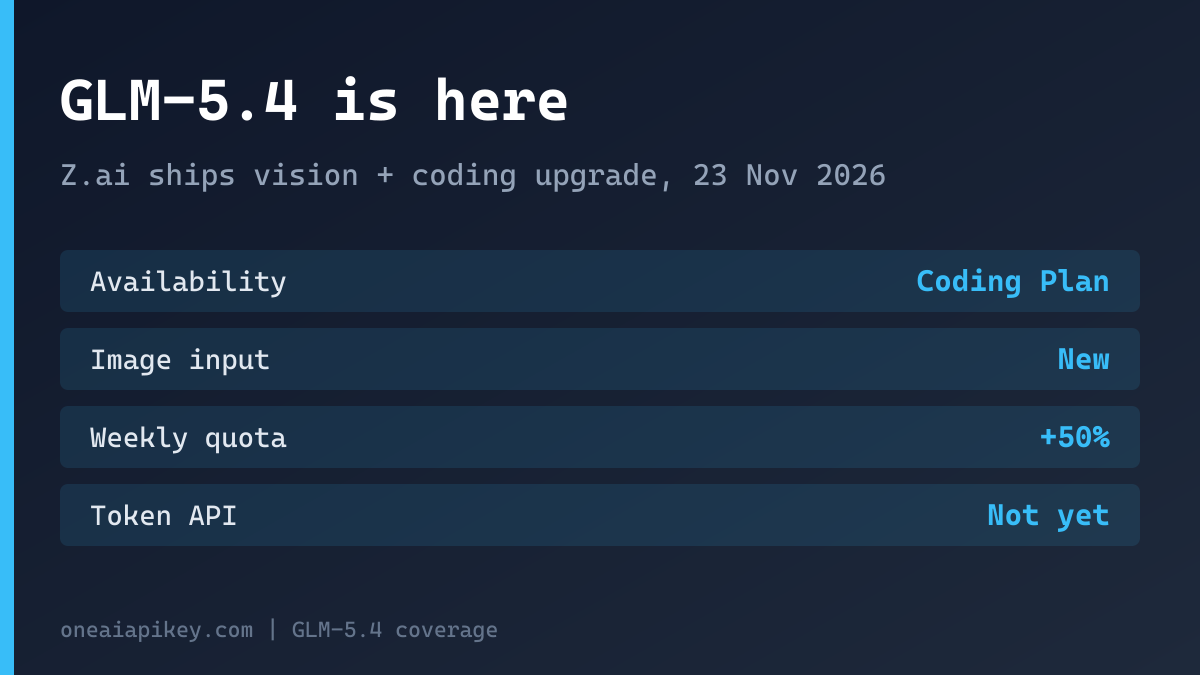
Before the detail, a snapshot of launch day. Z.ai announced GLM-5.4 with a vision upgrade, stronger coding, a 1 million token context, and a 50% quota bump for subscribers. What the announcement did not include was a weight release, a license, or a model card.
The confirmed status: not published at launch
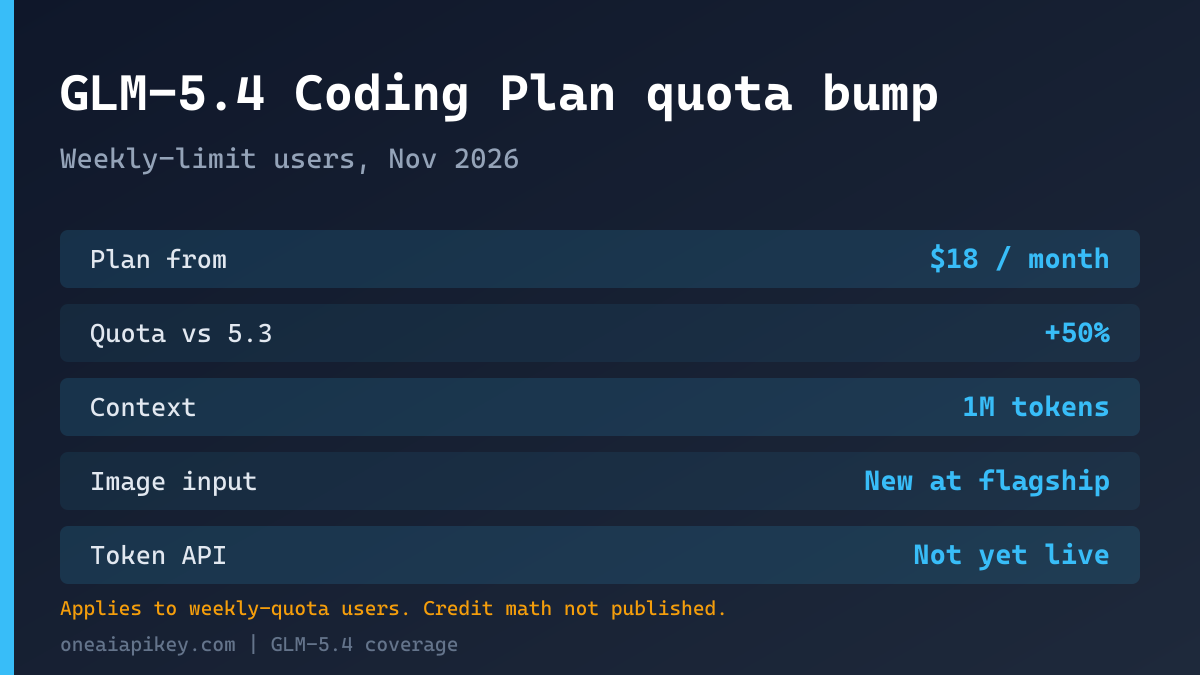
Here is what is verified. GLM-5.4 is available to GLM Coding Plan subscribers, who pay from 18 US dollars a month, and it is not yet on the pay-as-you-go token API. Z.ai has not published public weights for GLM-5.4. There is no download, no Hugging Face release tied to the launch, and no license text in the announcement. The launch materials describe image input, stronger coding, a 50% quota bump for weekly-limit users, and a 1 million token context window. None of that is a weight release.
This is not unusual for a launch of this shape. Many labs ship the hosted model first and publish weights later, or never. But it is a change from what the previous GLM flagship did, and that change is worth taking seriously rather than assuming it will resolve itself.
The community noticed the gap immediately. In the replies to AICodeKing’s launch-day test run, the user @teortaxesTex asked the question that captures the whole uncertainty around this release: “will it be open though?” It is a short question, but it cuts to the point. A series with an open track record shipping a flagship with no weights and no statement is exactly the situation where the community has learned not to assume. Nobody in that thread had an answer, because Z.ai had not given one. The question is still open at the time of writing.
If you are planning a project around GLM-5.4 running on your own infrastructure, the honest planning assumption today is that you cannot, and you should have a fallback. Our GLM-5.4 self-hosting guide covers what it would take to run this model if the weights do land, and why the hardware math is demanding even in the best case.
The open history that sets the expectation
The reason people expect open weights from Z.ai is the recent record. GLM-5.3, the flagship before this one, shipped with open weights under a custom license. That is a restrictive-but-open arrangement: you can download and run the model, but the license carries conditions that a fully permissive license would not. GLM-5.3-Flash, the smaller and faster tier, shipped under MIT. MIT is about as open as software licensing gets. You can use it, modify it, ship it in a product, and sell it, with attribution and almost nothing else.
That split, custom license on the flagship and MIT on the small model, is a strategy you see across the open-model field. It lets a lab keep some control over the model it cares most about while using the small model as a developer-adoption play. The open weights on the small model pull builders in, and the flagship stays a little closer to the vest.
GLM-5.4 breaks the first half of that pattern at launch because it has no published weights at all, not even a custom license. Whether that is a delay, a strategy shift, or a vision-driven decision is unknown. Z.ai has not said. The GLM-5.4 launch coverage lists the missing weights among the questions the release leaves open, and until Z.ai comments, any answer is speculation.
The big open question: vision as open source
The most interesting part of this question is the vision upgrade. GLM-5.4 is the first GLM flagship to accept image input. GLM-5.3 was text-only, and image input in that generation lived only in GLM-5.3-Flash. Bringing vision to the flagship is a meaningful capability step, and it is the headline change in the launch.
It is also the part most likely to stay closed. Vision-capable open models are rarer and more expensive to train than text-only ones, because you need image encoders, paired image-text training data at scale, and alignment work that does not apply to a text model. Labs that release open weights for a text flagship sometimes hold the multimodal version back. The open question for GLM-5.4 is whether the vision upgrade ships as open source at all, or whether open weights, if they come, cover a text-only variant while vision stays hosted-only.
There is no public answer. Z.ai has not framed the vision feature as open or closed, and the launch announcement does not address weight plans for it. If you are building a screenshot-to-code or document-understanding pipeline and you specifically want it self-hosted on open weights, you are waiting on a decision Z.ai has not made public. Our GLM-5.4 vision guide covers what the new image input can do, and GLM-5.4 vs GLM-5.3 covers exactly what changed between the two flagships.
How open are the rivals, really
Openness is a spectrum, not a switch, and putting GLM-5.4 in context means looking at where the rest of the field sits. The current frontier is a mix of fully open, conditionally open, and fully closed, and the differences matter if openness is part of your buying decision.
DeepSeek V4.1 is MIT. That is the most open posture among the current strong coding models, and it means you can self-host, modify, and commercialize with minimal restriction. It is the reference point for what fully-open looks like in this generation, and our DeepSeek V4.1 coverage touches how the smaller DeepSeek and GLM tiers compare.
Kimi K3.1 Pro uses a custom license. Like GLM-5.3, that means open weights with conditions rather than full freedom. You can usually self-host, but read the terms before you build a commercial product on it.
Claude Opus 5.5, GPT-6.2 Astra, and Gemini 4 Neon are closed. No published weights, no self-hosting, no on-prem option. If you use them, you use them through the provider’s API, full stop. That is the trade for the highest measured capability on the boards: our best frontier models roundup shows how far ahead the closed models are on the published indexes.
Against that field, GLM-5.3’s open weights made it the strongest fully-downloadable coding option in its generation, and GLM-5.4’s early KingBench 4 result at number 7 overall and first among open models suggests it inherits that open-model lead on capability. The measured-intelligence indexes, which are a separate measurement from KingBench, still rank the closed flagships ahead on published scores.
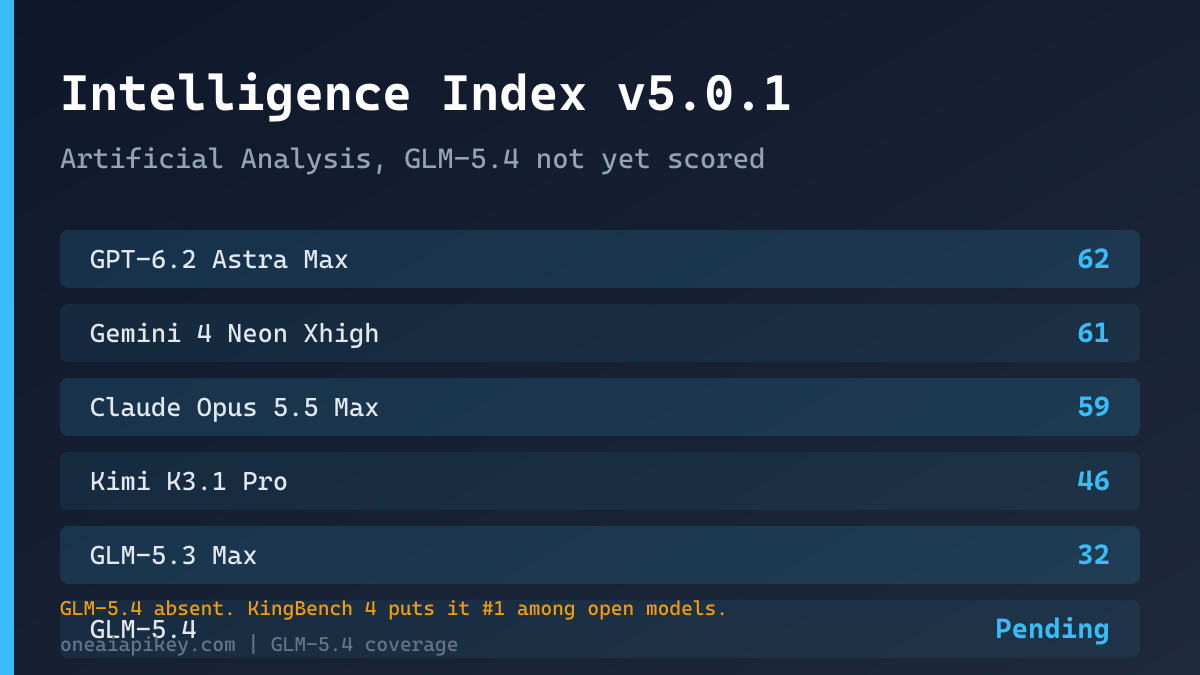
But capability and availability are different axes. AICodeKing called it the best open model you can use right now, which is a statement about quality among models you can access, not a statement that you can download it. Right now you access it through a plan. Our GLM-5.4 KingBench 4 deep dive has the full run, and GLM-5.4 vs frontier sets it against the closed flagships.
What open weights would actually mean
If Z.ai does publish GLM-5.4 weights, the practical consequences are concrete, and they are larger than a checkbox on a feature list.
Self-hosting becomes possible. You could run the model on your own GPUs, on a cloud provider of your choosing, or on a private cluster, instead of routing every request through Z.ai or a third-party router. That changes your cost profile, your latency profile, and your dependency profile all at once. Our GLM-5.4 self-hosting guide is honest that a model of this reported size is a serious infrastructure project, not a weekend deploy.
Fine-tuning becomes possible. With weights, you can adapt the model to your domain, your codebase conventions, or your review standards. Hosted APIs increasingly offer fine-tuning, but full-weight access gives you more control than a hosted fine-tune endpoint usually does. For a coding model you want to teach your internal patterns, that is a real advantage.
On-prem deployment for regulated data becomes possible. This is the one that matters most for healthcare, finance, and government work. If you handle protected health information, client financial records, or classified data, you may be legally required to keep that data inside infrastructure you control. A closed hosted API often cannot satisfy that requirement no matter how good the model is, because the data leaves your environment. Open weights are the precondition for running a capable model fully inside your own perimeter, which is what lets you make a compliance argument at all.
Model inspection and auditing become possible. Open weights let you examine what you are deploying, run your own evaluations rather than trusting a vendor table, and in principle probe for behaviors you care about. For teams that need to justify a model choice to a regulator or a security review, that transparency is worth a lot.
None of this happens without the weights. And the honest read today is that none of it is available for GLM-5.4 yet.
The PHI-on-prem case, in plain terms
It is worth being specific about the regulated-data use case because it is the strongest argument for caring about open weights at all. A hospital system, a health-tech startup handling patient records, or a payer processing claims often cannot send PHI to a third-party hosted model without a business associate agreement and a long compliance review, and sometimes cannot send it at all under their own policies.
Open weights change that calculus. If a capable model runs on hardware the organization controls, inside its own network, the data does not leave. That makes it far easier to satisfy HIPAA and internal policy, because the model is infrastructure, not a vendor relationship. GLM-5.3’s open weights made it a candidate for exactly this kind of deployment. GLM-5.4, with vision added, could in principle extend that to reading scanned documents, screenshots, or medical images, which is a large share of real clinical data. But that only works if the vision-capable weights are released, and that is precisely the open question above.
We are not saying GLM-5.4 will get there. We are saying that the reason open weights matter for this model is bigger than saving on API bills. It is about who is allowed to use a capable model at all, and for a meaningful slice of the market, the answer depends on weights they can host themselves. If you are weighing hosted versus self-hosted for cost alone, our inkling-2-mini-cheapest-hosted guide shows the current economics of cheap hosted access, which is the alternative to self-hosting for most teams.
Why labs hold weights back, and why timing is hard to predict
It helps to understand why a launch like this ships without weights, because the reasons are usually strategic rather than accidental, and knowing them makes the waiting easier to plan around. The first reason is commercial. GLM-5.4 is being sold through a Coding Plan subscription, and a hosted-only model is a subscription driver. Every person who wants to try the new flagship has to subscribe, at least for a month. Publishing weights on day one gives a slice of those people a reason not to subscribe at all, because they could host it themselves. Holding the weights keeps the launch funnel pointed at the plan.
The second reason is timing and polish. A weight release is not just uploading a file. It involves a license review, a model card, safety evaluation, inference code that works with the major runtimes, and usually coordination with hosting platforms so the model is usable the day it appears. Labs often ship the hosted model first to start gathering feedback and revenue, then publish weights once the packaging is ready. That can be weeks, sometimes months, and sometimes it never happens if the commercial case for hosting wins out internally.
The third reason, specific to GLM-5.4, is the vision component. Multimodal weights carry more complexity than text-only ones, as covered above, and a lab may want to release text and vision weights separately, or gate the vision model behind more restrictive terms. If GLM-5.4’s weight plan is tied up in decisions about the vision variant specifically, that could explain a longer delay than a text-only release would have taken.
None of these reasons tells you when or whether weights arrive. They tell you that the absence at launch is normal, that the precedent in the GLM series is reason for measured optimism, and that the timing is genuinely unpredictable. Planning around a guess would be a mistake. If weights matter to your project, the responsible move is to build against a model you can download today and treat GLM-5.4 weights as a possible future upgrade rather than a scheduled one.
The commercial trade-off, stated plainly
There is a real tension at the heart of this question, and it is worth naming rather than glossing. Open weights and subscription revenue pull in opposite directions. Z.ai earns from GLM-5.4 primarily through the Coding Plan, and the plan is more valuable the longer the model stays hosted-only. Open weights are a gift to the ecosystem and a long-term adoption play, but they cannibalize short-term subscription revenue from the exact users most likely to self-host.
The subscription lever on launch day was quota. GLM Coding Plan users who run GLM-5.4 get 50% more weekly quota than they get running GLM-5.3, which is how Z.ai pulled subscribers toward the new flagship.
The GLM series’ history suggests Z.ai values the long-term play enough to open at least some models. GLM-5.3 and GLM-5.3-Flash are both downloadable, which means Z.ai has already chosen openness over pure subscription capture for those models. The question for GLM-5.4 is whether the strongest, vision-capable flagship gets the same treatment, or whether it is treated as the premium tier that stays closer to the vest. Both outcomes are consistent with Z.ai’s history. The flagship being more restrictive than the small model is a pattern, and GLM-5.4 is the most valuable flagship the series has shipped.
For users, the practical read is this. If you are a plan subscriber, you benefit from the model being hosted-only in the short term, because the plan is how you access it and the quota bump makes it cheap to try. If you are a self-hosting team, you benefit from the opposite outcome, and you are waiting on a decision driven by Z.ai’s commercial strategy rather than by community demand. Neither side is wrong. They just want different things from the same release.
Future update: when the weight question gets an answer
This section will be updated once Z.ai publishes the GLM-5.4 weights or makes a public statement about licensing. As of launch day, 23 November 2026, Z.ai has said nothing about open-sourcing GLM-5.4, and there is no download, no Hugging Face or ModelScope listing, and no license text to analyze. Search returns zero.
Based on Z.ai’s own history, a reasonable expectation is that open weights arrive eventually, because the two models immediately before this one both shipped openly: GLM-5.3 under a custom license and GLM-5.3-Flash under MIT. That is an inference drawn from the MIT-and-custom-license track record, not an announced plan. It is also not a schedule, and the timing is genuinely unpredictable. Z.ai has previously shipped hosted-only first and published weights after packaging was ready, so a delay of weeks or months would be consistent with how the series has behaved. Whether the vision-capable flagship gets the same treatment as its text-only predecessor, or is held closer as the premium tier, is the specific open question. That is inference from history, not a confirmed release. We will update this section the moment there is a license, a download, or an official statement either way.
What to watch, and what to do meanwhile
Watch for three signals. First, a weight release or a statement from Z.ai on licensing, which would resolve the biggest question in one post. Second, the technical report Z.ai has said is coming, which will clarify the architecture and may hint at the release plan. Third, any Hugging Face or model-hub listing, which is usually how open weight releases surface.
Meanwhile, here is the practical guidance. If you need a capable open coding model today and you need weights now, DeepSeek V4.1 under MIT is the most open option in this generation, and GLM-5.3 under its custom license is the strongest GLM option you can actually download. GLM-5.4 is the better model on early testing, but it is not downloadable, so it cannot be your self-hosting choice today. If you can wait, waiting for a weight decision costs you little, because the model is improving through hosted access in the meantime and the weights would be a superset of what you would get by committing to GLM-5.3 now.
If your requirement is strict on-prem with no third-party calls, the responsible answer today is that GLM-5.4 does not meet it, and you should evaluate GLM-5.3 or DeepSeek V4.1 for that deployment while watching whether GLM-5.4 weights arrive. We would rather tell you that plainly than imply a self-hosted GLM-5.4 is an option it is not.
For the full context on how this model compares once you can actually get it, see GLM-5.4 alternatives for the open models competing for the same work, GLM-5.4 pricing for the plan and rate-card picture, and GLM-5.4 API for how hosted access works today. The licensing question is one of five the launch leaves open, and it is the one with the longest tail.
Sign up for a key to call GLM models through hosted access, or browse the model catalogue to see which models have hosted access today.
More GLM-5.4 coverage
This is part of a series on GLM-5.4. The rest of the cluster goes deeper on the areas this launch only sketched:
- GLM-5.4 launch on what shipped and what did not
- GLM-5.4 benchmarks once Z.ai publishes the official tables
- GLM-5.4 vs GLM-5.3 on what actually changed model to model
- GLM-5.4 vs frontier against the closed flagships
- GLM-5.4 coding performance on the Loop architecture and the reviewer profile
- GLM-5.4 vision on the new image input and screenshot-to-code use
- GLM-5.4 pricing on the 50% bump and the missing token rate
- GLM-5.4 API guide on calling
glm-5.4and the Coding Plan path - GLM-5.4 context window on the 1M window and long-context coding
- GLM-5.4 self-hosting if the weights go public
- GLM-5.4 KingBench 4 on the early independent run in full
- GLM-5.4 loop transformer on the architecture and the technical report
- GLM-5.4 for code review on the planner and reviewer deployment pattern
- GLM-5.4 alternatives on the open models competing for the same work