Here is the comparison that looks like a mistake and is not. Ling-3.2-air is the newer model, released on 23 November 2026. It is larger, at 124 billion total parameters. It is multimodal, taking text, image and video input. And on the Artificial Analysis Intelligence Index, it scores 23. Ling 3.1 Flash, an earlier model in the same family, scores 29.57 on that same index. The older model beats the newer one on the aggregate measure.
If you assume that newer and larger means higher-scoring, this looks like an error in the data. It is not. Both numbers are real, they come from the same index, and the gap between them is not a contradiction. It is a genuine result about what the Intelligence Index measures, what kind of model Ling-3.2-air is, and what it trades to be a self-hostable multimodal model with open weights.
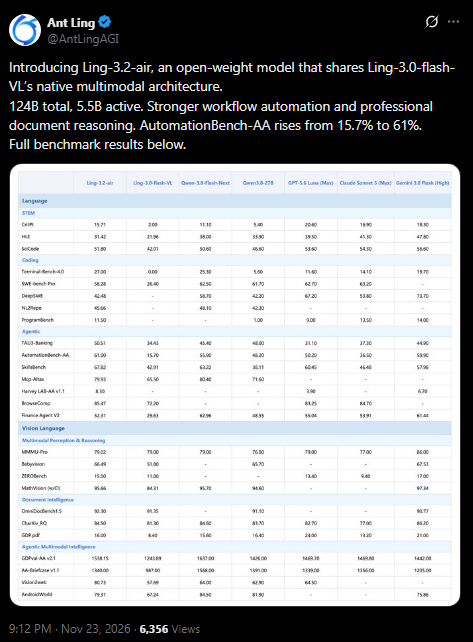
There is also more to the comparison now than two index scores. InclusionAI published a full benchmark table through the official Ant Ling account on launch day, and it shows that on a meaningful set of agentic tasks, Ling-3.2-air is the stronger model by a clear margin. Air scores 27.00 on Terminal-Bench 4.0 and 61.00 on AutomationBench-AA, and it leads the agentic cluster against a comparison set that includes DeepSeek, GPT-5.5, Claude and Gemini. So the honest picture is two-sided: Ling 3.1 Flash scores higher on the general index, and air wins on the agentic work that matters most for automation and self-hosting. This post walks through both sides without pretending either one settles the comparison.
What the two numbers actually are
The Artificial Analysis Intelligence Index is a single aggregate score built from nine evaluations. For version 5.0.1, those evaluations are AA-Briefcase v1.1, AutomationBench-AA, Terminal-Bench 4.0, FrontierCode-AA 2.0, AA-Omniscience v1.1, GDP.pdf, HLE-Diamond, CritPt v2 Hard Subset, and Terminal-Bench-Science 0.1. The index does not publish individual sub-scores for coding, math or reasoning separately. It combines them into one number that is meant to reflect general capability across agentic and reasoning tasks.
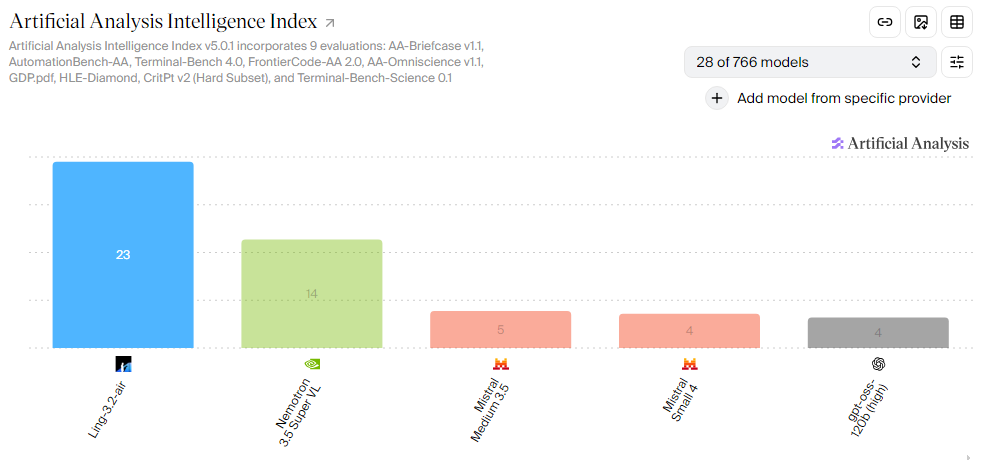
Ling-3.2-air scores 23 on that index, with a raw score of 23.39. That places it first out of five models in its comparison class, and Artificial Analysis describes it as among the leading open-weight models of similar size. The median for comparable open-weights models of that size is 5, which means air sits far above what a typical model in its class manages.
Ling 3.1 Flash scores 29.57 on the same index. That is higher than 23, and it is the figure that makes this comparison interesting. The two scores come from the same evaluation framework, so they are directly comparable as index scores. What they do not tell you is how the models compare on any specific task, because the index does not break out sub-scores for either model.
It is worth being precise here about what we are comparing. These are two numbers from one third-party index, and they are the only directly comparable public figures between these two models on general capability. There is no published head-to-head benchmark suite that runs Ling-3.2-air against Ling 3.1 Flash across a range of tasks. The Hugging Face model card benchmarks compare air against Ling-3.0-flash-VL, not against Ling 3.1 Flash. So the index scores are the anchor, and everything else in this post is about interpreting them rather than adding to them.
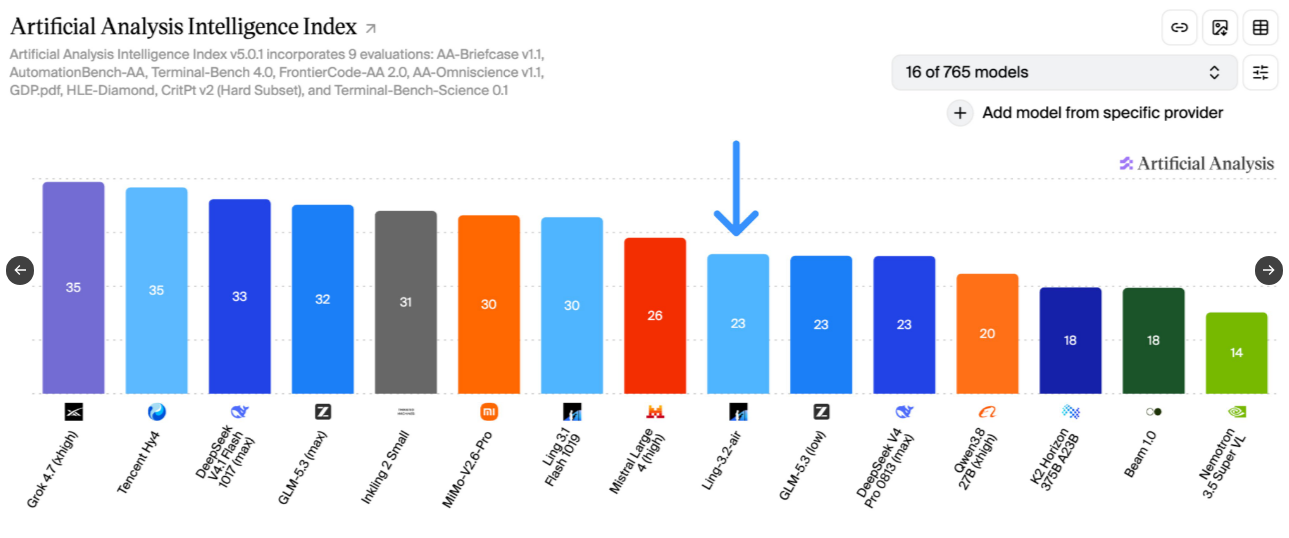
Seeing both models on the same chart reframes the 29.57-versus-23 comparison usefully. In the overall open-weights ranking, Ling 3.1 Flash 1019 sits at 30, tied with MiMo-V2.6-Pro and just below GLM-5.3 at 32, while Ling-3.2-air sits at 23 alongside GLM-5.3 low and DeepSeek Pro. Both InclusionAI models occupy the middle of the open-weights field, behind the much larger dense flagships. So the gap between them, while real, is a gap between two models that are both well short of the top of the open-weights class. Neither is competing with Grok 4.7 or Tencent Hy4 on this index, and that context keeps the 23-versus-30 difference in proportion rather than reading it as one model being far ahead of the other.
Why the newer model is not the higher-scoring one
The gap makes sense once you stop treating the Intelligence Index as a leaderboard that ranks models from worst to best and start treating it as a measure of a specific kind of capability. Ling-3.2-air is built to a different design point than Ling 3.1 Flash, and the index rewards the design point Ling 3.1 Flash is built to.
Ling-3.2-air is a 124 billion parameter mixture-of-experts model with 5.5 billion active parameters per token. That active-parameter count is the key fact. Air is designed to be efficient enough to self-host, small enough in active compute to run on a four-GPU node, and multimodal enough to take images and video. Every one of those goals pushes the design toward a smaller active parameter set. A model that activates only 5.5B parameters per token has less compute to bring to bear on any single hard reasoning step than a model that activates far more.
Ling 3.1 Flash is a different model built to a different target. It is not the same architecture scaled down, and it is not a predecessor that air replaces in a straight line. It is a separate model in the family that scores higher on a general capability index because it brings more capability to the kind of tasks that index measures. The name is a source of confusion here. “Flash” in InclusionAI’s naming does not map cleanly across generations to mean the same tier of model, so comparing the two by name alone is misleading.
The honest framing is this. Ling 3.1 Flash is a more capable model on the tasks the Intelligence Index aggregates, and it scores higher there. Ling-3.2-air is a newer, larger-total-parameter multimodal model with open weights and a self-hosting design, and it trades measured index score for those properties. Neither fact cancels the other. They are both true at once, and the comparison only looks like a contradiction if you assume a single axis of goodness.
The other side: where air’s agentic scores are genuinely strong
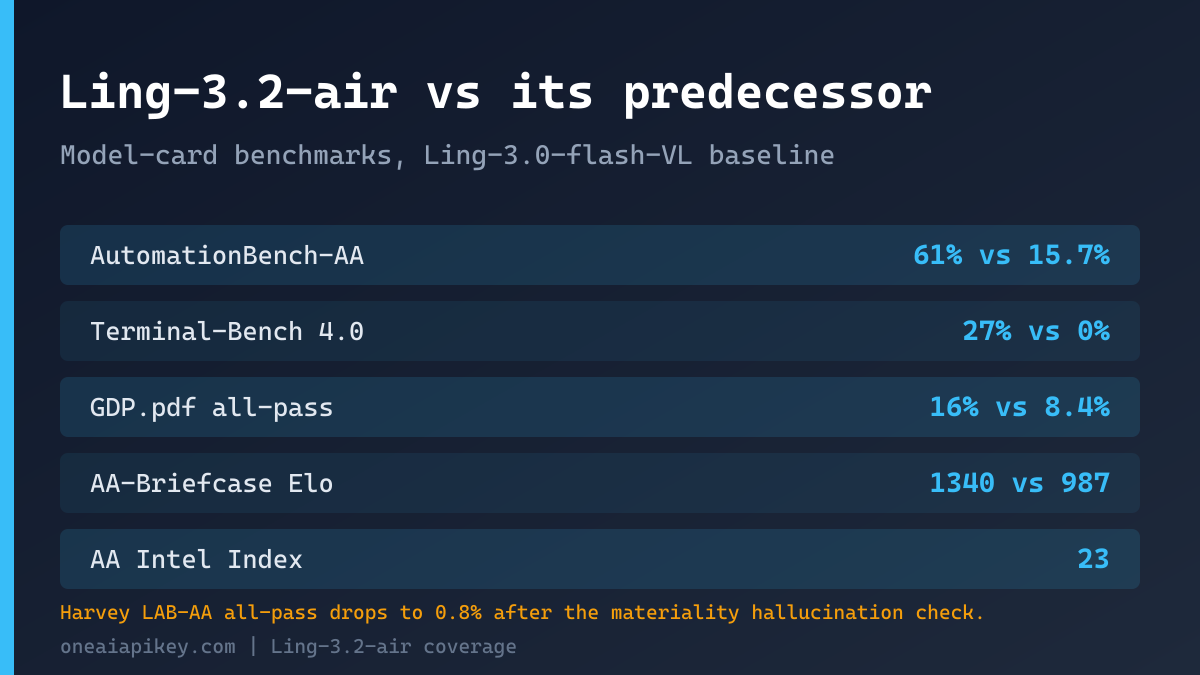
The index comparison is not the whole story, because the official benchmark table InclusionAI published shows air winning an agentic cluster against frontier models, and those wins are the dimension the aggregate index undercounts. On Terminal-Bench 4.0, air scores 27.00, the best result in the entire table, ahead of Qwen-3.5-Flash at 25.30, Claude at 14.10, Gemini at 13.70 and GPT-5.5 at 11.60. Its predecessor scored 0.00. On AutomationBench-AA, air scores 61.00, again the best in the table, ahead of Qwen at 55.90, Gemini at 53.00, GPT-5.5 at 50.20, DeepSeek at 49.20 and Claude at 36.50. The predecessor scored 15.70.
To be precise about what this does and does not prove: Ling 3.1 Flash is not a column in that table, so these numbers do not directly show air beating 3.1 Flash on Terminal-Bench or AutomationBench. What they show is that on the agentic tasks where air is strongest, it outperforms a comparison set of closed frontier models, which is a stronger result than simply scoring well against its predecessor. The index that places air below Ling 3.1 Flash does not break out those agentic sub-scores, so a model can lead its comparison set on terminal coding and workflow automation and still sit lower on the aggregate. That is the mechanism behind the apparent paradox, and it is why the two numbers describe different questions rather than one model being better than the other in every sense.
Air’s broader agentic wins reinforce the point. It leads the table on SkillsBench at 67.82, BrowseComp at 85.47, TAU3-Banking at 50.51 and OmniDocBench 1.5 at 92.30, and it scores a strong 1518.15 on the long-context agentic benchmark GDPval-AA v2.1. The pattern is consistent: air is built to act, browse, operate tools and work over documents, and on those tasks it competes with or beats Mini-configured frontier models.
The honest losses air carries
An honest comparison has to include where air loses, and it loses on two clusters. On heavy software engineering it trails the frontier models clearly: air scores 58.28 on SWE-Bench Pro, the lowest in its comparison set, against Claude at 63.20, GPT-5.5 at 62.70 and Qwen at 62.50, and 42.48 on DeepSWE against Gemini at 73.70 and GPT-5.5 at 67.20. On pure STEM reasoning it is also mid-pack, scoring 15.71 on CritPt against GPT-5.5 at 20.80, and 16.00 on GDP.pdf against GPT-5.5 at 24.00.
These are real gaps, and they are worth stating plainly. Air is not a frontier coding model and not a top-tier pure reasoning model. Its strength is narrower and more specific than a general capability score suggests: terminal tasks, workflow automation, browse, banking agents, skills, and document intelligence. If your workload is large-scale software engineering or abstract scientific reasoning, the models that beat air on those benchmarks are the right choice, and air’s lower index score is a fair reflection of that. If your workload is agentic automation and document-heavy work you want to self-host, the same table that shows the losses shows why air is still the pick.
What air trades for open weights and multimodality
It helps to name the tradeoff directly rather than leave it implied. Ling-3.2-air gives up index score relative to Ling 3.1 Flash and gains three things in return.
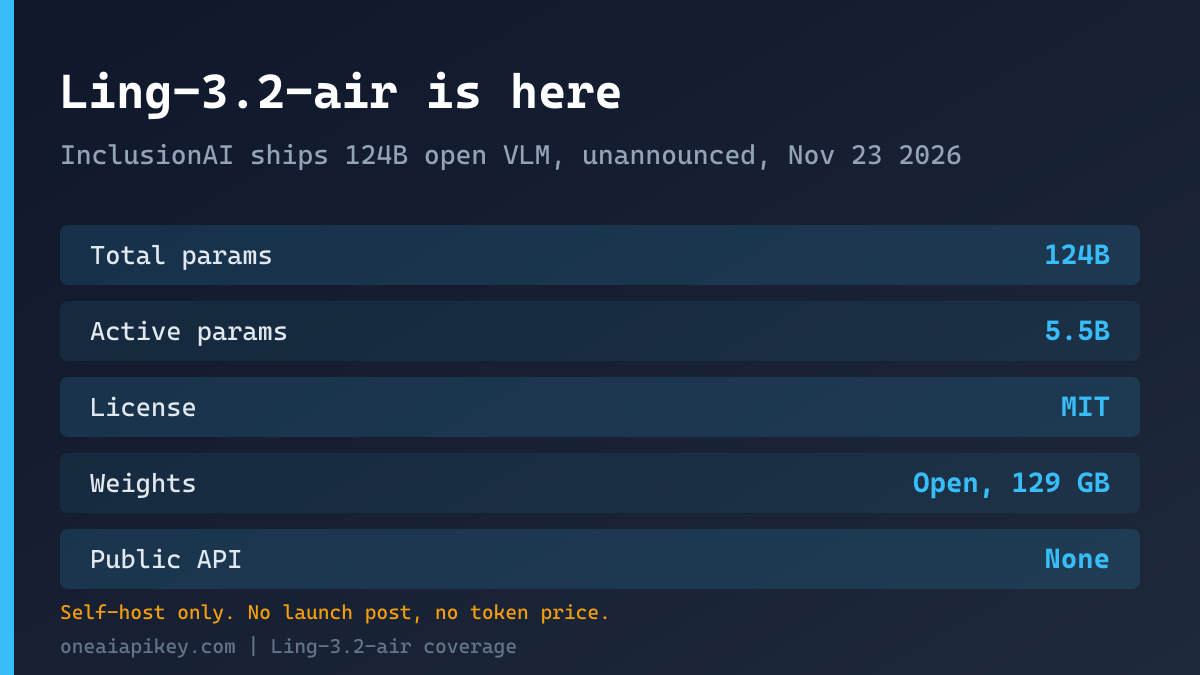
The first is open weights under MIT license. The weights are on Hugging Face, the total download is 129 GB, and commercial use is allowed. You can download them, run them on your own hardware, modify them, and build a product on them without asking anyone. Ling 3.1 Flash’s availability on those terms is a separate question, and the point here is not to compare licensing but to note that open weights are a real property air has and that it is part of what the design optimizes for.
The second is self-hosting at a bounded hardware cost. The active parameter count of 5.5B is what keeps the compute per token low enough to run on the hardware the model card recommends. That is a genuine engineering achievement and a genuine design choice. A model with a much larger active parameter set would score differently on capability benchmarks and would also need a different hardware budget to serve. Air’s design point is chosen so that a team with four 141 GB-class GPUs can run it, and that choice shows up in the index score.
The third is native multimodality. Air takes text, image and video input through an architecture built for it, in the lineage of Ling-3.0-flash-VL. That is a capability dimension the Intelligence Index does not fully capture, because the index’s nine evaluations are primarily text and agentic tasks. A model can be genuinely more capable in a dimension the index does not weight heavily and still score lower on the aggregate.
None of this means the index score does not matter. It does. A lower score on a general capability index is a real signal that on the tasks that index measures, air is not the strongest model in its own family. If your workload is pure text reasoning and you can run Ling 3.1 Flash, the index is telling you something useful. If your workload needs multimodal input or needs to run on hardware you control, the index is measuring something you may care about less.
The compute-per-token argument, made concrete
The reason air scores lower and still makes sense comes down to a single architectural number, so it is worth making concrete. Air activates 5.5 billion parameters per token out of 124 billion total. It routes each token through 8 of 512 routed experts plus 1 shared expert. That routing is the whole trick. Most of the model’s knowledge sits unused for any given token, and only the experts relevant to that token fire.
Compare that to a hypothetical dense model of the same total size. A dense 124B model would activate every parameter on every token, bringing far more compute to each reasoning step. It would likely score higher on a capability index, because more compute per step generally means more capable reasoning. It would also need hardware that most teams cannot access, and it would cost far more per token to serve. Air gives up that per-step compute in exchange for being servable.
This is not a defect. It is the design point working as intended. The Artificial Analysis write-up describes air as amongst the leading models in intelligence when compared to other open-weight models of similar size, and that is the correct comparison frame. Within its size and compute class, air is the top scorer out of five. Against a larger-capability model like Ling 3.1 Flash, it scores lower, and that is expected rather than surprising. You are comparing a model built to run on four GPUs against one built to maximize capability, and the capability-maximizing one scores higher on a capability index.
For anyone choosing between them, the compute framing is the most honest way to hold it. Air is not a worse Ling 3.1 Flash. It is a different model that trades per-token capability for per-token efficiency, and the efficiency is what makes open self-hosting viable at all.
The verbosity signal nobody expected
There is one more data point in this comparison, and it is easy to overlook. On the Artificial Analysis Intelligence Index runs, Ling-3.2-air generated 199 million output tokens, the most of any model in its five-model class. The median for similar-size models was 72.4 million. Air produced nearly three times the median output volume.
That number tells you something about how the model works. A model that generates far more output tokens than its peers on the same evaluations is a model that thinks in long chains, writing out its reasoning at length before arriving at an answer. This is consistent with the model card’s recommended sampling settings, which enable thinking by default with enable_thinking=true, temperature of 1.0, top_p of 0.95 and top_k of 20. The model is configured to reason extensively.
For a self-hoster, verbosity has a direct cost. More output tokens means more compute, more time per response, and more memory pressure on the KV cache as sequences grow. It also means the 256K context window fills faster, because generated tokens count against it alongside the input. If you are planning a deployment, the verbosity is not a curiosity, it is a capacity planning input. Our Ling-3.2-air context window post covers the memory implications, and Ling-3.2-air self-hosting covers how to configure for a model that generates long outputs.
There is a second reading of the verbosity worth noting honestly. Higher output volume on an evaluation can reflect a model that reasons deeply, or it can reflect a model that is less efficient at reaching an answer. Without per-task breakdowns, which the index does not publish, you cannot tell from the aggregate which is the case for air. The honest position is that air is the most verbose model in its class, that verbosity has real serving costs, and that whether it reflects depth or inefficiency is not something the public data settles.
Why there is no direct head-to-head to cite
It would be convenient to point at a benchmark that runs both models across a suite of tasks and shows where each wins. That benchmark does not exist publicly. What exists is the two index scores, and it is worth being clear about why that limits what this comparison can claim.
The Artificial Analysis Intelligence Index is an aggregate, and it does not publish sub-scores for individual capabilities. So you cannot look up whether Ling 3.1 Flash beats air on coding, or whether air closes the gap on a task that involves images. The nine evaluations that make up the index are combined before publication, and the combination is all you get. The model card for air compares it to Ling-3.0-flash-VL, a different predecessor, on a different set of general benchmarks. None of those runs include Ling 3.1 Flash as a comparator.
That means any claim that air beats Ling 3.1 Flash on a specific task, or that the gap narrows on multimodal work, would be an invention. We are not making it. What is verified is the two index scores, the parameter counts, the modality difference, the open-weights status, and the verbosity figure. Everything else about how these two models would compare on your specific workload is untested in public, and the only way to know is to test on your own data.
It also means the comparison cannot tell you about speed, latency, price or cost per task for either model. Those figures are listed as not available for Ling-3.2-air because there is no public API to meter. The index is a capability measure, not an efficiency measure, and the two should not be conflated. A model can be more capable per task and still be more expensive to run, and in air’s case the open weights mean the cost is your hardware rather than a token bill.
Which model for which job
Given the tradeoff, the practical question is which model fits which situation. The answer depends on what you are optimizing for, and being specific about that is more useful than declaring a winner.
If your workload is text-heavy reasoning and you want the highest measured general capability, and you can access Ling 3.1 Flash, the index favors it at 29.57. That is the straightforward reading of the data. On tasks like those the index aggregates, it is the stronger scorer.
If your workload involves images or video, Ling-3.2-air is the model in this pairing that is documented to take that input natively, accepting text, image and video. The official benchmark table now scores that capability, and air is genuinely strong at document intelligence and agentic multimodal work, as we cover in Ling-3.2-air vision. It is the model built for that input, in a way the index does not fully capture.
If you need to run the model on your own hardware, under your own control, without sending data to a third party, Ling-3.2-air is the model with open MIT weights and a documented self-hosting path. That is a capability the index does not measure at all, and for teams with sensitive data or regulatory constraints, it can outweigh a few points of index score. Our Ling-3.2-air self-hosting and Ling-3.2-air hardware posts cover what that takes.
If your workload is agentic automation, terminal tasks or document processing, the official benchmark table makes the case for air directly: it scores 27.00 on Terminal-Bench 4.0 and 61.00 on AutomationBench-AA, both the best results in its comparison set, alongside 85.47 on BrowseComp and 92.30 on OmniDocBench 1.5. On exactly the work that automation and self-hosting pipelines are made of, air leads its comparison set even while sitting below Ling 3.1 Flash on the aggregate index.
To price these options against each other, our cost calculator compares self-hosting economics with per-token API pricing, and our model catalogue lists the hosted alternatives if you decide a closed model fits better. You can sign up for a key to test either path on your own workload.
If you are comparing against other open-weight options in the same class, the relevant context is that air scores 23 against a median of 5 for comparable open-weights models of similar size. Within its size class, it is not competing with Ling 3.1 Flash, which is a different and larger-capability model. It is competing with other models of similar size, and against them it ranks first out of five. Our Ling-3.2-air benchmarks post covers that class comparison.
How this fits the wider family
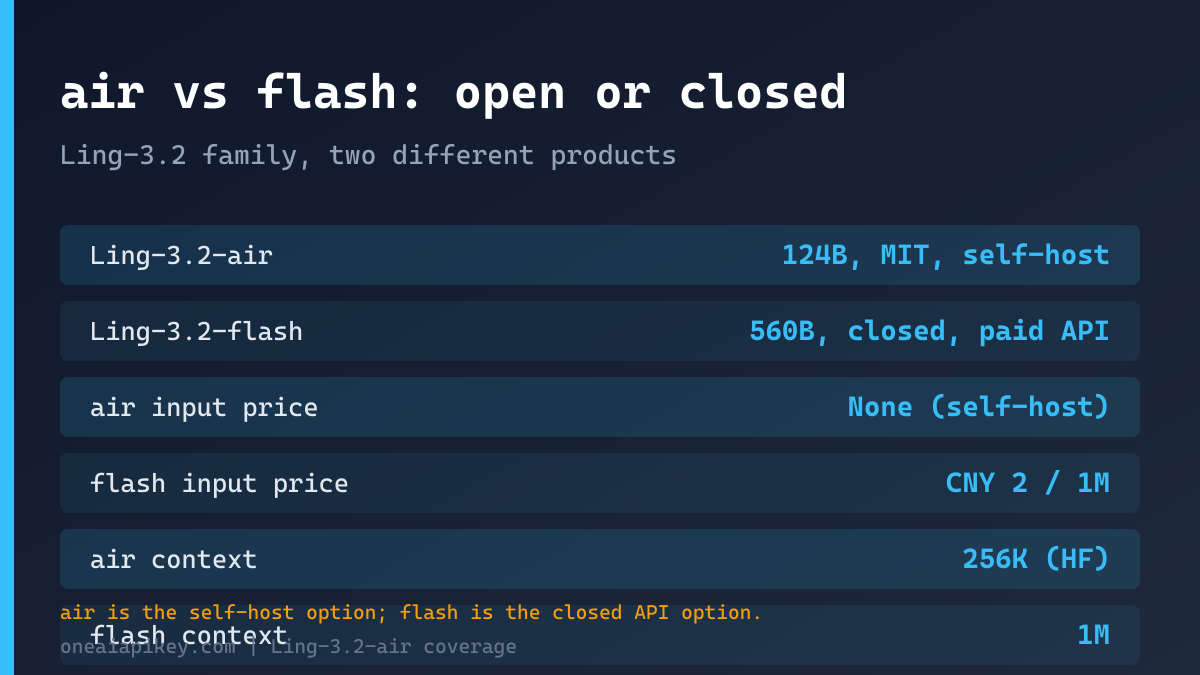
The Ling naming is genuinely confusing across generations, and this comparison is a good example of why. Ling-3.2-air, Ling-3.2-flash, Ling 3.1 Flash, and Ling-3.0-flash-VL are all different models with different design points, and the suffixes do not map to a consistent tier across versions. Air is the open self-hosted multimodal model. The 3.2 flash is a closed 560B model with a paid API and a 1M context, which we compare in Ling-3.2-air vs Ling-3.2-flash. Ling 3.1 Flash is a separate model that scores high on the index. Ling-3.0-flash-VL is the vision predecessor that air’s benchmarks compare against.
A related model in the family worth knowing about is Lingsante 3.1 Flash, a medical-focused variant. Our Lingsante 3.1 Flash vs frontier and Lingsante 3.1 Flash launch posts cover it, and Lingsante 3.1 Flash clinical safety covers its safety profile. It is a different model with a different purpose, and it is easy to conflate with Ling 3.1 Flash when scanning the family.
For a smaller open model at a very different point on the size and cost spectrum, our Inkling 2 Mini vs frontier and Inkling 2 Mini benchmarks posts cover a model built for modest hardware rather than datacenter GPUs.
This section will be updated
This page will be updated once InclusionAI publishes official benchmarks that include both Ling-3.2-air and Ling 3.1 Flash, or once third-party evaluators run a direct head-to-head. Based on what the Artificial Analysis Intelligence Index confirms today, Ling 3.1 Flash scores 29.57 and Ling-3.2-air scores 23, and the newer, larger multimodal model is not the higher-scoring one on that index. What is not available is any published comparison beyond those two aggregate numbers, and no sub-scores that would show where each model is stronger. That is what is verified, not a prediction. When a direct head-to-head appears, we will add it here and revise the tradeoff framing if the evidence calls for it.
Related reading for this decision
The November frontier-model comparison shows how both models sit in the full field. Lingsante 3.1 Flash benchmarks covers the similarly named specialist without conflating it with Ling 3.1 Flash. The blog category lists every comparison in date order.
More Ling-3.2-air coverage
This post is part of a cluster covering the launch. Each links back to the hub and to the others:
- Ling-3.2-air launch for the release overview
- Ling-3.2-air benchmarks for the index and class comparison
- Ling-3.2-air architecture for the MoE design and active parameters
- Ling-3.2-air vs Ling-3.2-flash for open versus closed in the same generation
- Ling-3.2-air vs MiniCPM-V 4.7 for datacenter versus pocket
- Ling-3.2-air self-hosting for running it yourself
- Ling-3.2-air hardware for the GPU requirements
- Ling-3.2-air vision for the multimodal input
- Ling-3.2-air context window for the 256K versus 1M question