Put two multimodal models side by side and the natural question is which one scores higher. For Ling-3.2-air and MiniCPM-V 4.7 there is still no shared benchmark harness that scores them against each other, and this post will not manufacture one. But the picture around air changed on launch day, and it changes the shape of this comparison without resolving it. InclusionAI posted an official benchmark table and Artificial Analysis published scored charts, and together they show exactly what the 124B datacenter end of the spectrum buys you on document intelligence and multimodal reasoning. That is the concrete case for the server side. The hardware math is still the case for the phone side.
This post compares them on parameters, deployment target, hardware requirements, and the use cases each is built for. It adds the official vision and document-intelligence scores for Ling-3.2-air, which are new since the last revision. It is explicit about which numbers are verified and which gaps remain, and it does not invent a shared benchmark with MiniCPM or MiniCPM specifications beyond the two facts we have.
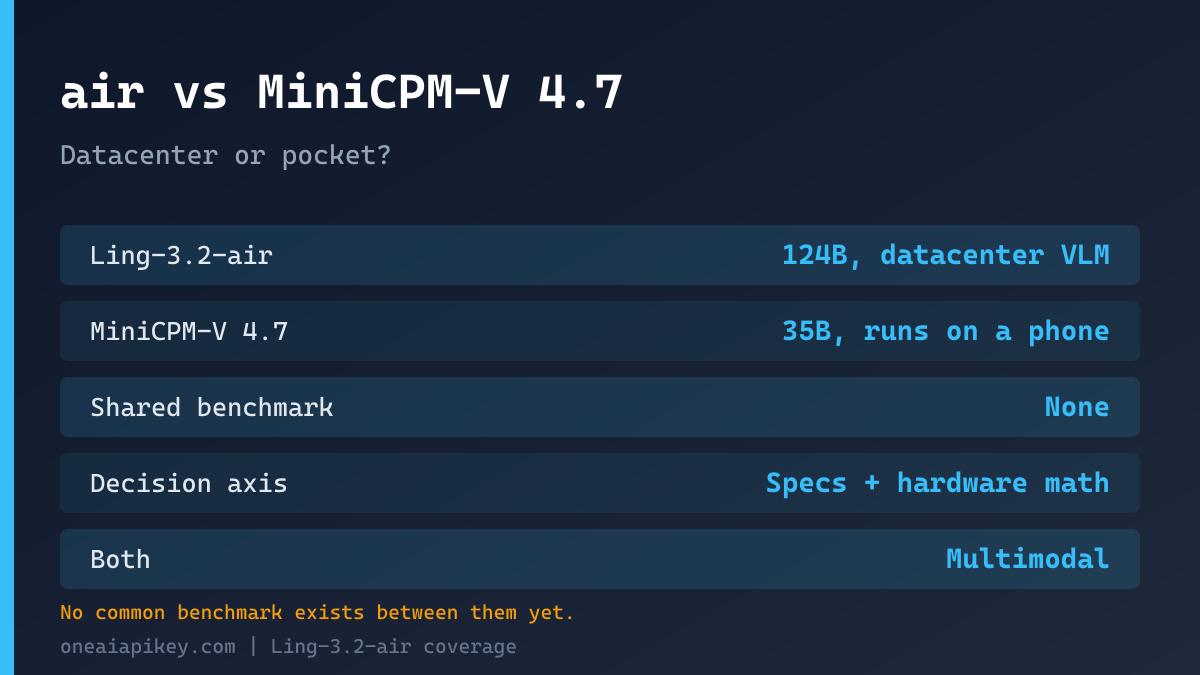
So the framing holds. Ling-3.2-air is a 124 billion parameter model built for a GPU cluster. MiniCPM-V 4.7 is a 35 billion parameter model built to run on a phone. One lives in a datacenter. The other lives in your pocket. What is new is that the datacenter side can now show you its actual vision scores rather than asking you to take its scale on faith.
Why model families split this way
It helps to understand that the datacenter-versus-pocket split is not an accident of these two models. It is a deliberate axis that vision-language model families organize themselves along, and Ling-3.2-air and MiniCPM-V 4.7 simply sit at opposite ends of it.
The physics of the problem push designs in one of two directions. On one side, you can make the model large and capable, which requires server power and memory, which means it has to live in a datacenter. On the other side, you can make the model small enough for mobile hardware, which caps how much capability you can pack in, but means it runs anywhere. No design currently escapes that trade. You cannot serve 124 billion parameters from a phone battery, and you cannot get datacenter-scale context windows from a mobile chipset. So model families offer both, and users pick the end that matches where their inference needs to happen.
Ling-3.2-air chose the large end explicitly. InclusionAI describes it as a medium-size open-weights model designed for self-hosting, which in practice means a server. The 124 billion parameters, the 256K context window, and the video input all point at workloads that are server-bound. MiniCPM-V 4.7 chose the small end, and the “runs on a phone” framing is the design goal stated plainly. Neither is the compromise and neither is the ideal. They are two valid answers to “where should multimodal inference run,” and the answer depends entirely on your constraints.
The two models in one paragraph each
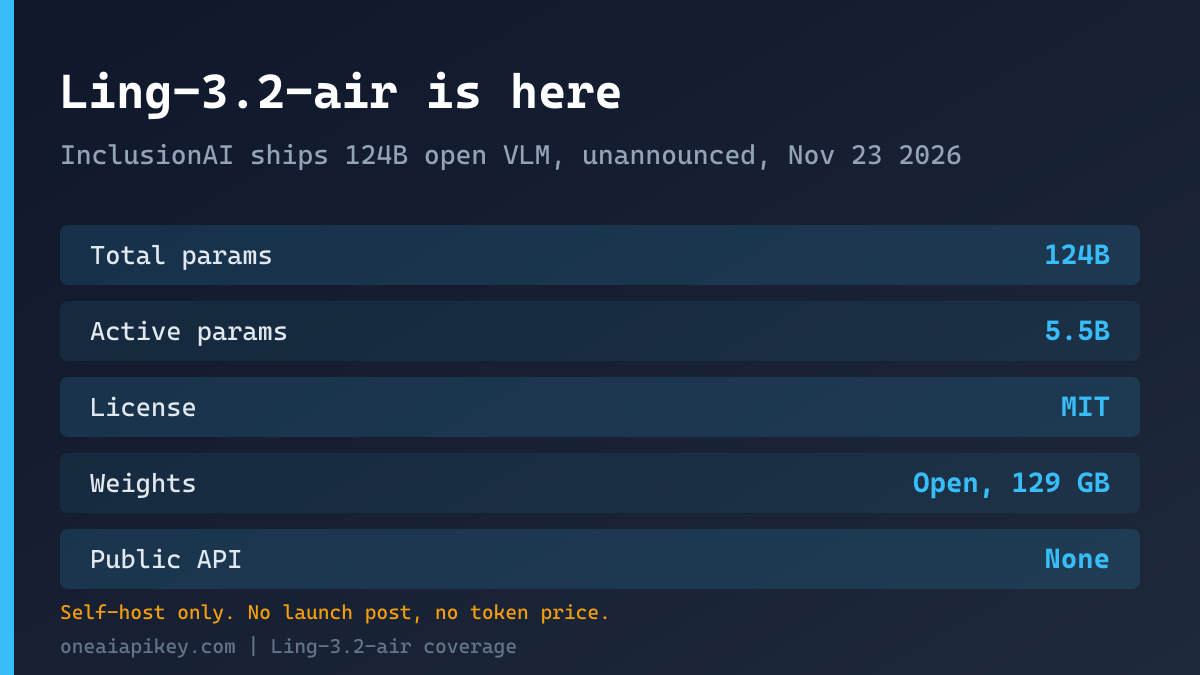
Ling-3.2-air is a 124 billion parameter open-weights vision-language model from InclusionAI, released on 23 November 2026 under the MIT license. It accepts text, image, and video input, ships as 129 GB of FP8 weights on Hugging Face, and is designed for self-hosting on a multi-GPU node. It has no public API. It is a mixture-of-experts model with 512 routed experts and 5.5 billion active parameters per token, and our Ling-3.2-air architecture guide covers that design.
MiniCPM-V 4.7 is a 35 billion parameter multimodal model in the MiniCPM-V line, and its defining trait is the one the comparison material leads with: it runs on a phone. That on-device capability is the whole reason it sits in a different category from Ling-3.2-air. Beyond the 35 billion parameter count and the on-device framing, we do not have verified MiniCPM-V 4.7 specifications in the material for this post, and we are not going to fill those gaps with guesses.
Why this is not a fair fight, and why that is fine
Most model comparisons start from an implicit assumption that the two models are competing for the same job, and the comparison ranks them. This one does not work that way, and it is worth saying plainly rather than pretending to a ranking that would not survive contact with the hardware.
Ling-3.2-air and MiniCPM-V 4.7 are built for hardware that does not overlap, which means they cannot substitute for each other in either direction. You cannot deploy air on a phone, and there is no reason to deploy a mobile-optimized 35B model on a four-GPU server when you could run a 124B model instead. The 3.5x parameter gap and the memory footprint gap mean the hardware decides which model you can even consider before capability enters the picture.
That is why the honest comparison is about deployment, not scores. A shared benchmark would tell you which model is more capable in the abstract. It would not change the fact that only one of them fits the hardware you have, and for most teams the hardware they have is the binding constraint. If your workload runs on a phone, MiniCPM-V 4.7 is the only option in this pairing that is physically deployable there. If your workload runs on a GPU cluster and you want the larger model, air is the one that scale.
There is also no published head-to-head benchmark between them in the material we can verify, so we will not manufacture one. Where a genuine gap exists we say so rather than guessing, and the gap here is a real one. The comparison is decided by specs and hardware math, which is what this post gives you, not by a score table neither model has published.
What air actually scores on vision and documents
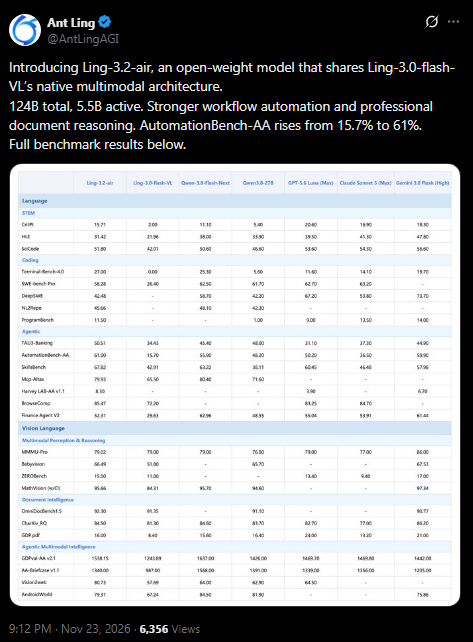
The launch-day benchmark table puts numbers on the datacenter side of this comparison, and they are the reason a team would run a four-GPU server rather than a phone. On document intelligence, which is the workload that pays for server-scale multimodal in most deployments, Ling-3.2-air scores 92.30 on OmniDocBench 1.5, the best figure in its comparison set and ahead of Claude and Gemini at 90.77. On MathVision it scores 95.66, strong though Gemini at 97.84 and Qwen at 95.70 edge past it. On MMMU-Pro, the broad multimodal reasoning benchmark, air scores 79.32, behind Gemini at 85.00 but ahead of Claude at 77.00. The predecessor Ling-3.0-flash-VL scored 75.00 on MMMU-Pro, 84.31 on MathVision, and 91.35 on OmniDocBench, so the gains are real but modest on these vision rows. The agentic vision rows move further: GDPval-AA v2.1 goes from 1243.69 to 1518.15, and AA-Briefcase from 987 to 1348.
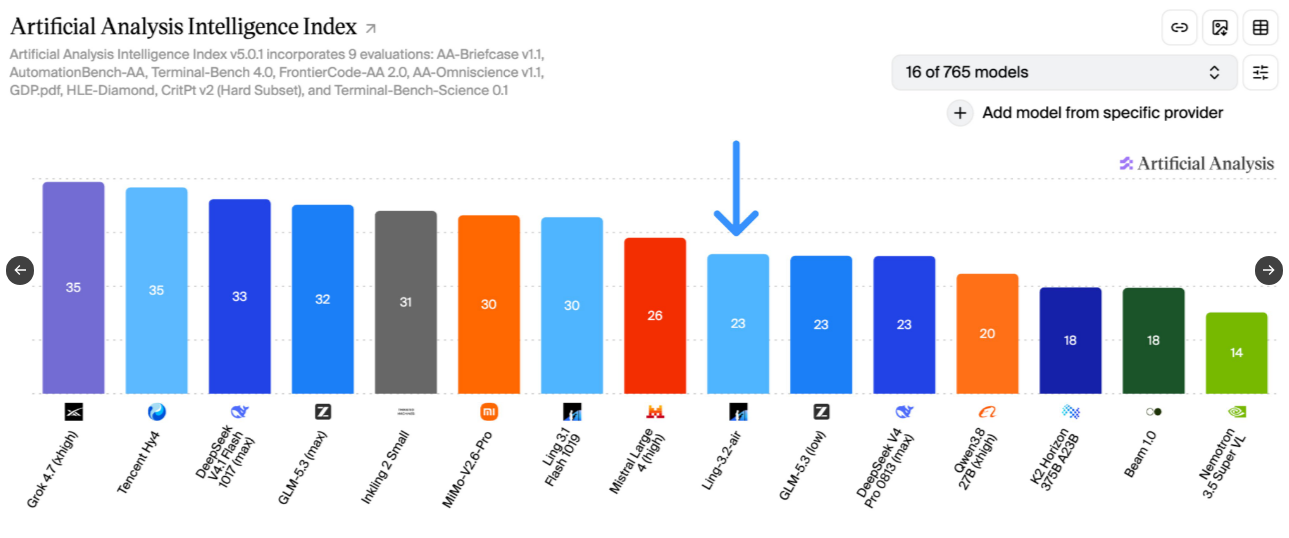
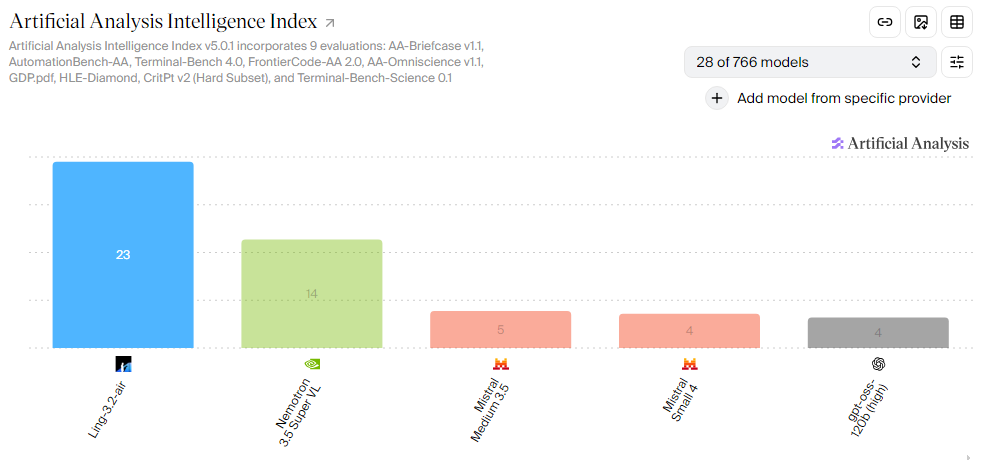
Those are the numbers for air against a field of closed Mini-class frontier models, not against MiniCPM-V 4.7, and the distinction matters. We still do not have verified benchmark scores for MiniCPM-V 4.7 in the material reviewed, so we cannot tell you where it would land on OmniDocBench or MMMU-Pro. What the scores do establish is the shape of the datacenter offer: a 124B open model that reads documents at 92.30 and reasons over images at 79.32 while also winning the agentic cluster, including Terminal-Bench at 27.00 and AutomationBench at 61.00. That capability density is what justifies the server. Our Ling-3.2-air benchmarks guide walks the full table.
The same table is honest about where air is not the winner, and it is worth reading those losses too so this does not read as a puff piece. On the harder vision rows Gemini pulls ahead: ZeroBench goes to Gemini at 17.00 against air’s 15.00, and GDP.pdf, a hard document-reasoning benchmark, goes to GPT-5.5 at 24.00 against air’s 16.00. AndroidWorld and Vision2Web are mid-table for air rather than wins. The pattern is that air leads on document parsing, math-vision, and agentic automation, and trails the largest closed models on the very hardest reasoning tasks. For a server deployment that is a good trade; you are buying the document and automation cluster, not the reasoning frontier.
What each model is built for
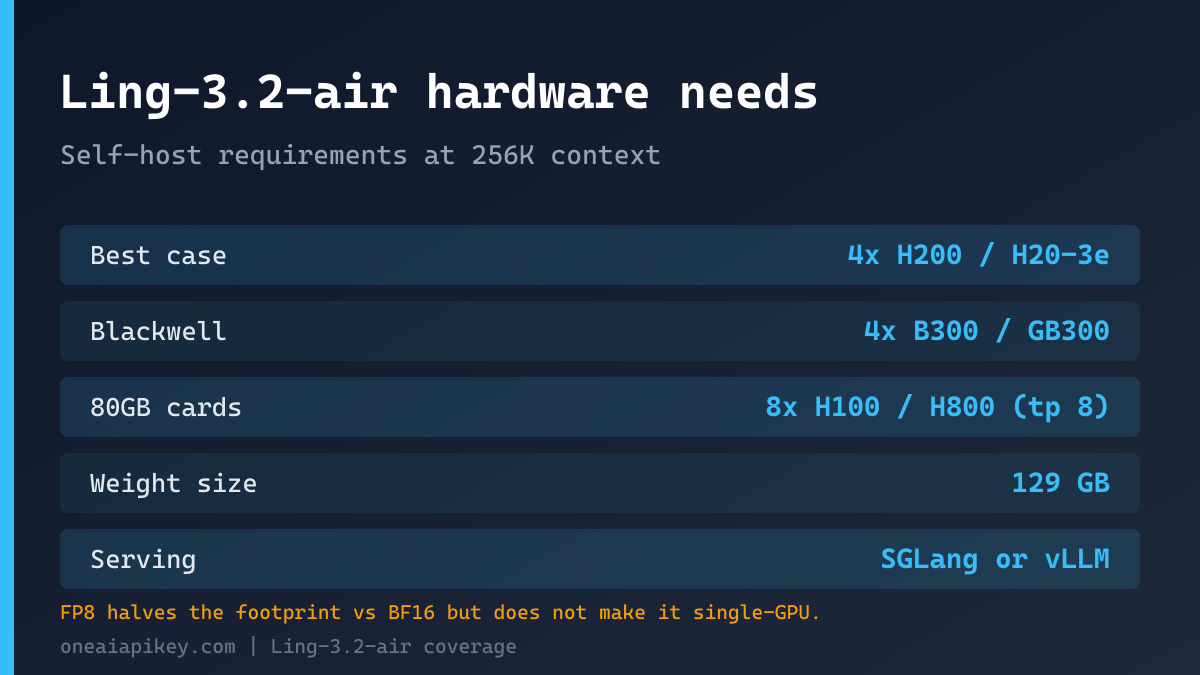
Ling-3.2-air is a 124 billion parameter vision-language model designed for datacenter deployment, and every design choice points that direction. It ships with MIT-licensed open weights at 129 GB in FP8 on Hugging Face, which means you can download it, inspect it, fine-tune it, and run it on your own infrastructure with no per-token cost and no external dependency. It handles text, image, and video input. It requires four 141GB-class GPUs or a 4-GPU Blackwell node for its full 256K context window, or eight 80GB cards at reduced capacity. That is a server rack, not a workstation. The deployment story is our Ling-3.2-air self-hosting guide and the GPU math is in Ling-3.2-air hardware.
MiniCPM-V 4.7 is a 35 billion parameter multimodal model built to run on-device, meaning it targets phones and edge hardware rather than server racks. Its 35B parameter count is chosen to fit mobile-class memory. The comparison material between these two models covers only the headline facts: 124B versus 35B, datacenter versus pocket. Beyond that, we do not have verified MiniCPM-V 4.7 deployment specs, pricing, or benchmark scores in what we reviewed, so we will not state them. What we can say honestly is that the 35B count and the on-device target put it in a completely different hardware class than air.
The datacenter-versus-pocket framing
This is the framing the comparison is really about, and it is worth taking seriously rather than treating as a slogan.
Ling-3.2-air is a datacenter model in the literal sense that its 124 billion parameters and 256K context window require server-class hardware. The official hardware guidance calls for four 141GB-class GPUs such as the H20-3e or H200, or a 4-GPU Blackwell node, to serve 256K context. On 80GB cards you need eight GPUs. There is no version of this model that fits in a phone, a laptop, or a single desktop card. Our Ling-3.2-air hardware guide walks the full requirements, and Ling-3.2-air self-hosting covers the serving stack.
The weight file alone tells the story. 129 GB of FP8 weights is more than the storage on many laptops, let alone the memory a phone carries. Before you add a single token of context, before the KV cache, before activations, the model’s parameters need 129 GB of fast memory just to exist. A phone does not have 129 GB of RAM. That single fact settles the deployment question more decisively than any benchmark could.
MiniCPM-V 4.7 is a pocket model in the same literal sense. It is built to run on-device, on the kind of hardware a phone carries. That constraint shapes everything about it: the parameter count stays small enough for mobile memory, the design prioritizes efficiency over raw capability, and the use cases skew toward things that must work without a network round trip. We do not have a verified VRAM figure or quantization ladder for MiniCPM-V 4.7 in this material, so we will not state one, but the on-device target is the verified fact that matters. A 35 billion parameter model that fits mobile memory is a genuinely different engineering object from a 124 billion parameter model that needs a server rack.
How they compare on what is verified
Here is the honest table. Where a cell is thin, it is thin because that is all the verified data supports.
| Dimension | Ling-3.2-air | MiniCPM-V 4.7 |
|---|---|---|
| Parameters | 124B total, 5.5B active | 35B |
| Class | Datacenter VLM | On-device / pocket VLM |
| Deployment | Self-host on multi-GPU cluster | Runs on a phone |
| Weights | Open, MIT, 129 GB on HF | Not detailed here |
| Input | Text, image, video | Multimodal |
| API | None, self-host only | Not detailed here |
The parameter gap is roughly 3.5x in total size, and Ling-3.2-air’s architecture spreads that across 512 routed experts with only 5.5 billion active per token, which our Ling-3.2-air architecture guide covers. That active-parameter count is in the same ballpark as what a small dense model uses, which is why MoE models are efficient to run per token even when the total count is large. But the deployment gap is larger than any parameter number suggests, because a model that fits a phone and a model that needs a four-GPU server are not really competitors. They solve different problems, and no amount of score comparison changes which hardware each one requires.
Why the comparison is decided by hardware math, not scores
Because there is no shared benchmark, the decision comes down to a question that has nothing to do with model quality: where does your inference need to run?
If the answer is “on a server you control, with a large context window, processing images and video at scale,” Ling-3.2-air is the model shaped for that. It gives you 256K context, open MIT weights you can fine-tune, and multimodal input, at the cost of a multi-GPU deployment. Nothing about that is portable.
If the answer is “on a device, offline, with no server in the loop,” MiniCPM-V 4.7 is the model shaped for that, and Ling-3.2-air is physically incapable of filling the role. You cannot put 129 GB of weights on a phone. The hardware math rules it out before any benchmark enters the conversation.
That is why the missing shared benchmark is less of a loss than it would be for two models in the same deployment class. A score comparison would tell you which is smarter. It would not change which one you can actually deploy, because the deployment targets do not overlap. Where a model runs is a harder constraint than how well it scores.
Where each model fits
The use-case split follows directly from the hardware split, and it is worth being concrete about where each one wins.
Ling-3.2-air fits workloads that are server-bound anyway. Document and video analysis at scale, agentic pipelines that need a long context window, self-hosted multimodal assistants behind your own infrastructure, and any application where you want open weights you can adapt and audit. The video input is worth emphasizing because it is genuinely uncommon at this model size. A model that accepts video_url input alongside text and images, with 256K context to hold long sequences, is built for exactly the kind of work that never leaves a server. If you already operate GPUs, or you have a data-residency requirement that rules out hosted APIs, air is built for you. Our Ling-3.2-air benchmarks guide covers what it scores on automation and terminal tasks, and our Ling-3.2-air vision guide covers the image and video input.
MiniCPM-V 4.7 fits the opposite end. On-device photo understanding, offline translation and OCR, mobile assistants that must respond without a network, and any application where shipping every request to a server is too slow, too expensive, or impossible because the device is offline. The value proposition is latency and privacy. A model that runs locally answers in milliseconds without uploading your data, and it works in a basement, on a plane, or in a region with poor connectivity. Those are not edge cases. They are the entire reason on-device models exist.
We do not have verified benchmark numbers for MiniCPM-V 4.7 in this post, so we are describing its target rather than measuring its capability. What we can say honestly is that the use cases are non-overlapping. A phone cannot host Ling-3.2-air, and a server has no particular reason to prefer a mobile-optimized model when it can run a larger one. The hardware decides the use case before capability enters the picture.
The two can also coexist. A common pattern is a small on-device model handling fast, private, offline tasks while a larger server model handles the heavy reasoning. A phone might run a local model to transcribe a voice note or read a receipt, then hand off a complex multi-document analysis to a server model when connectivity allows. Ling-3.2-air and MiniCPM-V 4.7 sit at opposite ends of exactly that spectrum, which makes them complements more than rivals.
The open-weights difference between them
One more axis separates these two models, and it cuts in Ling-3.2-air’s favor for a specific slice of workloads. Air ships with open weights under the MIT license on Hugging Face, 129 GB you can download, audit, fine-tune, and run commercially. That openness means you can adapt the model to a vertical domain, remove it from any external dependency, and verify exactly what the weights do. For regulated industries, defense-adjacent work, or anyone who needs to explain and control their model supply chain, that is a meaningful advantage that no benchmark score captures.
The licensing and weight situation for MiniCPM-V 4.7 is not something we can verify from the material for this post, so we will not characterize it. What we can say is that the openness question and the deployment question are separate. A model can be open-weighted and still be a datacenter model, as Ling-3.2-air is. Openness does not make a 129 GB weight file fit on a phone, and it does not change the hardware math in either direction. If you need both on-device deployment and open weights, you are looking for a model that satisfies both, and neither air nor any 124B model will be it.
For teams choosing between the two, the openness axis adds a consideration to the server-side case rather than resolving the on-device case. If your inference is server-side anyway and you want open weights, air becomes the obvious pick in this pairing. If your inference must be on-device, openness is secondary to the hardware requirement, and that requirement points away from air regardless of licensing.
The efficiency story, and where it confuses people
Ling-3.2-air has a detail that makes people misread the hardware requirement, and it is worth addressing here because it affects how you compare the two models. Air activates only 5.5 billion parameters per token against 124 billion total. That active count is smaller than MiniCPM-V 4.7’s 35 billion parameter count, which sounds like it should mean air is cheaper to run. It is not, and the reason is the split between active and total parameters.
Compute follows active parameters. Memory follows total parameters. Air does less arithmetic per token than a dense 35B model would, because it routes each token through only 8 of 512 experts. But it holds all 512 experts in VRAM at all times, because routing is unpredictable. So air’s per-token compute is modest while its memory footprint is enormous. MiniCPM-V 4.7 at 35 billion parameters has a much smaller memory footprint and can therefore fit mobile hardware that air never could.
This is the trap in the comparison. If you size by active parameters, air looks light and you under-provision. If you size by total parameters, you get the right answer: air needs a cluster, MiniCPM-V 4.7 needs a phone. Our Ling-3.2-air hardware guide works through this math in detail, and it is the single most common sizing mistake with mixture-of-experts models.
What we cannot tell you
Honesty requires naming the gaps, because inventing numbers to fill them would be worse than leaving them open.
There is no published benchmark comparing Ling-3.2-air to MiniCPM-V 4.7. The comparison material between them covers only the meta facts: 124B versus 35B, and datacenter versus on-device. The detailed comparison body did not load, so there is nothing verified beyond that. We will not construct a score table, and we will not borrow MiniCPM-V numbers from unrelated sources and present them as a head-to-head.
On the MiniCPM-V 4.7 side specifically, this post works from two verified facts, the 35 billion parameter count and the on-device deployment target, and goes no further. We do not have a verified VRAM footprint, quantization ladder, context window, modality list, or benchmark score for it here. If you need those numbers, the MiniCPM-V project’s own materials are the source, not a comparison written from the Ling-3.2-air side.
This section will be updated once a shared benchmark between the two models is published, or once MiniCPM-V 4.7 specifications are confirmed in the material we can verify. Based on what is confirmed today, the comparison is a hardware and deployment decision, not a score decision. That is what is verified, not a prediction.
The decision, stated plainly
If you need on-device inference, the choice is made for you. Ling-3.2-air cannot run on a phone, so MiniCPM-V 4.7 is the option in that category, and no benchmark score changes that.
If you need server-side multimodal inference and the workload is documents, receipts, forms, video frames, or agentic automation over visual input, Ling-3.2-air is now a measured pick and not just a large one. OmniDocBench at 92.30 and the automation cluster are the numbers that justify the four-GPU node, and the open MIT weights mean you own the pipeline end to end.
If you need both, they are not in conflict. The on-device model handles the pocket tasks and the datacenter model handles the heavy ones, and the two are complements rather than rivals.
Either way, price the server side before you commit. Run your expected volumes through the cost calculator to see where self-hosting breaks even against a hosted API, and sign up for a key to compare hosted options in the model catalogue while your hardware plan is still on paper.
Where to go next
This post is part of a cluster on the Ling-3.2-air launch. For the deployment side, read Ling-3.2-air self-hosting and Ling-3.2-air hardware. For the model on its own merits, read Ling-3.2-air benchmarks and Ling-3.2-air architecture. For the other family comparison, see Ling-3.2-air vs Ling-3.2-flash. The Ling-3.2-air launch hub collects the series.
Sign up for a key to browse the model catalogue, or run your own volumes through the cost calculator before committing to a self-host build.
Related reading for this decision
The Inkling 2 Mini 16GB quant ladder, the Inkling 2 Mini memory footprint, and Inkling 2 Mini local vs API economics cover the small-model side of the same sizing question. The November frontier-model comparison places both models in the wider field.
The Lingsante 3.1 Flash launch covers another compact family model, while GLM-5.4 self-hosting documents a larger open-weight deployment. Compare metered alternatives on the pricing page, or browse the blog category for more hardware-focused comparisons.
More Ling-3.2-air coverage
- Ling-3.2-air launch on the unannounced release
- Ling-3.2-air benchmarks on the AA index and model card numbers
- Ling-3.2-air architecture on the hybrid-linear MoE design
- Ling-3.2-air vs Ling-3.2-flash on open weights versus paid API
- Ling-3.2-air self-hosting on SGLang and the serving recipe
- Ling-3.2-air hardware on GPU counts and memory math
- Ling-3.2-air vision on image and video input
- Ling-3.2-air context window on 256K and the 1M discrepancy
- Ling-3.2-air vs Ling-3.1-flash on the related-model comparison