inclusionAI, Ant Group’s open-model lab, released LingSante-3.1-flash on 2026-11-22. The announcement is a single sentence on inclusionAI’s X post: today, we release LingSante-3.1-flash. Behind that sentence sits a 560-billion-parameter mixture-of-experts model, open-weight under the MIT license, tuned specifically for healthcare work. It is a specialist, not a generalist, and that distinction decides everything about whether you should care. This post is the launch hub: what the model is, what it wins, where it loses, where it came from, and where to read more.
What LingSante-3.1-flash actually is
LingSante-3.1-flash is a text-only, open-weight mixture-of-experts language model built by inclusionAI for medical and healthcare reasoning. The headline architecture numbers are a 560B total parameter count with 25B active per token, which is what makes it a “flash” model despite its size: only a slice of the network fires on any given token, so inference stays cheaper than a dense 560B model would be. The model card on Hugging Face lists it at 572B parameters with weights released in BF16, F32 and FP8 (F8_E4M3) variants, tagged fp8. The license is MIT, which means you can self-host, fine-tune and ship it commercially without negotiating a seat.
The context window is 1 million tokens, and the model is text-only, no vision. The architecture is a hybrid-linear MoE under the bailing_hybrid design: 63 KDA layers plus 9 Gated MLA layers, a 7:1 ratio, alongside 4 dense layers. The expert pool is 512 routed experts with 1 shared expert, 8 routed experts activated per token, 64 attention heads, a hidden size of 4096, an expert intermediate size of 1280, a dense intermediate of 10240, and a vocabulary of 157184. Those are the load-bearing specs if you are sizing a deployment, and the cluster sizing in the self-hosting guide turns them into GPU math.
One naming caution before you go further. There is a base model called Ling-3.1-flash, and it is a different thing. The non-medical Ling-3.1-flash shipped earlier, on 2026-09-30. LingSante is the healthcare-specialized release built on top of that lineage, and the two share a family and nothing else, so check the name twice before you grab a weight file. For the non-healthcare trunk and its specs, our Ling-3.1-flash model guide covers it separately.
The lineage: from 124B to 560B
LingSante is not a first attempt. Its direct predecessor is Ling-3.0-flash-Sante, a 124B-total, 5.1B-active model documented on Hugging Face. The jump from 124B total and 5.1B active to 560B total and 25B active is roughly 4.5x on total parameters and 5x on active ones. That is a generational scale-up, not a refresh, and it shows up in the benchmark rows below: the 3.0-Sante generation was a credible medical model, the 3.1 generation is aimed at the frontier.
That lineage sits inside the wider Ling family. The base Ling-3.1-flash, the non-medical one, is the trunk both the general model and Sante branch from. If you want the non-healthcare sibling’s story, our Ling-3.1-flash overview covers it separately.
The headline wins
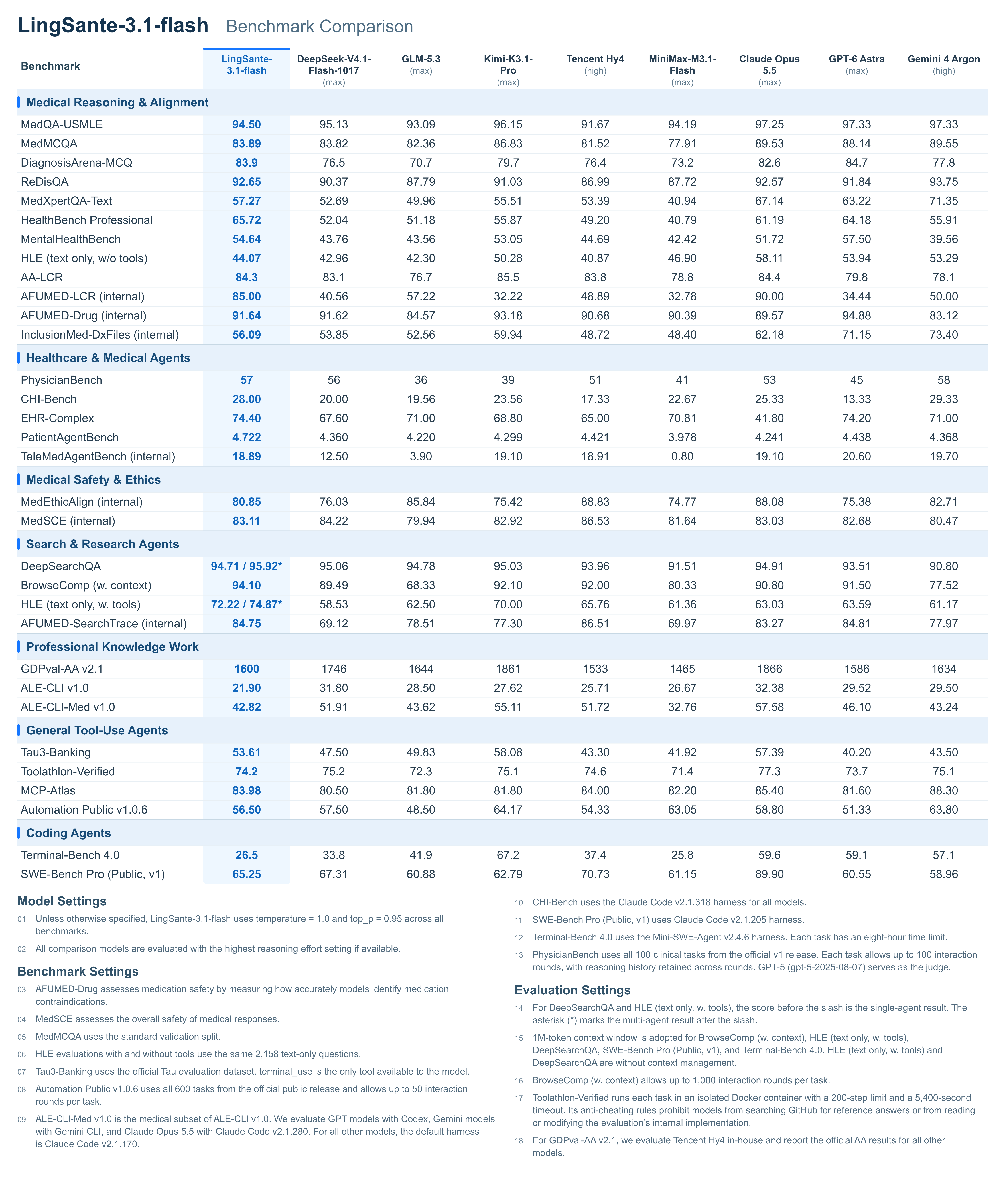
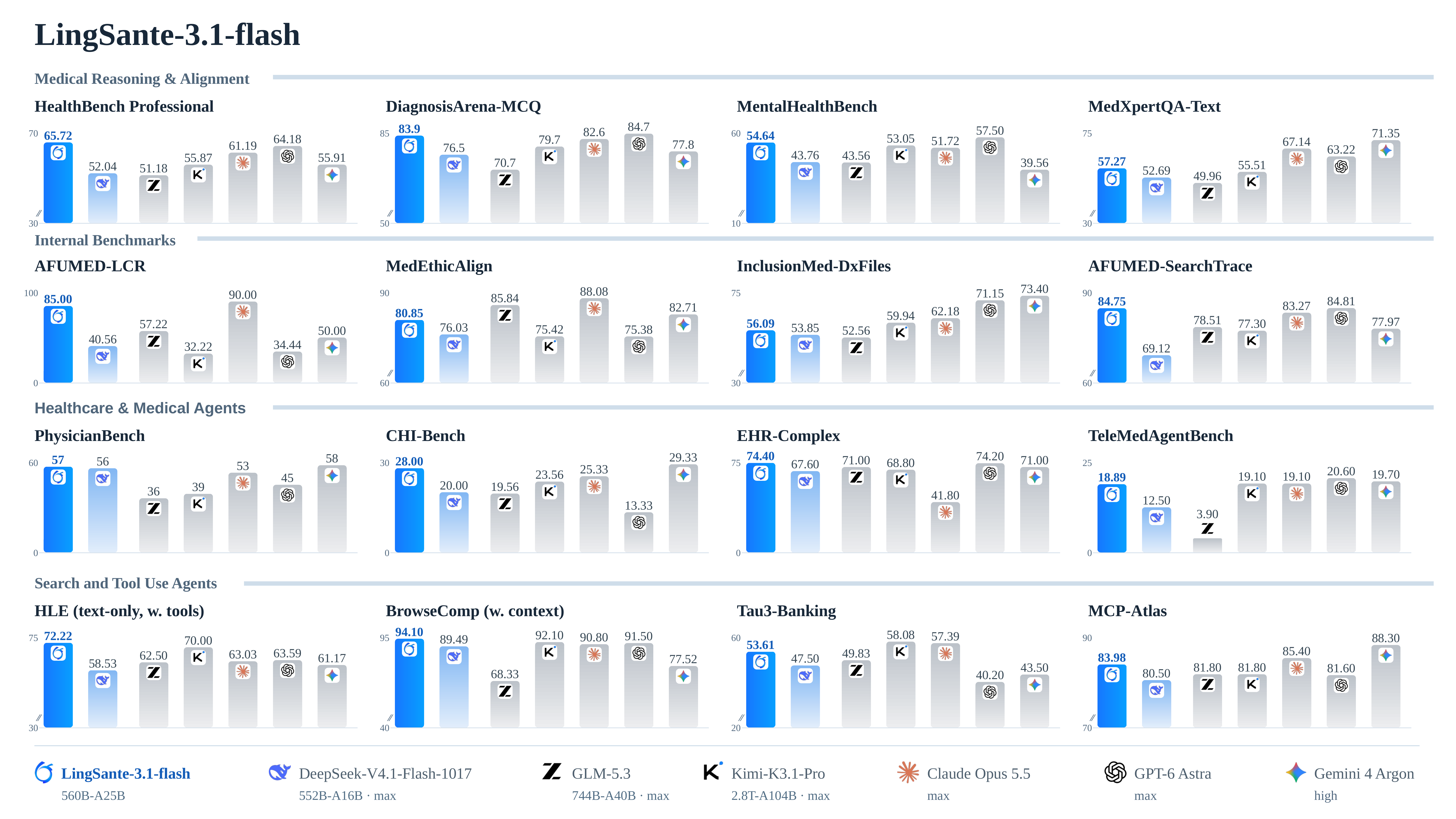
inclusionAI’s launch claims center on five results where LingSante-3.1-flash beats GPT-6 Astra, Claude Opus 5.5 and Gemini 4 Argon. All of these are vendor-supplied numbers, run by inclusionAI, and none has been independently replicated as of launch day. Quoted as published:
| Benchmark | LingSante-3.1-flash | Note |
|---|---|---|
| HealthBench Professional | 65.72 | Beats every listed frontier comparator |
| HLE text-only, with tools | 72.22 | 74.87 in the multi-agent setting |
| BrowseComp, with context | 94.10 | 1M-token window in play |
| PhysicianBench | 57 | Clinical agent tasks, Claude Code harness |
| EHR-Complex | 74.40 | Electronic health record reasoning |
HealthBench Professional is the one to lead with, because HealthBench is OpenAI’s own medical benchmark and its Professional split is the hard, specialist tier. Scoring 65.72 there against comparators that include Opus 5.5 at 64.18 and GPT-6 Astra at 64.18 is the single most quotable claim in the launch. If you want to know what HealthBench actually measures and why the Professional tier is the meaningful one, OpenAI’s HealthBench page is the source, and our benchmarks teardown walks the full cluster.
PhysicianBench deserves a separate note because it is an agent benchmark, not a multiple-choice one. It runs 100 clinical tasks through a Claude Code harness with a GPT-5 judge, and the method is documented in the PhysicianBench paper. LingSante scores 57, ahead of Opus 5.5 at 53 and GPT-6 Astra at 45, behind Gemini 4 Argon at 58 and DeepSeek at 56. Winning an agentic clinical harness is a different claim than winning a quiz, and it is the more interesting one, because it is the closest a benchmark gets to the clinical agent deployments this model is built for.
The honest caveat: this is a specialist
Now the part the launch post will not emphasize. LingSante-3.1-flash is a medical specialist, and it loses, sometimes badly, outside its lane. The clearest example is Terminal-Bench 4.0, a coding agent benchmark: LingSante scores 26.5 while Kimi-K3.1-Pro scores 67.2, Claude Opus 5.5 scores 59.6, GPT-6 Astra scores 59.1 and Gemini 4 Argon scores 57.1. That is not a narrow loss, it is a gap of more than 30 points, and it means nobody should route general coding work to this model. SWE-Bench Pro Public tells the same story: 65.25 for LingSante against 89.90 for Opus 5.5.
The losses are not confined to coding. On MedXpertQA-Text, a hard medical quiz, LingSante scores 57.27 and trails Opus 5.5, GPT-6 Astra and Gemini 4 Argon. On GDPval-AA v2.1, a professional knowledge-work benchmark, it scores 1600 against Kimi at 1861 and Opus at 1866. On ALE-CLI and ALE-CLI-Med it loses outright. The pattern is consistent and it is the whole point: buy this model for the healthcare and search clusters, not for general reasoning or code. Our head-to-head against the frontier maps every win and every loss in one place, and the full cluster tables are printed row by row.
A medical specialist that beats the frontier on HealthBench Professional, DiagnosisArena, EHR-Complex, BrowseComp and PhysicianBench, and loses on Terminal-Bench by 30 points. Route clinical and research traffic to it; route code somewhere else.
How the training makes a specialist
The model card describes a training pipeline built to produce clinical behavior rather than general chat. General and medical data are mixed across pretraining, mid-training and supervised fine-tuning. Post-training adds reinforcement learning targeted at medical reasoning, tool use, search and professional conduct. The final stage is multi-teacher on-policy distillation, and the whole thing is wrapped in what inclusionAI calls a medical evidence-reasoning alignment framework.
Two claims come out of that pipeline and both are vendor claims. First, a professional-behavior alignment score that inclusionAI says ranks second overall, behind only GPT-6 Astra. Second, the cluster of wins above. Neither is independent. A model trained this heavily on medical data and medical RL is exactly the model you would expect to dominate medical boards and underperform on Terminal-Bench, which is the pattern the table shows. The specialization is working as designed, in both directions, and our benchmarks breakdown is where every cluster is tabulated.
Safety is a hard boundary, not a footnote
The model card is unusually blunt, and it should be quoted rather than paraphrased away. LingSante-3.1-flash is not a medical device. It must not independently diagnose, prescribe, treat or triage. Its outputs may be incorrect. Its benchmark scores do not establish clinical effectiveness. Deployments must protect patient health information, and consequential actions require human approval with qualified human review.
That is not boilerplate. It is the difference between a model that drafts a clinician’s note and one that makes a clinical decision, and it is the reason the safety cluster in the benchmark table exists at all. On MedEthicAlign, an internal safety benchmark, LingSante scores 80.85, behind Opus 5.5 at 88.08. On MedSCE it scores 83.11, behind DeepSeek at 84.22. It is strong on safety, not the strongest, and the boundary in the model card applies regardless of the score. Our clinical safety guide covers the deployment rules in full.
Deploying it, in brief
The recommended serving stack is SGLang, with a dedicated image, on 8x H200 with tensor parallel 8 and expert parallel 8, or 4x GB300 with tensor parallel 4 and expert parallel 4. vLLM is supported on a branch with a ling3 tool-call parser and reasoning parser plus MTP speculative decoding. Verified hardware is H200, GB300, H800, H100 and B200. Recommended sampling is temperature 1.0, top_p 0.95, top_k 20, with thinking enabled.
{
"temperature": 1.0,
"top_p": 0.95,
"top_k": 20,
"enable_thinking": true
}
That is a 560B model even if only 25B are active, so the GPU bill is real and the self-hosting guide is where the cluster sizing and the FP8 Hopper flags live. If you would rather not run 8x H200 at all, the MIT license means hosted providers can serve it too, and the weights are mirrored publicly for providers that want to pick it up. Which route is cheaper for your volume is a cost-per-task question, not a benchmark one.
Who should care
Act if you are building a clinical documentation assistant, a medical research agent, an EHR reasoning pipeline, or a healthcare search product, and you want open weights under MIT so the model can run inside your own compliance boundary. The healthcare-agent wins, PhysicianBench and EHR-Complex in particular, are the reason. Wait, or look elsewhere, if your workload is general coding, general professional knowledge work, or anything where Terminal-Bench and GDPval are the relevant boards. For code, the frontier generalists are far ahead and no amount of medical fine-tuning closes that gap.
If you are evaluating it against the current frontier board, our best frontier models roundup and the GPT-6.2 Astra and Sol launch cover the generalist side of the comparison, and the Hy4 flash benchmarks cover another healthcare-adjacent open model from a different lab. For the deployment boundary that has to wrap any clinical use, the clinical safety guide is the place to start. For a free-lane way to test an open model before committing GPU budget, the Inkling 2 Mini free API guide is the cheapest starting point on our gateway.
Where to go next
This post is the hub. The cluster goes deeper on each axis:
- LingSante-3.1-flash benchmarks — every cluster, every number, the eval settings and the vendor-supplied caveat
- LingSante-3.1-flash vs the frontier — the win/loss map against Opus 5.5, GPT-6 Astra and Gemini 4 Argon
- LingSante-3.1-flash self-hosting — SGLang, vLLM, GPU sizing and the FP8 flags
- LingSante-3.1-flash clinical safety — the model-card boundaries turned into deployment rules
- Ling-3.1-flash — the non-medical base model this one branches from
LingSante-3.1-flash is a 560B model, so most teams will want it served, not self-run on day one. Our catalog lists the open-weight models we host, metered, with per-key limits on every plan. Browse hosted models See hosted pricing
How we checked this
Every number above was read from the sources in the frontmatter on 2026-11-22. All benchmark scores are vendor-supplied by inclusionAI, run at temperature 1.0 and top_p 0.95 for LingSante while comparators ran at their highest reasoning effort, and none has been independently replicated as of launch day. We quote the source and the date with each claim rather than summarizing a moving table. Nothing here is clinical advice, and no benchmark score establishes clinical effectiveness.
More across the gateway
- GPT-6.2 Astra benchmarks
- how GPT-6.2 Astra compares with Claude Opus 5.5
- the GPT-6.2 1M context window
- Qwen4-Max benchmarks
- the Hy4 flash benchmark breakdown
- the GPT-6 family API DevDay recap
- how to estimate your monthly LLM API cost
- OpenAI vs Anthropic compatible APIs
- the Inkling 2 Mini free API guide
- choosing a model for coding agents
- one API key per project with spend limits
- the model comparison tool