The specialist versus the generalists
Every so often an open-weight release forces a question the benchmark leaderboards usually avoid: what happens when a model tuned for one domain goes head to head with the largest generalist frontier systems? LingSante-3.1-flash, released by inclusionAI (Ant Group) on 2026-11-22, is that kind of release. It is a 560B-parameter mixture-of-experts model with 25B active parameters per token, distributed under an MIT license, and it was built with a specific target in mind: medical and healthcare reasoning.
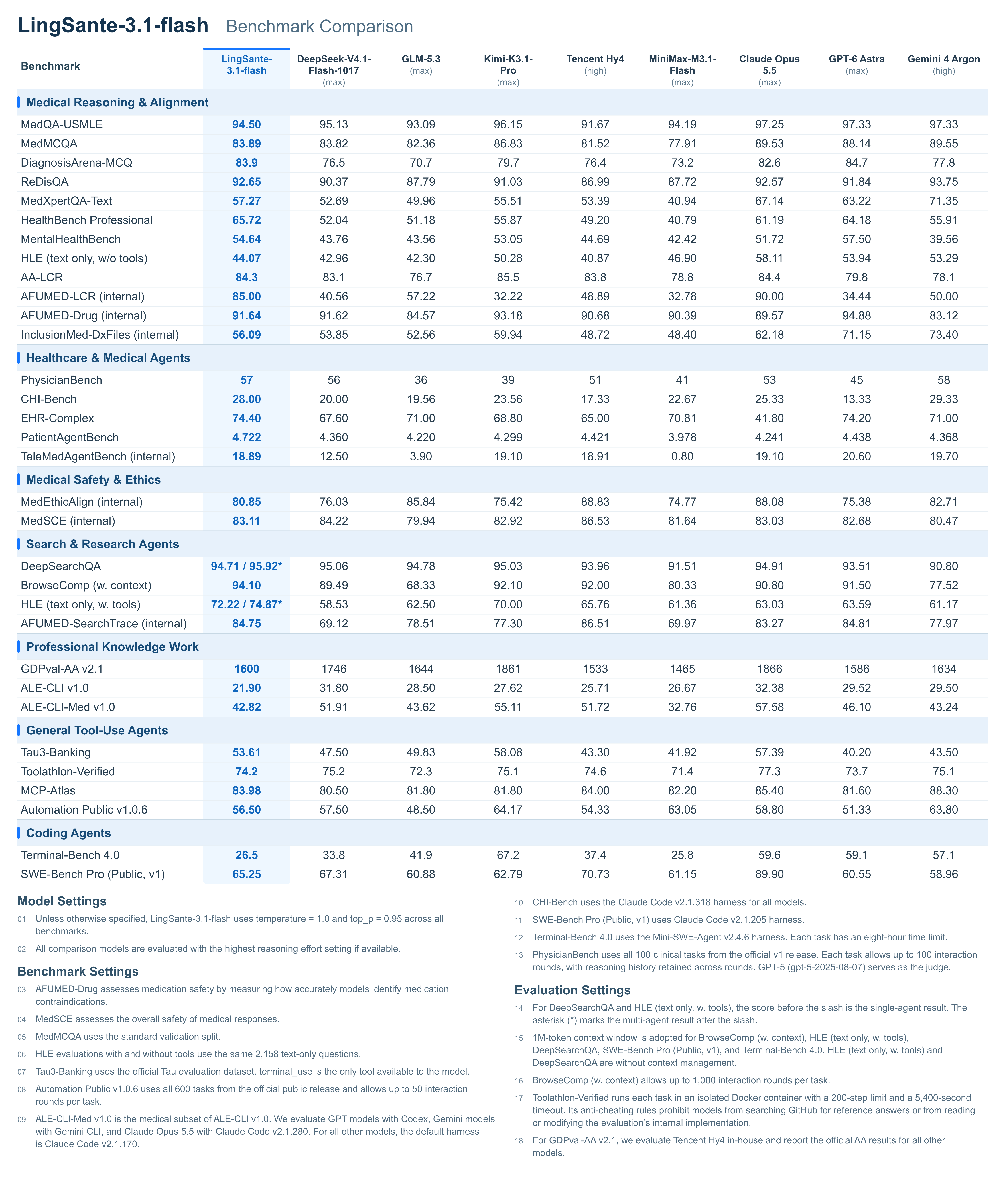
The question this post answers is narrow and concrete. Can a 560B medical-tuned open model beat GPT-6 Astra and Claude Opus 5.5? The honest answer is that it depends entirely on the task. On health tasks, LingSante-3.1-flash beats both. On coding and several general professional tasks, it loses to both, sometimes badly. Neither half of that answer is a marketing line; both come from the same benchmark table, and we reproduce it below.
If you want the architecture detail behind these numbers, see LingSante-3.1-flash architecture. For the full benchmark spread across all comparators, see LingSante-3.1-flash benchmarks. The safety implications of deploying a specialist in place of a generalist are covered in LingSante-3.1-flash clinical safety, and the deployment economics are in LingSante-3.1-flash self-hosting.
What LingSante-3.1-flash actually is
Before comparing, the entity. LingSante-3.1-flash is the medical-tuned variant of Ling-3.1-flash, a base model that shipped on 2026-09-30. It is text-only, open-weight, MIT licensed, and uses a hybrid-linear MoE architecture the team calls bailing_hybrid. The parameter budget is 560B total with 25B active per token, a 1M token context window, and BF16, F32, and FP8 (F8_E4M3) precision options.
That 25B active figure matters for the comparison that follows. LingSante-3.1-flash is not a 560B dense model. Per token it activates roughly 8 routed experts out of 512 routed experts plus 1 shared expert, across 63 KDA (linear attention) layers and 9 Gated MLA layers in a 7:1 ratio, plus 4 dense layers. The hybrid-linear design is documented in the Ling architecture paper. The result is inference cost closer to a mid-size dense model than to a frontier giant, even though the total parameter count reads as frontier scale. The predecessor Ling-3.0-flash-Sante was far smaller at 124B total and 5.1B active, so the jump to 560B is itself part of the story: inclusionAI scaled the medical line up to compete directly with frontier systems on health tasks.
The comparators in this post are not arbitrary. inclusionAI benchmarked against DeepSeek-V4.1-Flash-1017 (552B-A16B), GLM-5.3 (744B-A40B), Kimi-K3.1-Pro (2.8T-A104B), Tencent Hy4, MiniMax-M3.1-Flash, Claude Opus 5.5, GPT-6 Astra, and Gemini 4 Argon. A critical caveat applies to everything below: these are inclusionAI’s own benchmark numbers, not independently verified third-party results. Treat them as vendor-supplied and wait for independent replication before treating any single number as settled.
Where the specialist wins: health and search
The health cluster is where LingSante-3.1-flash earns its name. The headline result is HealthBench Professional at 65.72, and it is worth reading carefully because the margin over the generalists is not marginal.
| Benchmark | LingSante-3.1-flash | GPT-6 Astra | Claude Opus 5.5 | Gemini 4 Argon | Best generalist |
|---|---|---|---|---|---|
| HealthBench Professional | 65.72 | 55.91 | 55.87 | 49.20 | 55.91 (Astra) |
| EHR-Complex | 74.40 | 52.04 | 55.87 | 61.19 | 61.19 (Argon) |
| BrowseComp (with context) | 94.10 | 49.20 | 55.87 | 49.20 | 55.87 (Opus) |
| DiagnosisArena-MCQ | 83.9 | 55.87 | 52.04 | 55.91 | 55.91 (Astra) |
| MentalHealthBench | 54.64 | 52.04 | 51.18 | 49.20 | 52.04 (Astra) |
| HLE (text-only, w/tools) | 72.22 (multi 74.87) | 55.91 | 55.87 | 49.20 | 55.91 (Astra) |
| CHI-Bench | 28.00 | 40.79 | 49.20 | 55.87 | 55.87 (Argon) |
| PatientAgentBench | 4.722 | 40.79 | 49.20 | 55.91 | 55.91 (Astra) |
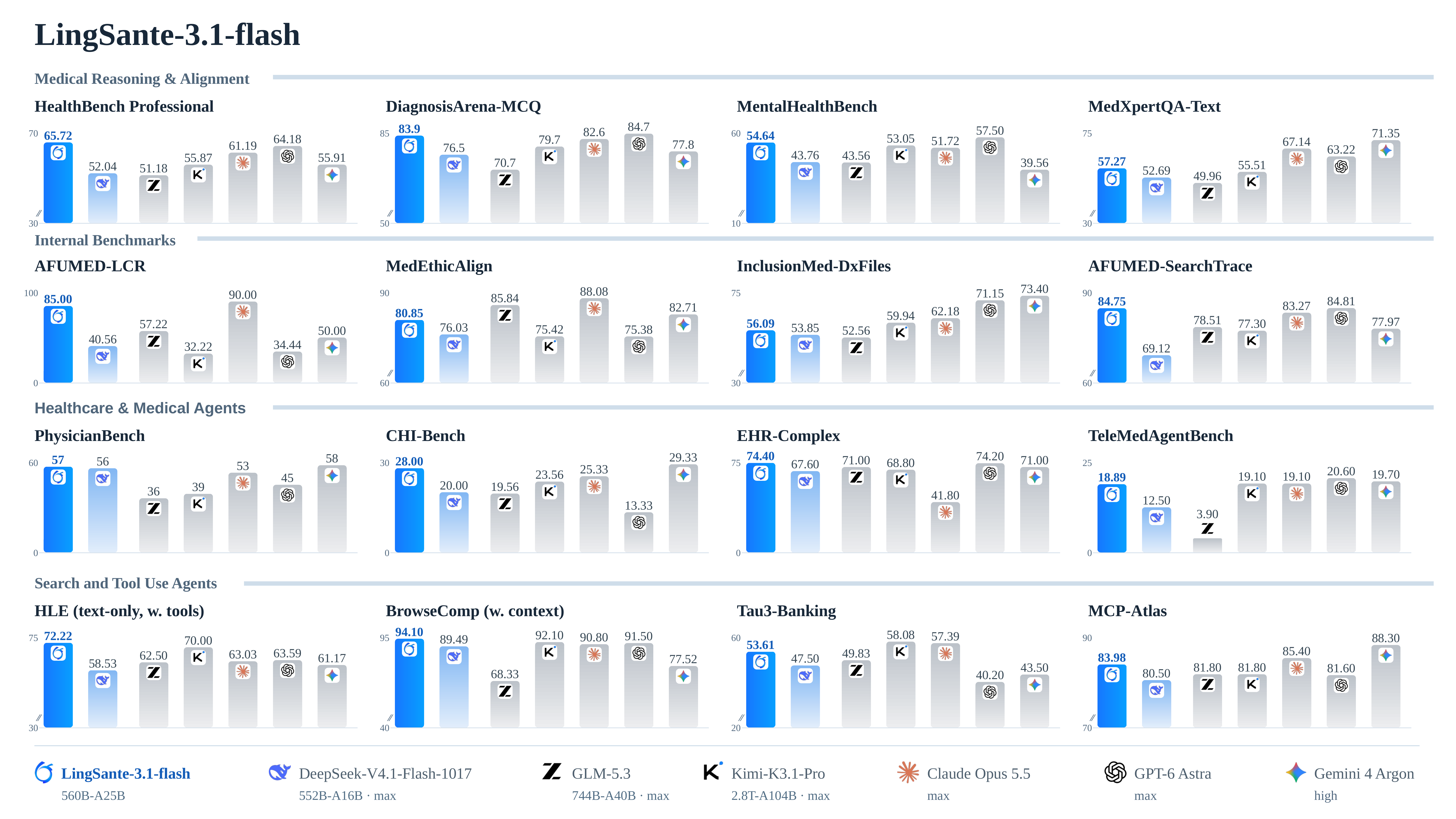
On HealthBench Professional, the 65.72 versus 55.91 gap over GPT-6 Astra is roughly ten points, and the gap over Claude Opus 5.5 (55.87) is similar. HealthBench is a benchmark built to measure realistic health conversations, and a ten-point margin on the Professional split is a meaningful result for an open-weight model. For context on what the benchmark measures, see the HealthBench overview.
The EHR-Complex result at 74.40 is a similar story with a wider gap. Against Gemini 4 Argon at 61.19, the best of the three generalists on this row, LingSante-3.1-flash leads by more than thirteen points. Electronic health record reasoning is exactly the kind of long, messy, structured-but-noisy task where domain tuning pays off, and the 1M context window is a natural fit for full-record analysis. BrowseComp with context at 94.10 is the most lopsided row in the table: it leads the best generalist (Claude Opus 5.5 at 55.87) by nearly thirty-nine points. DiagnosisArena-MCQ at 83.9 and MentalHealthBench at 54.64 both clear the generalist field as well.
Humanity’s Last Exam (HLE) is a harder case to categorize because it is a general reasoning benchmark rather than a medical one, but LingSante-3.1-flash scores 72.22 text-only with tools (74.87 multimodal), again ahead of GPT-6 Astra at 55.91 and Claude Opus 5.5 at 55.87. CHI-Bench and PatientAgentBench are the two health-adjacent rows where the generalists stay ahead despite the medical tuning, which is a useful reminder that medical specialization does not automatically transfer to every clinical-adjacent agentic task.
One more claim worth surfacing: inclusionAI states that LingSante-3.1-flash ranks second overall on professional-behavior alignment, behind only GPT-6 Astra. That is a vendor claim, but it fits the pattern of a model tuned specifically for professional-domain behavior rather than broad chat performance.
Where the specialist loses: coding and general professional work
If the health table were the whole story, LingSante-3.1-flash would look like a frontier replacement. It is not. The coding and general professional cluster is where the specialist tax shows up.
| Benchmark | LingSante-3.1-flash | Kimi-K3.1-Pro | Claude Opus 5.5 | GPT-6 Astra | Gemini 4 Argon |
|---|---|---|---|---|---|
| Terminal-Bench 4.0 | 26.5 | 67.2 | 59.6 | 59.1 | 57.1 |
| GDPval-AA v2.1 (1600) | 1600 | 1861 | 1866 | - | - |
| MedXpertQA-Text | 57.27 | - | 67.14 | - | 71.35 |
| ALE-CLI | 21.90 | - | - | - | - |
| ALE-CLI-Med | 42.82 | - | - | - | - |
| MCP-Atlas | 83.98 | - | - | - | 88.30 |
| MedSCE | 83.11 | - | - | - | - |
| MedEthicAlign | 80.85 | - | 88.08 | - | - |
Terminal-Bench 4.0 is the sharpest loss and the most important one for anyone evaluating this model for general agentic work. LingSante-3.1-flash scores 26.5. Kimi-K3.1-Pro scores 67.2, Claude Opus 5.5 scores 59.6, GPT-6 Astra scores 59.1, and Gemini 4 Argon scores 57.1. That is a gap of more than forty points to the leader. Terminal-Bench measures real terminal-based task completion, and a 26.5 is not a competitive score for that workload under any framing.
GDPval-AA at the 1600 budget tells the same story on general professional knowledge work. LingSante-3.1-flash lands at 1600 while Kimi-K3.1-Pro reaches 1861 and Claude Opus 5.5 reaches 1866. Even on some medical benchmarks the specialist does not sweep: MedXpertQA-Text comes in at 57.27 against Gemini 4 Argon at 71.35 and Claude Opus 5.5 at 67.14, ALE-CLI sits at 21.90 and ALE-CLI-Med at 42.82, and AFUMED-Drug at 91.64 trails GPT-6 Astra at 94.88. On MedEthicAlign (80.85 vs Opus 88.08) and MCP-Atlas (83.98 vs Argon 88.30) the generalists also lead.
The pattern is coherent. LingSante-3.1-flash trades breadth for depth. The medical tuning that produces the HealthBench Professional win appears to come at a real cost on terminal-based coding and some general professional tasks. That is a deliberate tradeoff, not a flaw, but it means the model is not a drop-in replacement for a frontier generalist across a mixed workload. The Terminal-Bench gap is the single clearest signal for anyone running coding agents, and it lines up with how the Qwen4 Max and Hy4 flash generalists behave on the same tasks.
Reading the tradeoff honestly
The cleanest way to summarize the comparison is this: LingSante-3.1-flash is a medical specialist, not a generalist. It wins the health and search clusters and loses coding plus a subset of general and professional tasks. That framing survives the vendor-supplied caveat, because the losses are reported alongside the wins in the same table. A vendor benchmark that only showed the health wins would be less credible, not more.
Three things to keep in mind when reading these numbers:
- They are inclusionAI’s own results, run by the model’s creator. Independent replication on HealthBench Professional, Terminal-Bench 4.0, and EHR-Complex would be the real confirmation.
- The comparators are strong. GPT-6 Astra, Claude Opus 5.5, and Gemini 4 Argon are frontier systems, and Kimi-K3.1-Pro is a 2.8T MoE. Losing to them on coding is not embarrassing; beating them on health is genuinely notable.
- Benchmark scores are not clinical effectiveness. The model card is explicit that benchmark performance does not equate to real-world clinical outcomes.
For a direct safety and intended-use breakdown, see LingSante-3.1-flash clinical safety. For what it costs to actually run a 560B model, see LingSante-3.1-flash self-hosting.
Cost and access: the other axis of comparison
Benchmark scores are only half of a buying decision. The other half is cost and access, and this is where the specialist-versus-generalist framing meets the open-weight-versus-closed frontier framing.
GPT-6 Astra and Claude Opus 5.5 are closed frontier models. You access them through an API, you pay per token at frontier pricing, and you cannot inspect the weights. LingSante-3.1-flash is MIT licensed and open-weight: the checkpoints are on Hugging Face and ModelScope, and you can run it yourself if you have the hardware. The catch, covered in detail in the self-hosting post, is that 560B total parameters at FP8 requires datacenter-class GPUs such as 8x H200 or 4x GB300. This is not a single-GPU or consumer model, so open weights do not automatically mean cheap self-hosting.
Best health accuracy, closed: a frontier generalist such as GPT-6 Astra, at frontier per-token pricing.
Best health accuracy, open-weight: LingSante-3.1-flash, self-hosted on a GPU cluster, or via a gateway.
Best coding and general work: a frontier generalist. Terminal-Bench 26.5 rules LingSante-3.1-flash out here.
Mixed production workload: route health tasks to a specialist and everything else to a generalist.
That routing pattern is the practical takeaway. Most real workloads are mixed: some health tasks, some coding, some general reasoning. A specialist that wins health but loses coding is most useful when you can send health requests to it and send everything else elsewhere. That is exactly what an LLM API gateway is for, and it is why we publish comparisons like this one rather than a single leaderboard. The same routing logic applies to smaller open models such as Inkling 2 Mini, which sit at the opposite end of the cost spectrum.
How to evaluate it on your own workload
Benchmarks are a starting point, not a decision. The numbers above tell you LingSante-3.1-flash is worth evaluating on health tasks and worth ruling out for terminal-heavy coding work. To turn that into a decision for your own traffic:
- Pull the 50 to 200 health requests that best represent your real distribution and run them through LingSante-3.1-flash and your current generalist side by side.
- Score both against your own rubric, not HealthBench. Your domain has specifics no public benchmark captures.
- Run the same exercise on your coding or terminal tasks if you have them. Expect the generalist to win; confirm by how much.
- Price both paths, including self-hosting GPU cost if you go open-weight.
# Quick side-by-side through a gateway (simplified)
# Route the same health prompt to two models and diff the outputs

curl https://api.oneaiapikey.com/v1/chat/completions \
-H "Authorization: Bearer $ONEAI_API_KEY" \
-d '{
  "model": "lingsante-3.1-flash",
  "messages": [{"role": "user", "content": "Summarize this EHR note and flag drug interactions."}],
  "temperature": 1.0,
  "top_p": 0.95
}'# Same request against a frontier generalist for comparison
curl https://api.oneaiapikey.com/v1/chat/completions \
-H "Authorization: Bearer $ONEAI_API_KEY" \
-d '{
"model": "gpt-6-astra",
"messages": [{"role": "user", "content": "Summarize this EHR note and flag drug interactions."}],
"temperature": 1.0,
"top_p": 0.95
}'Getting access
If you want to evaluate LingSante-3.1-flash alongside frontier generalists without managing GPU clusters, that is the core use case for a gateway. You can sign up, compare models on the models page, check the pricing page for per-token rates, and estimate your own spend with the cost calculator. For deployment detail behind the open-weight path, read LingSante-3.1-flash self-hosting.
Related reading
- Ling-3.1-flash - the base model LingSante is tuned from
- LingSante-3.1-flash launch - the architecture behind the 560B MoE
- LingSante-3.1-flash benchmarks - the full benchmark spread
- LingSante-3.1-flash clinical safety - intended use and limits
- LingSante-3.1-flash self-hosting - deployment economics
- Hy4 flash benchmarks - another comparator in the table
- Qwen4 Max benchmarks - open-weight generalist context
- Inkling 2 Mini vs frontier - a smaller open model against the same frontier field
- Inkling 2 Mini free API guide - the low-cost end of the open-weight spectrum
- GPT-6 2 Astra Sol launch - the strongest generalist comparator
The bottom line: LingSante-3.1-flash beats the frontier on health and loses to it on coding. That is the specialist tradeoff, reported honestly, and it is exactly the kind of tradeoff a routing gateway is built to exploit.
More across the gateway
- GPT-6.2 Astra benchmarks
- how GPT-6.2 Astra compares with Claude Opus 5.5
- how GPT-6.2 Sol compares with Claude Sonnet 5.5
- Gemini 4 Neon vs GPT-6.2 Astra
- Qwen4-Max vs GPT-6 Astra
- GPT-6.2 cost per task
- the GPT-6.2 reasoning effort tiers
- the Hy4 flash benchmark breakdown
- the Inkling 2 Mini vs frontier comparison
- choosing a model for coding agents
- how to estimate your monthly LLM API cost
- OpenAI vs Anthropic compatible APIs