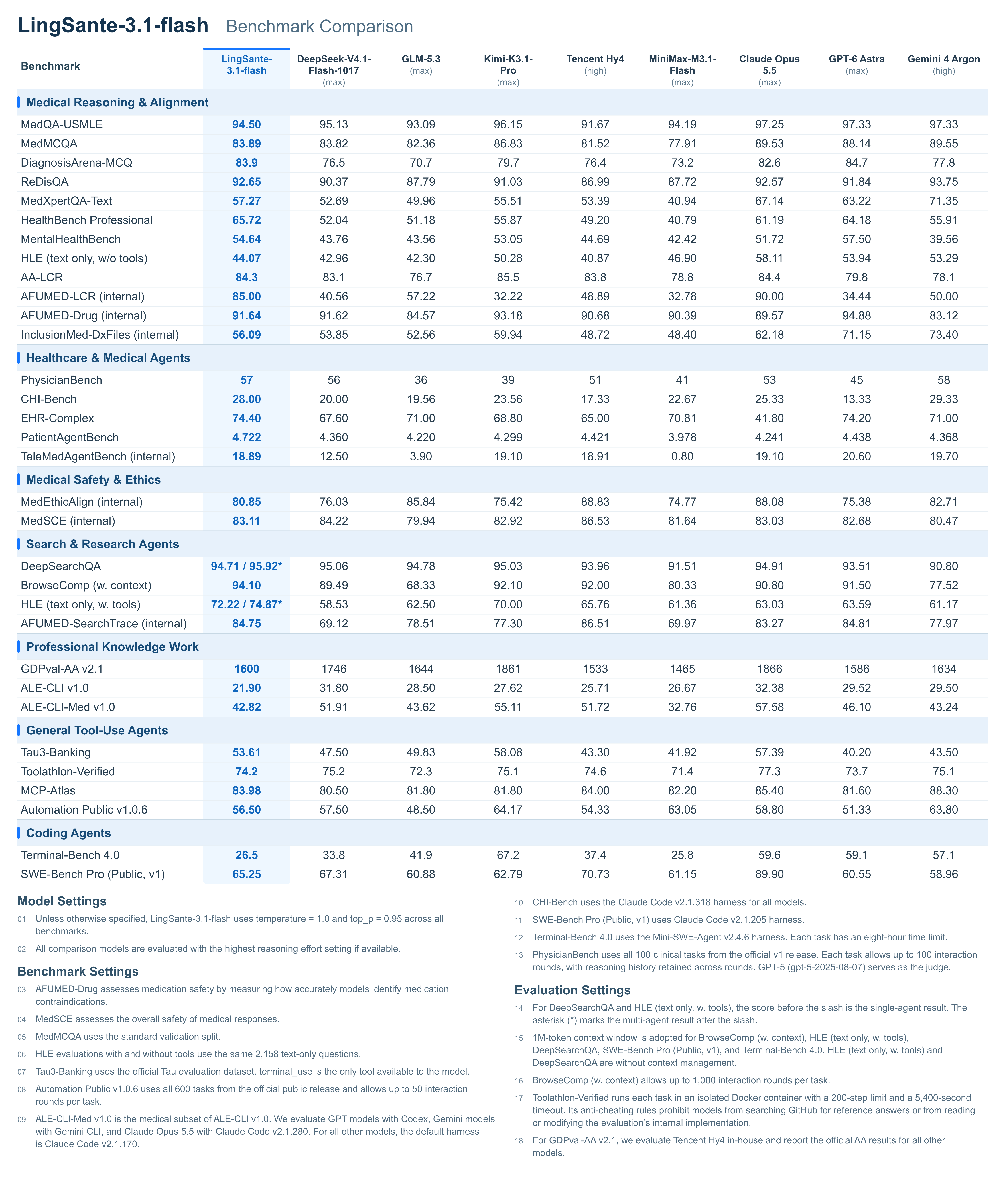
A benchmark table is only useful if you read the rows it loses. inclusionAI’s LingSante-3.1-flash launched on 2026-11-22 with a large comparison table against eight frontier models, and the honest summary is right there in the shape of it: LingSante leads the medical, healthcare-agent and search clusters, and falls away on coding and some professional work. This post walks all five clusters, prints the key tables, explains how the numbers were produced, and flags the one caveat that governs all of it: every score is inclusionAI’s own, unreplicated as of launch day. For the launch overview, read the LingSante-3.1-flash launch post first, and for the non-medical trunk this model branches from, the Ling-3.1-flash guide covers the base separately.
How to read this table, and who it was run against
Before any number, the settings, because they change what a win means. LingSante-3.1-flash was evaluated at temperature 1.0 and top_p 0.95, with thinking enabled. Every comparator was run at its highest reasoning effort, which is the most favorable setting available for those models. The comparators, with the sizes inclusionAI lists: DeepSeek-V4.1-Flash-1017 at 552B total and 16B active at max, GLM-5.3 at 744B total and 40B active at max, Kimi-K3.1-Pro at 2.8T total and 104B active at max, Tencent Hy4, MiniMax-M3.1-Flash, Claude Opus 5.5, GPT-6 Astra and Gemini 4 Argon, the last four at their max or high settings. The weights behind the LingSante rows are public on Hugging Face and mirrored on ModelScope, which is what makes this table auditable in a way a closed-model table is not.
Several benchmarks need their harness named. PhysicianBench runs 100 clinical tasks through a Claude Code harness with a GPT-5 judge, and its method is documented in the PhysicianBench paper. CHI-Bench uses Claude Code v2.1.318. Terminal-Bench 4.0 runs the Mini-SWE-Agent v2.4.6 with an 8-hour limit. Toolathon runs in isolated Docker with a 200-step and 5400-second budget. BrowseComp, HLE and DeepSearchQA get the full 1 million-token context. That is a real evaluation setup, not a toy one, which is exactly why the losses below carry weight.
LingSante-3.1-flash:  temperature 1.0, top_p 0.95
Comparators:          highest reasoning effort
PhysicianBench:       Claude Code harness, 100 clinical tasks, GPT-5 judge
CHI-Bench:            Claude Code v2.1.318
Terminal-Bench 4.0:   Mini-SWE-Agent v2.4.6, 8-hour limit
Toolathon:            isolated Docker, 200 steps, 5400s
BrowseComp/HLE/
DeepSearchQA:       1M-token context
Cluster 1: Medical reasoning and alignment, the strongest cluster
This is where LingSante-3.1-flash earns its name. Across the medical reasoning rows it leads on the benchmarks that reward clinical judgment over recall:
| Benchmark | LingSante | Best comparator |
|---|---|---|
| MedQA-USMLE | 94.50 | Opus 5.5 / Astra / Argon 97.33, Kimi 96.15 |
| MedMCQA | 83.89 | — |
| DiagnosisArena-MCQ | 83.9 | Beats all comparators |
| ReDisQA | 92.65 | — |
| MedXpertQA-Text | 57.27 | Argon 71.35, Astra 67.14, Opus 5.5 63.22 |
| HealthBench Professional | 65.72 | Opus 5.5 / Astra 64.18 — LingSante wins |
| MentalHealthBench | 54.64 | Wins |
| HLE text-only, no tools | 44.07 | Loses |
| AA-LCR | 84.3 | Wins |
| AFUMED-LCR (internal) | 85.00 | Opus 5.5 90.00 |
| AFUMED-Drug (internal) | 91.64 | Astra 94.88 |
| InclusionMed-DxFiles (internal) | 56.09 | Argon 73.40 |
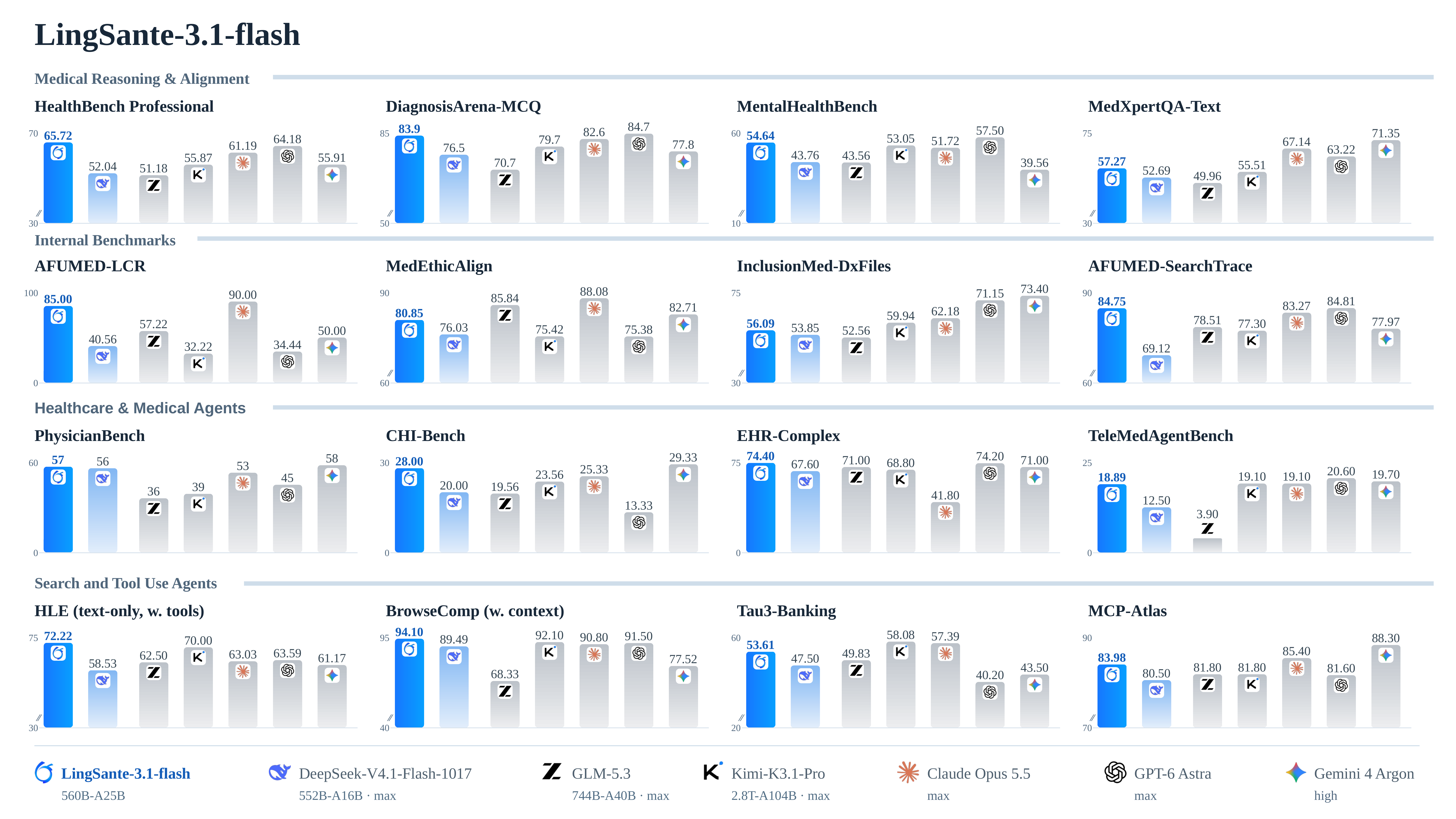
HealthBench Professional at 65.72 is the headline, and it matters because HealthBench is OpenAI’s own medical benchmark and the Professional tier is its specialist split. Beating Opus 5.5 and GPT-6 Astra, both at 64.18, on a board neither lab controls is the most defensible claim in the launch, and it is the number the launch overview leads with. DiagnosisArena-MCQ at 83.9 beats every comparator outright, and MentalHealthBench at 54.64 and AA-LCR at 84.3 are also clean wins. Those four are the core of the case for this model, and they are exactly the rows a clinical deployment should reproduce on its own cases before routing any traffic.
The losses in this cluster are just as informative. MedXpertQA-Text is a genuinely hard medical quiz, and there LingSante at 57.27 trails Gemini 4 Argon at 71.35, GPT-6 Astra at 67.14 and Claude Opus 5.5 at 63.22. MedQA-USMLE tells a subtler story: 94.50 is a strong score, but three comparators sit near 97.3, so this is a cluster where LingSante is competitive without leading, which our head-to-head against the frontier unpacks row by row. On the internal AFUMED and InclusionMed benchmarks, Opus 5.5, GPT-6 Astra and Gemini 4 Argon are all higher, and internal benchmarks are the least verifiable rows in the table because nobody outside inclusionAI can run them. Strong cluster, not a sweep, and the pattern is consistent: LingSante wins where clinical judgment and evidence alignment are scored, and loses where raw knowledge breadth is scored.
Cluster 2: Healthcare and medical agents, the reason to buy
Multiple-choice medical quizzes are the easy part. The harder claim is that a model can operate as a clinical agent, running tools across multi-step tasks, and this is the cluster where LingSante-3.1-flash is most interesting, and the one the clinical safety guide speaks to directly:
| Benchmark | LingSante | Best comparator |
|---|---|---|
| PhysicianBench | 57 | Argon 58, DeepSeek 56 |
| CHI-Bench | 28.00 | Argon 29.33 — close, LingSante wins cluster |
| EHR-Complex | 74.40 | Astra 74.20 |
| PatientAgentBench | 4.722 | Wins |
| TeleMedAgentBench (internal) | 18.89 | — |
EHR-Complex at 74.40 is the standout, edging GPT-6 Astra at 74.20 on electronic health record reasoning, which is the task most hospital deployments actually care about. PhysicianBench at 57 puts LingSante ahead of Opus 5.5 at 53 and GPT-6 Astra at 45, behind Gemini 4 Argon at 58 and DeepSeek at 56, and it is worth restating that this is an agentic harness, not a quiz. CHI-Bench is a narrow loss to Argon at the top, 28.00 to 29.33, but LingSante still beats the rest of the field. PatientAgentBench at 4.722 is a win. The agent cluster is where the medical fine-tuning plus tool-use RL pays off most clearly, and it is the cluster a healthcare buyer should weight highest. Our clinical safety guide covers the human-review rules that have to wrap any of these agent deployments.
Cluster 3: Safety and ethics, strong but not the strongest
inclusionAI runs two internal safety benchmarks, and LingSante-3.1-flash is competitive rather than dominant on both. On MedEthicAlign it scores 80.85, behind Claude Opus 5.5 at 88.08. On MedSCE it scores 83.11, behind DeepSeek-V4.1 at 84.22. Both are internal benchmarks, so treat them as inclusionAI’s own measurement rather than a shared scoreboard. The qualitative claim from the model card, that professional-behavior alignment ranks second overall behind only GPT-6 Astra, is a vendor claim consistent with these two rows but not independently established by them. Safety is a reason to consider this model, not a tiebreaker over Opus 5.5 on the evidence published so far, and the clinical deployment boundaries matter more than either score.
Cluster 4: Search and research agents, a genuine bright spot
The search cluster may be the most surprising result in the table, because it is the least medical one LingSante wins, and it is the cluster the launch post leads with alongside HealthBench:
| Benchmark | LingSante | Best comparator |
|---|---|---|
| DeepSearchQA | 94.71 single / 95.92 multi-agent | Astra 95.03 single |
| BrowseComp, with context | 94.10 | Wins |
| HLE, with tools | 72.22 / 74.87 multi-agent | Wins |
| AFUMED-SearchTrace (internal) | 84.75 | Wins |
BrowseComp with context at 94.10 and HLE with tools at 72.22 are clean wins over the entire frontier field, and HLE climbs to 74.87 in the multi-agent setting. DeepSearchQA is near the top in both single-agent and multi-agent forms, with GPT-6 Astra marginally higher at 95.03 on the single-agent row. The 1 million-token context window is doing real work here: BrowseComp, HLE and DeepSearchQA all get the full window, and a model built to pull evidence across long documents is exactly the model you would expect to score well on long-context search. If your product is research or evidence retrieval rather than diagnosis, this cluster is arguably a stronger reason to evaluate LingSante than the quiz cluster is. The head-to-head against the frontier lines these rows up side by side.
Cluster 5: Professional work, general tools, and the coding collapse
Here is where the specialist label stops being a nuance and becomes the decision. Three sub-clusters, all losses:
| Benchmark | LingSante | Best comparator |
|---|---|---|
| GDPval-AA v2.1 | 1600 | Opus 5.5 1866, Kimi 1861, Argon 1634 |
| ALE-CLI v1.0 | 21.90 | Loses |
| ALE-CLI-Med v1.0 | 42.82 | Loses |
| Tau3-Banking | 53.61 | — |
| Toolathon-Verified | 74.2 | — |
| MCP-Atlas | 83.98 | Argon 88.30 |
| Automation Public v1.0.6 | 56.50 | Loses |
| Terminal-Bench 4.0 | 26.5 | Kimi 67.2, Opus 5.5 59.6, Astra 59.1, Argon 57.1 |
| SWE-Bench Pro Public | 65.25 | Opus 5.5 89.90 |
Terminal-Bench 4.0 is the number to remember. LingSante-3.1-flash scores 26.5 while Kimi-K3.1-Pro scores 67.2, Claude Opus 5.5 scores 59.6, GPT-6 Astra scores 59.1 and Gemini 4 Argon scores 57.1. That is a gap of more than 30 points to the leader on a standard coding-agent board, run through the Mini-SWE-Agent harness with an 8-hour budget. SWE-Bench Pro Public repeats it at smaller scale, 65.25 against Opus 5.5’s 89.90. No healthcare fine-tune closes a gap that wide, and no healthcare buyer should route general code to this model on the strength of a medical benchmark. If you need a model for the coding side of a healthcare product, the frontier generalists are the right shelf, and the frontier comparison shows how far ahead they sit.
The professional-knowledge rows are softer losses but losses all the same. GDPval-AA v2.1 at 1600 trails Opus 5.5 at 1866 and Kimi at 1861. ALE-CLI and ALE-CLI-Med both go to the comparators, and ALE-CLI-Med is worth a second look precisely because it is a medical-flavored professional benchmark where LingSante still loses. General tool-use is mixed: competitive on Tau3-Banking at 53.61 and Toolathon-Verified at 74.2, behind Argon on MCP-Atlas, and behind the field on Automation Public. The generalist board does not flatter this model, and it is not supposed to.
Wins: HealthBench Professional, DiagnosisArena, MentalHealthBench, AA-LCR, EHR-Complex, PatientAgentBench, BrowseComp, HLE with tools. Losses: Terminal-Bench, SWE-Bench Pro, GDPval, MedXpertQA, ALE-CLI, ALE-CLI-Med, Automation Public. A specialist, measured.
The caveat that governs all of it
Every number in this post is vendor-supplied. inclusionAI ran the table, on its own harnesses, against its own selections, and published it on launch day. None of it has been independently replicated as of 2026-11-22, and some of the highest and lowest rows are internal benchmarks that only inclusionAI can run. A model trained this heavily on medical data and medical reinforcement learning is exactly the model you would predict to dominate medical boards and underperform on coding boards, so the pattern is internally coherent, but coherence is not replication. Quote the source and the date with every figure, and if a row is load-bearing for a purchase decision, run it yourself on your own tasks before you route production traffic. The model weights are open under MIT, so replication is possible in a way it is not for closed models; the self-hosting guide is the starting point if you want to verify a row on your own hardware.
What to do with these numbers
Use the table as a routing map, not a leaderboard. If your workload sits in the medical-reasoning, healthcare-agent or search clusters, LingSante-3.1-flash is now a credible open-weight candidate and the HealthBench Professional and EHR-Complex rows are the ones to test against your own cases. If your workload is coding or general professional work, these numbers argue against it, and the frontier generalists are far ahead on the boards that matter there. The cheapest way to settle it is to run your own ten tasks on both and meter the result; the cost calculator is where the arithmetic goes once you know the token counts.
For context on the comparators, our GPT-6.2 Astra and Sol launch covers OpenAI’s current frontier pair, the Qwen4-Max benchmarks cover another open-weight contender, and the Hy4 flash benchmarks cover a healthcare-adjacent open model from Tencent with a very different evidence base. If you want to compare the generalist side of the field before deciding, the best frontier models roundup links out to the free-lane options on our gateway where you can test an open model without a GPU cluster.
More in this cluster
- LingSante-3.1-flash launch — what it is, the headline wins, the lineage, the hub
- LingSante-3.1-flash vs the frontier — the win/loss map against Opus 5.5, GPT-6 Astra and Gemini 4 Argon
- LingSante-3.1-flash self-hosting — SGLang, vLLM, GPU sizing and the FP8 flags
- LingSante-3.1-flash clinical safety — the model-card boundaries as deployment rules
- Ling-3.1-flash — the non-medical base model this one branches from
How we checked this
Every benchmark figure above was read from the sources in the frontmatter on 2026-11-22 and is vendor-supplied by inclusionAI, run at temperature 1.0 and top_p 0.95 for LingSante while comparators ran at their highest reasoning effort. Internal benchmarks are marked as such and cannot be run outside inclusionAI. No score here has been independently replicated, none establishes clinical effectiveness, and nothing here is clinical advice.
More across the gateway
- GPT-6.2 Astra benchmarks
- how GPT-6.2 Astra compares with Claude Opus 5.5
- the GPT-6.2 reasoning effort tiers
- GPT-6.2 hallucination rates
- Qwen4-Max benchmarks
- the Hy4 flash benchmark breakdown
- GPT-6.2 cost per task
- the Inkling 2 Mini benchmarks
- the Inkling 2 Mini agentic-failure caveat
- Qwen4-Max vision and video benchmarks
- the GPT-6.2 1M context window
- how to estimate your monthly LLM API cost