Ling-3.2-air has a benchmark story, and unlike most models that ship this quietly, it comes with an official comparison table. On the Artificial Analysis Intelligence Index v5.0.1 the model scores 23, first out of five in its size class and far above the median of 5 for comparable open-weights models. On the Hugging Face model card it shows large jumps over its predecessor Ling-3.0-flash-VL on agentic and document tasks. And on the official Ant Ling table published on X the same day, it goes head to head with Mini-class closed frontier models, which is where the most interesting results sit.
Read together, those three sources tell a story with a clear shape. Ling-3.2-air beats a field of closed Mini-class models on agentic workflow automation, terminal coding, banking and finance agents, browse, skills, and document intelligence. It loses to those same models on heavy software engineering and pure STEM reasoning. It is first in its own size class on the independent index but mid-table against the largest open flagships. And it carries one unresolved reliability question on the Harvey LAB-AA benchmark that collapses once a materiality hallucination check is applied.
That mix, real wins in a specific cluster, honest losses outside it, and one caveat, is a complete enough picture to act on, which is unusual for a model with no launch post and no API. This post walks every part of it: the official table benchmark by benchmark, the index placement in both the size-class and broader rankings, the predecessor jumps, the Harvey caveat, and the gaps that still exist. Where a published value is uncertain we describe the trend rather than quote a digit.
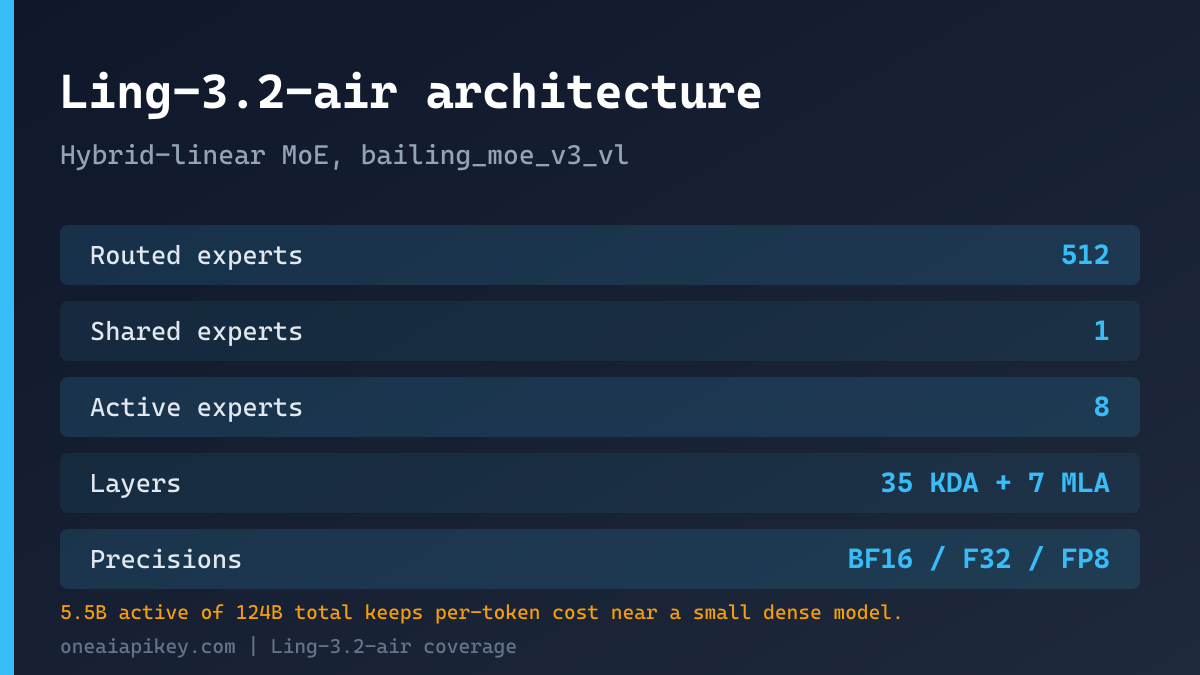
This is the second post in a series on Ling-3.2-air. If you want the overview first, Ling-3.2-air launch covers the unannounced release, the MIT license, and the self-hosting angle. For the design behind the scores, Ling-3.2-air architecture explains the hybrid-linear MoE that makes a 124-billion-parameter model behave like a much smaller one per token.
The Intelligence Index score: 23, first in class
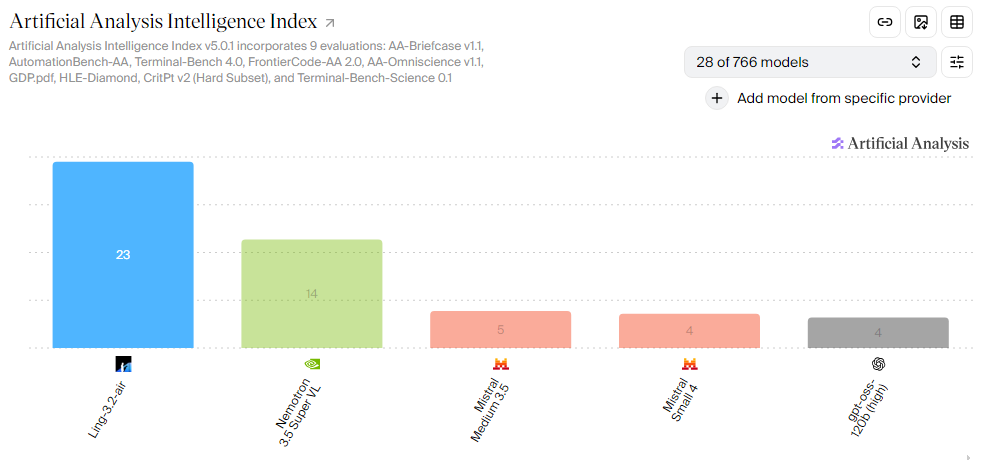
The headline number is 23 on the Artificial Analysis Intelligence Index v5.0.1, with a raw score of 23.39. The index ranks Ling-3.2-air first out of five models in its class. Artificial Analysis describes it as being among the leading models in intelligence when compared to other open-weight models of similar size, which is a measured statement about a specific peer group rather than a claim about the whole field.
The median for comparable open-weights models of similar size is 5. Set against that, a 23 is not a marginal win. It is more than four times the median for the size tier, and that gap is the clearest signal that this model is doing something different from the average open model at this parameter count. For context on how open-weight models of this class usually land, our Lingsante 3.1 Flash benchmarks post shows a related model in the same family being measured on a comparable harness.
The official account published two Artificial Analysis charts that put that 23 in context, and reading them together gives the honest placement. In the medium open-weights class, Ling-3.2-air is first by a wide margin: it scores 23 against Nemotron 3.5 Super VL at 14, Mistral Medium 3.5 at 5, Mistral Small 4 at 4, and Qwen3-120B at roughly 4. That is a nine-point lead over the nearest peer and close to a twenty-point lead over the rest, which is what being a 124-billion-parameter model among mostly smaller open peers buys you.
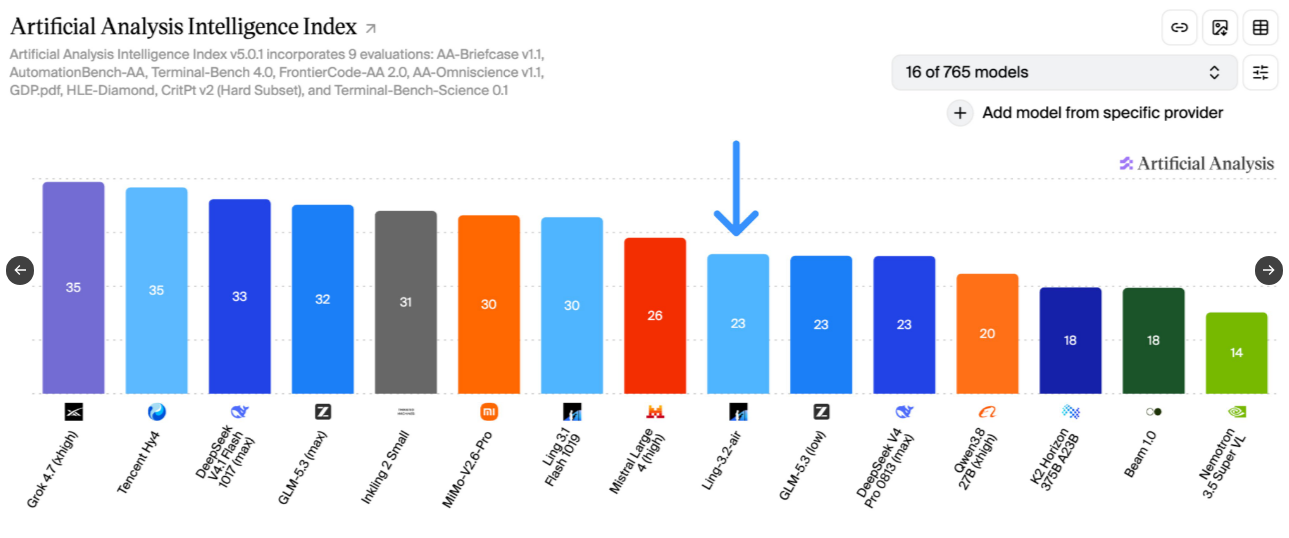
The broader ranking is the more sobering of the two, because it adds the largest open flagships. There Ling-3.2-air sits at 23, below Grok 4.7 at 35, Tencent Hy4 at 35, DeepSeek V4.1 Flash at 33, GLM-5.3 at 32, Inkling 2 Small at 31, MiMo-V2.6-Pro at 30, Ling 3.1 Flash at 30, and Mistral Large 4 at 26. It is level with GLM-5.3 low and DeepSeek Pro at 23, and above Qwen3B at 20, K2 Horizon at 18, Beam 1.0 at 18, and Nemotron-VL at 14. So the honest placement is dominant in its own size class, mid-table against the biggest open models, and behind them specifically on heavy code and pure reasoning. Both charts are true at once, and which one you weight depends on what you are comparing it to.
There is one more index number worth knowing, and it is about verbosity rather than intelligence. Ling-3.2-air generated 199 million output tokens across the Intelligence Index run, which ranked it fifth out of five, meaning the most verbose model in its class. The median output for similar-size models is 72.4 million, so this model produced roughly two and a half times the median token volume. The output-to-input ratio is 0.83 percent. Verbosity is not a quality judgment on its own, but it matters for anyone planning to run the model, because more output tokens per task means more compute per task on your own hardware.
What the index actually measures
The Artificial Analysis Intelligence Index v5.0.1 is not a single test. It is a composite built from nine evaluations, and knowing what those nine are tells you what the 23 is actually summarizing. The components are AA-Briefcase v1.1, AutomationBench-AA, Terminal-Bench 4.0, FrontierCode-AA 2.0, AA-Omniscience v1.1, GDP.pdf, HLE-Diamond, CritPt v2 Hard Subset, and Terminal-Bench-Science 0.1.
Reading that list, the index leans heavily toward agentic work, terminal use, document reasoning, and code. Those are the areas where Ling-3.2-air shows its strongest movement on the model card too, which is consistent. But here is the honest limitation: although the index is built from nine evaluations, Artificial Analysis does not break out individual coding, math, or reasoning sub-scores for Ling-3.2-air. You get the composite 23 and the component names, but not a per-component scorecard for this model. That means you cannot yet answer targeted questions like whether it is stronger at code than at math, or where it sits specifically on the reasoning-heavy components.
That gap in the independent index is exactly why the official table matters so much. Where the index gives you one composite number, the Ant Ling table gives you roughly thirty individual benchmarks across STEM, coding, agentic, and four flavours of vision-language work, each scored against six comparators. It is the most granular public view of what this model can and cannot do, and it is the source for the rest of this post.
The official comparison table: who it is up against
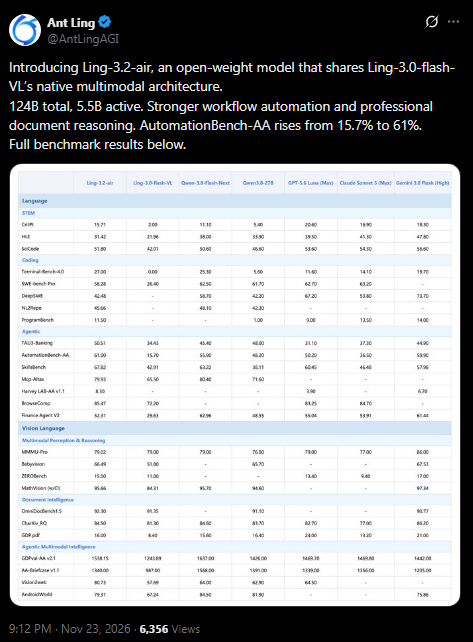
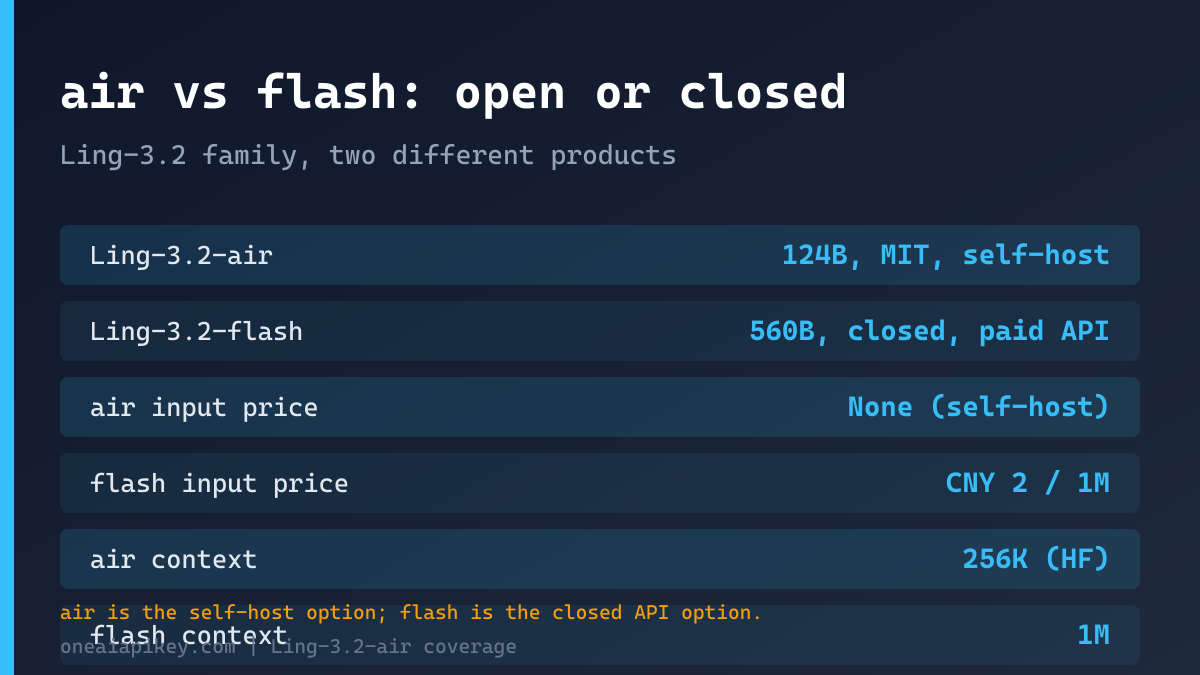
Before the numbers, the comparison set, because the strength of the table comes from who is in it. The seven columns are Ling-3.2-air, its predecessor Ling-3.0-flash-VL, Qwen-3.5-Flash-Novt, DeepSeek-V3.2, GPT-5.5-Low (Mini), Claude-Sonnet-5 (Mini), and Gemini-3.5-Flash (Mini). Three of those, GPT-5.5-Low, Claude-Sonnet-5 and Gemini-3.5-Flash, are closed frontier models from the Mini tier. That is the company Ling-3.2-air is being measured against: an open MIT model you can self-host, scored against models you can only reach through a paid API.
The one-line summary of the whole table is this. Ling-3.2-air leads on the agentic, terminal-coding, banking, browse, skills and document-intelligence cluster. It trails on heavy software engineering and pure STEM reasoning. Neither half of that sentence is negotiable, and both are needed to read the model correctly.
The agentic and terminal cluster: where it earns its place
This is the part of the table that justifies the model’s existence, and it is worth going result by result.
Terminal-Bench 4.0 is the starkest number in the whole release. The predecessor Ling-3.0-flash-VL scored 0.00, which means it completed none of these terminal tasks. Ling-3.2-air scores 27.00, and that is the best figure in the table, ahead of Qwen-3.5-Flash-Novt at 25.30, Claude-Sonnet-5 at 14.10, Gemini-3.5-Flash at 13.70, GPT-5.5-Low at 11.60, and DeepSeek-V3.2 at 5.60. Going from zero to the top of a seven-model field is a categorical change, not an increment, and it says the terminal-use side of the model was reworked in a meaningful way.
AutomationBench-AA is the number the official account led with, and it is the largest relative jump. It moves from 15.70 on the predecessor to 61.00, close to a fourfold gain, and 61.00 is the best in the table, ahead of Qwen-3.5-Flash-Novt at 55.90, Gemini-3.5-Flash at 53.00, GPT-5.5-Low at 50.20, DeepSeek-V3.2 at 49.20 and Claude-Sonnet-5 at 36.50. AutomationBench measures multi-step tool-using work, so this says the model is substantially better at finishing agentic workflows rather than merely attempting them.
SkillsBench goes to 67.82, the best shown, ahead of Qwen-3.5-Flash-Novt at 63.22 and GPT-5.5-Low at 60.45. TAU3-Banking is 50.51, the best in the set, against DeepSeek-V3.2 at 49.00, Qwen-3.5-Flash-Novt at 45.40, Gemini-3.5-Flash at 44.90, and GPT-5.5-Low at 31.10. BrowseComp reaches 85.47, narrowly the best, ahead of Claude-Sonnet-5 at 84.70 and GPT-5.5-Low at 83.25. MCP-Atlas is 75.93, behind Qwen-3.5-Flash-Novt at 80.40 but ahead of the predecessor at 65.50 and DeepSeek at 71.60.
Two more results round out the cluster. Harvey LAB-AA v1.1 shows 8.30, the highest figure displayed, ahead of Gemini-3.5-Flash at 6.30 and GPT-5.5-Low at 3.90. That is an all-pass metric where low absolute numbers are normal across the board, so read it as a relative lead rather than a strong absolute score, and see the caveat section below for why it needs care. Finance Agent V2 is 52.31, a solid mid-pack result behind Gemini-3.5-Flash at 61.64, Qwen-3.5-Flash-Novt at 62.90 and GPT-5.5-Low at 55.04, but well ahead of the predecessor at 29.63.
The takeaway from this cluster is the single most important thing to know about the model. A 124-billion-parameter open MIT model with 5.5 billion active parameters, one you can download and run on your own hardware, beats a field of closed Mini-class frontier models on agentic workflow automation, terminal coding, banking agents, browse, skills, and document intelligence. That is the special part, and it is exactly the workload a self-hosted multimodal agent is bought for.
The honest losses: heavy SWE and pure STEM
A table that only showed the agentic wins would be a puff piece, so here is the other half, and it matters just as much for anyone choosing a model.
On heavy software engineering Ling-3.2-air comes last in its comparison set. SWE-Bench Pro is 58.28, the lowest of the seven, behind Claude-Sonnet-5 at 63.20, GPT-5.5-Low at 62.70, Qwen-3.5-Flash-Novt at 62.50, DeepSeek-V3.2 at 61.70, and Gemini-3.5-Flash, whose figure is uncertain in the published image but clearly higher. DeepSWE is 42.48, also the lowest, well behind Gemini-3.5-Flash at 73.70 and GPT-5.5-Low at 67.20, though roughly level with DeepSeek-V3.2 at 42.20. Both results are still large improvements over the predecessor, which sat far lower, but against the current field the model is the weakest of the seven on real-world software engineering.
On pure STEM reasoning the model is mid-pack rather than leading. CritPt is 15.71, a large step up from the predecessor’s 2.00, but behind GPT-5.5-Low at 20.80, Claude-Sonnet-5 at 18.90 and Gemini-3.5-Flash at 18.30. GDP.pdf is 16.00, up from 8.40, but behind GPT-5.5-Low at 24.00, Gemini-3.5-Flash at 21.00 and Claude-Sonnet-5 at 18.20. On HLE the model posts 51.42, behind DeepSeek-V3.2 at 55.80 and Qwen-3.5-Flash-Novt at 55.00. On SciCode it is 51.80, behind Gemini-3.5-Flash at 58.60, Claude-Sonnet-5 at 54.30 and GPT-5.5-Low at 53.60. ProgramBench is a clear weak spot at 11.50, behind Claude at 13.50, Gemini at 14.00 and GPT-5.5-Low at 9.00, though ahead of DeepSeek at 1.00.
The honest read is that Ling-3.2-air is not a heavyweight coding or proof model. It does not beat the Mini-class closed models on the hardest software engineering or the deepest STEM reasoning, and on those specific harnesses it is often the weakest of the seven. If your workload is dominated by large-scale SWE or proof-heavy maths, the table is telling you to look elsewhere. What it is built for, and what it wins at, is agentic and document work.
Vision-language results: strong on documents, solid on perception
Because this is a vision-language model, the table splits the multimodal results into four groups, and the pattern mirrors the text-side story.
On document intelligence, OmniDocBench 1.5 is 92.30, the best in the set, ahead of Claude-Sonnet-5 and Gemini-3.5-Flash at 90.77 and the predecessor at 91.35. CharXiv_RQ is 84.50, mid-pack behind Gemini at 85.20 and Qwen at 84.60. GDP.pdf, covered above, is a loss to GPT-5.5-Low. On perception and reasoning, MathVision averages 95.66, strong but behind Gemini-3.5-Flash at 97.84 and level with Qwen at 95.70. MMMU-Pro is 79.32, solid but behind Gemini at 85.00, with Claude at 77.00 and the rest of the field lower. Babyvision is 66.69, ahead of Gemini at 67.53 is the only higher figure shown, and well ahead of the predecessor at 51.80. ZEROBench is 15.00, behind Gemini at 17.00 but ahead of GPT-5.5-Low at 13.40 and Claude at 9.60.
On agentic multimodal intelligence, the results are competitive without leading. GDPval-AA v2.1 is 1518.15, behind Qwen-3.5-Flash-Novt at 1537.00 and GPT-5.5-Low at 1469.78 is the next closest, so a strong second-tier result and far ahead of the predecessor at 1243.69. AA-Briefcase v1.1 Elo is 1348.00, up from 987.00 on the predecessor, but behind Qwen at 1556.00, Claude at 1356.00 and GPT-5.5-Low at 1339.00. Vision2Web is 60.75, behind Qwen at 64.00 and GPT-5.5-Low at 64.50. AndroidWorld is 79.31, behind Qwen at 84.50 and DeepSeek at 81.90 but ahead of Gemini at 75.88 and the predecessor at 67.24.
The vision story is the same shape as the text story: best-in-set on document parsing, competitive on perception, and not the leader on the most demanding reasoning. For a model whose headline is native multimodality, that is a coherent result. Ling-3.2-air vision covers what the multimodal input enables in practice.
The predecessor jumps behind the headline
The model-card comparisons against Ling-3.0-flash-VL are worth isolating, because they are the clearest before-and-after numbers and they explain why the official account led with AutomationBench.
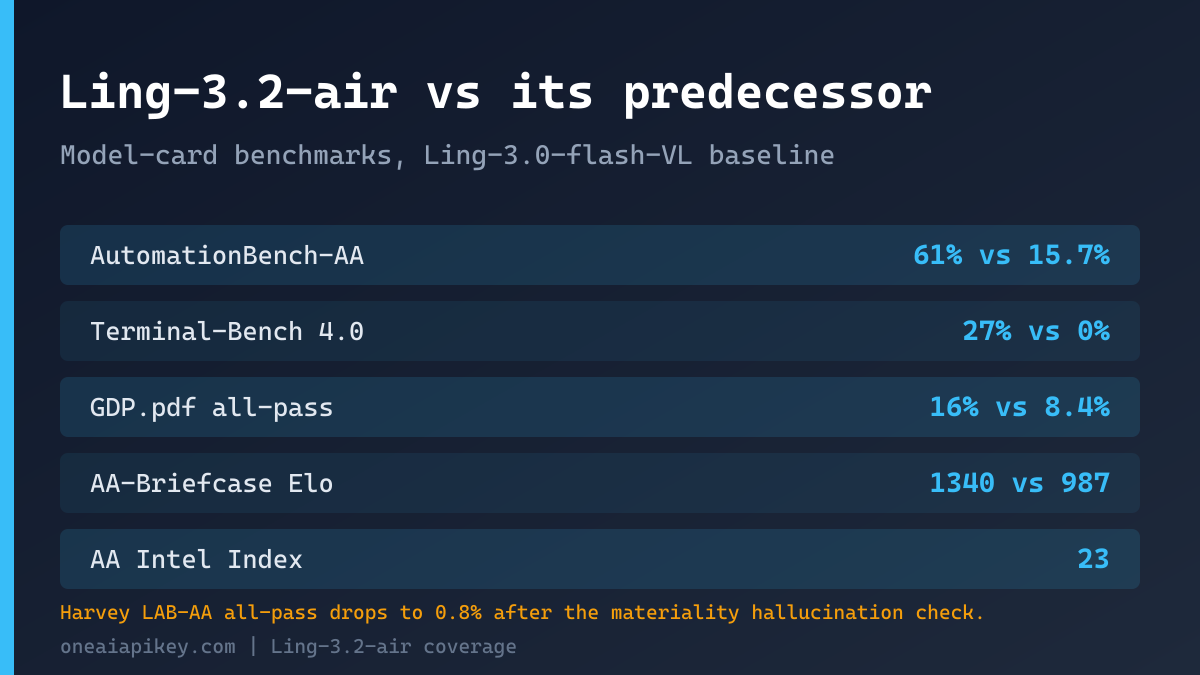
AutomationBench-AA moves from 15.70 to 61.00, close to fourfold. Terminal-Bench 4.0 goes from 0.00 to 27.00, from nothing to the top of the table. GDP.pdf doubles from 8.40 to 16.00. AA-Briefcase v1.1 Elo rises from 987 to 1340, a gain of 353 points. TAU3-Banking climbs from 34.43 to 50.51. SkillsBench jumps from 42.91 to 67.82. BrowseComp rises from 72.20 to 85.47. Finance Agent V2 goes from 29.63 to 52.31. AndroidWorld climbs from 67.24 to 79.31. And CritPt, a benchmark where the new model still trails the Mini models, still nearly eightfold improves from 2.00 to 15.71.
These are vendor-published numbers from the lab’s own harness, so treat them as a statement of what the lab measured rather than an independent audit. But the deltas are large and consistent across a dozen separate benchmarks, which makes a measurement error unlikely, and the official table puts them in front of external comparators rather than only against the predecessor.
The Harvey LAB-AA caveat, explained properly
There is one result on the model card that deserves its own section, because it is the most important nuance in the whole benchmark picture and it is easy to misread. The benchmark is Harvey LAB-AA v1.1, and it reports three numbers for Ling-3.2-air rather than one.
The first is the standard pass measure: 87.7 percent. On its face that is a strong result, and if you stopped reading there you would come away thinking the model handles this benchmark well.
The second is the all-pass rate before the materiality hallucination check: 8.3 percent. The third is the all-pass rate after the materiality hallucination check is applied: 0.8 percent. Those two numbers are where the story gets uncomfortable, and the drop between them is the whole point of the benchmark.
So what is happening here. The standard pass measure and the all-pass measure are not the same test. A standard pass asks whether the model gets individual items right. An all-pass asks whether the model gets an entire set of items right in a single response, with no errors anywhere. All-pass is a much stricter standard, because a single mistake anywhere fails the whole set. That is why 87.7 percent standard can coexist with 8.3 percent all-pass: the model is often right on individual items, but it rarely gets a whole multi-item set completely clean.
The materiality hallucination check then adds a further filter on top of all-pass. It is specifically looking for hallucinations that matter, meaning cases where the model states something false that would actually affect a decision or a conclusion rather than making a harmless slip. When that check is applied, the all-pass rate falls from 8.3 percent to 0.8 percent. In plain terms, almost none of the sets the model completes cleanly survive a strict check for material errors.
The honest interpretation is that Ling-3.2-air is fluent and often correct on individual items, but under a standard that demands a fully clean output with no material hallucinations it is not yet reliable. That is a real limitation, and it is exactly the kind of thing that matters if you are considering the model for work where a single confident false statement is costly, such as legal review, financial analysis, or any document task where precision is the point. It does not cancel out the strong index score, but it does qualify it: the 23 reflects broad capability, and the Harvey result reflects a specific reliability standard the model does not currently meet.
For a related read on how a model in this family handles a domain-specific reliability question, Lingsante 3.1 Flash clinical safety looks at the same theme in a medical context.
Ling 3.1 Flash scores higher on the index, and that matters
One comparison is easy to miss and worth making explicit. Ling 3.1 Flash 1019 scores 29.57 on the Artificial Analysis Intelligence Index, which is higher than Ling-3.2-air’s 23. That is worth knowing before assuming the newest release is automatically the strongest model in the family on every measure.
This is not a contradiction so much as a reminder that model generations do not move in a straight line. Ling-3.2-air is a different design point from Ling 3.1 Flash, with a different parameter count, a different modality focus, and a different intended deployment. It leads on agentic and terminal benchmarks and it is first in its own size class, while Ling 3.1 Flash currently posts a higher composite index number. Both can be true at once. The right way to use this is to match the model to the task rather than assuming newer means better across the board.
Ling-3.2-air vs Ling-3.1 Flash covers that comparison in full, including where each model’s strengths actually sit.
What is missing, and why the gaps matter
It is worth being precise about what the public benchmark record does not contain, because the gaps are as informative as the numbers.
There are no individual coding sub-scores. FrontierCode-AA 2.0 is one of the nine components of the index, so coding is clearly part of what the composite 23 summarizes, but there is no standalone coding number published for Ling-3.2-air. You cannot yet compare it directly to a coding-specialist model on a shared coding harness.
There are no math or reasoning sub-scores either, even though HLE-Diamond and CritPt v2 Hard Subset are reasoning-heavy components of the index. Same limitation: they feed the composite, but they are not broken out. If you are trying to decide whether Ling-3.2-air is the right model for a math-heavy or proof-heavy workload, the public data does not answer that yet, and the only honest way forward is to test it on your own tasks.
There is no speed figure. No tokens per second, no latency, no time to first token. On Artificial Analysis these fields are listed as not available for Ling-3.2-air. The reason is structural rather than an oversight: speed is measured through an API, Ling-3.2-air has no public API, so there is no standardized way to measure it. Anyone running the model themselves will get a speed that depends on their hardware, which means the only meaningful speed number for this model is the one you measure on your own deployment.
There is no price and no cost per task for the same reason. A cost-per-task figure requires an API rate, and there is no API rate to apply.
A note on where these numbers come from
Because Ling-3.2-air shipped without a launch post, it is worth being explicit about the provenance of every benchmark figure in this post, because the source affects how much weight each number can carry.
There are now three sources, and they carry different kinds of weight. The official Ant Ling comparison table published on X is the lab’s own announcement, and it is the most granular source, covering roughly thirty benchmarks against six comparators. It is vendor-published, so read it as a statement of what the lab measured on its own harness rather than as an independent audit. Its strength is breadth and the presence of external frontier comparators, which makes it harder to cherry-pick than a predecessor-only table.
The model-card comparisons against Ling-3.0-flash-VL also come from InclusionAI’s Hugging Face card. They are vendor-published in the same way, and they remain worth taking seriously because the deltas are large and consistent across a dozen separate benchmarks, which makes a measurement error unlikely. But until a third party reproduces them, they are the lab’s numbers rather than the community’s.
The Intelligence Index score comes from Artificial Analysis, which is an independent third-party evaluator. That gives the composite 23 a different kind of credibility: it was not produced by the lab that built the model. The tradeoff is that the index is a composite, so it summarizes rather than breaks out, and as noted above the per-component scores are not published for this model.
None of the three sources publishes a speed or cost figure, because none can. Speed and cost are measured against a live API, and there is no live API for Ling-3.2-air. This is a structural gap rather than an oversight, and it is the single biggest practical difference between reading benchmarks for this model and reading benchmarks for a hosted one. For a hosted model you can compare scores and prices side by side. For Ling-3.2-air you can compare scores, and then you are on your own for cost.
For a related read on what happens when two credible sources disagree about a model’s scores, our Inkling 2 Mini vals vs AA contradiction post covers exactly that situation on a different model, and it is a useful reminder that benchmark disagreements are normal in this space.
How to actually use these numbers
Given all of the above, here is the practical read, and it is more actionable than it was before the official table landed.
The index score of 23 tells you that among open-weight models of similar size, Ling-3.2-air is a strong general reasoner with a real lead on its peer group, and first in its own size class by a wide margin. That is a useful signal if you are choosing between open models at this size tier and want one that scores well broadly. Just remember the broader ranking too: against the largest open flagships it is mid-table, not leading.
The official table tells you where the model genuinely wins and where it does not, and this is the part to weight most heavily. If your workload is agentic workflow automation, terminal coding, banking or finance agents, browse, skills, or document intelligence, Ling-3.2-air beats a field of closed Mini-class frontier models on exactly those harnesses, and it is the only model in the comparison you can self-host. That combination is the reason to pick it. If your workload is large-scale software engineering or proof-heavy STEM reasoning, the same table shows it trailing the Mini models on SWE-Bench Pro, DeepSWE, CritPt and GDP.pdf, and you should look at a coding-specialist or a larger model instead.
The Harvey result tells you to be careful about precision-critical work. If your application cannot tolerate a confident material hallucination, the 0.8 percent all-pass after the materiality check is a number you should take seriously and test against your own tasks before committing.
And the gaps tell you what you have to measure yourself. Speed, latency, and cost on your own hardware are unknowns you will have to fill in, because there is no public API to give you standardized figures. Plan a benchmark pass on your own deployment rather than assuming the index score translates directly to your workload.
For the deployment side of that equation, Ling-3.2-air hardware breaks down the GPU requirements, and Ling-3.2-air self-hosting covers the serving stack you would run. If you are weighing the model against a closed alternative with published scores and a known price, Ling-3.2-air vs Ling-3.2-flash makes that trade explicit, and Ling-3.2-air vs MiniCPM-V 4.7 compares it to a much smaller multimodal model on specs rather than shared benchmarks. And if you would rather not run a four-GPU server at all, you can sign up for a key to use capable open models through hosted access, or check the model catalogue for what is available through an API today.
What would change the picture
The official comparison table already filled in the biggest gap, so what is left is narrower. The first is independent replication of the official and model-card numbers, particularly the Harvey result and the Terminal-Bench jump, since vendor-published benchmarks are stronger when a third party confirms them. The second is per-component scores for the nine index evaluations, which would fill in the standalone coding and reasoning picture the composite does not break out. The third is any hosted deployment that adds the model to a router, which would produce a real speed and cost figure for the first time, since both are currently listed as not available.
Any of those would sharpen this post further, and we will update it when they land. For now, the honest summary is that Ling-3.2-air is a strong open-weight reasoner, first in its size class, that beats closed Mini-class frontier models on agentic automation, terminal coding, banking, browse and document intelligence while trailing them on heavy SWE and pure STEM. It has one unresolved reliability question on precision-critical work, and no public speed or cost figure. That is what the verified data supports today.
Related reading for this decision
The November frontier-model comparison supplies the broader competitive frame, and Inkling 2 Mini benchmarks shows how a smaller open model performs on a different evaluation set. Lingsante 3.1 Flash vs frontier covers another specialist model whose aggregate score needs context.
If you are comparing benchmark claims against operating cost, GPT-6.2 Astra pricing and GLM-5.4 pricing show how published API rates differ from a self-hosting bill. The blog category lists every Resources article in date order.
More Ling-3.2-air coverage
This is one post in a ten-part series on Ling-3.2-air. The rest of the cluster:
- Ling-3.2-air launch on the unannounced release, the MIT license, and the self-hosting angle
- Ling-3.2-air architecture on the hybrid-linear MoE and why 5.5B active of 124B matters
- Ling-3.2-air vs Ling-3.2-flash on the open self-host model against the closed API sibling
- Ling-3.2-air vs MiniCPM-V 4.7 on datacenter versus pocket multimodal
- Ling-3.2-air self-hosting on running the model yourself day to day
- Ling-3.2-air hardware on the GPU options and the memory math
- Ling-3.2-air vision on text, image and video input in practice
- Ling-3.2-air context window on the 256K documented window and the 1M discrepancy
- Ling-3.2-air vs Ling-3.1 Flash on why the older Flash scores higher on the index