The context window of Ling-3.2-air is the one specification where the public sources disagree, and the disagreement is the story. The Hugging Face model card and the official SGLang serving recipe both set the context at 256K tokens, written as 262,144. The Artificial Analysis model page lists the same model at 1M tokens, which it describes as roughly 1,573 A4 pages. Those are not the same number, and on launch day nobody has published an authoritative reconciliation.
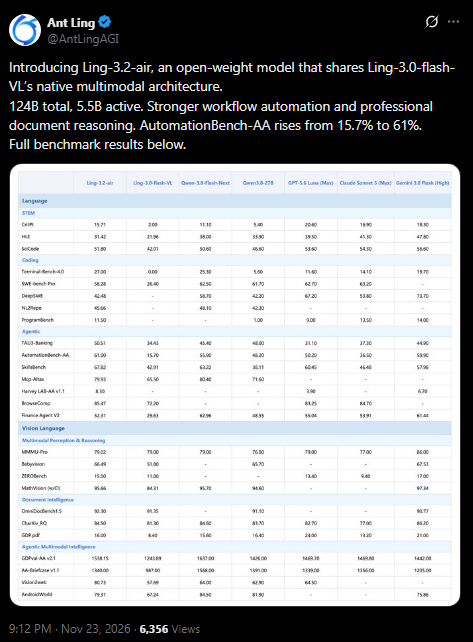
This post takes the conflict seriously rather than picking a side quietly. We use 256K as the documented and native configuration, because that is what the serving recipe actually sets, and we present 1M as what Artificial Analysis lists. We explain why a documented context and a listed context are not the same kind of claim, why the difference matters more for self-hosting than for a hosted API, and what the memory cost of a long context looks like on the hardware this model needs. We also look at the official benchmark table published through the Ant Ling account, because it shows what a large context window is actually for: long-context agentic work, where air scores 1348.00 on AA-Briefcase v1.1 and 1518.15 on GDPval-AA v2.1. What we do not do is invent an answer to the discrepancy or pretend a number is settled when it is not.
Why the context window is worth its own post
For a text model, context length is one number among many. For a self-hosted multimodal model, it is one of the biggest drivers of cost, because the memory needed to serve the model grows with the context you configure. That makes the context window a hardware decision, not just a capability label. If you plan against the wrong number, you either waste GPUs on capacity you do not use or run out of memory when a long sequence arrives.
Ling-3.2-air makes this especially relevant because it is a multimodal model with image and video input. Encoded images and sampled video frames consume context tokens just as text does, and they consume them fast. A model that accepts a screen recording or a document full of images fills its context window much quicker than a text-only workload, which means the exact size of that window shapes what the model can do in a single pass. Our Ling-3.2-air vision post covers the multimodal input, and this post covers the container it all has to fit in.
What the model card and recipe actually say
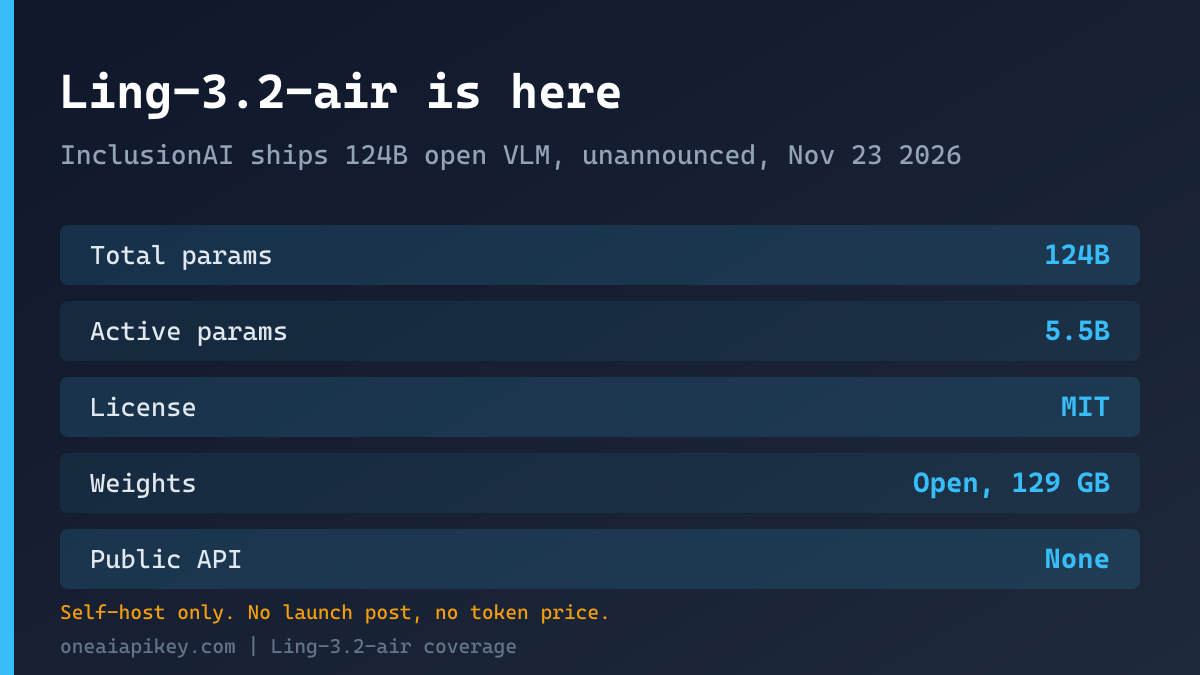
The documented figure comes from two places that agree with each other. The Hugging Face model card for inclusionAI/Ling-3.2-air describes a 256K token context. The official SGLang serving example, which is the recipe InclusionAI provides for running the model, sets the context explicitly with the flag --context-length 262144. That is 256K written as an exact token count.
The serving recipe matters more than a specification line, because it is the configuration the team used to run the model themselves. When the people who built the model set --context-length 262144 in their own example, that is a strong signal about the intended and tested operating point. It is not a marketing figure. It is a command line someone ran.
The Artificial Analysis page is a different kind of source. It is a third-party model directory that aggregates specifications, and it lists Ling-3.2-air at 1M tokens. That is a real entry from a real source, not an error we can dismiss, and it is roughly four times the documented figure. But it is a listed value in a directory, not a configuration someone used to serve the model.
Documented context versus listed context
The reason this distinction matters is that the two numbers come from different kinds of claim. A documented context is a configuration the model creator published and, in this case, used in their own serving recipe. It says: here is a context length we set up, tested, and expect to work. It is backed by a specific flag in a specific command.
A listed context is a value a directory or aggregator records about a model. It may reflect a theoretical maximum the architecture supports, a figure the creator mentioned somewhere, or an interpretation of the model’s design. It is not necessarily the configuration you get when you download the weights and run the recommended recipe. Two sources can list different context lengths for the same model because they are answering slightly different questions. One is describing what the recipe sets, the other is describing what the model can apparently reach.
Neither number is wrong in its own frame. The 256K figure is what you should plan a deployment around, because it is the configuration with a published command behind it. The 1M figure is what one directory lists, and it may represent a capability the architecture has that the default recipe does not enable. Until InclusionAI clarifies which is the native maximum and under what conditions 1M is reachable, the honest position is to treat 256K as the documented operating point and 1M as a listed value from a third party.
What the window is for: long-context agentic work
A context window is a means, not an end, and the official benchmark table is the clearest public evidence of what Ling-3.2-air’s window is built to serve. Two benchmarks in that table are long-context agentic evaluations, and they measure a model holding a large body of material in context and then acting on it, rather than simply reciting it.
On AA-Briefcase v1.1, which scores an agent working over an extended brief, air scores 1348.00. The predecessor Ling-3.0-flash-VL scores 987.00 on the same benchmark, a gain of 361 points, and air sits ahead of DeepSeek-V3.2 at 1291.00 and Gemini-3.5-Flash at 1295.00 while Qwen-3.5-Flash leads the group at 1556.00. On GDPval-AA v2.1, which scores getting real multimodal document work done end to end, air scores 1518.15 against the predecessor’s 1243.69, ahead of DeepSeek at 1428.00, Gemini at 1442.00, GPT-5.5-Low at 1469.78 and Claude at 1489.60, with only Qwen ahead at 1537.00.
Those two rows are the justification for a large window. A model does not score 1518.15 on a long-context document task by holding a paragraph. It scores there by ingesting a substantial brief, keeping track of it, and completing multi-step work over it without losing the thread. That is the workload a 256K window enables, and it is why the size of the window is not just a specification line. For a team choosing a self-hosted model to process long contracts, extended case files, or large document sets in a single pass, these are the numbers that say the window is usable rather than theoretical.
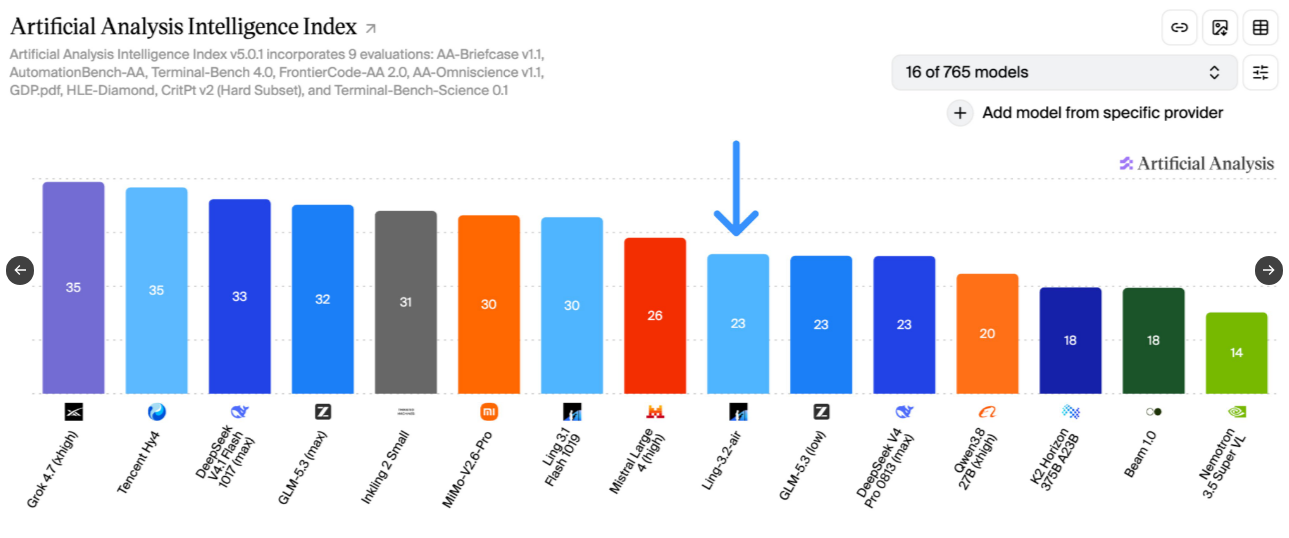
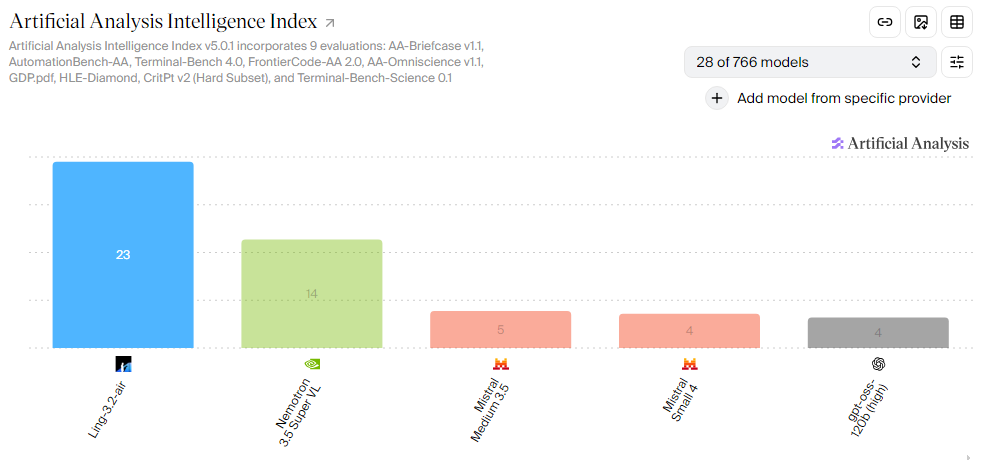
It is worth pairing that with an honest limitation. The AA Intelligence Index score of 23 places air below the largest open-weights flagships, with Grok 4.7 and Tencent Hy4 at 35, DeepSeek V4.1 Flash at 33 and GLM-5.3 at 32. Within its own medium open-weights class, though, air leads at 23 against Nemotron 3.5 Super VL at 14 and the Mistral and Qwen-120B entries at 4 to 5. So the long-context agentic ability is real and class-leading, but it is not flagship-class against much larger models. The window gives air room to do long agentic work, and the scores show it does that work well for its size, while the biggest models still outscore it overall.
The predecessor comparison makes the generational point sharpest. The jump on AA-Briefcase from 987.00 to 1348.00 is the largest single gain of any benchmark in the official table, larger than the AutomationBench improvement from 15.7 percent to 61 percent in relative terms. InclusionAI built this generation specifically to hold more context and act on it, and that shows up as the single biggest year-over-year improvement the team can point to.
Why this matters for self-hosting specifically
If Ling-3.2-air were a hosted API model, the context discrepancy would be an interesting footnote. You would send a request, the provider would handle the memory, and the exact window would show up in the response metadata. You would care about the number, but not about provisioning for it. The provider’s engineering team would have already decided what context to serve, provisioned hardware for it, and priced it into the token rate.
Ling-3.2-air has no public API. It is a self-hosting model under MIT weights, which means the context window you configure is the context window your hardware has to pay for. That is where the discrepancy stops being academic and becomes a line item in your infrastructure budget.
The mechanism is the KV cache. When a model processes a sequence, it stores intermediate attention states for every token so it can attend back over them as it generates. Those stored states are the context in a physical sense. They are what let the model refer to something it read twenty thousand tokens ago. The memory they occupy grows with the number of tokens in the sequence, and it grows in a way you cannot reduce without shortening the context itself.
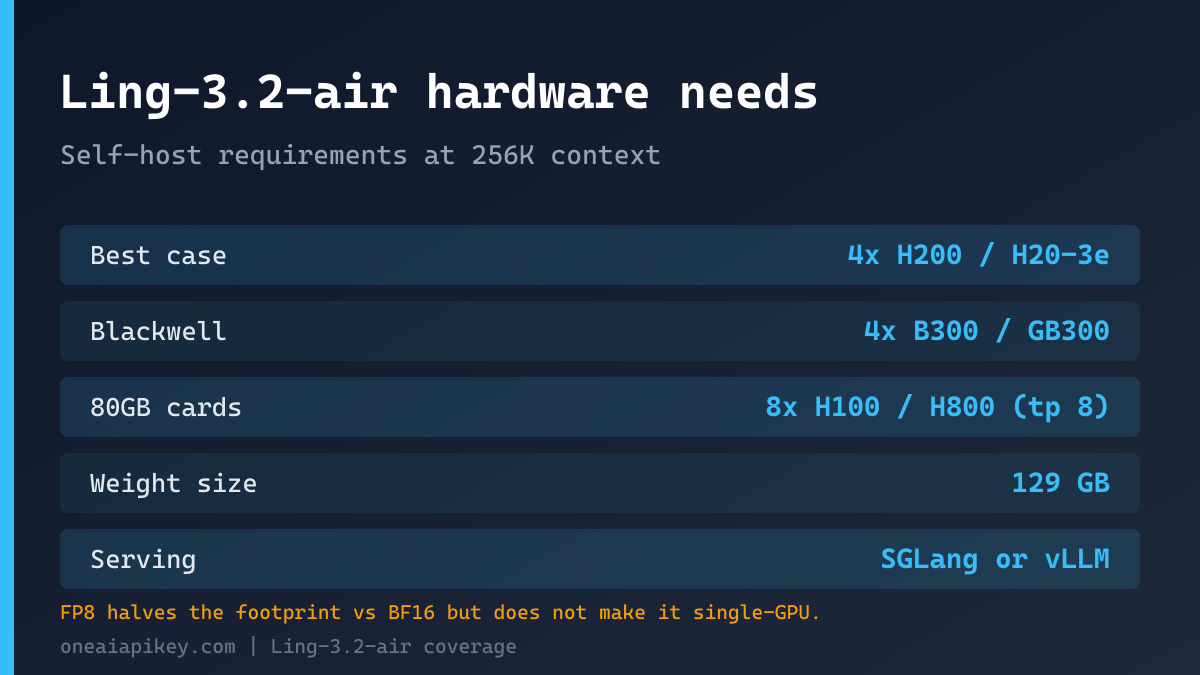
A 256K context needs far more KV cache memory than a 32K context, and a 1M context needs roughly four times what 256K needs, because four times the tokens means four times the stored attention state. That memory has to come from somewhere, and on the GPUs this model runs on, it is a substantial share of the total budget. It competes directly with the memory needed to hold the model weights themselves. The weights are a fixed cost, the KV cache is a variable cost that scales with how long a sequence you serve, and the two together have to fit on the hardware you have.
This is why the hardware recommendations are tied to context rather than to the model alone. At the documented 256K context, the model card recommends four GPUs in the 141 GB class, such as the H20-3e or H200, or a four-GPU Blackwell node with B300 or GB300. If you drop to 80 GB cards like the H100 or H800, you need eight of them with tensor parallelism set to --tp 8. Those figures are not abstract capacity statements. They are the memory budget for weights plus KV cache at the 256K operating point, spread across however many GPUs you bring.
Configuring for 1M would push the KV cache requirement up accordingly, and the model card does not publish hardware guidance for that operating point, because it does not document 1M as the served configuration. This is one of the clearest signals that 256K is the tested configuration. When a team publishes hardware requirements, they publish them for the context they actually run. If 1M were the operating point, the hardware table would be built around it.
The practical consequence is that the context discrepancy is a hardware decision. Choosing to believe the 1M figure and configure for it, without published hardware guidance, means guessing at a memory budget nobody has validated. Choosing the 256K figure means deploying to a configuration with a published command and a published hardware table behind it. For a self-hosted deployment where you are buying or renting the GPUs, that difference is not subtle.
Our Ling-3.2-air hardware post covers the GPU options in detail, and Ling-3.2-air self-hosting walks the serving setup where the context flag is set. For a related read on how memory constraints shape model choice, our Inkling 2 Mini 16GB quant ladder covers the same tradeoff at a much smaller scale.
The architecture that makes a large context possible
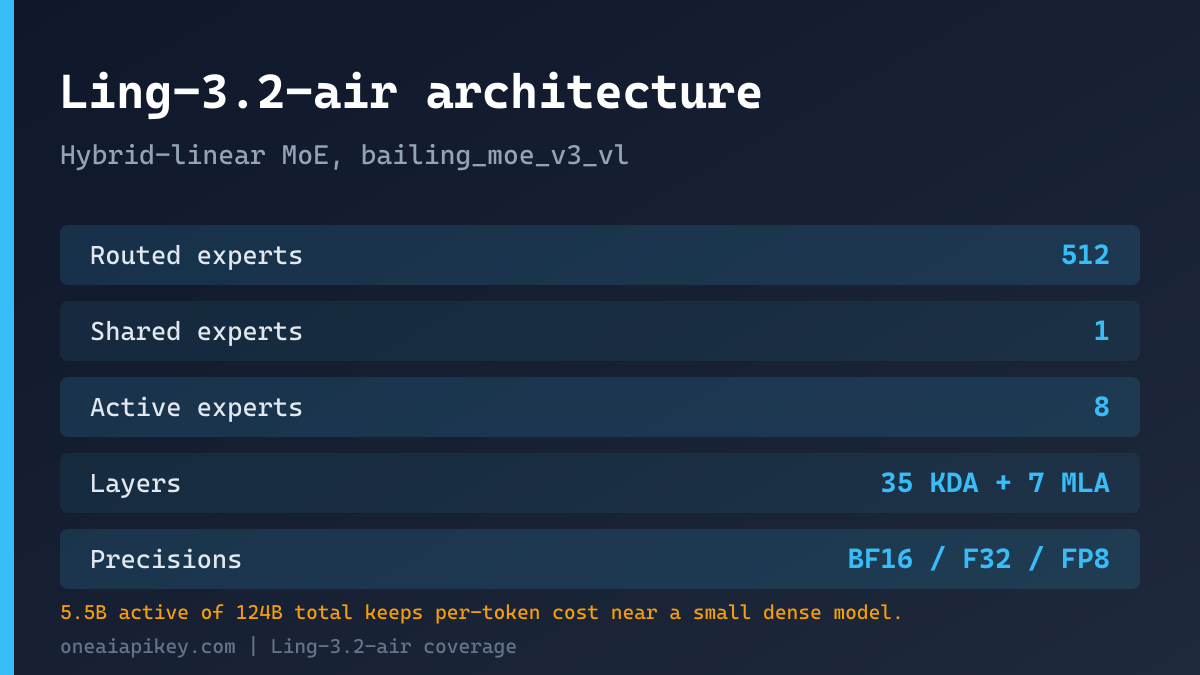
The context window is not independent of the architecture. Ling-3.2-air uses a hybrid-linear design with 35 KDA layers and 7 Gated MLA layers in a 5:1 ratio. Those attention mechanisms matter for long context because they change how the model handles sequences. Gated MLA, or multi-head latent attention, compresses the key-value states so the KV cache stays smaller than a standard attention design would produce, and KDA, a linear attention variant, handles long-range dependencies without storing full attention states for every token.
The practical result is that the architecture is built to keep long contexts affordable. That is consistent with a model documented at 256K, and it is the kind of design that could plausibly extend further. It is also consistent with why a directory might list a higher figure. A hybrid-linear architecture with compressed attention is exactly the design that makes very long contexts feasible in principle, even when the default recipe serves a smaller window. Our Ling-3.2-air architecture post covers the attention design in depth.
This is offered as context for the discrepancy, not as a resolution of it. The architecture being capable of long context does not tell you which number is the tested maximum. It tells you the model is not an unlikely candidate for a large window, which is a different claim.
What 256K and 1M mean in practical terms
Numbers like 256K and 1M are hard to feel, so it helps to translate them into something you can picture. Artificial Analysis describes its listed 1M figure as roughly 1,573 A4 pages. That gives a sense of the scale: a context window that could hold a large body of documents in a single pass, without retrieval or chunking, all available to the model at once.
At the documented 256K, you are working with roughly a quarter of that, on the order of 400 A4 pages of text. That is still a large window by any standard. It holds a long transcript from hours of audio, a mid-sized codebase with room for a question, a legal contract set, or a research folder, all in one context. Most requests that people actually make of a model, even at work, sit well inside it.
The page count is a text approximation, and it is worth being clear about its limits. Tokens do not map to words at a fixed rate. English prose averages somewhere around four characters per token, so 256K tokens is on the order of a million characters, but code, JSON, and non-English text tokenize differently and often consume more tokens per unit of meaning. A codebase with dense punctuation and short symbols can eat a context window faster than its line count suggests. A document in a language that tokenizes less efficiently can too. The 400-page figure is a feel for the scale, not a guarantee you can fit 400 pages of any particular content.
Where the window tightens is multimodal work, and this is the part most relevant to Ling-3.2-air specifically. Images and video frames consume context tokens just as text does, and they consume them at a rate that varies with resolution and frame count. A single high-resolution image can take up as many tokens as a page or several pages of text, and a video with many sampled frames multiplies that. A 256K window that has to hold encoded images fills faster than one holding only text, and a video session tighter still. The model card does not publish a per-image or per-frame token cost, so you cannot compute exactly how many images fit in a 256K window. What you can say honestly is that multimodal input spends the budget faster than text, and that the exact rate is undocumented.
The honest framing is that 256K is a genuinely large context for a self-hosted model, large enough for the majority of document and code workloads, and tight enough that heavy multimodal input is where you would notice the ceiling first. If the 1M figure turns out to be a reachable configuration, that would substantially expand the multimodal headroom, roughly quadrupling the room available for images and video. That is not confirmed, so it is not something to plan a deployment around today.
The output cap nobody has published
Context length is only half the sequence budget. The other half is how many tokens the model can generate in a single response, and that number is not published for Ling-3.2-air. The model card documents the context window but does not state a maximum output length. Artificial Analysis does not publish an output cap either.
There is one related signal worth noting without overstating it. On the Artificial Analysis Intelligence Index, Ling-3.2-air generated 199 million output tokens across the evaluation runs, the most of any model in its comparison class, against a median of 72.4 million for similar-size models. That tells you the model is verbose in practice, producing long outputs when it works through tasks. It does not tell you the maximum output the model can produce in a single response, which is a different question. Verbosity is a behavioral observation. The output cap is a configuration limit, and it is undocumented.
For self-hosting, that gap matters in the same way the context gap does. When you configure the serving stack, you set a maximum generation length, and the KV cache has to accommodate context plus generated tokens. Without a published output cap, you are choosing that value yourself based on your workload, and our Ling-3.2-air self-hosting post covers how to set it conservatively.
How to plan a deployment given the conflict
Given that the sources disagree, the practical recommendation is to plan against 256K and treat anything above it as unconfirmed. That is not a conservative guess for its own sake. It is the number the serving recipe sets, the number the hardware recommendations assume, and the number with a published command behind it.
If your workload genuinely needs more than 256K tokens in a single pass, Ling-3.2-air at the documented configuration is not a fit today, and you should not configure for 1M on the assumption it works. Test at 256K first, measure whether the context is the binding constraint, and revisit if InclusionAI clarifies that a larger window is supported. Configuring for an undocumented context length is a way to spend GPU memory on a configuration nobody has validated.
If your workload fits comfortably in 256K, the discrepancy is largely irrelevant to you. Set the context flag to 262,144 as the recipe shows, provision the hardware the model card recommends, and the ambiguity costs you nothing. Most self-hosted workloads, even multimodal ones, sit well inside 256K.
The long-context agentic scores give you a way to decide which side of that line you are on. If your work looks like AA-Briefcase or GDPval-AA, meaning long briefs, extended document sets and multi-step work over them, then you are exactly the user the 256K window and the 1348.00 and 1518.15 scores are for, and it is worth testing at the documented configuration. If your work is short prompts and single documents, a large window buys you little and a smaller model may serve you better. Our cost calculator helps you price self-hosting a 256K deployment against per-token API pricing, and our model catalogue lists alternatives if you do not need the long context. To benchmark air against your own long documents, you can sign up for a key and run representative samples at the documented 256K before committing to hardware.
How the context compares across the cluster
Two comparisons put the window in context. Against Ling-3.2-flash, the closed 560B model with a paid API, Ling-3.2-air’s documented 256K is smaller than the flash model’s 1M context. That is a real difference, and it is one of the tradeoffs of choosing the open self-hosted model over the closed API. Our Ling-3.2-air vs Ling-3.2-flash post covers it.
Against Ling-3.1 Flash, the picture is different in an unexpected way. Ling 3.1 Flash scores 29.57 on the Artificial Analysis Intelligence Index, above Ling-3.2-air’s 23, even though air is newer and larger. Context is not the driver of that gap, but the comparison is worth understanding, and our Ling-3.2-air vs Ling-3.1-flash post explains it.
This section will be updated
This page will be updated once InclusionAI clarifies the context window specification. Based on what the model card and the serving recipe confirm today, the documented context is 256K tokens, set explicitly as --context-length 262144, and that is the configuration the hardware recommendations assume. Artificial Analysis separately lists the model at 1M tokens, a figure that is not backed by a published serving configuration. What is not known is whether 1M is a reachable and tested operating point, and what hardware it would require. That is what is verified, not a prediction. When InclusionAI publishes clarity on the native maximum and the conditions for reaching it, we will revise this page.
Related reading for this decision
GPT-6.2’s 1M-context analysis examines another long-context model, while Lingsante 3.1 Flash self-hosting covers serving a smaller family member. The November frontier-model comparison shows where context sits among other buying criteria.
Use hosted API pricing when you need a metered alternative, and browse the blog category for more context-window and deployment guides.
More Ling-3.2-air coverage
This post is part of a cluster covering the launch. Each links back to the hub and to the others:
- Ling-3.2-air launch for the release overview
- Ling-3.2-air benchmarks for what the scores measure
- Ling-3.2-air architecture for the hybrid-linear attention design
- Ling-3.2-air vs Ling-3.2-flash for the 256K versus 1M split across models
- Ling-3.2-air vs MiniCPM-V 4.7 for datacenter versus pocket
- Ling-3.2-air self-hosting for setting the context flag
- Ling-3.2-air hardware for GPU requirements at 256K
- Ling-3.2-air vision for how multimodal input consumes context
- Ling-3.2-air vs Ling-3.1-flash for the index comparison
For related reading on self-hosting economics, see our Inkling 2 Mini local vs API economics guide, and for the memory tradeoffs of running open models on your own hardware, our Inkling 2 Mini memory footprint post covers a smaller model at a different point on the spectrum.