The most common mistake people make when sizing hardware for a mixture-of-experts model is to look at the active parameter count and assume that is what determines the GPU requirement. Ling-3.2-air activates 5.5 billion parameters per token, which sounds like something a single high-end card could handle comfortably. It cannot. The official requirement for running this model at 256K context is four 141GB-class GPUs or a 4-GPU Blackwell node, and on 80GB cards you need eight of them. That gap between 5.5 billion active parameters and a four-GPU minimum is the whole lesson of this post, and understanding it will save you from sizing a deployment wrong.
This post covers the official hardware requirements, why a 124 billion parameter MoE with only 5.5 billion active parameters still needs multi-GPU, what the 129 GB weight file implies for memory, why FP8 does not rescue you into single-GPU territory, and how the 256K context window adds to the bill. It also covers the question that has to come first: whether the model’s benchmark results justify a four-GPU server in the first place. For the serving software that runs on this hardware, our Ling-3.2-air self-hosting guide covers the SGLang recipe.
Why the four-GPU bill is worth paying
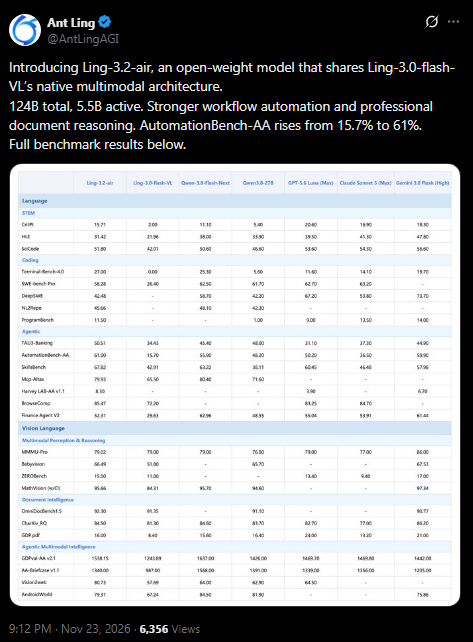
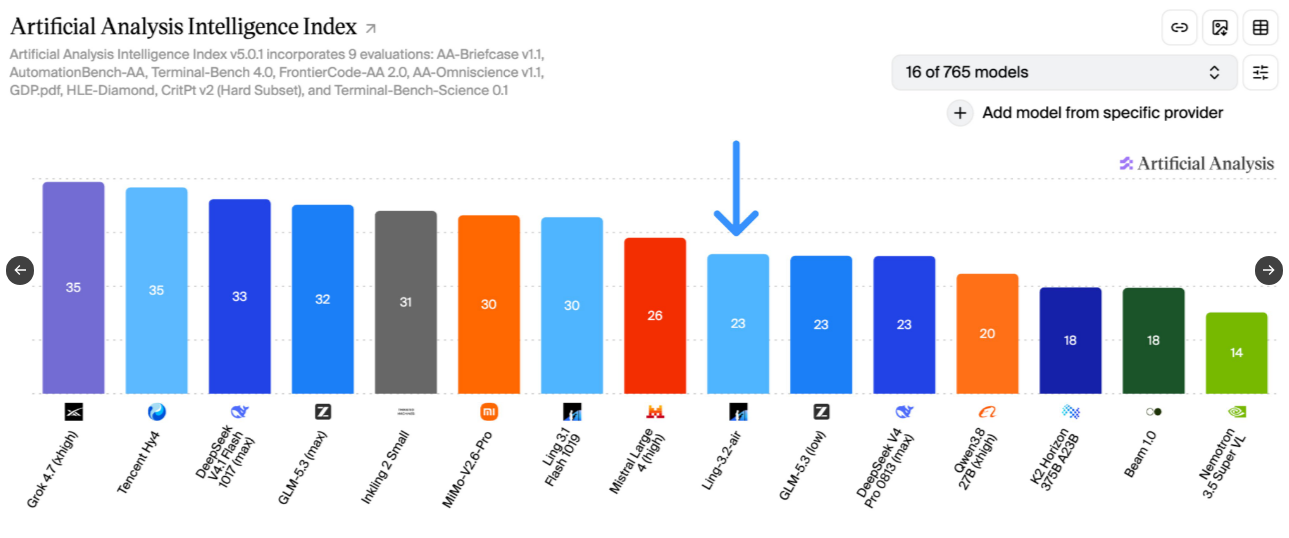
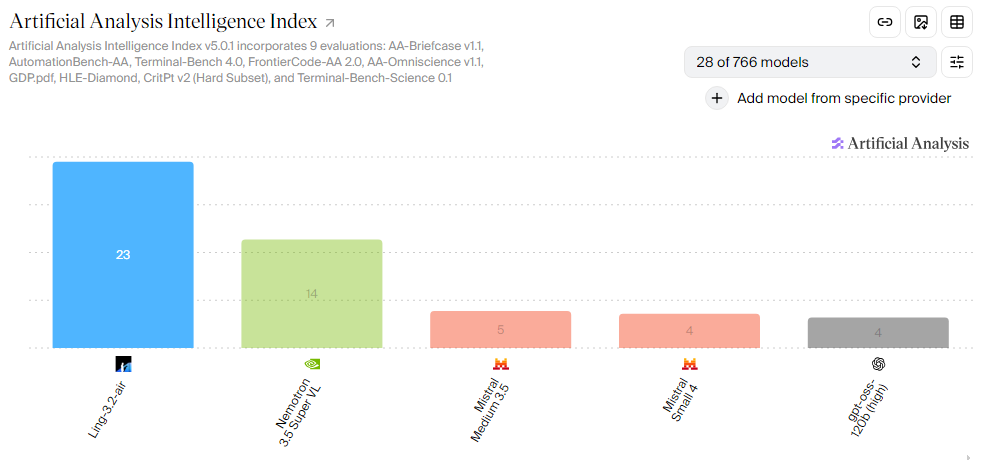
A four-GPU server is a real commitment, so it is fair to ask what the hardware buys before working through the memory math. The launch-day benchmark table answers that. Ling-3.2-air wins the agentic cluster against a field that includes closed Mini-class frontier models: Terminal-Bench 4.0 at 27.00, AutomationBench-AA at 61.00, TAU3-Banking at 50.51, SkillsBench at 67.82, and BrowseComp at 85.47 all lead the comparison set, and OmniDocBench 1.5 at 92.30 tops it on document intelligence. The Artificial Analysis Intelligence Index scores it 23, first in the medium open-weights class and well clear of Nemotron 3.5 Super VL at 14 and the Mistral Medium and Small models at 5 and 4.
That is the return on the hardware: an open-weights model you own outright that beats rented closed models at terminal automation, workflow automation, banking and finance agents, browse, and document reading, with no per-token cost once the node is paid for. The honest limits are the same ones the benchmarks show. Air loses the heavy software-engineering rows, scoring 58.28 on SWE-Bench Pro and 42.48 on DeepSWE, the lowest in its set, and trails on the hardest STEM reasoning with CritPt at 15.71 and GDP.pdf at 16.00. So the hardware is worth it for the agentic and document cluster specifically. If your workload is frontier code generation, the same four GPUs pointed at a different model would serve you better. Our Ling-3.2-air benchmarks guide covers the full table.
How this compares to other deployment classes
It helps to place these requirements in context, because “four GPUs” means different things depending on what you are comparing it to. Against a small open model that runs on a single consumer card, Ling-3.2-air is a large deployment, and there is no way to shrink it to consumer scale. Against the largest open MoE models shipping today, it is comparatively modest. Our LingSante-3.1-flash self-hosting guide covers a 560B MoE whose reference deployment is eight H200 or four GB300 cards, roughly double air’s footprint on the H200 path.
That placement is the point of the “medium-size” framing InclusionAI uses. Ling-3.2-air is large enough to need a real server and small enough that a single 4-GPU node handles it, which is a deliberate position in the open-weights landscape. It is meant to be self-hostable by teams that operate GPU infrastructure, without requiring the cluster floor that the biggest models demand. The four-GPU requirement is the dividing line between “a team with a server can run this” and “this needs a dedicated cluster,” and Ling-3.2-air sits just on the reachable side of it.
For comparison with closed hosted models in the same family, our Ling-3.2-air vs Ling-3.2-flash guide covers why flash ships as an API rather than a download, and the hardware reason is exactly the memory math above applied to a much larger parameter count.
The MoE memory math, made concrete
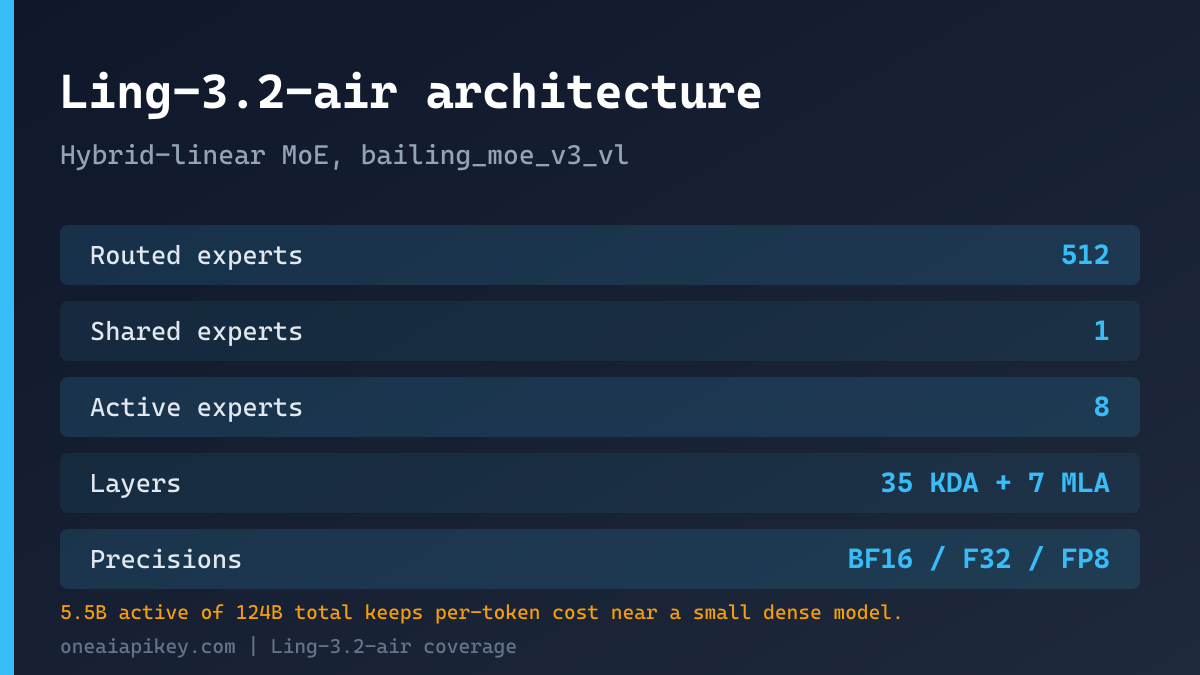
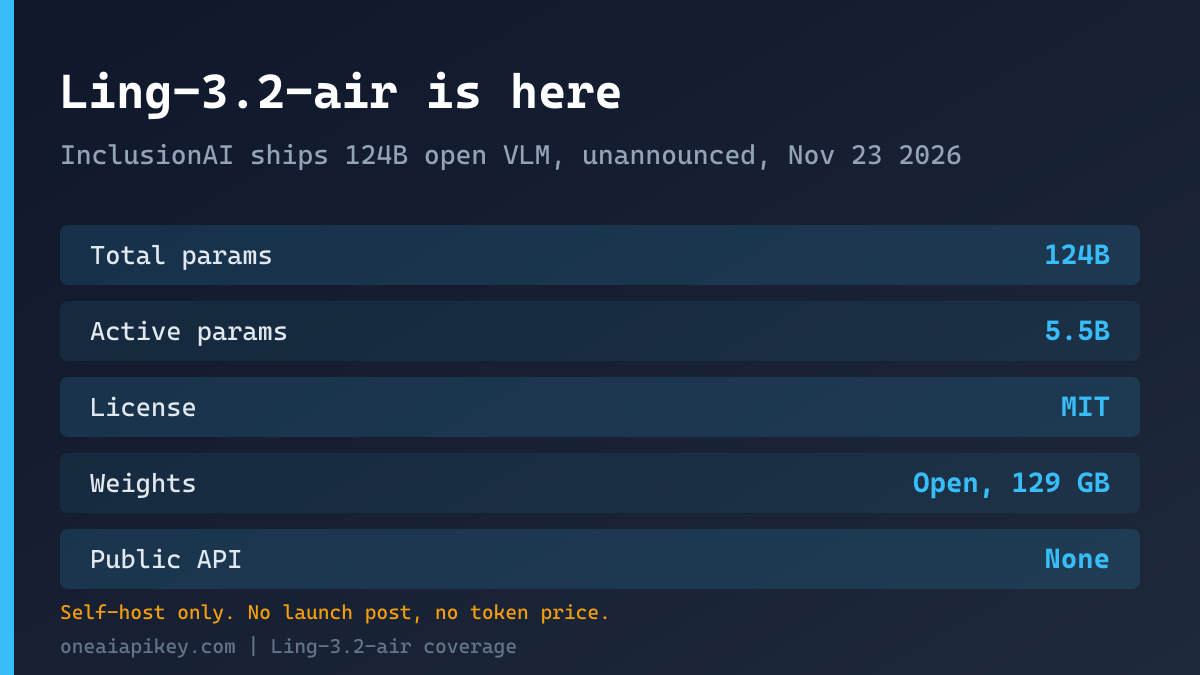
It is worth walking the architecture numbers directly, because they explain the requirement better than any summary. Ling-3.2-air is a bailing_moe_v3_vl hybrid-linear model with 124 billion total parameters and 5.5 billion active per token. The transformer stack is 35 KDA layers plus 7 Gated MLA layers at a 5:1 ratio, with 2 dense layers. The expert layer has 512 routed experts and 1 shared expert, and 8 experts activate per token. Hidden size is 2560 and expert intermediate size is 768. Our Ling-3.2-air architecture guide covers what each of these means.
The memory story is driven by the 512 routed experts. Each expert is a feed-forward block sized by the hidden dimension and the expert intermediate dimension, and there are 512 of them across the routed layers. Only 8 fire per token, but all 512 must be resident. Add the shared expert, the attention weights for the KDA and Gated MLA layers, the embeddings over a 157,184-token vocabulary, and the layer norms, and you reach the 124 billion parameters that produce a 129 GB FP8 file.
The reason this is worth spelling out is that people see 5.5 billion active and reason that the model should fit somewhere near a 5.5 billion parameter dense model. It should not, because the sparse activation saves compute, not memory. The 512 experts are individually small, but there are enough of them that the total is large. That is the entire gap between “5.5B active” and “four GPUs required,” and it is the single most important thing to internalize before you size hardware for any MoE model.
The official requirements
Here is what the model card specifies, and it is the baseline to plan against rather than a stretch goal.
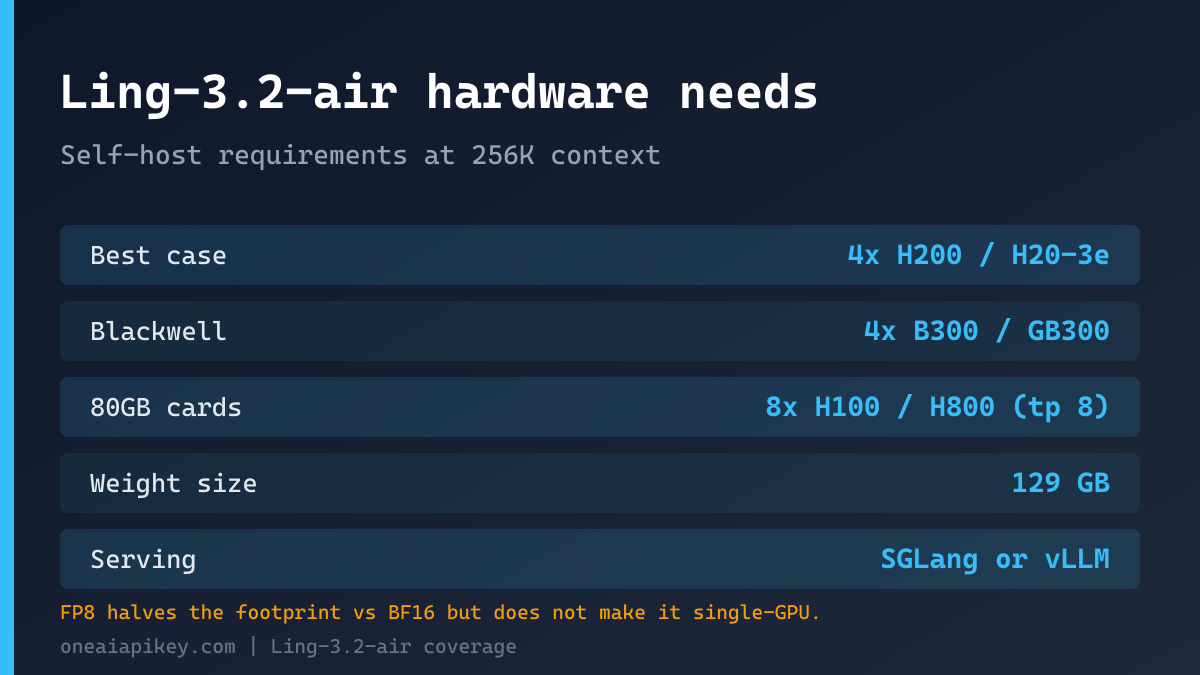
For 256K context, the documented requirement is four GPUs in the 141GB class, specifically naming the NVIDIA H20-3e or H200, or alternatively a single 4-GPU Blackwell node using B300 or GB300 parts. On 80GB cards such as the H100 or H800, the requirement rises to eight GPUs with tensor parallelism set to 8. There is no documented single-GPU configuration, and no documented configuration smaller than four GPUs, at any context length.
The weight download is 129 GB in FP8. That number is the anchor for everything that follows, so it is worth holding onto as we work through why the GPU counts are what they are.
Why a 5.5B-active model needs four GPUs
The confusion comes from mixing up two different measures of a model’s size. Active parameters are the ones that fire for a given token. Total parameters are the ones that exist in memory whether they fire or not. Ling-3.2-air is a mixture-of-experts model with 512 routed experts, of which only 8 activate per token, which is why the active count is 5.5 billion against a total of 124 billion. Our Ling-3.2-air architecture guide covers this design.
Compute follows active parameters. Memory follows total parameters. That is the sentence that resolves the confusion.
When a token arrives, the model routes it to 8 of the 512 experts, so the arithmetic per token is small and the model runs efficiently. But which 8 experts a token needs is not known until the token arrives. You cannot preload a subset, because different tokens need different experts. That means all 512 routed experts, plus the shared expert, plus the attention layers, must sit in VRAM at all times. The GPU has to be ready for any routing decision the model makes. So the memory requirement is set by the full 124 billion parameters, not the 5.5 billion that happen to activate.
That is the reason the GPU count is what it is. Four 141GB cards give you roughly 564 GB of aggregate VRAM, which comfortably holds 129 GB of FP8 weights plus the KV cache for 256K context plus activations and serving overhead. A single 141GB card holds 141 GB, which cannot hold 129 GB of weights plus the KV cache and overhead a 256K deployment needs. The math rules it out before performance even enters the conversation.
The active-versus-total split is also what makes this model worth running at all despite the memory cost. The efficiency trick is real: per-token compute stays close to a small dense model, so throughput per GPU is better than a dense 124B model would give you. You pay for 124 billion parameters worth of memory and get 5.5 billion worth of compute. That is the MoE bargain, and it is a good one when you have the memory to pay it. The hardware requirement is the price of admission, not a design flaw.
The 129 GB weight file and what it implies
The published download is 129 GB, and it ships in FP8 precision. That is already a compressed format. The model card lists BF16, F32, and FP8 as supported precisions, and FP8 is roughly half the per-parameter footprint of BF16. If the same 124 billion parameters were stored in BF16, the weight file would be in the neighborhood of twice as large.
Two things follow from that. First, the 129 GB figure is the practical floor for this model, not a padded number. It is already the smaller option. Second, and this is the misconception worth killing, FP8 does not make Ling-3.2-air a single-GPU model. Halving a footprint that starts near 258 GB in BF16 gets you to about 129 GB, which is still larger than the memory of any single GPU you can buy, and that is before you add the KV cache for a 256K context window, activations, and the overhead of serving concurrent requests. FP8 is what makes a four-GPU deployment work instead of an eight-GPU one. It does not make a one-GPU deployment possible.
The KV cache and the 256K context bill
Weights are the fixed part of the memory bill. The KV cache is the part that grows with usage, and at 256K context it is not a rounding error.
A model serving a long context has to keep key and value tensors for every token in the context window, for every attention head, for every layer, for every active request. That memory scales with context length and with how many requests you serve at once. At 256K tokens the KV cache for even a single sequence is large enough that the deployment has to budget for it explicitly, and at concurrent load it can rival the weights themselves. This is why the four-GPU requirement is stated at 256K specifically. The weights alone might squeeze onto fewer cards in theory; the weights plus a 256K KV cache do not.
This is also the lever you control. If your workload does not need the full 256K window, a shorter context length lowers the KV cache requirement and can reduce the memory pressure, though the weights still set a hard floor that no context reduction crosses. Our Ling-3.2-air context window guide covers the 256K window and the conflicting 1M figure some listings show.
Why the 80GB path needs eight GPUs
The requirement on 80GB cards is eight GPUs rather than four, and the reason is the same memory math applied to smaller cards. Eight 80GB cards give you 640 GB of aggregate VRAM, which clears the same bar that four 141GB cards clear at roughly 564 GB. The weights and a 256K KV cache fit either way. On four 80GB cards you would have 320 GB, which is tight against 129 GB of weights plus a full 256K KV cache plus serving overhead, and the model card does not document that as a supported configuration. Hence eight.
This is worth internalizing if you are shopping hardware. The requirement is about aggregate VRAM, and you can reach it with different cards in different counts. What you cannot do is reach it with one card, whatever the card is. The 129 GB weight floor plus the KV cache sees to that.
The card generation also matters beyond raw memory. The model card names Blackwell parts, the B300 and GB300, as an alternative 4-GPU path, and those generations carry higher memory bandwidth and better support for FP8 arithmetic than the Hopper generation does. The SGLang dev image for this model ships Hopper decode optimizations specifically, which tells you where the serving performance work has been focused. Choosing between the H200 path and the Blackwell path is a choice between proven compatibility and newer silicon, and the right answer depends on what your team already operates. Our Ling-3.2-air self-hosting guide covers the runtime side of that decision.
The card classes, named
The model card is specific about which GPUs it means, and it is worth understanding the classes rather than just the counts.
The 141GB class covers the NVIDIA H20-3e and H200. These are Hopper-generation datacenter parts with large HBM capacity, and the H200 in particular is a common reference card for large-model serving because its memory headroom fits big MoE weight sets. Four of them give you enough aggregate VRAM for the weights and a 256K KV cache with room for serving overhead.
The Blackwell alternative is a 4-GPU node using B300 or GB300 parts. Blackwell is the newer generation, and the relevant advantage here is higher memory bandwidth and native FP8 acceleration, both of which matter for MoE serving throughput. The model card treats this as an equal-or-better path to the H200 one.
On the 80GB side, the named parts are the H100 and H800, the Hopper cards that defined the previous generation of large-model infrastructure and are still widely deployed. Eight of them reach the aggregate VRAM the four larger cards reach, which is why the requirement doubles. If you are already running H100 or H800 nodes, the eight-GPU path is the one that applies to you, and it is a real configuration rather than a fallback.
Sizing a deployment in practice
Putting the pieces together, the practical planning numbers are these. The weights need 129 GB of VRAM as a hard floor in FP8. The 256K context adds a KV cache that scales with concurrent requests. The official minimum for the full 256K configuration is four 141GB-class GPUs or a 4-GPU Blackwell node, and eight 80GB GPUs on the Hopper path. Anything below that is not a documented configuration, and treating a smaller setup as viable is where self-hosting projects get into trouble.
The serving side matters as much as the cards. The model card recommends SGLang, and the dev image ships with the speculative decoding and memory optimizations this class of model needs to use that VRAM well. Hardware without the runtime to drive it is only half a deployment, and our Ling-3.2-air self-hosting guide covers that stack.
What this hardware is not for
It is worth being direct about the conclusion this points to. Ling-3.2-air is not a model for a workstation, a single high-end desktop GPU, a laptop, or any consumer setup. The 129 GB weight floor rules that out on its own, and the 256K KV cache requirement removes any ambiguity. If you cannot fund a four-GPU server node, this is not a model you can self-host, and that is a deliberate property of the design rather than an accident. InclusionAI built it as a datacenter model.
If your need is on-device or single-GPU multimodal inference, the honest answer is that Ling-3.2-air is the wrong size class, and a model built for that target is the right one to look at. Our Ling-3.2-air vs MiniCPM-V 4.7 guide covers exactly that split, datacenter versus pocket, and explains why the two are not really competitors.
Before you order hardware, price the alternative. The benchmark case for self-hosting is real, but so is the capital cost of four 141GB-class cards. Run your expected token volumes through the cost calculator to find the break-even point against a hosted API, and sign up for a key to see what hosted options in the model catalogue cost while your hardware quote is still on paper.
The precision choice affects the bill
One variable you control that changes the memory math is weight precision. Ling-3.2-air supports BF16, F32, and FP8, and the published 129 GB figure is the FP8 distribution. That is already the compressed option, and it is what the serving recipe assumes.
Running at BF16 instead would roughly double the weight footprint, pushing the parameters alone well past what four 141GB cards hold comfortably once you add a KV cache for 256K context. FP32 would be worse still. In practice FP8 is the practical choice for this model at this context length, and the serving recipe reflects that. It is worth knowing the other precisions exist for cases where you might want higher fidelity for fine-tuning, but for inference at 256K, FP8 is what makes the documented four-GPU configuration work.
This is also why the FP8 misconception keeps coming up. People hear that FP8 halves the footprint and conclude it turns a four-GPU model into a single-GPU model. It does not. It turns a model that would need eight GPUs into one that needs four. The floor is still multi-GPU, and understanding that distinction is the difference between sizing a deployment correctly and sizing one that fails on first load.
What is not documented
Honesty requires naming the gaps. The model card gives GPU counts and classes but not measured throughput, tokens per second, power draw, or cost per hour for any of these configurations. There is no published performance benchmark for the hardware, because Ling-3.2-air has no hosted API against which speed and cost are normally measured. Artificial Analysis lists speed, latency, price, and cost per task all as not available for that reason. We have not run this deployment ourselves, so the numbers here are the documented requirements, not tested results.
This section will be updated once InclusionAI publishes official deployment benchmarks or performance figures. Based on what the model card confirms today, the four-GPU 141GB-class requirement at 256K and the eight-GPU requirement on 80GB cards are the documented baseline. That is what is verified, not a prediction.
Where to go next
This post is part of a cluster on the Ling-3.2-air launch. For the software that runs on this hardware, read Ling-3.2-air self-hosting. For why the memory math works this way, read Ling-3.2-air architecture. For what the model does once deployed, read Ling-3.2-air benchmarks. For the deployment-class comparisons, see Ling-3.2-air vs Ling-3.2-flash and Ling-3.2-air vs MiniCPM-V 4.7. The Ling-3.2-air launch hub collects the series.
Sign up for a key to browse the model catalogue, or run your own volumes through the cost calculator before committing to a self-host build.
Related reading for this decision
The Inkling 2 Mini 16GB quant ladder shows the opposite end of the memory spectrum. Inkling 2 Mini local vs API economics and the cheapest hosted Inkling options help test whether owning hardware beats renting capacity.
GLM-5.4 self-hosting covers another open-weight serving path, and the November frontier-model comparison puts hardware requirements beside capability. Compare metered alternatives on the pricing page, or use the Resources hub to find more deployment guides.
More Ling-3.2-air coverage
- Ling-3.2-air launch on the unannounced release
- Ling-3.2-air benchmarks on the AA index and model card numbers
- Ling-3.2-air architecture on the hybrid-linear MoE and 512 experts
- Ling-3.2-air vs Ling-3.2-flash on open weights versus paid API
- Ling-3.2-air vs MiniCPM-V 4.7 on datacenter versus pocket deployment
- Ling-3.2-air self-hosting on SGLang and the serving recipe
- Ling-3.2-air vision on image and video input
- Ling-3.2-air context window on 256K and the 1M discrepancy
- Ling-3.2-air vs Ling-3.1-flash on the related-model comparison