Most self-hosting posts about a new model launch have to open with an apology. The weights are not out, the license is unclear, and the best anyone can offer is a hypothetical. This post does not have that problem. Ling-3.2-air is genuinely self-hostable today. InclusionAI published 129 GB of weights on Hugging Face under the MIT license, the license allows commercial use, there is no API gating access, and the model card ships a real serving recipe built on SGLang. If you have the hardware, you can download this model and run it, and this post walks through what that actually involves.
We will cover what the weights are and where they live, the recommended serving runtimes, the sampling settings InclusionAI specifies, the full SGLang command from the model card, how the reasoning and tool-call parsers resolve, and the one context-window discrepancy you should know about before you size a deployment. It also covers the question that should come before all of it: whether the benchmark results justify the deployment at all. For the hardware behind the recipe, our Ling-3.2-air hardware guide has the GPU counts.
Why you would self-host this model at all
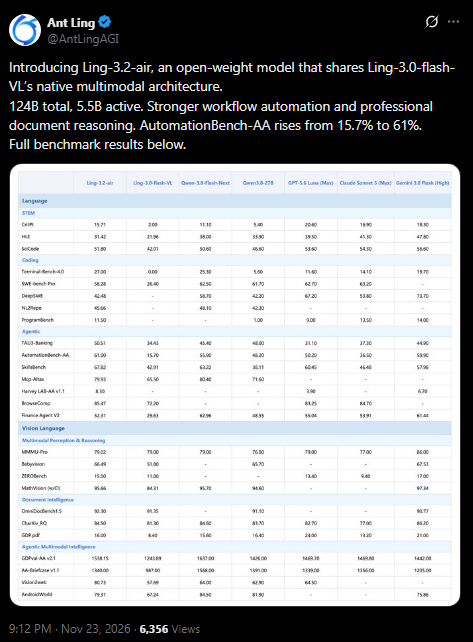
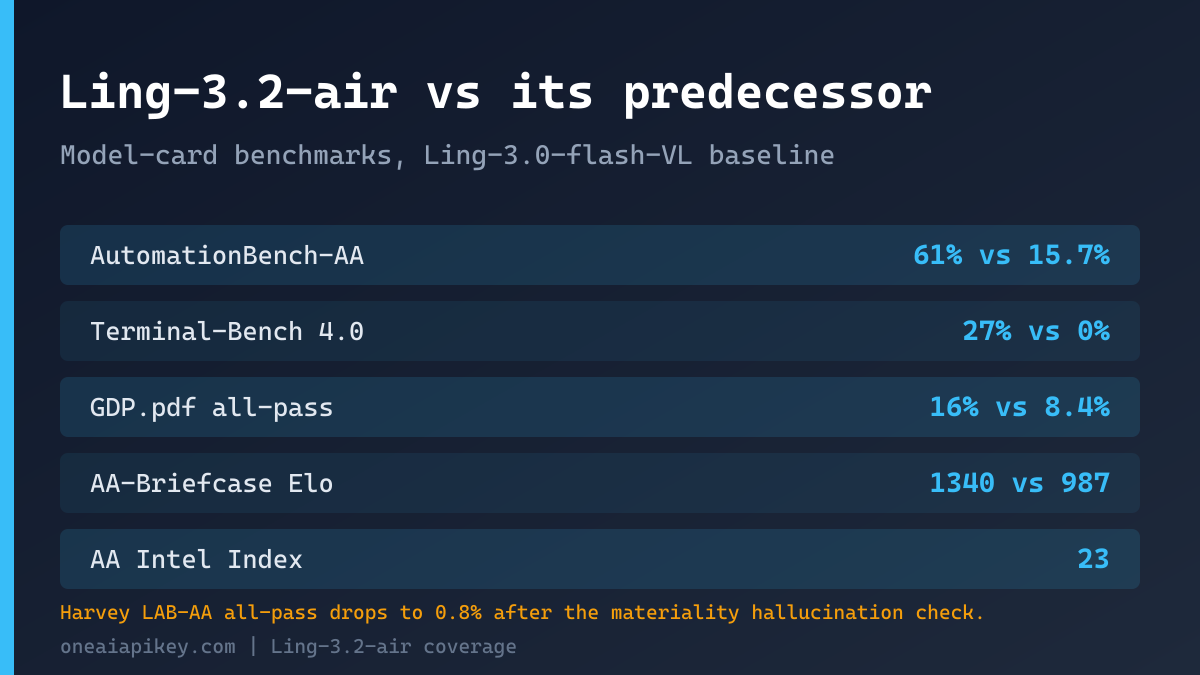
Before the recipe, the reason. Self-hosting a 124B model is a real project, so the benchmark results need to justify it, and on launch day they do. The official table compares Ling-3.2-air against its own predecessor, Qwen-3.5-Flash, DeepSeek-V3.2, and the Mini-class closed frontier models GPT-5.5-Low, Claude-Sonnet-5, and Gemini-3.5-Flash. Air wins the agentic cluster outright. Terminal-Bench 4.0 goes to air at 27.00, ahead of Qwen at 25.30, with every closed Mini model in the teens or below. AutomationBench-AA goes to air at 61.00 over Qwen at 55.90, up from 15.70 on the predecessor. TAU3-Banking at 50.51, SkillsBench at 67.82, and BrowseComp at 85.47 all lead the set. On document intelligence, the workload that most often justifies a self-hosted VLM, air scores 92.30 on OmniDocBench 1.5, ahead of Claude and Gemini at 90.77.
That is the case for self-hosting: an open-weights model that beats rented closed models at the agentic workflow and document automation cluster, deployable behind your own firewall with no per-token cost. The honest counterweight is that air loses the heavy software-engineering rows. SWE-Bench Pro at 58.28 and DeepSWE at 42.48 are the lowest in its comparison set, behind Gemini at 73.70 and GPT-5.5 at 67.20, and on the hardest STEM reasoning CritPt at 15.71 and GDP.pdf at 16.00 trail the bigger Mini models. So the self-host case is specifically the agentic and document cluster, not code-generation at the frontier. If your workload is agentic automation, banking agents, browse, and document reading, the benchmark math favors owning it. Our Ling-3.2-air benchmarks guide walks the full table row by row.
Why this recipe is unusually complete
It is worth appreciating how much of the usual self-hosting guesswork is absent here. For most new models, especially unannounced drops, the community spends the first days reverse-engineering the serving configuration: which tensor-parallel size works, what sampling settings the model was trained with, which parser handles the reasoning trace, and whether speculative decoding is supported. That work is error-prone and it delays real deployments by days or weeks.
Ling-3.2-air skips most of that because the model card answers the questions directly. The tensor-parallel size is documented for the reference hardware. The sampling settings are published, including the less-obvious ones like temperature 1.0 that people would otherwise second-guess. The parsers resolve automatically. Speculative decoding is built into the image. The context length for the reference configuration is stated. That is a complete deployment recipe, published on day one, for a model nobody announced.
The comparison with GLM-5.4 from the same week makes this concrete. GLM-5.4 shipped behind a plan wall with no weights, so its self-hosting guide is a forward-looking hypothetical. Ling-3.2-air shipped weights and a recipe, so this guide can be concrete all the way through. The difference is not effort on our part. It is whether the maker published the pieces a self-host deployment needs. InclusionAI did, and that is why this post can tell you how to run the model rather than what running it would someday require.
The architecture you are serving
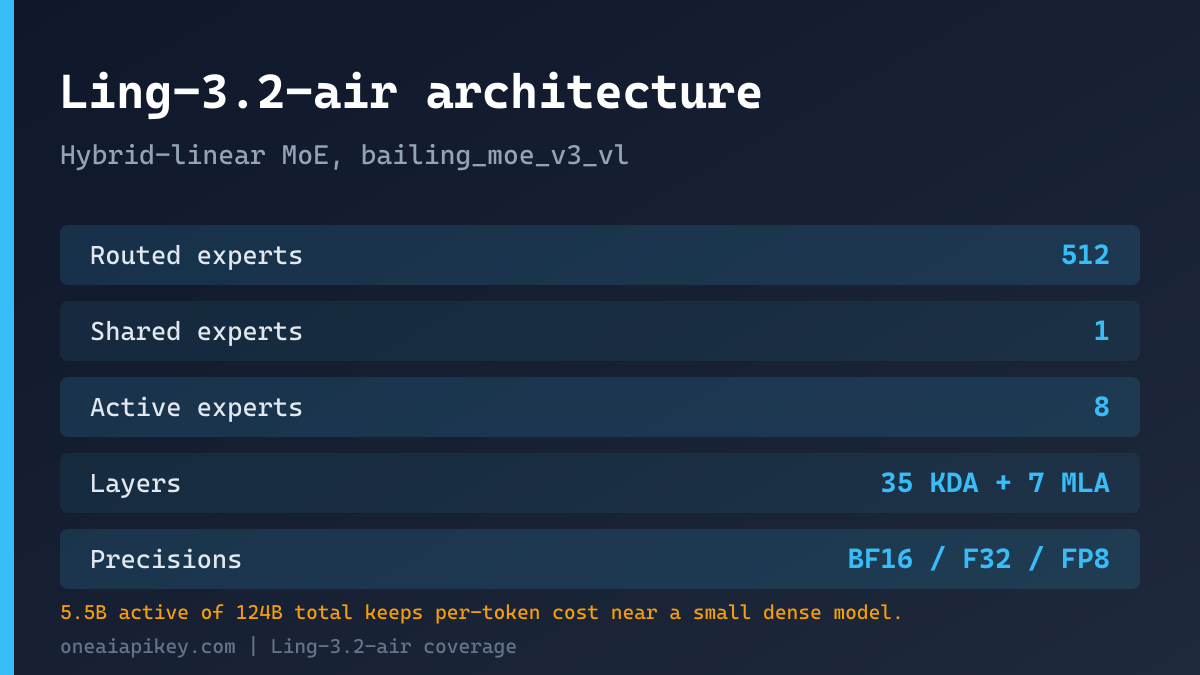
Understanding what the SGLang image is doing under the hood helps you configure it well. Ling-3.2-air is a hybrid-linear mixture-of-experts model built on the bailing_moe_v3_vl architecture, and that architecture is why the runtime matters as much as the hardware. It has 512 routed experts with only 8 activating per token, plus 1 shared expert, which gives it 5.5 billion active parameters against a 124 billion total. The transformer stack mixes 35 KDA layers with 7 Gated MLA layers in a 5:1 ratio, alongside 2 dense layers. Our Ling-3.2-air architecture guide covers this in detail.
The reason this matters for serving is that a mixture-of-experts model has a routing step the runtime has to handle efficiently. Every token gets dispatched to a subset of experts, and the runtime has to do that dispatch fast enough that the expert-parallel compute is worth it. SGLang’s dedicated image for this family has those routing kernels tuned already. That is part of why InclusionAI recommends it over a generic setup: the model-specific integration is done, and you are not debugging expert dispatch on day one.
The hybrid-linear layer structure also interacts with the long context. KDA and Gated MLA are attention variants designed to keep memory and compute manageable at long sequence lengths, which is what lets this model offer 256K context without the KV cache growing completely out of control. The layers do their part; you still have to provision the memory to hold the result.
The weights are real, and that changes everything
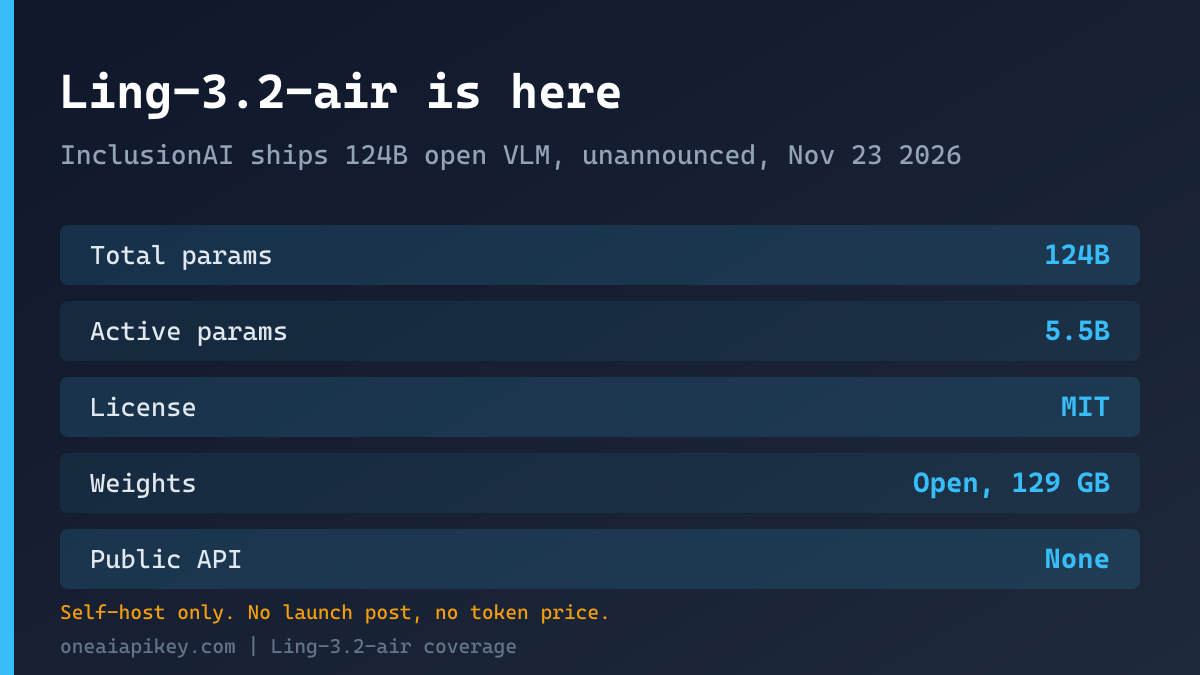
Start with the facts that make this a real deployment rather than a thought experiment. Ling-3.2-air’s weights are published on Hugging Face at inclusionAI/Ling-3.2-air. The total download is 129 GB in FP8, distributed as safetensors files. The license is MIT, which is the most permissive license in common use and explicitly allows commercial use, modification, and redistribution. The model card tags it with safetensors, the bailing_moe_v3_vl architecture, custom code, and FP8 precision.
This is the opposite of the situation with GLM-5.4, which shipped the same week with no published weights at all. Our GLM-5.4 self-hosting guide opens by saying you cannot host it. This guide opens by saying you can. That difference is the reason Ling-3.2-air exists as a self-host story: InclusionAI built it as a medium-size open-weights model specifically so people could run it themselves. There is no public API competing with your download, because there is no public API at all.
The serving stack: SGLang preferred, vLLM supported
The model card names two runtimes and ranks them. SGLang is the recommended and preferred path. vLLM is also supported. Both are established runtimes for large mixture-of-experts models, and both are covered in our LingSante-3.1-flash self-hosting guide, because that 560B deployment leans on them too.
The reason SGLang gets the recommendation here is concrete. The official SGLang image for this model family, lmsysorg/sglang:dev-Ling-3.0-flash-VL, ships with the model-specific pieces already integrated: MTP speculative decoding using the NEXTN algorithm, and Hopper-generation decode optimizations. That means you are not wiring up custom kernels yourself. You pull an image that already understands this architecture and start the server. That is a meaningful reduction in the work between “I have the weights” and “I have a working endpoint.”
vLLM remains a valid option if it is already your standard runtime, but the model card’s integration and the ready-made image are on the SGLang side. If you have no existing preference, use SGLang. If you do have a vLLM deployment already running, check its current support for the bailing_moe_v3_vl architecture before committing.
Sampling settings from the model card
InclusionAI specifies exact sampling parameters, and they are worth copying rather than improvising. The recommended settings are a temperature of 1.0, a top_p of 0.95, a top_k of 20, and enable_thinking set to true.
Two of those deserve a note. Temperature 1.0 is on the high side compared with the values people often reach for by habit, and it is paired with a tight top_k of 20 and a top_p of 0.95, which together keep the distribution controlled. This is a deliberate configuration, not a default someone forgot to change. The enable_thinking flag is the other important one: it turns on the model’s reasoning trace, which is central to how Ling-3.2-air approaches agentic and automation tasks. Our Ling-3.2-air benchmarks guide covers why that reasoning behavior shows up in the model’s automation scores.
The SGLang command from the model card
Here is the serving command as the model card documents it. This is reproduced from InclusionAI’s own recipe, and it is the closest thing to a copy-paste deployment path that exists for this model. It uses the SGLang dev image, tensor parallelism across four GPUs, the documented 256K context length, NEXTN speculative decoding, and automatic parser resolution.
# From the Ling-3.2-air model card - SGLang serving recipe
docker run --gpus all lmsysorg/sglang:dev-Ling-3.0-flash-VL python -m sglang.launch_server   --model-path inclusionAI/Ling-3.2-air   --tp 4   --context-length 262144   --speculative-algorithm NEXTN   --reasoning-parser auto   --tool-call-parser auto   --sampling-params '{"temperature": 1.0, "top_p": 0.95, "top_k": 20}'   --enable-thinking
Treat the exact flag formatting as illustrative of the recipe rather than a literal transcript, because the model card presents these as parameters to set rather than one canonical shell string. The substantive content is what matters and it is all from the card: the image is lmsysorg/sglang:dev-Ling-3.0-flash-VL, tensor parallelism is 4, context length is 262144, the speculative algorithm is NEXTN, both parsers are set to auto, and the sampling block carries temperature 1.0, top_p 0.95, and top_k 20 with thinking enabled. The --tp 4 value assumes you are on four 141GB-class GPUs; on 80GB cards you would raise it to 8, as our Ling-3.2-air hardware guide explains.
The multimodal serving path
A point that is easy to miss when you are focused on the serving command: Ling-3.2-air is a vision-language model, and serving it means accepting image and video input, not just text. The model accepts text, image, and video through image_url and video_url input types, and the SGLang dev image handles that multimodal input path as part of the bailing_moe_v3_vl integration.
This has practical consequences for your deployment. The preprocessing for image and video inputs happens in the runtime, which means the server does more work per request than a text-only model would. Requests that carry images or video are heavier on preprocessing and on the attention layers that process visual tokens. If your workload is video-heavy, plan for that in your throughput expectations, because a video request is not equivalent to a short text prompt in resource cost. Our Ling-3.2-air vision guide covers what the multimodal input enables in application terms.
It also means the parser story matters more than it would for a text model. Multimodal requests often combine visual input with structured output, like a request that reads a screenshot and returns a structured tool call. That is exactly the case the auto-resolving ling3 parsers are there for, and it is a good example of why having the model-specific integration prebuilt saves real debugging time.
Parsers resolve automatically to ling3
One detail that saves real time. The reasoning parser and the tool-call parser both support auto resolution, and in this SGLang image they resolve to ling3. You do not need to name the parser explicitly or write custom parsing logic for Ling-3.2-air’s structured output. Setting the flag to auto is enough, and the runtime picks the correct ling3 integration.
This matters because structured output is where model-specific serving usually gets painful. A model that emits reasoning traces and tool calls in its own format needs a parser that understands that format, or your agent loop breaks on the first tool call. The fact that this image resolves both automatically to a model-specific parser is the difference between a deployment that works and one you spend a day debugging. Our Ling-3.2-air vision guide covers the multimodal input side, which relies on the same runtime plumbing.
The context-length discrepancy to know about
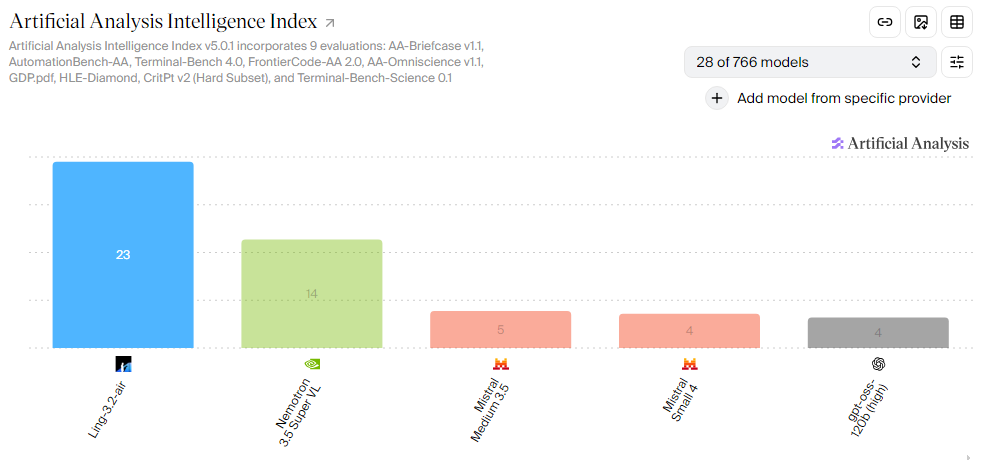
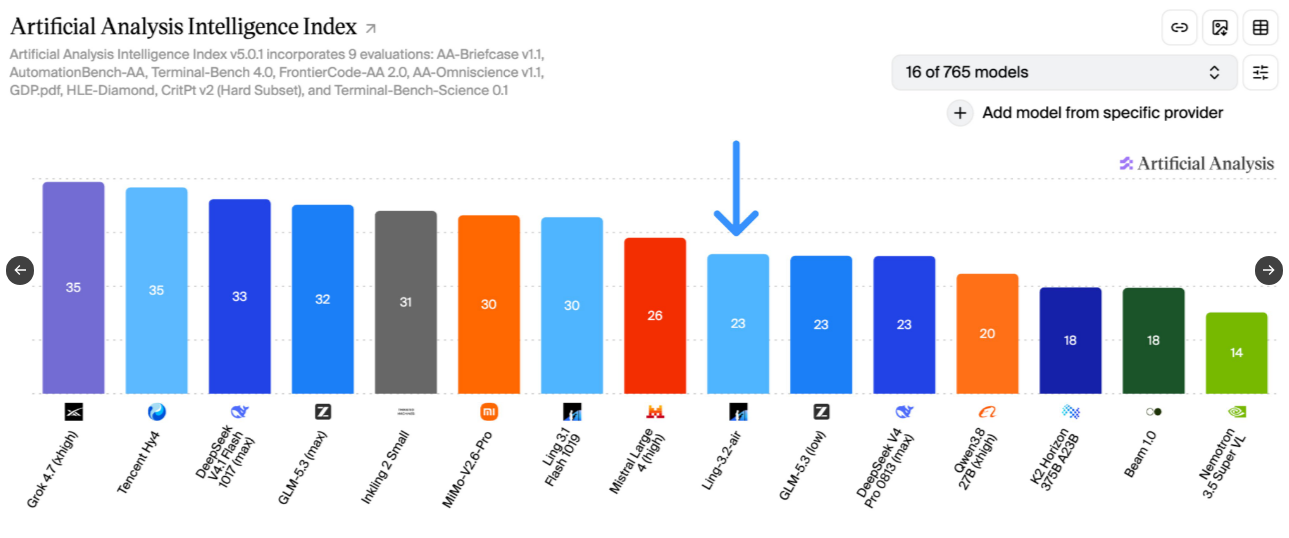
Before you size a deployment, know that Ling-3.2-air’s context window has a documented conflict. The Hugging Face card and the official SGLang recipe both say 256K, and the serving command above sets --context-length 262144, which is 256K. But Artificial Analysis lists the model at 1M tokens.
The number to plan around is 256K. That is the documented native configuration and it is what the official serving recipe actually uses, so it is the figure InclusionAI is standing behind for deployment. The 1M figure on Artificial Analysis may reflect a maximum the architecture can reach with more memory, but InclusionAI has not confirmed a 1M serving configuration for air, and the recipe does not use one. Until there is an official statement, treat 256K as your deployment target and the 1M figure as an unconfirmed higher bound. Our Ling-3.2-air context window guide covers this discrepancy in detail.
What a deployment actually costs you
The weights are free. The deployment is not. Ling-3.2-air’s real cost is the hardware it runs on and the operational work of keeping it up. The 129 GB weight file alone rules out any single-GPU setup, and the 256K context adds a KV cache requirement on top. The official minimum for 256K context is four 141GB-class GPUs, which is a serious node. Our Ling-3.2-air hardware guide walks the configurations and the memory math behind them.
Whether that is worth it depends on your workload shape, and that question is bigger than this model. Our hosted API pricing page covers how to think about owning inference versus renting it, and the cost calculator lets you model your own volumes. The short version is that self-hosting wins on steady high volume and hard data-residency requirements, and loses on bursty or low-volume use where idle GPUs cost more than tokens would.
Operational realities the model card does not cover
The SGLang recipe gets you a running server. Running a server in production involves a set of concerns the model card does not address, and it is worth being honest that these are general large-model operational practices rather than Ling-3.2-air-specific guidance.
Memory management under concurrent load is the first one. The 256K context KV cache is sized for peak concurrent sequences, not for one request at a time. A deployment that assumes single-request memory and then gets hit with ten simultaneous long-context requests will run out of VRAM, and the failure mode is not graceful. Production deployments use memory tiering and continuous batching to manage this, and both are areas where the SGLang runtime does work for you if you configure it.
Monitoring is the second. A distributed four-GPU or eight-GPU runtime is a complex system, and the failures it produces are the distributed-system kind: a GPU that falls behind, a request that hangs in routing, memory fragmentation that degrades throughput over hours. None of that is visible without instrumentation. Teams that already operate GPU clusters have this tooling. Teams that do not are underestimating the operational project if they are budgeting only for hardware and weights.
The third is model updates. Ling-3.2-air shipped unannounced, with no launch post and no published roadmap. That means you should not assume the weights you download today are the last version. A self-hosted deployment needs a plan for re-pulling weights and validating that a new version does not regress your workload. With a hosted API that burden sits with the operator. Self-hosted, it sits with you.
None of these are reasons to avoid self-hosting. They are reasons to go in with accurate expectations. The model card gives you a working recipe, and the operational layer around it is a real engineering effort that serious deployments budget for explicitly.
What is not documented yet
Honesty requires naming the gaps. The model card gives a serving recipe but not a performance figure. There is no published tokens-per-second number, no throughput benchmark, and no latency figure for Ling-3.2-air, because those are normally measured against a hosted API and this model has none. Artificial Analysis lists speed, latency, price, cost per task, and time per task all as not available for exactly that reason.
There is also no official launch post from InclusionAI explaining the release, and no deployment guide beyond the model card itself. The recipe in this post comes from the card, and the operational knowledge around it, things like memory tiering for long context and monitoring for a distributed runtime, is general large-model practice rather than Ling-3.2-air-specific guidance. We have not run this deployment ourselves, so we are passing along the recipe, not a tested result.
This section will be updated once InclusionAI publishes a launch post or official deployment benchmarks. Based on what the model card confirms today, the SGLang recipe above is the documented path and the 256K context length is the documented native configuration. That is what is verified, not a prediction.
A pre-flight checklist
Because the recipe is real, a short checklist is genuinely useful here rather than padding. Before you commit hardware to a Ling-3.2-air deployment, confirm these.
First, GPU count and memory. You need four 141GB-class cards for the documented 256K configuration, or eight 80GB cards. Verify your actual cards against the model card’s named parts, because a card that is nearly but not quite in the right memory class is the kind of mismatch that only shows up under load. Our Ling-3.2-air hardware guide has the full breakdown.
Second, disk space for the weights. The download is 129 GB, and you want headroom above that for the download process itself and for any local caching. Pulling 129 GB over a slow connection is not a five-minute task, so plan the transfer.
Third, the runtime image. Confirm you are pulling lmsysorg/sglang:dev-Ling-3.0-flash-VL, because that is the image with the NEXTN speculative decoding and the auto-resolving parsers built in. A generic SGLang image will not have the model-specific integration, and you would be rebuilding what the dev image already ships.
Fourth, context length. The documented native configuration is 256K, set as --context-length 262144. If you do not need the full window, a shorter value reduces memory pressure, but the 256K figure is what the recipe and the hardware requirement are sized for. Note the separate 1M listing and treat it as unconfirmed for deployment.
Work through those four and you have covered the decisions the model card actually constrains. Everything beyond them is general operational practice for a distributed inference server.
Where to go next
This post is part of a cluster on the Ling-3.2-air launch. For the hardware behind the recipe, read Ling-3.2-air hardware. For what the model does once it is running, read Ling-3.2-air benchmarks and Ling-3.2-air architecture. For the family comparisons, see Ling-3.2-air vs Ling-3.2-flash and Ling-3.2-air vs MiniCPM-V 4.7. The Ling-3.2-air launch hub collects the whole series.
Sign up for a key to browse the model catalogue, or run your own volumes through the cost calculator before committing to a self-host build.
Related reading for this decision
The GPT-6.2 API quickstart and the Gemini 4 Neon API quickstart show the hosted path when operating a GPU node is not the goal. Inkling 2 Mini local vs API economics works through the same ownership-versus-rental decision at a smaller scale.
The November frontier-model comparison helps choose a model before choosing a server. The quickstart documentation covers the gateway’s OpenAI-compatible request format.
More Ling-3.2-air coverage
- Ling-3.2-air launch on the unannounced release
- Ling-3.2-air benchmarks on the AA index and model card numbers
- Ling-3.2-air architecture on the hybrid-linear MoE design
- Ling-3.2-air vs Ling-3.2-flash on open weights versus paid API
- Ling-3.2-air vs MiniCPM-V 4.7 on datacenter versus pocket deployment
- Ling-3.2-air hardware on GPU counts and memory math
- Ling-3.2-air vision on image and video input
- Ling-3.2-air context window on 256K and the 1M discrepancy
- Ling-3.2-air vs Ling-3.1-flash on the related-model comparison