Ling-3.2-air is built on an architecture called bailing_moe_v3_vl, and that name packs in most of what makes the model interesting. It is a hybrid-linear mixture-of-experts design with 124 billion total parameters, of which only 5.5 billion are active when the model processes any single token. It combines two different attention mechanisms across 42 layers, routes each token through a small slice of a large pool of experts, and is multimodal in its native design rather than through an add-on. Understanding how those pieces fit together explains both why the model is cheap to run per token and why it still needs serious hardware to host.
This post works through the architecture layer by layer, then explains in plain terms why the total-versus-active split matters, and finishes by flagging a discrepancy in the published parameter count that you will run into if you read about the model elsewhere.
This is the third post in a series on Ling-3.2-air. If you want the release story first, Ling-3.2-air launch covers the unannounced shipping, the MIT license and the self-host-only model. If you want what the design delivers rather than how it is built, Ling-3.2-air benchmarks covers the index score and the model-card jumps.
The headline numbers
Here are the published architecture figures, gathered in one place so you can refer back to them.
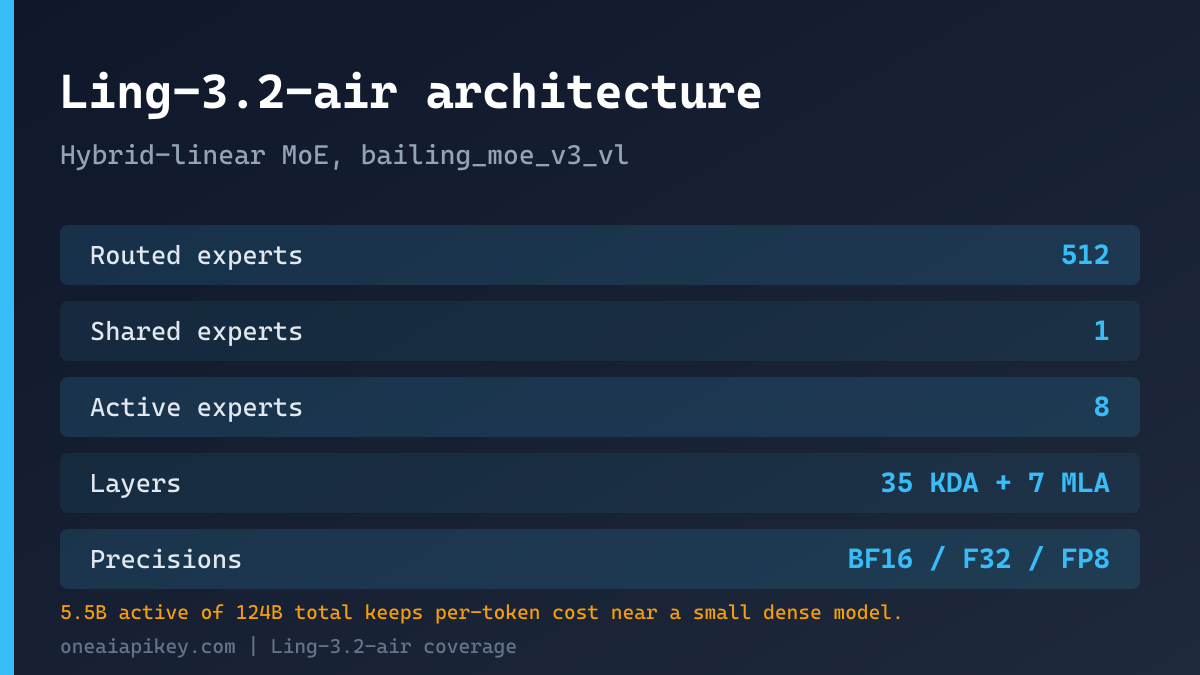
Total parameters are 124 billion. Active parameters per token are 5.5 billion. The transformer layer stack is 35 KDA layers plus 7 Gated MLA layers, a ratio of 5 to 1, alongside 2 dense layers. The expert configuration is 512 routed experts with 1 shared expert, and 8 experts activated per token. Attention uses 32 heads. Hidden size is 2560, expert intermediate size is 768, and dense intermediate size is 6144. The vocabulary is 157,184 tokens. Supported precisions are BF16, F32, and FP8 in the F8_E4M3 format.
Each of those numbers earns its place, and the rest of this post unpacks what they mean in practice.
Mixture of experts, in plain terms
A mixture-of-experts model replaces the single monolithic block that a dense model uses to process every token with a large collection of smaller specialist blocks called experts. When a token arrives, a routing mechanism looks at it and picks a few experts to handle it, rather than passing it through every expert. Only the chosen experts do work on that token.
Ling-3.2-air has 512 routed experts and activates 8 of them per token, along with 1 shared expert that every token passes through. So out of a pool of 512 specialists, a given token uses 8 routed ones plus the shared one. That is about 1.6 percent of the routed pool doing work on any single token.
Why build a model this way? Because it decouples two things that a dense model forces to move together: how much the model knows, and how much compute each token costs. In a dense model, every parameter is used on every token, so knowledge and per-token cost scale together. In a mixture of experts, the total parameter count can grow to hold more knowledge while the per-token active count stays small, keeping the compute cost of each token near that of a much smaller model. That is the core idea, and Ling-3.2-air is a clear example of it.
Why 5.5B active of 124B is the number that matters
The 124 billion total and 5.5 billion active split is the single most consequential fact about this architecture, and it is worth understanding from two separate angles because they pull in opposite directions.
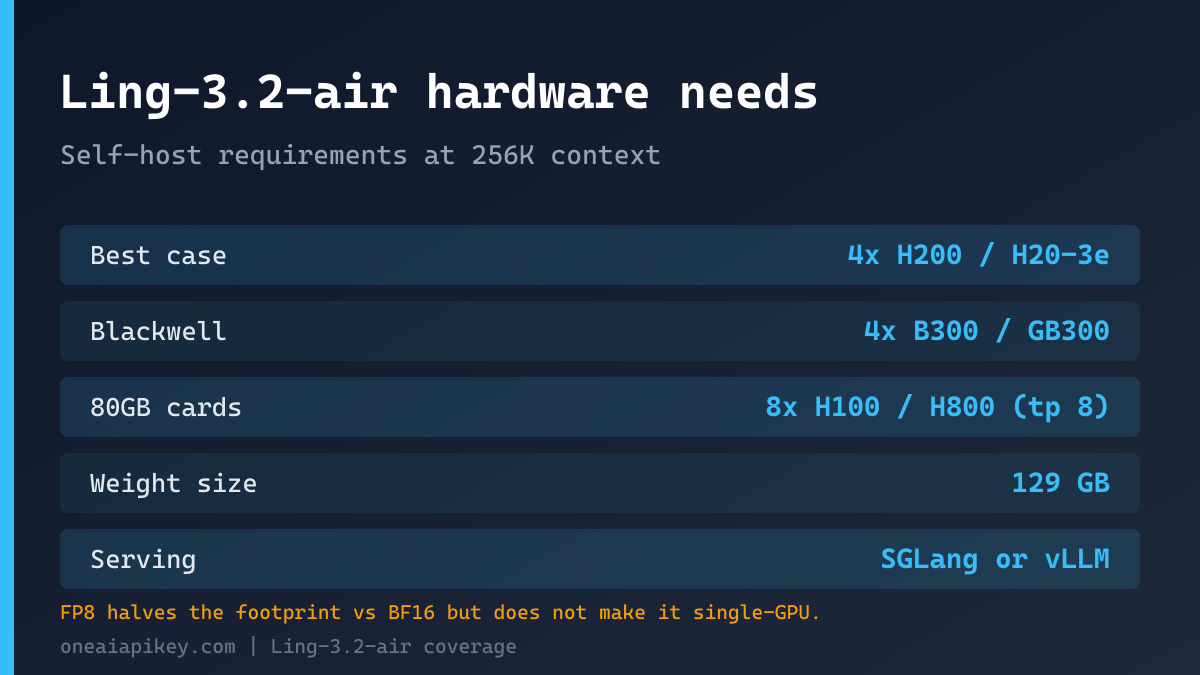
The first angle is memory. To run the model at all, you have to hold all 124 billion parameters in memory, because at any moment a token might be routed to any of the 512 experts and the hardware needs all of them available. You cannot load only the experts you expect to use, because the router decides which ones it needs per token and that changes constantly. So the memory requirement is set by the full 124 billion, and that is why the hardware recommendation for the documented 256K context configuration is four GPUs in the 141 GB class or a four-GPU Blackwell node. The whole model has to fit, and fitting 124 billion parameters plus the overhead of serving a long context takes a lot of memory. Ling-3.2-air hardware works through those requirements in detail.
The second angle is compute per token. When the model generates each token, only 5.5 billion parameters are actually doing arithmetic. That is the figure that drives how much computation each token costs and, roughly, how fast the model can generate. Five and a half billion active parameters is in the range of a small dense model, which means that on a per-token basis, Ling-3.2-air does work closer to a compact model than to a 124-billion-parameter one.
Putting those two together gives the design its character. The model carries the knowledge capacity of a very large model, because 124 billion parameters are available to be routed through. But it generates each token with the compute budget of a small one, because only 5.5 billion parameters activate. The practical consequence is that the memory bill is large and the per-token compute cost is comparatively modest. You pay for the whole model in hardware, but you do not pay for the whole model on every token.
This is also why the model has an unusual cost profile for a self-hosted deployment. The dominant cost of running it is not compute per token, it is keeping the hardware powered and occupied, because the hardware requirement is set by memory rather than by throughput. A model that needs four large GPUs to hold its weights but only activates a small slice per token is a model whose economics are dominated by the fixed cost of the hardware rather than the variable cost of generation.
The hybrid-linear layer mix: 35 KDA plus 7 Gated MLA
The transformer stack is not uniform. It mixes two attention mechanisms in a 5 to 1 ratio: 35 layers use KDA and 7 layers use Gated MLA. There are also 2 dense layers in the stack. Understanding the split requires a quick word on what each attention type optimizes for.
Standard attention in a transformer keeps a record of every previous token so the model can look back at any of them. That is what lets it reason over long passages, but it also means the memory and compute needed grow as the context grows. Long-context models spend a lot of effort managing that growth.
Gated MLA, or multi-head latent attention, is a design that compresses the attention record rather than storing it in full, which reduces the memory and bandwidth cost of attending over long sequences. It is a technique aimed squarely at making long-context inference more efficient.
KDA is the other attention mechanism in the mix, and the hybrid design alternates the two in a fixed ratio so that most layers use KDA while a smaller share use Gated MLA. The idea behind a hybrid-linear design like this is to combine the strengths of different attention approaches rather than committing to one. Some layers handle the long-range dependency tracking in one way, others in a more compressed way, and the model as a whole gets a balance of capability and efficiency that a single uniform attention type would not provide.
For a model that is documented at a 256K token context window, that efficiency focus is not academic. Serving a 256K context means the model has to attend over a very long record of previous tokens, and the choice of attention mechanisms directly affects how much memory that takes. Ling-3.2-air context window covers the context length in detail, including a discrepancy between the documented 256K figure and a larger number listed elsewhere.
The expert configuration: 512 routed, 1 shared, 8 active
The expert pool is 512 routed experts plus 1 shared expert, with 8 experts activated per token. That is a large pool relative to the number activated, which is a design choice worth pausing on.
A large pool with few experts active per token means each token takes a narrow path through the model, drawing on a small number of specialists out of many. That gives the model a lot of capacity for specialization: across 512 experts, different subsets can become tuned to different kinds of content, and the router can learn which combination fits a given token. It also reinforces the per-token efficiency story, because 8 of 512 is a small fraction.
The shared expert is a separate piece. Because every token passes through it regardless of routing, the shared expert acts as a common foundation that all tokens rely on, while the routed experts provide the token-specific specialization on top. That division, a universal base plus a selectable specialist layer, is a common pattern in modern mixture-of-experts designs and it helps stabilize training and inference.
The intermediate sizes differ between the expert and dense paths, and those numbers are consistent with their roles. Expert intermediate size is 768, which is comparatively narrow, fitting the idea that each expert is a focused specialist handling a slice of the work. Dense intermediate size is 6144, which is much wider, fitting the idea that the dense layers do broader processing that every token passes through.
Native multimodal, from the Ling-3.0-flash-VL lineage
The vl suffix on bailing_moe_v3_vl signals the vision-language lineage, and Ling-3.2-air is multimodal by native design rather than by bolting a vision encoder onto a text model after the fact. It comes from the same architectural family as Ling-3.0-flash-VL, its direct predecessor, and it inherits that model’s multimodal foundation.
In practical terms, native multimodality means the model accepts text, image and video through the same interface and processes them through the same underlying architecture. The model card exposes image and video input types directly, so passing a screenshot or a video clip is a first-class operation rather than a workaround. Output is text.
This matters for how you think about the architecture as a whole. The 5.5 billion active parameters are not just handling text; they are handling a fused representation of whatever combination of text, image and video the model receives. A multimodal mixture-of-experts model has to route and process visual content through the same expert mechanism as text, which makes the routing layer do more work than it would in a text-only model. Ling-3.2-air vision covers what the multimodal input enables in practice.
For context on how a related model in the same family handles a similar multimodal brief, Inkling 2 Mini multimodal vision covers vision input on a much smaller model, and the contrast in scale is instructive.
Precisions: BF16, F32, and FP8
The model is published in three precisions: BF16, F32, and FP8 in the F8_E4M3 format. Precision refers to how many bits are used to represent each parameter, and it trades numerical exactness against memory and speed.
F32 is full single-precision, the most numerically exact of the three, and the most expensive in memory. BF16 is bfloat16, a half-precision format that keeps the exponent range of F32 while halving the bits per parameter, and it is widely used for training and inference because it is numerically stable enough for most work while being much cheaper than F32. FP8 is eight-bit floating point, which halves the memory again relative to BF16 and is increasingly supported on modern GPU hardware for inference.
The availability of FP8 is the most operationally relevant of the three. Running a 124-billion-parameter model means every bit per parameter multiplies across all 124 billion, so moving from BF16 to FP8 can meaningfully reduce the memory the weights occupy. That does not change the fundamental hardware picture, because you still need enough memory for the whole model, but it affects how much headroom you have on a given GPU configuration. The model card tags the release with fp8, which reflects that this precision is a supported and expected way to run it.
One practical note on choosing a precision. For most inference deployments BF16 is the sensible default, because it balances numerical stability against memory and is broadly supported across the GPUs the model targets. FP8 is the option to reach for when memory pressure is the binding concern and your hardware supports it well, since it frees headroom on the same physical cards. F32 is rarely the right choice for a full inference deployment at this parameter count because it doubles the memory of BF16 without a corresponding benefit for most workloads. The right answer depends on your hardware and your tolerance for numerical drift, and it is worth testing your specific workload on the precision you intend to ship rather than assuming the default is optimal.
All of these choices, the precision you pick and the expert and attention configuration behind them, feed into the same question of where the model can actually run. It is worth setting the architecture against a model built for a completely different deployment class to see how much the design decides.
The 124B versus 128B discrepancy
If you read about Ling-3.2-air in more than one place, you will see the parameter count quoted as both 124 billion and 128 billion. That is a real discrepancy in the public sources, not a mistake on your part, and it is worth knowing which figure to trust.
The architecture table on the model card lists 124 billion total parameters. The Hugging Face sidebar, which is an automatically generated summary, lists 128 billion. These two figures appear in different parts of the same public footprint, and they do not match.
We use 124 billion throughout this series because that is the figure in the detailed architecture breakdown, which is the more specific and authoritative source for how the model is actually constructed. The sidebar figure is a rounded or differently-computed summary and should be treated as secondary. The difference is small, about 3 percent, and it does not change any of the architectural conclusions above, but if you are checking our numbers against the Hugging Face page you will notice the sidebar disagrees, and now you know why.
A similar situation exists on the context window, where the documented native configuration is 256K tokens but Artificial Analysis lists 1 million. Ling-3.2-air context window covers that conflict. When two public sources disagree on a spec for this model, the more specific technical source is generally the one to go with, and that is the approach taken across this series.
What the architecture means for deployment
Bringing it back to the practical question of running the model, the architecture determines the shape of any deployment in three ways.
First, memory is the binding constraint. The full 124 billion parameters must be resident, so the minimum viable hardware is set by fitting those weights, and the documented configuration is four 141 GB-class GPUs or an eight-GPU 80 GB setup for the 256K context. No amount of per-token efficiency changes that floor.
Second, per-token compute is comparatively light for the model’s size, because only 5.5 billion parameters activate. That means once you have the hardware, throughput is better than the raw parameter count would suggest, and the recommended serving stack is built to take advantage of that. The model card recommends SGLang, with speculative decoding through MTP and Hopper decode optimizations included in the referenced image, and those optimizations are aimed at making the most of the efficient per-token profile. Ling-3.2-air self-hosting covers the serving stack in full.
Third, the hybrid attention design is what makes the long context practical. A 256K window on a model this size is only workable because the attention mechanisms are chosen to keep the memory cost of long sequences manageable.
Where this design sits in the wider field
It is useful to place this architecture against the alternatives a team might otherwise consider. Against a dense model of the same total size, Ling-3.2-air trades a simpler design for a much better per-token cost profile, at the price of needing the full weights in memory either way. Against a smaller dense model that fits on less hardware, it trades a larger memory footprint for more knowledge capacity while keeping per-token compute in a similar range.
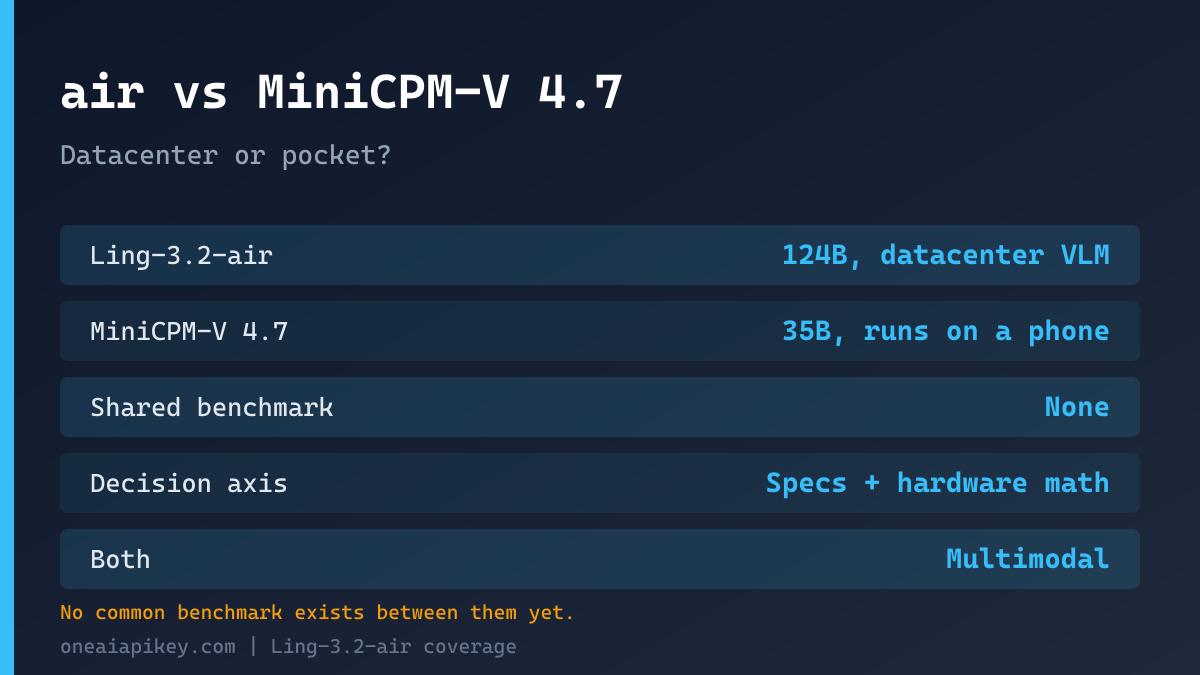
Against a closed model served through an API, the architecture is the reason self-hosting is viable at all. A model with 124 billion parameters but only 5.5 billion active is one of the few points in the design space where a team with multi-GPU hardware can host a very capable model without per-token compute costs running away. If you are weighing that against a closed sibling, Ling-3.2-air vs Ling-3.2-flash makes the trade explicit, and for a comparison against a model at the opposite end of the size spectrum, Ling-3.2-air vs MiniCPM-V 4.7 sets the 124B architecture against a 35B on-device model.
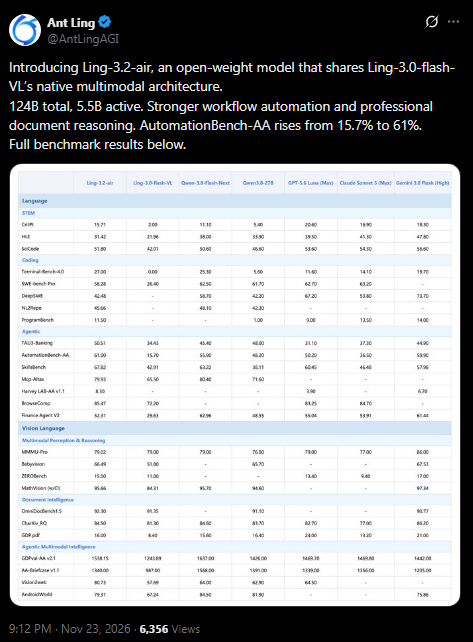
The architecture is also the reason the benchmark profile looks the way it does, and the official Ant Ling table published alongside the release makes that connection explicit rather than leaving it as a plausible guess. A model that activates a small expert subset per token and mixes attention mechanisms for long-context efficiency is built for agentic and document work over long inputs. On the official table, that is precisely where it performs best. Terminal-Bench 4.0 is 27.00, the best figure in a seven-model field that includes GPT-5.5-Low, Claude-Sonnet-5 and Gemini-3.5-Flash, against a predecessor score of 0.00. AutomationBench-AA is 61.00, also the best in the set and up from 15.70 on the predecessor. TAU3-Banking is 50.51, SkillsBench is 67.82, BrowseComp is 85.47, and OmniDocBench 1.5 is 92.30, all leading their comparison set.
The design explains the shape of those results in both directions. The same small-active-expert routing that keeps per-token compute cheap and makes long agentic sessions affordable is not the configuration you would choose to win a heavyweight software-engineering or proof-heavy maths benchmark, and the table shows it does not. SWE-Bench Pro is 58.28 and DeepSWE is 42.48, both the lowest of the seven comparators, and pure STEM results like CritPt at 15.71 and GDP.pdf at 16.00 trail GPT-5.5-Low. The architecture is tuned for breadth of routing across many specialists on agentic and document tasks, not for the deep sequential reasoning heavy SWE demands. Design and scores point the same direction on both the wins and the losses.
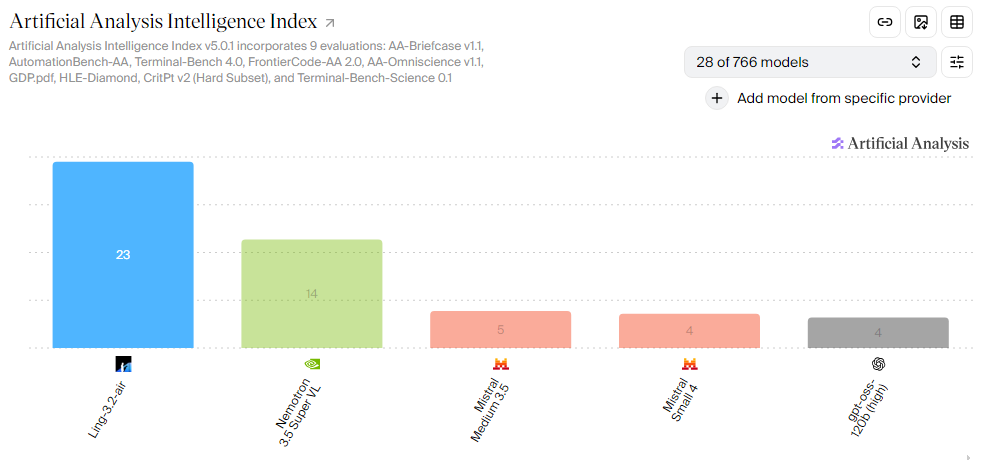
On the independent Artificial Analysis index, the 124B-total, 5.5B-active design scores 23 and ranks first out of five in the medium open-weights class, ahead of Nemotron 3.5 Super VL at 14, Mistral Medium 3.5 at 5, Mistral Small 4 at 4 and Qwen3-120B at roughly 4.
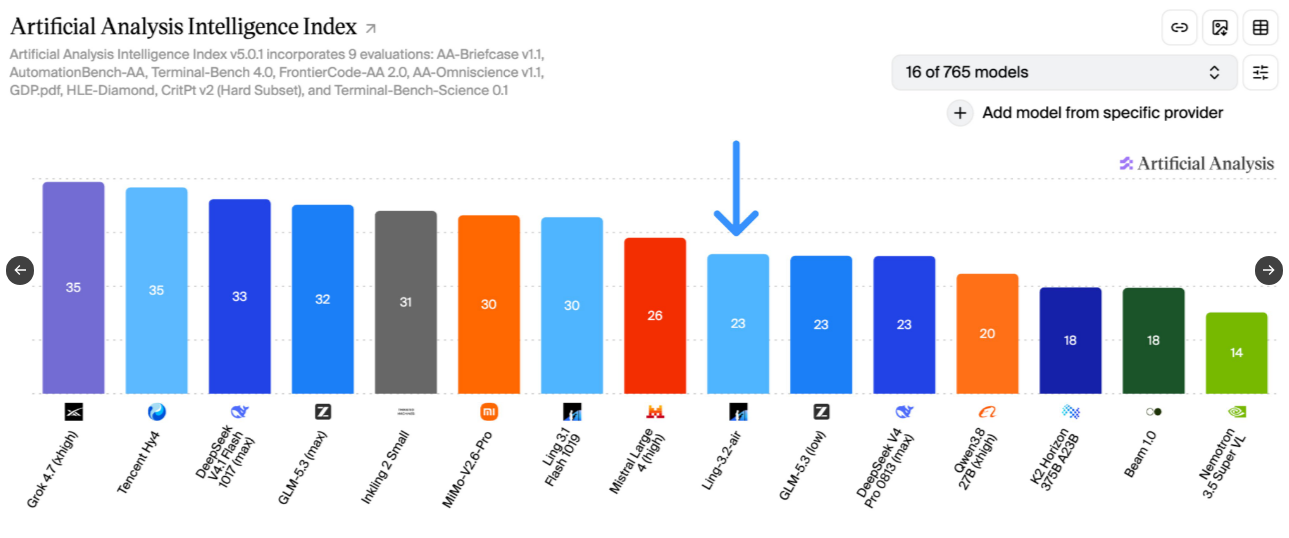
Against the broader open-weights field it sits at 23, below the 30-plus dense flagships like Grok 4.7 and Tencent Hy4 at 35, DeepSeek V4.1 at 33 and GLM-5.3 at 32, but above Qwen3B, K2 Horizon, Beam 1.0 and Nemotron-VL. That placement is the architecture in miniature: enough knowledge capacity to lead its size class, not the raw scale to top the largest dense models.
The full benchmark breakdown, benchmark by benchmark, is in Ling-3.2-air benchmarks.
What to watch
The architecture is well documented on the model card, so the main open question is not what the design is but how it performs at scale in independent testing. Two things would add to the picture. The first is a technical report from InclusionAI with ablations, which would show why the 5 to 1 KDA to Gated MLA ratio was chosen and how the expert configuration was tuned. The second is independent throughput and latency measurements on real deployments, since no official speed figure exists and the per-token efficiency of the design is currently a theoretical advantage rather than a measured one.
Until then, the architecture stands on its published figures. A 124-billion-parameter hybrid-linear mixture of experts with 5.5 billion active parameters, a 5 to 1 split of KDA and Gated MLA attention, 512 routed experts with 8 active and 1 shared, native multimodal input, and FP8 support. It is a design built to carry large-model knowledge at small-model per-token cost, and the official benchmark table confirms it delivers exactly that on agentic and document work while giving up ground on heavy code and pure reasoning. That is the trade the architecture makes, and it is the foundation everything else about Ling-3.2-air rests on.
If the design points at a deployment you want to run, Ling-3.2-air hardware covers the GPU requirements and Ling-3.2-air self-hosting covers the serving stack. If you would rather access capable open models without operating a four-GPU server yourself, you can sign up for a key, browse the model catalogue, or estimate your usage through the cost calculator.
Related reading for this decision
For a smaller model’s measured tradeoffs, Inkling 2 Mini benchmarks covers capability and efficiency at a different scale. The November frontier-model comparison places air in the wider market, while the Inkling 2 Mini 16GB quant ladder shows how binding memory changes model choice.
Another open-weight deployment path appears in GLM-5.4 self-hosting. Within the same Ling family, the Lingsante 3.1 Flash launch covers a narrower specialist model. For a hosted alternative, Qwen4-Max API pricing explains how to read a token rate card. The Resources hub collects the rest of these buying and deployment guides.
More Ling-3.2-air coverage
This is one post in a ten-part series on Ling-3.2-air. The rest of the cluster:
- Ling-3.2-air launch on the unannounced release, the MIT license, and the self-hosting angle
- Ling-3.2-air benchmarks on the index score, the official table, and the Harvey reliability caveat
- Ling-3.2-air vs Ling-3.2-flash on the open self-host model against the closed API sibling
- Ling-3.2-air vs MiniCPM-V 4.7 on datacenter versus pocket multimodal
- Ling-3.2-air self-hosting on running the model yourself day to day
- Ling-3.2-air hardware on the GPU options and the memory math
- Ling-3.2-air vision on text, image and video input in practice
- Ling-3.2-air context window on the 256K documented window and the 1M discrepancy
- Ling-3.2-air vs Ling-3.1 Flash on why the older Flash scores higher on the index